
Key Takeaways
1. Socialism Inevitably Creates Poverty and Economic Collapse.
This is a story of an evil that inevitably and inexorably leads to poverty, starvation, and ultimately violence.
Venezuela's decline. Venezuela, once the richest country in South America with the world's largest oil reserves, has been utterly devastated by socialist policies under Hugo Chavez and Nicolas Maduro. Despite Hollywood endorsements, the reality is widespread starvation, hyperinflation, and a mass exodus of over a million refugees. The country's GDP is contracting by 10%, and 87% of households have fallen into poverty.
Price controls and shortages. The core of Venezuela's economic tragedy lies in widespread price controls and currency exchange limits, which began in the 1970s and intensified under Chavez. These policies interfere with the fundamental economic law that setting prices below market value causes shortages and fosters a black market.
- Basic goods like toilet paper, flour, and milk became scarce.
- Multinational companies like Colgate-Palmolive and Nestlé shut down.
- The government deployed the army to police prices, leading to imprisonment for non-compliance.
Contrast with Chile. In stark contrast, Chile, which abandoned socialism in 1973, saw its incomes increase by 228% under free markets and capitalism, while Venezuelan incomes declined by 21%. This demonstrates that socialism, regardless of natural resources, poisons everything it touches, leading to economic destruction and a worsening of human life.
2. Socialism Breeds Corruption and Kleptocracy.
Under capitalism, rich people become powerful. But under socialism, powerful people become rich.
Chavez/Maduro's personal wealth. Despite promises to help the poor and equalize income, socialist leaders like Chavez and Maduro secretly enriched themselves while their citizens starved. Chavez's daughter reportedly became a multibillionaire, the richest person in Venezuela, while doctors earned $2.20/day. Maduro was caught dining on expensive steak in Istanbul as Venezuelans scoured garbage for food.
Castro's hidden wealth. Fidel Castro, like other socialist leaders, preached concern for the proletariat while living lavishly, owning mansions and private islands. Forbes estimated his worth at nearly a billion dollars, highlighting the hypocrisy inherent in systems that promise equality but deliver privilege to the ruling elite.
- Cuban doctors earn less than 1% of American doctors.
- Cuban citizens rely on ration books, with food often running out by Wednesday.
- Professionals often drive taxis for tourist dollars, as their official salaries are meager.
Kleptocracy as the rule. History repeatedly shows that socialism quickly devolves into kleptocracy, where power, not merit, determines wealth distribution. When the state owns the means of production, it creates opportunities for party loyalty and cronyism to dictate who gets rich, rather than consumer demand or innovation.
3. Free Markets and Capitalism Drive Prosperity, Not Socialism.
It’s not inequality that matters, it’s poverty and overall living standards.
Income inequality vs. rising living standards. While critics like Thomas Piketty focus on income inequality, the true measure of progress is the improvement in overall living standards and the reduction of poverty. Dwelling on income disparities ignores the dramatic decrease in extreme poverty globally over the past two centuries.
- In 1820, over 90% of the world lived in extreme poverty (less than $2/day).
- Today, less than 10% of the world lives in extreme poverty.
- Childhood mortality plummeted from nearly a third to less than 1% in wealthy countries.
Capitalism's role in reducing poverty. Capitalism, with its emphasis on free markets and the division of labor, has been the primary engine for this unprecedented prosperity. It allows individuals to buy significantly more goods and services for the same amount of work, making once-luxurious items accessible to the masses.
- In 1956, an average worker needed 116 hours to buy a refrigerator; in 2013, only 15 hours.
- From 1919 to 2019, an unskilled laborer could buy 7.6 times more commodities for the same amount of work.
- The average American family spends 8% less of their budget on food, clothing, shelter, and utilities than in 1980.
Middle class benefits and purchasing power. The argument that the middle class is worse off is a myth; their purchasing power has nearly doubled since 1960. Capitalism fosters income mobility, with studies showing that a significant portion of individuals move up the income ladder, including into the top 1%. The real problem is not inequality of outcome, but government-created inequality through cronyism and protectionism.
4. Scandinavia's Success is Rooted in Capitalism, Not Socialism.
Denmark is far from a socialist planned economy. Denmark is a market economy.
Nordic model is welfarism, not socialism. American socialists often point to Scandinavia as a model of "democratic socialism," but Nordic leaders themselves, like Denmark's Prime Minister, explicitly state they are market economies, not socialist. Their system is better described as "welfarism" or "social democracy" within a capitalist framework.
- Scandinavia has less state ownership of national wealth than the U.S. had under Reagan.
- 90% of Scandinavia's combined wealth is privately owned.
- Norway's wealth is largely due to oil discovery, with its sovereign wealth fund invested in capitalist countries.
Historical capitalist roots. Scandinavia's economic success predates its extensive welfare states. From 1870 to 1936, under low taxes and minimal regulation, Sweden's economy grew faster than the rest of the world. These countries consistently rank high in economic freedom indexes, indicating strong free-market principles.
- Denmark is ranked the third-easiest country to do business with globally.
- Nordic countries have historically had lower corporate tax rates than the U.S.
- Most large Swedish companies (IKEA, Volvo, Ericsson) were founded during its capitalist era before 1970.
High taxes on middle class. The generous welfare benefits in Scandinavia are financed by extremely high taxes on all income levels, not just the rich. This includes a 25% national sales tax (VAT) on almost all goods and services, making their tax system highly regressive.
- If America had Denmark's tax brackets, someone earning $60,000/year would face a 60% tax rate.
- Scandinavians often pay 70-80% of their income in taxes.
- Danes pay some of the highest car taxes in the world, up to 100% of the car's price.
5. Socialism's Utopian Promises Lead to Authoritarianism.
At the bottom of all totalitarian doctrines lies the belief that the rulers are wiser and loftier than their subjects and that they therefore know better what benefits those ruled than they know themselves.
Utopian ideals and human nature. Socialism, from its inception, has been criticized for its utopian nature, expecting selfless rulers and citizens. This ideal, often rooted in the belief of history's inevitable progression towards a perfect society, defies human nature and leads to impractical expectations.
- Plato's "Kallipolis" envisioned philosopher-kings ruling selflessly.
- Marx predicted a "workers' paradise" where the state would wither away.
- Lenin sought to create a "New Soviet Man" guided by altruism.
Karl Popper's critique. Philosopher Karl Popper argued that utopian attempts to realize an ideal state, using a blueprint for society, inevitably demand strong centralized rule and lead to dictatorship. When differences of opinion arise among "utopian engineers," power is used instead of reason, leading to violence.
- Popper saw Marxism as a pseudoscience because its claims were unfalsifiable.
- He linked central planning directly to state violence.
- Utopian visions select for leaders willing to wield absolute power, not selfless guardians.
The "New Soviet Man" and its impossibility. The pursuit of a "new man" who would prioritize collective good over self-interest proved futile. History shows that leaders who promise egalitarianism often succumb to tyrannical accumulation of power, using force to overcome man's inherent self-interest and resistance to property confiscation.
6. Historical Socialism: A Legacy of Tyranny and Mass Casualties.
The inescapable inference to be drawn is that the terror actually experienced in the socialist countries was not simply the work of evil men, such as Stalin, but springs from the nature of the socialist system.
Mao's Great Leap Forward and famine. Mao's attempt to rapidly industrialize China through "complete socialism" led to the Great Leap Forward (1958-1962), which resulted in perhaps the worst man-made famine in history. Collectivization of farms and abolition of private property destroyed incentives to work, leading to mass starvation.
- An estimated 45 million people died, with 2-3 million tortured or executed.
- Farmers were forced into giant communes, their homes and tools confiscated.
- Mao famously stated, "When there is not enough to eat people starve to death. It is better to let half of the people die so that the other half can eat their fill."
Pol Pot's "complete socialism" and the Killing Fields. Pol Pot, a French-educated Marxist, implemented "complete socialism" in Cambodia, banning money, private property, and market exchange. His regime, the Khmer Rouge, systematically eliminated intellectuals, property owners, and urban dwellers, leading to the "Killing Fields."
- Between 13% and 30% of the Cambodian population (1-2 million people) were killed.
- Victims were often clubbed to death to conserve bullets.
- Children were killed preventatively to prevent future revenge.
Stalin's purges and the Gulag Archipelago. Stalin's regime imprisoned an estimated 25 million people, with 7-11 million killed in 1932-33 alone, largely kulaks (landed peasants) resisting collectivization. The Gulag Archipelago, chronicling these horrors, reveals how state-organized violence is a necessary weapon of socialism.
- The Soviet government "rehabilitated" nearly 270,000 victims posthumously.
- Fear of secret police led to "mutual surveillance" and families reporting on each other.
- The constant terror created a "silent and conformist population."
7. Socialism Suppresses Individual Freedom and Dissent.
True literature can only exist when it is created, not by diligent and reliable officials, but by madmen, hermits, heretics, dreamers, rebels and skeptics.
Censorship and control of thought. In socialist states, where the government controls all media and cultural outlets, dissent becomes a crime. Isaak Babel, a Russian writer, noted that under Soviet surveillance, "a man only talks freely to his wife—at night, with the blankets pulled over his head."
- The Soviet censorship body, GLAVIT, employed 70,000 staff to control all published items.
- Yevgeny Zamyatin's dystopian novel We, which critiqued the collective, was the first book banned by the Soviets.
- Milan Kundera's The Book of Laughter and Forgetting illustrates how communist regimes erased individuals from history and photographs.
The "applause" anecdote. Aleksandr Solzhenitsyn's The Gulag Archipelago recounts an incident where a factory director was arrested for being the first to stop applauding Stalin, illustrating the frivolousness and severe consequences of perceived disloyalty. This chilling example highlights how even subtle expressions of dissent can be met with brutal punishment in totalitarian systems.
Modern suppression of dissent. While not state-controlled, modern social media platforms exhibit a disturbing trend of censoring conservative speech and de-platforming individuals who express dissenting views. This creates an environment where people fear voicing their true opinions, reminiscent of the "thought police" in Orwell's 1984.
- Twitter banned a feminist for stating "men are not women."
- Facebook workers reportedly suppressed conservative news stories.
- Democratic representatives have attempted to intimidate companies for sponsoring libertarian conferences.
8. The Allure of "Free Stuff" Masks Socialism's True Costs.
What today’s socialists really want is free health care, lunch, tuition, and someone to pay for really, really long maternity and paternity leave.
"Free" college tuition and its hidden costs. While Scandinavian countries offer "free" college tuition, it's not truly free; it's paid for by the world's highest middle-class taxes. Furthermore, access to higher education is not universal, with strict limits on degrees and a harsh meritocracy.
- In Denmark, only top 10% students get into competitive fields like medicine.
- Swedish students still graduate with significant debt (average $19,000) due to high living costs.
- Many blue-collar jobs in Scandinavia pay well, reducing the incentive for college.
High middle-class taxes in welfare states. American socialists often claim they can fund their "free" programs by taxing only the rich, but this is a lie. Scandinavia's extensive welfare state is financed by massive taxes on everyone, including the middle and working classes.
- Danes pay a 25% national sales tax (VAT) on almost everything, including food.
- In Denmark, a family earning $60,000/year could face a 60% tax rate.
- The U.S. tax code is already more progressive, with the top 1% paying nearly 40% of income tax revenue.
Social Security as a "socialist" program. America's Social Security system, a mandatory, tax-funded pension program, exemplifies welfarism. It faces an $11 trillion shortfall, as current workers pay for retirees, rather than saving for themselves. Policies that increase state control over pensions move us further towards socialism.
9. Socialism Exploits Crises to Expand State Control.
One has to free oneself from the illusion that international climate policy is environmental policy. This has almost nothing to do with the environmental policy anymore, with problems such as deforestation or the ozone hole.
Green New Deal's exorbitant costs. Today's socialists often present the Green New Deal as an urgent necessity, despite its mind-boggling costs (estimated at over $50 trillion) and radical proposals. This plan aims for communal ownership and a guaranteed job/income, even for those "unwilling to work," reflecting core socialist tenets.
- The plan includes regulating "farting cows" and potentially human reproduction.
- It calls for "public ownership stakes" and "community ownership" in businesses.
- The concept of Universal Basic Income (UBI) is a variant of "something for nothing."
Climate change alarmism as a tool. Many climate activists openly admit that the "climate struggle" is about dismantling capitalism and redistributing wealth, not just environmental policy. Former UN climate official Ottmar Edenhofer stated, "We redistribute de facto the world’s wealth by climate policy."
- Global investment in climate change reached $359 billion in 2013, with calls for $5 trillion more.
- Developed countries are expected to bear heavy carbon restrictions, while undeveloped countries emit freely.
- China and India's emissions largely offset U.S. reductions, which have been significant.
Questioning the "settled science." The insistence that climate science is "settled" and dissent is not tolerated stifles true scientific inquiry. While human emissions play a role, natural cycles (like Milankovic cycles) have historically caused extreme climate changes.
- Predictions of polar bear extinction and dramatic glacier loss have been proven false or exaggerated.
- The UN IPCC acknowledged in 2001 that "The long-term prediction of future climate states is not possible."
- The cost of keeping global temperature rise to 2.5 degrees Celsius is estimated at $134 trillion.
10. Surveillance and "FaceCrime" are Socialism's Ultimate Tools.
It was terribly dangerous to let your thoughts wander when you were in any public place or within range of a telescreen. . . . In any case, to wear an improper expression on your face (incredulity when a victory was announced, for instance) was itself a punishable offense. There was even a word for it in Newspeak: facecrime, it was called.
China's social credit system. In China, "FaceCrime" is a reality, with billion-dollar facial recognition companies enabling omnipresent surveillance. Citizens receive social credit scores, which determine access to jobs, loans, travel, and even pet ownership. Minor infractions like jaywalking or "fake news" posts can lead to blacklisting.
- Over 1,000 metrics impact a citizen's score.
- "Untrustworthy" individuals can be banned from flights, trains, and certain jobs.
- The system aims to predict crime and make it "difficult to move" for dissidents.
"PreCrime" and erosion of civil liberties. Philip K. Dick's "Minority Report" envisioned "PreCrime" units arresting people before they commit crimes, a concept increasingly mirrored in real-life surveillance. In America, "conspiracy" charges and crime-predicting algorithms raise concerns about punishing potential, rather than actual, wrongdoing.
- Chicago police use algorithms to predict crime and deploy raids.
- License plate readers and advanced cameras create massive databases, raising privacy concerns.
- Facial recognition technology often misidentifies minorities.
Surveillance's disproportionate impact. The proliferation of surveillance cameras and excessive fines for minor violations disproportionately harms the poor and minorities. Nonpayment of fines can lead to car impoundment or even jail, creating a spiral of hardship. This demonstrates how big government, even with seemingly benign intentions, can become draconian and unjust.
11. True Freedom Requires Limited Government and Voluntary Exchange.
Capitalism is synonymous with voluntarism and individual freedom.
The importance of individual liberty. Freedom, defined as the ability to engage in voluntary transactions without government coercion, is the cornerstone of prosperity and individual flourishing. Any shift towards socialism, which necessitates increased state control, not only damages economic well-being but also threatens fundamental liberties.
- The pursuit of freedom is a noble quest, not to be compromised.
- Limited government minimizes the "necessary evil" of state force.
- The more "equality" is enforced, the more force is required to achieve it.
Bipartisan efforts for common ground. Despite media narratives of extreme polarization, common ground can be found across the political spectrum on issues like criminal justice reform. The First Step Act, a bipartisan achievement, reduced unjust prison sentences and offered second chances, demonstrating that shared humanity can overcome partisan divides.
- Senator Ron Wyden and I have collaborated on privacy and Fourth Amendment issues.
- I've worked with Senators Booker, Leahy, and Harris on criminal justice reform.
- A right-left coalition exists to end wars in Afghanistan and Yemen.
The dangers of political polarization. The media often perpetuates the lie of intractable hatred between political sides, fueling online vitriol and even real-world violence. This polarization distracts from intelligent debate and undermines the ability to find solutions to national challenges.
- The MAGA hat has become a symbol of intolerance, leading to threats and false accusations.
- Hoax hate crimes are fabricated to fit political narratives.
- Media bias, as seen in the Covington Catholic incident, distorts truth and incites outrage.
Review Summary
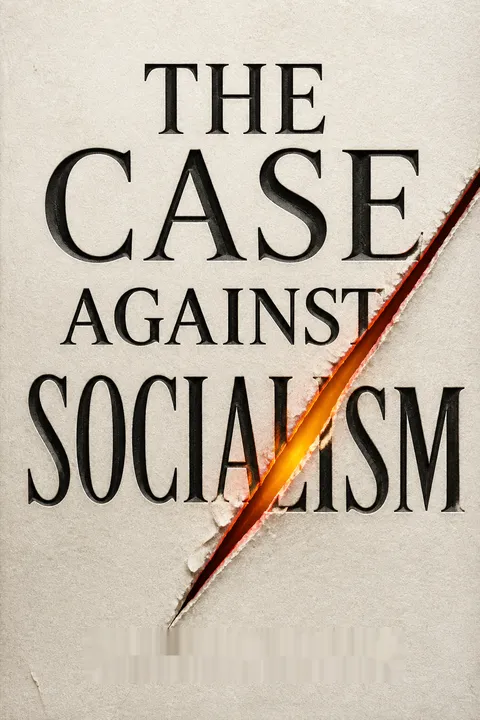
The Case Against Socialism receives polarized reviews with a 4.18/5 rating. Supporters praise Paul's historical examples and arguments defending free-market capitalism over socialism, citing evidence from Venezuela, USSR, China, and Cambodia. They appreciate his debunking of Scandinavian "socialism" myths and philosophical critiques. Critics condemn the book as propaganda, noting poor sourcing from conservative outlets rather than peer-reviewed research, conflation of socialism with communism/fascism, and failure to address successful European social policies. Several reviewers criticize Paul's emotional tone and partisan attacks. Many recommend it for understanding anti-socialist arguments, though detractors find it intellectually dishonest.
People Also Read





Download PDF
Download EPUB
.epub digital book format is ideal for reading ebooks on phones, tablets, and e-readers.








































