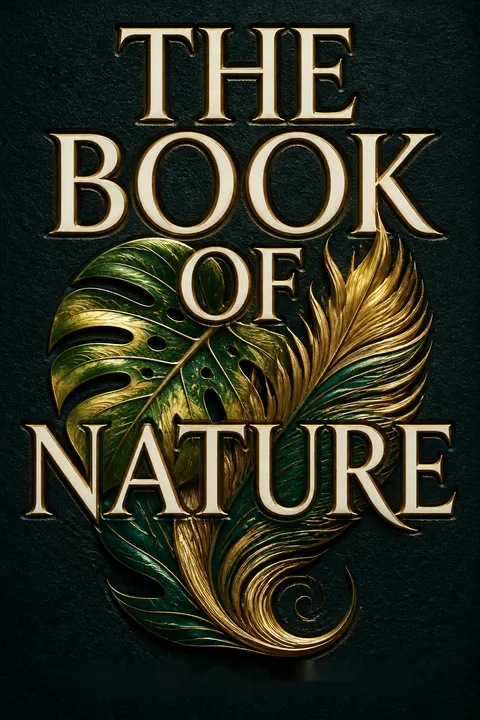

Key Takeaways
1. The Book of Nature: God's First Sacred Text
Ancient peoples read the Book of Nature as the first sacred text, the text of all of creation, inscribed and unfurled by a God present always and everywhere.
An ancient revelation. The concept of the "Book of Nature" is a metaphorical, ancient idea, predating written scripture. It suggests that God's initial revelation to humanity was through the entirety of creation itself—the mountains, seas, stars, and every living thing. This "book" needs no translation, composed in an alphabet of natural phenomena accessible to all.
A historical perspective. The idea gained prominence in the twelfth century, as scientific inquiry began to align with Christian thought. Thinkers believed that by studying nature, God's handiwork, humanity could gain deeper knowledge of the Creator. Galileo, in 1615, echoed this, stating that "God is known first through Nature, and then again, more particularly, by doctrine," emphasizing the imperative to pair nature with Scripture.
Universal understanding. Across cultures and continents, from mystics and poets to indigenous peoples, the Book of Nature has been read as a universal sacred text. It offers divine revelation without words, speaking through the flight of birds, the turning of seasons, and the vastness of the cosmos, inviting all to encounter its author.
2. Cultivating "Particular Attention" Reveals the Divine
Attention, taken to its highest degree, is the same thing as prayer.
The path to epiphany. The journey to spiritual insight begins with profound attention. Poets, prophets, and mystics throughout history have stalked the earth, attuned to the subtle stirrings and silences of the natural world, recognizing the animating author of the cosmos. This watchfulness is a spiritual practice, a deliberate opening of the senses to the "visible invisibility."
A sacred obligation. Given the brevity of human life, the author suggests we are "almost obliged to pay attention" to the world around us. This isn't a mere dalliance but a holy task—a "spark seeking" to gather the shards of holiness scattered throughout creation, as described in the Judaic mystical tradition of Shevirah, the shattering of vessels.
Beyond the obvious. Reading the Book of Nature requires patience and a willingness to look beyond the surface. It's about discerning the "underglimmer" in fleeting moments, like a single leaf fluttering on a tree or the precise rhythm of crickets. This "sacramental attention" allows us to see the miraculous in the common, transforming ordinary experiences into profound encounters with the sacred.
3. Panentheism: God's Presence Permeates All Creation
The embeddedness of the divine in all creation is emphatically not to be confused with pantheism’s point that God equals nature, the sense that God is the wind and water, sunlight and cloud. Rather, the lens through which I’m seeing is panentheism, God in wind and water, not God as wind or water.
God in creation. The author clarifies a crucial theological distinction: panentheism. This perspective holds that God is in all creation, permeating and sustaining it, rather than being identical to it (pantheism). This means that the stirrings and rumblings in nature reveal traces of the divine, pointing towards the inexpressible and immeasurable Creator.
A holy place. French Jesuit paleontologist Pierre Teilhard de Chardin argued that we often treat the world with "boredom and disrespect," imagining creation as "distant and inaccessible." However, he insisted that "the world, this palpable world...is in truth a holy place, and we did not know it." This understanding invites us to recognize the sacred in our immediate surroundings.
The Two-Book theology. This panentheistic view underpins the "Two-Book theology," which posits that God's presence is best understood by reading creation—God's original text—alongside Holy Scripture. As early as the ninth century, Celtic philosopher John Scotus Eriugena taught that "Christ moves among us in two shoes...one shoe being that of creation, the other that of the scriptures," emphasizing the need to be attentive to both.
4. Profound Wisdom Resides in the Quotidian Natural World
Holiness is just as likely lurking in the quotidian, in whatever patch of tall grass or weeds you call your own.
Everyday epiphanies. The author emphasizes that one doesn't need to trek to exotic locales to encounter the numinous. Holiness is readily found in the ordinary, in a backyard garden, a local patch of woods, or the familiar shoreline. The "star-knotted night cloth is draped over all of our heads; so, too, the moon, the light that shines nightly in ever-shifting fractions, never the same twice in a row."
Lessons from the garden. The author's own garden serves as a primary classroom for divine wisdom. From the improbable ascent of a delphinium to the resilience of a morning glory, the garden teaches lessons in:
- The inexplicability of botanical triumph
- The reproductive calculus of wind and pollen
- God's cradling presence in moments of brokenness
- The gospel of resurrection in persistent sprouts
The miracle of the seed. The humble seed holds profound theological lessons, embodying "fierce energy" and the promise of resurrection. Stories like the "seeds of Hiroshima," which sprouted amidst atomic devastation, and London's post-Great Fire blooms, illustrate nature's indomitable spirit and God's enduring promise of renewal, even in the darkest hours.
5. Earth's Turning: A Carousel of Timeless Spiritual Lessons
For everything there is a season, a time for every matter under heaven.
A divine guarantee. The faithful wheeling of the year—the undulations of earth's turning, the rhythms of shadow and light, heat and cold—is presented as a primary exhibit of God's genius. This perpetual carousel of seasons, promised in Genesis 8:22 ("As long as the earth endures, seedtime and harvest, cold and heat, summer and winter, day and night, shall not cease"), teaches trust and instills awe.
Reviewing life's lessons. The year is not a static circle but a spiral, offering continuous ascent and opportunities to revisit essential truths. God, knowing human density, keeps this seasonal show on autoplay, allowing us to review lessons in:
- Resurrection and rebirth
- The necessity of quiet and dormancy
- Surrender to holy rhythms
- Expectation of heartbreak and healing
Embroideries of time. Each season brings its unique "headlines" and sensory experiences, from springtime's "fizz and roar" to summer's indolence, autumn's "molasses-lit days," and winter's profound stillness. These seasonal shifts mark time in "embroideries of God's voluptuous making," inviting soulful inventory and a deeper connection to the Creator's intricate design.
6. Birds: Messengers of Wonder and Unseen Wisdom
What drives this small creature, barely heavier than air,” he wondered. “I can only imagine what has happened to it in its life—what near-brushes with predators it has escaped, what storms have tried to rake it from the sky, what females have taken it as a mate, what dynasties of redstarts it has founded. What thousands of miles have passed beneath its stubby wings.
A sacred entwinement. Birds, from the smallest chickadee to the soaring hawk, offer profound lessons and stir a sense of the otherworldly. The author's lifelong enchantment began with tending wounded birds, realizing that simple gestures of kindness can open us to reciprocities and "little-read epistles of wonder and awe."
Oracles of the sky. Birds inhabit the realm between heaven and earth, carrying the sky on their backs. Their presence has captivated humans for millennia, seen as messengers of the gods and symbols of divine praise. Birdsong, an "acoustic marvel" crafted by the pea-sized syrinx, is often heard as holy melody, from dawn lauds to twilight vespers.
Miracles of survival. The intricate lives of birds—their nest construction without instruction, their epic migrations guided by stars and magnetic fields, their ability to navigate thousands of miles to the same ancestral tree—defy belief. These "improbable flocks" teach us about:
- Ingenious adaptation and resilience
- The power of instinct and ancestral memory
- The profound interconnectedness of ecosystems
- The "great restlessness" (Zugunruhe) that drives their journeys
7. Wind and Rain: Elemental Forces Revealing God's Immeasurable Nature
The search is always for the Mystery that is deep within creation and yet infinitely other than anything we can know or name.
Wind: Heaven's breath. The invisible yet powerful force of wind is our first encounter with the ineffable. It's the planet's great circulatory system, spreading life, shaping landscapes, and inspiring ancient cultures to worship wind gods. Its invisibility and force link it intrinsically to spirit, with words for wind and divinity often being the same across languages (e.g., Hebrew ruach, Greek pneuma).
God's whispered name. In Hebrew mysticism, God's unutterable name, YHWH (Yahweh), is composed of breath-like consonants, suggesting it is "a name spoken, as it were, by the wind." This profound connection highlights the divine presence in every breath we take and every gust of wind, making it an intimate and omnipresent aspect of God's being.
Rain: God's eloquence. Rain, in its myriad moods—from gentle lullaby to thrashing storm—is an elemental life force that demands attention. It fills rivers, waters crops, and cleanses the earth, serving as a "wash for the soul." Whether a soft sprinkling or a "cataract of rain," it reveals a God of "endless eloquence," capable of both soothing comfort and awe-inspiring power, reminding us of the immeasurable nature of the divine.
8. The Night Sky: A Canvas for Awe, Faith, and Ancient Wisdom
You must understand that you are another world in miniature, and that there is in you sun and moon and also stars. . . . You to whom it is said that you are ‘the light of the world.’
Ancient fascination. From early Egyptians to Babylonians, stars have charted human paths, inspired myths, and been seen as living beings or "the jeweled face of God." The night sky, once obsidian dark, was a primary source of wonder and navigation, prompting profound questions about existence and our place in the cosmos.
Stars as divine mirrors. Theologians like Origen of Alexandria saw a "star-like quality" in every human, suggesting the soul mirrors the sky's ceaseless shimmer—a vast allegory of the divine. This perspective encourages us to "reach for the stars" not just literally, but as a reflection of the luminescence within ourselves, a "light of the world."
Moon's enduring lessons. The moon, "the orb imperial," offers nightly lessons in addition, subtraction, and fractions, but more profoundly, in faith. Its ceaseless shape-shifting, from new to full and back, symbolizes life after death—the "resurrection moon." Its unseen presence on cloudy nights teaches that "just because you can’t see the heavenly light...doesn’t mean it’s not there," a truth akin to the elusive yet certain presence of God.
9. The Interconnectedness of All Life Demands Reverence
Earth’s crammed with heaven, / And every common bush afire with God; / But only he who sees, takes off his shoes. . . .
Intricate choreography. Creation is a symphony of interconnectedness, where every element plays a vital role. From the blooming of bluebells timed with warming soil and tree canopies, to the profusion of caterpillars coinciding with hungry baby birds, and the precise wing beats of ibis flocks, an "intricate choreography" ensures life's continuation.
Hidden wonders. Even in the smallest details, profound connections exist. Consider:
- Spider silk used by hummingbirds for nest construction, offering both glue and flexibility.
- Monarch butterflies migrating thousands of miles to ancestral trees, drinking from mist and fog.
- The 228 muscles in a caterpillar's head or the 25,000 eyes of a dragonfly.
- The 1,356 living creatures in a square foot of forest loam.
Universal patterns. The universe reveals breathtaking symmetries and repetitions—spirals, fractals, tessellations, spots, and stripes—undergirded by mathematical algorithms and inviolable geometries. These patterns, from sand dunes to chameleon skin, are not accidental but point to a "Great Intelligence" and the inherent order of creation.
10. Lamentation and Action: The Urgency of Healing a Wounded Earth
We no longer read the Book of Nature,” writes theologian Thomas Berry in his call to attention, The Great Work. “We no longer coordinate our human celebrations with the great liturgies of the heavens. . . . We have silenced too many of those wonderful voices of the universe that spoke to us of the grand mysteries of existence.
A profound abandonment. The author laments humanity's abandonment of its watch on this holy earth, leading to dire personal, political, and sacred losses. The small-scale heartbreaks of nature are compounded by global environmental degradation—burning forests, toxic waters, extreme weather events—which are "grief squared, and squared again."
The cost of inattention. Our "insidious sin of looking away" has led to a spiritual void, where we no longer hear the voices of rivers, mountains, or birds. This alienation from nature, "unexampled in history," means we miss the "grand mysteries of existence" and lose "one of the most central parts of being human."
A call to healing. The solution lies in opening the "smoke hole"—reconnecting with the divine through nature. This requires:
- Exquisite attention: To the subtlest stirrings, the currents, the clouds.
- Accepting vulnerability: Recognizing that "none of this is forever."
- Whole-body attentiveness: Engaging all senses with the natural world.
The author concludes with Teresa of Avila's image of God as a "divine medic" kneeling over the earth, whose love "thaws the holy in us." Our role is to join this divine healing, offering our tenderness, awe, and prayer to reflect heaven's way, for "this day will not come again."
Review Summary
Reviews of The Book of Nature are largely positive, averaging 4.26 out of 5. Many readers praise Mahany's lyrical, meditative prose and her ability to blend science, spirituality, and poetry into a rich exploration of nature as a sacred text. Reviewers appreciate the extensive bibliography and diverse spiritual perspectives drawn from Jewish, Catholic, and other traditions. Some critics note the writing can feel overly contrived, inconsistent, or inaccessible, and that the book occasionally lacks cohesion. Most recommend reading it slowly and contemplatively.
People Also Read


Download PDF
Download EPUB
.epub digital book format is ideal for reading ebooks on phones, tablets, and e-readers.








































