


Plot Summary
Your Rent Is Due
On Tax Day 2015, Luke Griffin,1 the stay-at-home husband of America's only openly gay senator,2 notices strangers staring and a cashier offering pity. His sister Jenny12 finally tells him why: Barnes2 has been filmed having affairs with five former staffers, and the footage is on every channel. Luke1 drives home past news vans and protestors, shields his two young children,19 and confronts Barnes2 in the kitchen.
Barnes2 pleads that the men meant nothing, that only Luke1 and the kids19 matter. Remembering the decade of sacrifices he made to burnish Barnes's2 polished image, Luke1 refuses. He tells his husband2 he wants a divorce. Outside, a protestor raises a sign congratulating him on getting everything he deserves.
The opening weaponizes domestic ritual against public exposure: a supermarket, a macaroon, a child's soccer practice, all shattered by a viral sex tape. Holder frames marriage as performance and Luke as its most disciplined actor, a man who mistook complicity for love. The scandal is less a rupture than a revelation, forcing Luke to see the rot he has been polishing. Crucially, the protestor's sign externalizes Luke's own self-judgment. He half agrees. This inaugurates the novel's central engine: a man addicted to being chosen, discovering that the price of that safety was his integrity, and beginning, reluctantly, to reclaim authorship of his own life.
A Library in Shoulder Pads
Rewind to 2003. Luke,1 a bookish Dartmouth linebacker whose NFL future died in a drunk-driving crash that scarred his face and torso, reluctantly boards a plane to Grand Cayman for a new competition show, Endeavor. His father Mitch,13 a beloved coach, begs him to rejoin the living. At the gate Luke1 meets Arjun Bhaduri,3 a magnetic closeted British Indian reality star, and Imogen Cuthbert,4 a guarded Navy veteran.
The three form an instant alliance, dubbed LuMoJun, and dominate the season. Over stolen midnight beach conversations, Arjun3 gives Luke1 a little turtle keychain, then kisses him, insisting no one can ever know. Luke,1 who has spent his life feeling radioactive and unlovable, tumbles headlong into the first romance of his existence.
The origin story reframes Luke's whole identity as compensation. Mitch pushed football to make his gay son untouchable, teaching Luke that survival means being useful, an instrument of force. Reality TV becomes an unexpected confessional where the jock who hid in locker rooms finally gets asked about something other than sacks. Arjun's charisma, defined earlier as arrogance fused with generosity, seduces precisely because it grants Luke visibility while demanding secrecy. The turtle keychain (soft inside, tough exterior) diagnoses Luke exactly. Holder plants the novel's tragic pattern here: love offered only in darkness, off camera, contingent on concealment, a closet Luke enters willingly because being wanted at all feels miraculous.
Dismissed in Bel-Air
After LuMoJun wins Season 1, Arjun3 goes cold, dodging Luke's1 calls. When Luke1 scales the Bhaduri mansion gates in Los Angeles, Arjun3 coolly rebrands their affair a summer fling, warns that his father could have Luke1 arrested, and insists it meant nothing. Devastated, Luke1 drives away with Mitch,13 who had waited hoping to meet him.
Weeks later Mitch13 is diagnosed with pancreatic cancer, sparing Luke1 the sting of a canceled European trip and giving him a reason to defer graduate school. Luke1 becomes his dying father's13 caretaker as medical bills climb. Only Imogen4 keeps checking on him nightly, even as Arjun3 still answers her calls and never his, a rejection Luke1 cannot bear to examine.
Arjun's cruelty is the wound that structures everything after. Holder complicates it: Arjun is himself trapped by a family empire, race, and fame, weaponizing coldness as self-protection. But at twenty-two Luke registers only abandonment layered atop his mother's drowning and his ruined body, another apocalypse in a life that keeps ending. Mitch's cancer arrives as grim mercy, redirecting grief into caretaking and, fatefully, into financial dependence on the show. The chapter establishes reality television's predatory economics: it always gets you to show up. Imogen emerges as the one steady loyalty, foreshadowing how badly Luke will later betray the only person who never stopped reaching for him.
Rooming with Draco
At Season 2 in Turks and Caicos, Luke1 is stunned to find Barnes Appleby,2 once scrawny, now gym-sculpted and magnetic. Grieving and lonely, Luke1 rooms with him, and they become lovers; Barnes2 listens where no one else does. But Barnes plays the game like a chessmaster. He engineers a loyalty test, persuading Luke1 that Imogen4 secretly conspired to throw a competition.
Feeling used, Luke1 publicly denounces Imogen4 at the Trial, resurrecting a careless remark she once made and helping send her to elimination. Barnes2 stokes the fire with a jab about Imogen4 growing up poor that becomes a viral sound bite. Luke1 chooses to watch her lose. The inseparable trio shatters, and Luke1 binds his future to Barnes.2
This is the first great betrayal, and Holder shows how manipulation feels like intimacy to the manipulated. Barnes offers exactly what Arjun denied: to be chosen openly, to be defended. In exchange Luke surrenders his judgment, mistaking Barnes's control for devotion. The poisoned sound bite about poverty literally launches a political career, a chilling thesis about how private cruelty converts into public capital. Imogen's fury is righteous, yet Luke sides with the person who flatters his wounds. The scene diagnoses Luke's fatal flaw: he will sacrifice anyone, even his truest friend, for the narcotic certainty of belonging to someone. The trio's ruin is entirely self-inflicted.
Blackmailed With His Children
Back in 2015, Barnes2 refuses to resign and turns the divorce into a hostage negotiation. His lawyer reveals the trap: because Jenny12 donated the eggs and Barnes2 is the biological father, Luke,1 the unpaid primary caregiver, has no legal claim to Andie and Wallace.19 Reconcile publicly, or leave with nothing.
Jobless and reduced to inquiring at the local YMCA, Luke1 receives a stunning call: Endeavor wants its icon back for milestone Season 20, dangling 250,000 dollars merely to board the plane, more per episode, and a record five million dollar prize. It could fund a fresh start and a custody war. Luke1 tells his sobbing children19 he has to go, then flies toward the show that once destroyed him.
Holder tightens the vise: the man who traded everything for domestic safety now cannot legally claim the children he raised. Fatherhood, the one identity Luke ever truly wanted, becomes the stake that drives the entire plot. The custody threat exposes how legal and biological definitions of family erase caregiving labor, an irony sharpened by Barnes's own anti-family-values hypocrisy. Reality TV returns as both trap and lifeline, the only industry that will pay him. Luke's departure inverts his origin: once he boarded a plane to escape grief, now he boards to salvage the future. The tearful goodbye at the curb establishes the emotional debt every subsequent choice must repay.
Angels Versus Devils
Season 20 opens in a walled Italian arena where Luke,1 branded a bigot for enabling Barnes's2 anti-trans crusade, is deliberately cast as a Devil. He discovers Imogen4 has returned, her head shaved, her eyes cold with fury. He also meets Erika,5 a ferociously fit trans athlete, amid a swarm of new stars.
During the first Tribulation Luke1 rescues Imogen4 from a snake and she slaps him; undeterred, he cracks the lock code and wins for the Devils. That night, activist contestant Balthazar hurls the accusation Luke1 has dreaded for years aloud for the first time: that Arjun Bhaduri3 killed himself because Luke1 outed him to the entire world. Luke1 absorbs the blow, privately knowing his real crime was even worse.
The season's theme (Angels vs. Devils) literalizes the moral scoreboard Luke has internalized. Being slotted as a Devil is a public sentencing, and the reunion with a shorn, glacial Imogen dramatizes how far love can freeze. Holder stages the panopticon of reality production as a machine for extracting shame: every wound is content. Balthazar's outburst functions as a Greek chorus, voicing the charge the narrative has circled. Yet Luke's interior aside, that the truth is worse, converts audience assumption into suspense. The chapter reframes the game as literal purgatory, a place where Luke must relive and answer for his sins under stadium lights, with no possibility of hiding.
Arjun's Sister in the House
Volatile Vanessa,15 drunk and being expelled from the show, drops the bomb before she leaves: Erika is Erika Bhaduri,5 Arjun's younger sibling,3 once the shy boy Emaan5 whom Luke1 briefly met years ago. Reeling, Luke1 tells Imogen4 he never knew and asks her to relay the truth, offering to throw his Trial and go home if Erika5 wants him gone.
Instead a note appears taped by his kids' photo:19 Erika5 says he stays, and so does Imogen.4 Granted permission not merely to remain but to fight, Luke1 pours his rage into the Trial, climbing the man-made tree to seize the golden apple and defeat Balthazar, declaring simply, and truthfully, that he can win.
Coincidence becomes fate: the game reunites Luke with the family his cowardice helped shatter. Erika embodies the courage Arjun could never claim, having transitioned openly where her brother hid, and her permission is a fragile grace Luke has not earned. The note beside his children's photo fuses his two redemptive drives, custody and atonement, into one. Holder uses the Trial as ritual reclamation: stripped of the makeup that once hid his scars, Luke wins by owning his body and his history. His flat declaration that he can win marks the first time in the novel he fights for himself rather than absorbing someone else's blow.
The Celibate Porn Star
Luke1 bonds with Shawn,6 a sweet former adult performer wounded by a betrayal on his old show, who insists he stays celibate until he finds genuine connection. Their friendship warms into romance. Luke1 also allies with PB,7 a four-time champion strategist plotting to topple the bullying power couple Hartt17 and Chrissy.
As production relocates to China, Luke1 and Imogen4 slowly rebuild their bond, trading old wounds and confessions in a Shanghai penthouse; she reveals a failed marriage and admits she never stopped worrying about him. Luke1 introduces Shawn6 to Andie and Wallace19 by video call and finally sleeps with him. For the first time in a decade, Luke1 feels like himself, competing hard and imagining a future without Barnes.2
The middle act grants Luke tenderness and, briefly, self-belief. Shawn's chosen celibacy mirrors Luke's own hunger to be valued beyond his body, making their intimacy a mutual repair rather than conquest. PB's alliance reintroduces strategy as play rather than warfare, reminding Luke that the game can be joy, not just penance. The Imogen reconciliation is the emotional heart: two lonely people admitting the decade they lost. Holder threads warning into the warmth, though, via Jenny's observation that every relationship Luke has ever had began on this show. The reader senses that happiness built inside a manipulation machine rests on unstable ground, and that reckoning is coming.
The Word I Screamed
The buried truth surfaces through flashback. In Alaska during Season 3, Barnes2 engineered a scheme to become Endeavor's only solo winner, using Luke1 as his devoted double agent, and even encouraged a secret rekindled affair with Arjun3 as another game move. On a glacier cruise reward, Luke1 slept with Arjun,3 ring removed.
Then, in the finale week, Arjun3 dropped his charm and confessed he loved Luke,1 offered to publicly come out, and begged him to choose himself. Terrified of losing his fragile new life, Luke1 instead ran to Barnes2 and outed Arjun3 in front of the room, denouncing him. Arjun3 quit in silence. Two years later, in 2007, he jumped from a London balcony. Luke1 married Barnes2 and entombed the guilt.
This is the novel's moral core, and its most devastating irony: Arjun's outing was not calculated homophobia but a panicked act of self-preservation by a man too broken to accept love. Holder refuses easy villains. Arjun wounded Luke first; Luke returned the blow at the worst possible instant, converting Arjun's bravest gesture into public humiliation. The ring removed on the cruise ship, echoed later in Barnes's own infidelities, suggests betrayal is a language Luke learned before he taught it. The suicide, told with numb precision, becomes the gravitational center of Luke's guilt. His marriage to Barnes reads as self-imposed sentence, a life spent hiding from what he did.
The Twist Named Barnes
The network engineers its cruelest surprise. After forcing golden boy Camdon out over a smuggled beer, Endeavor unveils its late addition: Barnes2 himself, freshly resigned from the Senate over a newly exposed hotel affair paid for with taxpayer money. He claims he came to help Luke1 win and rebuild their family.
Worse follows at the New Zealand airport, where paparazzi swarm because a private video of Luke1 and Shawn6 having sex in Shanghai has leaked to the tabloids, despite assurances the hotel cameras were down. Cornered in a bathroom, Barnes2 insists he only wants to protect Luke.1 He sees only the man who torched everything he had rebuilt. He resolves not to flee but to evict Barnes2 from the game.
Barnes's arrival collapses Luke's two worlds, past and present, marriage and game, into a single arena. The leaked video is a grotesque symmetry: Luke, who was ruined by Barnes's sex tape, is now exposed by his own. Holder's satire bites hardest here, showing how the network monetizes catastrophe and how Barnes reflexively casts himself as savior of the very people he endangers. The bathroom confrontation revives their entire dynamic, Luke and Barnes always finding each other in crisis, muscle memory disguised as love. Luke's pivot from flight to vengeance signals growth and danger both: he finally fights back, but rage makes him reckless, a loose cannon others must contain.
Barnes Slept With Shawn
Greta Hendricksen,8 the veteran drama-machine secretly coerced by producers, detonates her biggest secret on camera: at a wrap party a year earlier, Barnes2 had drunken group sex with Shawn,6 unbeknownst to Luke.1 Shawn6 had known all along and hidden it, hoping to confess after the show to shield Luke's1 game. Betrayed everywhere he turns, Luke1 has a raw, violent kitchen encounter with Barnes,2 then coldly tells Shawn6 he means nothing.
Days later Shawn6 discovers that Greta8 engineered his public ruin, snaps at her, and throws a punch that lands squarely on Barnes,2 getting himself eliminated. Before flying home, Shawn6 tapes a confession Luke1 gently helps coax out, leaves his phone number, and insists Luke1 once glimpsed the better man inside him.
Holder tightens the web until every intimacy proves contaminated by the show's incestuous ecosystem, where, as Fortune notes, damage pulls toward damage. Shawn's concealment is a betrayal born of protectiveness, complicating Luke's rage: everyone here lies for love. The kitchen scene between Luke and Barnes, hostility curdling into desperate sex, exposes how trauma bonds can masquerade as passion. Greta emerges as tragic professional, manufacturing others' pain to justify her own survival. Shawn's punch, aimed at the man who degraded him, is the season's rawest honest act. His parting plea, to be remembered as the second self, the one trying to change, reframes redemption as a choice about which version of a person we choose to see.
Confessing to the Camera
Emptied of excuses after watching Shawn6 face his own reckoning, Luke1 asks the principled producer Zara,11 not the smarmy Troy,10 to film him at the firepit. There he tells Erika5 what he never told anyone: that Arjun3 loved him, offered to come out so they could finally be together, and that Luke1 threw it back and outed him.
Erika,5 who spent years defending Luke,1 is shattered. She refuses to forgive but issues a fierce command: he must stay and compete at full strength in the finale, so that when she wins, she truly beats him. Luke1 agrees. Barnes,2 having overheard everything, sits silently beside him afterward and simply holds him as he breaks apart.
Confession, the reality genre's cheapest currency, becomes here an act of genuine moral courage. By choosing the camera, Luke inverts the outing that damned Arjun: he exposes himself instead of another, on the record, with nothing to gain. Erika's response is the novel's ethical high point, refusing the cheap absolution of forgiveness while demanding accountability through effort. She will not let Luke perform penance by quitting; she requires him to fight. Barnes's wordless embrace is startling grace, complicating the antagonist yet again. Holder suggests atonement is not a milestone but a discipline, an endless swim against the tide of guilt, with no shore that certifies you are finally clean.
The Puppet Master Unmasked
Melange,9 flying to Luke's1 home on a tip, uncovers the conspiracy: showrunner Troy10 and Barnes2 have been secret on-and-off lovers for years. A hidden journal, a stolen tape recorder, and confiscated footage reveal that Troy10 engineered Luke's1 casting and humiliation, planted Shawn,6 leaked the Shanghai video, and even tipped off the audit that ended Barnes's2 Senate career, all to pry Barnes2 away from Luke1 for himself.
Confronted before the cast, Troy10 unravels; Barnes2 admits Troy10 was his first affair, back when Luke1 was newly grieving Arjun.3 A damning bathroom video and Erika's5 hidden recording seal it. Zara11 fires Troy10 on the spot. The network buries the scandal with settlements and gag orders, which Luke1 signs to keep competing.
The revelation reframes the entire season as a single man's romantic vendetta disguised as television, extending the novel's thesis that private desire drives public spectacle. Troy is Luke's dark mirror, another man who could not accept that Barnes would never choose him, weaponizing an entire production the way Luke once weaponized a Trial. Barnes's confession, that his affairs began the year after Arjun died, retroactively poisons the marriage's foundation. Holder indicts the network last and hardest: it does not punish the predator, it launders the crime into settlements and NDAs. The truth, once exposed, is not vindicated but monetized and silenced, a bleak comment on how institutions absorb accountability.
The Bridge Over Milford Sound
Barnes2 finally reveals his real motive: a network deal for his own television series, contingent on Luke1 winning, later expanded to require them starring together. In the New Zealand finale the survivors, chained by carabiners, decide to cross the finish line as one so everyone shares the prize.
A rope bridge over Milford Sound cracks; Fortune,14 Barnes,2 and Luke1 plunge while Imogen4 dangles at the fulcrum, the crew unable to lift the human anchor dragging her down. Barnes,2 unable to unclip because Luke1 earlier jammed his hook with a rock, unbuckles his belt entirely and drops toward the sea to save them. Luke1 then releases his own carabiner, hurling one last cry of love to his children19 into the lone camera. Impossibly, everyone survives.
The climax literalizes the novel's moral physics: people as weights and anchors, love measured by what one will release. Barnes's sacrifice is his single unambiguous act of love, complicating a decade of manipulation and confirming Luke's insistence that their life together was, however corrupted, real. Luke's own release, echoing his childhood terror of the water that took his mother, becomes an act of parenthood rather than self-destruction; his final thought is not of the show but of Andie and Wallace. Holder collapses spectacle and sincerity: the most authentic moment of these performers' lives happens on the most engineered stage. The near-death strips away every game, leaving only who reaches for whom.
Constants
Everyone lives. Barnes2 and Luke1 undergo surgery for internal injuries; each contestant collects a six million dollar settlement. Imogen4 and Erika,5 who crossed the line during the collapse, are declared Season 20 winners, Imogen4 retiring as the show's greatest champion and Erika5 its first trans victor.
Luke1 relocates to Pasadena, sharing custody with a genuinely reforming Barnes,2 who now advocates for trans rights on their reality series, Alone Together. At the live Reunion, PB7 reconciles with Luke,1 Jiamin16 awaits a child, and Arjun's3 parents return Luke's1 old novel inscribed with their son's love. Offered a chance to return to Endeavor to protect his friends, Luke1 instead drives toward a café to meet Shawn,6 ready at last to choose himself.
The resolution resists tidy redemption. Luke does not win the money or the man cleanly; he gains something rarer, primary custody, chosen family, and the beginnings of self-authorship. Holder lets Barnes reform without erasing his sins, and lets Imogen retire on her terms, insisting every goodbye is forever so that reunions feel like grace. The Bhaduris returning the annotated Chabon novel closes the wound Arjun opened, transforming guilt into inheritance: Luke is a library of everyone who pressed against his life. The final image, driving toward Shawn, uncertain, unfilmed, is quietly radical for a novel about spectacle. It ends not with a winner declared, but with a man finally deciding for himself.
Analysis
Holder's novel weaponizes the reality television format to interrogate the performance of identity, especially queer identity, under capitalism and surveillance. Endeavor is a panopticon that converts pain into content and confession into currency, and Luke's tragedy1 is that he learned to perform long before the cameras arrived: as a closeted jock, a caretaker, a political spouse, a man who mistook being chosen for being loved. The dual timeline argues that the past is never edited out; it merely awaits its rerun. At the book's ethical heart sits a refusal of easy moral scoring. The season's Angels versus Devils gimmick literalizes the binary the novel dismantles, insisting instead that everyone is complicit, wounded, and capable of both cruelty and grace. Arjun3 wounds Luke;1 Luke1 destroys Arjun;3 Barnes2 manipulates everyone yet performs the one unambiguous act of love. Holder is most incisive about complicity, how a good man silently enables monstrous politics because speaking up threatens his comfort, and how institutions, the network, the party, launder accountability into settlements and NDAs rather than deliver justice. The novel's model of atonement is strikingly modern and unsentimental: forgiveness is not owed, penance is not a milestone, and Erika's5 demand that Luke1 compete rather than flee reframes redemption as ongoing labor rather than absolution. Chosen family, Imogen,4 Erika,5 PB,7 Melange,9 becomes the true prize, replacing both biological and marital bonds corrupted by control. The recurring water imagery, from Luke's1 drowned mother to the final plunge, links love to what one is willing to release. Ultimately the book asks whether a person shaped entirely by being wanted can learn to want for himself, ending not with a declared winner but with a man driving, unfilmed and uncertain, toward a choice that is finally, quietly, his own.
Review Summary
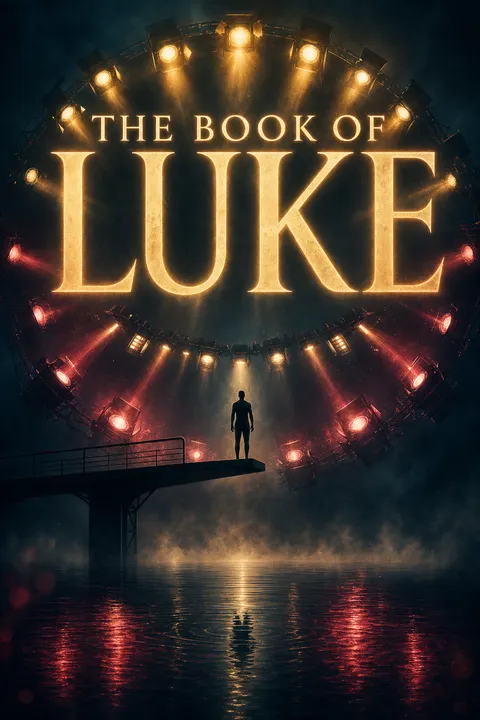
The Book of Luke follows reality TV star Luke Griffin returning to competition show Endeavor after his politician husband's infidelity scandal, needing prize money for custody of his children. Reviews praise the compelling drama, complex characters, and skilled dual-timeline structure reminiscent of Survivor and The Challenge. Criticisms include an overwhelming cast size, lengthy challenge descriptions, and Luke's sometimes unlikable decisions. Most readers found it addictive and hard to put down despite pacing issues. The queer representation and themes of redemption resonated strongly, though some felt the ending too neat. Reality TV fans particularly enjoyed the authentic behind-the-scenes details.
Characters
Luke Griffin
Guilt-ridden reality TV iconA former Dartmouth linebacker whose NFL dreams and unblemished face were destroyed in a car crash he caused, Luke is the novel's narrator and moral center. Bookish, physically imposing, and deeply gay, he was raised to believe survival depends on being useful and chosen, an instrument of force rather than a person with desires. That hunger to belong makes him endlessly loyal, endlessly complicit, and chronically silent, willing to absorb others' blows and betray his own values to keep whoever loves him. Fatherhood is the one identity he claims without shame. Across two timelines he oscillates between passivity and reckless self-assertion, haunted by a buried betrayal, driven by love for his children, and slowly, painfully learning that atonement means choosing himself.
Barnes Appleby
Ambitious gay senator husbandIntroduced as a scrawny, scheming reality contestant, Barnes reinvents himself into a gym-sculpted, silver-tongued strategist and eventually America's only openly gay Republican senator. A master manipulator who narrates his own cruelty as pragmatism, he engineers loyalty, controls narratives, and mistakes providing a lifestyle for offering love. Orphaned young and profoundly lonely, he clings to Luke1 as the one constant who ever chose him, even as he betrays that bond repeatedly. Barnes is charismatic, calculating, and genuinely devoted in his warped way, capable of appalling political theater and startling tenderness in the same breath. He is the person Luke1 married, the person Luke enabled, and the person Luke cannot fully stop loving.
Arjun Bhaduri
Closeted first loveA dazzling British Indian reality star from a media-dynasty family, Arjun radiates the charisma born when arrogance fuses with generosity. He recruits Luke1 into the game, seduces him in secret, and then retreats behind the armor of fame, race, and a controlling family that forbids him from ever being openly himself. Loving Arjun means loving in darkness, on his terms, never first. Beneath the swagger lies a terrified man crushed by expectation, capable of both wounding cruelty and heartbreaking vulnerability. He names things, adores his younger sibling5, and haunts the entire novel as its absent gravitational center, the road not taken and the debt never repaid.
Imogen Cuthbert
Estranged best friendA tall, formidable Black Navy veteran abandoned by her mother and raised into fierce self-reliance, Imogen entered reality TV to fund her own gym and escape a life where no one looked out for her. Blunt, loyal, and allergic to bullshit, she becomes Luke's1 protector and truest friend, the one person who reads every room and never breaks her word. Betrayal fractures that bond and hardens her into cold fury. Her arc across the novel is a slow, wary thaw, a reckoning with loneliness and the question of whether trust, once shattered, can be rebuilt. She remains the moral spine Luke1 leans on.
Erika Bhaduri
Arjun's fierce trans sisterOnce the shy boy Luke1 briefly met years ago, Erika is now a ferociously fit, private, principled competitor and the first openly trans star on the show. She transitioned openly where her brother3 hid, refusing to invent a fictional self for a camera. Puzzle-brilliant and quietly brave, she extends Luke1 unexpected grace while refusing to be anyone's redemption prop. She carries grief, resolve, and a hard-won insistence on accountability over cheap forgiveness, becoming both Luke's1 conscience and, improbably, his ally.
Shawn
Sweet former porn starA warm, luminous younger contestant from the docu-soap Beverly Blonde, Shawn built a reality career after adult film work and now dreams of legitimacy and working with children. Gentle, impulsive, and self-described as broken, he declares himself celibate until he finds real connection. His tenderness toward Luke1 and Luke's kids19 feels effortless and genuine, though his past and the show's machinery entangle him in secrets that test whether he can become the better self he wants to be.
PB (Paul-Bryan O'Connell)
Scheming four-time championA disgraced former stockbroker turned four-time Endeavor winner, PB plays the show like a chessboard, spinning schemes, keeping receipts, and pissing off everyone he outmaneuvers. Beneath the ruthless strategist is a lonely man who lost the love of his life to his own inability to stop competing. Witty and calculating, he becomes Luke's1 unlikely ally and, eventually, something rarer, a genuine friend, though trusting him always carries risk.
Greta Hendricksen
Drama-stirring reality veteranA perpetually scheming blonde from a Hollywood docu-soap, Greta seems to be pure vapid theatrics, weaseling into every conversation to manufacture story. But she is a trained actress performing a survival caricature, coerced by producers to generate conflict or lose her career. Self-serving yet shrewd, she orchestrates cruelty she claims is mercy, and proves capable of surprising, complicated loyalty when it matters most.
Melange Mason
Sharp-tongued bombshellA platinum-haired, costume-obsessed Southern spitfire feuding on a Dallas oil-family drama, Melange masks razor intelligence and all-state athleticism behind theatrical props and drawled insults. She is the first to take a chance on Luke1, and her loyalty runs deep. Hiding a hardscrabble past behind her glamorous persona, she is compassionate, self-aware, and fiercely protective, a rare true friend in a world of performers.
Troy
Charming ambitious showrunnerOne of Season 20's showrunners, Troy is all megawatt smiles, backslapping warmth, and relentless narrative engineering. He claims Luke1 and Endeavor inspired him to come out and to enter reality TV. Beneath the sunny handler lurks a producer who treats people as ingredients, always steering, always angling for a story, with motives more personal and tangled than anyone suspects.
Zara Norris
Steely no-nonsense showrunnerTroy's10 co-showrunner, a flannel-clad, iron-willed veteran who handles logistics and liability with granite composure. A recovering addict who lost an earlier career to a drunken mistake, she believes she owes it to the people on camera to protect the good ones. Cold on the surface, she proves to be the production's conscience and Luke's1 unexpected advocate.
Jenny
Fiercely protective sisterLuke's1 older sister, a tenured biology professor who mothered him since childhood and never trusted Barnes2. Wracked by guilt over Luke's accident, she repeatedly upends her life to rescue him, donating the eggs that made his children19 possible. Blunt, brilliant, and exhausted by her caretaking, she is Luke's1 oldest anchor and sharpest critic.
Mitch
Beloved coach fatherLuke's1 widowed father, a beloved high school athletic director who pushed football to make his gay son untouchable. Terrified of the world's cruelty yet endlessly loving, he shaped Luke's1 belief that safety comes from being useful, and remains a tender ghost throughout.
Fortune West
Immovable gentle giantA massive, unflappable former celebrity bodyguard who competes under stoic calm. He never fires the first shot but always the last, methodically eliminating anyone who crosses him. Fair, photographic-memoried, and quietly formidable, he becomes a wild card in the endgame.
Vanessa
Volatile chaos queenA brilliant, self-destructive Wall Street reality star notorious for drunken violence and brutal honesty. What you see is what you get, and her chaos conceals real pain. She delivers a pivotal revelation before her explosive departure.
Jiamin
PB's guarded ex-fianceeA regal former model and puzzle genius, PB's7 estranged ex-fiancee, who returns to the show carrying a private ultimatum and a life-altering secret. Poised and wounded, she forces PB7 to confront whether he can ever choose love over the game.
Hartt
Bullying frat-boy jockA swaggering, coke-scandaled former football prospect dubbed Luke1 Junior by fans. Crude, bigoted, and manipulative, he leads the dominant Devil alliance and becomes Luke's1 chief in-game antagonist early in Season 20.
Drew Ecklund
Bumbling show hostEndeavor's perpetually botox-frozen host, who has fronted the show since its 2003 debut. All catchphrases, terrible puns, and needy improvisation, he presides over every Tribulation and Trial with cheerful cluelessness.
Andie and Wallace
Luke's beloved childrenLuke1 and Barnes's2 young daughter and son, raised by Luke1 and biologically fathered by Barnes2 via Jenny's12 donated eggs. Precocious Andie and sweet Wallace are the emotional stakes of the entire novel, the family Luke1 will risk everything to keep.
Plot Devices
Twin-timeline episode chapters
Braids past guilt with presentThe novel alternates chapters headed by fake episode titles and seasons, cutting between Luke's1 reality TV origins (Seasons 1 through 5, 2003 to 2007) and his return for Season 20 in 2015. The past timeline slowly excavates the affair, betrayal, and tragedy Luke1 has buried, while the present timeline forces him to face their living consequences. Holder synchronizes the two so revelations detonate exactly when the present demands them, letting readers understand Luke's1 choices before Luke can articulate them. The structure mimics a reality edit itself, splicing backstory into current drama, and mirrors Luke's psychology: a man who cannot escape his history because the show, and his guilt, keeps replaying it.
Tribulations and Trials
Physical arena for moral testsEndeavor's game structure pits contestants in Tribulations (team or individual challenges granting safety) and Trials (elimination duels), themed around religious imagery like Eden, Purgatory, and Heaven. Beyond spectacle, these contests externalize the novel's ethics: alliances, betrayals, sacrifices, and loyalties all play out as puzzles, climbs, and endurance tests. Recurring challenge motifs, snakes, apples, saints, water tanks, ring tosses, become arenas where Luke1 must decide whom to protect and whom to abandon, echoing the choices that defined his past. The escalating danger, culminating in a bridge over the sea, transforms the game from career salvage into a literal reckoning where survival and morality converge under stadium lights.
Producer manipulation
Reality as engineered narrativeThe novel repeatedly exposes how reality TV is authored, not captured. Contestants are story'd, fed plot points, cast to provoke reactions, denied phones, cut off from crew, and edited into heroes or villains. Producers plant secrets, orchestrate twists, and monetize catastrophe. This device drives the plot's paranoia and its central mystery: who is engineering Luke's1 humiliation, and why. It also frames the book's satire of how queer identity gets commodified and how private lives become content. The tension between what actually happens and what the edit will show forces characters, and readers, to constantly ask which confessions are genuine and which are performance.
The turtle keychain and Chabon novel
Token of a doomed first loveTwo objects thread Luke's1 history together: a cheap plastic sea turtle keychain Arjun3 gives him during their first summer, calling Luke1 soft inside with a tough exterior, and Luke's1 treasured, five-times-read copy of Michael Chabon's The Mysteries of Pittsburgh, which Arjun3 borrows and inscribes. These tokens embody the tenderness and secrecy of a love that could never be public. Their reappearances mark emotional turning points and, ultimately, deliver the novel's closing grace, transforming private grief into a legacy Luke1 can carry. The book becomes a metaphor for Luke1 himself, a library of everyone who pressed their fingerprints against his life.
Scars and stage makeup
Control over one's own imageLuke's1 face and torso are scarred from the crash, and early in his TV career he learns to cover them with concealer, a habit that becomes a metaphor for hiding his damage and letting others define how the world sees him. Whether to wear the makeup, and later to refuse it and compete with his scars bared, tracks Luke's1 journey from a man who lets others control his image toward one who claims authorship of his own body and story. The scars, reopened literally across the season, physicalize the theme that the past cannot be painted over, only owned.
Download PDF
Download EPUB
.epub digital book format is ideal for reading ebooks on phones, tablets, and e-readers.








































