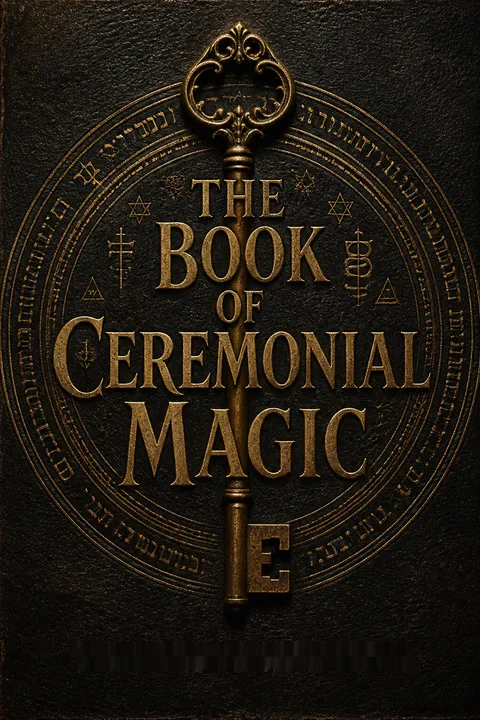

Key Takeaways
1. Ceremonial Magic: A Path of Futility and Illusion
If Magic in its proper and original meaning be synonymous with wisdom; if that wisdom, by virtue of this assumption which I have mentioned, were something inconceivably great, it is of certitude that it had no causal connection with the congeries of arts and processes which are understood by Practical Magic.
A Condemned Possibility. The author asserts that the "wonder-world" of ceremonial magic, with its claims of invisibility, transmutation, and communication with spirits, is ultimately an illusion. When subjected to reason, its paradoxes become ludicrous, its marvels trivial, and its elixirs fail. This domain, like "gold of Faerie," cannot withstand the light of day or the test of human intellect.
The Path of Illusion. True Magic, synonymous with wisdom, has no connection to the practical arts described in grimoires. These rituals represent a "path of illusion" by which the psychic nature of man descends into an abyss, rather than ascending to spiritual wisdom. The author, as a mystic, is certain that the science of ancient sanctuaries, which imparts wisdom, does not correspond to these arts.
Follies and Dangers. The investigation aims to expose the futility of ceremonial magic and the fantastic nature of its distinctions. It is a collection of "nauseating follies" that, if seriously pursued, lead to dangerous psychological states, such as hallucination. The author warns against these processes, which are not only ridiculous but also potentially perilous to the soul.
2. The Artificial Divide: White and Black Magic Converge
The distinction between White and Black Magic is the distinction between the idle and the evil word.
A Superficial Distinction. The author argues that the traditional distinction between White and Black Magic is largely artificial and unrooted in the subject's subsoil. While definitions might suggest a clear separation between good and evil purposes, a closer examination of the ceremonial literature reveals a significant overlap. So-called Theurgic Ceremonial, or White Magic, often includes rites for invoking evil spirits, blurring the lines.
Frivolous and Objectionable Aims. The purposes of magic, whether "white" or "black," are frequently childish, frivolous, or objectionable. White Magic, despite its claims, admits intentions that are far from noble, such as acquiring worldly advantages or influencing others' free will. This makes it often "blacker than it is painted," demonstrating that the two branches are not sharply distinct in their moral implications.
Tainted by Sin. All extant rituals, regardless of their pretended claims, are tainted with Black Magic, much as every idle word is tainted with sin. Some rituals are more absurd, others more iniquitous, but they all share a common root in seeking power apart from divine grace. The author concludes that the diabolism of the confessedly diabolical is often thin, while the angelic elements in supposedly angelic processes often border perilously on the Satanic.
3. The Solomonic Legacy: Foundation of All Rituals
The Key of Solomon proper is familiar to scholars in Latin, French, Italian and one or two German MSS.
The Progenitor of Grimoires. The Key of Solomon stands as the most important and influential source for nearly all subsequent magical rituals, both composite and explicitly black. Despite claims of Hebrew origin and Solomonic authorship, its true antiquity likely dates no earlier than the fourteenth or fifteenth century, permeated with late Jewish ideas and Christian anachronisms. Its widespread influence stems from its detailed instructions for magical procedure.
Mixed Intentions and Practices. The Key of Solomon, even in its "purified" English translation, contains elements typically associated with Black Magic, such as blood sacrifice and operations for hatred and destruction. Its aims range from the frivolous (detecting stolen goods, invisibility) to the foolish (preventing a sportsman from killing game), and the ethically dubious (seeking favour and love). This blend of intentions underscores the author's argument against a clear White/Black distinction.
The Lesser Key's Exalted Pretensions. The Lemegeton, or Lesser Key of Solomon, is presented as a work of "far more exalted pretensions," detailing the evocation of seventy-two chief devils and their ministers (Goëtia), spirits of the cardinal points (Theurgia Goëtia), angels of hours and zodiacal signs (Pauline Art), and other choirs (Almadel). While it tabulates infernal powers minutely, it remains largely silent on benefits from higher intelligences, suggesting its true focus is on demonic compulsion.
4. The Grand Grimoires: Explicit Pacts with Infernal Powers
The Grand Grimoire is the most fantastic of the cycle and is introduced with great pomp by its pretended editor, Antonio Venitiana del Rabina, a personage whose name indicates the Italian origin of the work.
The Apex of Diabolism. The Grand Grimoire and the Grimoire of Honorius are singled out as the most frankly diabolical and intelligible rituals of Black Magic. The Grand Grimoire is particularly notable for its detailed method of making pacts with infernal spirits, a concession to the operator's lack of resources for more elaborate evocations. It claims to derive from King Solomon's "veritable Clavicle," revealing "withering words" to compel rebellious angels.
Lucifuge Rofocale and the Blasting Rod. The central rite involves the evocation of Lucifuge Rofocale, Prime Minister of Hell, using a "Blasting Rod" and a Kabalistic circle made from a virgin kid's skin. The ritual demands specific preparations: a blood-stone, vervain crowns, virgin wax candles, and nails from a dead child's coffin. The Karcist (operator) must engage in a protracted negotiation with Lucifuge, who demands the operator's soul in exchange for treasure.
The Treacherous Pact. The pact described is a cunning, evasive contract, where the demon demands the operator's soul after a period (e.g., fifty or twenty years) in exchange for immediate wealth or other desires. The author notes the demon's reluctance to enter such a tricky contract, and the Church's provision of exorcisms to compel demons to return incriminating documents, highlighting the inherent dangers and the ultimate futility of such dealings.
5. Paradoxical Piety: Divine Names in Demonic Conjurations
The first impossibility required of the adept in Black Magic is therefore that he should love God before he bewitches his neighbour; that he should put all his hopes in God before he makes pact with Satan; that, in a word, he should be good in order to do evil.
Anomalous Observances. A striking anomaly in Black Magic is its incorporation of religious observances and the invocation of divine names. This is not an intentional profanation but a logical, albeit insane, extension of the belief that divine words possess power over all spirits. The sorcerer seeks to derive power from God to control evil spirits, even for nefarious purposes, tacitly assuming it's easier to compel demons than persuade angels.
Sanctity for Sin. The Grimorium Verum and Grand Grimoire paradoxically demand a proper spirit of reverence, devotion, and love for God as a prerequisite for successful operations. The operator must fast, abstain from sexual intercourse, and recite prayers to "Grand Adonai" before attempting to bewitch a neighbour or make a pact with Satan. This creates a bizarre contradiction: one must be good to effectively perform evil.
The Grimoire of Honorius: Ecclesiastical Diabolism. This ritual, intended for priests, exemplifies this paradox by prescribing Masses of the Holy Ghost and Angels, the use of consecrated Host, holy water, and Litanies of the Holy Name of Jesus. These sacred elements are twisted to compel "perverse Spirits of Darkness," demonstrating a profound corruption of religious practice for magical ends, rather than outright rejection of the divine.
6. The Magician's Arsenal: Consecrated Tools for Base Desires
Preliminary magical ceremonial seems to have as its chief object the personal consecration of every article, great or small, indispensable or occasional, which is connected with the several processes.
Personal Consecration. Every instrument used in ceremonial magic, from swords to pens, must undergo elaborate consecration. This process is believed to impart virtue, drawing power from divine names and the operator's own holiness. This emphasis on personal sanctity, even for black magic, highlights the underlying belief that the operator's purity amplifies the tools' efficacy.
Specific Instrument Preparations:
- Bolline (sickle): Forged on Jupiter's day/hour, extinguished in mole's blood and pimpernel juice, fitted with a horn handle, and consecrated with prayers.
- Knives (white/black handle): Made on Venus's or Saturn's day/hour, steeped in mole's or cat's blood, inscribed with characters. The black-handled knife is for the circle, the white for other tasks.
- Rod and Staff: Cut from virgin hazel or elder on Sun's day/hour, inscribed with characters, and consecrated to "ADONAY." The Grand Grimoire's "Blasting Rod" is particularly potent for diabolical evocations.
- Pen and Ink: Quills plucked from male geese or swallows, exorcised ink made from river water, gall-nuts, vitriol, and fern, often mixed with the operator's blood for pacts.
- Virgin Wax/Earth: For candles and images, consecrated with prayers to expel "phantoms."
- Silken Cloth: To wrap and preserve all consecrated instruments, inscribed with divine names in pigeon's blood.
The Victim of the Art. The requirement for a bloody sacrifice, typically a lamb or kid, is not for blood itself but to obtain "virgin parchment" for writing pacts and talismans. The animal must be slain at a single stroke while invoking a spirit, and its skin prepared with exorcised salt and quicklime. This practice, originating in the Key of Solomon, underscores the materialistic and self-sufficient nature of the magician's preparations.
7. The Infernal Hierarchy: Forms, Offices, and Compulsion
As regards spirits, says the former, some are superior and others inferior. The three superior are Lucifer, Beelzebuth and Astaroth.
The Demonic Ranks. The Grimorium Verum and Grand Grimoire detail the hierarchy of evil spirits. Lucifer is Emperor, Beelzebuth Prince, and Astaroth Grand Duke. These potentates command numerous subordinates, each with specific powers and offices. Their characters and seals, often inscribed with the operator's blood, are crucial for invocation and compulsion.
Key Infernal Princes and Their Powers:
- Lucifuge Rofocale: Prime Minister, controls world's wealth and treasures. Subordinates: Baal, Agares, Marbas.
- Satanachia: Commander-in-Chief, subjects women to his will. Subordinates: Pruslas, Aamon, Barbatos.
- Agaliarept: Discovers arcane secrets and sublime mysteries. Subordinates: Buer, Gusoyn, Botis.
- Fleurety: Performs night labours, causes hailstones. Subordinates: Bathsin, Pursan, Eligor.
- Sargatanas: Grants invisibility, transports, opens locks, reveals private matters, teaches arts. Subordinates: Zoray, Valefar, Faraii.
- Nebiros: Inflicts evil, discovers Hand of Glory, reveals virtues of nature, predicts future, necromancer. Subordinates: Ayperos, Naberrs, Glassyalabolas.
Manifestations and Compulsion. Spirits are said to borrow bodies to appear, assuming various forms: Lucifer as a comely boy, Beelzebuth as a misshapen calf or enormous fly, Astaroth as a human or ass. The magician compels their obedience through powerful conjurations, divine names, and threats of eternal torment, forcing them to manifest in a "fair and human shape" and fulfill desires, often for material gain or illicit pleasures.
8. Necromancy: The Ultimate Abomination for Earthly Gain
It is only within recent times that the attempt to communicate with the dead has been elevated to the dignity of White Magic.
A Barbarous Practice. Necromancy, the evocation of the dead, is firmly placed within Black Magic, distinguished from modern spiritualism by its barbarous rites. Unlike theurgic schemes, it was universally execrated. The Fourth Book of Cornelius Agrippa and later grimoires detail revolting rituals, assuming the damned carry their earthly desires into the afterlife, thus luring them by their attachment to the relinquished body.
Grave and Gibbet. The most suitable locations for necromantic evocations are churchyards, especially those of executed criminals, battlefields, or murder scenes before the body's removal. These places are believed to retain a "special alliance between soul and body" or an "attracting affection" that draws the soul back. The use of blood and portions of the body (flesh or bone) is deemed indispensable, as blood is the medium of physical life.
Compelling the Deceased. Rituals involve opening graves, touching the corpse with a magic wand, and conjuring the spirit by "the virtue of the Holy Resurrection and the torments of the damned." For suicides, the conjuration must occur at the spot of death. The spirit is compelled to re-enter its body, answer questions about its calamity, dwelling, and hidden treasures, under threat of "everlasting torment." The magician must remain within a protective circle, as the ghosts of the deceased can inflict sudden death.
9. True Mysticism vs. Occultism: The Abyss of Averse Tradition
The magic of the Ceremonial Rituals is no part of the real tradition, it is not in any form that we know it of the veils thereof, nor are they even its debasement.
The Secret Tradition Inviolate. Waite vehemently distinguishes the "Secret Tradition in Christian Times" (true mysticism) from the "occult sciences" and ceremonial magic. True mysticism, found in the literature of Christian Mystical Theology, focuses on the inward world, recollection, contemplation, and union with the Divine. It is the "way, the truth and the life" leading to God, where the self dissolves into the consciousness of God only.
The Tradition à Rebours. In stark contrast, occultism represents a "tradition à rebours," a path of illusion and descent into the "recremental deeps" or "cesspools of spiritual life." It is driven by the ambition for miraculous power and material gain, rather than spiritual grace. Waite asserts that those seeking powers of the soul apart from its graces are treading a downward path, leading to the "Houses of Sin."
Futility and Evil Intent. Ceremonial magic, whether "white" or "black," is ultimately an attempt to direct admitted efficacy into evil channels, compelling infernal cohorts or enlisting blessed hierarchies for "foolish or discreditable transactions." The desire for power, knowledge without learning, and base ambitions are characterized as inherently evil. The author concludes that this pseudo-art is of the abyss, leaving the operator with only "evil intention" and rarely with true fruition.
Review Summary
The Book of Ceremonial Magic receives mixed reviews (3.78/5). Readers appreciate it as a historical compilation of medieval grimoires but criticize Waite's contempt for the subject matter and deliberate alterations to rituals. Many note the book feels dated now that original grimoires are readily available. Reviewers fault Waite's verbose, dry writing style and his intrusive Christian biases. The work is praised for its scholarship and as a reference tool, though translation errors exist. Opinions vary from "waste of words" to "valuable resource," with nostalgia playing a role for older readers who had few alternatives.
People Also Read


Download PDF
Download EPUB
.epub digital book format is ideal for reading ebooks on phones, tablets, and e-readers.








































