

Key Takeaways
You are a $150,000 miracle nothing on Earth can replicate
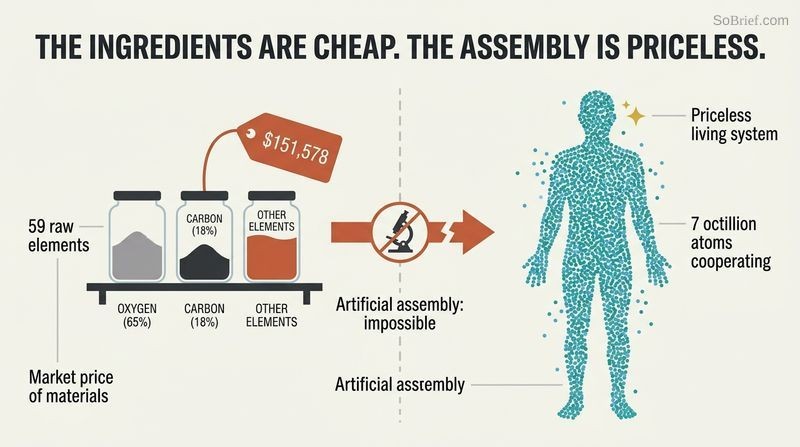
The elements are cheap; the assembly is priceless. Bryson opens by asking what a human body is worth in raw materials. Britain's Royal Society of Chemistry calculated it would cost roughly $151,578 to buy the 59 elements needed to build the actor Benedict Cumberbatch, though other estimates run as low as $168. Six elements (oxygen, carbon, hydrogen, nitrogen, calcium, and phosphorus) make up 99 percent of you.
The punchline: no amount of money buys life. Gather every brilliant scientist alive and hand them all the ingredients, and they still could not build a single living cell. It takes 7 octillion atoms to make you, all mindless particles, yet they cooperate to keep you humming through a quadrillion tasks a second without asking your permission or attention.
This framing echoes Erwin Schrodinger's 1944 question in What Is Life?, which puzzled over how inert matter organizes itself against entropy. Bryson's genius is emotional rather than technical: he converts biochemistry into gratitude. The comparison to a hardware-store price tag has a long pedigree in popular science, but pairing it with the impossibility of synthesis lands the deeper point that emergence, not ingredients, defines living things. One caveat worth noting: synthetic biologists like Craig Venter have since booted up cells running fully synthetic genomes, so the boundary of what humans can build is shifting faster than the awe suggests.
Race is a sliver of epidermis reacting to sunlight
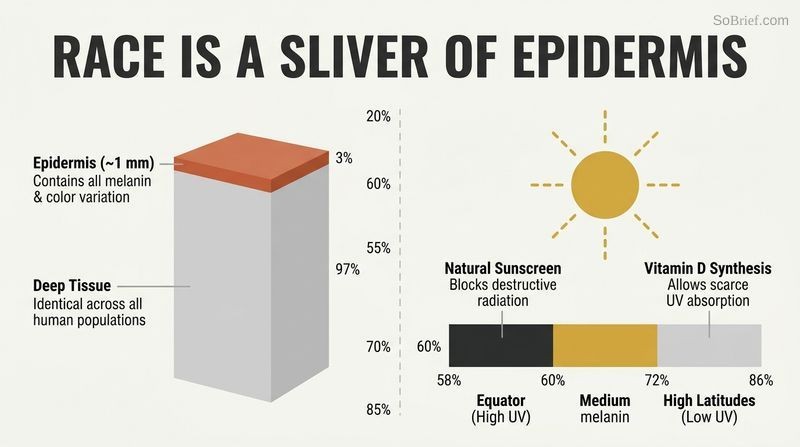
Skin color is a sunscreen calculation, not a character marker. A surgeon peeled a translucent, millimeter-thick layer from a cadaver's arm and told Bryson that this is all that race amounts to biologically. Anthropologist Nina Jablonski explains that all humans have the same number of pigment-producing cells; only the melanin output differs. Melanin is an ancient molecule that also colors bird feathers and squid ink.
Skin tone tracks a vitamin D balancing act. Dark skin blocks harmful UV near the equator; lighter skin evolved at higher latitudes to synthesize scarce vitamin D. This depigmentation happened independently at least three times and can occur in just 2,000 to 3,000 years. Roughly half the world is vitamin D deficient for part of the year because migration outpaced evolution.
Jablonski's convergent-evolution argument is one of the strongest scientific rebuttals to racial essentialism, aligning with population geneticists like Richard Lewontin, who showed in 1972 that most human genetic variation exists within, not between, populations. The vitamin D story is elegant but contested: some researchers argue sexual selection and genetic drift also shaped skin tone, and the folate-protection hypothesis (UV degrades folate, harming fetal development) competes with the vitamin D account. What is unimpeachable is the core reframe: a trait humans have killed and enslaved over is, mechanically, a localized adjustment of one pigment's dosage to latitude.
Your microbes outnumber your genes 500 to 1
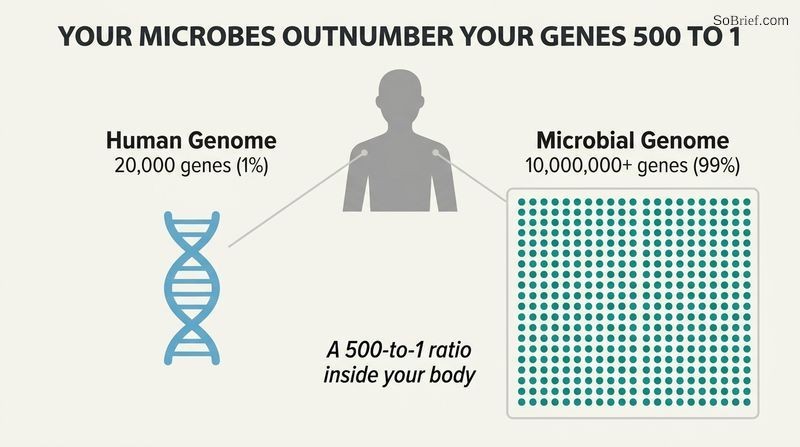
You are a walking ecosystem you barely control. Roughly 40,000 species of microbes call you home, weighing about three pounds, the same as your brain. Counted by cells, bacteria roughly equal your human cells. Counted by genes, you carry about 20,000 of your own and perhaps 20 million bacterial ones, making you around 99 percent bacterial from a genetic angle.
They do essential work, and they are winning the arms race. Gut bacteria produce about 10,000 digestive enzymes versus your own 20, extracting vitamins and calories you could never access alone. But antibiotics are grenades, not scalpels: they kill helpful microbes alongside harmful ones. Most Westerners take 5 to 20 antibiotic courses by adulthood, and resistant superbugs like MRSA already kill an estimated 700,000 people yearly.
The microbiome reframing dovetails with Lynn Margulis's endosymbiotic theory, which established that our own mitochondria were once free-living bacteria, meaning cooperation with microbes is not a bug of human biology but its foundation. Bryson's antibiotics warning deserves amplification: only about one-third of a new antibiotic can be developed today for the money that yielded ninety drugs in the 1950s, and most big pharma firms have exited the field because chronic-disease drugs are far more profitable. The looming forecast of ten million annual resistance deaths by 2050 reframes antibiotic overuse in agriculture (80 percent of US antibiotics feed livestock) as a genuine civilizational risk, not a nuisance.
Your brain invents reality, then lies to you about it
Perception is a construction, not a recording. The brain sits in silent darkness with no pain receptors of its own, yet it manufactures your entire vivid world from streams of electrical pulses. Color, sound, and smell do not exist out there: photons are colorless, sound waves silent, scent molecules odorless. Your brain paints them in. It even forecasts about a fifth of a second into the future to compensate for neural lag, so you literally live in a world that has not quite happened yet.
Memory is a Wikipedia page, not a filing cabinet. Psychologist Elizabeth Loftus implanted false childhood memories in about a third of subjects, convincing them a fictional Bugs Bunny hugged them at Disneyland. After 9/11, nearly half of surveyed people misremembered where they were within a year.
This connects to predictive-processing theory, championed by neuroscientists like Karl Friston and Andy Clark, which reframes the brain as a prediction engine that treats sensory input mainly as error-correction to its running model of the world. Loftus's work reshaped legal systems, casting doubt on eyewitness testimony that once sent people to prison. The unsettling implication rarely stated: if perception is inference and memory is reconstructive, then confidence is a terrible proxy for accuracy. Courts, journalists, and everyday arguments still treat vivid recall as reliable evidence. Bryson's soap-lather example (foam is always white regardless of soap color) is a charming, testable demonstration that color lives in the observer.
We are built to choke because upright walking rewired our throats
Speech and choking share the same anatomical bargain. Uniquely among mammals, humans send food and air down the same tunnel, guarded only by a tiny trapdoor called the epiglottis. This happened because bipedalism lowered our larynx and lengthened our necks. The tradeoff gave us the vocal apparatus for articulate speech, but also made us the only animal that routinely chokes to death on dinner, killing roughly 5,000 Americans a year.
Evolution is a series of accidents, not a design. Bryson repeats this theme across the body: we get impacted molars from jaws too small, backaches from spines meant for four legs, and painful childbirth from a pelvis narrowed for walking. The ear's three tiny bones were once jaw bones. Our bodies are three billion years of improvised patches.
The choking tradeoff is a favorite example in evolutionary medicine, articulated by Daniel Lieberman, whose concept of mismatch (bodies built for one environment living in another) underpins much of Bryson's framing. The deeper philosophical point challenges intelligent-design intuitions: a competent engineer would never route the recurrent laryngeal nerve on its absurd detour, nor share a food-and-air pipe. Stephen Jay Gould made the same argument with the panda's thumb, insisting that imperfection is the strongest evidence for evolution, since a designer would not build in flaws. Bryson democratizes this insight, turning every backache and wisdom tooth into quiet testimony about our jury-rigged ancestry.
Your heart lifts a one-ton weight 150 miles every lifetime
The most single-minded organ has no interest in your feelings. Despite poetry and valentines, the heart is a grapefruit-sized pump beating around 100,000 times a day, 3.5 billion times per lifetime, pushing blood with enough force to spurt three meters if the aorta is cut. It moves about 1,680 gallons daily. Yet more than half of first heart attacks strike people with no obvious risk factors: nonsmokers, non-obese, with clean cholesterol.
Medicine can now do more harm than the disease. Bryson cites precautionary angioplasties: of every 1,000 nonemergency procedures, roughly two patients die on the table and 28 suffer procedure-induced heart attacks, with no proven life extension. Even George W. Bush had one at 67 despite no symptoms, prompting a cardiologist to call it American medicine at its worst.
The overtreatment critique aligns with the Choosing Wisely movement and Gilbert Welch's work on overdiagnosis, which argues that screening and precautionary intervention can manufacture patients out of healthy people. The angioplasty data Bryson cites echoes the landmark COURAGE and later ORBITA trials, which found stents offered little benefit over medication for stable angina. The randomness of heart attacks (half hitting the apparently healthy) is a sobering counterweight to the wellness industry's implicit promise that virtue guarantees safety. As Bryson puts it elsewhere, a healthy lifestyle buys better odds, not immunity. The heart's indifference to emotion is a useful corrective to millennia of misplaced metaphor.
Sitting still can erase the benefit of your workout
Movement is medicine, but rest is metabolically vital too. We evolved as hunter-gatherers who walked about 19 miles for a day's food, yet were also wired to conserve energy whenever possible. The average American now walks about a third of a mile a day. Exercise cuts heart attack and stroke risk by roughly 31 percent, and eleven minutes of daily activity after 40 adds 1.8 years of life. If exercise were a pill, it would be the bestselling drug in history.
But sitting is its own hazard. A committed couch potato, defined as sitting six or more hours daily, raises mortality risk by nearly 20 percent for men and almost double that for women, and prolonged sitting can nullify the gains of an otherwise active day. The famous 10,000-steps target, incidentally, has no scientific basis.
The sitting-as-independent-risk finding, popularized by James Levine's NEAT research (non-exercise activity thermogenesis), reframed public health advice: it is not enough to hit the gym if you then sit motionless for fourteen hours. Epidemiologists debate the magnitude, and some 2019 studies suggest brisk daily activity can offset much sitting risk, softening the you-cannot-undo-sitting claim. Bryson's demolition of the 10,000-steps myth (a 1960s Japanese pedometer marketing figure) is a useful reminder that many health commandments are commercial artifacts. The evolutionary framing is the real value: our bodies are simultaneously lazy and endurance-tuned, a paradox that explains both the obesity epidemic and why movement feels like both chore and relief.
For every year of added life since 1990, only ten months are healthy
We extended lifespan without equally extending healthspan. Global life expectancy improved as much in the twentieth century as in the preceding 8,000 years, jumping for American men from 46 years in 1900 to about 76 today. But much of that gain came from crushing childhood mortality, not from keeping the old vigorous. Nearly half of people over 50 now live with chronic pain or disability, and the elderly fill half of hospital beds while making up a tenth of the population.
Aging remains a genuine scientific mystery. There are over 300 serious theories. Telomeres (protective DNA caps that shorten with each cell division) explain perhaps 4 percent of the added death risk after 60. Antioxidant supplements, a $2 billion industry, have no proven benefit and may even raise death risk.
The healthspan-lifespan gap is now central to geroscience, with researchers like Aubrey de Grey arguing aging itself should be treated as the target disease, since curing all cancer would add only 3.2 years and eliminating Alzheimer's a mere 19 days. This exposes a strategic flaw in medical priorities: we fund downstream diseases while the upstream driver (biological aging) goes comparatively neglected. Bryson's demolition of the antioxidant myth deserves emphasis, since Denham Harman's 1950s free-radical theory spawned a supplement empire that subsequent trials repeatedly failed to validate. The societal arithmetic (35 years of retirement funded by 40 years of work) is a demographic time bomb most nations have not honestly confronted.
Cancer is your own body attacking you without permission
Cancer is not caught; it is a civil war. Unlike infections, cancer is internal: your own cells proliferating wildly, tricking the body into feeding them a blood supply, ignoring commands to die, and spreading to distant organs where they seem to prepare base camps in advance. A 2000 landmark paper listed six shared hallmarks of cancer cells. Because they look so normal, most cancers grow painlessly and invisibly for years.
It is overwhelmingly an age and lifestyle disease. A person under 40 has roughly a 1 in 70 chance; over 60 the odds jump to 1 in 3 for men. More than half of cases trace to modifiable factors: smoking, drinking, and excess weight. Childhood leukemia survival, once near zero, now exceeds 90 percent thanks to Donald Pinkel's brutal high-dose combination therapy.
The framing of cancer as evolution's price is scientifically precise: the same mutability that lets our cells adapt is what lets them go rogue, a point developed by cancer biologists like Mel Greaves, who views cancer as Darwinian selection playing out within a single body. The metastatic base-camp idea Bryson describes maps onto the seed-and-soil hypothesis, first proposed by Stephen Paget in 1889 and ignored for a century. What Bryson underplays is immunotherapy's revolution, though he nods to it: checkpoint inhibitors and CAR-T therapy now cure some previously fatal cancers, albeit at costs approaching $500,000 per patient, raising brutal questions of access that medicine has yet to answer.
America spends the most on health care and dies soonest
More money buys worse outcomes. The United States spends about $10,209 per person on health care, two and a half times the developed-world average, yet ranks 31st in life expectancy, behind Costa Rica and Chile. A middle-aged American is more than twice as likely to die as a Swede of the same age. American children are 70 percent more likely to die in childhood than children elsewhere in the wealthy world.
The causes are lifestyle, risk, and cost, not lack of care. Americans eat about 20 percent more calories than the Dutch or Swedes, drive more dangerously, and wear helmets less. Meanwhile prices are surreal: an angiogram costs $914 in the US versus $35 in Canada, and America needs twice as many billing administrators as it has practicing physicians.
This paradox is well documented by health economists like the late Uwe Reinhardt, whose famous phrase It Is the Prices, Stupid captured that Americans do not consume more care, they pay more per unit. Bryson adds the lifestyle and injury dimensions, which matter: firearm deaths and car crashes disproportionately kill young Americans, dragging down averages. A subtler point deserves highlighting: the poorer outcomes extend even to prosperous, college-educated white Americans compared with their overseas peers, suggesting the problem is systemic rather than merely about the uninsured poor. The administrative-bloat statistic is a damning indictment of a system optimized for billing rather than healing.
Ignoring pain past a point serves no purpose; it is a disease itself
Chronic pain is a malfunction, not a message. Acute pain usefully tells you to withdraw your hand from the flame, but researchers now treat chronic pain as its own disease, a system stuck in the on position. Pain specialist Patrick Wall noted we spend mere seconds of a lifetime usefully recoiling from danger, yet months in pointless agony. Uniquely, when nerves are damaged they often switch on rather than off, refusing to quiet down. Cancer pain, cruelly, usually arrives too late to be a useful warning.
The brain, not the injury, generates pain. Pain has no single center and is intensely subjective, amplified by anxiety and dulled by pleasant aromas, music, or a loving partner, which halves reported angina pain. Even placebos work, sometimes when patients know they are placebos.
Irene Tracey's neuroimaging work has helped legitimize free analgesia, the idea that cognitive and behavioral approaches genuinely alter pain perception, not merely mask it. This aligns with the biopsychosocial model of pain championed since the 1970s, which treats pain as an experience constructed by brain, body, and context rather than a direct readout of tissue damage. The placebo findings connect to Ted Kaptchuk's open-label placebo trials at Harvard, which stunned researchers by showing benefit even when patients were told the pills were inert. The opioid catastrophe (a quarter-million American deaths from 1999 to 2014) is the tragic counterexample of what happens when medicine treats chronic pain as a simple signal to be chemically silenced.
Deep, loving relationships physically lengthen your telomeres
Social connection edits your biology. In Costa Rica's Nicoya Peninsula, people live longer than wealthier Americans despite higher rates of obesity and hypertension, and they carry longer telomeres. The catch: if they live alone or fail to see a child at least weekly, that telomere advantage vanishes. A 2010 US study found that lacking strong relationships doubles your risk of dying from any cause.
Kindness measurably heals. A 2016 New Zealand study found diabetic patients treated by doctors rated high for compassion suffered 40 percent fewer severe complications, a benefit comparable to the most intensive drug therapy. Epidemiologist Thomas McKeown argued that most of the great mortality declines came not from medicine but from better sanitation, diet, and living conditions. Everyday human attributes turn out to rival high-tech equipment.
The telomere-relationship link connects to Elizabeth Blackburn's Nobel-winning telomere research and her later collaboration with psychologist Elissa Epel, whose work tied chronic stress and loneliness to accelerated cellular aging. This resonates with the Harvard Study of Adult Development, the longest longitudinal study of happiness, whose director Robert Waldinger concluded that relationship quality predicts late-life health better than cholesterol. Bryson's compassion statistic is striking but demands caution: observational studies cannot fully separate whether compassionate doctors cause better outcomes or simply attract more engaged patients. Still, the convergence of evidence reframes medicine's obsession with technology. The cheapest, least patentable interventions, connection and kindness, may be among the most potent, which is precisely why they are chronically underfunded.
Analysis
Bill Bryson's The Body is not a thesis-driven argument but a guided anatomical tour, a science-anthology structured as a journey from skin inward to death. Its power lies in accumulation: chapter by chapter, an implicit worldview emerges that is more radical than any single claim. That worldview has three pillars. First, awe: the body performs octillions of coordinated tasks we never notice, and no science can build a living cell from scratch. Second, humility: we understand far less than our confidence suggests, from why we sleep and dream to what causes asthma, itching, migraines, and aging itself. Bryson returns obsessively to the phrase nobody knows. Third, contingency: the body is not designed but jury-rigged, a palimpsest of three billion years of evolutionary accidents that leaves us choking on food and aching in the spine.
What makes the book distinctive within popular science is its refusal of the triumphalist arc. Where many science writers narrate steady conquest, Bryson foregrounds error, injustice, and mystery: Albert Schatz robbed of credit for streptomycin, Semmelweis driven mad for suggesting handwashing, women excluded from drug trials, America spending most and dying soonest. This is science as a deeply human and often unjust enterprise.
The book's limitation is the flip side of its charm. Its anthology structure means it privileges the vivid anecdote over synthesis, and its heavy reliance on nobody knows, while honest, can leave readers without actionable frameworks. It is a book of wonder more than instruction. Yet buried in the wonder are consequential arguments: that lifestyle and inequality, not medical technology, drive most health outcomes; that overtreatment can harm; that connection and kindness are underrated therapeutics. Bryson's real achievement is making a reader feel simultaneously miraculous and mortal, inhabiting a cosmos of 37 trillion cells that will, for a few decades, improbably and generously, be you.
Review Summary
The Body: A Guide for Occupants is praised for its engaging and informative exploration of human anatomy. Bryson's trademark wit and accessible writing style make complex topics understandable and fascinating. Readers appreciate the blend of scientific facts, historical anecdotes, and medical discoveries. The book covers various body systems, diseases, and health issues, offering insights into both the known and unknown aspects of human physiology. While some readers found certain sections repetitive or unsettling, most recommend it as an enlightening and entertaining read.
People Also Read
FAQ
What's The Body: A Guide for Occupants about?
- Exploration of Human Anatomy: Bill Bryson provides a comprehensive overview of the human body, detailing its structure and functions. The book covers various systems, from the skin to the brain, explaining how they work together.
- Humorous and Informative Style: Bryson combines humor with scientific facts, making complex topics accessible and engaging. His narrative style invites readers to appreciate the intricacies of their own bodies.
- Interconnectedness of Systems: The book emphasizes how different bodily systems are interrelated, showcasing the intricate balance that sustains life.
Why should I read The Body: A Guide for Occupants?
- Unique Perspective on Biology: Bryson offers a fresh take on human biology, blending personal anecdotes with scientific insights, making the subject relatable.
- Educational Value: Readers will gain a deeper understanding of how their bodies function, which can lead to better health awareness and informed lifestyle choices.
- Engaging Storytelling: Bryson's humorous and conversational tone makes complex scientific concepts enjoyable to read, keeping readers engaged throughout.
What are the key takeaways of The Body: A Guide for Occupants?
- Complexity of the Human Body: The book illustrates that the human body is a marvel of evolution, composed of intricate systems that work in harmony.
- Importance of Microbes: Bryson discusses the role of microbes in our bodies, highlighting their significance in digestion and overall health.
- Health Awareness: Understanding how the body functions can empower individuals to make informed health decisions and appreciate their health.
What are the best quotes from The Body: A Guide for Occupants and what do they mean?
- "You are truly a wonder.": This quote encapsulates Bryson's admiration for the human body and its capabilities, serving as a reminder of our extraordinary nature.
- "The miracle of human life is not that we are endowed with some frailties but that we aren’t swamped with them.": Bryson highlights the resilience of the human body despite its imperfections.
- "The only thing special about the elements that make you is that they make you.": This quote reflects on the fundamental nature of human existence, emphasizing our uniqueness.
How does Bill Bryson explain the brain in The Body: A Guide for Occupants?
- Complexity and Functionality: Bryson describes the brain as "the most extraordinary thing in the universe," highlighting its complexity and vast information processing capabilities.
- Energy Consumption: The brain, while only 2% of body weight, consumes about 20% of our energy, showcasing its efficiency.
- Mysteries of Consciousness: Despite extensive research, many aspects of the brain remain mysterious, particularly consciousness and memory.
What insights does The Body: A Guide for Occupants provide about the immune system?
- Defense Mechanism: Bryson describes the immune system as a complex network that protects the body from pathogens, emphasizing its importance in maintaining health.
- Role of White Blood Cells: White blood cells are crucial for immune responses, identifying and attacking invaders, highlighting their significance in our overall health.
- Balance and Functionality: The immune system maintains a delicate balance, ensuring it responds appropriately without overreacting.
How does Bill Bryson address the topic of sleep in The Body: A Guide for Occupants?
- Essential Function: Bryson highlights sleep as a vital process for overall health and well-being, essential for processes like memory consolidation and hormonal balance.
- Sleep Cycles: The book explains the different stages of sleep, including REM and non-REM sleep, and their significance in restorative functions.
- Sleep Disorders: Bryson addresses common sleep disorders, such as insomnia and sleep apnea, and their effects on health.
What does The Body: A Guide for Occupants reveal about the digestive system?
- Complex Process: Bryson describes the digestive system as a complex network that breaks down food and absorbs nutrients, showcasing the intricacies of digestion.
- Role of Microbes: The importance of gut microbes in digestion and overall health is highlighted, noting their role in breaking down food and producing essential vitamins.
- Connection to Health: The book discusses the link between digestion and various health issues, including obesity and diabetes.
How does Bill Bryson explain the significance of skin in The Body: A Guide for Occupants?
- Largest Organ: Bryson emphasizes that skin is the largest organ of the body, serving multiple functions, including protection and sensory roles.
- Self-Repairing Ability: The skin's remarkable ability to repair itself after injury is discussed, reflecting on its aesthetic and functional importance.
- Microbial Ecosystem: Bryson explores the diverse microbial ecosystem present on the skin, illustrating the complexity of our skin's microbiome.
What does The Body: A Guide for Occupants say about the role of diet in health?
- Impact of Nutrition: Bryson emphasizes the importance of a balanced diet for maintaining health and preventing diseases, highlighting the body's resilience despite poor dietary choices.
- Cultural Eating Habits: The book explores how cultural habits influence diet and health outcomes, reflecting on changing dietary practices.
- Connection to Disease: Bryson discusses the link between diet and various health issues, including diabetes and heart disease.
How does Bill Bryson address the concept of aging in The Body: A Guide for Occupants?
- Biological Aging: Bryson explores the biological processes that contribute to aging, including cellular damage and hormonal changes.
- Health Implications: The importance of maintaining health as we age is emphasized, noting that lifestyle choices can significantly influence the aging process.
- Research on Aging: Bryson highlights ongoing research into the biology of aging and potential interventions to improve health in later life.
What are some common misconceptions about the body discussed in The Body: A Guide for Occupants?
- Misunderstanding of Body Functions: Bryson addresses myths about how the body works, such as the belief that we only use 10% of our brains.
- Dietary Myths: The book debunks common dietary misconceptions, explaining the differences between types of fats and their roles in health.
- Health and Longevity: Bryson challenges the notion that certain lifestyle choices guarantee health or longevity, emphasizing the role of genetics and other factors.
About the Author
Other books by Bill Bryson





Download PDF
Download EPUB
.epub digital book format is ideal for reading ebooks on phones, tablets, and e-readers.








































