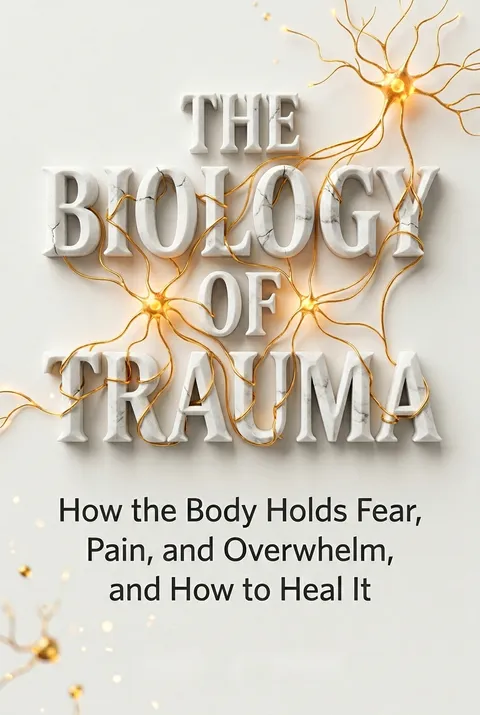

Key Takeaways
1. Trauma is a biological experience, triggering a universal 5-step survival response.
Trauma is not what happens to you, it’s what happens inside you as a result of what happened to you.
Trauma's true nature. Trauma is an internal, biological process, not merely an external event. The body possesses one instinctual, universal response to perceived inescapable danger, regardless of whether the trigger is physical or emotional. This powerful response operates entirely outside conscious control, making it stronger than logic or willpower.
The five steps. This survival programming unfolds in a precise, sequential manner:
- The Startle: An initial jolt of hypervigilance to assess potential threat.
- The Stress: A high-energy state for immediate action to overcome the danger.
- The Wall: The pivotal moment of realizing powerlessness, triggering a shift in survival strategy.
- The Freeze: A strategic paralysis, where the body locks up in shock.
- The Shutdown: A deep state of heaviness and energy conservation, akin to playing dead.
Elena's car accident illustrates this rapid progression, while childhood experiences can trigger it over longer periods.
Purpose of each step. Each step serves a crucial survival purpose. The Startle assesses the threat, Stress mobilizes energy to overcome, The Wall signals powerlessness, Freeze strategically paralyzes to prevent further harm, and Shutdown conserves energy by playing dead. Understanding these steps reframes seemingly irrational responses as brilliant, protective instincts.
2. The body's "critical line of overwhelm" and neuroception dictate whether an experience is stress or trauma.
Everyone’s body has a line—a precise point where growth turns into overwhelm, where challenge becomes too much, where stress transforms into trauma.
Stress vs. Trauma. Stress energizes and promotes growth when followed by adequate rest, much like an athlete building muscle. Trauma, however, depletes and crushes. The critical line of overwhelm is the precise boundary: staying on the stress side fosters growth, while crossing it leads to overwhelm and trauma.
Neuroception's role. Our nervous system's "neuroception" constantly assesses safety and danger, acting as a sophisticated, subconscious self-driving system. It monitors myriad internal cues (biology, thoughts, emotions) and external cues (environment, social interactions), factoring in past experiences to determine if our current capacity meets the demands we face.
Crossing the line. This critical line is crossed for two distinct reasons:
- "Too much too fast": A sudden, overwhelming event, like Elena's car accident or an intense emotional flood.
- "Too little for too long": A gradual, chronic depletion of resources, such as Claire's persistent fatigue or the emotional neglect experienced in childhood.
Both scenarios lead to an internal experience of powerlessness, triggering the body's freeze and shutdown states.
3. Three survival mechanisms (Dissociation, Immobilization, Energy Conservation) explain how the body endures powerlessness.
It’s paradoxical, but one’s best fighting chance at surviving is surrendering.
Surrender to survive. When confronted with an inescapable threat and the profound realization of powerlessness, the body engages its deepest survival strategy: surrender. This triggers three unifying mechanisms—Dissociation, Immobilization, and Energy Conservation (DIE)—designed to physically survive what would otherwise be unbearable.
Dissociation and Immobilization. Dissociation creates mental and emotional distance from overwhelming pain, often fragmenting memories and numbing feelings. This protective distance can make one feel detached or as if watching events from outside their body. Immobilization, which begins with the freeze state, is a whole-body stillness that prevents detection and further action, even if internal panic or energy surges persist.
Energy Conservation. This mechanism powers down all nonessential functions, akin to an animal entering hibernation, to preserve precious energy. It manifests as profound fatigue, brain fog, a sensation of coldness, and a pervasive lack of motivation. While these mechanisms are acutely protective, they become chronic patterns if the trauma response is not fully completed and resolved.
4. Unresolved trauma creates a "body-trauma loop" that manifests in five predictable patterns.
The past is never dead. It’s not even past.
Incomplete responses. When trauma responses fail to complete and reset to safety, the body remains primed for danger, initiating a "body-trauma loop." Neuroception, now viewing the world through "danger-colored glasses," constantly senses threats, reinforcing a self-perpetuating cycle between activation (stress) and trauma (shutdown) states.
Neuroplasticity's role. Neuroplasticity automates this loop into a default habit, making it the path of least resistance. Each time the body cycles through this loop, neural pathways deepen, causing reactions, coping mechanisms, and even health symptoms to progressively worsen over time. Sarah's perfectionism and anxiety, for instance, became more ingrained over decades.
Five D patterns. This persistent body-trauma loop manifests in five predictable patterns, offering clues to stored trauma:
- Disconnection: Emotional numbness, social distance, ignoring body signals.
- Disruption: Blocked movement, procrastination, feeling stuck in life.
- Depletion: Chronic fatigue, low motivation, constant energy conservation.
- Dysregulation: Over- or under-reactivity, emotional roller coaster.
- Disease: Chronic physical conditions, often without clear medical explanation.
5. Trauma's biological impact, from cells to systems, drives chronic disease and vulnerability.
The most prevalent health condition that medicine will face in the next decades isn’t a specific disease, it’s the accumulation of trauma manifesting as chronic illness.
Cellular shutdown. At the cellular level, trauma triggers a "cell danger response," where mitochondria become rigid and inefficient, and the cell membrane restricts nutrient flow. This leads to inefficient energy production and accumulating oxidative stress, damaging DNA and other cellular components.
Systemic dysregulation. This cellular impact ripples through whole-body systems. Chronic brain inflammation (from hypersensitive microglia), gut dysfunction (leaky gut, dysbiosis), and hormonal imbalances (adrenal, thyroid, reproductive) become pervasive. These dysregulations send constant danger signals to neuroception, maintaining the body-trauma loop.
Disease as a pattern. Chronic conditions like autoimmunity (Elena's lupus), metabolic syndrome (Alex's NAFLD), chronic pain, and chronic fatigue (Claire's exhaustion) are predictable outcomes of this sustained biological dysregulation. The Adverse Childhood Experiences (ACE) Study highlights this "dose-response" relationship, demonstrating that trauma fundamentally alters biology, creating vulnerability to disease independently of lifestyle factors.
6. Our "preexisting filter" (attachment, neurodevelopment, biology) determines our trauma vulnerability.
It’s not what happens to you, but how you react to it that matters.
The filter concept. Our "preexisting filter" is an invisible, internal blueprint that dictates how we perceive and respond to life's challenges. This filter integrates our current nervous system state, underlying biology, programmed beliefs, and somatic memories, influencing whether an experience is processed as a manageable stress or an overwhelming trauma.
Attachment as template. This filter is largely shaped by early attachment experiences, forming a core template for safety or danger. Unmet developmental needs—such as the need to be held, heard, supported, seen, understood, and loved—create "attachment pains" that wire our neuroception to perceive threats, even in objectively safe situations.
Three pillars of attachment. Attachment wiring is built on three interconnected pillars:
- Attunement: The co-regulation received from caregivers shapes the developing nervous system.
- Neurodevelopment: Specific movement patterns (e.g., crawling, rocking) organize brain stem and midbrain for self-regulation.
- Biology: Neurochemistry (oxytocin, dopamine, serotonin), biochemical imbalances (e.g., copper excess, pyroluria, methylation issues), and early brain inflammation influence the capacity for connection and regulation.
7. Healing requires an "essential sequence": Safety, Support, and Expansion.
The body comes out of a trauma response following the same precise sequence it followed to go in.
Body's innate design. The body is naturally designed to complete trauma responses and return to safety and growth. Healing, therefore, follows a precise "essential sequence" that reverses the steps of the trauma response, guiding the body from contraction back to its natural state of expansion.
The three steps. This sequence comprises:
- Safety: The initial phase of stabilizing the nervous system, stopping the "spinning" of the body-trauma loop, and creating a felt sense of inner safety. This foundation is crucial, postponing deep processing until the system is regulated.
- Support: The phase of repairing underlying biological, somatic, and psychological blocks that prevent sustained regulation. This addresses the anxiety and anger that predictably emerge as the body releases chronic shutdown.
- Expansion: The final phase of gradually stretching beyond the comfort zone, building capacity, and integrating new ways of being into a fuller, more authentic life.
Why sequence matters. Skipping steps or forcing the process—such as attempting deep trauma processing without first establishing safety—can lead to retraumatization or stalled progress. The essential sequence ensures the body receives what it needs at each stage, allowing natural, sustainable healing to unfold from the inside out.
8. Integrated repair addresses mind, body, and biology to resolve trauma patterns.
Creating deep and lasting change requires specific elements to reset each affected level: our mind (parts), our physical body (somatic), biology (systems and cells), and most fundamentally, our neuroception—the core of our survival response system.
Holistic approach. Effective trauma repair must be integrative, addressing all levels simultaneously: mind (beliefs, fragmented parts), body (somatic memories, blocked movements), and biology (cellular, systemic dysregulation). Neglecting any single level leaves unresolved signals that continue to keep the neuroception in danger mode, hindering true healing.
Somatic and Parts work. Somatic self-practices are vital for learning to track nervous system states, creating felt safety in the present moment, and completing previously blocked self-defense movements. Mind-body parts dialogues build a compassionate relationship with fragmented parts of self, understanding their protective roles, and negotiating new, healthier ways of being.
Biology's role. Biological repair is a crucial, yet often overlooked, component in traditional trauma therapies. It directly addresses issues such as brain inflammation, mitochondrial compromise, neurotransmitter imbalances, and gut dysfunction, which actively maintain the body-trauma loop and deplete the body's capacity for lasting change.
9. Addressing specific biological blocks is crucial for sustainable trauma healing.
I discovered I had nearly every biology block I’ve shared in this book. No wonder I had gotten stuck. It wasn’t the failure of the therapy—it had been my own biology.
Biological barriers. Even with dedicated psychological and somatic work, specific biological factors can create a "ceiling effect," preventing deeper healing and sustained regulation. These include:
- Brain inflammation: Hypersensitive microglia (brain immune cells) trigger shutdown and compromise energy.
- Mitochondrial compromise: Energy depletion hinders the body's ability to shift states and maintain regulation.
- Neurotransmitter imbalances: Affect mood, motivation, focus, and calmness, making emotional resilience difficult.
Deeper biological blocks. Further biological blocks that maintain the body-trauma loop include:
- Biochemical imbalances: Conditions like copper excess, pyroluria, and methylation issues create systemic dysregulation.
- Toxin overload: Heavy metals, mold, pesticides, and processed foods burden detoxification pathways and drain energy.
- Nutrient deficiencies: Depleted by chronic stress, hindering cellular function and nervous system health.
- Gut dysfunction: Leaky gut, dysbiosis, and hidden infections send constant danger signals to the brain.
Targeted repair. Repair involves specific, personalized tools:
- Brain: Sleep optimization, anti-inflammatory nutrients (NAC, magnesium L-threonate), ocular-cardiac reflex.
- Mitochondria: Ubiquinol, B vitamins, red-light therapy, balanced movement.
- Neurotransmitters: Amino acids (5-HTP, tyrosine), cofactors (B6, magnesium), sunlight exposure.
- Biochemistry: Targeted supplementation based on lab testing (e.g., zinc for pyroluria, SAMe for undermethylation).
- Toxins: Reducing exposure, supporting detoxification phases (resourcing, opening elimination channels, gentle binders).
- Gut: Establishing rhythms, digestive support (HCL, enzymes), addressing infections, barrier repair (L-glutamine, zinc carnosine).
10. True healing is a journey of expansion, leading to a fuller, more authentic life.
The paradox of trauma is that it has both the power to destroy and the power to transform and resurrect.
Beyond healing. The ultimate goal of the trauma healing journey is not merely to recover what was lost, but to expand into a fuller, more authentic life. This involves a profound shift from the contraction of survival to the natural state of openness, growth, and vitality, allowing one to live a life they are excited to wake up to every day.
The spiral staircase. Expansion is a continuous journey, akin to climbing a spiral staircase, where each step takes us both higher in capacity and deeper into self-awareness. The focus gradually shifts from "What in me needs fixing?" to "How can I be more alive?", transforming past triggers into valuable information for ongoing growth and self-discovery.
Creating new experiences. This phase requires intentionally creating new experiences of safety, connection, and agency, rather than passively waiting for them to occur. Consistent practice of foundational principles—establishing rhythm and routine, making dietary changes, matching activity to stress levels, practicing somatic awareness, and addressing unconscious programming like learned helplessness—allows for profound, often "magical," shifts that rewire the nervous system for lasting transformation and a life of genuine expansion.
People Also Read








Download PDF
Download EPUB
.epub digital book format is ideal for reading ebooks on phones, tablets, and e-readers.








































