

Key Takeaways
Being cheated on is trauma, not codependence or weakness
For decades, partners of unfaithful spouses were labeled codependent or co-addicted, told they had a shared disease. Michelle Mays, herself once married to a sex addict, shows why that framing was wrong. Research by Barbara Steffens found that 69 percent of partners of sex addicts meet every criterion for PTSD except the one requiring a physically life-threatening event.
Building on Jennifer Freyd's Betrayal Trauma Theory, Mays argues the core wound is relational disconnection. Freyd's key insight: the closer and more depended-upon the betrayer, the deeper the traumatic impact. Discovery instantly severs you from your partner, your sense of self, your friends, and your faith. Healing, therefore, cannot be a purely cognitive task of rebuilding assumptions. Because betrayal happens in relationship, recovery must happen in relationship too.
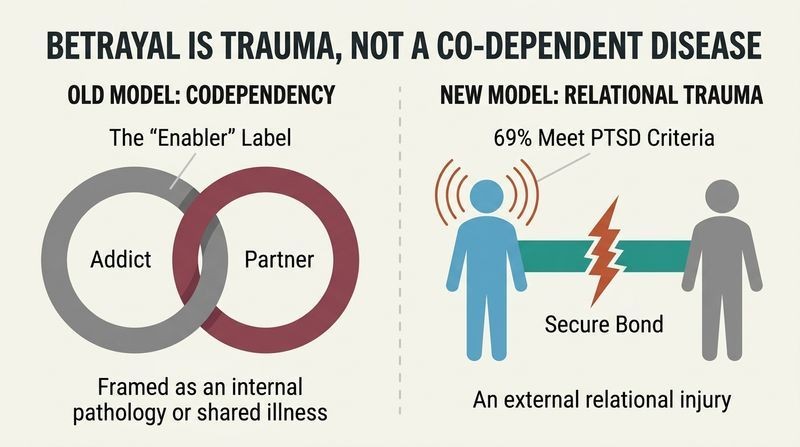
The reframe from codependence to trauma is more than semantic; it changes who gets blamed. The old model quietly implied the betrayed partner co-created the addiction, a stance that compounds injury with accusation. Freyd's contribution, echoed in Bessel van der Kolk's work on relational trauma, is recognizing that fear alone does not explain these symptoms; broken attachment does. One caution worth naming: PTSD criteria have evolved, and applying a diagnostic label to grief risks pathologizing a normal response to genuine harm. Mays largely avoids this trap by treating symptoms as intelligible reactions rather than defects, which is precisely what makes the trauma lens humane.
Your safe harbor became the storm: this is the betrayal bind
The book's title names a cruel paradox. Humans are wired with two primal systems. The attachment system says, when distressed, run to your partner for comfort. The threat system says, when in danger, fight or flee. Normally these align, because your partner is where you flee to. Betrayal collides them: the person your body reaches for is now the source of the danger.
Mays calls this attachment ambivalence, borrowing Sue Johnson's phrase for an impossible choice between isolation and dangerous connection. You simultaneously want your partner to move out and to hold you while you cry. You know they are lying yet desperately want to believe them. This is not madness or dysfunction. It is two survival systems firing opposite commands at once, leaving you at war with yourself.
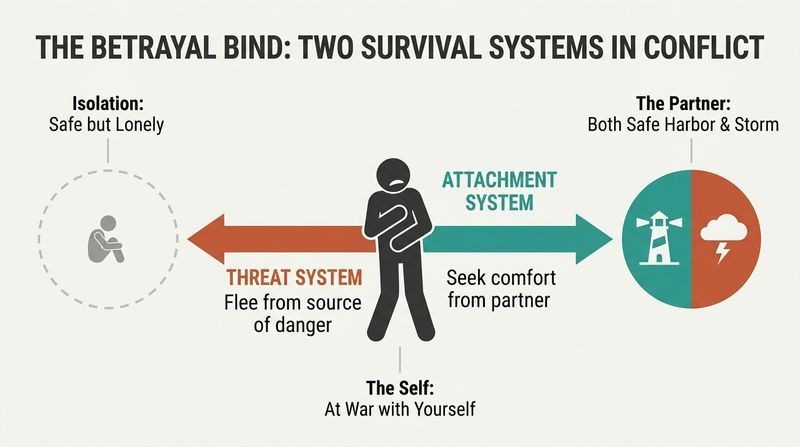
This maps neatly onto Mary Main's disorganized attachment, originally observed in infants whose caregiver was both refuge and threat, a state researchers called fear without solution. Mays extends that childhood finding to betrayed adults, a genuinely useful bridge. The framework also explains why outsiders judge harshly: from outside, staying looks irrational, but the observer is not experiencing two neurobiological systems in civil war. A subtle strength here is that naming the bind removes moral judgment. The betrayed partner is not weak for wanting the betrayer; the wanting is hardwired. That reframing alone tends to lower the shame that keeps people silent and isolated.
Your violent swings between fury and tenderness are predictable biology
Betrayed partners describe cycling from rage to cuddling within a single day, sometimes an hour. Mays maps this as a loop: disconnection to protect yourself, mounting tension because distance from your safe base is unbearable, exhaustion, reaching back toward your partner, a fragile moment of connection and relief, then a trigger (a memory, a TV plot about cheating) that shocks you back into fear and distancing.
Your attachment style shapes how long you linger in each phase. Roughly half of people are securely attached, about 20 percent anxious (who reconnect fast to soothe doubt), and about 25 percent avoidant (who tolerate distance longer). Under betrayal, even securely attached people temporarily behave like the anxious-avoidant 5 percent. Dan Siegel's principle applies: name it to tame it. Locating yourself on the cycle converts blind reaction into conscious choice.
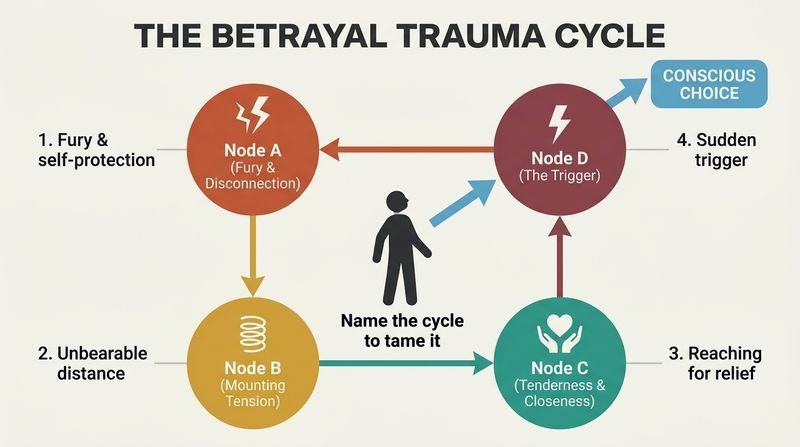
The clinical value here is de-escalation through prediction. When chaos becomes a recognizable pattern, the nervous system calms slightly, an effect supported by research on affect labeling, where putting feelings into words measurably dampens amygdala activity. Mays wisely insists this cycle is normal, countering a therapy culture that too quickly pathologizes ambivalence as commitment failure. The open question is duration: at what point does a months-long or years-long cycle stop being adaptive processing and start being a trap? The book's answer, developed elsewhere, is that awareness plus support should gradually slow the loop, not that the loop is harmless indefinitely.
Stop carrying shame that belongs to the cheater; hand it back
When someone behaves shamelessly, violating their own values by cheating and lying, they suppress the healthy guilt that should stop them. That disowned shame does not vanish. It spills onto the betrayed partner, who absorbs it as carried shame: the private conviction that something is wrong with me. My partner did something wrong quietly becomes something must be wrong with me.
Mays distinguishes toxic shame (I am bad) from guilt (I did something bad); guilt repairs relationships, shame corrodes them. Carried shame latches onto desirability, sexuality, trust, and worth. Her supervisor's line reframes the cure: you cannot heal carried shame, because it is not yours; you can only give it back. That means refusing to let the betrayal define your worth and holding the betrayer accountable, not shaming them in return, which would just flip you into a power-over stance.
The give it back framing is therapeutically elegant because it externalizes a feeling most people internalize as identity. It resonates with narrative therapy's technique of separating the person from the problem. Brene Brown's distinction between shame and guilt underpins the argument, and the empirical claim that guilt is relationally constructive while shame is destructive is well supported by June Tangney's research. One nuance: giving shame back is described almost as a discrete act (a list, a letter), but carried shame is sticky and recurs with each new trigger. The honest version is less a single handoff than a repeated practice of noticing and declining a burden.
Rebuild trust in your own gut before trusting the cheater again
Cheating survives on dishonesty, and Mays catalogs four types of gaslighting, named after the 1944 film where a husband dims the lights then tells his wife she imagines it:
1. The straight-up lie about whereabouts, money, or time.
2. Reality manipulation, attacking your perception (you are paranoid, you need therapy).
3. Scapegoating, exaggerating your flaws to justify the affair.
4. Coercion, ranging from charm offensives to intimidation.
Freyd's DARVO names a vicious combo: Deny, Attack, Reverse Victim and Offender, where the cheater cries betrayal and accuses you. Repeated gaslighting makes partners doubt their sanity. Mays's counterintuitive fix: the real question is not how do I trust my partner but how do I trust myself. Learn to hold your reality even when it clashes with your partner's, tolerate wait and see, and treat your body's unease as data worth heeding.
Centering self-trust over partner-trust is the book's most portable insight, useful far beyond infidelity. It aligns with research on epistemic trust, the capacity to know what you know, which chronic manipulation systematically erodes. DARVO deserves wider recognition; Freyd's studies suggest it not only harms victims but silences them, prompting retraction. A practical tension surfaces: Mays notes that a betrayed partner's threat system becomes chronically overactive, firing false alarms everywhere, so the same gut she urges people to trust can also mislead. Her resolution, leaning on skilled outside support to distinguish intuition from fear-based catastrophizing, is honest about how hard calibration is.
Refuse death by a thousand papercuts; insist on full disclosure at once
After discovery, most partners learn only a fragment of the truth. Then more dribbles out over weeks or months, each revelation a fresh wound. Mays calls this staggered discovery, and it is toxic: every new lie re-traumatizes, deepens mistrust, and still leaves you without the whole picture. The cheater, terrified of loss and drowning in shame, keeps confessing only what you specifically ask about.
The alternative is disclosure: a therapeutically facilitated, one-time full accounting of the betrayal. Discovery is part of the betrayal; disclosure is part of the healing. The hard truth is you cannot force honesty. Mays's counsel is to stop chasing information, set a bottom-line deadline (typically ten to twelve weeks, since cheaters must dismantle their own self-deception first), and take protective action for yourself if it is not met. Accepting the wait paradoxically lowers anxiety.
The distinction between discovery and disclosure is clinically important and often botched in ordinary couples work, where therapists inadvertently facilitate slow-drip revelations that retraumatize. Mays's insistence that cheaters must first break through their own denial, illustrated by a client who genuinely believed he had four partners before his records revealed twenty-five, reframes delay as neurological rather than merely evasive. This is charitable, perhaps too charitable; the same mechanism could rationalize indefinite stalling. Her safeguard, a firm deadline paired with self-protective consequences, keeps agency with the betrayed. The deeper wisdom echoes acceptance-based therapies: suffering multiplies when we fight a reality we cannot yet change.
Knowing but not knowing is your brain guarding the bond
Why do partners miss glaring signs? Mays uses Freyd's term betrayal blindness: an unconscious strategy of holding dangerous information outside awareness to preserve a relationship you depend on. It is not stupidity or denial as a character flaw; it is the freeze response aligning your threat and attachment systems, letting you stay connected to your partner by not seeing the danger.
It manifests as a fantasy honeymoon after discovery, failing to connect obvious dots (one client insisted her husband's affair child was not his despite years of support payments), or hyper-focusing on what you do not yet know to avoid feeling what you already know. Blindness deepens with a history of childhood betrayal, which can disable what Freyd calls our cheater detectors. Group support is one of the most effective ways to move gently from unawareness into awareness.
Betrayal blindness reframes what looks like foolishness as sophisticated self-protection, which is both compassionate and empirically grounded in Freyd's dissociation research. It connects to broader work on motivated reasoning and willful ignorance, where people avoid information that would force costly action. The evolutionary logic is compelling: a child cannot survive recognizing a caregiver as dangerous, so the mind blinds itself, and that circuitry persists into adult love. The provocative implication is that awareness itself carries a price, sometimes the relationship. This complicates any simple pro-honesty stance; sometimes people stay blind because seeing would demand a loss they are not yet resourced to bear.
You stay stuck because healing risks more loss; act scared anyway
Beneath the binds sit three engines: fear, shame, and powerlessness. The kingpin is fear of loss. Healing demands setting boundaries, using your voice, and asking for what you need, but each of those risks the very outcome you dread, that your partner refuses, lies again, or leaves. So the boundary you crafted quietly dissolves; the separation reverses. This sabotage is largely unconscious, your attachment system avoiding what Jaak Panksepp called primal panic.
Powerlessness breeds desperate behavior: endless fights, rage, staying in crisis to keep the cheater motivated. One client raged at her husband for four years because it felt like doing something while she avoided her terror of leaving. Mays's blunt remedy: do the thing you are afraid to do, in nudges, with a support system as your safety rope. Facing manageable fears builds the resilience that makes real choice possible.
The claim that we must act before the fear subsides inverts the intuitive order and matches exposure therapy's core finding: avoidance maintains anxiety, approach extinguishes it. Mays's rock-climbing metaphor, free climbing with a rope versus free soloing without one, captures a crucial safeguard often missing from bootstrap advice; courage here is relational, not solitary. The insight that people stay in crisis to keep a partner motivated is especially sharp, exposing a hidden logic in seemingly self-defeating behavior. The challenge is discernment: not every fear should be overridden, and some relationships genuinely are unsafe to confront. The nudge, not the leap, is the operative wisdom.
Cheating isn't about sex; it's hijacked belonging and mattering
Mays argues sex is powerful because it touches two core attachment needs: belonging (feeling wanted, included, connected) and significance (feeling seen, important, that you matter). In the moment of sexual connection, both needs can be met at once, which is why sex holds such force and why its betrayal cuts so deep.
Cheating, then, is often the sexualization of unmet core needs, offering a hit of mattering while dodging the vulnerability real intimacy demands. Her clients reveal the pattern: a porn-addicted man who felt safe and wanted only inside fantasy, a woman addicted to the moment a partner chose her over his own values, a man whose affair felt easy because there were no bills or parenting to fight about. Understanding this deepens rather than excuses accountability, and it explains why simply amping up the sexy at home never fixes betrayal.
Grounding sexuality in attachment needs rather than mere drive aligns Mays with Esther Perel and with self-determination theory, which names belonging as a fundamental psychological need. The clinical payoff is that it redirects the betrayed partner away from the futile competition (am I not attractive enough) toward understanding the cheater's internal deficit. That said, framing affairs primarily as unmet-need behavior risks sliding toward exculpation, a line Mays explicitly guards by keeping responsibility with the cheater. The strongest version of her point is diagnostic, not moral: you cannot out-seduce an attachment wound, so treating betrayal as a bedroom-technique problem guarantees failure.
Sexual safety and emotional safety build each other; take the leap
Betrayed partners often wait to reengage sexually until they feel fully safe, believing enough emotional repair will erase the risk. Mays says this is a trap. No amount of emotional safety eliminates the vulnerability of sex after betrayal; there will still be flashbacks, doubt, and grief. Waiting for zero risk means waiting forever, and anticipatory dread only grows.
Drawing on the Bercaws' Circulation Model, she shows sexual and emotional connection feed each other in a loop, and so do sexual and emotional safety. Good sexual experiences rewire the brain's associations from danger back toward comfort. Two common but harmful coping moves are pushing through (dissociating to finish) and total withdrawal; both freeze the problem. The healthier path treats triggers as an us problem: pausing, naming the flashback, and letting the partner ground you in the present through eye contact and reassurance.
The counterintuitive claim that sex with the person who hurt you can rebuild safety with that person rests on solid neuroscience of reconsolidation, where new emotional experiences overwrite old associative fear. Mays is careful to avoid black-and-white extremes, acknowledging that some emotional safety must precede reengagement and that a belligerent, unrepentant partner makes the leap unwise. The reframe of triggers as a shared problem rather than the betrayed partner's private burden is quietly radical; it assigns the cheater an active role in repair. The willingness model she cites, starting from willingness rather than desire with pleasure not orgasm as the goal, sensibly relieves performance pressure that itself suppresses arousal.
You cannot heal in isolation; recovery moves through six phases
Mays's Braving Hope model rests on one conviction: change happens in relationship. Because betrayal ruptures your bond with self, others, and higher power, healing means rebuilding secure connection, what she calls relational recovery. You cannot think your way calm; you need another steady nervous system to co-regulate yours, which is why isolation prolongs suffering.
She maps six phases: devastation (surviving the shock), realization (grasping the true scope), stabilization (moving from powerlessness to empowerment through boundaries and voice), reimagining (healing older, layered wounds and your sense of self), creating (building a new life or renewed relationship), and flourishing (the new normal). The phases are not linear; you flourish while still occasionally revisiting devastation. Braving hope means daring to risk something new after heartbreak, distinct from false hope's toxic positivity that fixes attention on the partner you cannot control.
Stage models risk implying tidy progression that real healing rarely follows, and Mays preempts this by stressing the phases loop and overlap. The core mechanism, co-regulation, is well established in developmental neuroscience via Stephen Porges and Allan Schore: nervous systems calm each other through safe connection, which is why the therapeutic alliance itself is curative. Her distinction between authentic and false hope is valuable in a wellness culture saturated with affirmations that ignore reality. The framework's honest limitation is that flourishing is not guaranteed for the relationship, only for the self; Mays's own story ends in divorce, a reminder that healing and reconciliation are separate outcomes.
Analysis
The Betrayal Bind occupies a specific and underserved niche: sexual betrayal viewed through attachment science rather than the addiction-recovery lens that long dominated the field. Michelle Mays's central move is to relocate the wound. Where earlier frameworks placed pathological fear (PTSD) or shared disease (codependence) at the center, she places broken attachment, following Jennifer Freyd's Betrayal Trauma Theory. This shift has real explanatory power. It clarifies why betrayed partners behave in ways that look irrational to outsiders and to themselves, cycling between rage and longing, seeing and not seeing, staying when leaving seems obvious. When the same person is both threat and refuge, contradiction is not dysfunction; it is design.
The book's greatest strength is normalization through nomenclature. Terms like attachment ambivalence, carried shame, and betrayal blindness give sufferers language for experiences that previously felt like madness, operationalizing Dan Siegel's name it to tame it. This is genuinely therapeutic, not merely descriptive.
Three tensions deserve scrutiny. First, the framework can drift toward explaining the cheater's behavior so empathetically (competing attachments, self-deception, unmet needs) that accountability risks dilution, a line Mays repeatedly polices but that less careful readers may cross. Second, self-trust is offered as the antidote to gaslighting, yet Mays concedes the betrayed partner's threat system is chronically miscalibrated, making the gut an unreliable narrator; the resolution leans heavily on professional support, which is not equally accessible. Third, the six-phase model, however hedged, imports a teleology of growth and flourishing onto experiences that are sometimes just loss.
What elevates the book above genre convention is its refusal of false comfort. Mays's own arc ends in divorce, reframed not as failure but as self-rescue. That honesty, paired with rigorous grounding in attachment research from Bowlby to Sue Johnson, makes this a credible map for a terrain most self-help treats with platitudes. Its ideal reader is anyone drowning in the aftermath who needs to know the chaos has a structure and a way through.
Review Summary
The Betrayal Bind receives overwhelmingly positive reviews, with readers praising its compassionate and insightful approach to healing from betrayal trauma. Many find the book validates their experiences, offering a clear path forward through the author's Braving Hope Treatment Model. Readers appreciate the focus on attachment theory and the comprehensive explanation of betrayal's impact. The book is lauded for its practical advice, whether choosing to stay in or leave a relationship. Some reviewers note it as life-changing, providing hope and empowerment to those struggling with betrayal.
People Also Read



Glossary
The Betrayal Bind
Refuge and threat in one personThe central dilemma Mays names: when a primary partner betrays you, your attachment system drives you to reach toward them for comfort while your threat system drives you to flee from them for safety. Because the source of danger is also the source of security, the two survival systems fire opposing commands, trapping the betrayed partner in an impossible push-pull with no safe direction to move.
Attachment ambivalence
Simultaneously craving and fleeing partnerThe cyclical push-pull state created by betrayal, in which a partner wants both closeness (to soothe the attachment system) and distance (to satisfy the threat system) from the same person. Mays describes it as a normal biological response, not dysfunction, that pulls betrayed partners rapidly in and out of connection, sometimes multiple times a day.
Carried shame
Absorbing the cheater's disowned shameShame that rightfully belongs to the betrayer but transfers onto the betrayed partner, who then feels defective, unworthy, or unlovable. It occurs when someone behaves shamelessly and suppresses the guilt that should stop them; that disowned shame spills onto their victim. Mays teaches that it cannot be healed internally, only given back by refusing to let the betrayal define one's worth.
Betrayal blindness
Not knowing to protect attachmentA term from Jennifer Freyd for the unconscious strategy of holding threatening information outside of awareness in order to preserve a relationship one depends on. A freeze response that aligns the threat and attachment systems, it lets a partner stay connected by not consciously seeing danger, and it intensifies in people with histories of childhood betrayal.
DARVO
Deny, attack, reverse victim/offenderA gaslighting tactic identified by Jennifer Freyd standing for Deny the behavior, Attack the person confronting you, and Reverse the roles of Victim and Offender. The betrayer denies wrongdoing, attacks the accuser, and recasts themselves as the wronged party, often leading the true victim to doubt themselves, retract, or fall silent.
Staggered discovery
Truth trickling out over timeThe re-traumatizing process in which betrayal details emerge in fragments over weeks or months, each accompanied by false assurances that the whole truth is out. Mays calls it death by a thousand papercuts and contrasts it with disclosure, a one-time therapeutically facilitated full accounting. Discovery is part of the betrayal; disclosure is part of the healing.
Braving Hope Process
Six-phase attachment-based healing modelMays's treatment model with six nonlinear phases: devastation, realization, stabilization, reimagining, creating, and flourishing. To brave hope means daring to risk something new after heartbreak. The model's foundation is relational recovery, the principle that because betrayal ruptures connection, healing must occur through rebuilt secure attachment with self, others, and a higher power.
Belonging and significance
Two core attachment needsThe two categories of core attachment-based needs Mays says drive sexual and relational behavior: belonging (feeling wanted, included, connected) and significance (feeling seen, important, that one matters). Sex is powerful because it can meet both at once, and cheating is often the sexualization of these unmet needs sought outside the primary relationship.
Window of tolerance
Zone of manageable emotional arousalA term coined by Dan Siegel for the state in which the nervous system is regulated enough to think, reason, problem-solve, and integrate experience. Severe stressors like betrayal bump partners outside this window into hyperarousal (anxiety, rage) or hypoarousal (numbness, shutdown), a neurobiological event that impairs functioning until connection and self-soothing restore balance.
Declawing the tiger
Shrinking partner to feel safeOne of three coping patterns Mays identifies after the attachment injury. It involves taking a power-over position by shaming, criticizing, or controlling the cheating partner to reduce their perceived threat. It backfires by diminishing the partner into a smaller, less alive person, eroding the very attraction and respect the relationship needs.
FAQ
1. What is The Betrayal Bind by Michelle Mays about?
- Focus on betrayal trauma: The book explores how to heal when the person you love the most hurts you the worst, with a special focus on sexual betrayal in romantic relationships.
- Attachment-based healing model: Michelle Mays uses attachment theory to explain the trauma of betrayal and the necessity of relational connection for recovery.
- Three core injuries: The book identifies attachment injury, emotional and psychological injury, and sexual injury as the intertwined wounds of betrayal.
- Comprehensive roadmap: It offers a structured healing journey, including the Braving Hope™ Process, to guide betrayed partners from devastation to flourishing.
2. Why should I read The Betrayal Bind by Michelle Mays?
- Unique relational perspective: The book shifts the understanding of betrayal trauma from a fear-based model to a relational, attachment-focused approach.
- Practical healing tools: Readers gain actionable strategies for creating safety, rebuilding trust, and reclaiming their sense of self after betrayal.
- Support for all roles: Whether you are a betrayed partner, the cheating partner, a therapist, or a support person, the book provides insights and tools for navigating betrayal.
- Empowerment and hope: It emphasizes authentic hope and empowerment, guiding readers to reclaim their core self and build secure bonds.
3. What are the key takeaways from The Betrayal Bind by Michelle Mays?
- Understanding complex trauma: Betrayal causes intertwined attachment, emotional, and sexual injuries that require nuanced, relational healing.
- Attachment needs are central: Healing must address core needs for belonging, significance, and safety, not just symptom management.
- Step-by-step recovery: The Braving Hope™ Process offers a six-phase roadmap from devastation to flourishing, with specific tasks and outcomes.
- Empowerment through boundaries: Setting boundaries, reclaiming power, and facing fear are essential steps toward recovery and self-restoration.
4. What are the three core injuries described in The Betrayal Bind by Michelle Mays, and why are they important?
- Attachment injury: This is the profound damage to the relational bond caused by betrayal, leading to deep disconnection and distress.
- Emotional and psychological injury: Chronic lying, manipulation, and gaslighting erode the betrayed partner’s sense of reality and mental health.
- Sexual injury: Betrayal disrupts the betrayed partner’s sexuality, damaging trust, safety, and their sexual self.
- Interconnected trauma: These injuries intertwine, creating a complex trauma that requires a comprehensive, relational approach to healing.
5. What is the Braving Hope™ Treatment Model in The Betrayal Bind by Michelle Mays?
- Attachment-based healing: The model centers on building secure bonds with self, others, and a higher power as the foundation for recovery.
- Six structured phases: The process includes devastation, realization, stabilization, reimagining, creating, and flourishing, each with clear goals and tasks.
- Core healing elements: It emphasizes understanding attachment motivations, accessing validation, connecting to core emotions, and building resilience.
- Empowerment focus: The model guides betrayed partners from powerlessness to empowerment, helping them reclaim their voice and make informed choices.
6. How does The Betrayal Bind by Michelle Mays define and address betrayal blindness?
- Protective coping mechanism: Betrayal blindness is when betrayed partners unconsciously block awareness of betrayal to preserve attachment and avoid overwhelming pain.
- Manifestations: It can appear as obsessive searching, retelling betrayal details, or creating chaos to distract from emotions.
- Therapeutic approach: Healing requires gentle, step-by-step work, often with group or individual therapy, to increase awareness and process emotions.
- Impact on recovery: Recognizing and addressing betrayal blindness is crucial for moving out of denial and beginning authentic healing.
7. What is attachment ambivalence in The Betrayal Bind by Michelle Mays, and how does it affect betrayed partners?
- Definition of ambivalence: Attachment ambivalence is the simultaneous experience of positive and negative feelings toward the cheating partner, creating emotional conflict.
- Conflicting internal systems: The attachment system seeks connection for safety, while the threat system urges withdrawal, resulting in a no-win dilemma.
- Cycle of connection and disconnection: Betrayed partners oscillate between seeking closeness and needing distance, leading to intense emotional turmoil.
- Impact on healing: This ambivalence complicates decision-making and prolongs the healing process.
8. How does The Betrayal Bind by Michelle Mays explain the role of shame in betrayal trauma and recovery?
- Attachment shame: Betrayed partners experience shame tied to their connection and disconnection with the cheating partner, questioning their worth and dignity.
- Shame bind: Shame arises both when distancing (feeling unworthy) and reconnecting (feeling undignified), trapping partners in a painful cycle.
- Carried shame: Betrayed partners often internalize shame that belongs to the cheating partner, which must be consciously released for healing.
- Path to self-worth: Reclaiming self-worth involves recognizing and giving back carried shame, and building dignity through boundaries and self-care.
9. What are the common trauma symptoms and coping patterns after betrayal, according to The Betrayal Bind by Michelle Mays?
- Emotional dysregulation: Betrayed partners often experience intense emotions, difficulty concentrating, and physical health issues due to chronic stress.
- Behavioral coping patterns: Common patterns include battling for empathy, repudiating shame, and attempting to control or shame the cheating partner.
- Need for healthy coping: The book emphasizes replacing reactive behaviors with strategies that calm the nervous system and support attachment needs.
- Cycle of reactivity: Without intervention, these patterns can perpetuate trauma and hinder recovery.
10. What healthy coping strategies does The Betrayal Bind by Michelle Mays recommend for betrayed partners?
- Calm the body: Techniques like deep breathing, meditation, gentle exercise, and sensory soothing help regulate the nervous system.
- Build alternative safe bases: Connecting with therapists, support groups, and safe friends provides relational grounding when the partner is not safe.
- Set boundaries and reclaim power: Learning to set effective boundaries and making conscious choices are vital for healing and empowerment.
- Solo self-care: Reclaiming sexual and emotional safety may begin with solo practices to rebuild confidence and self-connection.
11. How does The Betrayal Bind by Michelle Mays address the sexual injury caused by betrayal and the process of sexual healing?
- Sex as core attachment need: Sexuality is deeply tied to belonging and significance, making betrayal especially wounding.
- Common sexual patterns: The book identifies patterns like “normal” sex alongside cheating, no sex, objectified sex, and duty sex, each with unique impacts.
- Sexual trauma symptoms: Betrayed partners may experience avoidance, negative feelings with touch, loss of sexual voice, and carried sexual shame.
- Healing process: Recovery involves reclaiming sexual voice and power, addressing shame, and gradually reengaging sexually with safety and support.
12. What are the best quotes from The Betrayal Bind by Michelle Mays, and what do they mean?
- “It is when the fear of losing themselves is greater than the fear of abandonment that [betrayed partners] are most apt to begin their own recovery process.” — Claudia Black, PhD: Healing starts when self-preservation outweighs fear of relational loss.
- “When desire is bent by our sense that the world is one of scarcity, it devolves into devouring.” — Curt Thompson: Unmet attachment needs can distort desire, leading to harmful behaviors.
- “We do the thing we are afraid to do.”: Facing fear directly is essential for breaking free from paralysis and moving toward healing.
- “No matter how hard or horrific the truth you are naming with your client, the act of naming what is true always brings hope.”: Truth and validation are powerful tools for overcoming betrayal trauma.
- “This has not been about stripping you, taking away from you, robbing you of what you desire. This has been about saving you. I am giving to you, not taking away.”: Betrayal, while painful, can be transformative and lead to self-discovery and growth.
Download PDF
Download EPUB
.epub digital book format is ideal for reading ebooks on phones, tablets, and e-readers.








































