
Plot Summary
The Wager's Fatal Night
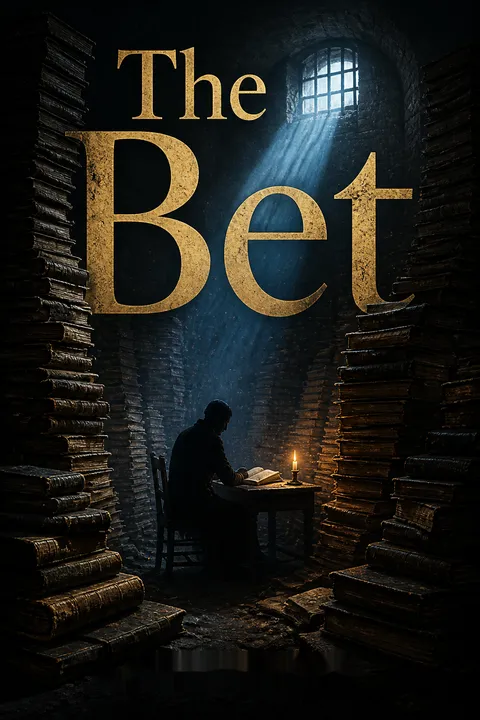
On a stormy autumn evening, an affluent banker hosts a gathering where the morality of capital punishment versus life imprisonment is fiercely debated. The young lawyer, idealistic and proud, claims he would prefer life in prison to death, prompting the banker, in a fit of arrogance, to wager two million rubles that the lawyer cannot endure fifteen years of voluntary solitary confinement. The lawyer accepts, staking his freedom against the banker's fortune. The terms are strict: absolute isolation, no human contact, but unlimited books, music, and comforts. The bet, born of pride and caprice, sets both men on a path that will unravel their lives and beliefs.
Solitude and Self-Discovery
The lawyer's years in confinement are marked by profound changes. At first, he suffers from loneliness and despair, seeking solace in music and light novels. As time passes, his interests deepen—he devours classics, philosophy, languages, and theology, his mind expanding beyond the cell's walls. The banker, meanwhile, observes these changes with a mix of curiosity and dread, as the lawyer's intellect and spirit seem to transcend the material world. The lawyer's journey through books becomes a journey through the heights and depths of human experience, leading him to question the very value of life, knowledge, and freedom.
The Price of Freedom
Fifteen years later, the banker's fortunes have dwindled due to reckless speculation. The impending payout threatens his financial ruin. Desperate and fearful, he contemplates murdering the lawyer to avoid bankruptcy. Sneaking into the lawyer's cell on the final night, he finds the man emaciated, aged beyond his years, and asleep over a letter. The banker reads the letter, discovering that the lawyer, having tasted all the world's wisdom and pleasures through books, now despises material wealth and the world's vanities. He renounces the prize, planning to forfeit the bet by leaving moments before the deadline. The banker is left humbled and ashamed, his own moral bankruptcy exposed.
The Banker's Descent
The banker's journey from arrogance to desperation mirrors the lawyer's transformation. Once powerful and self-assured, he is reduced to a trembling, fearful man, haunted by the consequences of his actions. The bet, once a trivial amusement, becomes a symbol of his moral decay and the emptiness of his pursuits. The lawyer's renunciation of the prize is a final blow, forcing the banker to confront the futility of his life and the hollowness of his values. The story ends with the banker locking away the lawyer's letter, a silent testament to his own defeat.
The Lawyer's Awakening
The lawyer's ordeal strips him of illusions. Through years of study and introspection, he comes to see the world's pleasures and achievements as fleeting and meaningless. His final act—renouncing the money and his own freedom—demonstrates a spiritual awakening, a rejection of materialism, and a profound understanding of life's impermanence. His suffering becomes a path to enlightenment, but also to alienation, as he can no longer find meaning in the world he once desired.
The Professor's Twilight
In "A Tedious Story," an eminent professor faces the decline of his body and mind. Once celebrated, he now struggles with insomnia, failing memory, and a sense of alienation from his family and former passions. His relationships with his wife, daughter, and ward Katy are strained by misunderstanding and emotional distance. The professor's reflections on science, art, and the meaning of life reveal a deepening sense of futility and regret, as he confronts the limitations of intellect and the inevitability of death.
Family, Fame, and Frailty
The professor's household is a microcosm of disappointment and disconnection. His wife is preoccupied with finances and social status, his daughter is absorbed in her own pursuits, and Katy, once a symbol of hope, is now a source of melancholy. The professor's fame brings him no comfort; instead, it isolates him, as he realizes that his achievements are ephemeral and his relationships shallow. The passage of time erodes both his physical strength and his sense of purpose, leaving him adrift in a world that no longer values or understands him.
The Theatre's Allure and Disillusion
Katy, the professor's ward, is captivated by the theatre, seeing it as a realm of beauty and meaning. Her experiences as an actress, however, expose her to betrayal, exploitation, and heartbreak. Her letters, once filled with hope, become increasingly bitter and despairing. The theatre, like the professor's science, proves to be a false idol, unable to provide lasting fulfillment. Katy's eventual return, broken and disillusioned, mirrors the professor's own decline, as both characters grapple with the loss of dreams and the harshness of reality.
The Fit of Conscience
In "The Fit," Vassiliev, a law student, is persuaded by friends to visit a street of brothels. The experience, instead of providing amusement, plunges him into a crisis of conscience. He is repulsed by the degradation and indifference he witnesses, unable to reconcile the suffering of the women with the casual enjoyment of his companions. The night ends with Vassiliev in the grip of a psychological and spiritual fit, overwhelmed by guilt, pity, and the sense of his own complicity in a corrupt world.
Love, Temptation, and Weakness
In "Misfortune," Sophia Pietrovna, a married woman, is pursued by Ilyin, a family friend. Despite her initial resistance and declarations of virtue, she is gradually drawn into temptation, her resolve undermined by flattery, loneliness, and the thrill of forbidden desire. The story explores the complexity of human emotions, the ease with which one can rationalize weakness, and the pain of self-betrayal. Sophia's struggle is both universal and deeply personal, capturing the tension between duty and longing.
The Cost of Compassion
In "Enemies," Dr. Kirilov loses his only son to illness just as Aboguin, a desperate man, arrives seeking help for his own wife. Torn between personal grief and professional duty, Kirilov reluctantly accompanies Aboguin, only to discover that the emergency was a ruse—Aboguin's wife has left him for another man. The encounter devolves into mutual recrimination, each man blinded by his own suffering. The story exposes the limits of empathy and the ways in which pain can isolate rather than unite.
Innocence and Betrayal
In "A Trifling Occurrence," a young boy, Alyosha, becomes the unwitting confidant and victim of adult secrets and lies. His innocent revelations about clandestine meetings with his estranged father and the opinions of adults lead to a confrontation that shatters his trust. The story highlights the vulnerability of children in a world of hypocrisy and the lasting impact of betrayal on the young.
The Weight of Suffering
Across these stories, characters grapple with suffering in its many forms—physical, emotional, existential. Whether through illness, unrequited love, or the burdens of age, each is forced to confront the limitations of human endurance and the elusive nature of happiness. The narratives are suffused with a sense of longing for connection, understanding, and redemption, even as they acknowledge the inevitability of disappointment and loss.
Lessons in Disillusionment
In "Expensive Lessons," Vorotov, a young scholar, seeks to better himself through language study, only to become infatuated with his French tutor. The lessons, both academic and emotional, prove costly and ultimately fruitless, as Vorotov realizes the futility of his efforts and the impossibility of bridging the gap between desire and reality. The story is a meditation on the illusions of self-improvement and the pain of unfulfilled longing.
The Calendar of Regret
In "A Living Calendar," the passage of years is marked by fading memories, lost opportunities, and the erosion of youthful energy. The characters reminisce about past glories, artistic triumphs, and charitable endeavors, only to realize that time has dulled their passions and left them with little but regret. The calendar becomes a symbol of mortality, as each year brings new losses and the gradual dimming of hope.
Old Age and Remembrance
In "Old Age," Usielkov, an architect, returns to his hometown and confronts the ghosts of his past—failed marriages, lost loves, and the betrayals of youth. His reunion with Shapkin, a former accomplice, is tinged with nostalgia and remorse. Visiting the grave of his ex-wife, Usielkov is overcome by the desire to weep for all that has been lost, but finds himself unable to do so. The story ends with a sense of resignation, as the characters accept the finality of old age and the impossibility of undoing the past.
Analysis
Chekhov's stories, as collected in "The Bet and Other Stories," offer a profound meditation on the human condition, exploring themes of isolation, suffering, disillusionment, and the search for meaning. Through a diverse cast of characters—bankers, lawyers, professors, artists, and ordinary people—Chekhov examines the ways in which pride, ambition, and desire can lead to both enlightenment and despair. His use of irony, psychological realism, and subtle social critique invites readers to question the values and assumptions that govern their own lives. The stories are united by a sense of existential uncertainty, as characters confront the limitations of knowledge, the inevitability of loss, and the fleeting nature of happiness. In a modern context, Chekhov's work remains strikingly relevant, offering insights into the complexities of human relationships, the dangers of materialism, and the enduring quest for authenticity and connection. His refusal to provide easy answers or moral judgments challenges readers to embrace ambiguity and to find meaning in the midst of uncertainty. Ultimately, Chekhov's stories are a testament to the resilience and vulnerability of the human spirit, capturing the beauty and tragedy of life in all its contradictions.
Review Summary
The Bet by Anton Chekhov is a thought-provoking short story exploring capital punishment versus life imprisonment through a wager between a wealthy banker and young lawyer. The lawyer agrees to fifteen years of solitary confinement for two million rubles. During his isolation, he reads extensively, transforming from materialistic to spiritually enlightened, ultimately rejecting worldly values. Reviewers praise Chekhov's concise brilliance, philosophical depth, and unexpected ending. The story examines themes of materialism, knowledge's value, human nature, and life's meaning, demonstrating how books can profoundly shape one's perspective and soul.
People Also Read

Characters
The Banker
The banker is a man whose arrogance and impulsiveness set the central wager in motion. Initially confident in his wealth and power, he is gradually undone by his own pride and the unforeseen consequences of his actions. As his fortunes decline, he becomes desperate and morally compromised, contemplating murder to save himself. The lawyer's renunciation of the prize leaves him humbled and exposed, forced to confront the emptiness of his values and the futility of his pursuits. His relationship with the lawyer is adversarial yet strangely intimate, as both are transformed by the bet.
The Lawyer
The lawyer begins as a young, ambitious man eager to prove his convictions. His fifteen years of isolation become a crucible of self-discovery, leading him from despair to enlightenment. Through relentless study and contemplation, he transcends worldly desires, ultimately rejecting the material reward he once sought. His journey is marked by suffering, but also by a profound awakening to the impermanence and vanity of human existence. His final act of renunciation is both a victory and a loss, as he emerges free but alienated from the world.
The Professor (Nicolai Stiepanovich)
The professor is a celebrated scholar whose life is defined by achievement and reputation. As he ages, he is beset by insomnia, failing health, and a growing sense of futility. His relationships with his family and ward are strained by emotional distance and misunderstanding. Despite his intellectual accomplishments, he is haunted by regret and the realization that fame and knowledge offer little comfort in the face of death. His psychological journey is one of disillusionment, as he confronts the limitations of reason and the inevitability of decline.
Katy
Katy, the professor's ward, embodies youthful idealism and the longing for meaning. Her pursuit of a career in the theatre is driven by a desire for beauty and significance, but her experiences lead to betrayal, heartbreak, and disillusionment. Her relationship with the professor is complex—part daughter, part confidante, part mirror of his own lost dreams. Katy's journey from innocence to despair parallels the professor's own decline, highlighting the fragility of hope and the pain of unmet expectations.
Vassiliev
Vassiliev, the protagonist of "The Fit," is a law student whose night among the brothels triggers a profound moral and psychological crisis. His acute sensitivity and capacity for empathy make him unable to accept the suffering and degradation he witnesses. The experience leaves him alienated from his friends and tormented by guilt, as he struggles to reconcile his ideals with the realities of the world. Vassiliev's psychological turmoil is emblematic of the struggle between conscience and complicity.
Sophia Pietrovna
Sophia is a married woman whose life is upended by the attentions of Ilyin, a family friend. Despite her initial resistance and commitment to her family, she is gradually drawn into temptation, her resolve eroded by loneliness and longing. Her journey is one of self-deception and rationalization, as she struggles to maintain her sense of virtue while succumbing to weakness. Sophia's story is a nuanced exploration of the complexities of love, fidelity, and self-control.
Dr. Kirilov
Dr. Kirilov is a rural physician whose life is shattered by the death of his only son. Called upon to help another in the midst of his own grief, he is torn between duty and personal suffering. His encounter with Aboguin, who seeks his help under false pretenses, leads to a confrontation that exposes the limits of empathy and the isolating power of pain. Kirilov's character is defined by his integrity, but also by his inability to connect with others in the depths of his sorrow.
Aboguin
Aboguin is a man driven by personal crisis, seeking the doctor's help for his wife, only to reveal that his true anguish is over her betrayal. His emotional volatility and self-absorption blind him to the suffering of others, leading to a clash with Kirilov that underscores the theme of mutual incomprehension. Aboguin's character is a study in the ways that personal pain can distort perception and breed enmity.
Alyosha
Alyosha, the young boy in "A Trifling Occurrence," is a symbol of innocence and vulnerability. Drawn into the web of adult secrets and lies, he becomes both a confidant and a victim, his trust shattered by betrayal. Alyosha's experiences highlight the impact of adult actions on children and the loss of innocence that comes with exposure to the complexities of the adult world.
Vorotov
Vorotov, the protagonist of "Expensive Lessons," is a young scholar eager to improve himself through language study. His infatuation with his French tutor leads to disappointment and self-realization, as he confronts the limits of self-improvement and the pain of unfulfilled desire. Vorotov's journey is a microcosm of the broader themes of aspiration, disillusionment, and the search for meaning.
Plot Devices
The Bet as Existential Catalyst
The central bet in "The Bet" serves as a catalyst for the transformation of both the banker and the lawyer. It is a plot device that forces each character to confront the true value of life, freedom, and knowledge. The strict terms of the wager create a crucible in which the lawyer's spirit is tested and ultimately transcends worldly desires, while the banker's moral and financial decline is laid bare. The bet is both a literal and symbolic device, representing the human tendency to stake everything on pride, only to discover the futility of such pursuits.
Isolation and Introspection
Across multiple stories, characters are isolated—physically, emotionally, or intellectually. This isolation prompts deep introspection, leading to moments of revelation, despair, or enlightenment. Whether through solitary confinement, insomnia, or emotional estrangement, Chekhov uses isolation to explore the inner lives of his characters and the universal search for meaning.
Irony and Reversal
Chekhov frequently employs irony and reversal to challenge characters' assumptions and expose the gap between appearance and reality. The lawyer's renunciation of the prize, the professor's disillusionment with fame, and the failure of compassion in "Enemies" all serve to undermine conventional narratives and highlight the unpredictability of human experience.
Psychological Realism
Chekhov's stories are marked by a focus on psychological realism, delving into the thoughts, emotions, and motivations of his characters. Internal conflicts—between duty and desire, hope and despair, pride and humility—are central to the narrative structure, driving the action and shaping the characters' fates.
Symbolism of Time and Memory
Time is a recurring motif, symbolized by calendars, aging, and reminiscence. The relentless march of time erodes dreams, relationships, and achievements, leaving characters to grapple with regret and the inevitability of loss. Memory serves as both a refuge and a source of pain, as characters revisit the past in search of meaning or solace.
Social Critique
Through his characters and their interactions, Chekhov critiques the social structures and values of his time—materialism, the pursuit of fame, the emptiness of social rituals, and the failure of compassion. His stories reveal the ways in which societal expectations can stifle individuality and perpetuate suffering.


Download PDF
Download EPUB
.epub digital book format is ideal for reading ebooks on phones, tablets, and e-readers.








































