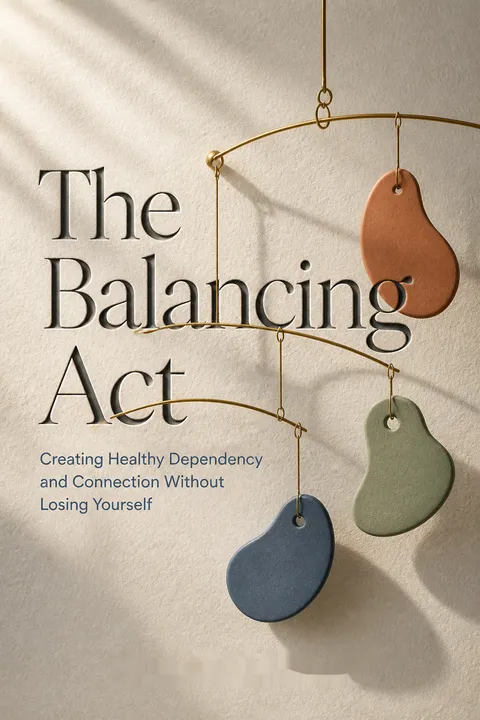

Key Takeaways
1. The Spectrum of Dependency: From Hyper-Independent to Hyper-Dependent
Existing at either extreme can be unhealthy for our relational wellness.
Finding balance. Healthy relationships require a delicate balance between leaning on others and maintaining individuality. The book introduces a spectrum of dependency, with healthy interdependence at its center, flanked by the extremes of hyper-independence and hyper-dependency. Both extremes, while seemingly opposite, lead to similar outcomes like loneliness and resentment, as they prevent genuine, reciprocal connection.
Unhealthy extremes. Hyper-independence, often praised as "self-sufficiency," can lead to isolation and a refusal to accept help, stemming from past experiences where asking for support felt weak or was met with disappointment. Conversely, hyper-dependency involves excessive reliance on others, often neglecting one's own needs to maintain relationships, driven by a deep-seated fear of abandonment or a need to feel indispensable. The author's personal journey from childhood hyper-independence highlights how these patterns, though initially protective, become detrimental in adulthood.
Beyond assumptions. Many people unconsciously fall into these patterns, repeating what they know rather than creating what they truly desire. The key is to recognize that both your needs and the needs of others matter, and assuming what others are comfortable with without direct communication can lead to misunderstandings and unfulfilled expectations. Healthy dependency means being flexible, tailoring your approach to each unique relationship, and understanding that giving and receiving are essential for mutual growth and satisfaction.
2. Attachment Styles Shape Our Relational Patterns
Basically, secure people feel comfortable with intimacy and are usually warm and loving; anxious people crave intimacy, are often preoccupied with their relationships, and tend to worry about their partner’s ability to love them back; avoidant people equate intimacy with a loss of independence and constantly try to minimize closeness.
Understanding origins. Our attachment styles, formed in early childhood interactions with caregivers, profoundly influence how we approach dependency in adult relationships. These styles are not fixed labels but flexible patterns that can shift depending on the relationship and our personal growth. Recognizing your predominant style—secure, anxious, avoidant, or disorganized—provides valuable insight into your relational tendencies.
Beyond myths. The book debunks common myths about attachment, emphasizing that your origin story doesn't determine your destiny, your style isn't fixed, it's not black and white, and you shouldn't use it to diagnose others or as a deal-breaker. Instead, attachment styles offer a lens to understand how you function and how you might appear in relationships, empowering you to make conscious choices for healthier connections.
Impact on dependency. Each attachment style manifests differently in terms of dependency:
- Secure: "I can depend on others, and others can depend on me." (Healthy dependency)
- Anxious: "People want help, but no one is helpful when I need it." (Often leads to codependency)
- Avoidant: "People are not dependable, and people can take care of themselves." (Hyper-independence/counter-dependency)
- Disorganized: "I want closeness, but I’m unsure how to create it." (Fluctuates between hyper-independence and hyper-dependency)
Understanding these internal narratives is crucial for addressing the root causes of unhealthy dependency.
3. Fear and Past Wounds Drive Disconnection
Just one traumatic experience can be enough to cause us to distrust all relationships.
The root of fear. Many struggles in relationships, whether hyper-independence or hyper-dependency, are rooted in fear—fear of vulnerability, rejection, abandonment, or not being enough. Past hurts, such as abandonment, betrayal, or being let down, can create a pervasive distrust that extends to all new relationships, leading to self-protective behaviors that inadvertently push people away. Quinn's story illustrates how hypervigilance and a constant questioning of others' motives can isolate individuals, even when they crave connection.
Self-protection's paradox. While self-protection is vital in genuinely harmful situations, it becomes problematic when applied indiscriminately to healthy connections. Behaviors like emotional unavailability, meanness, finding fault in everything, or allowing others' problems to dominate can serve as armor, preventing both harm and genuine love. The "hugging a porcupine" metaphor highlights the challenge of loving prickly individuals, emphasizing the need for self-care and adjusted expectations when engaging with those who struggle to receive love.
Silent struggles. High-functioning trauma responses, depression, or PTSD can also manifest as relational difficulties, making individuals appear distant or moody while silently battling internal struggles. These "high-functioning" states are often untreated mental health issues that impact how one shows up in relationships. Recognizing these silent battles, both in ourselves and others, is crucial for fostering empathy and seeking appropriate support, rather than allowing past wounds to dictate future connections.
4. Unhealthy Dependency: The Pitfalls of Over-Giving and Over-Reliance
When we rely too heavily on a person or thing, our dependence is unhealthy.
The codependent trap. Unhealthy dependency, often termed codependency, involves an unbalanced attachment where one person excessively cares for others, neglecting their own needs. This dynamic, rooted in the substance use community, has broadened to describe any relationship where one person enables behaviors and doesn't receive mutual support. Raven's story exemplifies this, as she settles for a partner who doesn't align with her values, believing she can change him and feeling useful through his dependence.
Silent agreements. Codependent patterns are often maintained through "silent agreements"—unspoken understandings where one's actions contradict their true desires. These can include staying in uncommitted relationships, over-giving to the point of discomfort, or hiding parts of oneself to protect the relationship. Such incongruence between thoughts and actions leads to self-harm and prevents the fulfillment of personal values, as the focus shifts from mutual growth to maintaining an unbalanced dynamic.
Indicators and impact. Codependent tendencies manifest in various ways:
- Canceling plans to accommodate others
- Feeling obligated rather than joyful in giving
- Rushing to rescue others
- Connecting with people who have extreme needs
- Feeling jealous of others' relationships
- Treating others' problems as one's own
These behaviors, while often well-intentioned, deplete the individual and create one-sided relationships where their own needs are consistently unmet, leading to loneliness despite constant engagement.
5. Hyper-Independence: The Illusion of Self-Sufficiency and Its Costs
Too little dependence on others leaves us feeling alone in our deepest struggles and crises.
The self-made myth. Hyper-independence, often lauded as a strength, is actually a form of unhealthy dependency where individuals rely solely on themselves, prioritizing individuality to the detriment of connection. Xavier's story, a workaholic who neglected relationships, illustrates how a childhood message of "figure it out on your own" can lead to a deep-seated discomfort with vulnerability and a struggle to ask for or accept help. The "self-made" narrative, while empowering, often overlooks the countless seen and unseen supports that contribute to success.
Consequences of self-sufficiency. The relentless pursuit of self-sufficiency carries significant costs:
- Obliviousness to struggles: Others may not know when or how to offer support.
- "You got it" perception: People stop offering help when it's consistently declined.
- Unawareness of changing abilities: What's manageable today may become overwhelming tomorrow.
- Superhuman expectation: Others assume you don't need help and stop offering.
- Burnout: Taking on too much leads to exhaustion and resentment.
These consequences highlight that doing everything alone is neither effective nor sustainable for a fulfilling life.
Counter-dependence. An extreme form of hyper-independence, counter-dependence, stems from childhood abuse or neglect, leading to a profound difficulty in trusting others and an aversion to emotional closeness. Individuals with counter-dependent tendencies may believe vulnerability equals neediness, fear rejection if their hidden needs are discovered, and use achievements or busyness as a strategy to remain emotionally detached. This protective armor, while shielding from hurt, also blocks love, perpetuating a cycle of deep loneliness.
6. Enmeshment vs. Healthy Connection: Navigating Closeness and Autonomy
When there are no boundaries and a lack of autonomy in a relationship, enmeshment is the inevitable result.
Blurred lines. Enmeshment describes relationships where boundaries are absent, and individuals lack a sense of self separate from the other person, leading to blended ideas and emotions. Chrissy and Lola's inseparable friendship, initially mutual, became problematic when Chrissy desired more autonomy and new connections, while Lola struggled to accept the shift. This dynamic, common in adolescence, becomes unhealthy in adulthood when one person's desire for independence clashes with the other's expectation of constant lockstep.
Communicating shifts. When one person desires less enmeshment, open and direct communication is crucial, though often uncomfortable. Verbally, this involves affirming the relationship while clearly stating the need for more individual space or new connections. Behaviorally, it means being less available, making plans with others, and exploring new interests. The goal is to renegotiate the relationship's rhythm, acknowledging that what was once a comfortable level of closeness may no longer serve both parties.
Dealing with detachment. If you're on the receiving end of someone wanting more space, it's important not to personalize their need as a rejection. Many factors can cause a relationship to shift, and it doesn't necessarily mean you need to change. Instead, it's an opportunity to:
- Explore if the relationship still meets your needs
- Deepen other existing connections
- Meet new people
- Examine your own relational patterns
Honoring someone's request for space, even when difficult, prevents further strain and allows for the possibility of a healthier, more balanced connection in the future.
7. Embracing Vulnerability and Asking for Support
"I need your help" can be one of the most complicated phrases to say to others.
The power of asking. For those struggling with hyper-independence, learning to ask for and accept help is the antidote to counter-dependency. Naomi's micromanaging tendencies, rooted in a lack of trust and fear of being let down, highlight the discomfort of relinquishing control. However, allowing others to contribute, even imperfectly, can deepen connections and alleviate personal burden. The goal is to achieve the desired result, not to control every step of the process.
Overcoming barriers. Many reasons prevent people from asking for help:
- Fear of seeming needy or being shamed
- Being praised for self-sufficiency in the past
- Limited resources in formative years
- Fear of failure or rejection
- Worry that expectations won't be met
- Feeling too vulnerable or unable to reciprocate
- Unclear about one's own needs
These barriers often stem from past hurts, but one rejection does not mean everyone will let you down.
Practical steps. To effectively ask for and accept help:
- Give clear instructions: Be direct and specific about what you need.
- Ask the right person: Match the task to someone capable and willing.
- Accept when offered: Don't dismiss genuine offers of support.
- Teach skills: Patiently guide others if they need training for a task.
- Acknowledge hurt: Process past disappointments to prevent them from sabotaging future attempts.
Practicing vulnerability and asking for support, even in small ways, retrains the brain and builds confidence in receiving assistance.
8. Cultivating Deep Connections Beyond the Superficial
Emotional intimacy, openness, and honesty are necessary for deep connections.
Beyond surface level. Many people, like James, maintain numerous superficial connections centered on general topics, hobbies, or mutual acquaintances. While these relationships offer benefits like fun and minimal disappointment, they often lack the emotional intimacy needed during times of crisis or deep personal need. James's grief revealed the hollowness of his many "friends" who couldn't engage in meaningful dialogue, highlighting the critical difference between quantity and quality in relationships.
The value of depth. Deep connections are characterized by:
- Commitment: A willingness to be there for each other.
- Nurturing: Investing time and energy into the relationship.
- Trust: Confidence in sharing vulnerable information and keeping confidences.
- Vulnerability: The ability to share one's true self and feelings.
These qualities foster a sense of being seen, heard, and belonging, which is essential for emotional well-being. Superficial relationships become problematic when they are all one has, leaving individuals isolated in their deepest struggles.
Blurring the lines. Social media and parasocial relationships can blur the lines between superficial and deep connections, creating an illusion of intimacy. Romanticizing an online persona or expecting an associate to fulfill the role of a close friend can lead to disappointment and codependent attachments. While online communities can be a starting point for deeper connections, true intimacy requires two-way engagement and a willingness to move beyond curated images to real-life vulnerability.
9. The Importance of Intentional Care in Sustaining Relationships
Loving someone is not enough—we have to show them we care.
Nurturing connections. Relationships, like gardens, require consistent care and focused energy to thrive. The absence of intentional care leads to relationship neglect, causing individuals to feel unappreciated and lonely, even in long-term partnerships. Brandy's marriage, where conversations revolved solely around children and logistics, illustrates how taking relationships for granted can erode emotional connection, leading to resentment and disengagement.
Shifting needs. Care needs evolve throughout life transitions, such as children leaving for college or the arrival of a new baby. What was once a clear form of care may no longer be appropriate, requiring open communication and reassessment. When someone says, "I don't need anything," but clearly does, it's an opportunity to offer carefully considered help based on empathy and past experiences, rather than doing nothing.
Expressing care. Understanding how others prefer to receive care is vital. While Gary Chapman's "Five Love Languages" provide a framework, individual needs can be broader. Effective care involves:
- Asking questions instead of making assumptions
- Honoring boundaries
- Accepting responsibility for actions
- Respecting differences
- Acting kindly
- Taking care of oneself
- Remaining authentic
- Apologizing and correcting behaviors
Balancing care needs means recognizing that some relationships may always require more, but avoiding collective care or focusing too heavily on one person can neglect others and create new imbalances.
10. Understanding Our Inner Parts for Healthier Relationships
Your protectors’ goals for your life revolve around keeping you away from all that pain, shame, loneliness, and fear, and they use a wide array of tools to meet those goals—achievements, substances, food, entertainment, shopping, sex, obsession with your appearance, caretaking, meditation, money, and so on.
The internal landscape. The book introduces Internal Family Systems (IFS) therapy, a model that views the personality as comprised of multiple "parts" and a core "Self." These parts, or subpersonalities, each have their own roles, thoughts, and feelings, often developed as protective mechanisms against past pain, shame, or fear. Dana's story, where her shame from being a teen mother drove her to overachieve while disowning her desire for marriage, illustrates how these parts can dictate behavior and limit personal fulfillment.
Protective parts. IFS identifies three main types of parts:
- Managers (Proactive Protectors): Try to control life to prevent harm, often manifesting as inner critics, perfectionism, or people-pleasing.
- Firefighters (Reactive Protectors): Jump in to numb or distract from emotional pain when vulnerable "exile" parts are triggered, often through impulsive behaviors like excessive scrolling or substance use.
- Exiles (Vulnerable Parts): Carry the deep wounds and painful beliefs from past experiences, often frozen in time.
Unhealthy dependencies often arise when these protective parts operate at extremes, creating internal conflict and external relational challenges.
Shifting from parts to Self. The goal of IFS is not to eliminate these parts but to understand them and lead from the "Core Self"—an inherently compassionate, curious, and calm presence. By becoming curious about why a part behaves as it does, embracing discomfort when trying new behaviors, and practicing new ways of relating, individuals can heal their wounded parts and integrate them into a more harmonious internal system. This self-awareness allows for a shift from rigid, fear-driven patterns to flexible, authentic connections.
11. Navigating Modern Dependencies: Technology and Substances
Technology is a big part of many things in our modern lives. However, our use of it can either support us or hinder us.
Technology's double edge. Modern life presents new forms of dependency, particularly on technology and substances. While technology offers immense convenience and connection, it can also foster unhealthy habits, leading to distraction, reduced in-person interaction, and even technology-induced ADHD. Chance's story, a real estate agent whose phone usage became obsessive, highlights how blurred boundaries between work and personal use can impact reputation and relationships.
Assessing usage. Unhealthy technology dependency manifests as:
- Ignoring present company for devices
- Losing sleep to screens
- Excessively checking likes/comments
- Allowing technology to interfere with relationships
- Losing large chunks of time
The key is to discern between convenience and genuine need, recognizing that constant engagement isn't always beneficial. Similarly, substance use, while offering temporary escape, can mask deeper issues and lead to severe consequences, as seen in Zora's struggle with alcohol.
Finding middle ground. For both technology and substances, the goal is to find a healthy middle ground—moderation or abstinence, depending on individual needs and impact. This involves:
- Setting clear boundaries (e.g., "Do Not Disturb" times, tech-free zones)
- Being mindful of how usage affects well-being and relationships
- Communicating preferences to others (e.g., "I'm not drinking," "No social media updates")
- Seeking support for substance misuse (e.g., recovery programs)
Ultimately, conscious choices about how we engage with these modern dependencies are crucial for protecting our mental health and fostering genuine connections.
Review Summary
The Balancing Act receives mostly positive reviews (4.27/5), with readers praising Nedra Glover Tawwab's clear, compassionate approach to relationship dynamics and healthy dependency. Mental health therapists frequently recommend it to clients, appreciating its accessible explanations of attachment theory, boundaries, and interdependence. Readers value the practical tools, reflection questions, and real-life examples that make complex concepts digestible. Some critics note repetitiveness, lack of depth, or cultural specificity. Overall, reviewers find it useful for understanding how to maintain connections without losing oneself, emphasizing that vulnerability and imperfect relationships strengthen bonds.
People Also Read








Download PDF
Download EPUB
.epub digital book format is ideal for reading ebooks on phones, tablets, and e-readers.








































