

Key Takeaways
The agony of indecision is the one choice guaranteed to hurt you
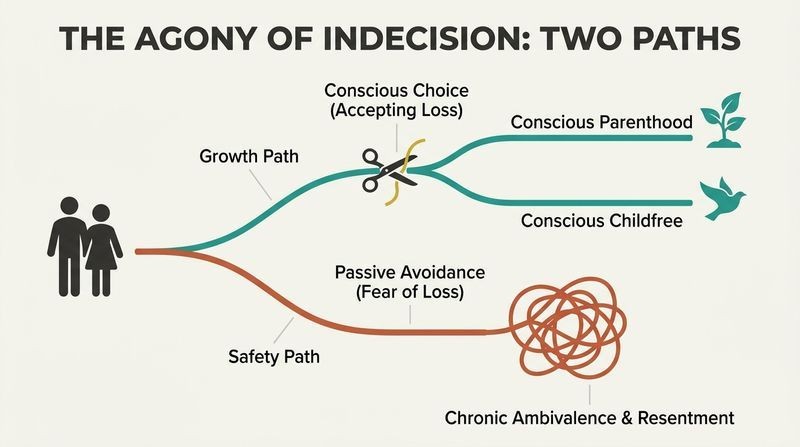
Not deciding is itself a decision. Bombardieri identifies six possible paths: three growth decisions (consciously choosing parenthood, consciously choosing childfree life, or strategically postponing with a set reevaluation date) and three safety decisions (the non-accidental accident, the passive childfree drift, and the endless agonizing). Safety decisions feel cheaper short-term but cost more long-term because they make you a victim of fate rather than author of your life.
The word decide means to cut away from. Every real choice involves loss. By refusing to decide, couples cling to the fantasy that they can keep both options and avoid all risk. But that fantasy exacts a price: chronic ambivalence, resentment, and the forfeited chance to grow through a hard, honest choice.
The framing echoes existentialist philosophy: Sartre argued that refusing to choose is still a choice for which we bear responsibility. What's distinctive here is applying that lens to reproduction, a domain people often outsource to biology or accident. Modern decision science supports the insight too: research on omission bias shows people irrationally prefer inaction even when action serves them better. Bombardieri's move to reframe drift as a costly active choice, not neutral waiting, is psychologically shrewd. One caution: for some, ongoing ambivalence reflects genuinely balanced values rather than avoidance, and her scheme risks pathologizing legitimate uncertainty.
Ask whether you are motivated by fear or by fulfillment
Growth versus safety needs. Drawing on psychologist Abraham Maslow, Bombardieri distinguishes deficiency motivation (acting to reduce anxiety, treating change as too risky) from growth motivation (acting toward greater fulfillment, treating risk as worthwhile). Applied to the baby question, the same outward choice can spring from either root. Having a child to quiet your parents' nagging is a safety move; having one because you genuinely crave the experience is a growth move.
The test is your inner posture, not the outcome. She contrasts two couples: Don and Cindy circle the question in dread, guaranteed to be miserable whatever they pick, while Ruth and Phil approach it with curiosity, excited by both paths. How you decide shapes your happiness as much as what you decide.
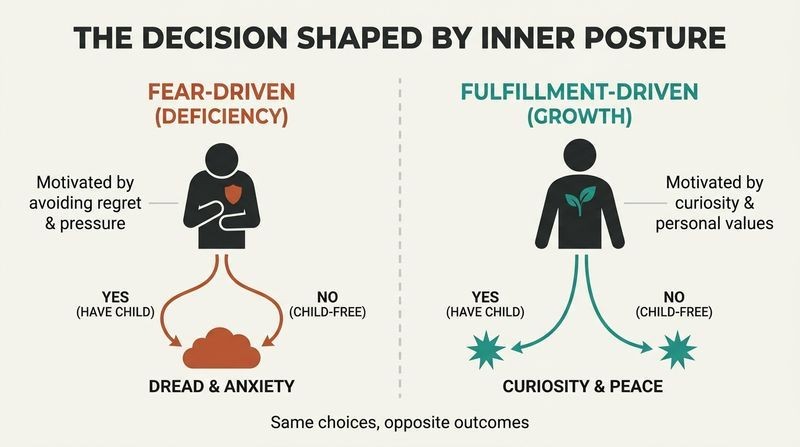
This maps onto the modern psychology of approach versus avoidance motivation, well documented by researchers like Andrew Elliot: avoidance-driven goals correlate with lower well-being even when achieved. Bombardieri's insight anticipates this by decades. The practical power is diagnostic: instead of endlessly debating pros and cons, examine the emotional engine beneath your leaning. A weakness worth noting: the growth/safety binary can feel morally loaded, subtly implying that anxious deciders are less evolved. In reality, fear and desire often coexist in the same person on the same day, which Bombardieri herself acknowledges through her emphasis on ambivalence.
Bypass pro-con lists; your imagination knows what logic hides
Feelings are data logic cannot reach. Bombardieri argues most baby-decision advice overweights rational cost-benefit analysis and starves the emotional signal. Her remedy is a battery of imagery and fantasy exercises designed to surprise you with buried reactions. Examples include: the chair dialogue (physically switching seats to voice your parent self and childfree self as separate arguing characters), the rocking chair (visualizing yourself at 75 looking back on each path), and the knapsack (imagining a baby kicking holes in a pack as your freedoms tumble out).
Watch the body, not just the mind. When one woman's throat tightened and eyes filled imagining a childless future, that visceral response revealed more than any spreadsheet. The exercises work like the Delphic oracle: they do not dictate answers, they provoke self-consultation.
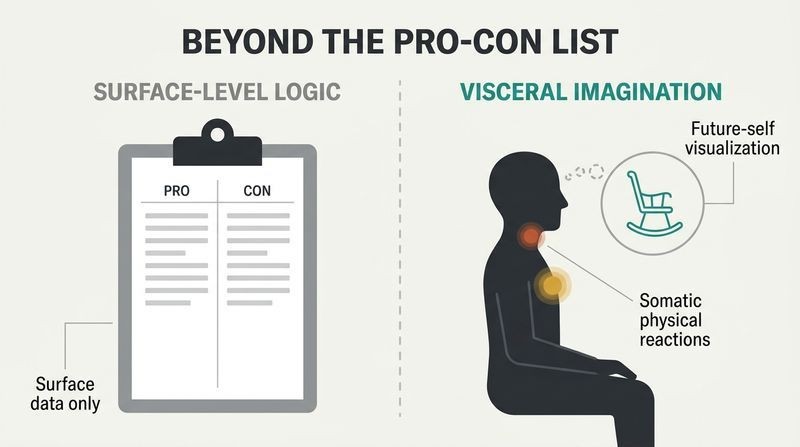
This anticipates the affective forecasting research of Daniel Gilbert and Timothy Wilson, who showed people are poor at predicting how future events will actually feel. Somatic markers, as neuroscientist Antonio Damasio demonstrated, genuinely carry decision-relevant information; patients with damaged emotional processing make disastrous choices despite intact logic. Bombardieri's chair dialogue borrows directly from Gestalt therapy's empty-chair technique, giving warring impulses distinct voices. The approach is refreshingly embodied. The limitation: vivid imagined scenarios can mislead, since we tend to picture idealized or catastrophized versions rather than the mundane texture of real life. Best used alongside conversations with actual parents and childfree people.
Both parents and the childfree face identical accusations flipped upside down
Every choice draws fire. Bombardieri lays out mirror-image prejudices. The parent chorus calls childfree people immature, selfish, narcissistic, and destined for regret. The childfree chorus calls parents immature, selfish, narcissistic, and destined for regret. The identical charges get twisted to fit whichever tribe is speaking, proving the accusations reveal the accuser's insecurity, not any truth about you.
Understand the machinery of pressure. She names the drivers: ambivalence (parents who secretly regret their own choice project it), ignorance (few know research shows childfree people are as happy and stable as parents), and failure to accept difference. Psychologist Eric Berne's concept of games applies: interactions like you'll be sorry are dishonest maneuvers with hidden payoffs, best countered by honest dialogue rather than defensive counterattack.
The symmetry observation is genuinely clarifying and has aged well into the era of online mommy wars and childfree subreddits, where the same reciprocal contempt plays out at scale. Bombardieri's point that projection fuels judgment aligns with social psychology's finding that we are harshest toward choices that threaten our own. Her invocation of cognitive dissonance is apt: watching someone thrive on the road you rejected destabilizes your certainty. One extension worth adding: the accusations are not perfectly symmetric in social power. Pronatalist pressure has historically carried institutional and religious backing that childfree criticism never matched, so the childfree still absorb the heavier cultural load.
Purge the poison vials: both children-are-heaven and children-are-hell are lies
Poison vials are distorted beliefs that sabotage clear thinking. Bombardieri coins this term for the culturally absorbed myths polluting the decision. The old myth (children guarantee fulfillment) has swung to a new myth (children wreck your life). Both are soap-opera fantasies. She dismantles specific vials on each side:
1. Infancy lasts forever (children actually grow more independent).
2. I must be 100% sure (humans never want anything 100%; some doubt is healthy).
3. Remaining childfree means selfishness (self-care differs from selfishness).
4. A pet or borrowed child will predict my parenting (they will not).
5. Changing my mind signals weakness (flexibility is maturity).
Listen to complaints critically. When someone recounts parental misery, ask whether it is a realistic portrait or a bitter bad day.
The pendulum framing is astute cultural criticism. Bombardieri wrote as the anti-natalist backlash was cresting, and her refusal to replace one dogma with its opposite models good epistemic hygiene. The demand for 100% certainty as a myth connects to modern work on maximizers versus satisficers by Barry Schwartz: maximizers who chase perfect certainty end up more anxious and less satisfied. Her insistence that both utopian and dystopian scripts distort reality resonates with contemporary happiness research showing parenthood's effect on well-being is small, conditional, and highly variable. The enduring value here is meta-cognitive: examine the provenance of your beliefs before trusting them as your own.
When one wants a baby and one doesn't, never twist an arm
There is no such thing as half a baby. This is the hardest conflict, because most disagreements yield to compromise and this one cannot. Bombardieri insists the process determines the outcome's quality: a decision reached by manipulation poisons the relationship. She catalogs destructive games: arm-twisting, the avoidance game (always too busy to discuss it), the shrink game (weaponizing amateur psychology), the sneak (sabotaging birth control), and courting divorce (proposing a baby as marital glue while secretly valuing the child over the marriage).
Direct, respectful dialogue is the only antidote. Even when one partner will not get their wish, listening without manipulation preserves the I-thou bond (philosopher Martin Buber's term for relating to another as a full person rather than an object). When leanings are truly opposite and fixed, remaining childfree is usually the wiser path, since an unwilling parent harms a child more than an unwilling non-parent suffers.
The claim that the reluctant party should prevail toward childfree is ethically weighty and defensible: a resented child bears lifelong consequences, and research on unwanted children (notably longitudinal studies following denied-abortion cohorts) shows measurable harm. Bombardieri's Buberian I-thou framing elevates the discussion above tactics into moral respect. Her warning against the single married parent (I'll do all the work, you stay uninvolved) is psychologically sharp, since a child reshapes both partners' lives whether or not one opts out on paper. A useful modern parallel: family therapists now emphasize that unrepairable perpetual disagreements on core issues, unlike solvable ones, predict divorce, echoing her insistence on honesty over coercion.
Individuate from your parents before you decide about becoming one
You cannot choose freely while still seeking approval. Bombardieri applies psychiatrist Murray Bowen's concept of individuation: separating your identity from your parents' while keeping a close relationship, rather than rebelling, fleeing, or capitulating. The baby decision often drags grown adults back into adolescent scripts, snapping at a mother's jab like a teenager.
David and Marilyn nearly had an unwanted child. Two doctors who had always pleased their parents assumed they would reproduce on cue. When pregnancy did not come instantly, she got headaches and he got nightmares, revealing they wanted the baby only to satisfy their families. They chose childfree life, faced four shocked parents, and paradoxically ended up closer to them than ever, feeling like real grownups for the first time. Honest conversation, not avoidance, built adult relationships.
Bowen's family systems theory is the intellectual backbone here, and it remains influential in couples therapy. The insight that a major life fork reactivates old family roles is well supported; stress reliably triggers regression to earlier attachment patterns. What's valuable is the reframe of the decision as a developmental opportunity, a forcing function for overdue individuation. The David and Marilyn story illustrates a counterintuitive truth therapists see often: authentic disappointment handled openly can deepen bonds more than performed harmony. A nuance Bombardieri wisely flags elsewhere: with genuinely abusive or untrustworthy parents, these dialogue techniques fail, and distance is the healthier move.
Ask which choice you would regret least, not whether you will regret
Some regret is guaranteed either way. Bombardieri reframes the dreaded will-you-be-sorry question, which is usually a smug accusation aimed only at the childfree. Since both paths involve real loss, will I regret this is meaningless; everyone will feel occasional pangs. The fruitful question is which decision would I regret less. Her rocking chair exercise has you imagine yourself at 75, under varied conditions (partner alive or dead, healthy or ailing), looking back on each path.
Regret does not mean wrong. She cites commentator Betty Rollin, misquoted by Time as regretting childlessness. Rollin actually said she sometimes felt wistful but would make the same choice again, adding that parents miss things too. Mild wistfulness about the road not taken is a normal feature of any good life, not evidence of error.
This is decision theory done humanely. Framing choices in terms of minimizing anticipated regret rather than maximizing certainty mirrors regret theory in behavioral economics (Loomes and Sugden). Bombardieri's distinction between wistfulness and remorse is psychologically precise and underappreciated; conflating the two drives a lot of needless anguish. The Betty Rollin episode doubles as media criticism, exposing how the culture polices the childfree by hunting for a moment of truth breakdown. Contemporary research on the psychological immune system (Gilbert) reinforces her point: people rationalize and adapt to irreversible choices remarkably well, so feared regret usually overestimates actual future distress.
Don't outsource happiness to children; identify your own building blocks first
Map what happiness actually requires for you. Bombardieri names ingredients to weigh against each path: adventure, risk, spontaneity, flexibility, mortality (children as one of several routes to feeling one outlives oneself), mission, solitude, freedom, intimacy, and a sense of family or community. She has readers mark each with a C or P depending on which lifestyle better delivers it.
Solitude clashes hardest with parenting. If contemplative quiet is central to you, weigh that seriously; you cannot hear your inner voice over a wailing toddler. Yet she notes irony: some parents savor rare quiet more than the childfree who overschedule themselves. On mission, she borrows Maslow's Jonah complex, the fear of one's own greatness, warning that some choose parenthood to dodge a scarier, more fulfilling calling. No child should be conscripted to supply your life's entire meaning.
The building-blocks inventory is a practical values-clarification tool that predates but resembles modern acceptance and commitment therapy's values work. The mortality angle is philosophically rich, drawing on psychiatrist Robert Jay Lifton's five modes of symbolic immortality; it reframes the baby urge as partly a death-anxiety management strategy, a claim terror management theory in social psychology has since supported experimentally. The Jonah complex warning is the sharpest: using parenthood as busywork to avoid a daunting vocation is a subtle self-betrayal few advice books name. The framework's limitation is that people are notoriously bad at knowing which ingredients truly drive their happiness, so pairing this with lived experimentation matters.
Single, gay, older, or infertile: parenthood has more doors than one
The decision is not binary or bound by circumstance. Bombardieri devotes major attention to paths beyond the conventional married-couple pregnancy. Single motherhood by choice, she argues from decades of practice, is typically single motherhood by second choice: capable women who wanted a partner but refused to marry the wrong person before their fertility ran out. Gay parenting through adoption, surrogacy, or donor conception honors family rather than threatening it.
For infertility, compassion means knowing when to stop. She frames enough is enough not as failure but as freedom from the monthly roller coaster of hope and grief. Options include donor gametes, surrogacy, adoption (open, special-needs, transracial, or legal-risk), or embracing childfree life. Her grief-work exercises, like listing everyone who had babies since you started trying, make diffuse loss concrete so it can finally be mourned and released.
Writing a pioneering childfree advocacy in 1981 and expanding to LGBTQ and single-parent paths by 2016, Bombardieri tracks a genuine democratization of reproduction. Her single-mothers-by-second-choice reframe is empathetic and accurate, pushing back on the caricature of the desperate or selfish solo mom. The infertility material is where her clinical depth shines: the Zen bull-in-a-pasture image for grief (stop wrestling the horns, let the animal run) captures the paradox that resisting sorrow prolongs it, consistent with modern acceptance-based grief therapy. A candid tension she names herself: the unfairness that wealth buys fertility treatment and adoption, leaving these expanded doors unequally open.
Steal from the road not taken to enrich the one you chose
Import the best of the rejected option. Once decided, Bombardieri advises deliberately capturing what you would otherwise miss. Choosing parenthood but craving exotic travel? Plan it for a year or two out and protect it. Choosing childfree life but wanting a bond with a child? Become a devoted aunt, uncle, mentor, Big Brother, or Big Sister. Neither path need be a total renunciation.
Guard friendships across the divide. Couples who chose opposite paths often drift apart, blaming having nothing in common. The real culprit, she argues, is having too much in common: unspoken ambivalence. Each couple secretly fears the other's thriving proves their own mistake, so they call less. The fix is naming it openly. And stop proselytizing; the energy you spend selling your choice to everyone is usually aimed at convincing yourself.
The steal-from-the-other-choice tactic is quietly brilliant applied psychology, defusing the false scarcity that makes any major decision feel like amputation. It resonates with research on psychological reactance, our craving intensifies for the option we foreclose, so consciously preserving a slice of it reduces the sting. The friendship insight is a gem of social observation: Bombardieri diagnoses drift not as divergence but as threatening similarity, an application of cognitive dissonance to social ties that rings true. Her closing counsel against proselytizing offers a useful self-diagnostic: the volume of your advocacy is inversely proportional to your peace with the choice. Comfort, in the end, is quiet.
Analysis
The Baby Decision occupies a rare niche: a decision-making manual for a choice most cultures never treated as a choice at all. First published in 1981, when contraception had newly made parenthood optional but social scripts had not caught up, Bombardieri's book is best understood as applied humanistic psychology. Its intellectual lineage is explicit and coherent: Maslow's growth versus deficiency needs, Buber's I-thou relating, Bowen's individuation, Berne's transactional games, Gestalt's empty-chair work, and Lifton's modes of immortality. She synthesizes these into a therapeutic toolkit rather than a thesis, which is both the book's strength and its structural challenge to summarize, since its value lives in dozens of exercises rather than a single argument.
What distinguishes the book is its studied neutrality in a polarized domain. Bombardieri was a genuine pioneer in legitimizing the childfree choice when professionals pathologized it, yet she refuses to become an anti-natalist evangelist, dismantling the children-are-hell myth as vigorously as children-are-heaven. This even-handedness, combined with her insistence that how you decide matters as much as what you decide, gives the work unusual durability.
Its limits are worth naming. The evidence base is largely clinical and anecdotal, drawn from her workshop and therapy practice, and the happiness research she cites is dated relative to current large-sample studies. The framework assumes a degree of psychological-mindedness, leisure, and economic security that many readers lack, a gap she candidly acknowledges regarding fertility treatment and adoption costs. The growth/safety binary risks moralizing anxiety.
Still, the core contributions endure: reframing indecision as an active, costly choice; separating wistfulness from remorse; asking which regret is smaller; and treating a reproductive fork as a developmental opportunity for self-knowledge. In an age of collapsing birth rates, climate anxiety, and expanding family forms, its central promise, that a deliberate choice beats a drifted one, feels more relevant than ever.
Review Summary
The Baby Decision receives mostly positive reviews for its unbiased approach to helping readers decide whether to have children. Readers appreciate the book's exercises, balanced perspective on both parenting and child-free choices, and emphasis on making an intentional decision. Many found it helpful in clarifying their thoughts and values. Some criticisms include its US-centric focus and limited discussion of adoption. Overall, reviewers found the book thought-provoking and supportive, regardless of their ultimate decision.
Glossary
Growth decisions vs. safety decisions
Deciding from fulfillment vs. fearBombardieri's core framework splitting the six possible baby choices into two families. Growth decisions (choosing parenthood, choosing childfree life, or postponing with a set reevaluation date) involve responsibility, risk, and commitment. Safety decisions (the non-accidental accident, passive childfree drift, and endless agonizing) avoid short-term discomfort but forfeit growth and make you feel like a victim of fate.
Poison vials
Culturally absorbed myths distorting judgmentBombardieri's coined term for false, exaggerated beliefs about parenthood or childfree life that pollute clear decision-making. Examples include infancy lasts forever, I must be 100% certain, remaining childfree is selfish, and a pet will predict my parenting. She holds each up to reality to neutralize its distorting power.
Chair dialogue
Voicing inner conflict via two seatsA Gestalt-derived exercise where you place two chairs facing each other, labeling one I want to be a parent and the other I want to be childfree, then physically switch seats to argue each side aloud. The technique separates warring impulses into distinct voices, revealing which desire is genuinely stronger and often uncovering suppressed feelings.
Rocking chair exercise
Imagining life review at 75A visualization in which you picture yourself at age 75 looking back on your life under varying conditions (partner alive or dead, healthy or ailing) for both the childfree and parenting paths. It reframes the useless question will I regret this into the useful one: which choice would I regret least.
Knapsack exercise
Visualizing freedoms lost to a babyAn imagery exercise where you imagine placing a baby in a backpack, then watch it kick holes through which your valued freedoms (solitude, career, travel, quiet) fall out. Your emotional reaction, whether you want to remove the baby or find ways to repack the items, signals your true leaning.
Individuation
Separating identity from parents healthilyPsychiatrist Murray Bowen's concept, applied by Bombardieri, meaning to come to terms with your parents by separating your identity from theirs while maintaining a close relationship, rather than rebelling, fleeing, or capitulating. She argues you cannot make a free baby decision while still driven by a need for parental approval.
I-thou vs. I-it relationship
Respecting a person vs. objectifyingPhilosopher Martin Buber's distinction Bombardieri uses for couple conflict. An I-thou relationship means relating to your partner as a full person, listening with respect. An I-it relationship treats them as an object to manipulate toward your goal. Arm-twisting over the baby decision slides couples into I-it and damages the bond.
Single mothers by second choice
Solo parents who wanted partnersBombardieri's reframe of the phrase single mothers by choice. From decades of practice she argues most such women wanted a co-parenting partner but refused to marry the wrong person before their fertility ran out, so solo parenthood was a second, deliberate choice rather than a rejection of partnership.
Jonah complex
Fear of one's own greatnessMaslow's term, cited by Bombardieri, for the fear of one's own potential greatness, the evasion of one's destiny. She warns that some people choose parenthood as busywork to avoid pursuing a scarier but more fulfilling calling, so the decision should be examined for whether it is an escape from one's best talents.
Enough is enough
Compassionately stopping fertility treatmentBombardieri's compassion-centered framing of the decision to end fertility treatment. Rather than surrender or failure, she casts it as freedom from the monthly roller coaster of hope and grief, invoking a Zen image of releasing a bull's horns to let it run in a pasture, since resisting the grief prolongs the suffering.
FAQ
What's The Baby Decision about?
- Exploring Parenthood Choices: The Baby Decision by Merle Bombardieri examines the decision-making process regarding parenthood and the option to remain childfree. It provides a guide for individuals and couples facing this significant life choice.
- Framework for Decision-Making: The book offers a structured approach to making the baby decision, focusing on personal values, emotions, and societal pressures. It encourages deep exploration of feelings and motivations.
- Support for All Perspectives: Bombardieri respects both the desire for children and the choice to remain childfree, offering insights and exercises for both paths. The aim is to empower readers to make informed decisions aligned with their true desires.
Why should I read The Baby Decision?
- Guidance for Major Life Choice: This book is a valuable resource for anyone contemplating parenthood or a childfree lifestyle, providing clarity and support for this life-altering decision.
- Research-Based Insights: The author integrates clinical wisdom and research findings to inform readers about the implications of their choices, enhancing the credibility of the advice given.
- Exercises for Self-Discovery: It includes exercises designed to help readers uncover their true feelings and motivations regarding parenthood, facilitating personal growth and informed decision-making.
What are the key takeaways of The Baby Decision?
- Growth vs. Safety Decisions: Bombardieri distinguishes between growth decisions (becoming a parent, remaining childfree) and safety decisions (non-decisions leading to emotional turmoil), helping readers assess motivations and fears.
- Emotional Awareness is Crucial: The book emphasizes integrating emotional awareness with logical reasoning in decision-making, teaching readers to honor their feelings as part of the process.
- Decision Maker’s Bill of Rights: Bombardieri provides a list of rights for decision-makers, empowering individuals to make choices right for them without external pressures, reinforcing personal happiness as a guide.
What is the "Decision Maker’s Bill of Rights" in The Baby Decision?
- Empowerment in Decision-Making: The Bill of Rights outlines entitlements for individuals making the baby decision, emphasizing the right to choose based on personal values and happiness.
- Freedom from External Pressure: It asserts the right to make decisions without succumbing to societal or familial expectations, crucial for maintaining autonomy in this personal choice.
- Encouragement to Change Minds: The Bill of Rights includes the right to change one’s mind about parenthood in the future, acknowledging the evolving nature of personal desires and circumstances.
How does The Baby Decision address the emotional aspects of decision-making?
- Emotional Awareness Techniques: The book provides exercises like the "Chair Dialogue" to help readers explore their feelings about children and parenthood, articulating conflicting desires for clarity.
- Recognizing Inner Conflicts: Bombardieri emphasizes acknowledging ambivalence and inner conflict as part of the decision-making process, leading to more informed and satisfying choices.
- Using Emotions as Guides: The author encourages using emotional responses as valuable information in decision-making, integrating feelings with logical reasoning for a balanced decision.
What are the "poison vials" mentioned in The Baby Decision?
- Negative Beliefs About Parenthood: "Poison vials" refer to harmful beliefs and societal myths that cloud judgment about parenthood, including exaggerated fears and unrealistic expectations.
- Impact on Decision-Making: These beliefs can lead to anxiety and indecision, making it difficult to make clear choices. Recognizing and challenging them is essential for healthy decision-making.
- Encouragement to Seek Reality: The book advocates for a realistic view of parenthood and childfree living, urging readers to question societal narratives and make choices based on true desires.
What exercises are included in The Baby Decision to aid decision-making?
- Chair Dialogue Exercise: This exercise involves role-playing a conversation between the desire to be a parent and the desire to remain childfree, helping articulate feelings and understand each desire's strength.
- Rocking Chair Visualization: Readers visualize their future selves reflecting on their decision to have children or remain childfree, clarifying potential regrets and satisfaction with their choices.
- Diary of Feelings: Keeping a diary to track thoughts and feelings about parenthood reveals patterns and preferences over time, aiding in self-discovery and decision-making.
How does The Baby Decision address the issue of couples in conflict over the baby decision?
- Tug-of-War Dynamics: The book discusses conflicts where one partner wants children while the other does not, emphasizing the need for open communication and strategies for navigating these conversations.
- Importance of Mutual Respect: Bombardieri stresses respecting each partner's feelings and desires, even when they conflict, crucial for maintaining a healthy relationship during decision-making.
- Negotiation Techniques: Practical advice is offered for negotiating compromises and finding common ground, including setting a timeline for discussions and exploring each partner's underlying motivations.
What are the advantages and disadvantages of delayed parenthood discussed in The Baby Decision?
- Advantages of Delayed Parenthood: Benefits include increased financial stability, greater self-awareness, and improved relationship dynamics, with older parents often having more patience and life experience.
- Disadvantages of Delayed Parenthood: Challenges include higher medical risks and decreased energy levels, complicating the parenting experience for older parents.
- Balancing Risks and Rewards: Readers are encouraged to weigh the pros and cons of delayed parenthood carefully, considering their unique circumstances and desires for informed decisions.
What insights does The Baby Decision provide about the childfree lifestyle?
- Validating the Childfree Choice: Bombardieri emphasizes that choosing to remain childfree is a legitimate and fulfilling option, reassuring that childfree individuals can lead rich, meaningful lives.
- Exploring Alternatives to Parenthood: Various ways to nurture and contribute to society without having children are discussed, such as mentoring or volunteering, broadening fulfillment beyond traditional parenting.
- Addressing Societal Pressures: The book confronts societal expectations surrounding parenthood, encouraging resistance to pressures to conform and empowering choices aligned with values and desires.
What are the best quotes from The Baby Decision and what do they mean?
- “The only right is what is after my constitution; the only wrong is what is against it.”: Emphasizes personal values and autonomy in decision-making, encouraging trust in instincts and choices resonating with true selves.
- “Freedom is the will to be responsible to ourselves.”: Highlights the connection between freedom and personal responsibility, suggesting true freedom comes from informed choices reflecting values and desires.
- “You CAN come to a decision and move forward.”: Reassures readers that despite complexities, clarity and resolution are achievable, instilling hope and encouraging proactive engagement in decision-making.
How can I apply the lessons from The Baby Decision to other life choices?
- Critical Decision-Making: Encourages applying the thoughtful decision-making process to other significant life choices, evaluating personal values and considering the decision's impact on overall happiness.
- Building Intimacy: The intimacy developed during the baby decision process can be leveraged in future decisions, fostering open communication and mutual support, strengthening relationships in various contexts.
- Embracing Risk: Bombardieri advocates for embracing risk and uncertainty in life choices, encouraging stepping outside comfort zones for personal growth and fulfillment in multiple areas of life.
Download PDF
Download EPUB
.epub digital book format is ideal for reading ebooks on phones, tablets, and e-readers.








































