

Key Takeaways
Empathy is the wrong tool for reading manipulators
Most of us don't read people, we project. Tuhovsky argues that what we call "reading" is usually empathy: we imagine how we would feel in someone's shoes and assume they feel the same. This works beautifully with honest, similar people, but collapses against those who fake emotions. He recalls a childhood bully who would cry convincingly to teachers, then resume tormenting him the moment they left. Later, a girlfriend cried and begged forgiveness for stealing his money, then stole again the next day.
Empathy assumes the face tells the truth. With low-empathy people, even the emotion on their face is a lie. To actually read someone, Tuhovsky says you must step outside your own head, accept the person may be deceiving you, and switch from feeling to analyzing.
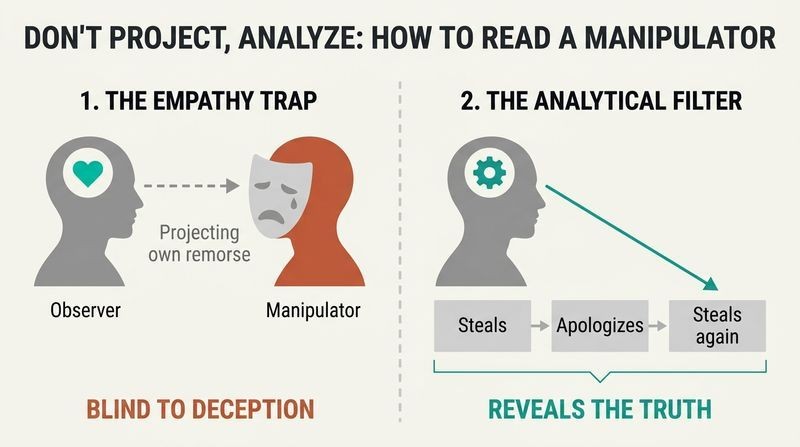
The distinction between empathy and analytical reading maps neatly onto psychology's split between "affective empathy" (feeling with) and "cognitive empathy" or theory of mind (modeling another's mind). Research on skilled manipulators suggests they often have intact cognitive empathy while lacking the affective kind, letting them read targets precisely without being moved. Tuhovsky's practical point is sharp: your greatest social gift becomes a vulnerability against someone who weaponizes it. One caution worth adding: flipping into permanent suspicion carries its own cost, eroding the trust that healthy relationships require. The skill is selective analysis, not blanket paranoia.
Stop sorting people into saints and villains; judge actions, not intentions
"Good" and "bad" are mostly subjective. Tuhovsky notes we judge strangers by grand moral abstractions but judge people we know by specific incidents and our personal history with them. After a bad breakup, he cast his ex as the villain and himself as the hero, yet in her eyes the roles were reversed. To the neutral world, they were just two people who clashed.
What matters is impact, not motive. He distinguishes objective badness (universally harmful acts like theft or assault) from subjective badness (someone whose only crime is not getting along with you). Crucially, you often cannot tell the willfully abusive from the accidentally abusive, so intention is unknowable. The workable rule: if you ask someone to stop hurting you and they don't, they are bad for you, regardless of their reasons.
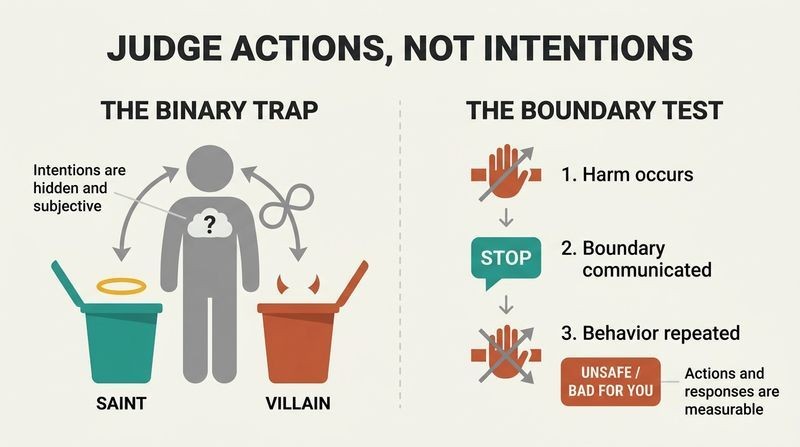
This reframing has real therapeutic value. It sidesteps the fundamental attribution error, our tendency to explain others' behavior through fixed character while excusing our own through circumstance. By focusing on observable actions rather than mind-reading motives, Tuhovsky gives readers a criterion they can actually apply. It echoes behaviorism's insistence on measurable conduct over inferred inner states. The subtle risk: "judge only actions" can flatten important distinctions, since intent genuinely matters in law and in forgiveness. But as a self-protection heuristic, refusing to let a charming apology override a repeated harmful pattern is exactly the discipline abuse victims most often lack.
Four questions unmask what any harmful person is really after
Play Devil's Advocate to explain, not excuse. Tuhovsky offers four diagnostic questions: What does this person gain? Do they know their behavior is wrong? Do they change when corrected? Do they act selfishly or with others in mind? The answers reveal one of four "Bad Guy" types:
1. The manipulator wants something concrete (money, time, sex, energy).
2. The follower wants to convert you, serving a cult, faith, or dominant figure.
3. The dreamer means well but repeatedly wrecks your life chasing fantasies.
4. The sadist wants your suffering itself, sometimes via schadenfreude, joy at others' pain.
Frequency defines danger. Everyone acts out one of these occasionally without being toxic. A bad person indulges one continually; a dangerous person runs two or more at once. The more reasons someone has to harm you, the more reliably they will.
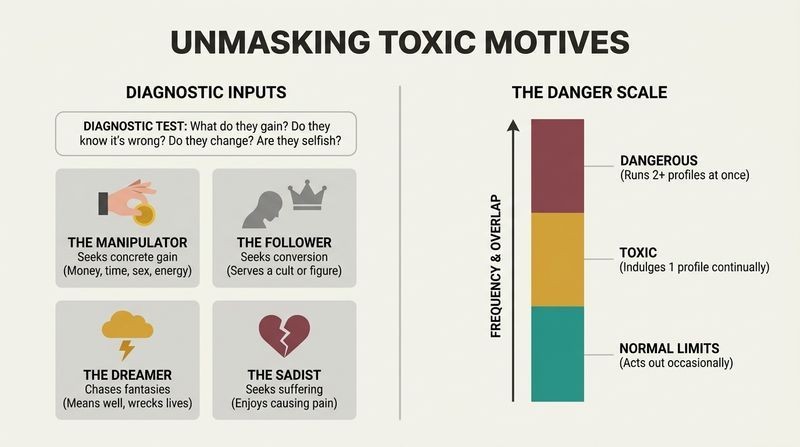
The four-type taxonomy is a useful field guide precisely because it forces specificity. Vague labels like "toxic" tell you nothing about how to respond, whereas knowing whether you face a resource-extractor, an ideologue, a well-meaning bungler, or someone who enjoys your pain dictates entirely different strategies. The "dreamer" category is especially underrated in popular discussions of manipulation, which fixate on calculating predators. Much real damage comes from sincere incompetence. One tension: the framework asks you to infer motive ("do they know it's wrong?") right after the book warns that motive is unknowable. In practice, the corrective test, do they change when corrected, is the most reliable signal.
You can truly befriend only about five people, so guard that circle
Quality of relationships beats quantity. Tuhovsky leans on Oxford anthropologist Robin Dunbar's research, which found humans can sustain roughly 150 stable relationships, nested in layers: about 5 intimates, 15 close friends, 50 friends, and 150 acquaintances. Everyone beyond is replaceable and, importantly, not your friend. Social media, he argues, has corrupted this, pressuring us to treat brands, bosses, and idols as "friends" who want our time, energy, and money.
An unguarded circle is a security hole. Because your inner circle trusts whomever you trust, letting a Bad Guy in endangers everyone you love, not just you. The fix is not building walls and shutting everyone out, which also blocks the many good people who add value. It is consciously knowing who is in your inner and outer circles and slowing anyone's advance inward.
Dunbar's number is real and widely cited, though it describes a cognitive ceiling on stable relationships rather than a prescription for how many friends to have. Tuhovsky's application is the fresh part: treating your inner circle as an attack surface with shared trust privileges, much like network security, where one compromised account exposes everything it can reach. The insight that granting someone your trust automatically extends them your friends' trust explains why con artists and abusers work so hard to get vouched-in. The corrective against cageyness is well judged, since isolation is itself a documented risk factor that predators exploit.
Learn the four ways predators worm into your life
Bad Guys use predictable entry tactics. Tuhovsky, drawing on his own painful history, names four:
1. Recruiting and applying: they make themselves indispensable, isolating you from others until you depend only on them.
2. Trauma bonding: they hurt you, then comfort you, becoming both poison and cure, as his scout-camp "friend" who bullied then bandaged him did.
3. Love bombing: overwhelming early affection, gifts, and constant messaging that vanishes overnight once they have you, as his college girlfriend flipped the instant she moved in.
4. Mirroring: posing as a shy introvert, studying you, then "discovering" they share all your values and tastes, manufacturing a false soulmate bond.
Each exploits a normal instinct. Love bombing hijacks the sunk-cost fallacy; mirroring exploits our attraction to people like us. A Bad Guy usually commits to one tactic relentlessly rather than mixing them.
These four tactics correspond to well-documented coercive-control mechanisms. Trauma bonding overlaps with the intermittent reinforcement studied in behavioral psychology, where unpredictable rewards create stronger, more addictive attachment than consistent ones, the same schedule that makes slot machines compulsive. Love bombing is now a recognized red flag in relationship science, though the term originated with cult recruitment. The mirroring point gains force in the digital age, since anyone can research a target's tastes overnight and stage an uncanny compatibility. A useful extension: the shared tell across all four is asymmetry and speed. Healthy intimacy builds reciprocally and gradually, while these tactics rush the timeline and tilt the ledger.
Three hidden fears, not bad luck, keep you in toxic relationships
Every excuse masks insecurity, attraction, or fear. Tuhovsky argues that all the reasons people give for staying ("they're not really like that," "I have no other option," "it's not their fault, they're ill") are bandages over three raw truths:
1. Insecurity: we are creatures of habit who dread an uncertain future without them.
2. Extreme attraction: love, sexual or platonic, blinds us to abuse the way it blinds us to harmless flaws.
3. Fear: of revenge, social stigma, or wasting what we have already invested (the sunk-cost trap).
Naming the real reason is the first treatment. "I take the good with the bad" really means extreme attraction; "I have no other option" really means fear of your options. Only by unrolling the bandage and assessing the actual wound can it heal.
Reducing a tangle of rationalizations to three drivers is clarifying, and it aligns with what domestic-violence researchers describe: leaving is a process obstructed by economic dependence, fear of escalation (the most dangerous period for victims is often right after leaving), and eroded self-worth. Tuhovsky's sunk-cost framing is particularly apt, since behavioral economics shows humans irrationally honor past investments, throwing good years after bad. The book's compassion here matters: it explicitly refuses the "why didn't you just leave?" victim-blaming that outsiders reflexively voice. If anything deserves more emphasis, it is that insecurity is frequently manufactured by the abuser, who deliberately strips away the victim's alternatives.
Narcissists, Machiavellians, and solipsists each fail you differently
Three overlapping mindsets produce three distinct harms. Tuhovsky adapts clinical and philosophical concepts:
1. Narcissism: a grandiose self-importance, need for admiration, entitlement, and stunted empathy; the narcissist puts themselves on a pedestal and treats you as a tool.
2. Machiavellianism: the belief that the ends justify the means. Unlike a pragmatist who weighs everyone's welfare, the Machiavellian convinces you their goal is your goal, as his uncle did promising a shared car that never materialized.
3. Solipsism: acting as if you are the only real mind, so others are mere characters. His shopaholic ex kept stealing openly because, in her world, his purpose was simply to fund her.
Awareness differs by type. Narcissists often know what they are and can hide it; solipsists genuinely cannot conceive that you have an inner life, which makes arguing pointless.
Tuhovsky is informally sketching what researchers call the Dark Triad (narcissism, Machiavellianism, and psychopathy), a cluster that predicts exploitative behavior. His addition of solipsism as a folk category is interesting, functionally describing extreme egocentrism or impaired perspective-taking rather than a clinical diagnosis. The Machiavellian analysis is the standout: distinguishing genuine pragmatism (holistic cost-benefit including others) from ends-justify-means idealism cuts through a confusion many self-styled "realists" hide behind. A caveat readers should hold: these labels are potent and easily misapplied to merely difficult people. The book's own repeated warning, that having a trait is not having the disorder, is the essential guardrail against armchair diagnosis.
Real psychopaths are 1-2% of people and usually unsuccessful
Forget the genius-villain stereotype. Psychopathy, clinically antisocial personality disorder, combines a near-total lack of empathy with extreme impulsivity. Tuhovsky stresses this makes real psychopaths more dangerous than movie ones: to them you are a rock, and if hurting you crosses their mind, it might just happen. But roughly 1-2% of people are psychopaths, and most are ordinary on the surface.
Impulsivity sabotages success. Because success requires self-control and planning, most psychopaths end up broke, jobless, or in bar fights rather than boardrooms. The rare "successful" ones usually inherited wealth, got lucky, or took credit for others' work. They are hedonists who avoid sacrifice, chase pleasure, and rarely hold onto money, status, or relationships. Assume caution around charismatic, impulsive, pleasure-driven people who never learn from consequences.
The corrective against the pop-culture "CEO psychopath" trope is valuable, though the reality is more nuanced than either extreme. Robert Hare and others have documented that psychopathic traits do appear elevated in some corporate leadership, suggesting a subset of "successful" or "corporate" psychopaths whose impulsivity is channeled rather than absent. Tuhovsky's version, that impulsivity nearly guarantees failure, is the more common outcome but not the whole picture. What holds up strongly is the behavioral profile for everyday self-protection: someone who cannot delay gratification, feels no remorse, and repeats harmful acts regardless of consequences is a reliable warning sign, diagnosis or not.
Lies leave fingerprints in both words and body
Deception costs the brain extra effort. Truth comes from memory, a simple retrieval; a lie comes from imagination, activating more of the brain and burning more oxygen. That strain produces observable tells: physical twitches, flushing, lip-licking, or glancing to the right (the imagining direction). In speech, liars tend toward verbal diarrhea (talking faster, using more words), shifting into third person to distance themselves from the lie, and swearing more than usual.
Reliability has limits. These signs weaken with low-empathy people who feel no guilt, with practiced liars who mask their cues, and with delusional people who believe their own fabrications. Tuhovsky separates pathological liars, who lie compulsively and often pointlessly, from manipulative liars. His advised response to chronic liars is disarmingly simple: calmly state the truth, verify their claims, and move on rather than staging a confrontation.
Readers should treat the specific body-language cues with healthy skepticism. Decades of deception research, notably by Aldert Vrij and Paul Ekman, show that no single behavioral tell reliably indicates lying, and the classic "looking right" and gaze-aversion myths have largely failed replication. Trained professionals barely beat chance at spotting lies from demeanor alone. What does hold up is the cognitive-load principle Tuhovsky invokes: lying is mentally taxing, and modern interview techniques exploit this by increasing that load (asking for reverse-order recounting, unexpected details). His practical counsel, verify claims rather than trust your gut lie-detector, is actually the most evidence-aligned advice in the chapter.
Having symptoms of a disorder does not make someone that disorder
Behaviors are not diagnoses. Tuhovsky warns against the comforting habit of explaining every cruelty as mental illness. A headache alone is not a cold, and a single narcissistic act does not make a narcissist. Plenty of harmful people have nothing clinically wrong with them; they are simply behaving badly. Conversely, many diagnosed people are perfectly safe.
He splits conditions into two groups. Some disorders (psychopathy, narcissism, borderline, histrionic, schizoid, codependency) are driven by symptoms like impulsivity, self-obsession, or paranoia that push sufferers toward harming others. Others (bipolar disorder, autism spectrum, schizophrenia, depression, PTSD) may make someone difficult but are not ruled by a harm-producing trait. His guidance for someone you care about with a diagnosis: talk openly, ask what helps and what to watch for, and remember it is never your obligation to fix, tolerate, or stay with anyone who harms you.
This is one of the book's more responsible moves, resisting both the stigma that equates mental illness with danger and the excuse-making that dissolves accountability into pathology. Epidemiological data support the corrective: people with most mental illnesses are far more likely to be victims than perpetrators of violence. The autism inclusion is handled with care, framing social difficulty as non-malicious. Where a specialist might push back is on the tidiness of the two-bucket sort, since conditions vary enormously by individual and severity. But the governing principle, that a diagnosis neither excuses harm nor obligates your endurance of it, is both ethically and practically sound.
Guarding yourself isn't selfish; it's oxygen-mask logic
Runaway altruism breaks you. Tuhovsky names the trap pathological altruism: giving so much time, money, and energy that you get sick, broke, and useless to the very people you wanted to help. Like the airplane instruction to fix your own mask first, you cannot protect anyone while depleted. And you are the only person always inside your own head, so no one else can guard you full-time.
Bad Guys erode your self-worth. Living around a narcissist can make you feel worthless while they seem magnificent. He invokes Stockholm Syndrome, where captives come to sympathize with abusers, and notes victims often relabel healthy acts (keeping your money, saying no, taking a sick day) as "selfish" and swear them off. He offers a self-esteem scale from 0.0 ("I have no value") to 1.0 ("I am a God"), placing health around the middle, and urges those stuck low to build back up.
The self-esteem scale is a rhetorical device rather than a validated instrument, but it usefully visualizes a truth clinical psychology confirms: both extremes are dysfunctional, and grandiosity is not the opposite of low self-worth so much as another distortion. The reframe that self-care is a precondition for caring for others has strong support in the burnout and compassion-fatigue literature among nurses, caregivers, and therapists, where depleted helpers demonstrably help worse. Tuhovsky's insight that abuse survivors pathologize legitimate boundaries as "bad" behavior is subtle and important; it explains why recovery often requires relearning that refusal and rest are ordinary human rights, not moral failings.
Build outcome independence: vet hard, set boundaries, never go back
Immunity comes in two layers. Tuhovsky's capstone concept, outcome independence, means reaching a state where no one's threats or manipulations can derail you. It requires physical safety first (you cannot be emotionally free of a tiger in your living room), then emotional independence. Practically:
1. Never hand others control over your money, home, or livelihood by default.
2. Vet new people by watching their actions toward others, not their reputation.
3. Refuse to "fight to win over" anyone; start relationships as equals.
4. Set boundaries as the relationship grows (a boundary says "I'd rather not discuss faith"; a wall says "I can't befriend your kind").
Rejected Bad Guys often turn vindictive. When you finally protect yourself, some retreat, but others seek revenge through rumors, sabotage, or worse. Stay safe, involve authorities if needed, and above all do not let nostalgia or their baiting lure you back.
The wall-versus-boundary distinction is the chapter's most portable idea and matches how clinicians teach healthy limits: boundaries are permeable and relationship-specific, whereas walls are indiscriminate defenses that also exclude good connections. The warning about post-separation danger is grounded in hard data, since violence frequently escalates when a controlling partner loses control. Vetting by observed behavior rather than reputation is shrewd, given that charm and social proof are exactly what manipulators cultivate. One honest tension in "outcome independence": total emotional invulnerability can shade into detachment that undermines intimacy. The healthiest reading is not caring about nothing, but refusing to let any single person hold your wellbeing hostage.
Analysis
Ian Tuhovsky's book sits in the crowded self-help niche of toxic-relationship recovery, but earns its place through an unusually coherent conceptual spine and disarming personal honesty. Rather than cataloguing red flags, he builds a progression: first dismantling the reader's faith in empathy as a reading tool, then supplying analytical replacements (typologies, diagnostic questions, tactic-recognition), and finally turning inward to self-worth and boundaries. The confessional structure, business partner who bankrupted him, girlfriends who robbed and stonewalled him, childhood bullies, keeps abstract psychology grounded in felt experience and models the self-examination he prescribes.
Intellectually, the work is a popularization that borrows liberally from clinical psychology (DSM criteria), anthropology (Dunbar), philosophy (solipsism, pragmatism, Machiavelli), and behavioral economics (sunk cost). Its strength is synthesis; its weakness is the confidence with which contested findings are presented as settled, particularly the lie-detection cues, which the deception-research literature has largely debunked, and the folk repurposing of clinical terms that risks encouraging amateur diagnosis. Tuhovsky partly inoculates against this with a repeated, genuinely responsible refrain: symptoms are not disorders, most people are decent, and cageyness harms you as much as gullibility.
The book's most valuable contribution is its insistence on judging impact over intention. By making "if you ask them to stop and they don't, they are bad for you" the operative rule, it hands anxious over-empathizers a criterion that bypasses the paralysis of mind-reading. Equally strong is its refusal of victim-blaming, framing the decision to stay as the product of manufactured insecurity, exploited attachment, and rational fear rather than weakness. Where it could go deeper is the reciprocity of toxicity, briefly acknowledged in the thrill-seeker chapter, since readers may be co-authors of their patterns. Overall, a practical, humane field manual best used as a lens for reflection rather than a diagnostic authority.
Review Summary
The Art of Reading People receives mostly positive reviews, with an average rating of 3.80 out of 5. Readers appreciate its insights on understanding toxic people, personality disorders, and improving emotional intelligence. Many find it easy to read and informative, praising its practical advice on dealing with difficult individuals. Some reviewers note its simplicity, which appeals to beginners but may disappoint those seeking more depth. The book is commended for its accessible language and real-life examples, though a few critics find it repetitive or overly focused on negative aspects of human behavior.
People Also Read



Glossary
Bad Guys
People who consistently harm youTuhovsky's umbrella term for people who repeatedly hurt you for one or more reasons. Defined by three social markers: they do not value you intrinsically, they harm you (intentionally or incidentally), and they collect social circles rather than valuing membership in them. A person becomes a Bad Guy through continual harmful behavior, not a single incident, and need not be mentally ill.
Outcome Independence
Immunity to others' manipulationA state in which no one's threats, baiting, or manipulation can derail your life. It requires two layers: physical independence (not giving others control over your money, home, or safety) achieved first, then emotional independence (not letting any single person hold your wellbeing hostage). Built through vetting people by their actions, refusing to chase approval, and enforcing boundaries.
Solipsism (as redefined)
Treating others as unrealTuhovsky repurposes this philosophical thought experiment to describe someone who chronically acts as if they are the only real mind, treating other people like television characters or objects. Unlike a narcissist, a solipsist genuinely cannot conceive that others have independent thoughts and needs, so correction produces confusion and anger rather than change.
Shallow affect
Reduced emotional range or intensityA condition in which a person experiences fewer emotions, or emotions of far lower intensity, than average, compared by Tuhovsky to color-blindness for feelings. Harmless on its own, but dangerous combined with other Bad Guy traits, because emotions like guilt, shame, and fear normally serve as a moral compass guiding good behavior.
Love Bombing
Overwhelming fake early affectionAn infiltration tactic in which a manipulator showers a target with intense affection, gifts, and constant attention early in a relationship, creating a feeling of true love. The affection is a performance designed to secure trust and sacrifice, and it stops abruptly, often overnight, once the manipulator gets what they want or the target wises up.
Trauma Bonding
Cycling abuse with reliefA tactic where a manipulator inflicts harm and then provides comfort or relief, becoming simultaneously the poison and the medicine. The victim, seeking safety, bonds to the source of both pain and rescue. It exploits the human instinct to unite in hardship and is easier to trigger in people from already-troubled backgrounds.
Mirroring
Faking shared values and tastesAn infiltration tactic in which a Bad Guy first poses as a shy introvert, studies the target, then pretends to spontaneously share the same values, goals, and tastes, manufacturing a false soulmate bond and an "us versus the world" feeling. This fast-tracks them into the inner circle before genuine vetting can occur.
Pathological Altruism
Self-destructive excessive givingGiving away so much time, money, and energy to others that you damage your own health, finances, and stability, ultimately becoming unable to help anyone. Tuhovsky frames it as an unhealthy response to a bad environment and counters it with the airplane oxygen-mask principle: secure your own wellbeing before assisting others.
Dunbar numbers
Limits on stable relationshipsOxford anthropologist Robin Dunbar's finding that humans can maintain roughly 150 stable relationships, nested in layers of about 5 intimates, 15 close friends, 50 friends, and 150 acquaintances. Tuhovsky uses it to argue for prioritizing relationship quality over quantity and consciously guarding one's inner circle from infiltration.
Schadenfreude
Pleasure at others' sufferingTaking amusement or satisfaction in another person's pain or misfortune. Tuhovsky notes a mild, common form (enjoying deserved karma without causing harm) is normal, but a toxic form drives bullying and deliberate cruelty. It is one of the motivations behind the "sadist" type of Bad Guy, whose harm is the goal rather than a byproduct.
FAQ
What's "The Art of Reading People" about?
- Understanding Toxic Relationships: The book by Ian Tuhovsky focuses on identifying and dealing with toxic people and manipulation to avoid or end abusive relationships.
- Reading People: It emphasizes the importance of social intelligence and understanding the deeper motivations behind people's actions.
- Self-Protection: The book provides strategies to protect oneself from being exploited by those with harmful intentions.
- Personal Growth: It encourages readers to cultivate self-awareness and emotional intelligence to improve personal and professional relationships.
Why should I read "The Art of Reading People"?
- Practical Guidance: The book offers actionable advice on how to identify and manage toxic relationships effectively.
- Emotional Intelligence: It helps enhance your ability to read and understand people, which is crucial for personal and professional success.
- Self-Improvement: By learning to protect yourself from manipulation, you can foster healthier relationships and personal growth.
- Supportive Community: The book reassures readers that they are not alone in their experiences and can find support from others who have faced similar challenges.
What are the key takeaways of "The Art of Reading People"?
- Empathy vs. Analysis: While empathy is important, the book stresses the need for analytical skills to see through deception.
- Identifying Bad Guys: It provides insights into recognizing different types of toxic personalities, such as narcissists and manipulators.
- Self-Love and Boundaries: The importance of self-respect and setting boundaries to protect oneself from toxic influences is highlighted.
- Outcome Independence: Cultivating a mindset where one's happiness and self-worth are not dependent on others' actions or approval.
How does Ian Tuhovsky define "Bad Guys" in the book?
- Objective vs. Subjective Badness: The book differentiates between people who are objectively harmful and those who are subjectively bad for you.
- Four Types of Bad Guys: It categorizes them into manipulators, followers, dreamers, and sadists, each with distinct motivations.
- Behavioral Patterns: Bad Guys often exhibit consistent patterns of deceit, exploitation, and lack of empathy.
- Impact on Relationships: These individuals can cause significant harm to personal and professional relationships if not identified and managed.
What strategies does "The Art of Reading People" suggest for dealing with toxic people?
- Reading and Analyzing: The book emphasizes the importance of stepping outside your own perspective to understand others' true intentions.
- Setting Boundaries: It advises establishing clear boundaries to protect yourself from manipulation and exploitation.
- Self-Love and Independence: Cultivating self-respect and emotional independence to avoid being overly affected by toxic individuals.
- Identifying Infiltration Attempts: Recognizing tactics used by toxic people to enter and disrupt your social circles.
What is the significance of "Outcome Independence" in the book?
- Emotional Resilience: Outcome independence involves not letting others' actions dictate your emotional well-being.
- Self-Sufficiency: It encourages maintaining control over your life and decisions, reducing reliance on others for happiness.
- Boundary Setting: By being outcome independent, you can set and enforce boundaries without fear of losing relationships.
- Handling Vindictiveness: It prepares you to deal with potential backlash from toxic individuals when you assert your independence.
How does Ian Tuhovsky address "Narcissism" in the book?
- Traits of Narcissists: The book outlines characteristics such as grandiosity, lack of empathy, and a need for admiration.
- Impact on Relationships: Narcissists can be exploitative and damaging to relationships due to their self-centered nature.
- Spotting Narcissists: It provides tips on identifying narcissistic behaviors, even when they are well-hidden.
- Managing Interactions: Strategies are offered for dealing with narcissists, including setting boundaries and maintaining emotional distance.
What role does "Empathy" play in "The Art of Reading People"?
- Empathy's Dual Nature: While empathy is crucial for understanding others, it can also lead to solipsism if not balanced with analysis.
- Empathy vs. Solipsism: The book warns against assuming others share your reality, which can lead to misjudgments.
- Empathy in Relationships: It highlights the importance of empathy in forming genuine connections but stresses the need for critical thinking.
- Empathy and Manipulation: Empathy can be exploited by toxic individuals, making it essential to combine it with analytical skills.
How does the book explain "Trauma Bonding"?
- Definition and Dynamics: Trauma bonding occurs when a victim forms a strong emotional attachment to their abuser due to cycles of abuse and reconciliation.
- Psychological Impact: It explains how trauma bonding can trap individuals in toxic relationships, making it difficult to leave.
- Breaking the Cycle: The book offers insights into recognizing and breaking free from trauma bonds through self-awareness and support.
- Role of Empathy: Empathy can contribute to trauma bonding by making victims more forgiving and understanding of their abuser's behavior.
What are the best quotes from "The Art of Reading People" and what do they mean?
- "We can't get better at something until we know our own limits." This quote emphasizes the importance of self-awareness in personal growth and understanding others.
- "People lie with their words, but also with their actions, and with their expressions." It highlights the need for vigilance in reading people beyond their verbal communication.
- "It's important to read people because people lie." This underscores the book's central theme of developing social intelligence to navigate relationships effectively.
- "Empathy ensures that we look after each other, but it can also give rise to solipsism." This quote warns of the potential pitfalls of empathy when it leads to assuming others share your perspective.
How does "The Art of Reading People" address "Pathological Lying"?
- Definition and Characteristics: Pathological lying is described as compulsive lying without clear purpose, often harming the liar themselves.
- Brain Differences: The book notes that pathological liars' brains are wired differently, making lying a habitual response.
- Impact on Relationships: Pathological lying can erode trust and create chaos in relationships, making it crucial to identify and address.
- Confronting Liars: It suggests calmly correcting lies and maintaining skepticism to protect oneself from manipulation.
What exercises does Ian Tuhovsky recommend for identifying toxic people?
- Analyzing Past Interactions: Reflect on past experiences with individuals to identify patterns of manipulation or deceit.
- Boundary Setting Practice: Practice setting and enforcing boundaries in various relationships to protect your well-being.
- Self-Reflection: Regularly assess your own emotional responses and vulnerabilities to better understand how toxic people may exploit them.
- Role-Playing Scenarios: Engage in exercises that simulate interactions with toxic individuals to develop strategies for managing them effectively.
About the Author
Other books by Ian Tuhovsky
Download PDF
Download EPUB
.epub digital book format is ideal for reading ebooks on phones, tablets, and e-readers.








































