

Key Takeaways
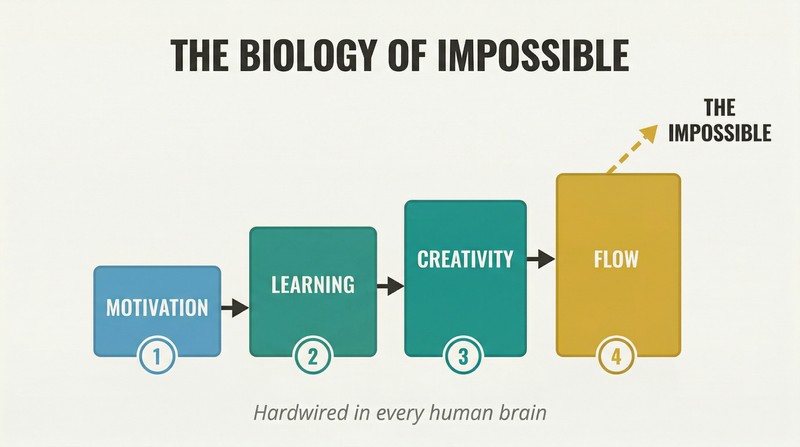
Impossible has a biological formula: motivation, learning, creativity, flow
Kotler spent decades studying impossible achievers — from rowdy action sports athletes who rewrote the limits of human physics to entrepreneurs like Peter Diamandis, who built a reusable spaceship NASA said couldn't exist (cost: $25 million, not billions; staff: 30 engineers, not ten thousand). His core finding: whenever the impossible becomes possible, the same four skills appear in sequence. Motivation gets you into the game. Learning keeps you playing. Creativity steers. And flow — an optimal state of total absorption where performance skyrockets — turbo-boosts everything.
The formula works because it's hardwired. Unlike personality-based advice, neurobiology is shared machinery across all humans. Flow shows up in every culture, class, gender, and age group ever studied. Evolution shaped the brain for peak performance; the formula simply activates what's already there.
Write 25 curiosities, find where three overlap, and ignite passion
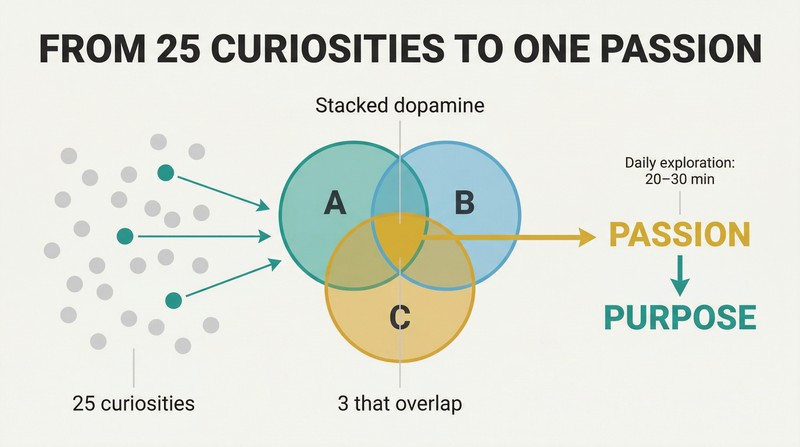
Five intrinsic drivers form a biological sequence: curiosity → passion → purpose → autonomy → mastery. Each produces dopamine and norepinephrine, neurochemicals that sharpen focus and prime the brain for flow. Start by listing 25 specific curiosities — not "food" but "can grasshoppers become a primary human protein source?" Then find where three or four items intersect. These overlaps stack neurochemistry: each connection triggers more dopamine, which finds more connections.
Spend 20 – 30 minutes daily exploring intersections through podcasts, articles, and books. Then go public — teach what you've learned to strangers or online communities. Social feedback adds oxytocin to the dopamine, cementing genuine passion. Finally, find where your passion solves a problem bigger than yourself. That overlap becomes your massively transformative purpose — a lifelong mission statement bold enough to guide your career and rally others to your cause.
Filter your life through three goal tiers: mission, milestones, daily wins
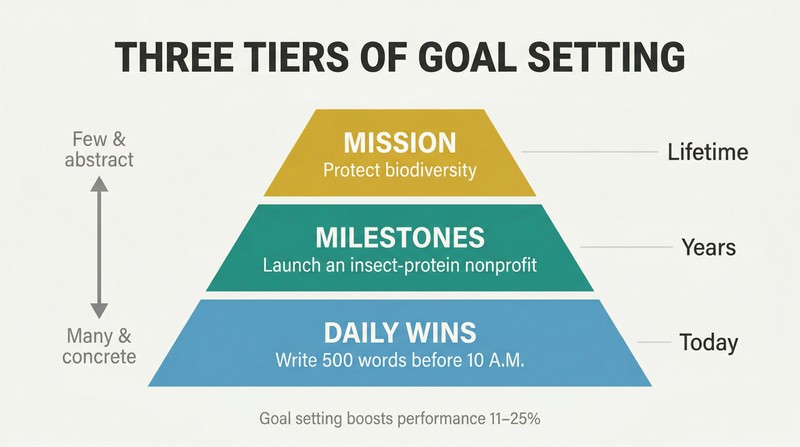
Three goal types operate at different timescales. A massively transformative purpose spans your lifetime ("protect biodiversity"). High, hard goals are multi-year stepping stones ("create a nonprofit using insect-based proteins"). Clear goals are daily targets inside the challenge-skills sweet spot ("write 500 words between 8 and 10 A.M."). Research by Latham and Locke shows goal setting alone boosts performance 11 – 25% — equivalent to two free hours in an eight-hour workday.
Keep goals private. NYU psychologist Peter Gollwitzer found that announcing a goal releases dopamine prematurely, creating a feeling of satisfaction before any work is done. Write tomorrow's to-do list tonight, cap items at your daily capacity, and cross off every single one. If it goes on the list, you complete it. Little win stacked on little win is the only road to impossible.
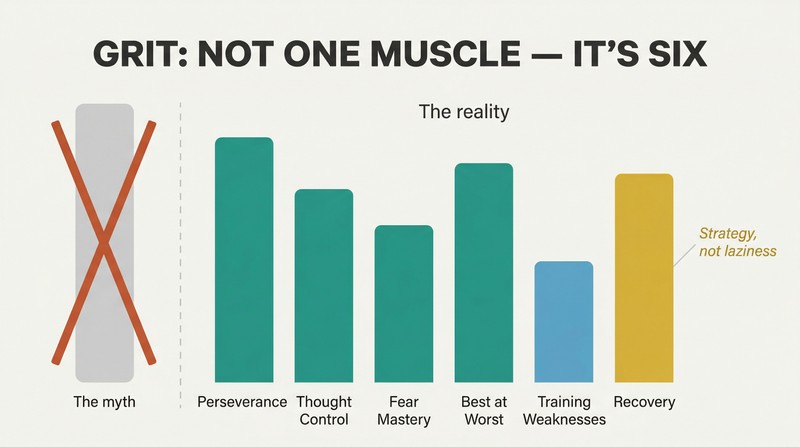
Grit isn't one muscle — it's six, and each needs separate training
Peak performers train six distinct grit skills:
1. Perseverance — trained through exercise and incremental physical wins
2. Thought control — daily gratitude, mindfulness, and a 3:1 positive-to-negative self-talk ratio
3. Fear mastery — heading toward what scares you, using fear as a directional compass
4. Being your best at worst — practicing skills under conditions of exhaustion
5. Training weaknesses — asking friends to identify your top three, then addressing root causes
6. Recovery — active protocols, sleep protection, and total resets every 10 – 12 weeks
Willpower depletes as the day progresses, so attack your hardest task first. Burnout — defined by exhaustion, depression, and cynicism — carries permanent neurological effects on memory and problem-solving. Getting gritty about recovery isn't laziness; it's strategy.
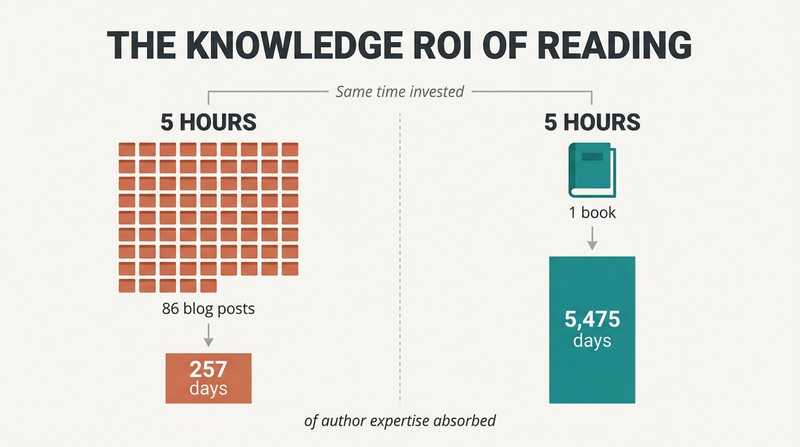
Five hours with a book buys fifteen years of the author's life
Kotler quantifies the ROI on reading. A blog takes three minutes and represents three days of research. A magazine article takes twenty minutes and reflects four months of work. A book takes five hours but contains fifteen years of distilled expertise. Binge-reading 86 blog posts delivers 257 days of effort; the same five hours on one book delivers 5,475 days.
For mastering new subjects, use Kotler's "five books of stupid" — read five progressively harder books without judging your confusion. Start with two fun, popular books, then a macroscopic overview, then a hard technical text, then a cutting-edge exploration. Take notes only on historical narrative, key terminology, and ideas that genuinely excite you. After five books, seek out experts — and be the dumbest person in that conversation.
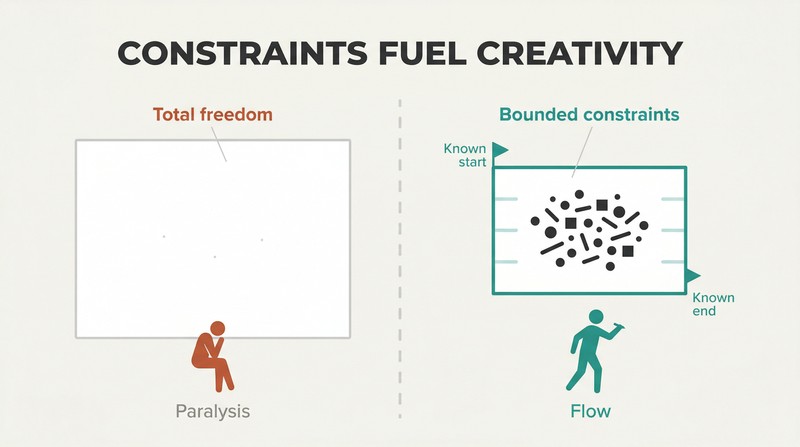
Constrain your creativity — the blank page is too blank
Limits fuel creative output. At Rider University, students given eight nouns to incorporate into rhyming couplets consistently outperformed students given total freedom. Improv actors trained to be hyper-specific ("the ZX-23 laser kill device" rather than "a gun") generate richer scenes. Kotler's rule: always know your starts and endings. Without those cornerstones, his first novel took eleven years.
The system also needs ammunition. Read 25 – 50 pages daily outside your specialty to feed the brain's pattern recognition system with novel raw material. Schedule "non-time" — solitude without deadlines — where the default mode network can daydream. When stuck, deploy the MacGyver method: write the problem in detail, step away for light incubation activity like gardening or model-building, then free-write. Answers typically surface within minutes.
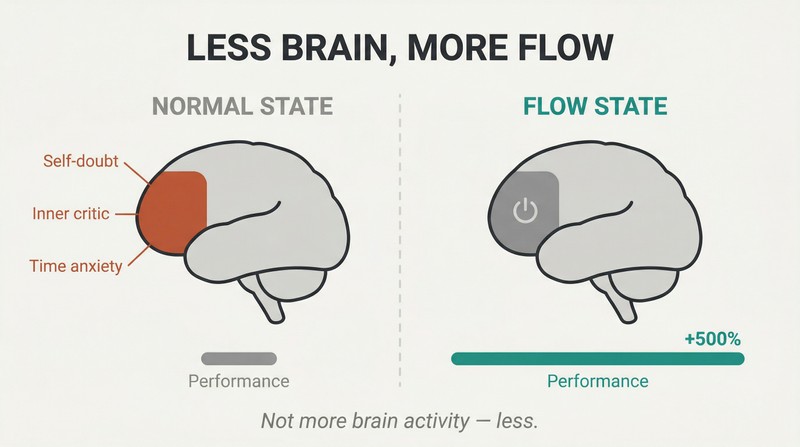
Flow silences your inner critic by literally deactivating it
The popular '10% brain myth' had it exactly backwards. Flow arises through transient hypofrontality — a temporary shutdown of the prefrontal cortex, the region housing self-monitoring, time perception, and the inner critic. When it goes quiet, doubt vanishes, time distorts, and the sense of self dissolves. Kotler discovered this firsthand: bedridden with Lyme disease, barely able to walk, surfing triggered flow states that over eight months brought him from 10% functional to 80%.
The neurochemistry is staggering. Flow floods the brain with all six major pleasure chemicals — dopamine, norepinephrine, endorphins, anandamide, serotonin, and oxytocin — possibly the only experience producing all six at once. McKinsey found productivity amplifies 500% in flow. Defense Department research showed learning rates spike 230%.
Stretch exactly 4% past your skills to enter the flow channel
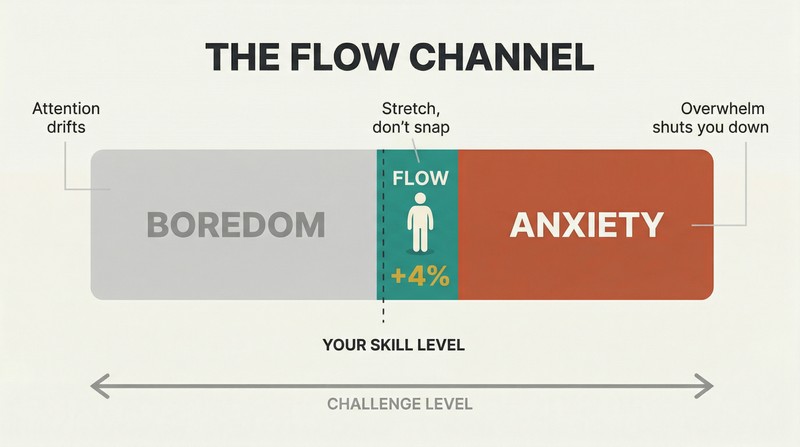
The challenge-skills balance is flow's most critical trigger. When a task is too easy, attention drifts. Too hard, and anxiety overwhelms. Flow lives in the narrow channel between boredom and panic, where challenge slightly exceeds current ability. Kotler uses 4% as a practical guideline — enough to push outside the comfort zone without breaking you. When writing books, he starts at 500 words daily, ramps to 750 mid-book, and finishes at 1,000, tuning difficulty as skills grow.
Twenty-two flow triggers have been identified in total, grouped into internal (clear goals, immediate feedback, autonomy, curiosity-passion-purpose), external (high consequences, rich environment, deep embodiment), creative (pattern recognition, novelty), and social (shared risk, close listening, "always say yes"). All work by driving attention into the present — pushing neurochemistry into the system or lowering cognitive load.
Flow starts in maximum frustration — embrace the struggle phase
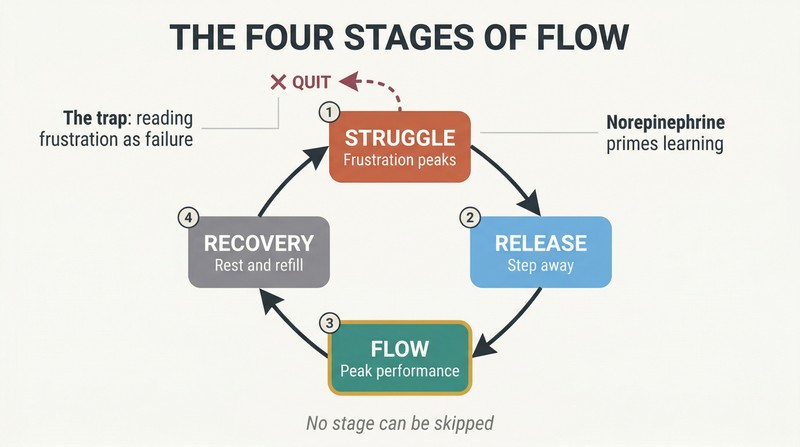
Flow is a four-stage cycle, not an on-off switch. Stage one, struggle, overloads the brain with information — the prefrontal cortex is hyperactive and frustration peaks. Stage two, release, is incubation: step away with light activity so the unconscious can process. Stage three is flow itself. Stage four, recovery, refills depleted neurochemical tanks through sleep and active rest. You cannot skip stages or reenter flow without completing the full cycle.
The trap is reading frustration as failure. In struggle, the brain produces norepinephrine — the very chemical that primes it for learning. The decision to fight through rather than flee triggers the transition toward flow. What Kotler calls the habit of ferocity — the instinct to automatically lean into challenges — determines whether you stall in struggle permanently or break through to the state that redeems all that suffering.
Impossible is a daily checklist executed with compound interest
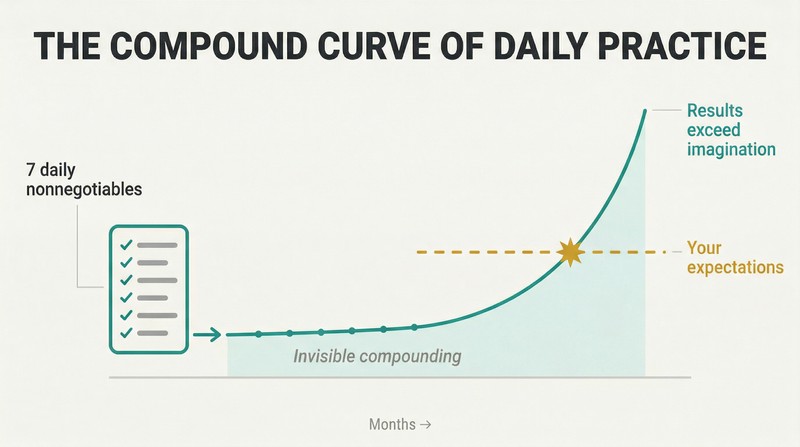
Kotler prescribes seven daily and six weekly nonnegotiables. Daily: 90 – 120 minutes uninterrupted concentration on your hardest task, distraction management, a clear-goals list, gratitude practice, 20 minutes mindfulness or release, 25+ pages of reading outside your specialty, and 7 – 8 hours of sleep. Weekly: 2 – 6 hours of a high-flow activity, exercise three times, active recovery three times, training a weakness, getting feedback, and 120 minutes of social support.
Stack practices for efficiency. Use exercise sessions to train grit. Use sauna recovery time for mindfulness and reading. Preload every release phase with the MacGyver method. Start with whatever you can manage — even 20 minutes of daily concentration. None of these interventions are glamorous. But peak performance compounds invisibly until results exceed not just your expectations, but your imagination.
Analysis
Kotler's book represents the most ambitious attempt in recent peak-performance literature to build a unified operating system from neuroscience rather than anecdote. The four-part architecture — motivation → learning → creativity → flow — is the core intellectual contribution, because the sequence is the insight. You cannot hack flow without first constructing the motivational and cognitive scaffolding. This developmental ordering distinguishes the book from the flow-trigger fixation of Kotler's earlier work and from the single-variable focus of peers like Duckworth (grit) or Dweck (mindset).
The central move — 'biology scales' — is both the book's greatest strength and a potential vulnerability. By anchoring every recommendation in neurochemistry (dopamine loops, transient hypofrontality, the seven affective circuits), Kotler sidesteps the personality-cult trap that plagues most performance literature. However, the neuroscience often functions as narrative scaffolding rather than causal proof. 'Dopamine does X' storytelling, while accessible, risks the same oversimplification that pop neuroscience critics like Molly Crockett have challenged. The brain rarely operates in the neat chemical sequences described.
Where the book genuinely excels is in translational architecture. The 22 flow triggers, the four-stage flow cycle, the passion recipe's specific steps (25 curiosities → intersections → public validation), and the daily/weekly practice protocols give readers engineering blueprints rather than motivational platitudes. The six-type decomposition of grit — expanding Duckworth's binary into trainable subcategories including fear mastery, thought control, and recovery — is a genuine conceptual advance.
The implicit assumption that everyone should be 'stalking the impossible' goes largely unexamined. Kotler acknowledges this isn't universal, yet the book's relentless intensity may optimize for extraordinary output at the expense of sustainability — precisely the burnout he warns against. Still, as a comprehensive synthesis of performance research into a single executable system, the book has few competitors in its weight class.
Review Summary
The Art of Impossible receives mixed reviews, with many praising its comprehensive approach to peak performance and motivation. Readers appreciate Kotler's insights on flow states, creativity, and learning. Some find the neuroscience explanations dense, while others value the practical tips and checklists provided. Critics argue the book rehashes ideas from other sources and lacks originality. Overall, it's recommended for those new to peak performance concepts, but may not offer much new information for experienced readers.
People Also Read



Glossary
Massively Transformative Purpose (MTP)
Lifelong audacious mission statementA large-scale, purpose-driven mission statement for one's life that is massively ambitious, transformative in its potential impact on a community or the planet, and rooted in a clear 'why.' Coined by Salim Ismail and adopted by Kotler, an MTP functions as a first filter—if a project doesn't advance the mission, it's not worth pursuing. Examples: 'advance the science of flow' or 'protect biodiversity through mega-linkages.'
High, Hard Goals (HHG)
Major multi-year stepping stonesA goal-setting concept from psychologists Gary Latham and Edwin Locke describing ambitious targets that serve as major steps toward a massively transformative purpose. HHGs span months to years ('get a degree in nutrition,' 'write a book') and significantly outperform small, medium, or vague goals in boosting motivation and productivity. They require alignment with personal values and intrinsic drivers to be most effective.
Challenge-skills balance
Flow's most important triggerThe condition where the difficulty of a task slightly exceeds one's current skill level—enough to stretch but not snap. Originally identified by Csikszentmihalyi as a proximal condition for flow, Kotler quantifies this as roughly 4% beyond current abilities. When tuned correctly, the brain rewards the effort with dopamine, tightening focus and pulling consciousness toward the flow state. Too little challenge produces boredom; too much produces anxiety.
Transient hypofrontality
Temporary prefrontal cortex shutdownA neurological mechanism underlying flow states, identified by neuroscientist Arne Dietrich, in which the prefrontal cortex temporarily deactivates. 'Transient' means temporary; 'hypo' means to slow or shut down; 'frontality' refers to the prefrontal cortex. This shutdown silences the inner critic, distorts time perception, and dissolves the sense of self, while freeing energy for heightened attention and pattern recognition.
Flow triggers
Preconditions that produce flowTwenty-two identified conditions that drive attention into the present moment, increasing the likelihood of entering a flow state. Originally called 'proximal conditions for flow' by Csikszentmihalyi, they include internal triggers (clear goals, immediate feedback, challenge-skills balance, autonomy, curiosity-passion-purpose), external triggers (high consequences, rich environment, deep embodiment), creative triggers, and ten social triggers for group flow. All work by pushing dopamine/norepinephrine into the system or lowering cognitive load.
Flow cycle
Four-stage sequence producing flowA four-phase process discovered by Harvard cardiologist Herbert Benson through which flow states arise and resolve. The stages are: (1) struggle—a loading phase of intense, frustrating conscious effort; (2) release—an incubation period using light activity to pass processing to the unconscious; (3) flow—the optimal state itself; (4) recovery—neurochemical replenishment through sleep, nutrition, and active rest. Each stage must be completed before reentering flow.
Habit of ferocity
Automatized instinct to attack challengesKotler's term for the ability to immediately and automatically lean into any challenge before conscious deliberation can intervene. Developed by aligning the full motivational stack and training all six types of grit until the fight response becomes habitual. This saves both time and cognitive energy—Kotler estimates it yields a five-day annual advantage over competitors who slow down when difficulty rises.
Passion recipe
Step-by-step passion cultivation processKotler's structured method for building genuine passion from scratch. Steps: (1) list 25 specific curiosities; (2) find intersections where three or four overlap; (3) spend 20–30 minutes daily exploring those intersections; (4) go public by teaching others and gathering social feedback; (5) transform passion into purpose by connecting it to a problem larger than yourself. Designed to stack dopamine, norepinephrine, and oxytocin progressively.
Five books of stupid
Beginner reading strategy for new topicsKotler's method for building a knowledge foundation in an unfamiliar subject. Read five progressively difficult books without judging your comprehension. Book one is popular and fun; book two is slightly more technical; book three offers a macroscopic overview; book four is the first genuinely hard text; book five explores the cutting edge. The approach leverages unconscious pattern recognition—the brain stitches meaning from repeated exposure to unfamiliar terminology.
MacGyver method
Subconscious creative problem-solving techniqueA three-step technique developed by TV creator Lee Zlotoff for harnessing the subconscious to solve creative problems. Step one: write down the problem in specific detail. Step two: engage in lightly stimulating activity (building models, gardening, showering) for one to four hours to incubate. Step three: return to writing and free-associate—solutions typically emerge within minutes. The method programs the subconscious with a problem, then uses mild activity to activate it.
Non-time
Unstructured solitude for creative workKotler's term for large blocks of unstructured time—typically early morning hours before the world wakes up—when deadlines don't press and the default mode network can daydream freely. Non-time provides the psychological distance, patience, and incubation periods that creativity requires. Paired with solitude ('no one'), it enables the brain to hunt remote associations between ideas without the sensory bombardment of daily life.
Match quality
Tight fit between skills and workAn economics term adopted by David Epstein in Range describing an exceptionally tight alignment among a person's skills, interests, and the work they do. High match quality predicts sustained peak performance better than early specialization. It correlates with higher learning rates and enhanced grit. Kotler's passion recipe is designed to produce match quality through experimentation rather than prediction, because research shows people cannot accurately forecast their own interests in advance.
Full intrinsic stack
Five aligned intrinsic motivatorsKotler's term for the complete, correctly sequenced set of five intrinsic drivers: curiosity, passion, purpose, autonomy, and mastery. These are biologically designed to work together—curiosity ignites passion, passion fuels purpose, purpose demands autonomy, and autonomy requires mastery. When properly stacked, they produce enough dopamine and norepinephrine to lower cognitive load, heighten focus, and serve as flow triggers—making peak performance feel less effortful.
FAQ
What's The Art of Impossible about?
- Peak Performance Focus: The Art of Impossible by Steven Kotler is a guide to achieving peak performance through understanding the science of creativity, motivation, and flow.
- Four Key Skills: It emphasizes four essential skills—motivation, learning, creativity, and flow—that are crucial for pushing limits and accomplishing extraordinary feats.
- Practical Playbook: The book provides a practical guide for readers to apply these concepts in their own lives, regardless of their starting point.
- Science and Real-Life Examples: Kotler combines insights from neuroscience with real-life examples of athletes and innovators to illustrate how to achieve the impossible.
Why should I read The Art of Impossible?
- Achieve Ambitious Goals: If you have dreams that seem out of reach, this book offers a roadmap to help you realize them.
- Science-Backed Strategies: The author combines personal anecdotes with scientific research, making the advice both relatable and credible.
- Unlock Your Potential: It provides actionable strategies to help you unlock your full potential and achieve your goals in any field.
- Inspiration and Practical Techniques: Kotler shares stories of real-life successes and offers practical techniques that can be implemented immediately.
What are the key takeaways of The Art of Impossible?
- Motivation Triad: The book introduces the motivation triad—drive, grit, and goals—as essential for achieving peak performance.
- Flow Cycle: It outlines the flow cycle, which includes four stages: struggle, release, flow, and recovery, crucial for maximizing creativity and performance.
- Creativity as a Skill: Kotler emphasizes that creativity can be trained and developed, not just an innate talent.
- Emotional Intelligence: The book highlights the importance of emotional intelligence, breaking it down into self-awareness, self-management, social awareness, and relationship management.
How does The Art of Impossible define flow?
- Optimal State of Consciousness: Flow is described as a state where individuals are fully immersed in an activity, experiencing heightened focus and enjoyment.
- Neurochemical Cocktail: The state of flow releases a mix of neurochemicals that enhance focus, creativity, and learning.
- Characteristics of Flow: Kotler outlines six core characteristics of flow, including complete concentration and a sense of control.
- Essential for Peak Performance: Flow is necessary for achieving the impossible, as it amplifies motivation and productivity.
What is the "passion recipe" mentioned in The Art of Impossible?
- Stacking Intrinsic Drivers: The passion recipe involves cultivating curiosity, amplifying it into passion, and then transforming that passion into purpose.
- Creating a List: Readers are encouraged to write down twenty-five things they are curious about to identify intersections that can lead to deeper passions.
- Public Successes: Sharing your passions with others and receiving positive feedback can further ignite and solidify your passion.
What are the stages of the flow cycle in The Art of Impossible?
- Four Stages: The flow cycle consists of struggle, release, flow, and recovery, each playing a vital role in achieving peak performance.
- Struggle: This initial stage involves grappling with challenges and acquiring new skills, essential for preparing the brain for flow.
- Release and Flow: The release phase allows the brain to process information subconsciously, leading to the flow stage where optimal performance occurs.
- Recovery: Recovery is necessary to recharge and prepare for the next cycle, ensuring sustainable peak performance.
What is the "habit of ferocity" discussed in The Art of Impossible?
- Automatic Response to Challenges: The habit of ferocity refers to the instinctive ability to rise to challenges without hesitation.
- Training for Resilience: Developed through consistent practice and alignment of intrinsic motivators, it helps individuals handle obstacles and maintain focus.
- Long-Term Benefits: This habit enhances overall performance by allowing individuals to tackle challenges head-on, saving time and energy.
What techniques does Kotler suggest for enhancing creativity in The Art of Impossible?
- Befriend Your ACC: Kotler emphasizes the importance of the anterior cingulate cortex (ACC) in recognizing weak signals and fostering insight.
- Broaden Your Horizons: Engaging with diverse experiences and perspectives can stimulate creative thinking.
- Practice Mindfulness: Mindfulness practices can help quiet the inner critic and allow for greater creative flow.
What is the "80/20 rule" in the context of The Art of Impossible?
- Focus on the Vital Few: The 80/20 rule suggests that 80% of results come from 20% of efforts, meaning you should concentrate on the most impactful areas.
- Maximize Efficiency: By identifying key components that yield the greatest results, you can accelerate your path to mastery.
- Application in Skill Acquisition: This principle can be applied to both learning new skills and improving existing ones, ensuring efforts are directed toward what truly matters.
How does The Art of Impossible address emotional intelligence (EQ)?
- Crucial for Success: Kotler emphasizes that “other people matter,” highlighting the importance of social support and emotional intelligence.
- Four Areas of EQ: The book breaks down emotional intelligence into self-awareness, self-management, social awareness, and relationship management.
- Training EQ: Techniques such as active listening and empathy are recommended to enhance emotional intelligence, boosting motivation and collaboration.
What are some practical exercises to improve performance from The Art of Impossible?
- Daily Gratitude Practice: Engaging in a daily gratitude practice can enhance mood and increase creativity.
- Uninterrupted Concentration: Dedicating 90 to 120 minutes each day to uninterrupted concentration on important tasks allows for deeper engagement and flow.
- Active Recovery: Incorporating active recovery practices, such as light exercise or mindfulness, helps recharge the brain and maintain long-term peak performance.
What are the best quotes from The Art of Impossible and what do they mean?
- “The impossible is actually a little farther out.”: This quote emphasizes that our limits are often self-imposed, and with effort, we can push beyond what we think is possible.
- “You get one shot at this life.”: A reminder to make the most of our time and pursue our passions and goals with vigor.
- “Flow is the source code of intrinsic motivation.”: This underscores the idea that flow experiences are deeply rewarding and can drive individuals to pursue their passions.
About the Author



Download PDF
Download EPUB
.epub digital book format is ideal for reading ebooks on phones, tablets, and e-readers.








































