

Key Takeaways
Before you act, wind the clock: assess before you react
Assessment is the missing first step. Hasard Lee opens with Air France Flight 447, which crashed in 2009 killing all 228 aboard. The plane was mechanically fine. Its pitot tubes (airspeed sensors) iced over, the autopilot disconnected, and a panicked copilot yanked back on the stick, stalling a perfectly flyable aircraft into the ocean in under five minutes. Nobody ever built an accurate mental picture of what was happening.
The antidote is a habit drilled into F-16 pilots: an old, useless analog clock sits in the cockpit, and instructors say to physically wind it before touching anything else. Those few seconds block the reflex to fix a problem before understanding it. Pilots cross-check every instrument and sense rather than fixating on one data source, what Lee calls getting sucked into the soda straw.
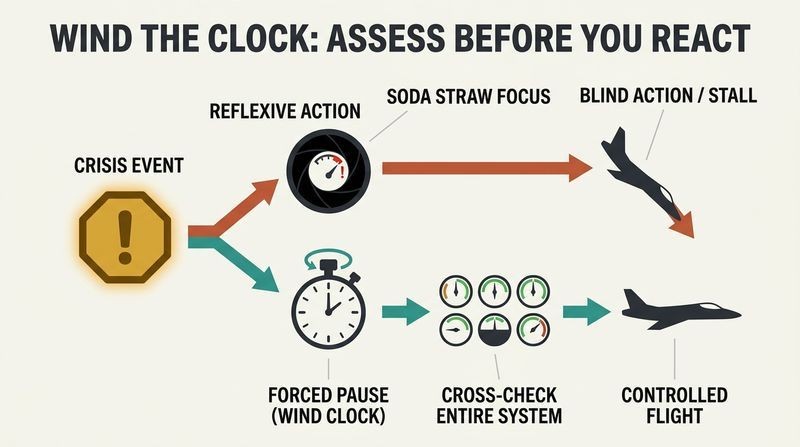
The counterintuitive claim, that slowing down under emergency prevents catastrophe, aligns with Daniel Kahneman's System 1 and System 2 distinction: stress hijacks us into fast, associative thinking exactly when deliberate reasoning is required. Aviation's black-box culture is itself a masterclass in institutional learning; medicine has borrowed it through surgical checklists (Atul Gawande) with measurable drops in mortality. One caveat worth noting: winding the clock works when seconds are available. In true split-second binds (a missile launch, a skid on ice) trained instinct must dominate. The skill is knowing which regime you are in, a meta-judgment the book returns to repeatedly.
Your brain assumes straight lines in a world that curves
Linear bias distorts most decisions. Humans intuitively expect proportional relationships, but reality runs on power laws, where small changes trigger outsized effects. Lee offers a penny that doubles daily: after 31 days it exceeds 10 million dollars, yet most people guess a few hundred. On day 20 you only have 20,000 dollars, so the explosive value hides until the knee in the curve.
He groups power laws into three types:
1. Exponential growth (populations, compound interest, doubling times)
2. Diminishing returns (each added cook helps less, then hurts)
3. Long tail (the 80-20 rule, where a few inputs drive most outcomes)
Even fuel math misleads: upgrading a 10 MPG truck to 20 MPG saves more gas than swapping a 20 MPG car for a 50 MPG car, because gallons burned, not MPG, is what counts.
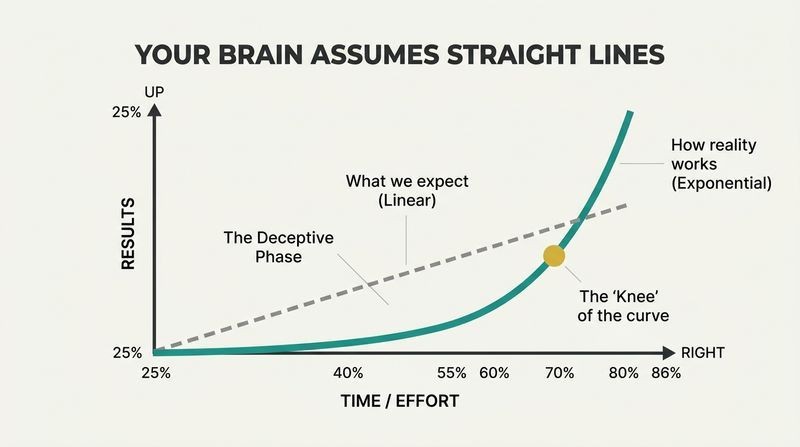
This is arguably the book's most transferable idea, and it echoes Nassim Taleb's warning that the modern world is dominated by fat-tailed, nonlinear dynamics our intuitions never evolved to handle. The MPG illusion is a documented cognitive error (the MPG paradox studied by Larrick and Soll). Lee's practical fixes, graphing data and testing extreme values, are genuinely useful: visualization offloads reasoning onto the fast visual cortex. Worth stressing that identifying which power law governs a system is itself hard and often only obvious in hindsight, which is precisely why the next takeaway's cautionary tale stings.
Excite passed on Google for 750,000 dollars by ignoring exponential growth
Missing a power law can cost trillions. In 1997 two Stanford students offered their search algorithm, then called BackRub, to Excite, the second largest web portal, for 750,000 dollars. CEO George Bell declined. He believed the search problem was solved, and worse, that a search engine too good would send users away and kill his ad-driven stickiness. His fix for spam was hiring 75 journalists to hand-rate websites, a linear solution to an exponentially growing internet.
The students became Larry Page and Sergey Brin, and BackRub became Google, worth over 1.5 trillion dollars. Bell also missed Metcalfe's Law, the principle that a network's value grows exponentially with its users. Portals bottlenecked connections; Google unleashed them. Today network effects can account for 70 percent or more of a digital company's value.
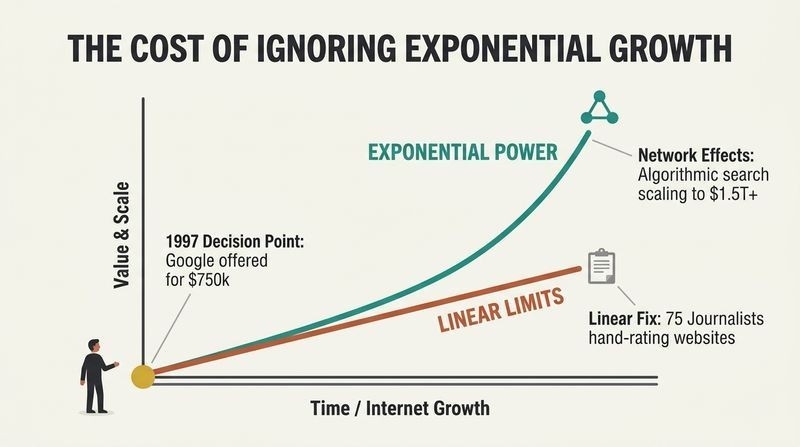
The story is a vivid business parable, though hindsight flatters it. Excite's failure was overdetermined: venture-capital control, a media-company mindset, and the fatal contract clause requiring the algorithm actually be used all played roles. Still, Lee's core diagnosis holds. Clayton Christensen's disruption theory describes the same trap: incumbents optimize existing metrics (stickiness, page views) while a technology reframes the entire game. The deeper lesson is epistemic humility about growth curves. In 1997 the internet's graph genuinely looked linear if you zoomed in, which is why extrapolating from extreme data points, as Lee advises, is a discipline rather than an instinct.
Teach concepts, not facts, so knowledge survives contact with chaos
Facts are leaves; concepts are the trunk. When the Air Force built F-35 training from scratch, Lee's team prioritized understanding over memorization. A pilot did not need an enemy missile's exact numbers; he needed to grasp how he would be targeted and how to defend. Numbers change fast; concepts evolve slowly. Any fact unattached to a concept is a fallen leaf, useless to the tree.
Their principles included making training learner-centered (customized syllabi, small classes), coaching rather than gatekeeping (a student's failure is treated as the system's failure), and using a spectrum of technology instead of one overbuilt simulator. Crucially, they killed rote tests, such as handwriting emergency procedures where a misspelling grounded a pilot, because punctuation has zero bearing on flying the actual emergency.
This maps neatly onto learning science: the distinction between transferable schemas and inert knowledge is well established since the 1980s. Experts, per research on chess masters and physicists, store patterns and causal models, not isolated data. Lee's insistence on asking why also mirrors the Socratic method and constructivist pedagogy, where learners integrate new material into existing frameworks. The critique of memorization-heavy testing indicts most formal schooling, which Lee traces to Industrial Revolution convergent thinking. One tension: some domains (aviation limits, medicine dosages) genuinely require memorized facts under load. The art is discerning which facts must be automatic versus which can be looked up.
The debrief where rank comes off is where mastery compounds
Brutal, egoless review beats talent. Fighter pilots fly for ninety minutes then debrief for hours, sometimes days, dissecting everything that went wrong. The rule that makes it work: rank comes off. A junior pilot can call out the base commander's mistakes, and the commander thanks him. The moment one person deflects blame, the collaborative environment collapses, so the highest-ranking pilot must model owning errors first.
The structure is disciplined:
1. Gather data (jets record every input, screen, and glance)
2. Reconstruct a god's-eye view of the mission
3. Analyze failed objectives and trace contributing factors
4. Teach the lessons back to everyone
Lee illustrates with a failed hostage-rescue exercise he commanded, where he built timing on everything going right instead of the typical 10-15 percent delay, and chose to execute without contact with the downed pilot.
The egalitarian debrief is a structural solution to a psychological problem, and it resonates with Amy Edmondson's research on psychological safety, which finds that teams admitting more errors actually perform better because they surface and fix them. Ray Dalio's radical transparency at Bridgewater is a corporate cousin. The genius is decoupling identity from performance: in the debrief, winning means finding your own mistakes. This is harder than it sounds because status hierarchies are evolutionarily sticky; the culture requires constant maintenance by leaders, as Lee stresses. It is a rare example of an institution engineering humility rather than merely preaching it.
Estimate expected value fast; precision is the enemy of a decision
Fast-forecasting beats false precision. Every decision is a bet. Expected value equals the upside times its probability minus the downside times its probability. But real-world probabilities are unknowable, what Lee calls the base of sand problem that plagues elaborate computer models. So pilots extrapolate from hard-won intuition to ballpark the answer, focusing only on the few variables that power laws make dominant.
Lee shows this over Bagram with fifteen minutes of fuel and a bombed runway. In roughly fifteen seconds he estimated a 97 percent survival rate landing on the cratered runway versus ejecting (98 percent survival but over 50 percent injury and guaranteed loss of the jet), eliminated ejecting, then hunted for a better option, ultimately refueling from a tanker he raced to intercept. Oversimplify first, refine later.
Fast-forecasting is essentially Fermi estimation fused with decision theory, and it echoes Gerd Gigerenzer's work showing that simple heuristics often outperform complex models in uncertain environments (the less-is-more effect). Lee's Feynman quote, that one must grasp roughly how an answer looks before making it precise, is a profound endorsement from physics itself. The approach also guards against analysis paralysis by pricing delay as a real cost. A fair challenge: subjective probability estimates can smuggle in bias and overconfidence, and calibration training (as in superforecasting research by Philip Tetlock) matters. Lee's antidote, having each person forecast independently before discussion, neatly counters groupthink.
Define the effect you need, then find any tool that delivers it
Effects over tools unlocks creativity. Effects-based operations, the doctrine behind the Gulf War's lopsided victory, starts with the desired outcome and refuses to tie it to a specific tool. In 1991, planners needed to blind Iraq's radar network covertly. Traditional doctrine never used helicopters for a war's opening strike, but by listing the required effects (find the sites at night, stay undetected, destroy them, confirm destruction) an unprecedented answer emerged: pairing Air Force Pave Low helicopters with Army Apache gunships as Task Force Normandy. They punched a 20-mile corridor so hundreds of fighters slipped in unseen.
Apply it anywhere. Commuting is not a requirement for a car; it is a requirement for commute time, cost, and reliability, which might point to rideshare or transit instead.
This is functional fixedness solved by design, the cognitive trap (Duncker's candle problem) where we see objects only in their conventional use. Effects-based thinking forces abstraction to the function layer, which is exactly how breakthrough innovation happens. Clayton Christensen's jobs-to-be-done framework is the business analog: customers hire a milkshake for a job, not for its milkshake-ness. Lee's structured creativity technique, prioritizing required effects and finding solutions for just the top one before layering constraints, is a practical de-anchoring device for groups. The Gulf War framing carries survivorship bias, since we remember the elegant plans that worked, but the underlying method is sound and teachable.
Build flexibility in, because complex systems refuse to be predicted
A creative enemy shreds rigid plans. Effects-based operations assumes a world of adaptive systems where small inputs cause huge outputs, so plans must anticipate change. Lee's cautionary tale is the 1999 shootdown of an F-117 stealth fighter, supposedly invisible, by Serbian officer Zoltan Dani's obsolete 1950s missile battalion. Dani innovated relentlessly: he made his immobile system mobile (packing up in ninety minutes), used his radar only in twenty-second bursts, built decoys from scrapped MiG radars, and planted spies near NATO bases. NATO helped him by flying nearly identical routes every night, letting him predict the attack.
Creativity, Lee argues, is the one resource that yields an exponential edge. Ukraine's improvised drone bombers and information warfare against a larger, inflexible Russian force make the same point.
The F-117 story is a beautiful humbling of technological determinism: cheap ingenuity beat billion-dollar stealth because NATO's bureaucratic rigidity became a predictable pattern. This connects to John Boyd's OODA loop, the idea that whoever cycles through observe-orient-decide-act faster imposes chaos on the enemy. Complexity science (Santa Fe Institute) formalizes why emergent behavior defies forecasting. The practical takeaway, decentralize authority so frontline actors can adapt, is echoed in modern management by mission command and in software by agile methods. Lee's own combat experience of altering orders on nearly every flight shows the doctrine internalized. The caution against believing models can predict war is well-earned humility.
Mental toughness is a trainable skill, not an inborn gift
Emotions can be engineered. Lee says pilots lose twenty IQ points the moment they put on the helmet, because stress floods the amygdala, shuts down the prefrontal cortex, and shrinks working memory. He watched a top student unravel over a single wrong radio frequency, spiraling into missed calls and erratic flying because anger and fear hijacked him. The Air Force long treated this as innate and washed out those who cracked.
Drawing on his boxing background, Lee helped build a formal program teaching four tools:
1. Preparation until skills are subconscious reflexes
2. Focus-based training (meditation to observe and release thoughts)
3. Box breathing to trigger the parasympathetic nervous system
4. Reframing negative self-talk with past counterexamples
Washout rates fell, and average students gained the most.
This mirrors the professionalization of sports psychology, where visualization, self-talk, and arousal control are now standard for Olympic athletes, as Lee notes. The neuroscience is accurate: Amy Arnsten's research documents how acute stress impairs prefrontal function while strengthening amygdala-driven habit. The reframing technique is essentially cognitive behavioral therapy applied preemptively. What is notable is the institutional shift from a Darwinian eat-your-own culture to a coachable-skill model, which challenges the macho mythology of elite performance. A modest caveat: individual differences in stress reactivity are real (genetics, temperament), so training raises everyone's floor but does not fully erase the spread. Still, treating grit as teachable is empirically defensible and humane.
Sort every task by importance versus urgency, then ruthlessly cut
Eisenhower's genius was prioritization. Facing the D-Day launch decision in June 1944, Eisenhower identified the weather as the single most important variable and the timing call as his highest-leverage decision, then guarded his focus for it. His framework sorts tasks into four quadrants:
1. Urgent and important (act now, the near rocks that can kill you)
2. Important but not urgent (schedule early, the far rocks)
3. Urgent but not important (delegate; beware the urgency effect that lures us into email over deep work)
4. Neither (delete entirely)
The subtle trap is quadrant three: our novelty-wired brains chase urgency over importance. After ordering the invasion, Eisenhower deliberately played checkers and board games to mentally recharge, knowing his judgment would be needed again.
The Eisenhower Matrix is now a productivity cliche, but Lee revives it with the striking detail of a general playing board games during history's largest invasion, illustrating that strategic rest is a decision, not a luxury. The urgency effect is documented behavioral science (Zhu, Yang, and Hsee showed people irrationally prefer urgent-but-trivial tasks). Cal Newport's deep work extends the same warning about shallow-task creep. What Lee adds is the framing that without a clear objective, the mind defaults to urgency regardless of importance, which reframes goal-setting as a prerequisite for prioritization rather than a separate exercise. The military near-rock, far-rock language makes the abstract quadrants viscerally memorable.
When options tie, pick the riskiest viable one, then commit
Indecision is itself a decision, usually the worst. People freeze trying to refine choices down to a single perfect answer, but often too much uncertainty remains. Lee's method: eliminate the clearly bad options (99 percent of routes across town are obviously poor), then apply your priorities to narrow to two or three good ones. At that point, stop deliberating and pick any viable option, or the simplest one to conserve mental energy and reduce failure points.
For consequential life choices among roughly equal options, he argues the riskiest viable one usually returns the most value, because humans are biologically wired to overestimate risk, so overcoming that instinct is a durable edge. Never exceed 90 percent task saturation; hit 100 percent and tasks drop off whether you choose them or not.
The claim that risk-aversion is systematically miscalibrated has strong support in Kahneman and Tversky's prospect theory, which shows losses loom larger than equivalent gains, biasing us toward inaction. Lee's edge-through-risk logic resembles the entrepreneurial and career advice that asymmetric bets (limited downside, large upside) are underexploited precisely because most people flee volatility. The 90 percent saturation rule is a sharp operational insight from aviation cognitive-load research: leaving spare capacity preserves the ability to reprioritize when the unexpected hits. One nuance the framing understates: riskiest-viable is sound when downside is survivable, but for irreversible, ruinous downsides the asymmetry reverses, a distinction the expected-value tools elsewhere in the book handle.
Analysis
Hasard Lee has written a decision-making manual disguised as a combat memoir, and the disguise is the point. The book's structure is the ACE Helix (Assess, Choose, Execute), chosen as a helix because decisions spiral, generating second- and third-order effects that never return to their starting point. Each chapter pairs a white-knuckle flying story (a Mach 1.9 test run, a danger-close bombing near friendly troops, a fuel-starved night over a bombed runway) with a historical case (Air France 447, Google versus Excite, D-Day) and distills a transferable principle. The pedagogy embodies its own thesis: Lee argues stories fuse context with knowledge to create durable understanding, and the book is engineered accordingly.
What distinguishes this from the crowded decision-science shelf is its provenance. Most such books are written by academics synthesizing experiments; this one is written by a practitioner whose errors killed people or nearly killed him. That gives the material an unusual weight and an unusual bias. The weight: these principles were paid for in lives and 50-million-dollar training pipelines. The bias: survivorship and a tendency to present aviation doctrine as universally applicable when some lessons are domain-specific. The book is strongest when Lee is humble about uncertainty (fast-forecasting, flexibility, the base-of-sand critique of models) and slightly weaker when confident heuristics (riskiest-viable-option, the finger-tapping tiebreaker) are extrapolated to life at large.
Intellectually, the book quietly integrates Boyd's OODA loop, Kahneman's dual-process psychology, Taleb's nonlinearity, Gigerenzer's fast-and-frugal heuristics, and Edmondson's psychological safety, without name-dropping most of them. Its most original contributions are cultural rather than conceptual: the egoless debrief, the reframing of mental toughness as trainable, and the concepts-over-facts learning model. The through-line is that in a technologically leveraged world where each decision is amplified, judgment, not talent or intelligence, is the scarce resource. A good pilot uses superior judgment to avoid needing superior skill. That maxim is the whole book.
Review Summary
The Art of Clear Thinking by Hasard Lee receives high praise for its engaging blend of fighter pilot experiences and practical decision-making strategies. Readers appreciate Lee's storytelling, the ACE Helix framework, and combat-tested techniques applicable to various fields. The book is lauded for its universal appeal, mental toughness insights, and ability to enhance cognitive abilities. While some find it overly masculine or autobiographical, most reviewers recommend it as a valuable resource for improving decision-making skills and navigating uncertainty with clarity.
People Also Read


Glossary
ACE Helix
Assess, Choose, Execute decision frameworkLee's three-part model for making decisions under pressure: first Assess the problem accurately, then Choose the best course of action by weighing expected value, then Execute by prioritizing and managing mental bandwidth. It is drawn as a helix because decisions are dynamic, producing cascading second- and third-order effects that shift conditions, so the framework must continually adapt rather than ending where it began.
Wind the clock
Pause before reacting to problemsAn F-16 training habit named for the useless analog clock in the cockpit. Instructors tell pilots to physically wind it before making a decision, occupying their hands and attention for a few seconds. This blocks the instinctive rush to fix a problem before understanding it, forcing the pilot to assess the full situation first.
Power laws
Small changes, disproportionately large effectsNonlinear relationships where a change in one variable produces an outsized change in another. Lee simplifies them into three types: exponential growth, diminishing returns, and the long tail (the 80-20 rule). Recognizing which power law governs a system lets a decision-maker prioritize the few variables that drive most of the outcome.
Fast-forecasting
Rapid intuitive expected-value estimationA technique for approximating the expected value of a decision by extrapolating from hard-won intuition rather than precise calculation. It deliberately oversimplifies, focusing only on the few dominant variables, because exact probabilities are usually unknowable. It prioritizes accuracy over precision and lets a decision-maker quickly eliminate bad options and narrow to viable ones.
Effects-based operations
Target outcomes, not specific toolsA military planning doctrine, central to the 1991 Gulf War, that starts from a desired end state and works backward, refusing to tie a requirement to any specific tool or process. By breaking problems into required effects, planners find creative solutions (like pairing helicopters for a war's opening strike) that traditional force-on-force thinking would miss.
Getting sucked into the soda straw
Fixating on one data sourceA pilot's term for tunnel vision, where attention locks onto a single instrument or piece of information at the expense of the bigger picture. Lee warns that this causes a decision-maker to lose sight of how their actions fit the larger system, which is why pilots deliberately cross-check all senses and instruments.
Focus-based training
Meditation for present-moment attentionA meditation-derived practice in Lee's mental-toughness program where pilots learn to objectively observe the stream of their thoughts without fixating on any, then return attention to the present when it drifts. It trains the mind to release dwelling on past mistakes or future worries and concentrate only on the next controllable decision.
Danger close
Weapon dropped near friendly forcesAn airstrike delivered so near friendly troops that there is significant risk of wounding or killing them. Because a bomb's destructive force follows a steep long-tail power law, dropping at one-third the normal safe distance exposes troops to roughly twenty-seven times the blast and fragmentation, making such drops extraordinarily high-stakes.
Staking
Extrapolating from memorized anchor numbersA mental shortcut where you memorize a few key reference values and extrapolate between them to solve complex calculations quickly, without pausing to compute or look up formulas. Lee uses it for Fahrenheit-to-Celsius conversion and for combat tasks like fuel management and weapons timing, where calculus has been solved ahead of time.
FAQ
What's The Art of Clear Thinking about?
- Decision-Making Focus: The book explores decision-making processes, particularly in high-stakes environments like military operations, using the author's experiences as a stealth fighter pilot.
- ACE Helix Framework: Introduces the ACE Helix framework—Assess, Choose, Execute—to systematically approach decision-making in complex situations.
- Human vs. Computer: Discusses the advantages of human decision-making over computer algorithms, emphasizing adaptability and creativity.
- Real-World Applications: While rooted in aviation, the principles are applicable to various fields, including business and healthcare.
Why should I read The Art of Clear Thinking?
- Practical Insights: Offers practical tools and techniques for improving decision-making abilities, applicable across different contexts.
- Engaging Stories: Uses compelling stories from the author's flying career to illustrate key concepts, making the material relatable.
- Enhance Critical Thinking: Encourages questioning assumptions and thinking creatively, valuable in today's fast-paced environment.
- Unique Perspective: Provides a unique perspective on high-pressure decision-making from a fighter pilot's viewpoint.
What are the key takeaways of The Art of Clear Thinking?
- Importance of Clarity: Clear thinking is essential for effective decision-making, especially in complex situations.
- OODA Loop: Discusses the OODA (Observe, Orient, Decide, Act) loop for rapid adaptation in dynamic environments.
- Learning from Mistakes: Highlights the value of debriefing and learning from past experiences to refine decision-making skills.
- Creativity in Solutions: Emphasizes the need for creativity in problem-solving, advocating for a flexible approach.
What is the ACE Helix in The Art of Clear Thinking and how does it work?
- Three Phases: Consists of Assess, Choose, and Execute, each building on the previous to create a dynamic decision-making framework.
- Assess Phase: Involves gathering information and analyzing the situation to understand the problem fully.
- Choose and Execute: After assessment, individuals choose the best course of action and execute it effectively, with continuous evaluation.
- Dynamic Framework: Encourages ongoing adjustment as new information becomes available.
What is the fast-forecasting method mentioned in The Art of Clear Thinking?
- Quick Estimation: Involves rapidly estimating the expected value of a decision based on available information.
- Accountability: Holds individuals accountable for their understanding of the situation, preventing groupthink.
- Improves Decision Quality: Enhances decision quality by integrating critical thinking and personal judgment.
- Streamlined Process: Allows for quicker decision-making without excessive analysis.
How does The Art of Clear Thinking define creativity in decision-making?
- Connecting Ideas: Creativity is the ability to connect seemingly unrelated ideas to form innovative solutions.
- Framework for Creativity: Provides a framework for fostering creativity by breaking down problems into essential effects.
- Real-World Applications: Illustrates how creativity can lead to exponential advantages in various fields.
- Crucial Skill: Argues that creativity is crucial for effective problem-solving.
What are the best quotes from The Art of Clear Thinking and what do they mean?
- “There’s no problem so bad you can’t make it worse.”: Highlights the importance of careful decision-making to avoid exacerbating problems.
- “You don’t rise to the level of your expectations, you fall to the level of your preparation.”: Emphasizes the importance of thorough preparation for success.
- “What is important is seldom urgent and what is urgent is seldom important.”: Encourages prioritization in decision-making, focusing on long-term goals.
- “A good pilot uses superior judgment to avoid situations that require the use of superior skill.”: Reflects the value of proactive decision-making over reactive problem-solving.
How does the author use storytelling in The Art of Clear Thinking?
- Personal Experiences: Shares anecdotes from his time as a fighter pilot to illustrate key concepts.
- Engagement: Storytelling engages readers and maintains interest, transforming complex ideas into memorable narratives.
- Lessons Learned: Each story ties to specific lessons about decision-making, reinforcing the book's teachings.
- Relatable Context: Provides context and makes the material more relatable to readers.
What role does technology play in decision-making according to The Art of Clear Thinking?
- Augmentation of Training: Technology enhances training and decision-making processes through simulators and virtual reality tools.
- Data Analysis: Enables the collection and analysis of vast amounts of data to inform decision-making.
- Continuous Improvement: Emphasizes the need to continually assess and adapt technology for improved decision-making capabilities.
- Staying Ahead: Helps organizations stay ahead in dynamic environments.
How can the principles in The Art of Clear Thinking be applied outside of aviation?
- Business Decision-Making: Frameworks and techniques improve strategic planning and operational efficiency in business settings.
- Healthcare and Emergency Response: Professionals can make quick, informed decisions in high-pressure situations.
- Personal Life: Individuals can enhance decision-making skills in everyday life by adopting a structured approach.
- Universal Relevance: Principles are applicable across various fields and contexts.
What is the significance of debriefing in the decision-making process in The Art of Clear Thinking?
- Learning from Experience: Debriefing allows reflection on decisions and identification of areas for improvement.
- Team Collaboration: Fosters collaboration and communication among team members, encouraging open discussions.
- Continuous Improvement: Analyzing past missions helps refine strategies and build a culture of continuous improvement.
- Collective Learning: Leads to collective learning and better decision-making over time.
How does The Art of Clear Thinking address the concept of mental toughness?
- Skill Development: Argues that mental toughness is a skill that can be developed through training and practice.
- Techniques for Resilience: Outlines techniques like visualization, self-talk, and breathing exercises to build mental toughness.
- Real-Life Applications: Shares personal experiences to illustrate the importance of mental toughness in high-pressure scenarios.
- Accessible Concept: Makes the concept accessible and relatable to readers through practical examples.
Download PDF
Download EPUB
.epub digital book format is ideal for reading ebooks on phones, tablets, and e-readers.








































