
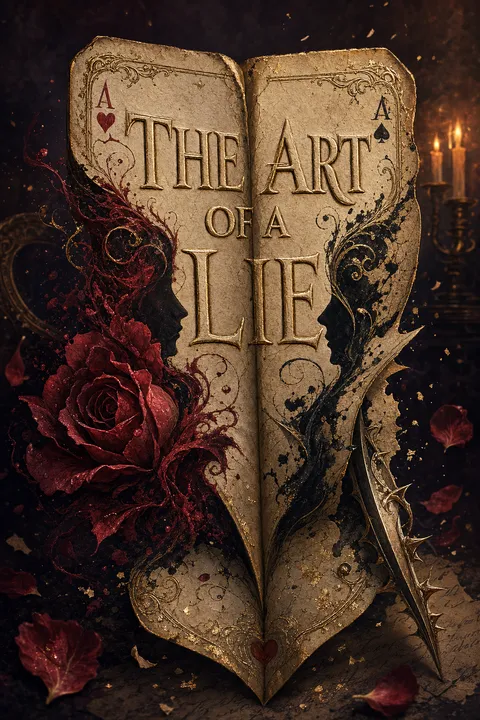


Plot Summary
A Stranger Orders Sherbet
At the Punchbowl and Pineapple, her grandfather's confectionary shop on Piccadilly, Hannah Cole1 studies a stylish customer2 in the mirror behind her counter. He introduces himself as William Devereux,2 claims he advised her late husband Jonas4 on investments, and presses a silver crown into her hand as a dividend.
Widowed barely three months, drowning in debts and bled by suppliers who resent a woman in trade, Hannah1 grasps at the unexpected coins. When he reminisces about the iced cream his Italian mother once made, a frozen delicacy unknown in London, she sees a way to lure new customers. The seed of innovation, and of their entanglement, is planted in a single conversation over rosewater ice.
The opening establishes Hannah as a woman performing composure over precarity, reading desire in others the way a confectioner anticipates a craving. Devereux's entrance is staged as seduction disguised as commerce, his charm refracted through the literal mirror that becomes the novel's governing metaphor. Shepherd-Robinson frames eighteenth-century widowhood as economic peril: respectability and solvency are mutually hostile for a woman alone. Iced cream functions as both genuine aspiration and bait, fusing Hannah's hunger to survive with Devereux's hunger to exploit. The mirror motif signals that every face here reflects what the observer wants to see, inviting the reader into a story where surfaces and appetites conceal predatory design.
Fifteen Hundred Hidden Pounds
Henry Fielding,3 the novelist turned chief magistrate of Westminster, arrives to announce he is taking personal charge of Jonas Cole's4 killing. He reveals that Jonas4 had secretly banked over fifteen hundred pounds, a fortune impossible from a shop earning ten pounds a week.
The missing watch never surfaced, and on the night he vanished Jonas4 twice asked a tavern landlord to watch for a midnight-blue carriage with brass trim. Fielding3 concludes the robbery was staged to mask a murder by an acquaintance, and freezes probate, suspecting the money was corruptly gained.
Daniel,5 Jonas's4 cousin and executor, confirms the stay and urges Hannah1 to leave the inquiry alone, fearing dangerous accomplices and clinging to his larger share of the inheritance.
Fielding embodies institutional suspicion sharpened by literary intuition, a man who reads human wickedness as both magistrate and author. His intervention transforms a closed case into an existential threat to Hannah, weaponizing the law's machinery against her livelihood through frozen probate. The hidden fortune introduces the corruption subplot while destabilizing Hannah's understanding of her own marriage. Daniel's evasiveness plants distrust, suggesting men perpetually withhold knowledge from her. The blue carriage operates as a tantalizing clue and red herring. Crucially, Fielding's professional ambition (he needs a solved murder to win parliamentary support for his police) makes his pursuit personal, turning justice into a vehicle for self-advancement.
The Mallet in the Cellar
The grieving facade collapses into confession: Hannah1 herself killed Jonas,4 beating in his skull with the mallet she uses to break ice. She insists it was necessity rather than pleasure, hinting that Jonas4 had been planning something monstrous that had to be stopped. Now Fielding's3 revelations terrify her, because the comfortable fiction of a street robbery has shattered.
If she can prove the money was honestly won, perhaps gambling, she can steer him back toward footpads and away from the dark corners of her marriage. She finds a porcelain fish among Jonas's4 effects, a gaming token, and resolves to trace it. Her grief is performance; her real labor is concealment, and every customer who praises her dead husband4 twists the knife.
This early reversal detonates the reader's sympathy and reconstructs the entire narrative as a study in justified or unjustified violence. By granting Hannah the confession privately, Shepherd-Robinson makes complicity intimate: we now share her secret and her dread. The mallet, a tool of her craft, doubles as instrument of murder, collapsing nurture and destruction. Her cool procedural mind, treating concealment like a recipe, mirrors Fielding's analytic method and foreshadows her later cunning. The withholding of motive sustains suspense while inviting moral calculation. The chapter interrogates how patriarchal law would never recognize a wife's desperation as self-defense, positioning Hannah as both perpetrator and victim of an unjust order.
The Golden Hell's Fish
Devereux2 escorts Hannah1 to Professor Becker's19 chemistry spectacle, where the showman reveals that salt mixed with ice draws out hidden heat and freezes cream solid. The dissolute young aristocrat Lord Richard11 identifies her porcelain token as belonging to the Goldfish, an exclusive gaming house in St James's Square.
Ignoring warnings, Hannah1 goes there alone, where a man named Arbuthnot lures her into an alley and assaults her; she stabs him with a pastry knife and flees. Devereux2 finds her trembling, comforts her in her kitchen, and offers to investigate the Goldfish himself. That same evening her iced cream finally freezes to perfection, and amid shared laughter Fielding3 walks in, requesting questions about her marriage.
The chapter braids triumph and trauma, science and violence. Becker's lesson, that cold liquids secretly contain fire, becomes an emblem for the novel's buried passions and concealed truths. Hannah's solitary venture into the male preserve of the gaming house exposes the bodily danger women face when they transgress social boundaries, and her knife answers Arbuthnot's predation with the same improvisational survival instinct that killed Jonas. Devereux's tender rescue deepens her dependence precisely when she is most vulnerable. The simultaneous arrival of culinary success and Fielding's renewed scrutiny dramatizes Hannah's predicament: every step toward salvation draws the magistrate's eye closer to her guilt.
The Swindler Behind the Smile
The perspective flips to Devereux,2 who is no gentleman but Spruce Billy, born William Cullen, a confidence trickster operating from the Black Lion tavern among actors and thieves. He never knew Jonas;4 the dividend, the friendship, the recipe hunt were all invention. A clerk at the probate court tips him off to wealthy widows, and Hannah,1 set to inherit five hundred pounds and a shop, is his mark.
He plans to extract four hundred, leaving her enough to feel merely unlucky rather than robbed. His method, the Mirror, reflects a woman's dead husband and unmet longings until she falls. His coachman Tom6 is his accomplice, his lover Amy10 and elderly Sylvia (playing Mrs Parmenter)17 his supporting cast.
The structural pivot recasts every prior tender gesture as choreography, implicating the reader who, like Hannah, was charmed. Billy's first-person rationalizations, that he leaves widows happier and only somewhat poorer, expose the predator's self-mythology and the seductive logic of the lie. Shepherd-Robinson stages a delicious dramatic irony: two deceivers circling each other, each believing themselves the puppeteer. The Mirror theory crystallizes the book's thesis that people believe what flatters them. Billy's reliance on theatrical labor, scripted chaperones and hired aristocrats, frames con artistry as authored fiction, making him a dark double of both Hannah the storyteller and Fielding the novelist-magistrate.
The Dance at Ranelagh
Billy2 escorts Hannah1 to the Rotunda at Ranelagh Gardens, the centerpiece of his orchestrated courtship he calls the Dance. There he confronts Mitford Banks,13 the corrupt clerk known as Mr Fox who sold gaming houses advance warning of magistrates' raids, the very racket through which Jonas4 enriched himself. Banks13 surrenders a list of bribed officials and gaming bosses.
Meanwhile Billy's2 actress,10 posing as Lady Mountford, draws Hannah1 aside and confides that Devereux2 is secretly smitten and has defended her honor in glowing terms. A staged carriage breakdown strands the pair under the stars, and Hannah,1 flushed with wine and the planted flattery, begins to flirt, lowering her guard exactly as Billy2 intends.
Ranelagh functions as theater within theater: a real pleasure garden converted into Billy's private stage. The Lady Mountford ploy demonstrates the psychology of indirect persuasion, since praise overheard from a third party bypasses skepticism more effectively than direct flattery. Shepherd-Robinson dramatizes how desire is manufactured, how Hannah's loneliness is reverse-engineered into longing. The Banks subplot grounds the romance in the corruption economy, revealing that Jonas's fortune came from extorting the very system meant to police vice. The list becomes leverage. The chapter's pleasure lies in watching Hannah, herself a consummate liar, be outmaneuvered by a superior practitioner of the same craft.
Outwitting the Magistrate
Billy2 visits Fielding3 and spins a tale: an anonymous letter exposed Jonas's4 corruption, prompting a furious quarrel between them. He hands over the list of crooked magistrates, warning that prosecuting Hannah's1 fortune would make powerful enemies and doom Fielding's3 cherished judicial reforms. Fielding3 relents and lifts the stay on probate.
But he drops a bombshell: Jonas4 kept a pregnant mistress named Annette16 and planned to flee to Scotland, and Annette16 believes Hannah1 murdered him. Shaken, Billy2 travels to Hackney to visit his dying stepmother, who reveals his mother was never an adulteress but was locked in a madhouse by his cruel father, where she died by her own hand. The discovery cracks something deep in him.
Billy's manipulation of Fielding showcases how reform-minded idealism can be turned against itself, since the magistrate sacrifices a corruption probe to protect his larger ambition and his romantic fantasy of true love crossing class lines. The Annette revelation introduces dramatic irony at scale: Billy now holds a secret that endangers his mark and his payday. The Hackney interlude humanizes the con man, exposing the originating wound beneath his charm, a mother betrayed and abandoned, a father who taught fearlessness through cruelty. Shepherd-Robinson suggests Billy's predation on widows is a compulsive reenactment of maternal loss, the lie a defense against unbearable truth.
A Kiss and a Threat
Billy2 delivers the devastating account of Jonas's4 mistress and her unborn child. Hannah,1 undone, kisses him with raw hunger, and Billy,2 unexpectedly disarmed, pulls away and flees his own seduction. That night the crime boss Patrick Musgrave,12 owner of the midnight-blue carriage and master of the gaming empire Jonas4 robbed, forces his way into Billy's2 rooms with hired thugs.
He has heard Billy2 asked questions about Jonas,4 was himself arrested and cleared of the murder, and now claims Hannah's1 inheritance as restitution for what Jonas4 stole. He demands four hundred pounds, leaving Billy2 a humiliating hundred. The con that promised easy profit is now squeezed between a vengeful magistrate3 and a remorseless villain who skins men alive.12
The kiss marks the fissure in Billy's professional armor, the moment his Mirror begins reflecting genuine feeling back at him. His retreat, baffling to himself, signals authentic disturbance rather than tactic. Musgrave's intrusion escalates stakes from financial to mortal, externalizing the danger Billy has courted by meddling near real violence. The revelation that Musgrave has an alibi reopens the murder question for Billy, who cannot know Hannah is the killer. Shepherd-Robinson tightens the vise: Billy is now performing love while being hunted, and the money he means to steal is already promised to a man who answers betrayal with crucifixion. Desire and danger become inseparable.
Reading the Dead Man's Letters
Hannah1 reveals the full reason she killed Jonas.4 Drugging his wine, she opened his locked letters and learned he intended to sell her grandfather's shop, her only inheritance and home, to fund a new life in Scotland with Annette,16 leaving her destitute. She waited for a storm to swell the underground river beneath her ice-store, then lured him down and struck.
In the present, she and Billy2 become lovers, and for the first time since Jonas4 she feels alive, even as Fielding's3 noose tightens. Daniel,5 meanwhile, declares his own love and expectation of marriage; when Hannah1 refuses him, naming her feelings for Devereux,2 he turns vicious and warns she will regret her choice.
Hannah's motive transforms her from suspect to tragic agent: not jealousy but dispossession drove her, the threatened erasure of her patrimony and identity under laws that rendered wives propertyless. The culverted river, weaponized by weather, shows her methodical intelligence. Her affair with Billy is doubly ironic, each lying to the other while she experiences her truest joy inside his fabrication. Daniel's proposal reframes him as another man who covets her body and shop, and his rejection breeds the resentment that will later betray her. The chapter deepens the novel's argument that women's survival demands deception, and that love and danger arrive entwined.
The Mansion and the Boy
Billy2 unveils his masterstroke: a mansion at Kensington Gore and a golden-curled child named Teddy,14 supposedly his orphaned ward menaced by a brutal stepfather. Watching Hannah,1 barren and aching, cradle the boy,14 he sees the perfect snare, a future of motherhood and marriage dangled before her.
At Morrow House, Lord Richard11 hosts a lavish supper for the Arcadia syndicate, complete with a turbaned ambassador and a tiger cub, celebrating a plantation colony that supposedly doubles investors' money yearly. Hannah's1 pineapple sculpted from iced cream dazzles the guests. Then the agent Bennett reports a ship impounded in Lisbon demanding heavy fees, a contrived emergency designed to make Hannah1 hungry to invest her windfall.
Teddy is the cruelest instrument, exploiting Hannah's deepest grief, her childlessness, the wound Jonas inflicted with his contempt. Billy converts maternal longing into financial leverage with chilling craft, yet his own buried mother-loss bleeds through. The Arcadia supper is elaborate theater, an entire fictional colony staged to manufacture credibility, echoing the historical Poyais fraud. The tiger cub and ambassador are props in a confidence cathedral. Shepherd-Robinson exposes how greed is seeded socially, through envy and belonging, and how the promise of a family and a future is the most powerful currency of all. The ship crisis primes the trap's spring.
The Name He Denied
Billy2 invents a new emergency: Teddy's14 mother demands five hundred pounds or she will spirit the boy14 to Ireland and his violent stepfather. With his funds supposedly tied up in the mansion and the Lisbon ship, he cannot pay. Hannah,1 desperate to save the child and the dream, insists on lending him her inheritance once probate clears.
The trap closes. But as Billy2 leaves the shop, a man named David Thewson hails him as William Everhart,2 an old acquaintance from a Wandsworth military academy. Billy2 coolly denies it, yet Hannah1 glimpses a flicker of panic, the same evasion Jonas4 wore when caught in a lie. Her trust fractures, and the practiced deceiver in her begins to wake.
The double blackmail fuses Hannah's compassion and aspiration into a single irresistible pull, demonstrating that the most effective lies recruit the victim's virtues rather than her vices. Billy nearly succeeds because Hannah wants to be generous, to mother, to belong. Thewson's recognition is the plot's hinge, a chance encounter that activates Hannah's dormant suspicion. Her recognition of the liar's tell, learned at Jonas's side, is poignant: her painful marital education becomes her weapon. Shepherd-Robinson stages the reversal subtly, a flicker rather than a confrontation, honoring Hannah's intelligence. The hunter senses the hook, and the duel of deceivers tilts toward its true contest.
Hannah Unmasks the Con
Refusing to be a fool twice, Hannah1 investigates rather than confront. At the Royal Hospital in Chelsea she learns Everhart2 was court-martialed at Tilbury for negligence and theft. Mary George,18 a fellow officer's widow, paints him as a slandered hero.
But Billy,2 alerted by Felix8 and aided by Amy,10 has already rigged the trail: Amy10 poses as Penelope Felton,15 telling Hannah1 a tearful tale of Everhart's2 wronged innocence and undying love, complete with forged letters.
Hannah1 plays along, then waits outside the lodging house and watches the supposed Mrs Felton10 climb into a chaise driven by Tom,6 Devereux's2 manservant. The whole rescue narrative is exposed as staged. Devastated and enraged, Hannah1 finally grasps the full scope of the con against her.
Hannah's methodical detective work mirrors Fielding's and Billy's, completing the trio of master manipulators. Billy's countermove, fabricating an entire exonerating biography, represents the con's apotheosis and its overreach, since the very elaborateness leaves a thread to pull. The image of Tom driving the false widow is the moment fiction's seams show. Hannah's response, betrayal sharpened into cold purpose rather than collapse, reveals her formidable resilience. Shepherd-Robinson frames the discovery as worse than Jonas's cruelty, because Billy weaponized her hopes and her dead child's surrogate. The wronged woman who once killed to protect her home now turns her storytelling gift toward vengeance.
Arrested, Then Rescued by Water
Daniel,5 spurned, reports to Fielding3 that Jonas4 suspected Hannah's1 jealousy, and Oscar,9 broken under questioning, confesses he found the cellar floor scrubbed clean and a bloodied tooth behind a flour sack. Fielding3 arrests Hannah1 and sends constables to find the missing watch. In her cell she tells Billy2 the watch lies hidden in her ice tub down the well.
Driven by genuine love and the need to free her for the money, Billy2 breaks into the empty house next door, descends its well, and plunges into the storm-swollen culverted river, nearly drowning to retrieve the oilskin packet. He then hires Musgrave's12 fearsome lawyer, and with insufficient evidence and Devereux's2 testimony, Fielding3 is forced to release her.
The arrest pays off the buried tooth, the scrubbed floor, and Daniel's grievance, the seeds sown chapters earlier. Oscar's confession dramatizes how the powerless are coerced into betraying their protectors. Billy's underwater ordeal is his moral climax: the man terrified of water since his father dunked him in the millrace conquers that primal fear for Hannah, proving his feeling outruns his greed. The river that swallowed Jonas now nearly swallows Billy, binding the two crimes in one current. Shepherd-Robinson lets the swindler perform an act of authentic, near-fatal sacrifice, complicating any simple verdict on him even as Hannah prepares his destruction.
The Shroud She Embroidered
Freed, Hannah1 spends one final night with Billy,2 professing love that is both surrender and declaration of war. She hands him a bank authorization letter, then plants Jonas's4 watch in his rooms and brings Fielding3 a forged trade card and the very letters Amy10 gave her, steering him to suspect Devereux2 of the murder. Fielding3 arrests Billy2 at the bank.
Cornered, abandoned by Penelope Felton,15 Billy2 faces Tom,6 who silences him to protect his own future; Fielding3 calls it suicide. The Countess of Yarmouth's visit rescues Hannah's1 shop. Then Fielding3 reveals Billy2 never withdrew her money, and his final letter arrives: a tale of ruin and renunciation, woven from lies, written to spare her, a last gift from the man who loved her.2
Hannah's revenge completes her transformation into supreme author of the narrative, turning Billy's own techniques, the planted suggestion, the flattered ego, against him with lethal elegance. The framing is poetic justice and self-preservation fused. Yet the closing inversion devastates: Billy had already chosen not to rob her, leaving her fortune untouched and crafting a final fiction to release her honorably. His death, ambiguous between betrayal and mercy, and his letter, lies braided with truth, fulfill the novel's thesis that storytelling can wound and redeem alike. Shepherd-Robinson ends on tragic irony: each lover saved the other while destroying them, love and lie indistinguishable to the last.
Analysis
The Art of a Lie is a duel of fabulists masquerading as a romance, in which a murderess1 and a confidence trickster2 fall in love while each schemes to destroy the other. Shepherd-Robinson's masterstroke is structural: by splitting narration between Hannah1 and Billy2 and detonating each one's secret as an early reversal, she makes the reader complicit in both deceptions, then forces a continual recalculation of sympathy. The result is a meditation on storytelling itself. Billy's2 Mirror technique, Hannah's1 performed grief, and Fielding's3 novelist's instinct all rest on the same premise that people believe what flatters or comforts them. Lies here are not merely crimes but acts of authorship, and the most dangerous fictions are the ones we write for ourselves. The novel is also a sharp historical argument about power. Hannah1 kills not from passion but because eighteenth-century law would let Jonas4 sell her inheritance and cast her destitute, rendering wives propertyless and voiceless. Her violence is reframed as the only redress available to a woman the system refuses to protect, while Billy2 preys on widows precisely because shame and double standards keep them silent. Corruption saturates every institution, the vestry, the bench, the gaming hells, so that the official guardians of justice are often the worst offenders. Against this, Fielding's3 incorruptible zeal becomes both admirable and exploitable. Most affecting is the tragic inversion of the climax: each lover saves the other while engineering their ruin, love and lie collapsing into a single gesture. Billy,2 the man who never says the words, performs his deepest truth through a final fiction; Hannah,1 having learned deceit at her cruel husband's side, weaponizes that education for survival and vengeance. The book leaves a bitter, glittering aftertaste, the recognition that we are all, to some degree, prisoners of the stories we need to believe.
Review Summary
The Art of a Lie is set in 1749 London and follows Hannah Cole, a widow struggling to maintain her confectionary shop after her husband's murder. Magistrate Henry Fielding suspects her late husband's money was obtained illegally and freezes her inheritance. William Devereux appears offering help and introduces Hannah to "iced cream," an Italian delicacy that revitalizes her business. The novel alternates between Hannah and William's perspectives, revealing layers of deception, secrets, and a battle of wits. Reviewers praise the clever plotting, historical detail, and numerous twists, though some found pacing issues or disliked the ending.
Characters
Hannah Cole
Widowed confectionerProprietor of the Punchbowl and Pineapple, a luxury sweet shop inherited from her grandfather, Hannah is intelligent, proud, and quietly formidable. Orphaned young and raised among sugar and spice by an adoring father, she married his apprentice Jonas4 and watched love curdle into cruelty over years of failed pregnancies. Now a struggling widow, she fights debts, scornful neighbors, and a world determined to punish a woman in trade. Beneath her composed, grieving exterior runs a deep current of resourcefulness and buried rage. She reads people as shrewdly as she anticipates a customer's craving, and her devotion to her shop, her father's legacy and her only identity, drives nearly everything. Tender yet capable of cold calculation, she is both the novel's most sympathetic and most dangerous mind.
William Devereux (Billy)
Charming enigmatic suitorA handsome, well-traveled gentleman of about forty who befriends Hannah1, claiming friendship with her dead husband4 and a worldly past in the Far East and Italy. Cultured, witty, and disarmingly tender, he possesses an uncanny gift for reading what a lonely heart most wants and reflecting it back. He carries a wound from childhood, a vanished mother, a brutal father, that shadows his charm with melancholy. A performer to his marrow, he treats persuasion as an art form, weaving truth into lies until the two are indistinguishable even to himself. He insists he is fundamentally generous, leaving people happier than he found them, yet his sincerity is impossible to measure. His growing feeling for Hannah1 threatens the careful detachment that has always kept him safe.
Henry Fielding
Novelist turned magistrateThe chief magistrate of Westminster and famed author of Tom Jones, Fielding is a gouty, port-loving, brilliant, and self-regarding man who hunts Jonas Cole's4 killer with a novelist's instinct for the lies people tell. Conflicted between his dissolute appetites and his crusading integrity, scandalized for marrying his late wife's maid, he pours his thwarted ambition into reforming London's broken policing. He despises corruption and cannot be bribed, which makes him both noble and dangerous. He believes any person, himself included, is capable of monstrous acts under the right pressure, a conviction rooted in his own youthful transgressions. Tenacious, perceptive, and vain, he is the immovable obstacle both schemers must outmaneuver.
Jonas Cole
The murdered husbandHannah's1 late husband, once her father's ambitious apprentice, who rose from spiked-haired boy to striving committeeman dreaming of Parliament. Talented with figures and ruthless in dealings, he married Hannah1 partly for love and partly for the shop. Years of childlessness hardened him into a cold, contemptuous man who took mistresses and treated his wife with quiet cruelty. His secret fortune and hidden schemes drive the mystery.
Daniel Cole
Cousin and executorJonas's4 stocky, fair, plummy-voiced Irish cousin, raised a gentleman and educated at Cambridge, now overseeing Westminster's post offices through Jonas's4 patronage. Charming but idle, he handled the funeral and probate, supports Hannah1 outwardly, yet guards his lion's share of the inheritance. His cheerful insouciance masks his own debts and desires, and his feelings for Hannah1 curdle dangerously when rebuffed.
Tom
Loyal accomplice coachmanLean, pox-scarred, and razor-sharp, Tom poses as Devereux's2 liveried coachman but is in truth his junior partner and the steadier half of their enterprise. Met years ago when he smoked out one of Billy's2 schemes, he is ruthless, pragmatic, and protective. Expecting a child with his sweetheart Beth, he wearies of the con life and longs to leave it behind, straining his bond with Billy2.
Theo
Devoted shop apprenticeTheodora, a fifteen-year-old pauper apprentice taken from the workhouse, all big honest eyes and dimpled cheeks, fascinated by gossip, scandal sheets, and the lives of the great. Loyal to Hannah1 and the shop, artistically gifted with confectionary decoration, she is fiercely attached to her brother Felix8 and torn when his discontent threatens their place.
Felix
Surly apprentice doormanTheo's7 brother, a savage-looking workhouse boy hired to guard the shop door and move on thieves. Insolent, idle, fond of drink and easy money, he resents the labor Hannah1 demands. Streetwise and observant, he eavesdrops shamelessly and grasps more about the adults around him than anyone suspects.
Oscar
Anxious trade apprenticeA heavy, awkward youth of nearly eighteen, gifted with sugar though clumsy with everything else, apprenticed by his cabinetmaker father who has a Cheapside premises waiting for him. Honest, fretful, and easily intimidated by Felix8, Oscar notices things others miss and carries his observations like a burden too heavy for his years.
Amy
Billy's actress loverA vivid, dark-haired beauty from Billy's2 theatrical underworld, adept at impersonating ladies and playing roles in his schemes. She adores him with a possessiveness sharpened by jealousy, mocks his sentimental notions about leaving widows happy, and resents the attention his marks command. Beneath the glitter she is clear-eyed about what they do.
Lord Richard
Dissolute young aristocratThe youngest son of the Marquis of Morrow, genuinely highborn but drowning in gambling debts and terrified of being cut off. Rakish, impertinent, and fond of the company of rogues, he plays himself for Billy's2 schemes, lending aristocratic gloss in exchange for cash. He loves the thrill of pretending to be the very sharper he half is.
Patrick Musgrave
Ruthless crime lordThe richest man in London nobody has heard of, owner of gaming hells, brothels, taverns, and pawnshops, and master of the midnight-blue carriage. Square-faced and brutal, with the look of a prizefighter who ignores the rules, he answers betrayal with torture and demands what he is owed. He unnervingly resembles Billy's2 late father in his casual menace.
Mitford Banks
Corrupt court clerkA boyish, affable clerk of the peace known by the alias Mr Fox, who sells gaming houses protection against raids and compliant juries. Cheerful and venal, he was Jonas's4 partner in the bribery racket and a key to understanding the dead man's4 fortune.
Teddy
The angelic childA golden-curled little boy presented as Devereux's2 orphaned ward, threatened by a cruel stepfather. Sweet-faced and endearing, he is used to stir Hannah's1 maternal longing, though there is more to his origins than first appears.
Penelope Felton
A former targetAn embittered, greedy widow of Bath whom Billy2 once swindled out of seven hundred pounds. Refusing to be quietly humiliated, she pursues him across the country under his various aliases, determined and unforgiving, a loose thread from his past that tightens around him.
Annette
Jonas's secret mistressA beautiful young Huguenot woman of seventeen, kept by Jonas4 in Shepherd Market and pregnant with his child. He planned to flee to Scotland with her. She loved him and is convinced his wife1 killed him.
Sylvia (Mrs Parmenter)
Veteran actress chaperoneA wizened, gin-loving old actress who plays the supposed Mrs Parmenter, Billy's2 disapproving family friend and chaperone. She relishes playing the villainess, sowing doubt that paradoxically pushes marks toward Billy2. A seasoned hand at the long game.
Mary George
Loyal officer's widowKeeper of an Islington tavern and widow of a lieutenant who died at Tilbury. Devoted to the memory of the man she knew as William Everhart2, she defends his honor fiercely and unwittingly aids his schemes when Hannah1 comes investigating.
Professor Becker
Chemistry showmanA portly, German-accented natural philosopher whose spectacular chemistry demonstrations dazzle fashionable London. He reveals the salt-and-ice freezing method that finally lets Hannah1 perfect her iced cream.
Plot Devices
Iced Cream
Lure binding two deceiversThe frozen delicacy Billy2 invokes from his Italian mother's memory becomes the pretext that draws Hannah1 into his orbit and the innovation that revives her failing shop. Tracking down the recipe, learning the salt-and-ice freezing method, and serving ever more elaborate creations, sculpted pineapples, candle molds, Parmesan wedges, structures their courtship and her commercial triumph. It carries genuine emotional weight for Billy2, tied to the mother he lost, and authentic ambition for Hannah1, who sees it as a path to independence. The shared pursuit manufactures the intimacy his con requires, yet also produces real partnership and pleasure. Sweet, cold, and concealing hidden heat, it embodies the novel's theme of fire beneath cool surfaces.
The Mirror
The seducer's core techniqueBilly's2 signature method, named for reflecting a target's grief and unmet longings back at her until she falls in love with her own desire. He studies a widow's home, her tastes, her wounds, then becomes the man she secretly wishes existed, the antidote to a cruel dead husband. The novel's opening epigraph and the literal mirror behind Hannah's1 counter establish the motif: every face reflects what the observer wants to see. The technique drives the entire seduction, from staged friends to planted rumors. It also exposes the book's central insight, that people believe whatever flatters them, and ultimately turns back on its author when his own reflection begins to show genuine feeling.
The Tsar's Watch
Hidden murder evidenceA distinctive pocket watch engraved with the Russian imperial double-headed eagle, gifted to Hannah's1 grandfather by Peter the Great and treasured by Jonas4, who flaunted it constantly. Its disappearance after the murder is what first makes Fielding3 doubt the robbery story, since no thief ever sold so recognizable a prize. Hannah1 keeps it concealed in an oilskin packet inside her ice tub down the culverted well, unable to part with her father's legacy. The watch becomes the single object capable of hanging her, the prize Fielding's3 constables hunt, and the relic that triggers a desperate retrieval. Its final placement determines who pays for Jonas's4 death.
The Culverted River
Body disposal and reckoningBeneath Hannah's1 cellar runs an old well opening onto a tributary of the Tyburn, ordinarily a sluggish trickle but a roaring torrent during storms. Jonas4 repurposed the cold shaft as an ice-store; Hannah1 used its storm-swollen current to carry his battered body toward the Thames, where it washed up at Wapping. The river links her crime to the watch hidden in the ice tub above it. Late in the novel it becomes the site of a near-fatal underwater ordeal, as a desperate swimmer2 braves the same black current to recover the incriminating watch. The buried waterway literalizes the novel's theme of concealed truths flowing beneath respectable surfaces.
Arcadia Syndicate
The fictitious investment trapAn elaborate fabricated enterprise, a spice-and-sugar plantation colony on the invented island of Bentoo, leased from a maharajah and yielding impossible returns. Billy2 stages an entire supper of investors, a turbaned ambassador, a tiger cub, and a glib agent named Bennett to lend it credibility, evoking the historical Poyais fraud. A contrived crisis, a ship impounded in Lisbon, plus a blackmail demand over the child Teddy14, are engineered to make Hannah1 eager to lend her windfall. The scheme demonstrates how greed and belonging are manufactured socially, through envy, spectacle, and the promise of a family and future, the most seductive currency the con artist deals in.
Download PDF
Download EPUB
.epub digital book format is ideal for reading ebooks on phones, tablets, and e-readers.








































