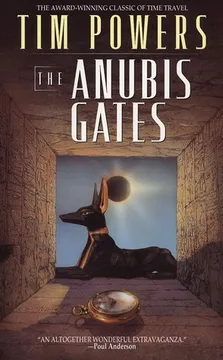

Plot Summary
Rituals and Ruin
In 1802, secretive Egyptian sorcerers attempt a dangerous ritual to open the Anubis Gates—a breach between realms whose effect is distorted by Christianity's "seal" on magic. Their ceremony, fueled by blood and the legendary Book of Thoth, ends in horror and confusion: the spell's promise is twisted and incomplete, leaving one sorcerer half-possessed and the ancient occult order scrambling for purpose. Meanwhile, the modern world stands unknowing, its fate entangled with these failed ambitions and the repercussions that will ripple forward in time, threatening the very nature of history itself. Atmospheric tension hangs thick: the power invoked is too great to be contained or simply forgotten, setting the stage for a story embroiled in both magic's decay and the stubborn persistence of old gods.
Coleridge's Invitation
Dr. Brendan Doyle, a struggling scholar and Coleridge expert, is hastily summoned to London by the enigmatic Darrow, an industrialist with occult aspirations. Doyle, jaded and adrift after personal loss, is drawn not only by the promise of financial security but by his own gnawing curiosity. He is swept into a covert operation involving Darrow's time travel scheme—a staged journey for wealthy patrons to attend a lost Coleridge lecture in 1810. Uncertain whether this is lunacy or true science, Doyle's skepticism is breached by both the rigors of his interview and the mounting strangeness of the preparations. He senses that beneath the enterprise—a technical marvel—lies a deeper alchemical hunger, one that might consume all involved.
The Temporal Ruse
On the eve of the experiment, Doyle and a cadre of wealthy thrill-seekers make the jump into 1810, each branded with a magical "hook" ensuring their return. The journey, a kaleidoscopic collapse of senses, flings them into Regency London as physical spectators, forced to maneuver amid period danger and eccentricity. The mission's careful choreography is soon disrupted: Doyle is abducted, missing the return jump and stranded in a past whose wonders quickly sour into desperation. Alone, hunted, and stripped of resources, he is forced to shed his modern detachment—the safety net of disbelief—facing headlong the unpredictable consequences of meddling with time and magic.
Through London by Candlelight
Doyle, disoriented in the vibrant and dangerous heart of 19th-century London, is compelled into survival schemes—selling onions, joining beggar guilds, crossing paths with thieves, sorcerers, and monsters only half-remembered in history. The city is a living tangle: plague, beggar kings, mystical clown-lords, and the shadow of "Dog-Face Joe," a monstrous lycanthrope. Doyle's scholarly knowledge proves both asset and hindrance; he is both participant and trembling observer, seeking clues not only to his own escape but to the fates of enigmatic historical figures—especially Ashbless, the cryptic poet whose absence from the record now feels cosmically personal.
Ghosts and Gypsies
As magic works fitfully in the strange "gaps" of time and place, Doyle finds himself manipulated by gypsy sorcerers and beggar overlords—each vying for their own restoration or ruin. The boundaries between legend and reality dissolve: Horrabin the clown's mutated beggar-army, ka-doubles created in vats of paut, Dog-Face Joe's cycle of bloody body thefts—a chain of predation unmaking and remaking identities. Doyle navigates a labyrinth of shifting loyalties, barely comprehending the shadow struggle between the remnants of old gods, resurgent magic, and the plans of powerful men, both alive and undead.
The Beggar's Masquerade
Doyle, now Dumb Tom the consumptive beggar, vanishes into the city's underworld—experiencing firsthand the ruthless commerce and code of the kingdom of the poor, ruled by the flamboyant Copenhagen Jack and threatened by the monstrous clown, Horrabin. As bodies change and loyalties twist, Doyle forges unexpected friendships—the mysterious Jacky Snapp, haunted by vengeance, and the tragic Colin Lepovre, linked to both loss and prophecy. Wealth and squalor, innocence and corruption, converge at puppet shows and in midnight politics, with Doyle learning the price of empathy and the cost of survival in every guise.
Horrabin's Dominion
The mysterious clown Horrabin reveals himself as a sorcerer in his own right, running a beggar empire complete with beggar-lords, mutated "mistakes," and miniature homunculi. The alliance of the clown and the gypsy chief opens doors to grotesque secrets of the city: magical creatures, remnants of failed transformations, and the ceaseless machination for power amid supernatural urban underworlds. The beggars' parliament, consisting of thieves, mutants, and puppeteers, becomes the staging ground for fresh attempts to breach the deeper source of magical power and catastrophe, as the old world and new ambitions clash—and Doyle's presence remains a troubling wild card.
Agendas of the Sorcerers
The project for magical restoration, led by the Master in Cairo and his lieutenants (including the twin doctors Romany and Romanelli), becomes an obsessive, paranoid campaign to rewrite history. Their hope: open the Anubis Gates, revive the old gods, and change the world's destiny. To achieve this, they manipulate ancient and modern magics, kidnap and brainwash figures like Lord Byron, and set plots in motion across multiple centuries. Rival groups—such as the Antaeus Brotherhood—desperately attempt to counteract these threats, using their own chain-bound, earth-connected forms of defense.
Disentangling Fate
As plots collapse and new magic is unleashed, Doyle's struggle converges with those of the other manipulated or lost souls—Jacky, the Byron ka, ashbless incarnations, and the shadow of Darrow's ambitions. The chains of body switching, possession, and ka-duplication—previously mechanisms of horror—become moments of choice for Doyle. In Egypt and London, during assassination attempts and monstrous uprisings, the lines among villain, victim, and savior blur. Memory, identity, and agency twist under the constant threat of erasure—but friendship and decency offer surprising strength.
Body and Shadow
The aftermath of theft—of bodies, souls, names—catches up with all. Doyle inhabits the newly-furred body of Benner, becoming (historically) Ashbless; Jacky's secrets come to light; Lord Byron's destiny shatters, forcing the ka into oblivion. Horrabin and Romanelli's dark empire crumbles in civil war. In a final, fraught attempt to outwit death and restore lost love, Doyle is confronted by promises of cosmic reversal and heartbreaking temptation. Some redemptions are possible, others remain eternally deferred, and fate (with a magician's sleight of hand) closes one circle by opening another.
The Cursed Boat
Captured and transported to Egypt, Doyle/Ashbless and Romanelli pass through a literal and metaphysical underworld—crossing the Nile and, in vision or reality, boarding the mythic Boat of Ra through the Twelve Hours of Night. Twisted in magical duress, surrounded by ghosts, serpent gods, and the promise of renewal or doom, they face the ultimate question: can any soul return unchanged, and at what cost to time's seamless thread? The oldest magics, divorced from human empathy, reveal their power and pitilessness.
The Labyrinth Below
Back in London, rebellion breaks out among the puppet-masters and their monstrous "mistakes" as Carrington's mutiny sweeps Rat's Castle. The city's supernatural underworld erupts in violence: mutated beggars and tiny homunculi storm through tunnels, waging war on their makers, while dying sorcerers and old enemies converge. Jacky and Coleridge escape the hardening darkness, leading to confrontation, rescue, and loss. The labyrinth is both literal and psychological, echoing the story's greater motifs: who is master, and who puppet?
Judgments and Justifications
Each plot, plan, and soul meets its reckoning. The fates of Dog-Face Joe, Darrow, and the castoff bodies reach their tragic or poetic conclusion; Jacky must confront identity and loss; Ashbless faces his biographical doom and the mythology of his own creation. As time's web tightens, the possibility of renewal—through love, memory, and self-knowledge—competes with the inevitability of violence and decay. All past bargains are called; debts are paid, often in ways their makers never intended.
The End and the Beginning
The final games of cat-and-mouse are played. Bodies are inhabited, shed, and lost; friendships transcend death; betrayals and forgiveness spiral into myth. Ashbless, finally at peace with his created self, walks through the day that will be remembered as his murder—but the mystery, always fraught, always human, knits itself into eternity. Lives wind into story, each with a song to carry beyond the gates.
Circle Completed
In an eloquent epilogue, the created loops of fate close. Ashbless meets his assassin, dies, and is reborn—as legend, as text, as memory. Characters once lost find unexpected grace: Jacky and Ashbless, both forged in resilience and sorrow, claim at last the moment of quiet, sunlit peace. Identity, in all its mangled, haunted facets, remains inseparable from stories told—and retold—on the wide, reflected river between dusk and dawn.
Analysis
Tim Powers' The Anubis Gates is a masterwork that entwines time travel, magic, and psychological depth into a narrative that meticulously questions the nature of selfhood, fate, and creativity. At its core is the anxiety (and hope) that the past is both inexorable and endlessly rewritten—by both history and personal longing. Characters are displaced bodily and psychically, forced to shed and don new selves, their old ones hunted or haunted by ancient tyranny or their own regrets. The novel interrogates coloniality, the danger of nostalgia, and the cost of "restoration"—insisting that the past's magic is mortally dangerous, and that will alone cannot master it without paying a price in suffering and monstrosity. Powers' greatest triumph is his ability to wrest meaning from closed loops: Doyle's fate as Ashbless transforms circularity from doom to promise—an embrace of the limits and bounty of story. The resilience, wit, and kindness that emerge amid violence and horror offer a modern lesson: history can be tragic, redemption partial, but agency and grace persist. This is a novel that urges us to inhabit the "twelve hours of the night"—to find, even and especially on the deepest journeys, the possibility of dawn.
Review Summary
People Also Read
Characters
Brendan Doyle / William Ashbless
Doyle begins as a burned-out academic, haunted by loss and futility, only to be thrust into history and forced to assume the very identity he once researched—becoming the elusive poet William Ashbless. His psychoanalytic journey is one from detached observer to unwilling participant, and at last to author of his own legend; he is hounded by fear, amorphous guilt, and a longing to fix the past, whether by saving Rebecca or preserving history. Doyle's transformation is physical (adopting new bodies, even new handwriting) as well as psychological; in the end, he learns the tragic necessity of living forward, accepting the irreversibility and creative power of his own choices, even as he fulfills the very fate he sought to decipher.
Jacky Snapp / Elizabeth Jacqueline Tichy
Jacky is a beggar of ambiguous gender, initially masquerading as a boy but eventually embodying resilience and courage as Elizabeth Jacqueline Tichy. She is motivated by vengeance for the murder of her beloved Colin Lepovre (Dog-Face Joe's victim) and the pursuit of justice through personal agency. Jacky becomes Doyle/Ashbless's closest ally and mirror—resourceful, wounded, and as deeply marked by loss as he. Her psychoanalytic arc is a struggle between self-effacement and assertion, culminating in the revelation that she is both the avenging angel and, unwittingly, the destined bride. Jacky's importance lies in her ability to outlast trauma, adapt to shifting tides, and at last claim both love and selfhood.
Dog-Face Joe / Amenophis Fikee
Once a powerful gypsy sorcerer, Fikee is transformed by the failed ritual into Dog-Face Joe, the infamous werewolf of London—condemned to body-hopping as his hosts become overwhelmed with monstrous fur. He is the embodiment of the "return of the repressed": grotesque, compulsive, searching for release through violence and transformation, yet always haunted by losing his own core. Joe's interactions with Doyle—and his ultimate fate—represent the monstrous cost of unmoored will and identity.
Doctor Romany / Romanelli
The master manipulators behind the plots to rewrite history, Romany and Romanelli are ruthless, brilliant, double-faced architects of the past and future. Their psychoanalysis is of divided selves, self-consuming desire, envious of both the old gods and the modern capacity for science, and themselves subject to bodily and magical decay. Each is both puppet-master and puppet, relentless in pursuit of power but fated to discover that their ka-doubles decay, their plots revert to chaos, and their will can only twist the world so far before it breaks.
Horrabin
Ruler and creator of the beggar underworld, Horrabin is both mockery and tyrant—commanding an empire of beggar-lords, mutant "mistakes," and tiny Spoonsize Boys. He is a master puppeteer whose identity (and deformity) is a mask for both creative magic and childhood trauma; he perverts family, power, and art into monstrous forms. Horrabin is the Jungian shadow of the city—comical, grotesque, but also vulnerable to rebellion from within his own creations.
J. Cochran Darrow / Jacob Dundee
Darrow begins as a dying industry magnate, relentlessly shifting from science to magic in the pursuit of life beyond death. He orchestrates the time travel experiment, motivated by a Faustian desire to escape fate and bodily limits. Darrow's psychoanalysis is of desperation—his hunger for control leading him to ever darker bargains, including alliance with Dog-Face Joe, body-switching, and the scarring of all those around him. His fate—a descent into paranoia, nightmares, and eventual destruction—underscores the limits and dangers of unchecked will.
Lord Byron (and the Byron ka)
Byron appears as both the real poet—cynical, vital, memory HAUNTED—and as a ka-duplicate, mind-wiped and programmed to perform a political assassination for the sorcerers' plot. He serves as emblem of the conflict between genius and manipulation, historical destiny and agency. Byron reflects Doyle's own struggle: to assert the authenticity of self against forces that would rewrite one's past or use one's gifts for another's ends.
Jacky's "Mistakes" (Big Biter, Eyeless Sisters, etc.)
These mutated, deformed creatures are unintended offspring of Horrabin's and Romany's experiments—symbols of the price of unchecked magical will. Despised and hidden, they are also capable of autonomy and last-minute rebellion, offering an image of the resilience (and the cost) of the "castoffs" in any structure of power.
Coleridge, Ashbless's Literary Circle
Coleridge and others are not merely historical cameos but serve as touchstones for Doyle's longing for meaning and home. Their own struggles with inspiration, decay, and the logic of fate mirror—and at times inspire—the protagonist's own.
The Master in Cairo
Evoking the ancient order's aspirations for magical and historical restoration, the Master is a figure of both cosmic aspiration and ossified monomania. A being more monstrous than divine, his psychoanalysis is of longing for a return to the past, the revival of gods, and the abolition of uncertainty—a longing so potent it threatens to erase all agency, compassion, and possibility in those below him.
Plot Devices
Time Gaps and Magical Logic
The central device is the scattered existence of "gaps" in time—spots in which magic once more supersedes machinery and history bends, permitting passage, possession, and magical working. These are both literal plot portals (the Coleridge lecture, London's shifting years) and symbolic breaches, where the irreversibility of the past is challenged by desperate, usually self-defeating will. Foreshadowing is deftly handled through literary allusion (the "river of time" metaphor) and the motif of self-fulfilling prophecy, while narrative itself becomes a chain of mirrors: identities double, poems originate themselves, and memory's reliability cracks.
Ka-duplication and Body Theft
The magical creation of duplicates (ka) and the repeated motif of body theft (Dog-Face Joe, Darrow's ambitions, Byron's enslavement) interrogate not only the fear of being replaced or erased but the desperate hope for rebirth, revenge, or escape from fate. Each "switch" is both a horror—whether through grotesque physical transformation or lethal erasure—and a potential, if limited, new beginning. The use of the magical "hook" ensures a tenuous link to safety—one always threatened by accident, malice, or betrayal.
Alternate Selves and Closed Causality Loops
The book plays with the paradoxes of time: Ashbless's poems exist because Doyle remembers them; the closed loop renders creativity both vital and melancholy—a product of itself, scripted but also real. The foreshadowed deaths (Rebecca, Jacky, Ashbless) become both certain and ambiguous; the story mourns the impossibility of truly rewriting the past, but celebrates the meaning found in its telling, reliving, and acceptance.
Urban (and Suburban) Underworld
The city is not just setting but actor and mirror: labyrinthine slums, sewers, and crypts form both the actual network of plot and the psychological structure of secrets, denials, and lurking desire. The grotesque societies of beggars and thieves, ruled by their monstrous sovereigns, show the unconscious "shadows" of both magic and history—"mistakes" that rebel, chain-bound brotherhoods, puppet shows and revolts, the cost of hierarchy always paid in flesh.
Literary Allusion and Self-Reflexivity
The book is rife with quotations, allusions, and self-reflexive motifs: the fate of poets, the repetition of heroic lines at moments of crisis, characters quoting fiction to explain reality. This provides groundwork for both foreshadowing and thematic resonance and allows both humor and pathos as the characters attempt to live stories whose outlines they half-know but can never fully possess.
Download PDF
Download EPUB
.epub digital book format is ideal for reading ebooks on phones, tablets, and e-readers.








































