
Key Takeaways
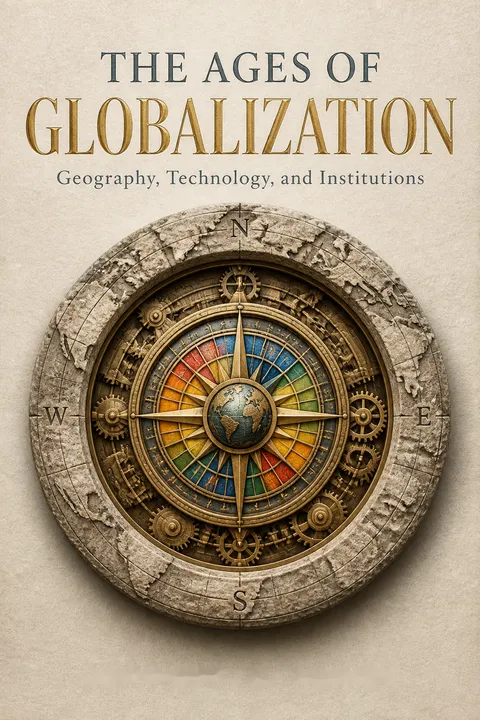
1. Globalization is an ancient, accelerating human journey driven by geography, technology, and institutions.
Humanity has always been globalized, since the dispersals of modern humans from Africa some seventy thousand years ago.
Interconnected history. Globalization is not a modern phenomenon but a continuous process dating back to the first human migrations out of Africa. Its character, however, has dramatically transformed across seven distinct ages, each marked by unique global interlinkages. These changes have often been rapid and violent, underscoring the urgency for peaceful and wise navigation in the nuclear age.
Three pillars of change. Every age of globalization is fundamentally shaped by the intricate interplay of three core elements:
- Physical geography: Climate, flora, fauna, diseases, topography, resources.
- Technology: Both the hardware and software of production systems.
- Institutions: Politics, laws, and cultural ideas and practices.
Understanding how these elements interact is crucial for comprehending human history and guiding our future.
Accelerating pace. History reveals a super-exponential acceleration of change, with the most significant transformations occurring in the last two centuries. This acceleration is evident in:
- Population growth: From 2 million in 10,000 BCE to 7.7 billion today.
- Urbanization: From near zero to over 55% of humanity living in cities.
- Output per person: Stagnant for millennia, then soaring eleven-fold since 1820.
This dramatic increase in scale has intensified global interdependencies and awareness, shifting politics from local to global.
2. The Paleolithic and Neolithic Ages forged human nature, spread our species globally, and initiated agriculture.
The Paleolithic Age was the formative period for all of human history.
African origins. Our species, Homo sapiens, emerged in Africa around 200,000 years ago, with the "Great Dispersal" from Africa beginning 50,000 to 70,000 years ago. These early migrations led to the global spread of humans, encountering and likely outcompeting other hominins like Neanderthals and Denisovans, whose genes still reside in modern Eurasians. This period also saw the extinction of megafauna in newly settled continents, highlighting early human impact on ecosystems.
Cultural revolution. The Upper Paleolithic (50,000–10,000 BCE) witnessed a profound acceleration in human cultural development, including:
- The emergence of art, language, and religious practices.
- Advances in toolmaking, campsites, and long-distance exchange of precious objects.
Language, in particular, was the greatest "technological" breakthrough, enabling complex social life, intergenerational knowledge transfer, and high within-group cooperation, often balanced by aggression towards out-groups.
Agricultural transformation. The Neolithic Age (10,000–3000 BCE) brought the independent invention of agriculture in multiple locations worldwide, such as the Fertile Crescent and China. This shift from nomadic foraging to sedentary farming, despite initial nutritional drawbacks, supported vastly larger populations and led to:
- The rise of permanent villages and early city-states.
- New technological discoveries in metallurgy, ceramics, and record-keeping.
- The development of "alluvial civilizations" along fertile river basins like the Nile and Tigris-Euphrates, which became cradles of early states and writing systems.
3. The Equestrian and Classical Ages saw the rise of vast empires, propelled by animal power, writing, and philosophical breakthroughs.
The period from 3000 to 1000 BCE marked decisive civilizational advances in the Fertile Crescent, including Egypt, the Levant, and Mesopotamia.
Horsepower and empire. The Equestrian Age (3000–1000 BCE) was defined by the domestication of the horse in the Eurasian steppes around 3500 BCE. This "disruptive technology" offered unparalleled speed, durability, and power, fundamentally transforming:
- Transport and communication: Enabling long-distance overland travel.
- Agriculture: Providing animal traction for farming.
- Warfare: Creating powerful cavalry and chariots.
The absence of horses in the Americas until European arrival was a catastrophic disadvantage, limiting their civilizational advances compared to Eurasia.
Metal and script. Alongside the horse, the Metal Ages (Copper, Bronze, Iron) brought stronger tools and weaponry, while the development of writing systems (hieroglyphics, cuneiform) provided invaluable tools for public administration and knowledge transfer. These innovations facilitated the emergence of early states and larger political units across Eurasia.
Axial Age and imperial ambition. The Classical Age (1000 BCE–1500 CE) saw the rise of large, land-based empires like Rome, Han China, and Persia. This era was marked by:
- Philosophical and religious breakthroughs: The "Axial Age" (800-300 BCE) saw the simultaneous emergence of foundational philosophies and religions (Plato, Aristotle, Confucius, Buddha, Zoroastrianism) across Eurasia.
- Imperial expansion: Empires consciously aimed to create global civilizations, using state power to disseminate ideas, technologies, and build continental-scale infrastructure.
- Geographic influence: The "lucky latitudes" (25°N to 45°N in Eurasia) consistently concentrated population, economy, and technology due to favorable temperate climates and east-west diffusion axes.
4. The Ocean Age marked the violent birth of global capitalism and European transoceanic dominance.
The discovery of America, and that of a passage to the East Indies by the Cape of Good Hope, are the two greatest and most important events recorded in the history of mankind.
Global reconnection. The voyages of Columbus (1492) and Vasco da Gama (1498) fundamentally reshaped world history by reconnecting the Old and New Worlds after 10,000 years of separation. This era saw a "Great Chinese Reversal," as China, despite its superior naval technology (Zheng He's voyages), abandoned oceanic exploration, ceding dominance to European powers.
The Columbian Exchange. This unprecedented two-way exchange of species had profound and often devastating consequences:
- Crops: Maize, potatoes, tomatoes from the Americas to the Old World; wheat, rice, sugar, coffee to the Americas.
- Animals: Horses, cattle, sheep, pigs from the Old World to the Americas.
- Pathogens: Old World diseases (smallpox, measles, malaria) decimated indigenous American populations, leading to a 90% decline by 1600 and a significant reforestation that may have contributed to a "Little Ice Age."
Birth of global capitalism. European powers, armed with Chinese-derived gunpowder technology adapted into powerful naval cannons, established transoceanic empires. This era saw the rise of:
- Multinational corporations: Chartered companies like the British and Dutch East India Companies, with their own armies and foreign policies.
- Slave trade: Millions of Africans forcibly transported to the Americas to fuel plantation economies (sugar, cotton, tobacco), creating immense wealth for Europe on a foundation of horrific cruelty.
- Global wars: Conflicts among European powers (e.g., Nine Years' War, Seven Years' War) spilled across continents, foreshadowing the world wars of the 20th century.
5. The Industrial Age unleashed unprecedented economic growth, creating a "Great Divergence" and global conflicts.
The steam engine gave birth to the Industrial Age and the modern economy.
The energy revolution. James Watt's commercialization of the steam engine in 1776 marked the decisive shift from an "organic economy" (dependent on human/animal labor and biomass) to an "energy-rich economy" powered by fossil fuels, primarily coal. This general-purpose technology revolutionized:
- Manufacturing: Mechanized factories, mass production.
- Transport: Steam-powered railroads and ships.
- Metallurgy: Massively scaled-up steel production.
This breakthrough initiated a self-sustaining process of "endogenous growth," where innovations beget further innovations, leading to continuous economic expansion.
British leadership and global divergence. Britain's unique combination of scientific inquiry, market institutions, accessible coal, and a global trading system propelled it to industrial leadership. This led to a "Great Global Divergence" in the 19th century:
- North Atlantic prosperity: Western Europe and the United States experienced soaring incomes and industrial output.
- Asian decline: China and India, once economic powerhouses, suffered under imperial encroachments and policies that stifled their industries, leading to widespread poverty and chaos.
- African subjugation: The discovery of quinine and machine guns enabled Europe's rapid colonization of tropical Africa, dividing the continent at the 1885 Berlin Conference.
World wars and American hegemony. The 20th century was scarred by two devastating World Wars, costing tens of millions of lives and fundamentally reshaping the global order. The United States emerged from World War II as the undisputed global hegemon, ushering in the "American Century" characterized by:
- Unrivaled economic and technological power.
- The establishment of multilateral institutions like the UN, IMF, and World Bank.
- A complex foreign policy balancing international cooperation with "regime change" operations and a vast global military presence.
6. The American Century established a global hegemon, but decolonization initiated a new era of convergence.
The United States, as the global leader between 1950 and 2000, had a complex and ambiguous attitude toward decolonization, convergence, and the rising voice of developing countries in world affairs.
Post-war order. Following World War II, the United States, having avoided direct attacks on its homeland and benefiting from wartime technological advances, became the world's dominant economic and geopolitical power. This era saw the establishment of a new global order, with the UN and its specialized agencies (IMF, World Bank, WHO) designed to foster peace, stability, and economic development. However, this leadership was often tempered by the Cold War struggle with the Soviet Union and a tendency to prioritize narrow U.S. interests.
Decolonization and convergence. The post-war period also witnessed the rapid unraveling of European empires, leading to the independence of numerous African and Asian nations. This decolonization process was crucial for global convergence, as newly sovereign states could:
- Pursue their own development destinies, investing in industrialization rather than serving as mere raw material suppliers.
- Implement mass literacy, public schooling, and public health programs to build human capital.
While many faced challenges, countries that embraced global trade and investment, maintained peace, and invested in their people began to narrow the income and technology gaps with industrialized nations.
Shifting global dynamics. This period marked a fundamental shift from centuries of global divergence to an era of convergence. The share of world output produced by Asia, Africa, and Latin America began to rise, reversing the trend of increasing North Atlantic dominance. This convergence, particularly in East Asia, demonstrated that economic development was no longer the exclusive preserve of the West, setting the stage for a multipolar world.
7. The Digital Age brings ubiquitous connectivity, rapid economic shifts, and China's re-emergence as a global power.
The ubiquity and scale of data processing and transmission are utterly mind-boggling.
The digital revolution. The 21st century is defined by the Digital Age, characterized by ubiquitous connectivity and the astounding capacities of digital technologies. This revolution, rooted in Alan Turing's conceptual machine and John von Neumann's computer architecture, was propelled by:
- Moore's Law: The exponential doubling of transistors on microchips, leading to unprecedented computing power.
- Internet and mobile telephony: Rapid dissemination of information and communication, with billions of users and devices worldwide.
- Artificial intelligence: Machine learning through neural networks, achieving superhuman skills in complex tasks like chess and Go, and transforming fields from translation to medical diagnostics.
Poverty reduction and convergent growth. The digital revolution has accelerated progress in poverty reduction, notably in China, which achieved an "economic miracle" by lifting hundreds of millions out of extreme poverty since 1978. This period has seen continued global economic convergence, with developing countries generally outpacing developed nations in GDP per capita growth.
China's re-emergence. The most dramatic shift has been China's surge to the forefront of the global economy. Following Deng Xiaoping's market reforms in 1978, China achieved decades of rapid growth, becoming the world's largest economy (in purchasing-power-adjusted terms) by 2013. China is now a major technology innovator and exporter, challenging the North Atlantic's long-standing dominance in R&D and high-tech sectors like 5G, signaling a return to a multipolar world.
8. Humanity faces a triple crisis: soaring inequality, devastating environmental degradation, and rising conflict risks.
This Digital Age poses at least three great risks.
Unshared prosperity. Despite unprecedented global wealth and the promise of ending poverty, the gains from economic growth are not evenly distributed. Inequality is soaring within many countries, including the United States and China, as digital technologies displace low-skilled workers while empowering high-skilled ones. This creates economic insecurity and threatens social cohesion, demanding policies that ensure all segments of society benefit from technological advances.
Planetary boundaries breached. Two centuries of rapid economic growth have pushed the planet to its ecological limits, creating a devastating global environmental crisis. Key threats include:
- Human-induced climate change: Massive greenhouse gas emissions from fossil fuels.
- Biodiversity loss: An estimated 1 million species threatened with extinction due to habitat destruction.
- Mega-pollution: Widespread contamination of air, soils, freshwater, and oceans by industrial chemicals and plastics.
These impacts threaten the habitability of the planet and the survival of countless species, demanding a fundamental transformation of technologies and behaviors.
Rising risk of conflict. The transition to the Digital Age, coupled with rapid shifts in geopolitical power, heightens the risk of major conflict. History shows that transitions between ages of globalization are often accompanied by war, and the current dynamic between a dominant power (U.S.) and a rising power (China) poses a significant threat. The consequences of such a conflict, in a world armed with godlike technology, would be catastrophic, making peacebuilding efforts more critical than ever.
9. Sustainable Development offers a holistic framework for navigating the Digital Age's complex challenges.
The key to wellbeing, therefore, is a combination of objectives—not just the pursuit of wealth, but the combination of prosperity, lower levels of inequality, and environmental sustainability.
A new ethos for globalization. The relentless pursuit of national wealth, the ethos of the Industrial Age, has led to immense prosperity but also intense inequalities and environmental destruction. The Digital Age demands a new, holistic approach: sustainable development, defined as meeting the triple bottom line of economic prosperity, social inclusion, and environmental sustainability. This concept, championed by the Brundtland Commission, is the essential vision for our time.
The Sustainable Development Goals (SDGs). Adopted by UN member states in 2015, the 17 SDGs provide a comprehensive roadmap for achieving sustainable development by 2030. These time-bound and quantifiable objectives cover:
- Economic: Ending poverty and hunger, universal health and schooling, decent jobs, modern infrastructure.
- Social: Gender equality, reduced income inequality, peaceful and inclusive societies.
- Environmental: Sustainable cities, responsible consumption/production, climate action, protection of marine and terrestrial ecosystems.
Achieving these goals requires dynamic, adaptive planning, integrating systems thinking across sectors like agriculture, healthcare, energy, and land use.
Directed technical change. To achieve sustainability, technological advances must be directed towards lowering humanity's environmental impact per unit of GDP. This involves:
- Shifting to renewable energy sources (wind, solar, hydro).
- Adopting plant-based diets to reduce land pressure.
- Improving building designs for energy efficiency.
- Implementing precision agriculture to minimize resource use.
These innovations, combined with behavioral changes, can deliver prosperity with lower environmental costs, moving away from the historical pattern of profligate resource use.
10. Effective global governance requires a social-democratic ethos, subsidiarity, and a reformed United Nations.
More than ever, we need to manage globalization with these large goals in mind.
Social-democratic principles. Countries at the forefront of SDG achievement and life satisfaction, particularly in Northern Europe, share a "social-democratic ethos." This approach combines a market economy with:
- High worker unionization and labor rights.
- Universal provision of quality healthcare and education.
- Progressive taxation and social protection.
This ethos is crucial for ensuring that the benefits of digital technologies are shared across society, mitigating rising inequality by taxing "winners" to support universal public services.
Subsidiarity in action. Effective governance requires applying the doctrine of subsidiarity, which dictates that public goods and services should be managed at the lowest feasible level. While local governments handle local public goods (schools, clinics), national governments manage national defense, and transnational authorities are essential for:
- River basin management and transboundary pollution control.
- Continental infrastructure (highways, railways, power grids).
- Global challenges like climate change, epidemic control, and international financial stability.
Regional groupings (e.g., EU, African Union, ASEAN) will become increasingly vital for managing these multi-country public goods, fostering cooperation among a more manageable number of entities than 193 individual nations.
Reforming the UN. The United Nations, a 20th-century institution, needs reform to reflect 21st-century geopolitical realities. The current Security Council, with its five permanent members (P5) reflecting post-WWII power dynamics, is outdated. A reformed UN would:
- Expand the Security Council to include major underrepresented powers like India, Japan, Germany, Brazil, Indonesia, and Nigeria.
- Rebalance representation to reflect current global population and economic weight, particularly for Asia and Africa.
Such reforms are essential for building a legitimate and effective global consensus, fostering trust, and ensuring peace in an interdependent world where the capacity for mutual destruction is unprecedented.
Review Summary
The Ages of Globalization offers a comprehensive overview of human history through seven ages of globalization, from the Paleolithic to the Digital Age. Readers appreciate Sachs' clear writing and broad scope, though some find the policy recommendations idealistic. The book's strengths lie in its accessibility and synthesis of various disciplines, while criticisms include a lack of engagement with existing globalization literature and insufficient analysis of modern challenges. Overall, it provides an insightful perspective on human development and global interconnectedness, despite occasional oversimplifications.
People Also Read







About the Author

Download PDF
Download EPUB
.epub digital book format is ideal for reading ebooks on phones, tablets, and e-readers.








































