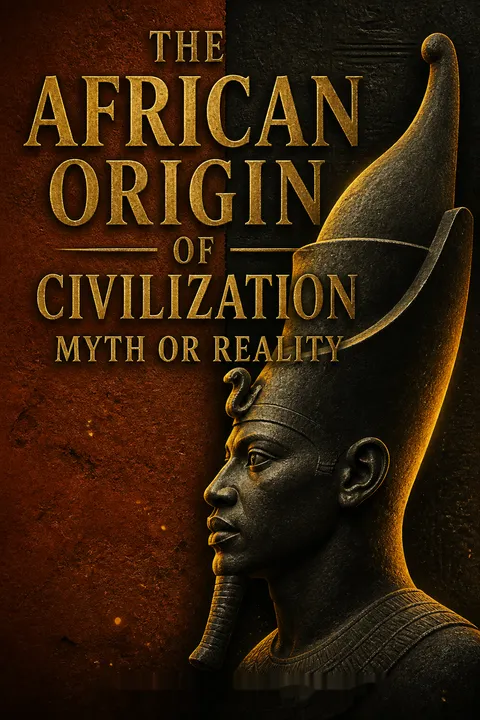

Key Takeaways
1. Ancient Eyewitnesses Unanimously Affirm Egyptian Blackness.
"By the almost unanimous testimony of ancient historians, they belonged to an African race [read: Negro] which first settled in Ethiopia, on the Middle Nile; following the course of the river, they gradually reached the sea."
Historical consensus. Ancient Greek historians, including Herodotus and Diodorus of Sicily, consistently described the Egyptians as Black, often equating them racially with Ethiopians and Colchians. Herodotus, a meticulous observer, used their "black-skinned and woolly hair" as a definitive marker to link the Colchians to Egyptian origins, and even cited the Egyptians' blackness as evidence against certain theories about the Nile's flooding. These firsthand accounts from visitors to ancient Egypt provide compelling evidence of the racial identity of its inhabitants.
Biblical corroboration. The Bible further supports this, identifying Egypt (Mesraim) as a descendant of Ham, the ancestor of Black peoples, alongside Kush (Ethiopia) and Canaan. This places the Egyptians firmly within the lineage of the Black world, a fact often overlooked or reinterpreted in modern scholarship. The term "Kemit," meaning "black" in ancient Egyptian, was the indigenous name for Egypt, referring to the people and their land, not merely the soil.
Enduring blackness. Even after centuries of foreign invasions and interbreeding with white populations (Persians, Macedonians, Romans, Arabs), Herodotus found the Egyptians still predominantly Black. This suggests an original population that was "basic black at the start," as significant admixture would have otherwise diluted their features more profoundly if they had initially been white. The persistence of these traits underscores the foundational Negro character of the ancient Egyptians.
2. Modern Egyptology Systematically Whitewashed African Origins.
"The birth of Egyptology was thus marked by the need to destroy the memory of a Negro Egypt at any cost and in all minds."
Deliberate distortion. Following Champollion's decipherment of hieroglyphics in 1822, the immense grandeur of Egyptian civilization became undeniable, but its Negro origin, previously acknowledged, became "inadmissible" to a Eurocentric world. This led to a systematic falsification of history, where scholars either ignored ancient testimonies, dogmatically rejected them, or reinterpreted evidence to fit a preconceived notion of a white Pharaonic race. The Sphinx, with its undeniably Negro features, stands as a silent rebuke to these efforts.
Reinterpreting evidence. Scholars like Champollion-Figeac, despite his brother's findings, argued that "black skin and woolly hair do not suffice to characterize the Negro race," only to contradict himself later. They invented terms like "dark red race" or "copper-colored" to describe Egyptians, even though these colors are common among various Black African groups. This linguistic manipulation aimed to create a racial category distinct from "Negro" but still darker than white, thereby obscuring the true identity.
Ignoring inconvenient facts. The consistent portrayal of Egyptians in art with features identical to other Black Africans, and the placement of white races (like the "tattooed savage" Tamhou/Europeans) at the lowest echelon of humanity in Egyptian ethnological documents, were often dismissed or explained away. The selective presentation of mummies and the suppression of evidence pointing to Negro characteristics further exemplify this deliberate obfuscation, driven by a desire to deny Black people their rightful place as originators of civilization.
3. Egypt: The Primary Cradle of World Civilization.
"The moral fruit of their civilization is to be counted among the assets of the Black world. Instead of presenting itself to history as an insolvent debtor, that Black world is the very initiator of the 'western' civilization flaunted before our eyes today."
Unparalleled antiquity. Egypt, and its southern precursor Nubia, represents humanity's oldest definitively dated civilization, with the invention of the calendar by 4236 B.C. This predates any comparable complex societies in Mesopotamia, Europe, or Asia. While other regions were still in barbarism, the Nile Valley had developed sophisticated systems of governance, science, and art.
Foundational contributions. The Egyptians pioneered numerous fields that became cornerstones of global civilization:
- Mathematics and Astronomy: Essential for predicting Nile floods, land surveying (geometry), and calendar development.
- Medicine: Advanced medical practices, surgical techniques, and pharmaceutical knowledge.
- Writing: Hieroglyphic script, later influencing Phoenician and Greek alphabets.
- Architecture: Monumental stone structures like pyramids, temples, and obelisks, demonstrating unparalleled engineering skill.
- Religion and Philosophy: Complex cosmogonies, the concept of a redeemer-god (Osiris), and moral codes that influenced Judaism, Christianity, and Islam.
Influence on Greece. Greek philosophers and scholars, including Thales, Pythagoras, Plato, and Solon, openly acknowledged their intellectual debt to Egypt, where they often studied for extended periods. Alexandria became the intellectual hub of the Hellenistic world, a testament to Egypt's enduring academic prestige. The "Greek miracle" is, in this light, largely a continuation and adaptation of Egyptian achievements, often stripped of their original religious context.
4. The Nile Valley's Unique Environment Fostered Early Development.
"The extensiveness of the floods of the Nile forced all the inhabitants of the valley to face the annual event collectively, to regulate their whole life in its smallest details on the inundation."
Collective necessity. The unique geographical conditions of the Nile Valley, particularly its annual, predictable floods, compelled its inhabitants to develop collective social organization and advanced technical skills for survival. No single clan could manage the floods or reclaim land alone, fostering an early sense of communal solidarity and the need for a centralized authority.
Catalyst for innovation. This environmental imperative spurred numerous inventions and practices:
- Irrigation and Dams: Sophisticated systems to manage water resources.
- Geometry: To re-establish property boundaries after floods.
- Calendar and Astronomy: To predict the inundations and plan agricultural cycles.
- Writing: To record administrative data, laws, and religious texts.
- Medicine: Driven by the need for public health in a densely populated, fertile valley, including practices like mummification to prevent epidemics.
Sedentary life and ethics. The transition to a sedentary, agricultural lifestyle in the fertile valley fostered a peaceful, idealistic, and just society, contrasting sharply with the nomadic, warlike cultures of the Eurasian steppes. This environment shaped a distinct ethical code, emphasizing charity, truth, and social harmony, as evidenced in texts like The Book of the Dead. The ease of existence, once regulated, led to a spiritual focus, with nature's bounty attributed to an omnipotent, benevolent deity.
5. Profound Cultural and Linguistic Unity with Black Africa.
"The oneness of Egyptian and Black culture could not be stated more clearly. Because of this essential identity of genius, culture, and race, today all Negroes can legitimately trace their culture to ancient Egypt and build a modern culture on that foundation."
Shared cultural traits. Egyptian civilization exhibits deep affinities with the cultural forms found throughout Black Africa, suggesting a common origin and continuous cultural flow. These shared elements include:
- Totemism: The belief in a biological relationship between humans and animals, evident in Egyptian deities (e.g., Horus as a falcon) and widespread in African societies.
- Divine Kingship: The concept of the king as a sacred figure, whose vitality is linked to the well-being of the land and people, including the ritualistic killing or rejuvenation of the monarch.
- Cosmogony: Striking similarities in creation myths and the deification of ancestors, such as the Egyptian and Dogon Octads and Enneads.
- Ancestor Cult: A foundational aspect of religious life in both ancient Egypt and traditional Black Africa.
Linguistic parallels. Beyond cultural similarities, there are demonstrable linguistic connections between ancient Egyptian and various Black African languages, particularly Wolof. These include shared grammatical structures and vocabulary:
- Past tense morpheme 'n': Identical in Egyptian and Wolof.
- Suffixal conjugation and pronoun suffixes: Verbatim matches in both languages.
- Vocabulary: Numerous words with identical meanings, such as "Ka" (essence of being) and "Ba" (soul/ostrich) in Egyptian and Wolof/Peul.
Unbroken continuity. This profound unity indicates that African history, from Nubia and Egypt, flowed continuously into the great empires of Ghana, Mali, and Songhay, and continues to resonate in contemporary African cultures. Recognizing this connection is crucial for reconstructing a coherent and accurate narrative of the African past.
6. Theories of White or Asiatic Egyptian Origins Lack Evidence.
"Nowhere else had natural conditions favored the development of a human society to the same extent as in Egypt. Nowhere else do we find a Chalcolithic industry comparable in its technical perfection."
Absence of external cradles. Claims of an Asiatic or European origin for Egyptian civilization are unsupported by archaeological evidence. No comparable cradle of civilization with the same antiquity and technical sophistication has been found outside the Nile Valley. Mesopotamia, for instance, shows no trace of man earlier than 4000 B.C., by which time Egypt was already on the threshold of its dynastic period.
Mesopotamian belatedness. Mesopotamian civilization, often presented as a parallel or even earlier development, is demonstrably later and less advanced in its early stages. Its monumental architecture was initially limited to sun-dried bricks, contrasting sharply with Egypt's enduring stone structures. Early Mesopotamian texts are largely commercial records, lacking the rich historical and religious narratives found in Egypt. The "Chaldeans," often credited with early Mesopotamian astronomy, were themselves considered by the Egyptians to be a colony of their own astronomer-priests.
Phoenician and Arabian connections. The Phoenicians (Canaanites) and early inhabitants of Arabia (Kushites/Adites) were originally Negro or Negroid peoples who developed civilizations influenced by Egypt. Later, white nomadic tribes mixed with them, forming the "Semitic" groups known today. This historical sequence contradicts theories that posit a white Semitic origin for Egyptian culture, instead showing a diffusion of Black African civilization into these regions.
7. Anthropological Data Confirms Predominant Negro Element.
"Despite their differences, these conclusions attest to the Negro foundation of the Egyptian population in the predynastic epoch."
Consistent Negroid traits. Despite attempts by some anthropologists to "whiten" the ancient Egyptians, objective analysis of skeletal remains and mummies consistently reveals a predominant "Negroid" or "brown race" element from predynastic times through the dynastic periods. Terms like "brown race" or "Mediterranean" are often euphemisms for non-white, specifically melanodermic, populations.
Flawed criteria. Anthropological criteria used to distinguish "Negroid" from "non-Negroid" skulls have been shown to be arbitrary and inconsistent. For example, applying the same "nasal index" criterion used to classify Egyptians would categorize a significant percentage of modern English or Black African populations as "Negroid" or "whitened," respectively, highlighting the elasticity and bias in such measurements.
Physical evidence. The physical characteristics of ancient Egyptians, as described by various studies, include prognathism (protruding jaw), platyrrhinian (broad) noses, and thick lips—traits unequivocally associated with the Negro race. The meticulous selection of "straight-haired" mummies for display, while ignoring the majority described by Herodotus as having "woolly hair," further exposes the deliberate manipulation of evidence to support a white Egyptian narrative.
8. African "Decivilization" is a Consequence, Not an Inherent Trait.
"Regression is also an historico-sociological phenomenon that the specialist has a duty to explain, whenever it is objectively detected."
External factors of decline. The perceived "decline" or "decivilization" of Black African societies, including Egypt itself, is not due to an inherent lack of capacity but rather to external factors such as invasions, colonization, and environmental shifts. Egypt, despite its long history, experienced periods of regression and loss of knowledge, even on its own soil, due to foreign domination.
Colonial impact. European colonization, particularly the transatlantic slave trade, systematically dismantled existing African political, social, and economic structures. The introduction of firearms, the exploitation of resources, and the imposition of foreign rule disrupted centuries of indigenous development. This process actively "decivilized" many regions, pushing populations into isolation and altering their cultural trajectories.
Historical parallels. Such regressions are not unique to Africa. Europe itself experienced a significant "decivilization" during the Dark Ages, losing much of the knowledge and technical prowess of Greco-Roman antiquity. Comparing the Ptolemaic map with medieval European maps reveals a stark loss of geographical understanding. Therefore, attributing Africa's decline to an inherent racial flaw is a biased and unscientific interpretation of historical processes.
9. Global Negro Substratum and Influence in Antiquity.
"The Negroid human substratum is as extensive as it is durable."
Widespread early presence. Archaeological findings, particularly the Grimaldi skeletons in Europe, demonstrate that the earliest Homo sapiens, dating back approximately 40,000 years, were "Negroid." This indicates a widespread Negro presence across the globe long before the emergence of other distinct races. This "Negroid" substratum extended across North Africa, Palestine (Natufian culture), and parts of Western Asia (Elam, Phoenicia, Arabia), influencing nascent civilizations in these regions.
Cultural diffusion. The influence of this Negro substratum is evident in various cultural phenomena:
- Megalithic structures: Found from Africa to India, Australia, South America, Spain, and Brittany, often associated with agricultural, copper-age civilizations.
- Religious cults: The worship of Isis, a Negro goddess, spread throughout the Mediterranean and even into Germanic tribes, influencing the "Black Madonnas" cult in Europe.
- Linguistic elements: The presence of cacuminal sounds in Aryan languages in India (from Dravidian Negroes) and in Mediterranean languages suggests a deep, ancient influence.
Challenging Eurocentric narratives. This evidence challenges the notion that civilization originated solely in Eurasia or that white races were the sole progenitors of culture. Instead, it points to a complex history of interaction and diffusion, with a significant and often foundational role played by Black populations. The "discovery" of these facts often meets resistance, as it overturns long-held, racially biased historical paradigms.
10. Matriarchy: A Foundational Trait of African Civilization.
"The matriarchal system is the base of the social organization in Egypt and throughout Black Africa."
Contrasting social structures. Matriarchy, where political rights and lineage are transmitted through the mother, was a fundamental aspect of social organization in ancient Egypt and remains prevalent in many parts of Black Africa. This stands in stark contrast to the patriarchal systems that characterized Indo-European societies from their earliest known history.
Economic roots. The origins of matriarchy are often linked to the discovery and development of agriculture, traditionally associated with women who remained at home while men engaged in hunting. This gave women a central economic role, particularly in food production and household management, leading to their elevated status and authority within society.
Enduring legacy. While European societies, influenced by nomadic, patriarchal traditions, largely rejected matriarchal systems (as seen in the Roman legal codes and the absence of queens in early European history), it persisted in Africa. Even when external influences like Islam introduced patriarchal norms, the underlying matriarchal principles often continued to shape social dynamics, such as the dowry system, which in Africa serves as a guarantee for the woman, not a purchase price. This fundamental difference highlights distinct evolutionary paths shaped by environmental and historical conditions.
Review Summary
Readers largely praise The African Origin of Civilization as a groundbreaking, scholarly work that compellingly argues ancient Egyptians were Black Africans, dismantling Eurocentric historical narratives. Many consider it essential reading for understanding African history and the cultural bias embedded in Western scholarship. High ratings reflect admiration for Diop's meticulous research, wit, and revolutionary perspective. A few critics note the book's reliance on racial classifications and occasional overreach, while others find it dense but rewarding. Overall, it is widely regarded as a transformative, important contribution to Afrocentric historiography.
People Also Read


Download PDF
Download EPUB
.epub digital book format is ideal for reading ebooks on phones, tablets, and e-readers.








































