


Key Takeaways
A father's absence is a presence that reshapes a daughter's soul
The presence of absence. Schwartz, a Jungian analyst, argues the most damaging thing about an absent father is not empty space but an active, haunting force. Absence, whether from a father who left physically or one who sat silently in the same house, occupies psychic territory. It demands attention while withholding it.
A father can be absent through death, divorce, or abandonment, but also through emotional deadness while physically present: the workaholic, the tyrant, the man who provided money but no warmth. Schwartz contends a daughter left without paternal recognition develops a hole in her heart, her personality threads rupturing. She questions whether she is worthy of love, since the first man charged with reflecting her value never looked. This wound becomes the paradoxical engine of her later search for self.
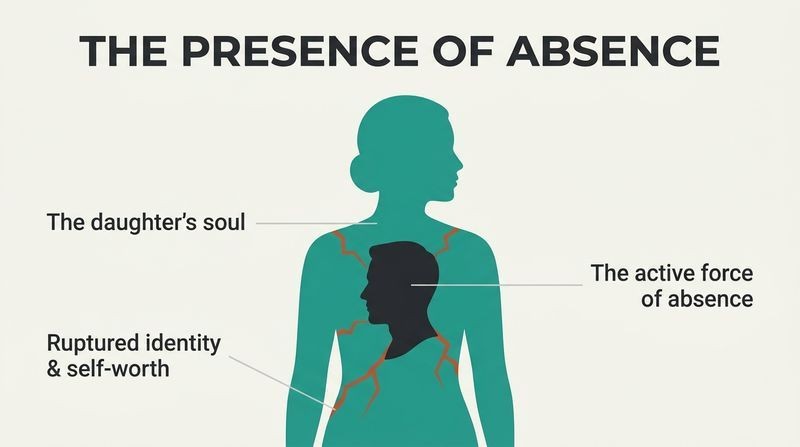
The reframe that absence is itself a force echoes attachment research: the 'still face' experiments by Edward Tronick showed infants become distressed when a parent's face goes blank, not just when the parent leaves. Emotional unavailability registers as loss. Schwartz's clinical claim aligns with population data linking father absence to daughters' anxiety and relational difficulty, though her mechanism is depth-psychological rather than statistical. A fair challenge: by centering the father so heavily, the account risks underplaying mothers, siblings, and culture. Schwartz concedes this, framing her focus as a deliberate corrective to a literature that ignored fathers for decades.
When a father won't reflect you, you can't find yourself
The mirror that shows nothing. Drawing on the idea that infants first discover who they are in a caregiver's face, Schwartz argues a father's gaze validates a daughter's emotions and worth. His approving eyes teach her she exists and matters. When his gaze is blank, critical, or absent, she has no reflection to build a self from, and anxiety about being unseen follows her into adulthood.
Consider Shiloh, a composite patient obsessed with mirrors. She banished every mirror from her home except one small hand mirror, in which she daily hunted her face for flaws, picking at her skin. Schwartz reads this as the search for a self that her emotionally dead father never reflected back. Unable to find validation in his eyes, Shiloh sought and failed to find it in her own reflection, seeing only imperfection.
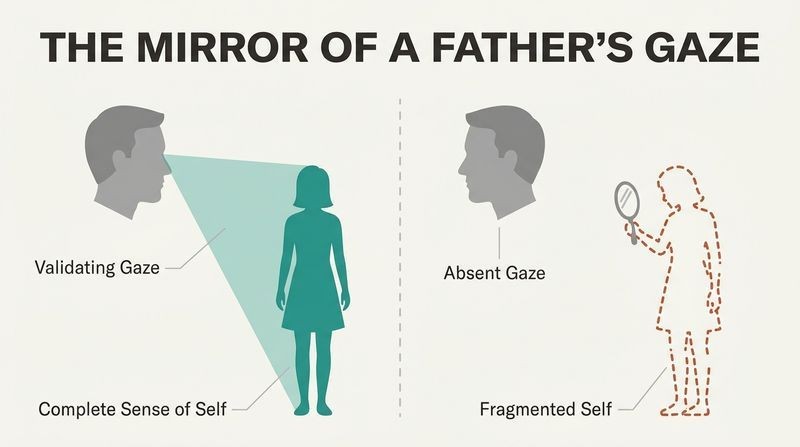
This builds on Winnicott's concept of the mother's face as the infant's first mirror and Kohut's self psychology, where 'mirroring' from caregivers is essential to a cohesive self. Schwartz's contribution is extending this to fathers and daughters specifically, a relationship both Freud and Jung largely ignored. The mirror obsession illustrates a real clinical pattern: body dysmorphia and skin-picking (excoriation disorder) often track to early relational voids. What deepens the insight is the irony that the more a father withholds, the more magnetic he becomes, a dynamic resembling intermittent reinforcement, which produces the stickiest attachments of all.
An internalized dead father freezes your vitality from the inside
The dead father effect. Borrowing from French psychoanalyst Andre Green's 'dead mother' concept, Schwartz describes fathers who are emotionally deadened, depressed, or internally vacant even when physically around. The daughter internalizes this deadness. Rather than living, she becomes tied to a blank, depleted inner father, and her own psyche goes numb to match.
Green described this as a gap where memory, contact, and feeling should be. The daughter's inner monologue turns into a flat refrain of 'no, I can't, it won't work.' Grace, a composite patient, spent years trying to revive a depressed husband exactly as she had tried to enliven her mechanical, distant father, draining herself in the process. Green's paradoxical insight is that this same emptiness, once made conscious, can become a space for new thought rather than a tomb.
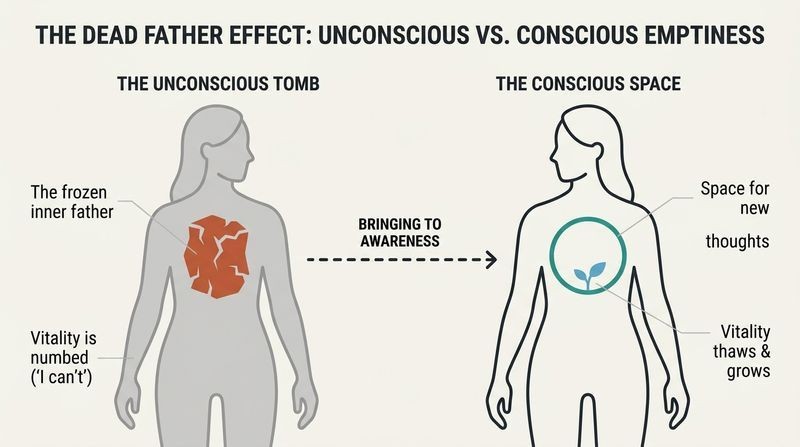
Green's framework is one of psychoanalysis's most influential late-century ideas, and Schwartz's application to fathers is genuinely novel. The mechanism resembles what family systems theorists call the 'parentified child,' the daughter who becomes emotional caretaker to a parent unable to care for her. There is also a striking overlap with research on maternal (and paternal) depression: children of depressed parents show measurable changes in affect regulation, sometimes mirroring the parent's flatness. Schwartz's hopeful turn, that absence can become generative space, is the book's most important therapeutic wager, resisting a purely deterministic reading of childhood damage.
The negative father complex can turn you into the man you fear
Bad dad inside. In Jungian terms, a complex is a cluster of charged feelings and behaviors operating semi-autonomously below awareness. A negative father complex, born from absence or cruelty, colors how a daughter sees everything: bleak, hopeless, herself as inadequate. The further it sits from consciousness, the more power it wields.
Schwartz warns of a cruel twist: a daughter gripped by this complex can become what she hated in her father, internalizing his harshness and turning it against herself as a savage inner critic. Kaleigh, raised by a man she called a thug, swung between a confident femme fatale persona and sudden collapses into self-destruction, smashing her own artwork. Rayelyn dreamed of marrying a man from 'St. Louis,' only to wake realizing Louis was her dead father's name, a warning that his self-negating personality still lived inside her.
The Jungian complex anticipates modern schema therapy, where early maladaptive schemas (like defectiveness or mistrust) run automatically until surfaced. Schwartz's point that we can become our persecutor mirrors the well-documented cycle of internalized abuse: the critical voice feels like one's own but is often a transplant. Neuroscience adds support, as harsh early environments shape the brain's threat and self-referential circuits. One caution: labeling patterns as a 'complex' can feel mystifying. The practical payoff is diagnostic, naming the autonomous voice as foreign, which is the first step to withdrawing its authority over daily life.
A charming, functional exterior can hide a hollow, borrowed self
The as-if personality. Coined by analyst Helene Deutsch in the 1940s, the 'as-if' personality describes someone who mimics genuine emotion and identity without inhabiting them, a skilled performance with no originality underneath. Schwartz links this to daughters who, lacking a father to model selfhood, literally learned how to be a person from books and observing neighbors.
These women appear polished, successful, warm. But underneath sits a void and the conviction they are frauds about to be exposed. Tiffany learned to need nothing and please everyone. Sydney called her presentation 'the poseur' and admitted she needed a 'how to be a person manual.' Winnicott noted such people can achieve visible success while feeling more phony the more they succeed, sometimes destroying themselves just as they seem poised to fulfill their promise.
The 'as-if' concept prefigures today's language around impostor phenomenon and Winnicott's 'false self,' the compliant shell built to protect a hidden true self. What Schwartz adds is the paternal etiology: without a father to mirror and anchor identity, the daughter assembles a self from external templates. This resonates with social learning theory, but the clinical picture is darker than everyday impostor feelings, involving genuine dissociation and inner emptiness. A useful distinction for readers: ordinary self-doubt differs from the as-if structure, where the performance is the whole architecture and collapse feels like annihilation rather than embarrassment.
Idealizing an absent father is a beautiful tomb you build for yourself
A tomb of illusion. Every daughter idealizes her father at some stage. But when he is absent, the idealization inflates and hardens, because there is no real man to puncture the fantasy. She cannot sense either of their realities. Behind the worship lurk the anger and grief she cannot let herself feel.
Tilisha's mother died young and her father had vanished earlier. Raised on secrets, she spent her youth constructing a fantasy of the perfect father whose return would make her whole. When she finally found him as an adult, he exploited her longing, casting her as his 'spiritual bride' and erasing her separate identity. The more she idealized him, the more her own vitality drained away. She later drifted into relationships with tyrannical men, trained since childhood to come second and wait.
Idealization as defense is classic psychoanalysis: it protects against the pain of ambivalence by splitting the father into an all-good figure while banishing rage. The cost, as Schwartz shows, is that the daughter cannot individuate from a phantom. This connects to research on 'ambiguous loss' (Pauline Boss), the unresolved grief of a person who is psychologically present but physically absent, which resists mourning precisely because there is no closure. Tilisha's drift toward exploitative men illustrates repetition compulsion: the psyche recreates the original wound seeking a different ending, and usually reproduces the same one until the pattern becomes conscious.
Daddy's girl pays for staying young with a life never fully lived
The puella trap. Puella is the Jungian archetype of the eternal girl, the modern daddy's girl: youthful, idealistic, charming, and perpetually unfinished. She lives provisionally, always about to start the real book, the real diet, the real life tomorrow. She resists aging, commitment, and descent into her own depths, mistaking a fierce independence for strength when it actually masks helplessness.
Zoe, a gifted violinist, called herself a daddy's girl and described her father as flawless and her mother as inferior. To stay bound to him, she had quietly negated her own sexuality and let her career lapse behind her husband's. Her dreams revealed a castle-like self that was mostly vacant, and a fixation on a tiny flaw in a beautiful tapestry, her perfectionism blinding her to her own richness. Only in midlife did she reclaim her instrument.
The puella describes a recognizable contemporary type that youth-obsessed culture actively rewards, which is why Schwartz frames it as both personal and collective. The provisional life, always deferred, echoes existentialist critiques of bad faith: avoiding the anxiety of choice by never fully committing to being. Developmental psychology would note that idealizing one parent while denigrating the other (here, mother) often signals unresolved triangulation. What is clinically astute is Schwartz's observation that the puella's independence is counterfeit, a flight from dependency needs rather than a genuine autonomy, which only real grieving and grounding in the body can produce.
Narcissism is not self-love but self-hate wearing a dazzling mask
Behind the glitter. Schwartz reframes narcissism, following analyst Mario Jacoby, as rooted in self-hatred rather than self-love. In Ovid's myth, Narcissus was told he would live only if he never knew himself; transfixed by his reflection, he could take in nothing and no one separate from himself, and died. The narcissist seeks mirroring in sameness and cannot tolerate the difference that real relationship and love require.
When a father is absent or coldly envious, a daughter may build a grandiose, idealized surface over a hollow, terrified core. Evie developed a secret self-image as a heroine while carrying her father's frustrated, unacknowledged rage. She craved constant admiration yet recoiled from intimacy, sending frantic texts for reassurance then pulling away. Beneath the omnipotence lay impotence, envy, and a fundamental sadness Green called 'death narcissism.'
The clinical consensus increasingly supports Schwartz here: contemporary research on narcissistic personality distinguishes grandiose from vulnerable presentations, and both often mask fragile self-esteem and shame. Kohut argued narcissistic wounds stem from failures of parental mirroring, exactly Schwartz's paternal thesis. The Narcissus myth is a shrewd choice, since the tragedy is not vanity but the inability to recognize himself, an epistemic failure as much as a moral one. Worth noting: Echo, the discarded feminine counterpart who can only repeat others' words, is Schwartz's image for the daughter who loses her own voice orbiting a self-absorbed man.
The body keeps score of a father's neglect, sometimes as illness
The body in shadow. Schwartz proposes that emotional wounds from an absent father can surface physically, pointing to the striking statistic that roughly 78% of autoimmune disease patients are women. In autoimmunity, the immune system misidentifies the body's own cells as foreign and attacks them, a physiological echo, she suggests, of a self that never learned to distinguish and protect itself.
Rana, a high achiever, never received warmth or touch from her father and long treated her own body as a distant object subject to neglect and self-violence. At the peak of her career her body collapsed with autoimmune illness. Schwartz reads this through Julia Kristeva's concept of the abject, the rejected parts of ourselves we cannot fully separate from, arguing the disease forced Rana to finally attend to the fragile, dissociated self she had ignored.
This is the book's most speculative claim and should be read as interpretive metaphor rather than established causation. The gender statistic is real and reflects genuine sex differences in immune function (estrogen, X-linked genes). The leap to a psychological cause is not supported by mechanistic evidence, and readers should resist a narrative that risks blaming patients for their illness. That said, the mind-body link is not fringe: research on adverse childhood experiences (the ACE studies) robustly correlates early trauma with later inflammatory and autoimmune conditions. The defensible version is that chronic early stress shapes physiology, not that neglect directly manufactures a specific disease.
Sylvia Plath's 'Daddy' shows rage as a route out of the father's grip
Killing the colossus. Schwartz devotes a chapter to poet Sylvia Plath, whose father died when she was eight and whose work obsessively circles his absence. In her poem 'Daddy,' Plath resurrects a vampire-like father only to drive a stake through his heart, a violent verbal act of separation from a man she both worshipped and hated. She symbolized him as a giant stone Colossus: monumental, unyielding, dead, and impossible to reach.
Plath married a man who echoed her father (she knew each for eight years) and took her own life at thirty. Schwartz reads the poetry not as pathology but as a daughter using creative fury to break the paternal spell, transforming herself from victim into someone who can obliterate the oppressor, even if the internal persecutory forces ultimately won.
Using Plath as an extended case is a smart move, offering a public, documented life to illustrate what composite patients only sketch. Schwartz's reading joins a large critical literature, but her angle, the poem as an act of individuation rather than mere symptom, is the most generative. There is a real tension she honors: the same rage that fuels liberating art can also turn homicidally inward. Plath's suicide complicates any triumphant reading. The lesson for non-poets is that naming and externalizing rage (through writing, therapy, art) can loosen a father complex's grip, though expression alone does not guarantee survival or healing.
Stop excusing him: naming the wound is what finally frees you
Filling the absence. Schwartz's therapeutic endpoint is not forgiveness and not reconciliation, which may be impossible. It is consciousness. The daughter must stop reflexively defending the father ('he did his best') and honestly name the deprivation, the rage, and the loss. Only then does she stop unconsciously repeating his patterns or rebelling against them, and plant her feet in her own ground.
Schwartz is blunt that some situations are unredeemable and that healing the daughter may never produce an actual relationship with the father. The work happens through Jungian analysis: tracking dreams, grieving what was never there, and rebuilding a supportive inner father image even without the real one. Absence, she argues, implies a space that can be filled, a call for something new to emerge rather than a permanent verdict.
Ending on consciousness rather than forgiveness is both honest and clinically sound. The forgiveness industry can pressure survivors to reconcile prematurely; Schwartz's refusal to demand it respects that some fathers do not change and that a daughter's recovery cannot be contingent on his participation. This aligns with trauma-informed practice, which prioritizes the survivor's integration over restoring the relationship. The idea of building an 'inner father' resembles internal family systems work and reparenting techniques. The one demand the book makes is unflinching honesty, which is harder than it sounds, since defending an absent parent often feels safer than facing the grief underneath.
Analysis
Susan Schwartz's book is a depth-psychological monograph, not a self-help manual, and that shapes both its strengths and its difficulty. Structurally it is an anthology of composite clinical portraits (Aurora, Jade, Shiloh, Grace, Kaleigh, Tiffany, Sydney, Sophia, Tilisha, Zoe, Evie, Rana) braided with dense theory from Jung, Andre Green, Julia Kristeva, Helene Deutsch, and Winnicott, plus fairy tales, myth, and a literary case study of Sylvia Plath. The prose is allusive and layered, prioritizing evocation over argument. This makes it hard to summarize: there is no numbered framework, few statistics, and the insights arrive through accretion and dream interpretation rather than linear claims. The book's genuine contribution is filling a documented gap. Both Freud and Jung, despite Jung having four daughters, largely ignored the father-daughter dyad, privileging the Oedipal father-son. Schwartz redresses this with compassion and without demonizing fathers, a tone reviewers rightly praised.
Intellectually, the work is strongest when it applies Green's 'dead father effect' and Deutsch's 'as-if personality' to a population they were not designed for, and weakest where it ventures psychosomatic causation (the autoimmune chapter), which outruns its evidence and flirts with patient-blaming. A modern reader should hold the clinical interpretations as hermeneutic, meaning-making tools rather than falsifiable claims. The methodological caveat matters: composite cases and dream analysis are unfalsifiable and selection-biased toward women already in Jungian analysis. There are no control groups, no base rates. Yet judged by its own aims, illuminating subjective experience and offering a therapeutic path, the book succeeds. Its most transferable takeaways cross theoretical lines: emotional unavailability wounds as much as physical absence; idealization prevents individuation; naming rather than excusing is the door to freedom; and healing need not wait on the father's cooperation. For readers outside the Jungian tradition, the value lies in these portable insights and in the permission to grieve a relationship that was never adequately there.
Review Summary
The Absent Father Effect on Daughters receives mixed reviews. Some readers find it insightful and transformative, praising its Jungian approach and exploration of father-daughter relationships. Others struggle with its dense, philosophical style and repetitive content. Many appreciate the book's research and valuable insights but find it challenging for casual readers. Some reviewers note its importance in addressing an under-explored topic, while others feel it lacks scientific rigor. Overall, the book appears to be more suited for those with a background in psychology or Jungian theory.
People Also Read








FAQ
What's The Absent Father Effect on Daughters about?
- Explores father-daughter dynamics: The book investigates the psychological impact of absent or inadequate fathers on their daughters, focusing on both physical and emotional absence.
- Jungian analytical psychology: It employs Jungian concepts to analyze how these dynamics affect a daughter's self-perception, personality development, and emotional well-being.
- Personal and collective narratives: The author shares personal stories, clinical examples, and cultural references to illustrate the complex relationships between fathers and daughters.
Why should I read The Absent Father Effect on Daughters?
- Insightful for therapy professionals: This book is essential for psychologists, therapists, and students interested in Jungian and post-Jungian psychology, providing a deep understanding of father-daughter relationships.
- Addresses a common issue: Many women experience the effects of an absent father, making this book relevant for those seeking to understand their own experiences or help others.
- Interdisciplinary approach: The author combines clinical examples with literature, dreams, and cultural references, enriching the reader's understanding of the subject matter.
What are the key takeaways of The Absent Father Effect on Daughters?
- Impact of absence: The book emphasizes that the absence of a father can lead to feelings of inadequacy, insecurity, and emotional turmoil in daughters.
- Healing through awareness: It suggests that recognizing and addressing these issues can lead to personal growth and healing, allowing daughters to reclaim their identities.
- Role of therapy: The therapeutic process is highlighted as a means to explore and understand the complexities of these relationships, facilitating healing and self-discovery.
What are the best quotes from The Absent Father Effect on Daughters and what do they mean?
- “The father is decisive in the destiny of the individual”: This quote underscores the profound influence a father has on a daughter's psychological development and life trajectory.
- “Absence can only be borne if it is recognized as such”: This emphasizes the importance of acknowledging the absence of a father to begin the healing process and move towards self-acceptance.
- “The psyche strives to keep balance”: This reflects the idea that the psyche seeks equilibrium, and when disrupted by an absent father, it can lead to various psychological issues.
What is the 'as-if' personality described in The Absent Father Effect on Daughters?
- Definition of 'as-if' personality: This term refers to individuals who mimic others' behaviors and emotions without genuine self-expression, often as a defense mechanism against emotional pain.
- Origins in childhood: The 'as-if' personality typically develops in response to an absent or emotionally unavailable father, leading to a lack of authentic self-identity.
- Consequences of this personality: Those with an 'as-if' personality may struggle with intimacy, self-worth, and emotional connection, often feeling like impostors in their relationships.
How does The Absent Father Effect on Daughters address the concept of the negative father complex?
- Definition of negative father complex: This complex arises from the absence or negative presence of a father, leading to feelings of inadequacy, self-doubt, and emotional turmoil in daughters.
- Impact on relationships: The negative father complex can hinder a daughter's ability to form healthy relationships, as she may internalize her father's negative traits and project them onto others.
- Path to healing: The book suggests that recognizing and addressing the negative father complex is crucial for personal growth and developing healthier relationships.
How does therapy play a role in addressing issues in The Absent Father Effect on Daughters?
- Therapeutic exploration: Therapy provides a safe space for daughters to explore their feelings about their fathers, facilitating understanding and healing.
- Transference and countertransference: The book discusses how the dynamics between therapist and patient can mirror the father-daughter relationship, offering insights into unresolved issues.
- Symbolic function of dreams: Dreams are highlighted as a means to access unconscious feelings and desires related to the father, aiding in the therapeutic process.
How does Susan E. Schwartz use Jungian concepts in The Absent Father Effect on Daughters?
- Archetypes and complexes: The author employs Jungian archetypes and complexes to analyze the psychological effects of father absence on daughters, providing a framework for understanding these dynamics.
- Symbolism in dreams: Jungian analysis of dreams is used to uncover hidden emotions and desires related to the father, facilitating self-discovery and healing.
- Collective unconscious: The book connects personal experiences with broader cultural narratives, illustrating how the absence of fathers affects women across generations.
What are the cultural implications discussed in The Absent Father Effect on Daughters?
- Patriarchal structures: The book examines how societal expectations and patriarchal norms shape the father-daughter relationship, often leading to emotional neglect.
- Collective narratives: It highlights the shared experiences of women regarding father absence, emphasizing the need for cultural awareness and change.
- Impact on identity: The author discusses how cultural perceptions of fatherhood influence daughters' self-identity and their ability to form healthy relationships.
How can daughters begin to heal from the effects of an absent father as described in The Absent Father Effect on Daughters?
- Acknowledging the absence: The first step is recognizing the impact of the father's absence on their lives and emotional well-being.
- Therapeutic engagement: Seeking therapy can provide a supportive environment to explore feelings, process grief, and develop a healthier self-identity.
- Reclaiming personal narratives: Daughters are encouraged to reclaim their stories and identities, moving beyond the limitations imposed by their fathers' absence.
What is the significance of the 'dead father effect' in the context of The Absent Father Effect on Daughters?
- Definition of dead father effect: This concept refers to the emotional and psychological impact of having a father who is physically present but emotionally absent or disengaged.
- Consequences for daughters: The dead father effect can lead to feelings of neglect, low self-esteem, and difficulties in forming healthy relationships.
- Path to recovery: The book emphasizes the importance of addressing the dead father effect through therapy and self-reflection to foster healing and personal growth.
How does The Absent Father Effect on Daughters relate to broader societal issues?
- Cultural Narratives: The book examines how cultural attitudes towards fatherhood and masculinity impact daughters’ experiences and emotional well-being.
- Gender Dynamics: It addresses the societal pressures that shape women’s identities and the expectations placed on them in relation to their fathers and male figures.
- Call for Change: Schwartz advocates for a reevaluation of these narratives to foster healthier relationships and empower daughters to reclaim their identities beyond paternal influence.
Download PDF
Download EPUB
.epub digital book format is ideal for reading ebooks on phones, tablets, and e-readers.








































