


Key Takeaways
Rip up your goals and write down what you'll commit to instead
Goals give hope; commitments give discipline. In the fable's pivotal scene, college coach Richie Moran has his frustrated, talent-heavy team write down goals like winning a championship, then makes them crumple the pages and toss them. Everyone writes those same goals, he explains, so goals alone won't separate you. He then asks each player to write three commitments: what they're willing to sacrifice to reach those goals. One player commits to skill work instead of video games, another to recovery time to stay healthy, another to studying film.
Hope doesn't wake you at 6 a.m. The energy in the room shifts from excitement to serious intention. Commitments create a standard you live up to when adversity, inconvenience, and distraction arrive. Jon Gordon's thesis is blunt: commitments create culture, and culture drives results.
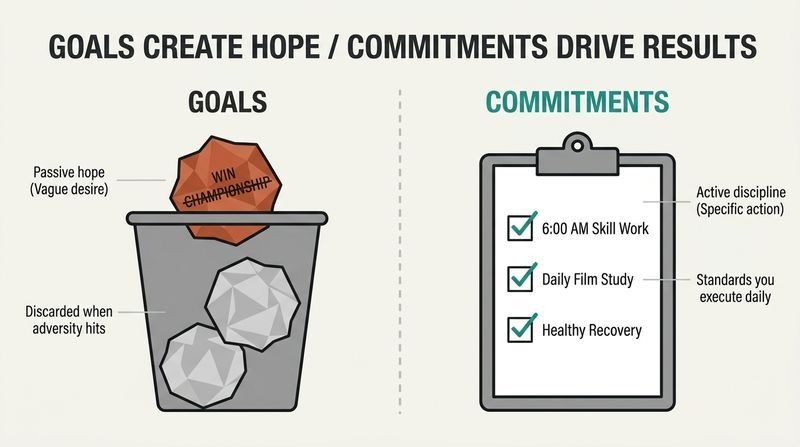
The distinction echoes research on implementation intentions by psychologist Peter Gollwitzer, whose studies show that specifying when, where, and how you'll act roughly doubles follow-through versus merely stating a goal. Gordon's crumpled-paper theater dramatizes a real cognitive gap: goals describe a destination, commitments describe behavior. What's useful here is the reframe from outcome to input, similar to James Clear's systems-over-goals argument. One caution worth noting: commitments without honest measurement can become their own form of wishful thinking. The fable's later accountability exercises exist precisely because writing a commitment down is the easy part; keeping it under fatigue and temptation is where teams actually break.
Make people feel valued before you ask anything of them
The commitment that unlocks the rest. Late in the story, CEO Tim discovers a seventh commitment missing from Coach's original six: commit to valuing each other. Speaker Damon West describes witnessing volunteers wash prisoners' feet, an act so foreign in a place where touch means violence that hardened men wept and asked to return the favor. The lesson: people who feel valued transform how they see themselves and treat others.
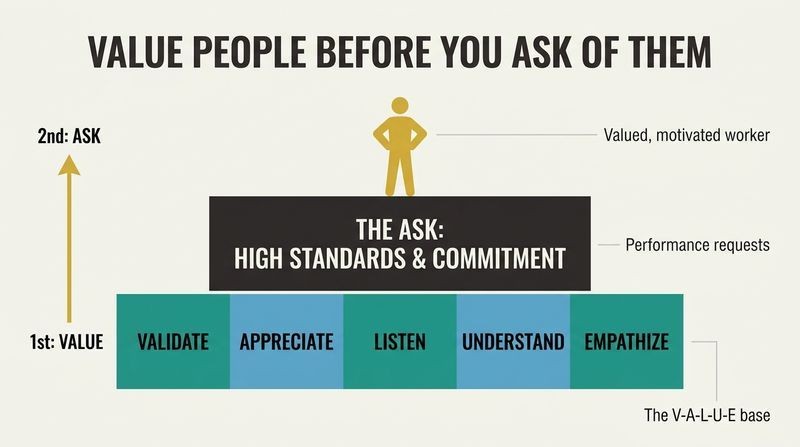
VALUE as a daily practice. Tim builds an acronym:
1. Validate their contribution
2. Appreciate who they are
3. Listen fully
4. Understand their perspective
5. Empathize with their emotions
He swaps generic praise like good job for specific selfie videos naming exactly what an employee did well. Gordon argues valuing each other is logically first: without it, no other commitment holds, because people give their best only to teams that treat them as worth something.
This aligns with self-determination theory, where relatedness (feeling seen and cared for) is a core driver of intrinsic motivation alongside autonomy and competence. Gordon's insistence on specific rather than generic recognition tracks decades of feedback research: vague praise reads as manipulation, while behaviorally precise recognition signals genuine attention. The foot-washing anecdote is emotionally powerful but also worth interrogating. Grand symbolic gestures can spike morale briefly without changing daily conditions. The stronger move is the mundane one Tim actually adopts: naming a concrete act by name. Feeling valued is built in ordinary repetitions, not staged epiphanies, which is why the acronym matters more than the story.
Attack a fresh opportunity instead of defending your reputation
Defending drains; attacking energizes. After a hot 5-0 start, Coach cites research that teams playing to protect status, hype, or expectations perform worse than teams attacking a new opportunity. His talent-heavy program always felt like it was defending something: reputation, media hype, what others expected. That pressure produced timid, tight play. He declares they will defend nothing except their goal and instead attack every moment and every game as a fresh chance.
Care but don't carry. Coach coins a companion phrase to keep expectations from becoming weight: care deeply, but don't carry the burden. He promises to model it himself. The shift is subtle but decisive. The team stops looking backward at last year's losing season and stops performing for outside opinion, freeing them to compete loose and confident.
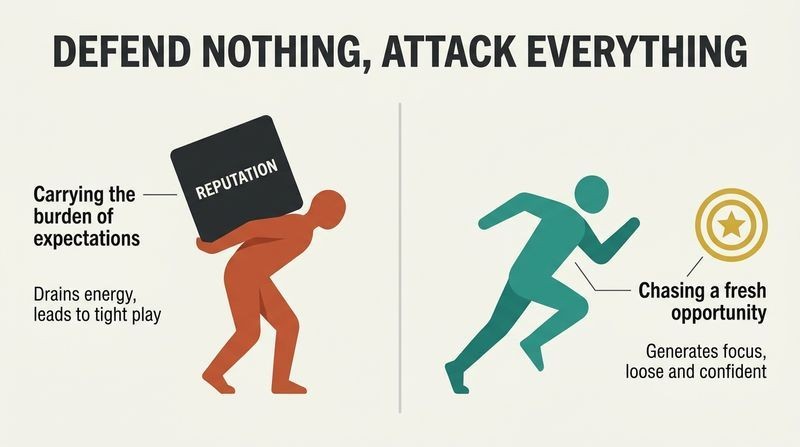
This maps neatly onto psychologist Tory Higgins's regulatory focus theory, which distinguishes a promotion focus (pursuing gains, growth, and aspirations) from a prevention focus (avoiding losses and protecting what you have). Prevention-focused performers tend toward vigilance and risk-aversion, which under pressure can curdle into the tightness Coach describes. Attacking a new opportunity is essentially inducing promotion focus. Sports psychology supports this: athletes cued to win rather than not lose show more fluid execution. The nuance is that prevention focus isn't always inferior; it drives accuracy and safety in some domains. For a talented team paralyzed by expectation, though, the reframe toward opportunity is exactly the right medicine.
Choose gratitude as the antidote to entitlement, stress, and frustration
Positivity is a team decision, not a mood. When training-camp fatigue erupts into a locker-room fight, Coach reframes it: you can't control soreness, but you always choose your response, and negativity is contagious enough to infect a whole team. His rule is staying positive together, feeding yourself so you can feed teammates. He shares a mnemonic, LIGHT: Love instead of fear, Inside out (the power within exceeds outside forces), Get to (not have to), Have faith, and Talk to yourself rather than listen to yourself.
Appreciation is the master tool. Coach Amy singles out one strategy anyone can use immediately: appreciate where you are, what you have, and what you get to do. Research, she notes, shows you cannot feel stressed and grateful simultaneously. Gratitude shifts you from entitlement and frustration toward abundance, lifting mood and performance at once.
The claim that gratitude and stress can't coexist has empirical backing. Robert Emmons's gratitude research links regular thankfulness to lower cortisol, better sleep, and improved wellbeing, and gratitude activates parasympathetic calming responses that blunt the stress response. The get to versus have to reframe is a cognitive reappraisal technique straight out of clinical psychology. Where Gordon's framing deserves a gentle push: relentless team positivity can shade into toxic positivity, where genuine problems get papered over with forced optimism. Coach Amy's own no-moodiness edict flirts with this. The saving grace is that her positivity is paired with brutal honesty in later exercises, which keeps it from becoming denial.
Discipline is a byproduct of devotion, not willpower
Care more to work harder. When effort flags, Coach rejects the usual coaching cliche of just be more disciplined. He builds a causal chain instead: devotion fuels caring more, caring more drives discipline, discipline produces consistency, and consistency plus effort equals giving your best. His insight is that most leaders demand discipline without naming its source. Trying to be disciplined without devotion is like swimming upstream.
Love makes the grind disappear. No one forced the all-time greats in sport, music, or art to practice; they were devoted, and devotion drove the reps. Consistency, Coach explains, is repeatedly doing the right things (sleep, nutrition, skill work, showing up on time), while discipline is the will to do them when you don't feel like it. Giving 100 percent of what you have, even on truck-not-sports-car days, becomes possible when you genuinely love the work.
This inverts the popular willpower-as-muscle model associated with Roy Baumeister's ego-depletion research, which framed self-control as a finite resource that fatigues. Gordon's devotion-first sequence anticipates a real shift in the science: later studies suggest that people who are intrinsically motivated experience less depletion because the behavior doesn't feel like self-denial. Angela Duckworth's grit work makes a parallel point, that sustained passion feeds sustained perseverance. The practical wisdom is to stop white-knuckling habits you don't care about and instead cultivate genuine devotion to the underlying craft. The limitation: some necessary tasks will never inspire love, and there discipline really does have to carry the load alone.
Great teams get stronger from problems weak teams ignore
Difficult conversations are the price of greatness. After complacency turns 5-0 into 5-2, Coach installs a Tell the Truth routine after every practice and game, built on three questions: what went well, what could be better, and what did we learn that makes us better. He distinguishes three tiers: bad teams ignore issues, good teams address them, great teams grow stronger because of them. Teammates are pushed to call each other out rather than stay comfortably silent.
Celebrate, then chase improvement. Coach Amy names the mindset positive discontent: feeling genuinely good about a win while staying hungry to improve. She invokes John Madden's line that winning is a great deodorant that masks what stinks. Coach also reframes every obstacle, rival, and setback as a partner in growth, arguing that a team never tested stays weak.
The three-question debrief mirrors the U.S. Army's After Action Review, one of the most studied continuous-improvement rituals in organizational learning, and Amy Edmondson's research at Harvard shows that teams which surface errors openly outperform teams that hide them. The deodorant metaphor captures a well-documented trap: success breeds overconfidence and suppresses the very feedback that created it, a pattern Sydney Finkelstein documented in studying corporate failures. Positive discontent is essentially a disciplined refusal to let victory close the feedback loop. The subtle risk is that constant discontent can corrode morale if untethered from genuine celebration, which is why the framing insists on doing both, dancing after wins and then dissecting them.
Earn the right to challenge someone by loving them first
Accountability wrapped in love. After two gut-wrenching overtime losses, Coach diagnoses the real problem: his team challenged each other more than they loved each other. He coins love tough, the inverse emphasis of tough love. You love teammates first, which earns you the right to hold them accountable. When people feel your love, your challenge lands as an act of care rather than an attack; without that foundation, criticism is rejected.
Fear was masquerading as fire. In the huddle, players shouted no fear and get angry, but Coach sensed they feared losing more than they loved competing. Every great team, he insists, needs both love and accountability, but love has to come first. He cancels practice, prioritizing connection over drills, because a team that only pushes each other eventually fractures under pressure.
This sequencing is validated by Amy Edmondson's concept of psychological safety, which shows that candor only produces performance when people first trust they won't be humiliated for their vulnerability. Kim Scott's Radical Candor makes the identical structural argument: challenge directly, but only after demonstrating you care personally, otherwise it reads as obnoxious aggression. Gordon's contribution is the memorable ordering. The distinction between fearing loss and loving competition also echoes the attack-versus-defend mindset elsewhere in the book, revealing a unified psychology beneath the fable. The honest tension is that love-first can slow urgent correction; sometimes a team needs blunt accountability immediately, before the relationship account has been fully funded.
Shared vulnerability turns talented individuals into an unbeatable team
Connection creates team grit. Coach argues that individual grit isn't enough; a team needs team grit, which comes only from connection. To build it, Coach Amy runs two exercises. In One Word, each player picks a single word to guide his season and explains why, revealing what matters most to each teammate. In the 5 Hs, players take turns in a Safe Seat sharing their Hero, a Hardship, a Highlight, a Hope, and something Hilarious.
Walls come down, results go up. When Tim reveals his father abandoned his family, and Joey shares he wears number 11 to honor a best friend killed by a red-light runner, the room transforms from disconnected individuals into brothers. Coach's mantra crystallizes it: team beats talent when talent isn't a team. The less-talented but deeply connected squad then beats several superior opponents.
Arthur Aron's famous 36 questions study demonstrated that structured, escalating self-disclosure can manufacture intimacy between strangers in under an hour, which is essentially what the 5 Hs engineer. Google's Project Aristotle, studying what made its teams effective, found psychological safety and interpersonal connection outweighed raw individual talent, empirically echoing team beats talent. The Safe Seat's confidentiality rule is the mechanism that makes disclosure survivable. A responsible caveat surfaces in the fiction itself, when a player confesses suicidal thoughts. Peer vulnerability exercises can unearth serious mental-health issues that require trained clinical support, not just teammate hugs, a boundary organizations should respect when importing these tactics.
A disconnected leadership team guarantees a disconnected workforce
It always starts with the leader. When Tim finally brings the commitments into his failing company, he arrives believing his team is the problem. By the end of the workshop he realizes he was the uncommitted one. Coach Amy's principle, commitment recognizes commitment, states that the more a leader commits, the more commitment flows back. Tim's willingness to own his failures publicly and be vulnerable gives his people permission to do the same.
Align the top before the bottom. Amy insists on a full-day leadership workshop through all seven commitments before rolling out one commitment per month to the whole company. Her rule: a team that isn't connected at the top will crumble at the bottom. Tim's transformation, not his mandate, is what actually shifts the culture, proving change cascades downward from the leader's own behavior.
This reflects a robust finding in organizational behavior: culture is set by what leaders tolerate and model, not what they announce. Edgar Schein's foundational work on organizational culture argues that leaders embed values primarily through what they pay attention to and how they behave under pressure, not through posters or slogans. The commitment recognizes commitment principle is essentially reciprocity, the norm Robert Cialdini identified as one of the most powerful drivers of human behavior. Tim's vulnerability as the unlock is consistent with Brene Brown's research on daring leadership. The honest limitation: leader modeling is necessary but not sufficient; without structural changes to incentives and processes, even an inspired leader's example can be absorbed and neutralized by entrenched systems.
Trophies break, but the care you invest ripples into eternity
Essence outlasts appearance. The fable frames everything through Coach Richie's dying words: teammates are forever. Tim wrestles with the literal impossibility (bodies die, even the players' engraved One Word rocks will eventually turn to dust) until he resolves it: everything physical is temporary, but the love and care poured into people are eternal. His team lost the national championship, yet Coach called them the greatest team he ever coached because of how they cared for each other.
Care like a coach, wherever you are. Tim concludes you don't need a whistle to change lives; you need to care like a coach in the office, the conference room, anywhere. Coach reinforces it with a final act: he mails each player a championship ring he received years later, crediting their season as the foundation. His parting instruction, be a doer not a talker: don't just talk about being a forever teammate, do it.
The distinction between appearance and essence is ancient Stoic and religious philosophy repackaged for the locker room, and Gordon's version resonates because it reframes legacy as accumulated daily care rather than monuments. Research on eudaimonic wellbeing, the meaning-and-purpose branch of happiness studies, consistently links lasting fulfillment to contribution and connection rather than achievement and status, supporting the trophies-fade intuition. The Billy Graham line the book cites, that a coach influences more people in a year than most do in a lifetime, captures the multiplier effect of leadership. The one soft spot is that the fable somewhat has it both ways, delivering a redemptive championship ring after preaching that rings don't matter, a very human tension between transcending outcomes and still quietly wanting them.
Analysis
The 7 Commitments of a Great Team is a leadership parable, the genre Jon Gordon has built a franchise on since The Energy Bus. Its architecture is deliberately simple: a struggling CEO named Tim, spurred by the death of his transformative college coach, reconstructs the commitments that once turned a talented but fractured squad into a connected contender. The fable format is both the book's strength and its constraint. It makes abstract culture-building memorable through scenes (crumpling goals, washing feet, the Safe Seat) but sacrifices rigor, since fictional teams conveniently validate every principle without the messy failures real organizations endure.
What distinguishes this entry in Gordon's catalog is the central inversion: commitments over goals, and behavior over outcome. This is genuinely useful and aligns with the strongest current in behavioral science, from implementation intentions to systems thinking. The seven commitments themselves are not novel individually (vision, positivity, effort, growth, connection, and mutual sacrifice appear in countless leadership texts), but Gordon's sequencing carries insight. Placing value each other first, and love before accountability, reflects a sophisticated grasp of psychological safety that predates the corporate popularization of the term.
The book's honest limitation is its frictionless optimism. Every exercise works, every player is redeemed, and the one moment of real darkness (a suicidal confession) is resolved with peer encouragement rather than professional intervention. Leaders importing these tools should pair the emotional exercises with real support structures and resist the implication that vulnerability rituals alone fix cultures. Structural incentives, workload, and fairness matter too, and the fable largely ignores them.
Still, the core argument holds: culture is built through repeated, intentional commitments modeled first by the leader, and connection consistently beats raw talent. For a manager wanting a shared vocabulary and a set of concrete rituals to run with a team, the book delivers exactly that, quickly and memorably. Its value is operational, not theoretical.
Review Summary
The 7 Commitments of a Great Team receives mixed reviews averaging 3.93/5 stars. Fans praise Gordon's storytelling approach, actionable team-building exercises, and practical commitments applicable to sports teams, workplaces, and classrooms. Readers appreciate the fable format and find value in concepts like the 5Hs and Safe Seat exercises. Critics note repetitive content for longtime Gordon readers, overly simplistic writing, and excessive self-referential promotion. Some find the sports-focused narrative juvenile or salesman-like. Most agree the seven commitments offer useful insights for building cohesive teams, though implementation varies by context.
People Also Read







Glossary
Commitments Are Greater Than Goals
Behaviors, not aspirations, drive resultsGordon's foundational principle that goals merely provide hope and are shared by every competitor, so they don't differentiate you. Commitments, the specific behaviors and sacrifices you pledge to make, create a standard you live up to under adversity and distraction. Coach dramatizes this by having players write goals, discard them, and replace them with three personal commitments that will actually produce those goals.
The 7 Commitments
Framework for building great teamsGordon's core framework: (1) Value each other, (2) Commit to the vision and mission, (3) Stay positive together, (4) Give your best, (5) Get better, (6) Connect, and (7) Commit to each other. Originally six commitments taught by Coach Richie, a seventh (valuing each other) is added and considered logically first, since no other commitment functions without it.
VALUE
Acronym for making people feel valuedTim's practical method for the commitment to value each other: Validate contributions, Appreciate who people are, Listen fully, Understand their perspective, and Empathize with their emotions. Inspired by a story of prisoners having their feet washed by volunteers, the framework operationalizes making colleagues feel worthy, which Gordon argues unlocks every other team commitment.
Love Tough
Love first, then challengeGordon's inversion of tough love. You love teammates first, earning the right to hold them accountable. When people genuinely feel your care, your challenge is received as an act of love rather than an attack. Coach coins this after realizing his team challenged each other more than they loved each other, fracturing under pressure. Accountability is essential but must be wrapped in love.
5 Hs
Vulnerability-based team connection exerciseA team-building exercise where each member sits in a Safe Seat and shares five things: their Hero, a Hardship that was a defining moment, a Highlight they're proud of, a Hope, and something Hilarious. Confidential and emotionally raw, it rapidly transforms disconnected individuals into a bonded team by revealing what matters most to each person.
Positive Discontent
Celebrate wins yet chase improvementCoach Amy's mindset for the commitment to get better: feeling genuinely good and positive about what you've accomplished while retaining a productive discontent that drives continuous improvement. Paired with John Madden's line that winning is a great deodorant covering up what stinks, it warns teams not to let success mask the flaws that still need fixing.
Attack a New Opportunity
Pursue gains, don't protect statusA mindset shift Coach adopts after research showing teams that feel they are defending something (reputation, hype, expectations) perform worse than teams attacking a fresh opportunity. By refusing to defend anything except their goal and treating every moment as a new chance, the team escapes performance-killing pressure and plays loose and confident.
LOSS
Learning Opportunity, Stay StrongCoach's reframe of defeat: LOSS stands for Learning Opportunity, Stay Strong. Rather than treating a loss as failure, the team extracts the lesson and maintains resilience. Introduced after a devastating game where a star player's serious injury derailed the team, it pairs with treating adversity (personified as Murphy of Murphy's Law) as a partner in growth.
Commitment Recognizes Commitment
Leader commitment returns multipliedCoach Amy's principle that the more a leader commits to the team, the more commitment flows back. Applied when CEO Tim realizes he, not his employees, was the uncommitted party. His public ownership and vulnerability give his people permission to commit, proving that team culture cascades downward from the leader's own modeled behavior.
Download PDF
Download EPUB
.epub digital book format is ideal for reading ebooks on phones, tablets, and e-readers.








































