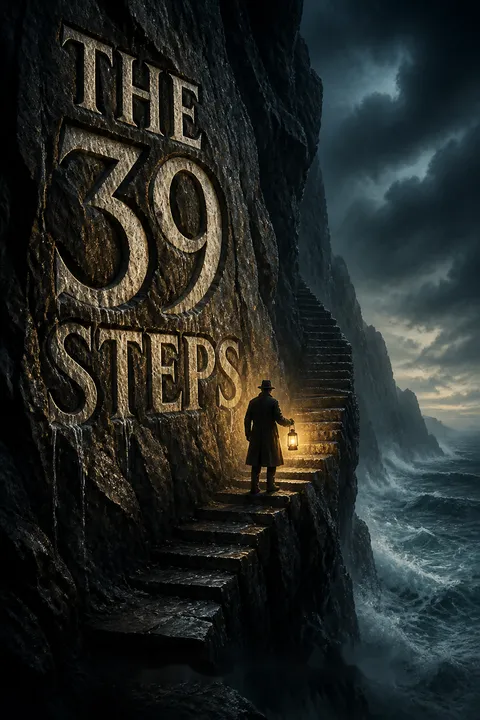

Plot Summary
Boredom and the Unexpected Guest
In London, recently returned from South Africa, Richard Hannay is weighed down by boredom and isolation. He's an outsider with no real friends or purpose, suffocated by the monotony of city life. But all changes one evening when Franklin Scudder, a frantic neighbor, bursts into his flat with wild accusations of political assassination and a vast international conspiracy brewing in Europe. Overnight, Hannay's home becomes a den of whispered fears, clashing accents, and fatal urgency, as Scudder reveals he's faked his own death and entrusts Hannay with a secret that could tip the world into chaos.
Scudder's Deadly Secret
Scudder, an American intelligence operative, speaks of shadowy anarchists and financiers aiming to trigger war between Germany and Russia by assassinating a key Greek diplomat, Karolides. Scudder's paranoia is palpable: he's certain he's pursued, marked for death, and that the plot hinges on him surviving just a few more weeks. Hannay listens, alternately incredulous and captivated, as Scudder's layered disguises and cryptic shorthand point to an enemy with tentacles everywhere. When Scudder is brutally murdered in the night, Hannay finds himself not just a confidant but the only person who can stop the web of intrigue from engulfing Europe.
On the Run
Realizing both the police and the conspirators will be after him—one side for Scudder's murder, the other to silence him—Hannay adopts a disguise, assuming the role of a milkman. He escapes early in the morning, blending into the working-class rhythm of London, haunted by paranoia and the terror of being followed. Armed only with Scudder's cryptic black notebook and the hope that he can warn the authorities, Hannay boards a train north, heading towards the wilds of Scotland, where anonymity and the country's remoteness offer his only hope.
Wild Moors and False Faces
Through the Scottish moors, Hannay changes identities as often as he encounters strangers: a farmer, a road worker, a livestock dealer. He is both pursuer and pursued, matching wits with police officers, local busybodies, and, at every turn, the ominous shadow of Scudder's killers. Each refuge is temporary—a friendly innkeeper's inn, a rustic cottage, the rough shelter of the moors. He picks up the thread of code-breaking, making sense of Scudder's notes even as danger closes in from all points of the compass.
The Manhunt Intensifies
The manhunt grows. Through chance and quick thinking, Hannay escapes aeroplanes overhead, police cordons, and encounters with locals who may or may not be informants. Every brief oasis of peace—chatter with an innocent shepherd, a meal by a peat fire—is tinged with the knowledge that the Black Stone, the secretive cabal behind the plot, is merciless and clever. Hannay finds sanctuary among the kind and the eccentric but must always move on, driving himself to exhaustion and ever more creative deceptions to stay ahead.
Disguises and Close Calls
To shake off his pursuers, Hannay dons the rough garb of a roadman, fakes accents, and even blackmails a pompous stockbroker to swap clothes and cars. A highlight is his accidental infiltration of an aristocratic household—there, mistaken for a colonial Free Trade speaker, he gives a stirring talk and, for a moment, tastes safety and camaraderie. Yet, at each stop, he barely stays ahead of recognition, fighting off fatigue, doubt, and the encroaching suspicion that his enemies may always be one step ahead.
Escape from the Enemy's Lair
Believing himself to have found refuge, Hannay discovers instead that he has stumbled into the very home of the Black Stone's mastermind, the "man with the hooded eyes." Captured and under threat of silent execution, Hannay uses technical knowledge and desperate ingenuity to trigger an explosion and stage a narrow escape. Pursuit is relentless. Driven by survival instinct, he flees the ruined house, finding brief shelter in an abandoned mill and an ivy-covered dovecote, always aware that relentless men seek his end.
Sanctuary and Recovery
Exhausted, poisoned by fumes and battered by the chase, Hannay collapses at the door of the one honest man he trusts—Turnbull, the roadman he earlier impersonated. There, he is nursed through fever and the effects of his injuries, cut off from the outside world, while news of the murder and conspiracies die down in the public mind. In this rural quiet, he reflects on his ordeal, regains strength, and comes to terms with his commitment to see Scudder's mission through.
Decoding the Conspiracy
Armed with time and clarity, Hannay turns again to Scudder's black notebook. Through astute observation and trial, he deciphers the code, learning that the true plot is not only about assassination but also about stealing Britain's top naval secrets for German intelligence via a group called the Black Stone. Hannay journeys south, seeking Sir Walter Bullivant, a high-ranking government official, convinced now that only direct communication with Britain's inner circle can avert catastrophe.
The Black Stone Revealed
Meeting Sir Walter and a cadre of admiralty and war office officials, Hannay races to convince them of the threat. They are skeptical until news arrives—the key diplomat, Karolides, has been assassinated, confirming Scudder's greatest fear. The realization dawns that the Black Stone's plans are in motion: the theft of naval secrets is imminent, and Britain stands on the cusp of being blindsided in war. Only one clue remains—a reference to "thirty-nine steps" tied to high tide at 10:17 pm.
Desperate Pursuit
Hannay and the officials labor to interpret Scudder's last cryptic note. Scouring tide tables and coast maps, Hannay deduces that the "thirty-nine steps" must refer to a particular set of stairs on the English coast, used for a clandestine escape by the conspirators. As time ticks towards the fated hour, a small force races to the Kentish coast, narrowing the options, their quarry tantalizingly close to vanishing over the horizon with Britain's most vital secrets.
The Thirty-Nine Steps Unveiled
In a tense, psychological confrontation, Hannay faces the Black Stone in the guise of English gentry at a seaside villa. Their innocence is nearly convincing, bolstered by impeccable alibis, social banter, and a seamless middle-class façade. Only the tiniest slip—a half-remembered gesture, a fleeting look—awakens Hannay's hunter's instinct and reveals their true identity. The conspirators make a last desperate dash for their yacht, using hidden stairs beneath the villa as escape.
Final Gambit at Sea
The Black Stone, believing themselves moments from freedom, sets off a hidden mechanism to collapse their escape route and cover their tracks. But Hannay has anticipated their plan: the authorities intercept their yacht, and the would-be traitors are arrested with the stolen naval plans in their possession. The success is total and bittersweet—Britain's vital secrets are safe, the immediate threat averted, but the winds of war are already rising.
Aftermath and the Coming Storm
The conspiracy thwarted, Hannay is cleared of all suspicion. The gratitude of the nation is muted by the coming deluge—the guns of war begin to thunder across Europe. For Hannay, what began as a lonely man's search for meaning has ended in a role far larger than he could have imagined. This brief, explosive adventure has changed him forever, forging unlikely connections and teaching him that heroism is often a matter of endurance, adaptation, and the courage to act when history comes calling.
Analysis
The Thirty-Nine Steps as prototype and parableJohn Buchan crafts the archetype for the modern thriller: a lone, resourceful protagonist, wrongly accused, forced into a frantic race to expose a conspiracy that could destroy his world. Beyond its breakneck suspense, the novel explores identity, belonging, and the permeability of trust within a society on the brink of war. Hannay's odyssey across Britain—an outsider's journey through class boundaries, rural landscapes, and the machinery of state—becomes a microcosm for the nation's own crisis, confronting uncertainty and division. The "enemy within" device, where ultimate danger hides behind the most banal facades, captures a mood of prewar anxiety that still resonates. The relentless pace, reliance on instincts, and gravitation toward action over methodical inquiry reflect not just genre innovation but a psychological truth about coping with existential danger. Ultimately, Buchan suggests that heroism is less about innate brilliance than about perseverance, adaptability, and a willingness to act—for others—when fate thrusts that responsibility upon us.
Review Summary
Reviews of The Thirty-Nine Steps are mixed, averaging 3.59/5. Admirers praise its fast pace, historical significance as a pioneering spy novel, and vivid descriptions of the Scottish landscape. Critics note underdeveloped characters, implausible plot points, and dated language reflecting early 20th-century attitudes. Many readers find the Hitchcock film superior, noting its added romance and tension. Despite its flaws, most acknowledge the novel's lasting influence on the espionage and "man-on-the-run" genres.
People Also Read



Characters
Richard Hannay
Born in Scotland and forged by colonial adventures in Africa, Hannay is a solitary, pragmatic man wrestling with the disillusionment of peacetime London. Plunged without warning into deadly intrigue, his resourcefulness, adaptability, and deep-seated decency drive him to accept unwelcome responsibility when Scudder is murdered. Cut off from help, Hannay's instinct for survival is equally matched by a developing sense of civic duty—outwitting enemies through disguise, sheer nerve, and analytical sharpness. He forms fleeting bonds with a spectrum of British society—from rural roadmen to government mandarins—proving his ability to exist in, and ultimately to rally, disparate worlds. Hannay's ordeal shapes him from a bored drifter into a symbol of the ordinary man's capacity for extraordinary acts.
Franklin P. Scudder
An American spy with a sharp mind and deep neuroses, Scudder is gripped by the truth of a vast, invisible threat to European peace. He oscillates between courage and trembling fear, haunted by the knowledge his death will ignite violence if he fails to warn the right people. Scudder entrusts his life's work to Hannay, glimpsing in him an honesty and boldness the situation demands. His murder—violent and symbolic—shifts Hannay's arc from observer to principal actor and plants the seeds for unraveling the Black Stone's intentions.
Sir Walter Bullivant
A shrewd, unflappable senior government official, Sir Walter represents the best of the British civil service—pragmatic, strategic, and cautiously open-minded. Initially skeptical of Hannay's wild story, he gives the fugitive a hearing, drawn by Hannay's clarity and evidence. Sir Walter's role is both gatekeeper and facilitator, translating scattered intelligence into coordinated action. His presence is a psychological safe harbor for Hannay and a reminder of the wider stakes.
The "Man with Hooded Eyes" / Black Stone Leader
The unnamed mastermind behind the Black Stone conspiracy is a chilling study in calculated evil. Camouflaging himself as a benign intellectual and English retiree, he embodies the spy as predator—emotionless, patient, able to shift identities with ease. His leadership is marked by an unflinching steeliness, haunting Hannay in dreams and memory. The conflict between Hannay's visceral morality and this man's icy amorality sits at the heart of the chase.
Percy and "Bob" Appleton (Black Stone Accomplices)
Posing as jovial Englishmen, these two complete the Black Stone's trio. Each plays a part: "Percy," the plump, polished actor, and "Bob," the wiry, cruel executioner. Their ability to immerse themselves in British middle-class normality tests Hannay's judgment and conjures the unsettling notion that treachery is most dangerous when it looks familiar. Their masks force Hannay to trust not evidence, but instinct.
Turnbull
The taciturn Scottish roadman whom Hannay impersonates—and later befriends—Turnbull offers the healing normalcy of the rural working class. His unquestioning aid during Hannay's illness is essential for the protagonist's physical and psychological recovery. Turnbull's presence signals the trustworthiness and decency of "ordinary" Britons and the quiet heroism outside government or espionage.
The Literary Innkeeper
A young Scot yearning to be a novelist, the innkeeper's hunger for "romance" and the extraordinary introduces a thread of meta-fiction. His enthusiastic complicity in Hannay's ruse, and his willingness to help despite danger, reflects the British belief in adventure, innocence, and the transformative power of storytelling.
Sir Harry
The aristocratic Free Trade candidate who, in a twist of fate, shelters Hannay, Sir Harry embodies a political and social openness that transcends class. His trusting acceptance of Hannay's incredible tale and practical aid are crucial steps in connecting the chased loner with the machinery of government. Sir Harry's role underlines how heroism is seeded in unexpected soil.
The Plump One and the Thin One (Black Stone Agents)
Appearing repeatedly in different guises—clubmen, farmworkers, city gent—the "Plump One" and "Thin One" are the faces of the Black Stone's hunter-killers. Their ability to blend in, manipulate, and relentlessly pursue Hannay heightens the novel's tension and demonstrates the psychological terror of an enemy hiding in plain sight.
Local Police and Authorities
The police, railway officials, and other local authorities, quick to chase and slow to recognize truth, embody the dangers of bureaucracy and the perils facing the wrongly accused. They force Hannay to hone his wits and operate outside the usual protections of the law.
Plot Devices
Reluctant Hero's Journey
The heart of The Thirty-Nine Steps is the transformation of Richard Hannay from disengaged observer to national savior. The "everyman" hero, unsure of his own abilities, is caught between escalating external threats and an urgent internal call to action. Each disguise, flight, and hard decision deepens his commitment and moral resolve.
Chases and Disguises
Hannay's journey unfolds through perpetual pursuit and an ever-changing wardrobe of disguises and roles. False identities enable his flight but also force him to see himself—and others—unsettlingly afresh. The dualities in the narrative echo the shifting masks of both hero and adversary.
The MacGuffin: Coded Notebook and the Thirty-Nine Steps
Scudder's ciphered notebook, and later the enigmatic "thirty-nine steps," are classic MacGuffins—objects both essential and obscure, carrying the plot forward, their true meaning revealed only at the last moment. The decoding process is at once literal (breaking the cipher) and metaphorical (unraveling layers of deception and truth).
Foreshadowing and Red Herrings
Buchan fills the plot with foreshadowing—glancing references, ominous characters glimpsed but not confronted, clues almost too cryptic to decipher—inviting both Hannay and the reader into paranoid alertness. Carefully placed red herrings, especially the "ordinary" Englishness of the villains, keep the resolution uncertain until the end.
Clock-Ticking Structure
Deadlines—Scudder's murder, the date of assassination, Karolides's planned visit, the time of high tide—create suspense and urgency. Hannay's actions are rendered more desperate, transforming the novel into both a psychological and physical race against the inevitable catastrophe of war.
Inversion of the Familiar
The most dangerous men and acts are embedded in the most familiar locations and people: rural farms, seaside villas, the British middle-class. This device amplifies tension and psychologically unsettles both protagonist and reader—the idea that the enemy is not foreign, but "next door."
Richard Hannay Series
Download PDF
Download EPUB
.epub digital book format is ideal for reading ebooks on phones, tablets, and e-readers.








































