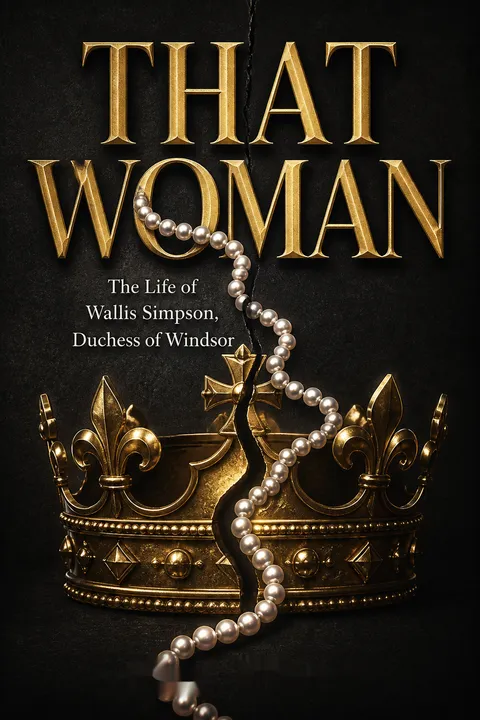

Key Takeaways
1. Wallis's Early Life: A Foundation of Insecurity and Self-Creation
Choosing your own name is the supreme act of self-creation.
A difficult start. Wallis Warfield's early life was marked by secrecy, financial instability, and a deep-seated need for control. Born Bessiewallis, likely out of wedlock in 1896, she quickly shed the "Bessie" as a name "fit only for cows," asserting her unique identity as "Wallis." This act of self-definition was crucial for a young woman who felt she had to fashion herself as strong and distinctive from a young age.
Financial dependence. Her father died five months after her birth, leaving her and her spirited mother, Alice Montague, dependent on the charity of the stern Warfield family matriarch and, more significantly, her controlling uncle, Solomon Davies Warfield. He funded her childhood but in a cruel, inconsistent manner, depositing varying sums into her mother's account. This instilled in Wallis an embedded fear of insecurity and a lifelong determination to avoid poverty, shaping her future choices.
Social ambition. Despite her financial struggles, Wallis was proud of her aristocratic Southern ancestry, tracing her lineage back to the 17th century. She attended elite schools like Oldfields, where she cultivated a competitive spirit and a desire to stand out. Her early experiences, including her mother's failed attempts at independence and the social stigma of being a "poor relation," fueled her ambition to secure a comfortable and respected position in society, primarily through marriage.
2. The Enigma of Her Sexuality: A Driving Force Behind Her Persona
Wallis herself, if she were born with some degree of DSD – and there is no medical proof that this is an accurate assessment of her case – would not have known that anything was wrong, at least for many years, and even then might have been given confused information unless she had cause to undergo an operation.
A medical mystery. Speculation about Wallis's sexuality and physical makeup is central to understanding her persona. The book explores the possibility that she was born with a Disorder of Sexual Development (DSD) or intersexuality, a condition that could manifest in subtle ways, such as slightly unusual genitalia or a lack of periods, which would have been undiagnosed and undiscussed in her era. This theory, supported by circumstantial and psychosexual evidence, suggests a deep-seated insecurity about her womanhood.
Behavioral manifestations. This potential condition, coupled with a lack of a uterus and inability to conceive, may have driven her intense flirtatiousness and desire to reaffirm her femininity. A graphologist's report described her as having "a strong male inclination in the sense of activity, vitality and initiative," needing to "dominate," and being "sadistic, cold, overbearing, vain." Dr. Christopher Inglefield, a plastic surgeon, noted her "angular, almost square-jawed and masculine-shaped face," indicating a lack of estrogen, and suggested that women with DSD often overcompensate by being "boy mad" and ultra-feminine in dress and sexual behavior.
The "China clinch" rumors. The persistent rumors of Wallis learning "ancient oriental techniques for pleasuring men" in Chinese "sing-song houses" or brothels, often referred to as the "Baltimore grip" or "China clinch," are presented as a reflection of societal ignorance and fantasy about female sexuality. While unverified, these stories highlight the public's need to explain her powerful allure over the Prince, often attributing it to exotic sexual prowess rather than her complex personality or his own psychological needs.
3. Strategic Social Ascent: Cultivating Influence in Diplomatic Circles
This exposure to an international network of men in high-powered jobs taught her some basic rules for a woman who wished to engage in conversations with the opposite sex in the early part of the century.
Mastering social skills. After her first divorce, Wallis moved to Washington D.C., a "special paradise" for single women with many unattached, attractive, and cultured men. Here, she diligently honed her social talents, learning to engage men in conversation by being well-informed about world affairs and flattering their interests. This strategic approach was key to her ambition to climb the social ladder.
Cultivating connections. Living with an Admiral's daughter, Dorothy McNamee, gave Wallis social standing and access to diplomatic and political circles. She made a point of remembering people and leveraging introductions, demonstrating an "art form enabling her to leap around the world." Her ability to charm and make men feel uniquely appreciated became a hallmark of her social strategy.
Ambition for marriage. Despite her stated desire for "deep love," Wallis was pragmatic about her future, openly declaring that the man she married "would have to have lots of money." Her passionate but ultimately unrequited love for Argentine diplomat Don Felipe Espil, who chose a wealthier, better-connected woman, reinforced her understanding that money and social standing were crucial for security and acceptance in the elite circles she aspired to join.
4. The Tumultuous First Marriage: A Catalyst for Independence
In order to make sense of Wallis it is important to understand the horror of her marriage to Spencer.
A shocking reality. Wallis's first marriage to Lieutenant Earl Winfield Spencer Jr. was a "harrowing experience" that quickly deteriorated from infatuation into a cycle of Win's heavy drinking, jealousy, and verbal and physical abuse. Wallis, who admitted to being "ignorant of the facts of life" when she married, found herself ill-equipped for the realities of a naval wife's life and her husband's volatile nature.
Escalating conflict. Win's anger was fueled by his perceived lack of promotion and his wife's "naturally gay and flirtatious" behavior. Wallis recounted being locked in rooms, subjected to "subtle innuendoes and veiled insults," and even bizarre rituals like forcing her to witness the destruction of her family photographs. Her closest male friend, Herman Rogers, later claimed Wallis "never had sexual intercourse with either of her first two husbands," suggesting a deeper marital dysfunction.
A desperate escape. After a brief, failed attempt at reconciliation in China, where Win's behavior worsened, Wallis decided to leave him for good. She sought a divorce, a decision met with strong disapproval from her family, who considered it a "deep shame" and would not support her financially. This experience solidified her determination to seek security and control in her future relationships.
5. Ernest Simpson: A Stepping Stone to London Society
What attracted Wallis to Ernest was probably his dependability, the air of security and breeding that he radiated.
Seeking stability. After her first divorce, Wallis was a free woman but without financial support, facing the daunting prospect of finding work, which she "did not relish." She yearned for stability and a comfortable lifestyle, and Ernest Aldrich Simpson, a British subject from a prosperous shipping family, offered just that. He was well-read, knowledgeable, and deeply in love with her, providing a stark contrast to her tumultuous first marriage.
A new beginning in London. Ernest's background, though not aristocratic, was respectable, and his sister Maud Kerr-Smiley, a prominent society figure, helped introduce Wallis to London's elite. This allowed Wallis to make a fresh start in a city where her past was unknown, and she could cultivate a new image. She meticulously decorated their flat, focusing on "feminine interests" and establishing a reputation as a successful and unusual hostess, known for her American recipes and cocktails.
The price of security. While Ernest provided the financial and social security Wallis craved, their marriage was not without its strains. Ernest's business suffered during the Depression, and Wallis's expensive tastes and constant need for entertainment put a strain on their finances. She also had to contend with Ernest's difficult father and his mistress, and the growing realization that she and Ernest would not have children, a subject she conspicuously avoided in her memoirs.
6. The Prince's Obsession vs. Wallis's Calculated Ambivalence
I think I do amuse him. I’m the comedy relief and we like to dance together but I always have Ernest hanging around my neck so all is safe.
A royal infatuation. Wallis met Edward, Prince of Wales, in 1931 through his then-mistress, Thelma Furness. Edward, a lonely and insecure man, quickly became infatuated with Wallis's sharp wit, directness, and American charm, finding her a refreshing change from the deferential British aristocracy. He began showering her with attention, gifts, and invitations to his country home, Fort Belvedere.
Wallis's strategic play. Initially, Wallis viewed the Prince's attention as a social coup and a source of amusement, believing she could "keep them both" – Ernest for security and the Prince for excitement and status. She was remarkably clear-eyed about the relationship, seeing herself as "comedy relief" and convinced that the infatuation would pass. She enjoyed the lavish lifestyle and the doors it opened, but also found the Prince demanding and "exhausting."
The turning point. As Thelma Furness departed for America, Edward's infatuation intensified into an all-consuming obsession. He began giving Wallis expensive jewelry and money, making it harder for her to "turn her back on" the luxuries. Despite her growing unease and the increasing public gossip, Wallis found herself trapped, unable to end the relationship, partly due to her fear of losing everything and partly due to the Prince's threats of self-harm if she left him.
7. The Abdication Crisis: A Clash of Personal Desire and Public Duty
The King represented an ideal: he was meant to uphold the law not to condone subversion of it.
A constitutional dilemma. Edward's accession to the throne in January 1936 immediately brought his relationship with Wallis to a head. His determination to marry a twice-divorced American woman, whose first divorce was legally questionable in England, clashed fundamentally with the deeply conservative values of the British establishment, the Church of England, and the Dominions. Prime Minister Stanley Baldwin, a man attuned to public sentiment, understood the gravity of the situation.
The King's defiance. Edward, convinced of his popularity and Wallis's unique qualities, believed he could modernize the monarchy and marry whomever he chose. He dismissed concerns about his "personal friends" and even lied to his father about Wallis not being his mistress. His behavior, including allowing Wallis to view his proclamation from a prominent window and presiding over Balmoral with her, deeply offended the royal family and courtiers.
The divorce controversy. Wallis's divorce from Ernest Simpson, granted in Ipswich on grounds of adultery, was a public spectacle. The King's Proctor's investigation into potential collusion and adultery on Wallis's part highlighted the hypocrisy of divorce laws at the time and fueled public resentment. The prospect of "Queen Wallis" was deemed unacceptable, threatening the stability of the monarchy and the Empire, leading to the stark choice: the throne or Wallis.
8. Wallis as Scapegoat: The Target of National Outrage
I who had sought no place in history would now be assured of one – an appalling one, carved out by blind prejudice.
Public vilification. As the abdication crisis unfolded, Wallis became the target of intense public hatred and media scrutiny. Caricatured as a "witch, whore or Nazi spy," she was blamed for the King's perceived dereliction of duty and the potential destruction of the monarchy. The British press, initially self-censored, unleashed a torrent of sensational stories once the Bishop of Bradford's speech opened the floodgates.
A pawn in politics. Wallis felt "used by politicians" and trapped by the "inexorability of the legal process." Her attempts to withdraw her divorce petition and leave the King were met with his threats of suicide and the belief that he would follow her regardless. She was acutely aware that "if he abdicated every woman in the world would hate me and everybody in Great Britain would feel he had deserted them."
The "China Dossier" and Nazi fears. Rumors of a "China Dossier" detailing her alleged sexual exploits and fears of her passing secrets to the Germans during a time of international tension further cemented her negative image. Despite a lack of concrete evidence, these accusations, coupled with her perceived "limitless ambition" and "partiality for Nazi Germans," made her an easy target for those who sought to discredit her and, by extension, the King.
9. Exile and the Battle for Dignity: A Life Defined by Royal Rejection
The Duke’s stubborn and self-centred behaviour at this most critical juncture in British history, when the country of which he had once been king was fighting an existential battle and he was telling diplomats privately ‘that the most important thing to be done was to end the war before thousands more were killed or maimed to save the faces of a few politicians’, has not endeared him or the Duchess to posterity.
A life in limbo. After the abdication, the Windsors embarked on a life of aimless exile, first in Austria, then France, and later the Bahamas. The Duke's "self-centred behaviour" and insistence on "trifles" like his wife's royal status, even during World War II, alienated many, including Winston Churchill, who had initially supported him. Their perceived "dereliction of duty" and "defeatist" attitudes during the war further damaged their reputation.
The Bahamas banishment. Their posting to the Bahamas as Governor and Governor's wife was seen as a "punishment station," a "charming little isle" that Wallis hated. She found the climate unbearable, the locals "petty-minded," and the visitors "common and uninteresting." Despite her efforts in Red Cross work and setting up a canteen for troops, she felt "buried alive" and frustrated by their inability to contribute meaningfully to the war effort.
Constant struggle for status. The Duke relentlessly fought for Wallis to be granted the title of "Her Royal Highness," a request consistently denied by the British royal family and government. This ongoing battle, coupled with financial worries and the Oakes murder scandal in the Bahamas, fueled their bitterness and sense of persecution. Wallis, though often despairing, maintained a defiant tone, believing "England carries on propaganda against us."
10. The Royal Family's Unwavering Opposition: A Lasting Legacy of Bitterness
The true feelings of the royal family – and especially those of the new Queen Elizabeth about the woman shortly to become her sister-in-law – is revealed in a letter sent from Windsor Castle to the Dominions Secretary, Lord Lloyd, in 1940 and only recently released with the agreement of the Royal Archives and after the Queen Mother’s death in March 2002.
Unforgiving stance. The British royal family, particularly Queen Mary and the new Queen Elizabeth (later the Queen Mother), maintained an implacable opposition to Wallis. Queen Mary famously refused to meet her, and Queen Elizabeth's private letters reveal her deep antipathy, referring to Wallis as "That Woman" and asserting that a woman with "three husbands alive" could never "lead or set an example."
Denial of HRH. The most significant and enduring symbol of this rejection was the denial of the "Her Royal Highness" title to Wallis upon her marriage to the Duke. Despite legal opinions suggesting she was entitled to it, the King and his ministers, influenced by the royal family's strong disapproval, ensured it was withheld. This decision effectively kept the Windsors in permanent, half-royal exile, a source of constant pain and resentment for the Duke.
Lasting bitterness. This unwavering opposition poisoned relations between the Duke and his family for decades. He felt betrayed and humiliated, blaming his mother and sister-in-law for his wife's treatment. Even after his death, Wallis's funeral was marked by the royal family's coldness, and efforts by Lord Mountbatten to reclaim the Duke's possessions for the "Royal Collection" further fueled her anger and neuroses, ensuring the bitterness endured until her own death.
11. The Enduring Mystery: Why "That Woman" Captivated a King
Because we cannot, by any rational means, explain why a middle-aged, married woman with large hands and a mole on her chin convinced a troubled, boyish prince to believe that his life could have no meaning unless lived alongside her, novelists and playwrights, actors and historians need to dig into their imagination in order to explain it.
An inexplicable allure. Wallis Simpson remains an enigmatic figure, her power over Edward VIII defying rational explanation. She was not conventionally beautiful, was older than him, and had a complex past, yet she captivated a king to the point of abdication. This "unbelievable" aspect of her story continues to fascinate writers and artists, who grapple with the mismatch between her public image and the profound impact she had on history.
A complex legacy. Wallis saw herself as an "ordinary woman" with "insatiable ambition," who "collided brutally with others" in her quest for a successful life. Her life was a blend of "light and shade, good and evil, darkness underneath the gloss." While often portrayed as a "grasping adventuress" or "wicked temptress," she also displayed courage, resilience, and a sharp wit, enduring immense public opprobrium and private ridicule.
Beyond the facts. The book concludes that her appeal lies not just in the dramatic events surrounding her, but in her "personal sparkle," "charisma," and "courage and grace" to live with a man she "privately ridiculed." Her story is a testament to how an ordinary person, through a unique combination of personality and circumstance, can unpredictably divert the course of history, leaving behind a legacy that continues to be reinterpreted and debated.
Review Summary
"That Woman" receives mixed reviews, averaging 3.44/5. Many readers criticize Anne Sebba's unsubstantiated medical theories, particularly her speculation that Wallis Simpson may have had a Disorder of Sexual Development or been intersex, which most reviewers find poorly evidenced and irresponsible. Additional conjecture about Edward VIII's possible autism and Wallis's alleged sexual techniques from Shanghai further frustrate readers. Structural issues are also noted, with uneven pacing and an abrupt ending. Positive reviewers appreciate the accessible storytelling, fascinating subject matter, and the newly discovered letters between Wallis and her second husband.
People Also Read




Download PDF
Download EPUB
.epub digital book format is ideal for reading ebooks on phones, tablets, and e-readers.








































