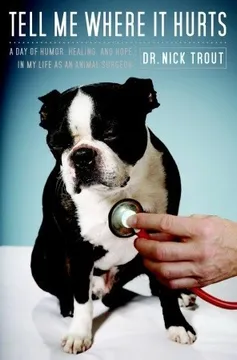

Key Takeaways
1. Veterinary medicine relies on interpreting non-verbal clinical signs rather than self-reported symptoms
Veterinarians spend their professional lives interpreting the language of animal signs, denied the luxury of plain, unambiguous communication.
Deciphering the unspoken. Unlike human physicians who rely on self-reported symptoms, veterinarians must become master detectives of non-verbal clinical signs. Every diagnosis hinges on a meticulous physical examination, where a subtle flinch, a change in posture, or an altered gait speaks volumes.
The evolutionary mask. Animals are hardwired to conceal pain and vulnerability to protect themselves from predators, a survival mechanism that persists in domesticated pets. This stoicism means that by the time an owner notices a problem, the underlying pathology is often advanced, requiring swift and decisive veterinary intervention.
The diagnostic toolkit. To bridge the communication gap, veterinarians utilize a sophisticated array of diagnostic tools to visualize and measure what the patient cannot express. These objective measures are crucial for confirming clinical suspicions and formulating effective treatment plans.
- Abdominal palpation to detect hidden masses, fluid, or localized pain.
- Gait analysis to differentiate between orthopedic injuries and neurological deficits.
- Advanced imaging, including X-rays, ultrasound, and MRI, to peer inside the body.
- Comprehensive blood profiles and urinalysis to evaluate organ function and systemic health.
2. Pets serve as profound emotional anchors, absorbing human loneliness and grief
Pets devour the loneliness. They give us purpose, responsibility, a reason for getting up in the morning, and a reason to look to the future.
An emotional anchor. Pets provide a unique form of unconditional love and stability that helps humans navigate profound grief, isolation, and life transitions. For many, such as the elderly widower Mr. Hartman, a beloved animal represents the last tangible connection to a lost spouse and a vital reason to keep living.
Uncomplicated mutual trust. The relationship between a pet and its owner is built on a foundation of silent, instinctual understanding that transcends human language. This deep emotional connection is so powerful that owners are often willing to make extraordinary personal and financial sacrifices to preserve their companion's life.
The therapeutic impact. The presence of an animal has a measurable, positive effect on human psychological and physical well-being, grounding us in the present moment. By demanding our care and responsibility, pets pull us out of our self-absorbed worries and connect us to a simpler, more honest reality.
- Alleviating profound loneliness and social isolation in vulnerable populations.
- Providing a consistent daily routine and a sense of purpose.
- Offering non-judgmental affection that fosters emotional healing and resilience.
- Serving as a catalyst for physical activity and social interaction with other pet owners.
3. Online medical information empowers pet owners but can foster dangerous denial and clinical skepticism
Sometimes the Internet can feel like a religion for agnostics who need a shoulder in times of trouble.
Empowerment and misinformation. The internet has revolutionized veterinary medicine by giving pet owners instant access to medical information, allowing them to be more informed advocates for their animals. However, this digital landscape is also a breeding ground for unverified advice, outdated statistics, and highly subjective anecdotes that can easily mislead.
The shield of denial. Access to online forums and search engines can inadvertently foster denial, leading owners to cling to rare, treatable diagnoses while rejecting grim clinical realities. This was starkly illustrated by Jester's owners, who used internet research to convince themselves their Great Dane had hip dysplasia rather than terminal wobbler's disease.
Navigating the digital noise. To protect their pets, owners must learn to evaluate online sources critically and use the internet as a tool for collaboration rather than confrontation with their veterinarian. A successful clinical outcome relies on trusting the hands-on expertise of the professional over the collective opinions of cyberspace.
- Recognizing that online medical data is often incomplete, biased, or outdated.
- Avoiding the temptation to self-diagnose or self-treat pets based on internet forums.
- Consulting credible, peer-reviewed veterinary websites for educational purposes.
- Discussing online findings openly and respectfully with a trusted veterinarian.
4. Delivering a "good death" through euthanasia is a veterinarian's ultimate act of mercy, yet it carries a heavy psychological toll
Euthanasia is an act to end discomfort. Death is the unfortunate, unavoidable, and unintentional effect of achieving this goal.
The ultimate act of mercy. Euthanasia, derived from the Greek for "good death," is a veterinarian's most profound and difficult tool for relieving intractable animal suffering. It offers a peaceful, painless release from the agonizing decay of terminal illness, sparing pets from a lingering and undignified end.
The psychological toll. Delivering a lethal injection requires veterinarians to balance clinical objectivity with deep empathy, a delicate act that carries a heavy emotional cost. The cumulative weight of performing euthanasia, combined with professional isolation, contributes to alarmingly high suicide rates within the veterinary community.
A dignified farewell. A compassionate euthanasia process requires careful preparation, clear communication, and a deep respect for the owner's grief. By guiding families through this final transition with honesty and grace, veterinarians help transform a moment of profound loss into a lasting memory of mercy.
- Placing intravenous catheters to ensure a smooth, painless delivery of barbiturates.
- Counseling owners on the physical realities of death, such as pets keeping their eyes open.
- Providing a quiet, supportive environment for families to say their final goodbyes.
- Helping owners navigate the intense guilt and second-guessing that often follows the decision.
5. Modern veterinary specialization forces owners to balance the price of advanced medicine against the value of a pet's life
The result is that owners can be forced to answer an unthinkable question: How much is my pet worth to me?
The price of advanced medicine. The rapid advancement of veterinary technology has made human-grade treatments available to pets, but these miracles come with significant financial costs. Without the safety net of universal pet insurance, owners are frequently forced to balance their love for an animal against the harsh reality of their bank accounts.
The economy of guilt. Emotional factors, particularly guilt and the desire to avoid regret, heavily influence an owner's willingness to spend thousands of dollars on veterinary care. This can lead to high-stakes financial gambles, where owners exhaust their savings or go into debt to buy a few more months of life for a terminal pet.
The reality of economic decisions. Veterinarians must navigate these sensitive financial discussions with empathy and transparency, offering realistic prognoses and alternative treatment plans. Ultimately, the goal of veterinary care is to preserve quality of life, which sometimes means choosing a humane release over a costly, futile intervention.
- MRIs, CT scans, and specialized surgeries costing thousands of dollars out-of-pocket.
- The low adoption rate of pet insurance in the U.S. compared to the U.K.
- The painful reality of "economic euthanasia" when life-saving treatment is unaffordable.
- The necessity of establishing clear financial boundaries before embarking on complex treatments.
6. Veterinary surgery is a learned craft where mistakes are inevitable, and mentorship shapes the next generation
Surgery is meant to be difficult, but the more you struggle, the more you learn.
The path to mastery. Veterinary surgery is a demanding craft that cannot be mastered through textbooks alone; it requires years of hands-on practice, repetition, and struggle. New graduates must learn to transition from academic theory to the operating room, developing the physical dexterity and confidence needed to handle live tissue.
The power of mentorship. Experienced surgeons play a vital role in shaping the next generation of veterinarians by guiding them through high-stress procedures and emergency shifts. This mentorship provides a crucial safety net, allowing residents and interns to learn from their mistakes without compromising patient safety.
Developing clinical intuition. Over time, a surgeon's hands learn to move with economy and grace, and their mind develops a "sixth sense" for recognizing subtle clinical complications. This intuition is forged through the crucible of difficult cases, sleepless nights, and the willingness to embrace the struggle of learning.
- Transitioning from spectator to active surgeon under the guidance of a mentor.
- Learning to manage the intense physical and mental demands of emergency on-call shifts.
- Developing the tactile sensitivity required to assess tissue viability during surgery.
- Embracing mistakes and complications as essential stepping stones to clinical competence.
7. Advanced surgical techniques now extend to all species, shifting the boundaries of what is treatable
The 'big six' may hail from different 'orders,' but at least they are all mammals. The exotic repertoire includes creatures of different 'classes,' meaning fish, amphibians, reptiles, and birds...
A vast taxonomical landscape. Modern veterinary medicine has expanded far beyond cats and dogs to encompass a diverse array of exotic species, each presenting unique anatomical and physiological challenges. Specialists in this field must adapt their surgical skills to operate on everything from tiny birds to reptiles and pocket pets.
Restoring function through reconstruction. Reconstructive surgery has evolved to prioritize the restoration of function and the relief of pain over cosmetic perfection. Techniques such as skin flaps and muscle transpositions allow surgeons to close massive wounds left by trauma or cancer removal, giving pets a second chance at a comfortable life.
The ethics of intervention. As the boundaries of what is treatable continue to expand, veterinarians and owners must critically evaluate whether an aggressive intervention is truly in the animal's best interest. The goal of exotic and reconstructive surgery must always be to improve the patient's quality of life, not merely to prove that a procedure is technically possible.
- Adapting surgical instruments and anesthesia protocols for fragile, non-traditional patients.
- Performing complex reconstructive surgeries to close large defects and preserve limbs.
- Navigating the unique physiological responses of reptiles, birds, and pocket pets to anesthesia.
- Balancing the technical excitement of a rare procedure against the patient's long-term prognosis.
8. Pet obesity is a growing epidemic that often reflects human behavior, indulgence, and emotional projection
Obesity is the most important nutritional disorder facing twenty-first-century pets...
An epidemic of indulgence. Pet obesity is a growing health crisis that directly mirrors human lifestyles, emotional needs, and behaviors. Owners frequently project their own desires for comfort and indulgence onto their pets, using food as a substitute for the time, exercise, and active engagement that animals truly need.
The psychology of overfeeding. Offering treats and large meals provides instant gratification for the owner, reinforcing a sense of love and care. However, this well-intentioned indulgence leads to severe, life-limiting health complications, including debilitating arthritis, diabetes, and cardiovascular strain.
Navigating sensitive conversations. Veterinarians face the delicate challenge of addressing pet obesity with owners who may be defensive or sensitive about their own weight. Helping a pet shed pounds requires educating the owner on the physical consequences of overfeeding and empowering them to make lasting lifestyle changes for their animal.
- Recognizing pet obesity as a primary threat to joint health and longevity.
- Understanding the link between human emotional projection and pet overfeeding.
- Implementing strict dietary controls and structured exercise plans to promote weight loss.
- Overcoming owner resistance and denial regarding their pet's body condition.
9. Despite the guarantee of future loss, the profound rewards of loving a pet make the emotional risk entirely worthwhile
We pour our heart and soul into the animals in our lives, insisting that they are our children... and we do this with a certainty that for all this joy, we are guaranteed to lose them...
The heartbreaking contract. Loving a pet requires accepting a painful truth: we will almost certainly outlive them. Despite the guarantee of future grief, millions of people choose to open their homes and hearts to animals, finding that the years of uncomplicated joy and companionship far outweigh the pain of the final goodbye.
A pure, uncomplicated love. The relationship between a human and a pet is free from the judgments, conditions, and complexities that often strain human interactions. This purity makes the bond incredibly resilient, allowing it to serve as a source of comfort and strength through life's deepest personal tragedies.
Savoring the small victories. For veterinarians and pet owners alike, surviving the emotional roller coaster of illness and loss requires learning to cherish every small moment of success and connection. These memories of healing and mutual devotion are the true rewards of the profession, sustaining us through the inevitable struggles of life and death.
- Accepting the emotional risk of loving a creature with a short lifespan.
- Finding solace in the non-judgmental, constant presence of a companion animal.
- Cherishing the memories of recovery and connection that outlast the pain of loss.
- Recognizing that the profound rewards of the human-animal bond are always worth the risk.