


Key Takeaways
97% of Americans fantasize — your desires are probably normal
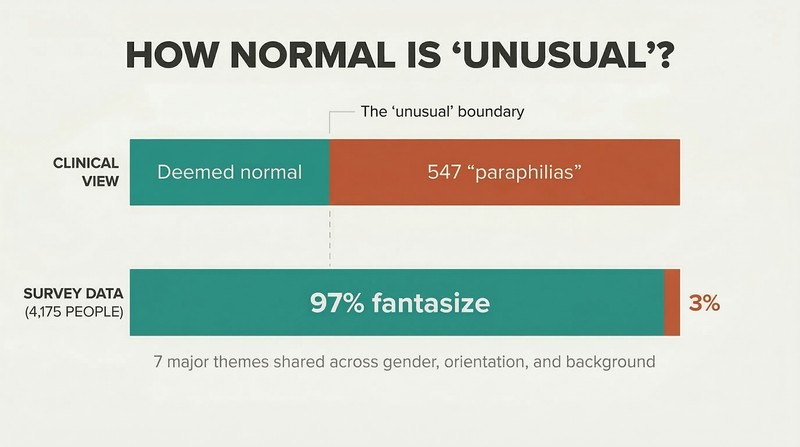
The largest fantasy survey ever. Sex researcher Justin Lehmiller surveyed 4,175 Americans with 369 questions and found that 97% reported having sexual fantasies — most several times per week. Seven major themes emerged that were shared by vast majorities regardless of gender, orientation, or background: multipartner sex, BDSM, novelty, taboo acts, nonmonogamy, passion and romance, and gender/sexuality flexibility.
Psychology has over-pathologized desire. One technical handbook catalogues 547 distinct paraphilias — supposedly unusual sexual interests — many of which Lehmiller's data revealed to be extraordinarily common. Dirty talk, food play, desire for novelty? All technically classified as paraphilias. The DSM once listed homosexuality alongside them. The range of "normal" sexual desire is far wider than the mental health community has admitted.
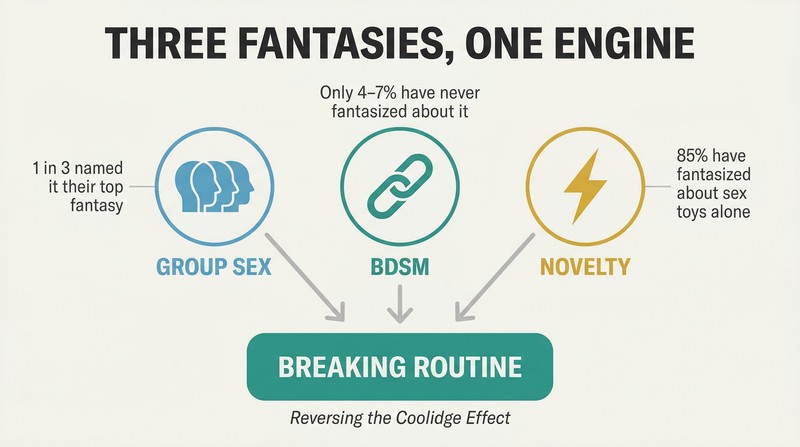
Group sex, BDSM, and novelty: America's three universal turn-ons
Three themes dominated. Over a third of participants named group sex — especially threesomes — as their all-time favorite fantasy. The appeal isn't about specific partners; it's sensory overload. BDSM rivaled it: just 4% of women and 7% of men had never fantasized about any form of bondage, dominance, submission, or sadomasochism. The third pillar — novelty — ranged from new positions to public sex to sex toys (85% had fantasized about those).
These three share a common engine: the desire to break routine. When we repeat the same sexual stimulus, arousal habituates — a pattern scientists call the Coolidge Effect. Group sex, BDSM, and novelty all inject enough variety to reverse this decline and reignite desire.
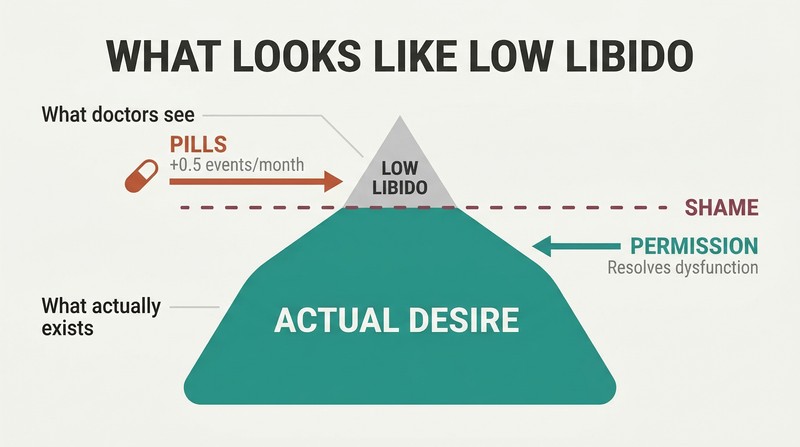
Most 'low libido' is shame about desire, not absence of desire
The pharmaceutical trap. When people suppress their real desires and force themselves into "acceptable" sex, satisfaction craters. Many get diagnosed with "low sex drive" and prescribed medications. But clinical trials showed the libido drug Addyi produced just 0.5 to 0.7 additional satisfying events per month versus placebo. The real problem isn't absent desire — it's desire for things we've been told are wrong.
Permission beats pills. Sex therapists using the PLISSIT model often find that simply giving clients permission to act on consensual desires — combined with proper sex education — resolves dysfunction that medication never could. Lehmiller's survey confirmed: participants who felt more guilt and shame about their fantasies reported significantly more sexual performance problems.
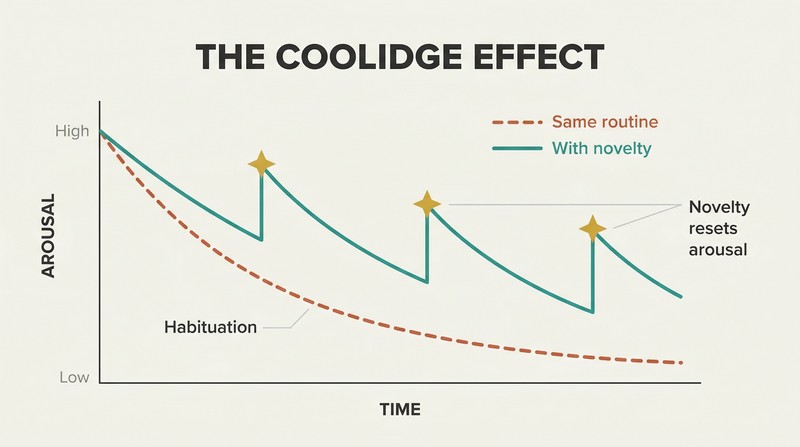
Same-partner arousal fades by design — novelty is the biological fix
The Coolidge Effect explained. Named after a (possibly apocryphal) anecdote about President Calvin Coolidge visiting a chicken farm, this principle holds that arousal declines with the same sexual stimulus over time. Research confirms it: men shown the same porn clip daily for weeks showed declining arousal — until a new actress appeared. They then ejaculated faster and produced semen with more active sperm.
Novelty isn't betrayal — it's maintenance. This doesn't doom relationships. Couples who regularly introduce variety — new positions, sex toys, role-playing, even exciting nonsexual activities like roller coasters — report the highest sexual satisfaction. The Coolidge Effect isn't a design flaw; it's a signal to keep evolving together.
Women's sexuality is more flexible than men's, not less sexual
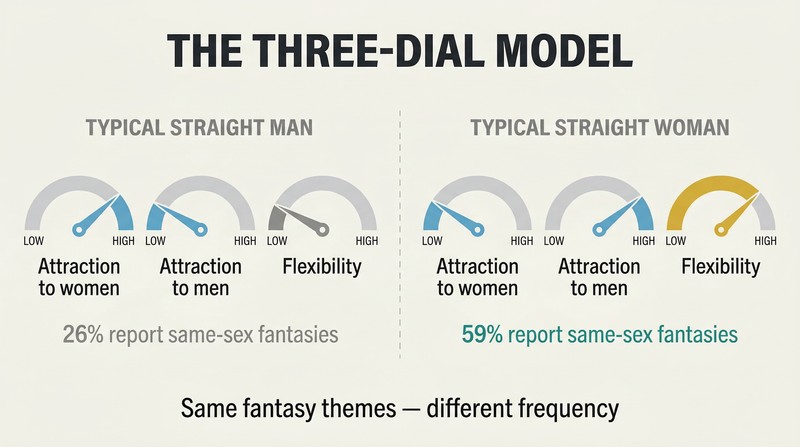
The three-dial model. Lehmiller proposes sexuality involves three brain "dials": two control attraction to men and women (your orientation); a third controls sexual flexibility — openness to deviating from orientation and cultural norms. In genital arousal studies, straight women responded to all types of pornography regardless of actor gender, while straight men's arousal was category-specific. 59% of exclusively straight women reported same-sex fantasies versus just 26% of straight men.
Flexibility extends beyond partner gender. Women reported more BDSM fantasies of nearly every type — twice as likely as men to report frequent bondage fantasies, four times as likely for masochism. Despite these differences, men and women share all seven major fantasy themes. The real difference is frequency, not kind.
Your forbidden desires often mirror the rules you were raised with
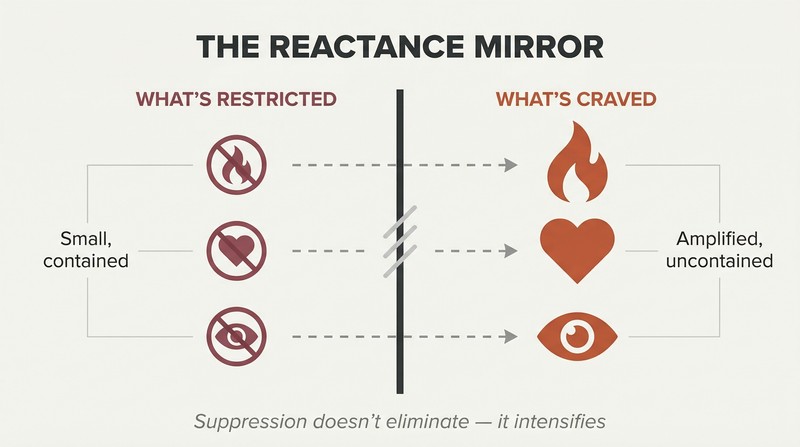
Reactance in the bedroom. Psychologists call it reactance: when freedoms are restricted, we rebel by craving exactly what's forbidden. Lehmiller found this across religion and politics. Religiously affiliated participants fantasized more about novel and taboo sex acts — the very things their faiths prohibit. Republicans fantasized more than Democrats about orgies, infidelity, swinging, cuckolding, voyeurism, and exhibitionism.
The pattern ran deeper. Heterosexual men with religious affiliations were more likely to have same-sex fantasies — possibly seeking faith to manage unwanted desires. Democrats, meanwhile, fantasized more about BDSM and emotional intimacy — desires reflecting psychological needs rather than rule-breaking. Sexual morality doesn't eliminate desire. It redirects it underground.
Young adults crave BDSM and romance; older adults want threesomes
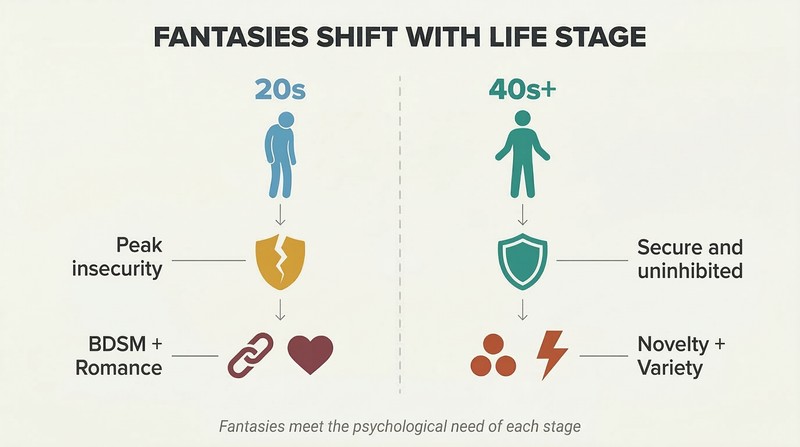
Counterintuitive age patterns. College-age adults were the least interested in threesomes — contrary to stereotypes. Sex itself is still novel at that age; no bells and whistles needed. But they're at peak insecurity, so they gravitate toward BDSM (which distracts from anxious self-awareness) and romance fantasies (which offer validation).
Middle-aged adults crave variety. After decades of sex — often with the same partner — the Coolidge Effect kicks in hard. But they're also more secure and less inhibited. So they crave group sex, nonmonogamy, and taboo acts to reignite arousal. Fantasies aren't random — they're precision instruments calibrated to meet evolving psychological needs as we enter new life stages.
Trying to suppress a fantasy only makes it come back stronger
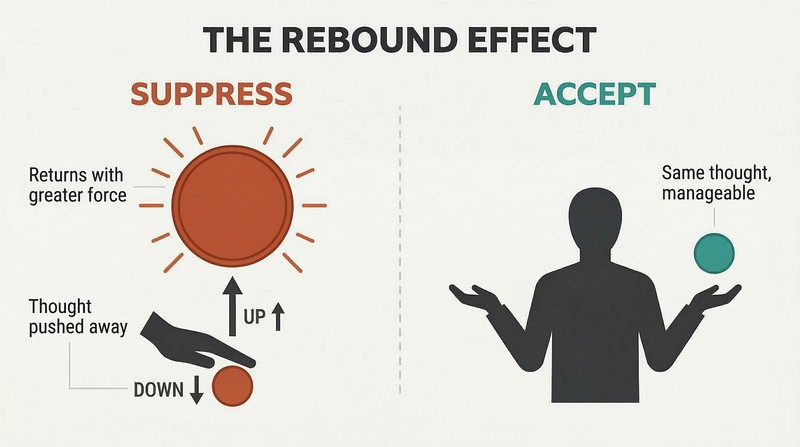
The white bear problem. In Dan Wegner's famous Harvard study, participants told to suppress thoughts of a white bear still thought about bears more than once per minute — and later experienced a rebound effect, thinking about bears more than anyone else. Sexual fantasies follow the same pattern. Trying to banish unwanted desires makes them return with greater intensity.
Repression creates pressure. Research shows that when willpower is depleted by sustained effort, people become worse at resisting urges. Acknowledging what Lehmiller calls the shadow self — the desires we've been taught to fear — doesn't require acting on every fantasy. It requires honesty. Notably, people who had acted on BDSM fantasies reported higher self-esteem than those still hiding them, mirroring the well-documented mental health benefits of coming out.
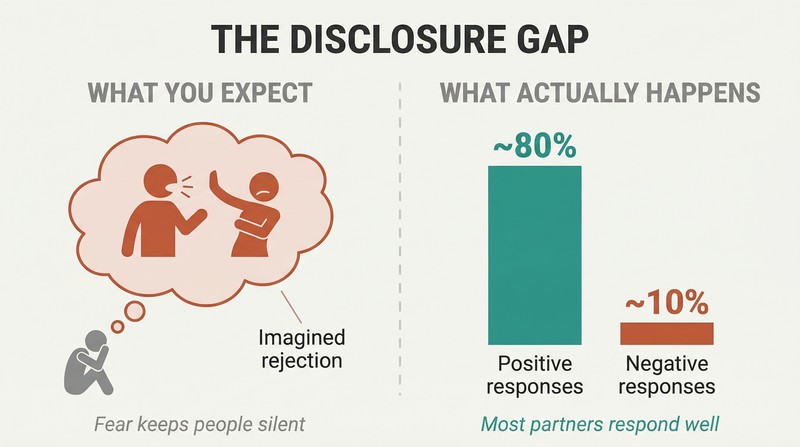
Tell your partner what you want — fear of rejection is usually wrong
The disclosure gap. Among those who hadn't shared their favorite fantasy, a majority expected negative reactions. But among those who actually shared, 74 – 82% reported positive responses for romance, novelty, and BDSM fantasies; 65 – 69% positive even for group sex and nonmonogamy. Negative reactions ranged from just 6% to 22% depending on the fantasy.
Self-disclosure builds intimacy. Research shows couples who share more report greater love, longer-lasting relationships, and fewer bedroom problems. Lehmiller's practical guidance: disclose gradually, choose private settings when both partners are already aroused (arousal reduces the disgust response), validate your partner throughout, and attend to body language. Consider sexual icebreakers — erotic films, sex-shop visits, or adapted versions of Arthur Aron's 36-question intimacy exercise.
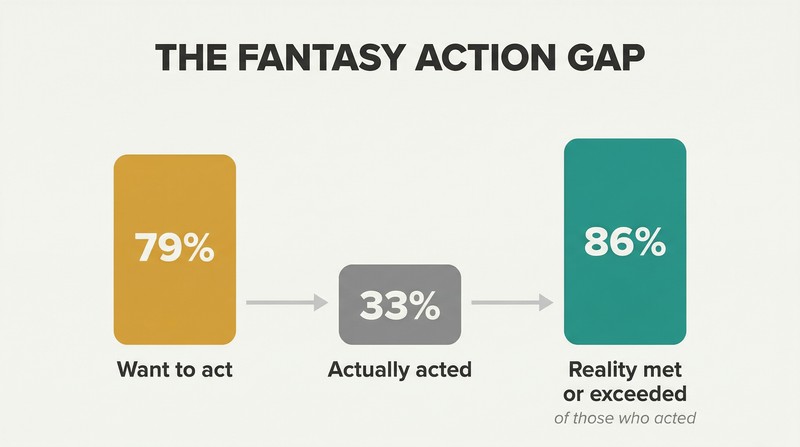
86% who acted on fantasies said reality met or beat the dream
The action gap. Only one in three Americans had acted on their biggest fantasy, despite 79% wanting to. Among those who did, 86% said reality met or exceeded expectations, and 91% reported neutral-to-positive relationship impact. Nonmonogamy fantasies had the highest satisfaction rate (92%); group sex the lowest — largely because there's no cultural script for how a threesome unfolds.
Who fares best? People in satisfying relationships, with high self-esteem, high sex drives, and low neuroticism. Lehmiller's practical framework for acting on fantasies:
1. Ensure the fantasy is safe, sane, consensual, and legal
2. Establish a safe word
3. Research best practices from expert sources
4. Take baby steps before escalating
5. Provide aftercare — gentle contact and debriefing afterward
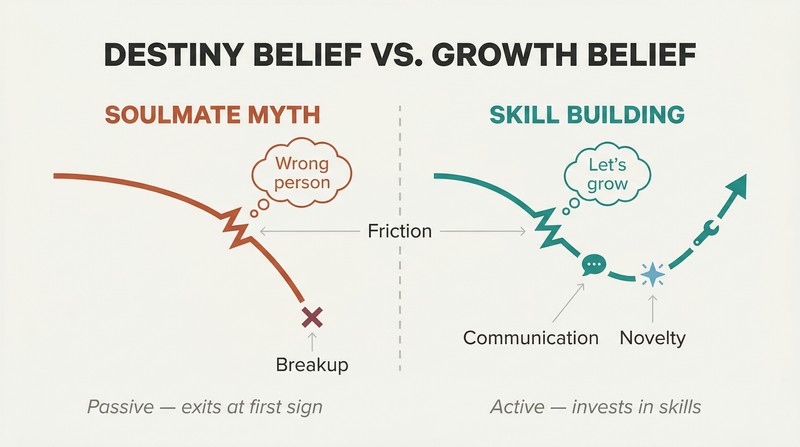
Ditch the soulmate myth — invest in skills, not destiny
Destiny beliefs destroy relationships. Up to three-quarters of Americans believe in soulmates, and the number is rising among millennials. But research shows destiny believers work less to resolve conflict and break up faster — they interpret friction as evidence of a mismatch rather than a challenge to overcome. Meanwhile, passion naturally declines after six to thirty months in most relationships. This isn't a sign something is wrong; it's the Coolidge Effect.
Flexibility beats fate. Successful long-term couples fight habituation through sustained novelty — in and out of the bedroom. And if monogamy doesn't serve both partners' needs, consensual nonmonogamy is a legitimate path. Studies show polyamorous and open relationships match monogamous ones in satisfaction and commitment. The key: know yourself, develop communication skills, and chart your own course.
Analysis
Lehmiller's work represents the most ambitious empirical attempt to map American sexual desire since Kinsey's mid-century surveys, though with important methodological differences. Where Kinsey relied on in-person interviews, Lehmiller used anonymous online surveys recruited via social media — a trade-off that likely yielded more honest responses but introduced selection bias toward digitally engaged, sex-positive respondents. The author acknowledges this candidly, noting his findings probably overestimate how many Americans have shared or acted on their fantasies.
The book's central argument — that psychology has systematically pathologized normal desire through the paraphilia label — is both its strongest contribution and its most provocative claim. By demonstrating that desires classified as 'unusual' by the DSM are held by statistical majorities, Lehmiller effectively inverts the diagnostic framework. The implicit question becomes uncomfortable: if 60% of people fantasize about voyeurism, who exactly qualifies as deviant?
However, the normalization project carries its own risks. Statistical frequency and psychological health are not synonymous, a distinction the author acknowledges in principle but occasionally underplays in rhetoric. The evolutionary psychology explanations — sperm competition, alloparenting hypotheses, sexual imprinting windows — are presented with appropriate tentativeness but remain largely unfalsifiable adaptive stories.
The three-dial model of sexuality, distinguishing orientation from flexibility, may be the book's most useful theoretical innovation, offering a framework that elegantly explains why identity labels never capture the full picture. The reactance findings — that moral restrictions amplify forbidden fantasies — have implications well beyond sexuality, illuminating the psychology of prohibition generally.
Perhaps the book's most quietly radical insight is that BDSM practitioners who are 'out' about their desires report higher self-esteem than those still hiding — mirroring the psychological trajectory of LGBTQ+ acceptance. This suggests that sexual shame, not sexual desire, is the real pathology worth treating. The concept of the shadow self — desires we suppress out of fear — emerges as the book's central therapeutic target.
Review Summary
Tell Me What You Want presents findings from a large survey on sexual fantasies. Readers found it informative and normalizing, appreciating its sex-positive stance and accessible writing. However, some criticized its focus on heterosexual, cisgender experiences and questioned the scientific rigor. Many felt the book was repetitive and overly speculative at times. While some found practical advice for improving their sex lives, others wanted more diverse representation and nuanced analysis. Overall, reactions were mixed, with readers valuing the attempt to destigmatize fantasies but noting limitations in methodology and scope.
People Also Read






Glossary
Coolidge Effect
Arousal fades with repetitionThe observation that sexual arousal habituates—decreases over time—in response to the same sexual stimulus. Named after an anecdote about President Calvin Coolidge visiting a chicken farm. Reversible by introducing novelty, such as a new partner, activity, or setting. Documented in laboratory studies showing declining arousal to repeated porn clips and increased arousal when new stimuli appear.
Sexual flexibility
Openness to deviating from normsA dimension of sexuality distinct from sexual orientation. Lehmiller describes it as a 'third dial' that controls willingness to deviate from one's underlying orientation and cultural sexual norms. High flexibility means greater openness to experimenting with partner gender, new activities, and norm-breaking behaviors. Women's flexibility dials tend to be turned higher than men's, supported by genital arousal studies and fantasy survey data.
Reactance
Rebelling against restricted freedomsA psychological phenomenon in which people respond to perceived restrictions on their freedom by doing or desiring the opposite of what is demanded. In Lehmiller's context, religious and politically conservative individuals fantasize more intensely about sexually forbidden acts—precisely those their moral authorities prohibit. Reactance explains why abstinence-focused messaging often paradoxically increases interest in restricted behaviors.
Shadow self
Hidden desires we fear acknowledgingA concept borrowed from psychology referring to the part of oneself composed of desires and urges—especially sexual ones—that a person suppresses because they believe they shouldn't have them. Lehmiller argues that accepting the shadow self rather than repressing it is essential for sexual well-being, because cordoning off these desires leads to shame, performance problems, and loss of control over one's desires.
Paraphilia
Labeled 'unusual' sexual interestA preference for nonnormative sexual activity or target as defined by the DSM (Diagnostic and Statistical Manual of Mental Disorders). Lehmiller challenges the concept, arguing that many formally designated paraphilias—including sadism, masochism, fetishism, and transvestism—are statistically common based on his survey data. He contends that the paraphilia label has been applied too freely and has stigmatized normal desires.
Self-expansion theory
Growth need driving relationship noveltyA theory by psychologist Art Aron proposing that humans have an innate need to continually grow and expand the self through new experiences, knowledge, and relationships. Lehmiller applies it to explain why consensual nonmonogamy and sexual novelty are appealing: monogamous sex can become predictable, and new partners or activities fulfill ongoing expansion needs while allowing a primary relationship to continue.
Erotical illusions
Mixed gender cues amplifying arousalA term from neuroscientists Ogi Ogas and Sai Gaddam describing unique combinations of sexual cues—such as masculine and feminine physical characteristics in the same person—that together produce an unusually intense state of sexual arousal, greater than either cue would generate alone. Used by Lehmiller to explain the appeal of transgender and androgynous partners in sexual fantasies, particularly among heterosexual men.
FAQ
1. What’s Tell Me What You Want by Justin J. Lehmiller about?
- Largest survey of fantasies: The book is based on the largest-ever survey of Americans’ sexual fantasies, analyzing responses from over 4,000 participants to uncover what people fantasize about and why.
- Science of sexual desire: It explores the psychological, cultural, and demographic factors that shape sexual fantasies, integrating scientific research and real-life stories.
- Practical relationship advice: Lehmiller provides guidance on how understanding and communicating about fantasies can improve sex lives and relationships.
- Destigmatizing sexual diversity: The book aims to normalize a wide range of sexual desires, challenging myths and reducing shame around sexual fantasies.
2. Why should I read Tell Me What You Want by Justin J. Lehmiller?
- Reduces shame and stigma: The book reassures readers that most sexual fantasies, even those considered taboo, are common and normal, helping to alleviate guilt and embarrassment.
- Evidence-based insights: Lehmiller uses scientific data to explain the origins and meanings of fantasies, offering a nonjudgmental perspective.
- Improves communication and intimacy: Readers learn how to discuss desires with partners, which can enhance trust, intimacy, and sexual satisfaction.
- Practical tools for relationships: The book provides actionable advice for safely exploring fantasies and strengthening relationships.
3. What are the key takeaways from Tell Me What You Want by Justin J. Lehmiller?
- Fantasies are universal and diverse: Nearly everyone has sexual fantasies, and most are more common than people think.
- Personality and context matter: Fantasies are shaped by personality traits, relationship status, cultural background, and life experiences.
- Communication is crucial: Openly sharing fantasies can improve relationships, but requires sensitivity and consent.
- Safe exploration is possible: The book outlines how to responsibly and ethically explore fantasies, emphasizing consent and safety.
4. What are the seven most common sexual fantasy themes identified in Tell Me What You Want?
- Group sex/multipartner scenarios: Threesomes and orgies are the most frequently reported fantasies, though rarely acted upon.
- BDSM and power dynamics: Fantasies involving dominance, submission, bondage, and rough sex are widespread across genders.
- Novelty and adventure: Many people crave new experiences, settings, or sexual activities, including public sex or use of toys.
- Taboo and forbidden acts: Voyeurism, exhibitionism, and other culturally taboo scenarios are surprisingly common in fantasy.
- Nonmonogamy and partner sharing: Fantasies about swinging, open relationships, and cuckolding reflect interest in consensual nonmonogamy.
- Romance and passion: Emotional connection, intimacy, and being desired are central to many fantasies.
- Gender-bending and erotic flexibility: Cross-dressing, same-sex encounters by heterosexuals, and fantasies involving transgender partners highlight sexual fluidity.
5. How do men’s and women’s sexual fantasies differ according to Tell Me What You Want?
- More similarities than differences: Both men and women commonly fantasize about group sex, BDSM, and romance, but differ in frequency and emphasis.
- Women’s greater flexibility: Women are more likely to fantasize about same-sex encounters and show more variety in partner gender and activities.
- Men’s focus on taboo and group sex: Men report more fantasies about taboo acts and group sex, possibly linked to evolutionary and psychological factors.
- Emotional and setting focus for women: Women’s fantasies often emphasize emotional connection and the context or setting, while men focus more on partner characteristics.
6. What psychological and demographic factors influence sexual fantasies in Tell Me What You Want?
- Personality traits: Extraversion, neuroticism, agreeableness, and sensation-seeking all shape fantasy content, with extraverts favoring group sex and sensation seekers craving novelty.
- Attachment style: Insecure attachment is linked to more BDSM, novelty, and romance fantasies, while secure individuals are more open to sharing fantasies.
- Demographics: Age, gender, sexual orientation, race, and political/religious beliefs all play roles in shaping fantasy preferences.
- Complex interplay: No single factor explains fantasies; instead, a combination of traits and life experiences creates unique fantasy profiles.
7. What does Tell Me What You Want by Justin J. Lehmiller reveal about the origins and psychological functions of sexual fantasies?
- Multiple origins: Fantasies arise from personality, early sexual experiences, psychological needs, and learned associations.
- Coping mechanisms: Some fantasies, especially BDSM or emotional ones, help people manage anxiety, insecurity, or past trauma.
- Learned associations: Fetishes and certain taboo interests can develop from strong early experiences that link specific objects or scenarios to arousal.
- Evolving over time: Fantasies change throughout life to meet shifting psychological and relational needs.
8. How does Tell Me What You Want by Justin J. Lehmiller explain the role of fantasy partners and self-image in sexual fantasies?
- Current partners are common: About 90% of people fantasize about their current romantic partners, often with added emotional or idealized elements.
- Celebrity and fictional partners: These appear less frequently but reflect cultural standards and personal preferences.
- Self-image changes: Many people imagine themselves differently in fantasies—altering body, age, or personality—to boost confidence or escape insecurities.
- Psychological implications: Changing oneself in fantasies is linked to self-esteem, relationship satisfaction, and coping with feelings of inadequacy.
9. What advice does Tell Me What You Want by Justin J. Lehmiller offer for sharing and acting on sexual fantasies with a partner?
- Benefits of sharing: Openly discussing fantasies can increase intimacy, trust, and sexual satisfaction in relationships.
- Risks and fears: Many fear negative reactions, but most partners respond neutrally or positively; however, negative responses can harm relationships.
- Safe communication: Timing, setting, and validation are crucial—partners should avoid judgment and coercion, and be prepared for differing interests.
- Responsible exploration: Only consensual, safe, and legal fantasies should be acted upon, with clear boundaries, safe words, and aftercare.
10. How do political and religious beliefs shape sexual fantasies in Tell Me What You Want by Justin J. Lehmiller?
- Reactance effect: People with conservative or religious backgrounds often fantasize more about taboo or nonmonogamous acts as a form of psychological rebellion.
- Traditional gender roles: Religious individuals may endorse traditional roles in fantasies but still show sexual flexibility, especially men.
- Political differences: Republicans report more taboo and nonmonogamous fantasies, while Democrats favor BDSM and emotional intimacy.
- Cultural reflection and challenge: Fantasies can both mirror and push against one’s cultural and moral environment.
11. What societal changes does Tell Me What You Want by Justin J. Lehmiller advocate for regarding sexual health and relationships?
- Comprehensive sex education: The book calls for education that covers sexual diversity, consent, and communication, using the Dutch model as an example.
- Reducing shame and stigma: Lehmiller urges society to stop sex shaming and recognize the normalcy of diverse sexual desires.
- Flexible relationship models: He challenges the soulmate myth and supports relationship structures that fit individual needs, including consensual nonmonogamy.
- Promoting open dialogue: Encourages honest conversations about sex and desire to foster healthier relationships.
12. What are some key definitions and concepts introduced in Tell Me What You Want by Justin J. Lehmiller?
- Sexual fantasy: A conscious mental image or thought that causes sexual arousal, distinct from unconscious sex dreams.
- Paraphilia: Non-normative sexual interests, often stigmatized but frequently harmless and common in fantasy.
- Sexual orientation vs. flexibility: Orientation is an inborn predisposition, while flexibility is the willingness to deviate from norms in desires.
- Coolidge Effect: The tendency for sexual arousal to decrease with repeated exposure to the same stimulus and increase with novelty, explaining the craving for variety.
Download PDF
Download EPUB
.epub digital book format is ideal for reading ebooks on phones, tablets, and e-readers.








































