


Key Takeaways
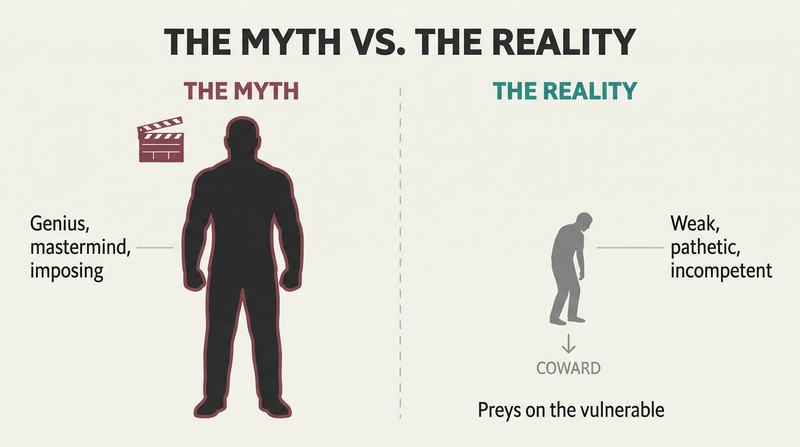
Serial killers are cowards who prey on the weak — not evil geniuses
Hollywood gets it wrong. Christopher Berry-Dee, who has sat unshackled in locked rooms with over thirty serial killers, insists they are "weak, pathetic, little people and cowards at heart." They target babies, children, the elderly, and vulnerable women — the easiest prey. When they try to intimidate during interviews with snarling glares and death stares, Berry-Dee's trick is to look back blankly and say, "So what?"
Their incompetence is staggering. Ronald "Butch" DeFeo Jr. drew police a map to the murder weapon. Neville Heath walked into a police station to "help" the investigation into his own killing. Some killers are intelligent — Michael Ross had an IQ of 150 — but intelligence doesn't make them formidable. It makes their waste more tragic.
No precaution will save you once a serial killer picks you as prey
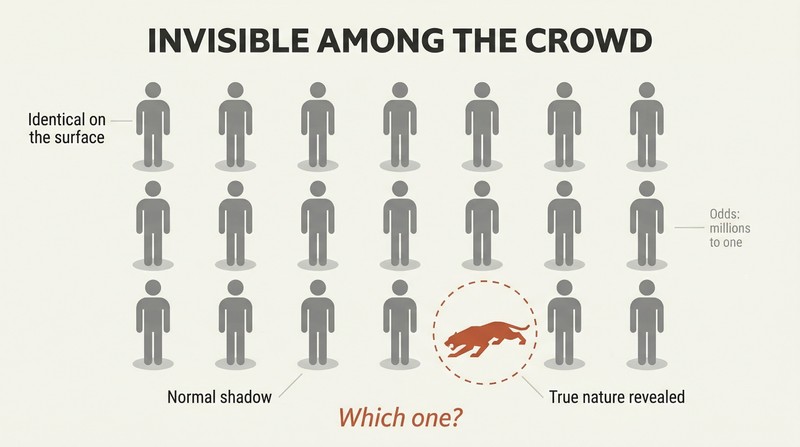
Berry-Dee is brutally direct. Despite every self-protection guide ever published, you cannot identify a homicidal psychopath before they strike. Ask any homicide cop and they'll confirm it. If a killer zeroes in on you, you won't suspect a thing — they may have watched you for days or weeks. Berry-Dee compares them to the camouflaged geckos and stick insects he observed at Manila Ocean Park: motionless, invisible, ready in an instant to strike.
The odds are in your favor, but the stakes are absolute. Your chances of becoming a victim are millions-to-one — you're more likely to die in a car crash. But if a serial killer does select you, "that individual is probably a dead person walking." They come in under the radar like Exocet missiles, and without conscience, rain down death.
Psychopaths' brains stay dark where yours light up with horror
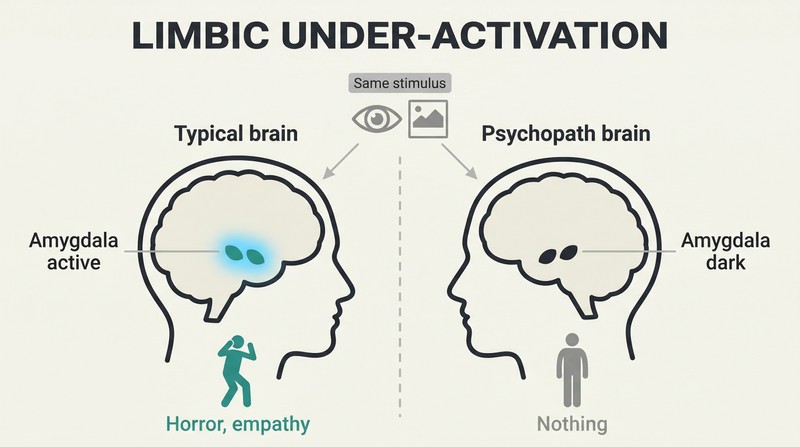
Functional MRI scans reveal the void. When normal people view images of bloody stabbings or evisceration, their amygdalae — almond-shaped brain structures that generate empathy — light up with heavy activity. In psychopaths, these regions remain dark, showing greatly reduced activity or none at all. This phenomenon, called limbic under-activation, means they literally cannot produce the basic emotions that keep primitive killing instincts in check. Researchers Tiihonen and Kiehl found psychopaths actually have physically smaller amygdalae.
Berry-Dee uses a London Tube analogy. If dopamine production drops and the amygdalae don't get enough "juice," the knock-on effect disrupts the entire system — expect depression, mood swings, explosive anger, and an inability to handle stress. When one part jams, everything downstream breaks.
Abusive childhoods build killers layer by layer, not overnight
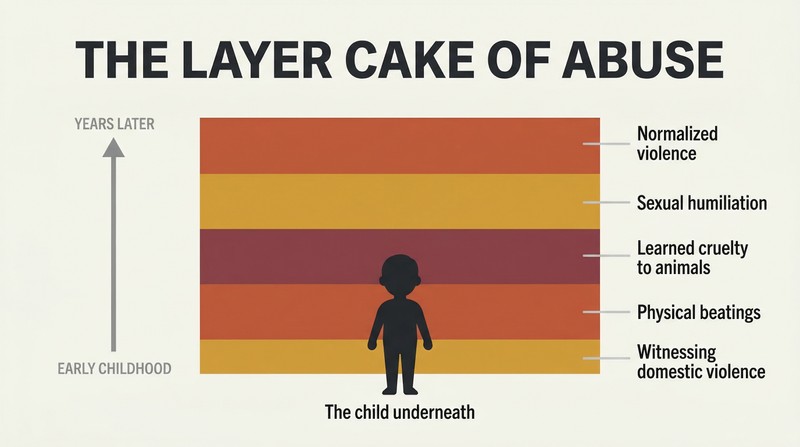
Berry-Dee calls it the "layer cake" of abuse. Day after day, week after week, children from dysfunctional homes absorb layer upon layer of psychological and physical abuse until maltreatment becomes the norm — what he terms negative parental conditioning. Peter Kürten's father was a brutal alcoholic who raped his wife in front of the children. The local dogcatcher taught young Kürten to torture animals. By age nine, Kürten had drowned two playmates.
John Christie's markers accumulated similarly. Viewing his grandfather's corpse at age eight produced a "fascinating" trembling sensation. His sisters dominated him. A sexual humiliation earned him the nickname "Reggie-no-Dick." FBI profiler John Douglas confirmed Kürten's violence toward animals and arson were textbook reactions to chronic abuse — giving him the control his father's beatings denied.
Some killers had ideal childhoods — one rotten apple defies the tree
Neville Heath had every advantage. Stable family in Essex. Fee-paying school. Athletic talent. Yet he stamped on a girl's fingers in school and viciously spanked another with a ruler — sadistic tendencies with zero environmental explanation. Col. Russell Williams enjoyed a healthy upbringing, elite education, and a distinguished military career. His stepfather, a nuclear scientist, ensured both boys received first-rate schooling.
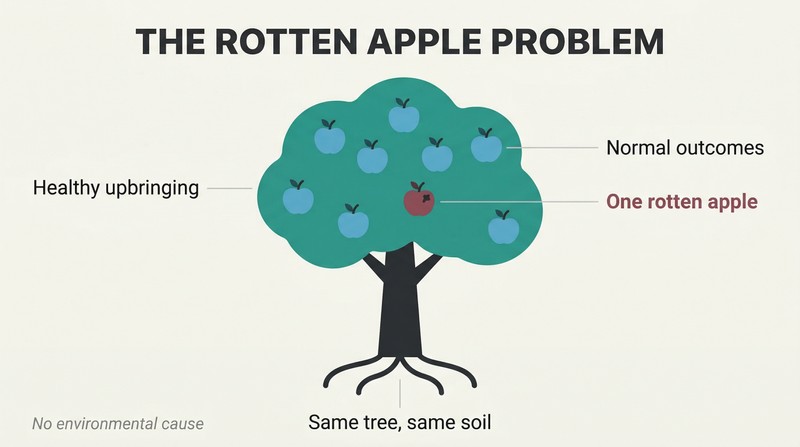
Berry-Dee calls it the "rotten apple" problem. Sometimes child "A" turns out to be the only bad fruit in a basket of otherwise good apples, all grown on the same tree. Siblings raised identically go on to live normal, productive lives while one becomes a killer. The old "Nature vs. Nurture" debate is now "Nature AND Nurture" — both contribute, and neither fully explains the phenomenon.
Serial killing escalates like drug addiction — each hit demands more
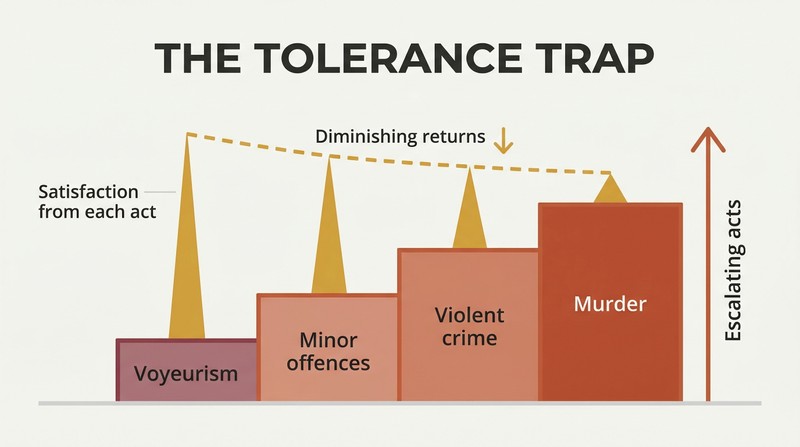
The dopamine cycle explains escalation. Berry-Dee compares the killer's craving to a chocolate addiction: the hypothalamus switches on reward feelings during pleasurable activities, driving the person to repeat them. When the limbic system's needs go unmet, dopamine drops, producing depression, anger, and murderous rage. Michael Ross, a Cornell graduate with an IQ of 150, was so enslaved by this cycle that his prison counsellor reported he "masturbates at least forty times a day to the degree that he has sores on his penis."
The pattern is predictable. Voyeurism leads to minor sexual offences, escalating through violent rape to serial murder. Each crime must intensify because the previous kill's satisfaction faded too quickly. Col. Williams progressed from stealing underwear to breaking in, then rape, then murder — each stage insufficient to satisfy the craving.
Killers' tears are costume jewelry — they only mourn being caught
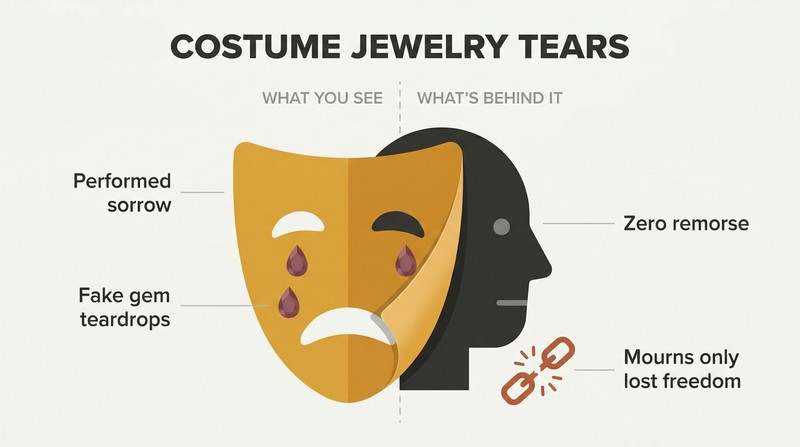
Decades of interviews confirm the pattern. Berry-Dee has never encountered a serial killer who genuinely feels remorse. Phillip Jablonski wrote from death row: "I have no remorse for the murders, rapes or pimping." Peter Kürten told his psychiatrist: "Thinking back to all the details is not all unpleasant. I rather enjoy it." Arthur Shawcross gleefully described eating a victim's frozen body parts, then chatting with cops about the killings at a Dunkin' Donuts.
They shift blame with surgical precision. Harvey Carignan insisted every victim provoked her own death. Neville Heath told his girlfriend the murder room was simply borrowed by a mysterious "Jack." Michael Rafferty, who raped and killed eight-year-old Tori Stafford, showed zero emotion across two days of interrogation. Their psychopathology is not wired for remorse — only self-pity at the loss of freedom.
The 'mask of normality' is what makes serial killers truly lethal
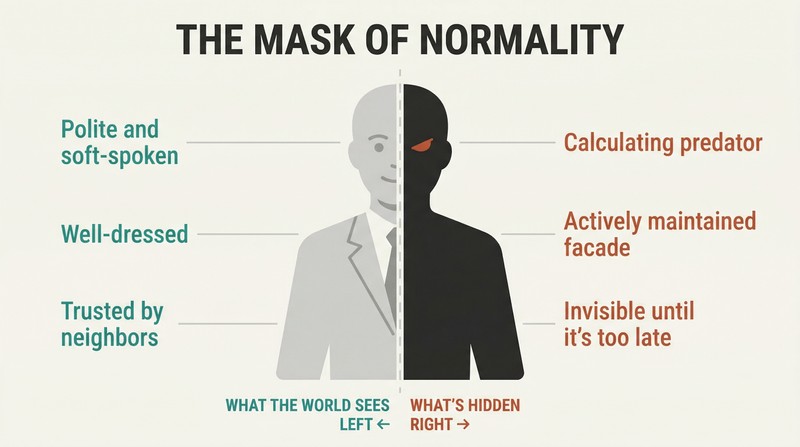
Every killer in the book maintained a false front. Christie was "the poshest man on the street" according to a neighbor — nobody suspected a thing. Kürten was polite, soft-spoken, and fastidious in dress; his wife described him as doting. Heath conned his way through three military commissions using stolen uniforms and phony ranks, fooling everyone from hotel managers to journalists. Williams flew the Queen of England while hoarding stolen underwear filed with military precision in his closet.
The mask is actively maintained. Christie bored a spy-hole above his kitchen door to watch visitors. Kürten returned to crime scenes to sit in nearby cafés, drinking beer while watching police activity. Berry-Dee compares them to camouflaged predators: invisible in their environment, ready to strike in an instant — then vanishing back into normalcy.
A colonel who flew the Queen led a secret life of rape and murder
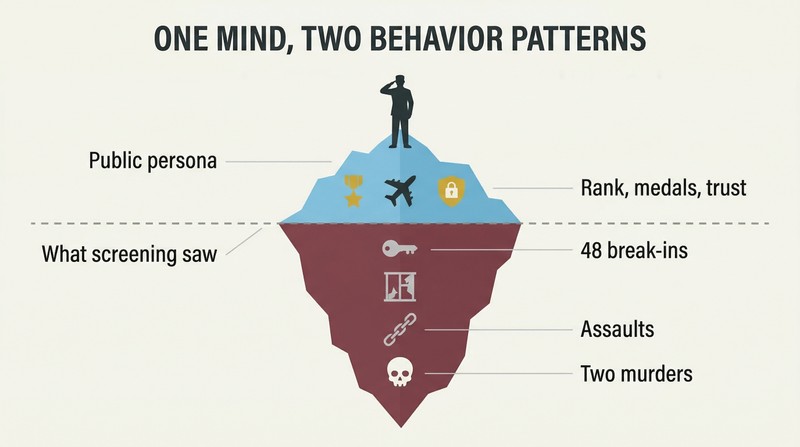
Col. Russell Williams is Berry-Dee's most chilling case study. He commanded Canadian Forces Base Trenton — the country's busiest military air transport hub — held TOP SECRET clearance, and piloted VIP aircraft for the Queen and Prime Minister. Meanwhile, he broke into 48 homes to steal women's underwear, committed multiple rapes, and murdered two women. Berry-Dee proposes the "entity" and "normal self" framework: the predatory entity committed the crimes while the disciplined normal self planned them with military precision.
After each attack, Williams would resolve never to do it again. He'd return to duty, function normally, then the resolution would evaporate as new cravings overwhelmed him. His career survived every screening — aptitude tests, criminal checks, character references — yet apparently no psychological evaluation was ever required. Detective Jim Smyth's ten-hour interrogation, now used as a worldwide training tool, finally peeled away the mask.
Overconfident killers always leave the trail that catches them
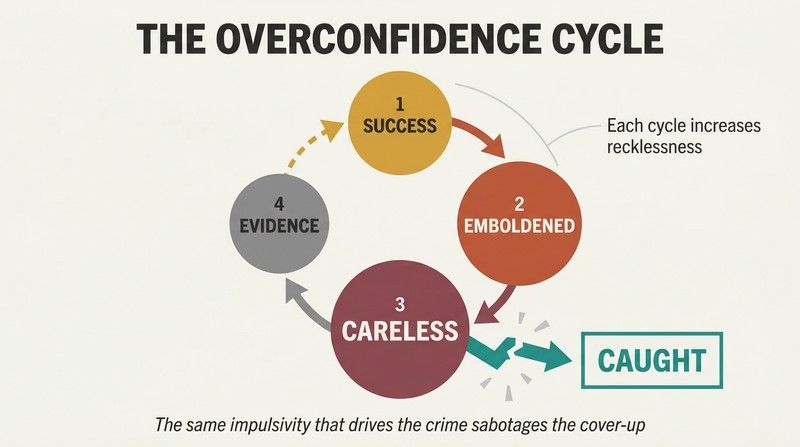
Meticulous planning rarely extends to cleanup. Williams drove his SUV onto Jessica Lloyd's snowy property, leaving unique tire tread impressions and distinctive boot prints that police matched directly to him. Jodi Arias planned Travis Alexander's murder obsessively — renting a car under her own name, filling gas cans, disabling her phone — then left behind a camera containing timestamped photos of the entire killing sequence. Heath, wanted nationally, checked into a luxury hotel under a fake name, killed again, then strolled into the police station to "assist" detectives.
The pattern repeats across every case. Christie buried bodies throughout his own property for the next tenant to discover. Kürten mailed a map marked with an "X" to a newspaper. Berry-Dee identifies this as the "I WANT it NOW, so FUCK the consequences" cycle — the same impulsivity that drives the killing also sabotages the cover-up.
Analysis
Berry-Dee's book occupies a unique position in true crime literature — it is neither academic criminology nor sensationalized pulp, but the field notes of someone who has sat unshackled with over thirty serial killers in locked rooms. His most provocative contribution is the argument that understanding these predators requires psychological immersion, not clinical distance — 'one has to take the plunge to become one with their warped mindset.'
The book's strongest analytical thread is the convergence of neuroscience and case study. By pairing fMRI research showing psychopaths' limbic under-activation with his own firsthand interviews, Berry-Dee bridges the gap between why serial killers cannot feel and how they behave as a result. The Williams case represents his most original contribution: demonstrating that a man who passed every conceivable security screening — Top Secret clearance, character references, aptitude tests — could simultaneously be a serial rapist and murderer. His "entity versus normal self" framework for high-functioning psychopaths offers a more nuanced model than the binary of 'evil' versus 'insane.'
The Nature AND Nurture framework (deliberately not 'versus') is well-illustrated through contrasting cases: Kürten's nightmarish childhood abuse alongside Heath's and Williams's perfectly stable upbringings. This juxtaposition undercuts simplistic causal narratives and suggests psychopathy may be irreducible to any single factor. Berry-Dee's central limitation is methodological — his conclusions derive from uncontrolled interviews and personal observation rather than systematic research. His certainty that serial killers can never be reformed forecloses inquiry into the heterogeneity of psychopathic presentations. Yet his proximity to his subjects provides data points no academic study can replicate. The book's ultimate value lies in its unflinching demonstration that the line between predator and neighbor is disturbingly, terrifyingly thin.
Review Summary
Talking With Psychopaths and Savages received mixed reviews, with many readers criticizing the author's writing style, frequent self-promotion, and lack of in-depth analysis. Complaints include poor editing, repetitive content, and minimal actual interviews with psychopaths. Some found the cases interesting but felt the book didn't live up to its title. Positive reviews praised the author's relatable writing and easy-to-follow narratives. Overall, readers expressed disappointment with the book's structure, content, and the author's perceived arrogance.
Glossary
Mask of normality
False front hiding the predatorThe carefully constructed public persona that serial killers maintain to blend into society. Every killer in the book — from Christie's 'posh' respectability to Williams's decorated military career — wore a mask concealing their predatory nature. Berry-Dee argues this is an active, ongoing psychological performance, not a passive trait, making detection virtually impossible until after they kill.
Organised offender
Killer who plans crimes methodicallyAn FBI classification for a serial killer who carefully selects victim types, develops a murder kit of tools, stalks prey before attacking, and attempts to control the crime scene. Examples include Col. Williams, who conducted military-style reconnaissance of victims' homes. Contrasted with disorganised offenders who strike opportunistically.
Disorganised offender
Killer who strikes by chanceAn FBI classification for a serial killer who comes upon victims almost by happenstance, carries no murder kit, and uses whatever means are at hand. Michael Ross strangled victims with his bare hands; Ted Bundy used tree limbs. These killers are impulsive rather than methodical, though some offenders exhibit traits of both types.
Limbic under-activation
Psychopaths' blunted brain-emotion responseA phenomenon observed in fMRI scans where psychopaths' amygdalae and limbic system show greatly reduced activity — or none at all — when viewing horrific images. In normal subjects, these emotion-generating brain regions light up intensely. Berry-Dee argues this neurological deficit explains why serial killers lack empathy, fear, guilt, and remorse, essentially freeing them from the emotional brakes that prevent normal people from committing violence.
Negative parental conditioning
Abuse normalized through sustained exposureBerry-Dee's term for the process by which children in dysfunctional homes absorb abusive behaviour as normal through prolonged, repeated exposure. He uses a 'layer cake' analogy: day after day, layer upon layer of physical and psychological abuse accumulates until the child accepts maltreatment as the norm, forming the psychological foundations for future criminal behaviour.
Murder Road
Where killer and victim fatally convergeBerry-Dee's recurring metaphor for the moment when two lives from entirely different backgrounds meet at a figurative crossroads — one life ending forever and the other irrevocably changed. He uses it particularly for cases like Travis Alexander meeting Jodi Arias, noting the astronomical statistical improbability (327.7 million-to-one in Arias's case) of these fatal convergences.
Entity and normal self
Two behaviour patterns, one mindBerry-Dee's framework for understanding high-functioning killers like Col. Russell Williams, who maintained a distinguished military career while committing serial sexual assaults and murders. The 'entity' is the predatory behaviour pattern that commits crimes, while the 'normal self' plans them and functions in everyday life. Berry-Dee stresses these are not two different minds but two different behaviour patterns of the same mind.
Murder kit
Tools assembled for planned killingsThe set of implements an organised serial killer develops and refines over time for use in crimes. May include items such as change of clothing, restraints (rope, handcuffs), plastic sheeting to prevent blood contamination of vehicles, weapons, and other tools. Killers typically begin as 'novices' and learn with each event what tools work best, gradually becoming more efficient and methodical.
Reid Technique
Structured police interrogation methodA method of police interrogation used prominently by Ontario Provincial Police Detective Sergeant Jim Smyth during his ten-hour interview of Col. Russell Williams. The technique involves establishing rapport, presenting evidence strategically, and psychologically cornering the suspect. Berry-Dee calls Smyth's application a 'master class' now used as a worldwide law enforcement training tool. The technique was also used in the Rafferty-McClintic child murder case.
FAQ
What is Talking With Psychopaths and Savages: Beyond Evil by Christopher Berry-Dee about?
- Deep dive into serial killers: The book explores the minds, backgrounds, and crimes of notorious serial killers and psychopaths, aiming to understand what drives their behavior.
- Firsthand interviews: Berry-Dee draws on his experience interviewing over thirty killers, providing unique insights into their personalities and motivations.
- Focus on psychology and evil: It examines the concept of evil, the absence of empathy, and the neurological and psychological factors behind homicidal behavior.
Why should I read Talking With Psychopaths and Savages: Beyond Evil by Christopher Berry-Dee?
- Authentic true crime perspective: The book offers rare, direct accounts from serial killers, making it a valuable resource for true crime enthusiasts and students of criminology.
- Challenges stereotypes: Berry-Dee dispels common myths about serial killers, showing that they can be anyone and often hide behind a mask of normality.
- Societal and law enforcement insights: The book discusses the challenges faced by police and society in identifying and dealing with such offenders, critiquing current systems and responses.
What are the key takeaways from Talking With Psychopaths and Savages: Beyond Evil?
- No easy way to spot killers: Serial killers often appear normal and blend seamlessly into society, making early detection nearly impossible.
- Psychopathy is incurable: Berry-Dee asserts that there is no cure for psychopathy; incarceration is the only effective solution.
- Understanding over sensationalism: The book urges readers to look beyond media portrayals and seek a deeper understanding of the psychological realities of serial killers.
What are the main psychological concepts explained in Talking With Psychopaths and Savages: Beyond Evil?
- Mask of normality: Many killers present themselves as charming or respectable, hiding their violent nature behind convincing facades.
- Divided personality/entity concept: Some offenders, like Colonel David Russell Williams, exhibit a split between their public persona and a hidden, violent "entity."
- Sadomasochism and substance abuse: The book explores how sadomasochistic tendencies and alcohol abuse can lower inhibitions and escalate violent behavior.
How does Christopher Berry-Dee define and distinguish serial killers, mass murderers, and spree killers in Talking With Psychopaths and Savages: Beyond Evil?
- Serial killers: Commit three or more murders with cooling-off periods between each crime, often planning meticulously.
- Mass murderers: Kill multiple victims in a single event without breaks, differing from serial killers in timing and planning.
- Spree/rampage killers: Kill multiple victims in a short time across several locations, with little or no break between murders.
What interviewing methods and advice does Christopher Berry-Dee share in Talking With Psychopaths and Savages: Beyond Evil?
- Thorough preparation: Berry-Dee emphasizes researching a killer’s background, criminal history, and psychological triggers before interviews.
- Maintaining psychological control: Interviewers must remain calm and authoritative, as killers often test for fear or weakness.
- Recognizing danger: Interviews can be unpredictable and life-threatening, requiring constant vigilance and psychological checks.
What does Talking With Psychopaths and Savages: Beyond Evil reveal about the neurological and psychological profiles of serial killers?
- Amygdala dysfunction: Psychopaths often have reduced activity in the amygdala, leading to deficits in empathy and fear.
- Dopamine and reward system: Dysfunction in these brain pathways can drive compulsive, addictive behaviors related to violence and sex.
- Emotional disconnect: Many killers have high thresholds for disgust and lack emotional inhibition, enabling them to commit horrific acts.
How does Talking With Psychopaths and Savages: Beyond Evil portray the concept of the "mask of normality" in serial killers?
- Charming and deceptive: Offenders like Neville Heath and Russell Williams convincingly present themselves as upstanding citizens.
- Dual lives: Many killers lead double lives, maintaining respectable jobs or relationships while committing heinous crimes in secret.
- Manipulation and method acting: Some, like Heath, are skilled at adopting false identities and manipulating those around them.
What are the physical and psychological traits of serial killers described in Talking With Psychopaths and Savages: Beyond Evil?
- Varied appearances: Serial killers can be of any body type, intelligence level, or social background.
- Narcissism and obsession: Many exhibit narcissistic, obsessive-compulsive behaviors and deep-seated hatred, often toward women.
- Masking true nature: They often wear a "mask of normality" to hide their pathology from others.
Who are some notable serial killers profiled in Talking With Psychopaths and Savages: Beyond Evil, and what makes their cases significant?
- John Reginald Halliday Christie: Known for obsessive-compulsive traits and sexual impotence, his case involved a major miscarriage of justice.
- Peter Kürten ("Vampire of Düsseldorf"): Combined sexual violence with a fascination for blood, and his case was pivotal in forensic psychology.
- Neville Heath and Colonel David Russell Williams: Both led double lives, with Heath being impulsive and disorganized, and Williams meticulously organized.
What are the best quotes from Talking With Psychopaths and Savages: Beyond Evil by Christopher Berry-Dee, and what do they mean?
- Ted Bundy on invisibility: “We serial killers are your sons … we are your husbands … we are everywhere.” This highlights the hidden nature of evil in society.
- Berry-Dee on cowardice: “Deep down they are weak, pathetic, little people and cowards at heart.” This reflects the author’s belief that killers lack true strength.
- Peter Kürten’s lack of remorse: “I have no remorse... I rather enjoy it.” This chilling statement exemplifies the emotional coldness of psychopaths.
According to Talking With Psychopaths and Savages: Beyond Evil, can serial killers and psychopaths be cured or rehabilitated?
- No cure for psychopathy: Berry-Dee asserts that decades of research and interviews show psychopaths cannot be cured.
- Lack of remorse: These offenders rarely admit wrongdoing or show genuine remorse, making rehabilitation impossible.
- Incarceration as only solution: The book concludes that permanent incarceration is the only effective way to protect society from such individuals.
Download PDF
Download EPUB
.epub digital book format is ideal for reading ebooks on phones, tablets, and e-readers.








































