

Key Takeaways
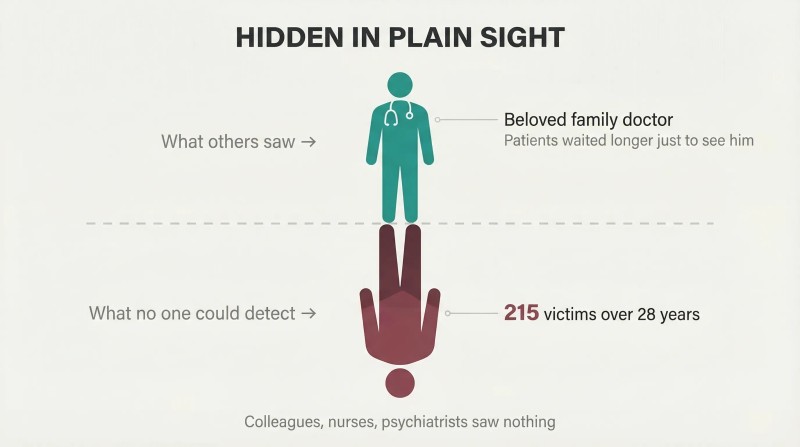
The deadliest psychopaths look exactly like your trusted family doctor
Dr. Harold Shipman murdered 215 patients over 28 years while working as a beloved GP in Hyde, near Manchester. His patients adored him — they waited longer just to see "Fred." He appeared on a Granada TV documentary about community mental healthcare while actively killing people. His medical colleagues, nurses, and psychiatrists saw nothing. Neither did his wife Primrose.
Berry-Dee's central thesis is blunt: if you think reading a checklist or watching a TV show will help you spot a killer, think again. The San Bernardino shooters were described by family as a normal, conservative couple. Serial killer Michael Ross looked like the "All-American Boy." In most cases documented in this book, victims only discovered the danger when it was already too late.
Distinguish psychopaths from savages — only one has a clinical excuse
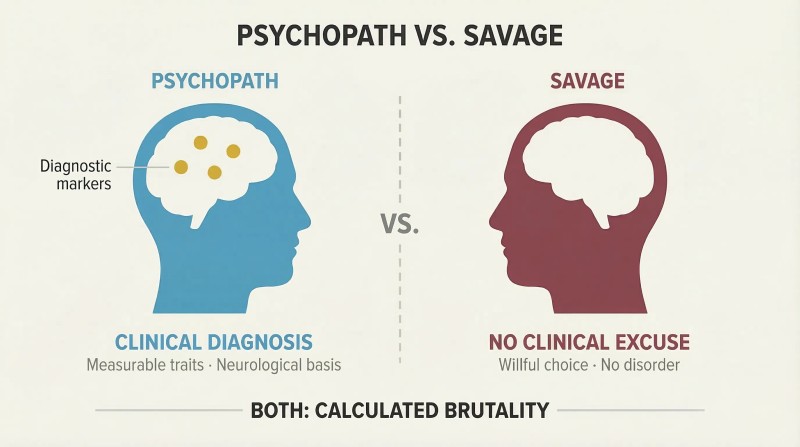
Berry-Dee draws a distinction courts often blur. A "psychopath" meets clinical diagnostic criteria — measurable traits on the Hare PCL-R Checklist, possible neurological or biochemical abnormalities, a condition arguably beyond full control. A "savage" combines brutal violence with willful abandonment of society's rules, without any clinical alibi.
The distinction shapes sentencing. Oscar Pistorius is classified as a savage: he fired four hollow-point "Zombie-Stopper" rounds through a bathroom door at girlfriend Reeva Steenkamp during a jealous rage, with no diagnosable disorder excusing his actions. Melanie McGuire drugged, shot, and dismembered her husband, then dumped his remains in suitcases in Chesapeake Bay — yet never once mentioned her children during a year of prison correspondence. Both acted with calculated brutality; neither had a clinical excuse.
Narcissism is the fuse — when the inflated ego pops, violence detonates
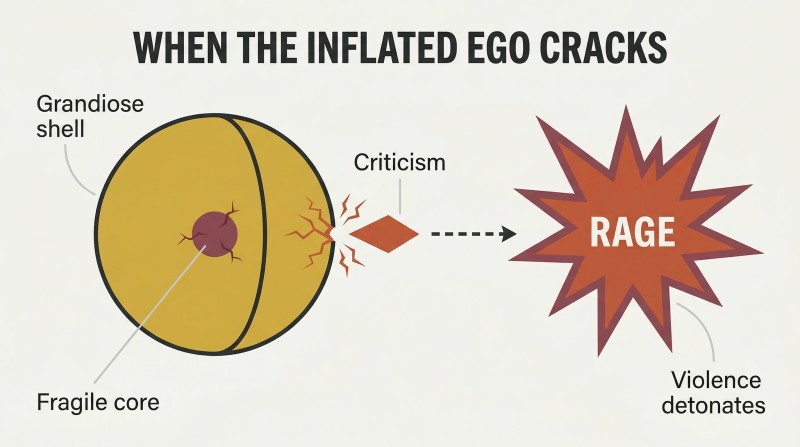
Berry-Dee argues narcissistic personality disorder is inextricably linked to psychopathy, though this connection is rarely discussed in psychiatric literature. Both affect roughly 1% of the population and share a defense mechanism he calls "splitting" — the internal tug-of-war between grandiose fantasies of unlimited success and a paralyzing fear of failure.
Every killer profiled displayed this pattern. Kenneth Bianchi's adoptive mother said catching him in lies made you feel like the crazy one. John Cannan's ego crumbled each time a lover left him, triggering escalating violence across 11 documented steps. Pistorius snapped when he imagined his faithful girlfriend cheating on him. The diagnostic warning sign: when someone's charm is magnetic but their self-esteem is fragile, criticism doesn't produce growth — it produces rage.
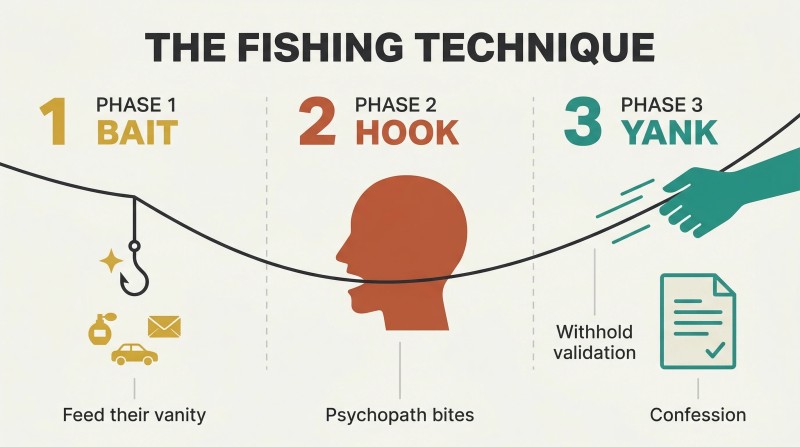
To extract a killer's confession, feed their vanity then yank the hook
Berry-Dee developed a "fishing" technique over decades of prison interviews. First, identify the killer's ego vulnerability. Then cast irresistible bait: Chanel perfume sprayed on cream Conqueror stationery for vain Melanie McGuire, talk of Jaguars and Aston Martins for status-obsessed John Cannan, the promise of being Best Man at his wedding for child-killer Arthur Shawcross.
Once hooked, control the conversation. Mirror the killer's coldness and strategically withhold the validation they crave. With Shawcross, invoking his girlfriend Clara's name flipped a switch that produced an on-camera confession to the murder of ten-year-old Jack Blake — a case police had failed to close for over two decades. With Michael Ross, belittling his kill count ("Just six victims?") provoked admissions to two additional murders. Psychopaths cannot resist an audience.
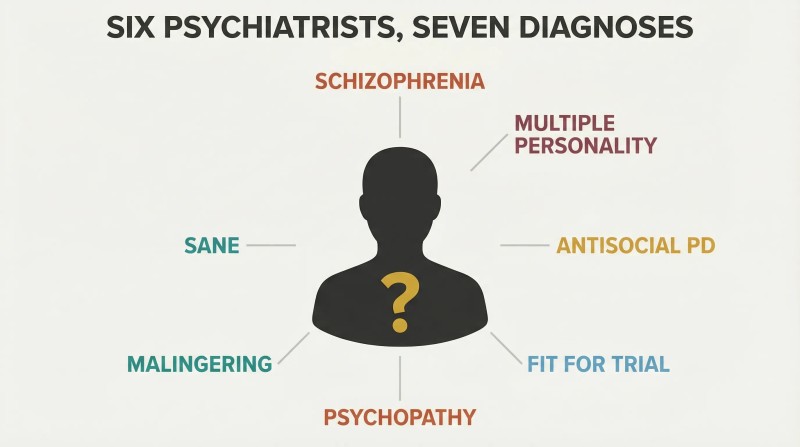
Six psychiatrists in a room will produce seven diagnoses
Berry-Dee documents psychiatric failure with darkly comic regularity. Kenneth Bianchi faked multiple personality disorder so convincingly that three eminent psychiatrists confirmed it — until Dr. Martin Orne devised a trap. He casually mentioned MPD rarely involves just two personalities. Bianchi immediately invented a third, "Billy." When asked to shake hands with a lawyer who wasn't in the room, Bianchi reached out to shake an invisible hand — exposing the performance.
The problem is systemic. During Peter Sutcliffe's trial, Dr. McCulloch admitted spending just 30 minutes with the defendant before diagnosing paranoid schizophrenia and hadn't read Sutcliffe's own statement until the day before trial. In the Lee Baker case, one prosecution psychiatrist based her "corroborating expert testimony" entirely on what a colleague had told her, having merely popped into the defendant's cell to say hello.
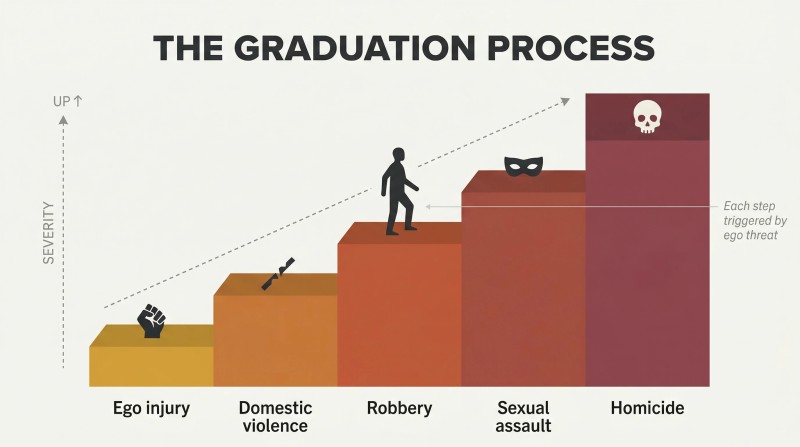
Serial killers don't start with murder — they graduate to it step by step
Berry-Dee traces a "graduation process" in every killer's history — a predictable escalation from minor offenses to homicide. John Cannan's criminal career spanned 11 documented steps:
1. Menial job frustration and narcissistic injury
2. Marriage collapse blamed on everyone else
3. Domestic violence against a partner
4. Armed robbery wearing a crash helmet
5. Savage rape of a pregnant woman in front of her toddler
Each step was triggered by a blow to his ego — being fired, dumped, or outperformed. The same pattern appears in Kenneth McDuff (teenage burglary to triple murder to parole to more murders) and Michael Ross (campus voyeurism to serial rape to serial murder). Escalating patterns of control, deception, and boundary violations are not phases people grow out of.
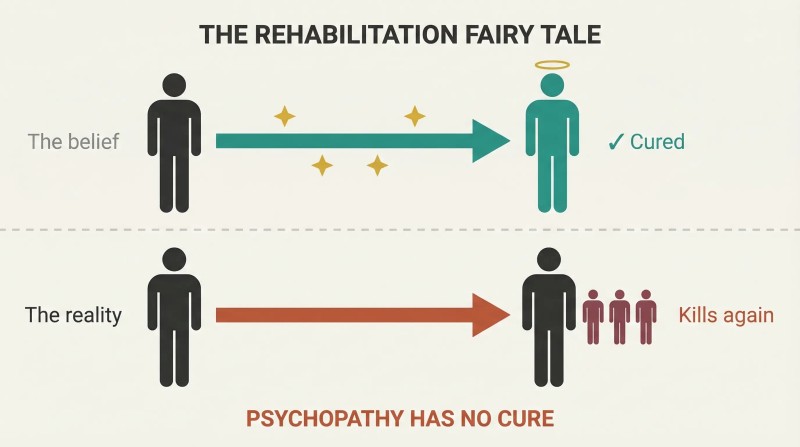
Released killers kill again because parole boards believe in fairy tales
The book's most damning indictment targets systems that return killers to the streets. Mass murderer Paul Beecham was released from Broadmoor Hospital after just 16 years, declared "unlikely to kill again." He shot his partner and then himself. Child killer Arthur Shawcross served 14 of 25 years despite one psychiatrist warning he was "possibly the most dangerous individual to have been released." He murdered at least nine more women.
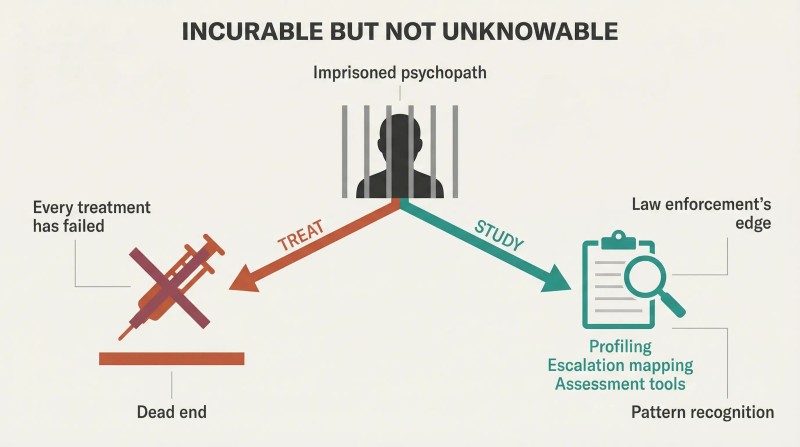
Kenneth McDuff was paroled from Death Row during Texas prison overcrowding — one of 20 former Death Row inmates and 127 murderers released in a single sweep. Three days later, he killed again. Berry-Dee's conclusion: psychopathy has no cure. No drug, no therapy, no rehabilitation program works. The only practical purpose of studying incarcerated killers is to help catch the next one faster.
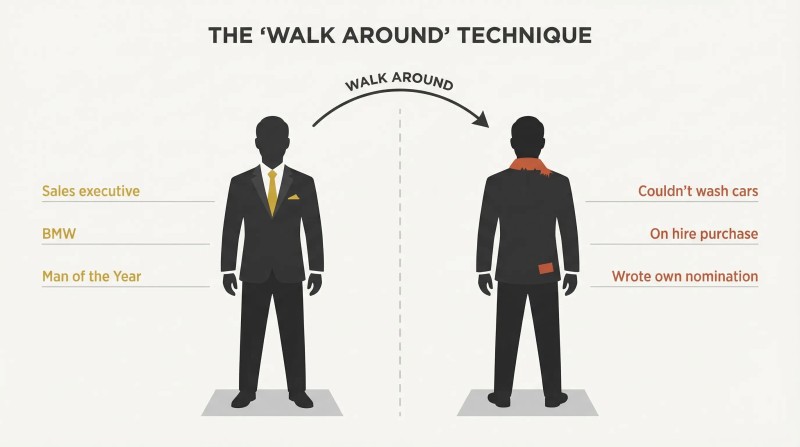
Walk around the person and check if their details match their claims
Berry-Dee's "walk around" technique involves mentally examining someone as if they were a wax figure on a plinth — studying their appearance, claims, and behavior for contradictions. John Cannan drove a bottom-of-the-range BMW on hire purchase while claiming to be a high-flying sales executive. His boot was stuffed with junk, handcuffs, and rope. His mother confirmed he'd been fired from his father's garage for failing to properly wash cars.
John Robinson's glittering CV fooled everyone: Eagle Scout, Man of the Year, Mobil Corporation director. Every credential was fabricated — yet a brigadier general and former White House physician hired him without checking. Robinson even wrote his own "Man of the Year" recommendation letters. The tell is always in the details nobody bothers to verify: the frayed collar beneath the flashy suit, the empty bank account behind the expensive car.
Dating sites and chat rooms are where modern psychopaths trawl for prey
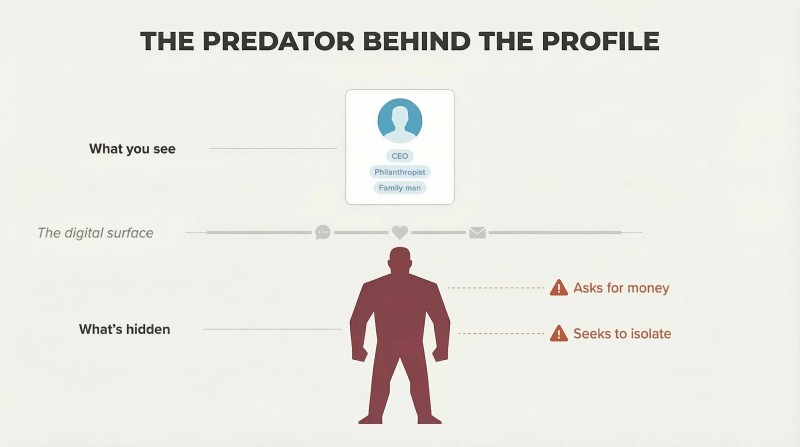
John Robinson — "The Slave Master" — was among the first Internet serial killers, using BDSM websites and fake job postings to lure victims. He convinced women to sign "Slave Contracts" granting him total physical and financial control. Several victims ended up decomposing in 55-gallon steel barrels on his property while Robinson continued cashing their government benefit checks.
The predatory patterns are ancient; the scale is new. Berry-Dee notes that the same tactics once confined to newspaper personal ads now operate across countless platforms. Robinson's fabricated online persona — consultancy CEO, charitable fundraiser, devoted family man — was indistinguishable from a legitimate businessman's profile. Berry-Dee's advice is blunt: the moment anyone you've met online asks for money or seeks to isolate you from your support network, cut contact immediately.
Studying locked-up killers is law enforcement's only real edge
Chemical castration was attempted on Michael Ross using massive doses of the contraceptive Depo-Provera. His weight ballooned, his liver failed, depression returned — but the psychopathy remained untouched. He warned staff he'd kill any female officer left alone with him. Electroconvulsive therapy, ice baths, Victorian-era leeches — all tried historically on psychopaths. None worked.
The practical value of this grim research lies not in prevention — Berry-Dee insists no one can prevent a first kill — but in pattern recognition. Understanding Ross's methods helps profile campus predators. Mapping Cannan's 11-step escalation helps identify someone mid-spiral. The Hare PCL-R Checklist gives investigators a structured assessment tool, though Hare himself warns it must never be applied by amateurs or used to pre-emptively punish anyone.
Analysis
Berry-Dee's book occupies a peculiar niche in true crime literature — neither clinical treatise nor conventional case study, but something closer to a field journal from decades spent inside maximum-security interview rooms. This positioning gives it an authenticity that academic works on psychopathy cannot match, while introducing ethical tensions the author only partially acknowledges.
The book's central contribution — the psychopath/ savage distinction — fills a genuine analytical gap. Courts routinely conflate clinical psychopathy with what Berry-Dee more usefully terms 'savagery': calculated brutality without neurological excuse. However, the framework remains undertheorized. Berry-Dee classifies Bianchi as a savage despite high PCL-R indicators, seemingly because psychiatrists couldn't agree on his diagnosis — circular reasoning given the book's simultaneous argument that psychiatrists are unreliable.
The most transferable insight is the 'graduation process 'framework, which maps how boundary violations escalate through identifiable stages. This has immediate applicability far beyond criminology — domestic violence counselors, HR professionals, and anyone evaluating interpersonal warning signs would recognize the pattern. Combined with the narcissism-psychopathy link Berry-Dee champions, it offers a practical early-warning heuristic: fragile ego plus escalating control plus inability to accept criticism equals increasing danger.
Berry-Dee's pessimism about detection is warranted but strategically overstated. His own cases reveal numerous red flags visible in hindsight: Cannan's cluttered car contradicting his flashy persona, Robinson's easily verifiable fake credentials, Shipman's suspiciously high death rate flagged by a funeral home. The real lesson isn't that detection is impossible — it's that surface charm short-circuits the verification instinct in otherwise intelligent people.
The book's most provocative element — detailed descriptions of psychologically manipulating killers into confessions — raises questions Berry-Dee barely addresses. The Ross interview flirted openly with entrapment. The Shawcross confession was obtained through deliberate deception about his girlfriend's presence. Berry-Dee operates in moral gray zones that mirror, uncomfortably, the manipulation he documents in his subjects. This may be the book's most honest, if unintentional, insight: understanding psychopathy requires getting uncomfortably close to its methods.
Review Summary
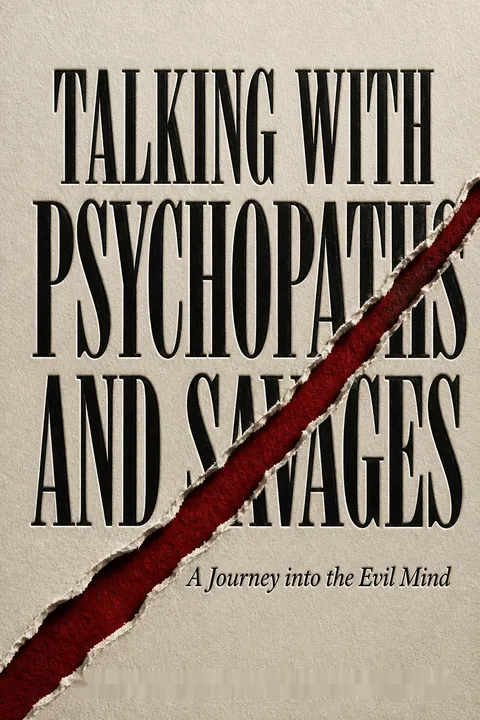
Talking with Psychopaths and Savages receives mostly negative reviews. Readers criticize the author's narcissistic tone, constant self-promotion, and lack of substantive content about the criminals. Many find the writing poorly edited, repetitive, and disorganized. Some readers feel misled by the title, as there is little actual discussion with psychopaths. The author's treatment of victims and mental illness is also criticized. A few positive reviews appreciate the insights into criminal minds, but overall, the book is seen as disappointing and self-indulgent.
Glossary
PCL-R Checklist
Psychopathy diagnostic assessment toolProfessor Robert Hare's Psychopathy Checklist-Revised. A 20-item psychological assessment measuring traits including glibness, grandiose self-worth, pathological lying, manipulativeness, lack of remorse, shallow affect, callous lack of empathy, parasitic lifestyle, poor behavioral controls, and criminal versatility. Each item is scored 0-2. Hare emphasizes it must only be administered by trained professionals—never by laypersons attempting self-diagnosis or amateur detection.
Savage
Brutal killer without clinical excuseBerry-Dee's term for a killer who combines brutal, unrestrained violence with willful transgression of society's laws and social rules, but who does not meet clinical diagnostic criteria for psychopathy. Unlike the psychopath—whose condition may be partially beyond conscious control—the savage acts with full awareness that their actions violate moral and legal norms, and has no neurological or biochemical abnormality to cite in mitigation. Berry-Dee classifies Oscar Pistorius, Melanie McGuire, and Kenneth Bianchi as savages.
Splitting
Internal ideal-self versus actual-self conflictA central defense mechanism used by people with narcissistic personality disorder and psychopaths. The inflated 'ideal self' (grandiose fantasies of unlimited success, power, and brilliance) merges and conflicts with the 'actual self' (the reality of who the person is). This creates an internal revolving door between magical dreams and crushing dread of failure, producing the Dr. Jekyll and Mr. Hyde duality Berry-Dee observed in killers like Shipman, who bullied colleagues while charming patients.
Graduation process
Escalating criminal behavior patternBerry-Dee's term for the predictable escalation observed in serial killers' criminal histories, where offenses progress through identifiable stages: petty theft, voyeurism or 'Peeping Tom' behavior, stalking, minor sexual assault, rape, serial rape, and eventually murder and serial homicide. Each escalation is typically triggered by a narcissistic injury—rejection, humiliation, or failure. Fantasy, often fueled by pornography, drives the downward spiral. Berry-Dee traced 11 specific escalation steps in John Cannan's history.
Kryptopyrrole
Biochemical marker of psychiatric dysfunctionA substance (from Greek kryptos 'hidden' and pyre 'fire') normally present in humans in very low amounts or not at all, detectable in urine which may appear mauve-colored. Berry-Dee discusses it extensively in the Arthur Shawcross case, where levels were found at 200mcg/100cc—ten times the threshold of concern (20mcg/100cc). Elevated kryptopyrrole can combine with vitamin B6 and zinc to cause pyroluria, a metabolic condition associated with inability to control anger, mood swings, sensitivity to stress, and violent behavior.
Aggressive narcissism
NPD traits linked to psychopathyBerry-Dee's framing of narcissistic personality disorder as a direct gateway to psychopathic behavior. Characterized by exaggerated self-importance, pathological lying, inability to handle criticism, exploitation of others, and the 'splitting' defense mechanism. Berry-Dee argues this link is 'rarely mentioned in medical papers' despite both conditions affecting approximately 1% of the population. He observed aggressive narcissism as a common denominator across every killer he profiled, from Shipman's 'God Complex' to Cannan's delusional self-image as a high-flying executive.
FAQ
What's Talking with Psychopaths and Savages about?
- Exploration of Criminal Minds: The book delves into the psychology of psychopaths and savages, offering insights into their motivations and behaviors.
- Interviews with Criminals: Author Christopher Berry-Dee shares his experiences interviewing notorious criminals, revealing their thought processes and manipulative tactics.
- Case Studies and Themes: It includes case studies of infamous criminals like Harold Shipman and Oscar Pistorius, and discusses themes like the nature vs. nurture debate.
Why should I read Talking with Psychopaths and Savages?
- Unique Perspective: The book provides a rare glimpse into the minds of some of the most dangerous individuals, making it compelling for true crime enthusiasts.
- Educational Value: Readers gain insights into criminal psychology, enhancing understanding of human behavior and societal issues related to crime.
- Engaging Narrative: Berry-Dee's storytelling combines factual accounts with personal anecdotes, making complex subject matter accessible and engaging.
What are the key takeaways of Talking with Psychopaths and Savages?
- Understanding Psychopathy: The book emphasizes that psychopathy is characterized by a lack of empathy, manipulative behavior, and a grandiose sense of self-worth.
- Psychopathy vs. Savagery: It distinguishes between psychopathy and savagery, with the latter involving brutal acts without a clinical diagnosis of psychopathy.
- Impact of Environment: The author discusses how upbringing and environmental factors can influence the development of psychopathic traits.
What are the best quotes from Talking with Psychopaths and Savages and what do they mean?
- “Whoever fights monsters...”: This Nietzsche quote warns against losing one's moral compass while engaging with evil.
- “The naïve person believes...”: It emphasizes the importance of critical thinking and skepticism, especially with manipulative individuals.
- “Psychopaths are the supreme con-artists.”: This highlights the manipulative nature of psychopaths and the danger they pose to society.
How does Christopher Berry-Dee conduct his interviews with psychopaths?
- Personal Approach: Berry-Dee builds rapport with subjects, using psychological insights to navigate their manipulative tendencies.
- Use of Correspondence: He often starts with written correspondence to establish a connection before face-to-face meetings.
- Focus on Honesty: He emphasizes honesty and transparency, creating an environment where subjects feel comfortable revealing their true thoughts.
What distinguishes a psychopath from a savage in Talking with Psychopaths and Savages?
- Psychopath Defined: Psychopaths lack empathy, remorse, and guilt, often displaying manipulative behaviors and superficial charm.
- Savagery Explained: Savages commit brutal acts without a clinical diagnosis of psychopathy, driven by primal instincts.
- Behavioral Differences: Psychopaths may plan meticulously, while savages act impulsively or out of rage.
What role do case studies play in Talking with Psychopaths and Savages?
- Illustrative Examples: Case studies provide real-life examples that illustrate the book's psychological concepts.
- Diverse Criminal Profiles: They showcase various manifestations of psychopathy and savagery, helping readers understand these behaviors' complexity.
- Lessons Learned: Each case study offers insights into criminals' motivations, backgrounds, and psychological profiles.
How does Talking with Psychopaths and Savages address the concept of evil?
- Evil as a Spectrum: The book explores evil as a spectrum, with psychopaths and savages representing extreme ends.
- Philosophical Reflections: Berry-Dee reflects on philosophical questions about evil, drawing on quotes and theories from notable thinkers.
- Real-World Implications: It highlights the consequences of evil behaviors on victims and society, emphasizing the importance of recognizing and addressing evil.
What insights does Talking with Psychopaths and Savages provide about the criminal justice system?
- Critique of the System: The author critiques the system's handling of psychopathic offenders, highlighting flaws in assessment and treatment.
- Need for Better Understanding: Berry-Dee advocates for a deeper understanding of psychopathy among law enforcement and legal professionals.
- Impact on Victims: The book emphasizes the long-lasting effects of violent crime on victims and their families, calling for a more victim-centered approach.
What is the PCL-R Checklist mentioned in Talking with Psychopaths and Savages?
- Definition of PCL-R: The Psychopathy Checklist-Revised (PCL-R) is a tool developed by Professor Robert Hare to evaluate psychopathic traits.
- Key Traits Assessed: It includes traits like "grandiose sense of self-worth" and "lack of empathy," helping professionals assess psychopathy.
- Importance in Criminal Justice: The PCL-R is used in forensic settings to assess risk factors for violent behavior and inform treatment strategies.
How does the book address the concept of "Internalized Imaginary Companion" (IIC)?
- Definition of IIC: IIC refers to a psychological construct where individuals create imaginary companions to fulfill emotional needs.
- Application to Psychopaths: The book discusses how killers like Kenneth Bianchi may develop IICs to cope with emotions and express darker impulses.
- Expert Opinions: Insights from psychologists explore the implications of IICs in understanding psychopaths' behaviors.
How does Talking with Psychopaths and Savages differ from other true crime books?
- Focus on Psychology: Unlike many true crime narratives, this book delves deeply into the psychological aspects of the killers.
- Personal Interaction: Berry-Dee's firsthand interviews provide a unique perspective, allowing readers to hear directly from the killers.
- Educational Approach: The book aims to educate readers about psychopathy's complexities and societal implications, rather than just sensationalizing stories.
About the Author
Other books by Christopher Berry-Dee

Download PDF
Download EPUB
.epub digital book format is ideal for reading ebooks on phones, tablets, and e-readers.








































