

Key Takeaways
Build strength without becoming useless everywhere else
Strength is the skeleton, not the whole body. Tactical Barbell targets the operational athlete: soldiers, SWAT, firefighters, paramedics, fighters, and anyone who must juggle strength, endurance, and job skills without specializing. A powerlifter can be sore for a week after leg day. An operator cannot. He might breach a door in body armor, chase a K9, then wrestle a suspect, all while sleep-deprived and running on gas-station donuts.
The goal is superiority in many domains, not elite in one. The author, a former infantryman, paratrooper, and Hostage Rescue Team member, argues you should abandon dreams of a 1,000-pound deadlift. Instead aim to deadlift 500-600 pounds and still finish a marathon. Being above average in several attributes simultaneously is itself elite, and it demands an organized, disciplined mind.
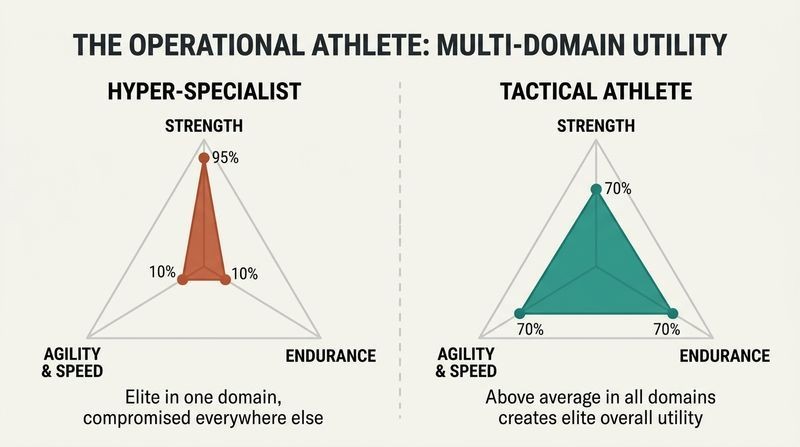
What's compelling here is the reframing of strength as infrastructure rather than a trophy. This mirrors the concept of 'general physical preparedness' in sports science and the military notion of the 'tactical athlete' whose fitness is instrumental, not decorative. The claim that maximal strength converts downstream into power and endurance (but not vice versa) is well supported: force production is a physiological ceiling that other qualities draw against. The tension the book names, that specialization is a liberty operators cannot afford, echoes decathlete training philosophy. The honest admission that real special operators often look 'underwhelming' rather than like action heroes is a useful corrective to gym-culture aesthetics.
Practice strength like a skill, don't attack it like a workout
Frequent, heavy, submaximal lifting while avoiding failure. This single principle drives roughly 90% of results, per the author. Instead of one all-out weekly session where you psyche up, eat like a horse, and grind to failure, you lift the same core lifts three or more times a week at submaximal loads, always stopping while fresh. You could squat and then jog immediately afterward. That fresh.
The farmboy analogy explains why. People develop uncanny 'farm strength' from repeatedly moving heavy objects over years, not from occasional maximal efforts. Tactical Barbell borrows this: scale frequency to load. Eastern Bloc strength science favors hitting each lift 3+ times weekly as optimal, once weekly as least effective. The trinity that must stay balanced: frequency, intensity (load heavy enough to trigger adaptation), and sufficient recovery between sessions.
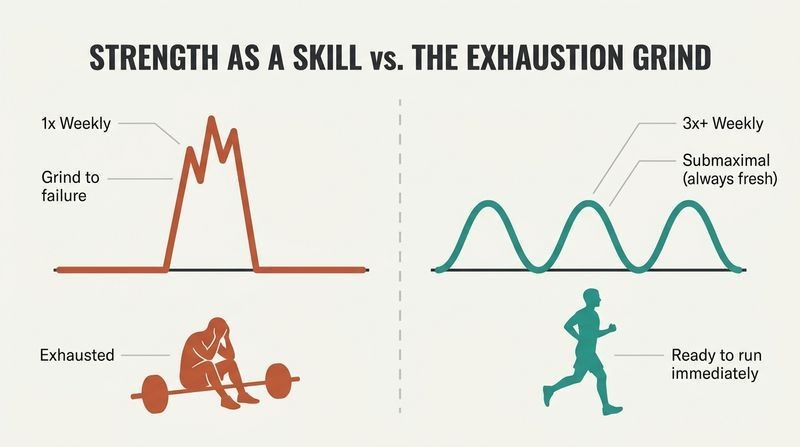
This is the motor-learning view of strength, and it has strong grounding. Strength is substantially neural: recruiting more motor units, firing them in sync, reducing antagonist co-contraction. Skills improve through frequent, quality, non-fatigued repetition, which is exactly how one would train a golf swing or a piano scale. The prohibition on training to failure aligns with modern findings that failure adds fatigue and recovery cost disproportionate to its stimulus. The Soviet and Bulgarian systems the author invokes (Verkhoshansky, Medvedyev, Bompa) built this logic decades ago. One nuance: very advanced lifters sometimes need occasional maximal exposure, which the program accommodates through its intermediate and advanced variants.
Rest at least two minutes between sets, always
The Golden Rule is non-negotiable. Rest a minimum of two minutes between every set, even if you feel ready sooner. The purpose is full recovery so you never approach muscle failure, which is the enemy of pure strength development. Most beginners sabotage themselves by cutting rest short, a habit drilled in by bodybuilding culture's obsession with the pump and the burn.
Longer rest also controls unwanted size. The book cites 17-year-old sprinter Allyson Felix, coached by Barry Ross, who deadlifted 300 pounds at roughly 100 pounds bodyweight. Her protocol used five-minute rest intervals to ensure near-complete ATP recovery and minimize sarcoplasmic hypertrophy (the 'puffy muscle' growth from bodybuilding-style training). Two to three minutes is the practical sweet spot. Push toward four or five if you want strength without added mass.
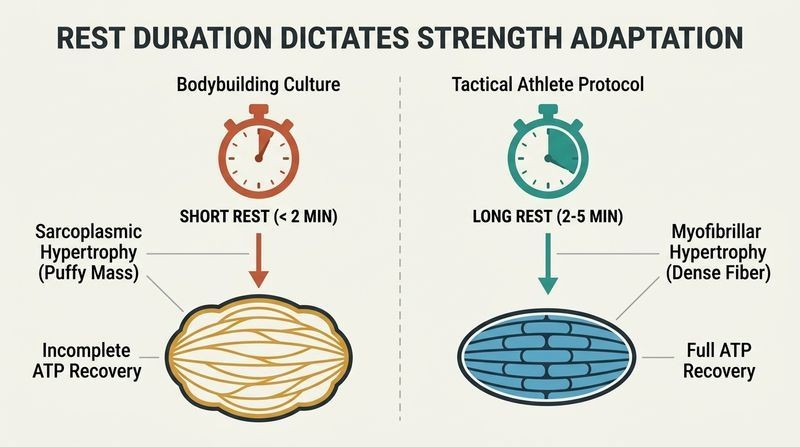
This is the book's most counterintuitive and most actionable lever. The physiology is sound: the phosphocreatine (ATP-PCr) energy system needs roughly three to five minutes to fully replenish, and lifting before it recovers forces reliance on glycolytic pathways that drive fatigue and hypertrophy rather than clean force output. A 2016 meta-analysis by Schoenfeld and colleagues found longer rest intervals produced superior strength and even hypertrophy gains, overturning the short-rest orthodoxy. What the book adds is discipline: naming it a 'rule' rather than a guideline exploits the fact that trainees, feeling recovered, chronically underrest. The Felix example is a vivid demonstration that rest is a dial for the strength-to-mass ratio.
Strip your program to three or four compound lifts
Ruthlessly cut everything nonessential. To lift each movement three times a week, sessions must be short, so you trim down to a small 'cluster' of core lifts. A cluster is simply a group of exercises: bench press, squat, and weighted pull-up, for example. Minimalist clusters have two or three lifts, standard have three to four, heavy have four or more. No bicep curls, no cable machines, no balance boards.
Compound lifts strengthen you everywhere. Run a bench/squat/pull-up cluster for 12 weeks without deadlifting, then test your deadlift, and it will likely hold or even climb. Why? The muscles trained by squatting and benching heavily overlap with those used to deadlift. Accessory isolation work distracts from the main lifts and eats recovery you need for the next frequent session.
The 'attributes versus tools' distinction is the sharpest conceptual contribution here: train the quality (maximal strength), then pick the most efficient tool (a barbell, because it loads incrementally). This dissolves the tiresome functional-training debates about push-ups versus bench press. The overlap argument is legitimate: compound movements recruit large amounts of musculature synergistically, which is why powerlifters rarely need direct arm work. A fair critique is that pure minimalism can leave specific weak points (rear delts, certain rotator function) underdeveloped over years, which is precisely why elite lifters eventually add accessories. But for the time-starved generalist the book targets, the Pareto logic (a few lifts yield most of the strength) is defensible.
Base every weight on a percentage of your one-rep max
Periodization means planned progression, not going 100% forever. You cannot max out every session and keep improving; you burn out and get injured. Instead you test your maximums, then lift calculated percentages of them, generally 70-95% of your one-rep max, for 1 to 5 reps. Some weeks are deliberately easy, others intense. Intensity here means load relative to your max, not how much you sweat.
You never have to grind a true single. Test a 3-to-5-rep max instead and plug it into a free online calculator to estimate your one-rep max. Being off by a pound or two is irrelevant; you want obvious gains between test days, not competition precision. The author, plateaued at a 185-pound bench at 150 pounds bodyweight, hit 300 within 18 months once he adopted structured percentage-based progression on an army base with constant PT interruptions.
Percentage-based training removes ego and emotion from the barbell, which is its quiet genius. The average gym-goer trains 'by feel,' riding good days and blaming bad ones on fatigue, and stalls for years. Prescribing loads in advance converts training into execution, a principle borrowed from Eastern European systems and popularized in the West through programs like Jim Wendler's 5/3/1 (which the book references via the 'training max' concept). The undulating structure (waving intensity week to week) is validated by research showing varied loading outperforms monotonous linear progression for intermediates. The author's own before-and-after (185 to 300 pounds despite field deployments and rations) is anecdotal but illustrates the method's robustness under imperfect conditions.
Pick one of three templates by how much you can train
Three templates scale to your life. All share the same DNA (frequent, submaximal, failure-avoiding lifting) but differ by weekly frequency and how much you prioritize strength:
1. Operator: three days a week, each lift hit three times. The backbone, ideal when strength and conditioning matter equally.
2. Zulu: four days a week, each lift twice, best for those wanting more exercises or accessory work.
3. Fighter: two days a week, each lift twice, for those whose strength is a lower priority behind heavy conditioning or sport skills.
Match honestly, then err downward. If you cannot decide between three and four days, choose three. A police-officer boxer in his 40s uses Fighter so lifting does not wreck his sparring. A sedentary civilian analyst uses Zulu with six lifts and recovers fast. Overestimating your available time is the classic mistake.
The three-template architecture is essentially a dosing system, and its strength is behavioral realism rather than physiological novelty. By forcing an honest audit of recoverable training time, it addresses the number-one cause of program failure: not the plan, but adherence to it. The two contrasting characters (the aging boxer-cop and the young sedentary analyst) function as anchoring extremes so readers can locate themselves. This resembles autoregulation frameworks in modern coaching, though here the flexibility is structural (choose your template) rather than daily. The insight that Fighter's twice-weekly frequency beats many programs' once-weekly frequency is subtle and correct: frequency, not session volume, is the underrated driver of strength progress.
When recovery lags, add rest days instead of quitting
Graduate to intermediate/advanced versions. As you get stronger, the loads get heavier and one rest day between Operator sessions may no longer be enough, especially while running conditioning alongside. The Operator I/A ('floating' or perpetual) template solves this: take one OR two days between strength sessions as your body demands, and expand volume up to 10 sets per exercise when you have recovery to spare.
Self-regulation is an advanced skill. You stop thinking in rigid seven-day weeks and instead do the next session whenever you have recovered. This demands honest self-knowledge that comes only from years of training. Novices swing between doing too much (grinding maximum sets every session) and too little (mistaking normal soreness for overtraining and taking a week off). Do not rush to 'advanced' thinking it means better. Regular Operator's higher frequency serves beginners best.
The 'floating' template quietly abandons the calendar week, a meaningful conceptual move. Most training programs impose an artificial seven-day cycle that reality (shift work, deployments, callouts) routinely shatters. Anchoring progression to completed sessions rather than dates is more honest about how adaptation actually works: the body responds to stimulus and recovery, not to the fact that it is Tuesday. This anticipates modern autoregulation and readiness-monitoring approaches (HRV tracking, velocity-based training). The candid warning that novices cannot yet self-regulate is important and often ignored by intermediate lifters eager to graduate. Autoregulation requires an accurate internal model of one's own recovery, which is earned, not assumed.
Never train strength and hard conditioning in the same breath
They interfere with each other. Maximal strength needs you rested and fresh to lift near-maximal loads for low reps. If you attempt heavy squats right after 400-meter sprints and 100 burpees, you will fail early, gain little strength, and risk injury. Group classes that mix barbells with high-intensity intervals give a great anaerobic workout but barely move your ability to generate force, because there is no systematic load progression.
Be the tortoise for strength, the hare for conditioning. Both attributes are mandatory for operators; neglecting either is a disservice. But train them as separate entities. When you lift, go slow, rest long, avoid failure. When you condition, go all out. The author suggests doing conditioning after weights, since pre-fatigue hurts lifting but is almost a bonus for cardio.
This addresses the 'interference effect' or 'concurrent training' problem, one of the most researched areas in exercise science. Hickson's 1980 study first showed that combining heavy endurance and strength training blunts strength gains. The mechanism is partly molecular: endurance stimulates AMPK pathways favoring mitochondrial adaptation, while strength stimulates mTOR pathways favoring protein synthesis, and acute activation of one can suppress the other. The book's practical solution (separate the qualities, sequence carefully) aligns with current consensus that spacing sessions and prioritizing the target quality minimizes interference. The tortoise-and-hare framing is memorable pedagogy. It does simplify: some overlap exists, and molecular interference is smaller in trained athletes than once feared.
Strength-endurance drains unless you refill the strength tank
Maximal strength feeds strength-endurance. Strength-endurance (SE) is generating force over time, like doing 100 push-ups or rucking until your legs give out. It is trained with light loads (20-40% of max), high reps, and short-to-zero rest in circuits. But SE draws on your maximal strength reserve, which is why a world-class powerlifter cannot necessarily crank out 100 push-ups without conversion work.
Neglect strength and SE collapses. A reader ran a specialist push-up program for weeks, neglecting strength training, and his max push-ups fell from the low 60s to the high 50s. He felt weaker. The lesson: train SE only in short 3-to-6-week blocks, then return to maximal strength, or train both concurrently. The book's SE circuits (Alpha, Bravo, Tango) progress by cutting rest and adding reps, never chasing heavy load.
The counterintuitive claim that a dedicated push-up program can lower your push-up count captures a real phenomenon: overtraining a single movement pattern without addressing its strength substrate leads to accumulated fatigue and regression. The 'watering hole' metaphor (periodically topping up maximal strength) reflects the physiological reality that endurance capacity is bounded by peak force. This has practical stakes for tactical selection candidates who obsess over test numbers. A useful cross-connection is the strength reserve concept: the higher your absolute strength, the lower the relative intensity of any submaximal task, so it fatigues you less. The distinct circuit progressions (rep-based Alpha and Bravo, time-based Tango) show thoughtful programming rather than random 'metcon' chaos.
Consistency beats intensity: don't break the chain
Show up and go through the motions. The program requires no superhuman willpower because every session is prescribed in advance: exact exercises, sets, reps, and pounds. Your only job is to physically appear on training days, even exhausted, even expecting a bad session. Motivation follows success, not the other way around. Miss sessions frequently and you stop adapting to the loads and start backsliding.
Borrow Jerry Seinfeld's calendar trick. Seinfeld reportedly advised a young comic to mark a big red X on a wall calendar every day he wrote. After a few days you have a chain; your only job is to not break it. Applied to the barbell: a year of unbroken training, good sessions and bad, compounds into a transformed physique and strength numbers you would not believe. The author sustained this through deployments, field rations, and shift work.
Ending a strength manual on behavioral psychology rather than physiology is wise, because programs fail on adherence, not design. The Seinfeld 'chain' method is a real-world application of what behavioral science calls streak-based habit formation and loss aversion: once a chain exists, breaking it feels like a loss, which motivates continuation. The counsel to 'go through the motions' rather than manufacture motivation aligns with research showing that action often precedes motivation, reversing the intuitive order. There is honest humility in the author's insistence that his own progress came not from being a 'special snowflake' but from unglamorous repetition under bad conditions. The deepest tactical lesson may be temperamental, not muscular.
Analysis
Tactical Barbell belongs to a small, credible niche: strength programming for people who cannot afford to be specialists. Written by a twenty-year veteran of infantry, airborne, and hostage-rescue units, it is a framework-based manual rather than a science text, though it leans on legitimate Eastern European periodization lineage (Verkhoshansky, Medvedyev, Bompa) and echoes Western programs like Wendler's 5/3/1. Its intellectual core is refreshingly narrow: nearly all results come from two levers, frequent submaximal lifting that avoids failure, and rest intervals of at least two minutes. Everything else (three templates, exercise clusters, deadlift options, strength-endurance circuits) is scaffolding that lets a chaotic operational life plug into that core.
The book's genuine originality is not physiological but organizational and psychological. It treats time, recovery, and adherence as the true constraints, then engineers flexibility around them. The 'attributes versus tools' distinction is a clean piece of thinking that dissolves pointless functional-fitness debates. The 'floating' Operator template, which abandons the seven-day week entirely, is ahead of its 2014 curve, anticipating autoregulation and readiness-based training now common in sports science.
Where it is vulnerable: the evidence is overwhelmingly anecdotal (the author's own lifts, reader testimonials, the Allyson Felix case), and the confident percentage prescriptions are presented without the individual-variation caveats a physiologist would demand. Its dismissal of accessory work and hypertrophy is pragmatic for its audience but would underserve someone with specific structural weaknesses. The concurrent-training advice is sound but simplifies a nuanced literature.
Still, the book earns its authority through hard-won specificity. It knows its reader eats donuts at 0400, sleeps in shifts, and deploys mid-block. By designing for imperfection rather than ideal conditions, it delivers something most strength manuals do not: a plan that survives contact with real life. Consistency, not heroics, is its final and most durable argument.
Review Summary
Tactical Barbell receives high praise for its effective strength training approach tailored to tactical athletes and everyday individuals. Readers appreciate its flexibility, focus on compound exercises, and periodization method. Many report significant strength gains and improved body composition. The program is lauded for balancing strength training with other physical activities, making it ideal for those with demanding professions or athletic pursuits. Reviewers consistently mention its simplicity, time efficiency, and ability to deliver promised results. The book is often recommended alongside other respected strength training resources.
FAQ
What's "Tactical Barbell: Definitive Strength Training for the Operational Athlete" about?
- Purpose: The book is designed to provide a strength training program specifically for operational athletes like military personnel, SWAT, and first responders.
- Focus: It emphasizes developing raw, usable strength without sacrificing other physical attributes like endurance and agility.
- Audience: While aimed at tactical professionals, it is also suitable for general fitness enthusiasts who want a muscular physique with real-world strength.
- Approach: The program is not a cookie-cutter plan; it offers customizable templates to fit various lifestyles and training needs.
Why should I read "Tactical Barbell" by K. Black?
- Efficiency: The book offers a strength program that delivers measurable results without requiring excessive time in the gym.
- Versatility: It provides templates that can be adapted to different training schedules and physical demands, making it suitable for both tactical professionals and general fitness enthusiasts.
- Expertise: The author, K. Black, draws on 20 years of experience in military and law enforcement to offer a tested and reliable system.
- Comprehensive: It covers not just strength training but also how to integrate it with conditioning and other physical skills.
What are the key takeaways of "Tactical Barbell"?
- Maximal-Strength Focus: The book emphasizes the importance of maximal strength as a foundational attribute for tactical athletes.
- Simplicity and Results: It advocates for simple, effective methods over complex or trendy workouts, focusing on results.
- Periodization and Progression: The program uses periodization to plan training progression, ensuring long-term gains without burnout.
- Flexibility: The book offers various templates and exercise clusters to fit different needs and schedules, allowing for a personalized approach.
How does "Tactical Barbell" define an "Operational Athlete"?
- Definition: An operational athlete is someone who needs to perform at a high physical level in stressful and dangerous environments.
- Attributes: They require mastery over multiple fitness domains, including strength, conditioning, and job-related skills.
- Training Balance: The book emphasizes that operational athletes should not specialize in one skill but maintain a balance across various attributes.
- Examples: This includes military personnel, tactical law enforcement, firefighters, paramedics, and combat athletes.
What is the "Operator Template" in "Tactical Barbell"?
- Core Template: The Operator Template is the standard strength model in the book, designed for tactical athletes.
- Frequency: It involves training three times a week, focusing on a small number of core lifts to maximize strength gains.
- Principles: The template is based on frequent, heavy lifting while avoiding failure and ensuring sufficient recovery.
- Customization: It allows for different exercise clusters to be chosen based on individual needs and goals.
How does "Tactical Barbell" address Strength vs. Hypertrophy?
- Strength Focus: The book primarily aims to develop maximal strength, which is the ability to generate force.
- Hypertrophy Explained: Hypertrophy refers to muscle size, often associated with bodybuilding, which is not the primary focus here.
- Training Differences: Strength training involves low reps with heavy weights, while hypertrophy involves higher reps with moderate weights.
- Real-World Application: The book emphasizes functional strength over aesthetics, suitable for tactical and operational roles.
What is the role of "Periodization & Progression" in "Tactical Barbell"?
- Planned Progression: Periodization is used to plan training progression, ensuring long-term gains without burnout.
- Load Management: The program involves lifting various percentages of your maximums, gradually increasing intensity.
- Recovery: It emphasizes the importance of recovery periods to prevent overtraining and ensure sustainable progress.
- Adaptation: The book suggests sticking with a load for several workouts to allow the body to adapt more thoroughly.
How does "Tactical Barbell" incorporate Deadlifts?
- Options Provided: The book offers three options for incorporating deadlifts: one work set per session, three work sets in a single session, or one work set per week.
- Customization: These options allow for flexibility based on individual recovery capacity and conditioning load.
- Frequency Management: The book acknowledges that not everyone can handle high-volume deadlifting, especially with a heavy conditioning load.
- Integration: Deadlifts can be integrated into various templates and clusters, depending on the athlete's needs.
What is the "Fighter Template" in "Tactical Barbell"?
- Two-Day Template: The Fighter Template is designed for athletes who need minimal strength training, allowing more focus on other skills.
- Frequency: It involves training twice a week, maximizing the frequency of major lifts within limited sessions.
- Target Audience: Suitable for athletes like runners, triathletes, and combat sports practitioners who prioritize other training domains.
- Efficiency: The template allows for significant strength gains without sacrificing time needed for sport-specific training.
How does "Tactical Barbell" approach Strength-Endurance?
- Definition: Strength-Endurance is the ability to generate force over an extended period, like doing 100 push-ups.
- Training Method: The book uses circuits with high repetitions and short rest intervals to develop this attribute.
- Conversion: It emphasizes the need for some form of conversion from maximal strength to strength-endurance.
- Programming: The book offers different circuit types and suggests incorporating SE training periodically or through conditioning.
What are the best quotes from "Tactical Barbell" and what do they mean?
- "Simplicity is the ultimate sophistication." This quote emphasizes the book's focus on simple, effective methods over complex or trendy workouts.
- "Consistency is the secret formula, the magic bullet." It highlights the importance of regular, disciplined training for achieving long-term results.
- "Frequent heavy lifting while avoiding failure/overtraining." This principle is central to the book's approach, advocating for sustainable strength gains.
- "Train smart. Don’t mistake frantic activity for progress." It advises against equating effort with effectiveness, focusing instead on measurable results.
How should I use "Tactical Barbell" to achieve my fitness goals?
- Read Entire Book: Start by reading the entire book to understand the flexibility and options available.
- Choose Template: Decide on a template based on your schedule, goals, and the number of sessions you can commit to.
- Select Cluster: Pick or create an exercise cluster that aligns with your needs and available equipment.
- Test Maximums: Test your one-rep maximums for all exercises in your cluster and plug the numbers into your chosen template.
- Execute and Adapt: Follow the program consistently, retesting and adjusting as needed to continue progressing.
Download PDF
Download EPUB
.epub digital book format is ideal for reading ebooks on phones, tablets, and e-readers.








































