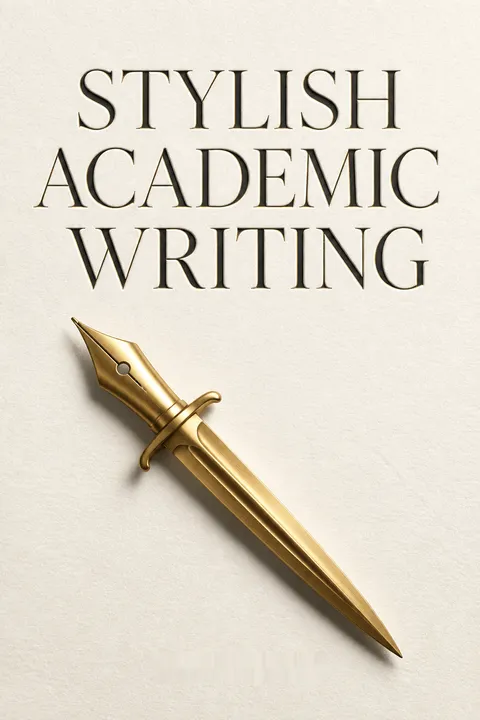

Key Takeaways
1. The Crisis of Academic Prose: A Call for Transformation
There is a massive gap between what most readers consider to be good writing and what academics typically produce and publish.
A pervasive problem. Academic writing often deviates sharply from principles of clear, engaging prose. Instead of clarity, precision, and reader engagement, much scholarly output is characterized by impersonal, jargon-laden, and abstract language. This creates a significant barrier, making complex ideas unnecessarily difficult to access and understand for both specialists and non-specialists.
Immobilizing the reader. The author uses a vivid metaphor of a spider (academic prose) immobilizing a fly (the reader) with silk (soggy syntax and big words). Examples from higher education journals illustrate this "discursive obscurantism," where sentences are convoluted and filled with gratuitous jargon, thwarting the desire to learn.
- Example sentences:
- "In this study, I seek to identify and analyze stakeholders’ basic beliefs on the topic of membership that can be considered in normative arguments on whether to allocate in-state tuition benefits to undocumented immigrants."
- "Via a symbolic interactionist lens, the article analyses the “identity work” undertaken in order to assert distinctive identities as specialist academic administrators."
A call for transformation. This widespread issue isn't due to explicit rules forbidding clear writing, but rather a "chain of misinformation and misunderstanding" where academics believe others demand dull prose. The book aims to empower writers to break free from these perceived constraints, fostering intellectual creativity and improved reading conditions for all.
2. Disciplinary Norms Are Not Compulsions: Embrace Informed Choice
A convention is not a compulsion; a trend is not a law.
Beyond disciplinary silos. Academics often operate within "silos" or "barricades," adhering rigidly to the perceived norms of their fields. This conformity, while offering comfort, can stifle innovation and prevent learning from other disciplines. The author advocates for looking beyond one's own "signature pedagogies" and research styles.
Challenging assumptions. Research reveals that while disciplinary trends exist, they are rarely absolute rules. For instance, despite common assumptions, scientists frequently use first-person pronouns, and even in highly prescriptive fields like evolutionary biology, a significant percentage of articles diverge from standard structures. This data empowers academics to question the "ironclad rules" they believe govern their writing.
- Examples of divergence:
- 10% of evolutionary biologists use unique/hybrid structures.
- 8% of computer scientists use IMRAD despite hybrid predominance.
- 92% of medical articles use first-person pronouns, confounding stereotypes.
The power of informed choice. Many academics feel they are "not allowed" to write in certain ways, but this book argues that most enjoy a far wider range of stylistic choices than they realize. By becoming aware of these shifting constellations of norms, writers can make informed, independent decisions, choosing to write with passion, courage, craft, and style, rather than merely replicating the status quo.
3. Cultivate a Human Voice: Engage Directly with Your Reader
When we muzzle the personal voice, we risk subverting our whole purpose as researchers, which is to foster change by communicating new knowledge to our intended audience in the most effective and persuasive way possible.
The impersonal trap. Many academics are trained to strip personality from their writing, believing objectivity demands an impersonal voice. This often leads to awkward third-person constructions, royal "we," or passive verb forms that obscure human agency. The result is prose that feels distant and disengaging, hindering effective communication.
Permission to be personal. Despite lingering misconceptions, first-person pronouns ("I" and "we") are widely accepted in most academic disciplines, including many sciences. The data shows, for example, that 100% of evolutionary biology articles and 92% of philosophy articles use them, contrasting with fields like higher education (54%) or history (40%) where they are less common, often due to perceived "objective" stances.
- Pronoun usage examples:
- Evolutionary Biology: 100%
- Medicine: 92%
- Philosophy: 92%
- Higher Education: 54%
- History: 40%
Connecting with the reader. Adopting a personal voice can make writing more energetic, persuasive, and easier to understand. It establishes a bond with readers, making them feel like they are in a conversation rather than being lectured. Even the second-person "you" or imperative verbs can create this connection, reminding authors to consider their audience and allow their words to echo in real people's ears.
4. Craft Clear, Concrete Sentences: Eliminate Clutter and Obscurity
Concrete language is arguably the single most valuable tool in the stylish writer’s toolbox.
The foundation of clarity. Well-crafted sentences are the bedrock of stylish academic writing. They are built on concrete nouns and vivid, active verbs, especially when explaining abstract concepts. This allows readers to immediately visualize objects, actions, and relationships, making complex ideas tangible and easier to grasp.
Combatting "clutter." Poorly constructed sentences often suffer from "clutter"—extraneous words and phrases that obscure meaning. Common culprits include:
- Weak verbs: Over-reliance on "forms of be" (is, are, was) and bland academic verbs (analyze, show).
- Abstract nouns: Nominalizations (e.g., "obfuscation," "abstraction") that lack physical presence.
- Excessive prepositions: Stringing together long sequences of abstract nouns (e.g., "the representation of female desire in an era characterized by the objectification of personal experience").
- Overuse of "it, this, that, there": These words can muddy meaning and create ambiguity.
Precision and impact. Stylish writers keep nouns and verbs close together, ensuring clarity on "who's kicking whom." They avoid weighing down sentences with unnecessary adjectives and adverbs, instead letting concrete language and strong verbs carry the descriptive energy. This meticulous attention to sentence-level craft ensures that every word counts, making the prose eloquent and ideas impactful.
5. Engage from the Start: Tempting Titles and Compelling Hooks
If you are still reading three pages later, they have probably got you for the long haul.
First impressions matter. The title and opening paragraphs are crucial for capturing a reader's attention. A dry, technical title or a predictable, formulaic opening can deter readers before they even engage with the content. Stylish writers understand the importance of creating an immediate, compelling impression to draw readers in.
Beyond formulaic openings. While some academic contexts demand formulaic openings (like the CARS model – Creating a Research Space), these often lead to predictable, sweeping statements, egregious name-dropping, and inflated claims of novelty. Many disciplines, however, allow for more engaging approaches.
- Effective opening strategies:
- Questions: "What Color Is the Sacred?"
- Anecdotes/Stories: Recounting a specific event or personal experience.
- Quotations: Starting with a literary or historical quote.
- Provocative statements: "Why Killing Some People Is More Seriously Wrong than Killing Others."
- Scene-setting descriptions: "When Parents Want Children to Stay Home for College."
The power of subtext. A catchy title or opening hook communicates a powerful subtext: "I care about my readers, and I am willing to work hard to catch and hold their attention." This signals intellectual confidence and a commitment to communication, rather than merely transmitting data. Even subtle attempts to amuse or intrigue can make a significant difference in reader engagement.
6. Weave a Compelling Story: Structure Your Research as a Narrative
Every research project is made up of stories—the researcher’s story, the research story, the stories of individual subjects and participants, the backstory—each of which contains various plot twists of its own.
Narrative as engagement. A compelling story sustains reader attention far more effectively than a sagging narrative. Stylish academic writers recognize that research is inherently a story, involving a "protagonist" (the scholar) facing a "problem" (the research question), collecting evidence, and persuading readers of a theory. The key is choosing which story to tell and how to tell it effectively.
Unpacking the research narrative. Beyond the researcher's personal quest, there's the "research story" itself—the narrative uncovered or recounted. This can be enriched by:
- Individual stories: Anecdotes about subjects or participants that illustrate relevance.
- Backstory: Brief accounts of previous scholarly debates or historical context.
- Character development: Conceptualizing abstract ideas or even non-human subjects as characters with obstacles and transformations.
- Setting: Sketching evocative physical details of where the research takes place.
Plotting for persuasion. Like novelists, academics can transform mere events into a "plot" by emphasizing causality and narrative sequence. Varying point of view, from the researcher's to a subject's or even a theoretical concept's, can add depth. The goal is to guide readers through the argument, making them want to keep reading to find out "what happens next," thereby making the research more powerful and persuasive.
7. Illustrate Abstract Ideas: Show and Tell with Examples and Visuals
Abstract concepts become more memorable and accessible the moment we ground them in the material world, the world that our readers can see and touch.
The "show and tell" principle. While creative writers "show, don't tell," stylish academic writers "show and tell," illuminating abstract ideas by grounding theory in practice and anchoring concepts in the real world. This involves a deliberate effort to make the intangible tangible for the reader.
Tools for vivid illustration. A range of techniques can bring abstract ideas to life:
- Examples: Plying readers with well-chosen, concrete instances.
- Anecdotes: Miniature, real-life stories that illustrate concepts and add human interest.
- Case studies/Scenarios: Detailed explorations of real or hypothetical situations.
- Figurative language: Similes, metaphors, analogies, and allusions that weave memorable imagery into the text (e.g., "evolutionary arms race," "Red Queen's hypothesis").
Visual impact. Visual illustrations—photos, drawings, diagrams, graphs—literally show what words tell. When chosen to complement rather than duplicate the text, they activate different brain pathways, making new concepts clearer and more memorable. The key is to use them self-consciously and purposefully, ensuring they forge an uncluttered path to understanding, rather than creating new roadblocks.
8. Master Jargon, Don't Be Mastered by It: Use Specialized Language Judiciously
Academics who are committed to using language effectively and ethically—as a tool for communication, not as an emblem of power—need first of all to acknowledge the seductive power of jargon to bamboozle, obfuscate, and impress.
The double-edged sword of jargon. Every discipline has its specialized language, which can function as efficient shorthand among experts. However, jargon often crosses into "unintelligible or meaningless talk," becoming a tool for intellectual pretension rather than precise communication. The challenge is to discern when technical terminology serves clarity and when it merely obfuscates.
The pitfalls of uncritical jargon. Uncritical use of jargon can lead to "muddy, obscurantist prose" and even grammatical errors, as authors become "intoxicated by big words." It can also become a "semantic shotgun," scattering meaning rather than focusing it, or a "computer macro" that substitutes for actual thought. Examples from computer science, psychology, and literary studies show how jargon can hinder understanding and even mask a lack of genuine engagement with complex ideas.
Judicious and ethical use. Stylish academic writers deploy specialized language gracefully, cautiously, and meticulously. They provide readers with "secure handholds"—definitions, background information, or contextualizing phrases—when introducing complex terms. This approach ensures that jargon serves as a tool for nuanced understanding and efficient communication among experts, rather than a barrier to entry or an emblem of academic hubris.
9. Design Thoughtful Structures: Move Beyond Rigid Templates
A well-structured article or book, like a well-built house, requires careful thought and planning.
Beyond the template. While conventional structures like IMRAD (Introduction, Method, Results, and Discussion) offer a paint-by-numbers approach that ensures coherence and completeness, they can also lead to generic, predictable prose and template-driven thinking. Academics often have more structural choices than they realize, from conventional to hybrid to unique designs.
Advantages and pitfalls of structure. Conventional structures allow readers to quickly locate key findings but offer little information in generic section titles. Hybrid structures, combining conventional and unique titles, offer flexibility. However, carelessly assembled structures, with inconsistent signposting or illogical flow, can expose cracks in an author's thinking, leaving readers disoriented and doubting the validity of the analysis.
- Example of poor structure: A "Findings and Interpretations" section promising four discourses but delivering five, in a different order, with a redundant subsection.
Crafting a compelling architecture. Unique and experimental structures can open new ways of approaching familiar issues, but they demand meticulous craftsmanship and clear signposting to guide readers. Whether using a unifying metaphor, a series of sequential steps, or even playful, disorienting designs, the goal is to create a satisfying reading experience where the text's architecture enhances, rather than detracts from, the intellectual journey.
10. Cite with Purpose and Precision: Enhance Readability, Avoid Pedantry
How we cite influences how we write, from the minutiae of bibliographic forms to the big picture of how we respond to and acknowledge other people’s work.
Citation as epistemology. Citation styles are not merely formatting rules; they reinforce disciplinary epistemologies and methodological prejudices. Different styles (e.g., APA vs. MLA) prioritize different values, such as "information prominent" vs. "author prominent" approaches, or paraphrasing over direct quotation. This can be a challenge for interdisciplinary writers.
The burden of bad citation. While academics often blame prescriptive gatekeepers, the responsibility for citing well lies with the author. Poor citation practices can lead to:
- Readability issues: Awkwardly placed parenthetical citations or ponderous footnotes disrupt narrative flow.
- Excessive erudition: Long discursive notes or extravagant name-dropping that distracts from the main argument.
- Lack of precision: Citing entire works without specific page numbers, especially prevalent in sciences and social sciences, undermining verification.
Humility and generosity in referencing. Citation, at its best, promotes academic humility and generosity by acknowledging intellectual debts and affirming peers' contributions. Stylish writers use citation judiciously, ensuring it supports their argument without overwhelming the text. They make conscious choices about the length and placement of notes, and prioritize clarity and readability, even within the constraints of a required style.
11. Paint the Big Picture Clearly: Express Complex Ideas Concisely
Clarity and complexity are bedfellows, not rivals.
The art of abstraction. Stylish academic writing excels at "abstraction"—the ability to paint a big picture on a small canvas, sketching intricate arguments in a few broad strokes. This is particularly crucial for abstracts, grant proposals, and book prospectuses, which must summarize complex research pithily and persuasively.
Concrete abstracts for complex ideas. Paradoxically, the most effective abstracts are often highly concrete, using sensory language and real-world examples to anchor theoretical concepts. They are clear, direct, and avoid vague, impersonal claims or excessive hedging. The author critiques abstracts that take simple ideas and twist them into "discursive pretzels," failing to invite readers to the table.
- Example of effective abstract elements:
- Clear, well-structured sentences.
- Concrete nouns and verbs.
- A "touch of humanity" (first-person pronouns, real people).
- A contestable thesis or argument.
The persuasive "elevator statement." Condensing a complex project into an "elevator statement"—a brilliantly polished single-sentence summary—is a hallmark of stylish writing. This statement should articulate not just the "what" but the "why" of the research, presenting a bold, defensible claim. This approach, championed by figures like Richard Dawkins, ensures that scholarship is "consequential" because it is understood, enlightening both specialists and non-specialists.
12. Infuse Your Writing with Creativity and Courage: Embrace Undisciplined Thinking
Stylish academics do not write 'outside the box' merely for the sake of showing off their intellectual audacity and skill. Their aim is to communicate ideas and arguments to readers in the most effective and engaging way possible—even when doing so means defying disciplinary norms.
The elusive "je ne sais quoi." Beyond technical skills, stylish writing possesses an elusive cluster of qualities: passion, commitment, pleasure, playfulness, humor, elegance, lyricism, originality, and "undisciplined thinking." These attributes, though hard to define, make certain writers stand out, transforming academic prose from mere information transfer into an engaging intellectual experience.
Unleashing emotion and joy. Academics often suppress emotion, but allowing a "modicum of passion" to color prose can be powerfully persuasive, especially in fields integrating identity politics. Pleasure, too, is contagious; writers who convey "intense, almost giddy pleasure" in their subject matter, like Douglas Hofstadter, draw readers in. Subtle humor, elegance (precision, concision, harmonious simplicity), and lyricism (expressive, poetic language) further enrich the text.
- Examples of creative elements:
- Humor: Wry asides, satirical riffs.
- Elegance: Watson and Crick's understatement.
- Lyricism: Julian Vincent's description of beetle forewings.
The power of "undisciplined thinking." Creativity, originality, and imagination are crucial for innovative research. This often involves "lateral thinking" and interdisciplinarity—reading and thinking widely across disciplinary lines. Such "undisciplined thinking" allows authors to defy rigid conventions, making bold structural choices, incorporating diverse allusions, and ultimately communicating ideas more effectively and engagingly, rather than remaining stubbornly unbudging like Dr. Seuss's Zax.
People Also Read



Download PDF
Download EPUB
.epub digital book format is ideal for reading ebooks on phones, tablets, and e-readers.








































