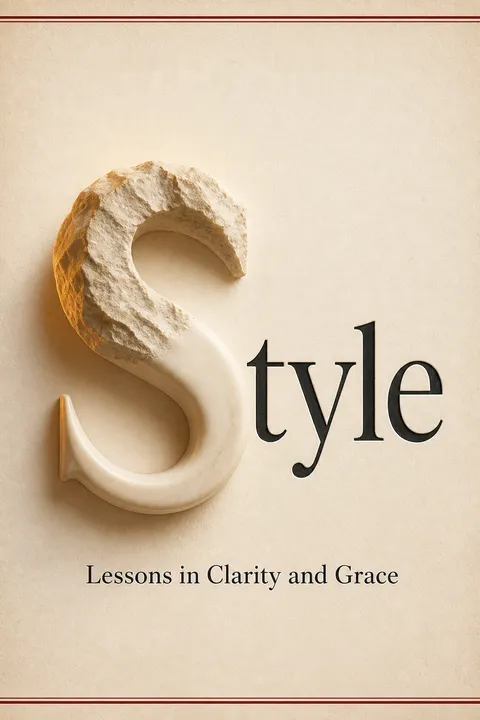

Key Takeaways
1. Understand the Roots of Unclear Writing
The truth will disconcert those of both persuasions. Nostalgic anecdotes aside, the best evidence suggests that students who spend a lot of time studying grammar improve their writing not one bit. In fact, they seem to get worse.
Beyond platitudes. Simply telling writers to "be clear" is like telling a golfer to "hit the ball squarely"—it states the goal but not how to achieve it. Effective writing improvement comes not from rote grammar study, but from understanding the underlying principles of how readers process language.
Historical influences. English prose has been shaped by historical factors that, while enriching its vocabulary, also encourage abstraction and complexity:
- Norman Conquest (1066): Introduced a two-tiered vocabulary (Anglo-Saxon for daily life, French/Latin for institutional/scholarly affairs).
- Renaissance (16th century): Massive borrowing from Greek and Latin, leading to more formal, abstract words.
These influences created a lexical resource but also a temptation to use "inkhorn" terms, contributing to stylistic inflation.
Personal causes. Beyond history, individual writers struggle due to:
- Pretentiousness: Using complex language to make simple ideas seem impressive or to guard knowledge.
- Fear of error: Over-focusing on obscure grammar rules, leading to stilted, cautious prose.
- Cognitive overload: Novices in a new field trying to master new knowledge, thinking styles, and voices simultaneously, often resulting in temporary stylistic regression.
2. Align Characters with Subjects and Actions with Verbs
Readers are likely to feel that they are reading prose that is clear and direct when (1) the subjects of the sentences name the cast of characters, and (2) the verbs that go with those subjects name the crucial actions those characters are part of.
The core of clarity. This is the foundational principle for clear writing. When the grammatical subjects of your sentences name the "characters" (the agents or entities performing actions) and the verbs express the "actions" those characters perform, your prose becomes direct and readable.
Combatting nominalizations. A common culprit for turgid, abstract prose is "nominalization"—turning verbs or adjectives into nouns (e.g., "decide" to "decision," "resist" to "resistance"). This hides the action and often the actor, leading to:
- Abstractness: "There has been an affirmative decision for program termination."
- Excessive prepositional phrases: "An evaluation of the program by us will allow greater efficiency in service to clients."
- Confused logical order: Actions are strung together as nouns, obscuring their sequence.
Simple revision strategy. To revise, identify the true characters and their actions. Make the characters the subjects of your sentences and express their actions as strong, specific verbs. This naturally makes your writing more concrete, concise, and logically ordered, often shortening sentences without sacrificing meaning.
3. Guide Readers with a Predictable Flow of Information
Put at the beginning of a sentence those ideas that you have already mentioned, referred to, or implied, or concepts that you can reasonably assume your reader is already familiar with, and will readily recognize.
The old-new contract. Effective writing guides the reader from familiar ground to new insights. Begin sentences with "old information"—concepts already introduced or easily recognizable—and end them with "new information"—the most significant or surprising details you want to emphasize.
Consistent topic strings. The "topic" of a sentence is its psychological subject, usually found in the first few words. A cohesive passage maintains a "consistent topic string," meaning the topics of consecutive sentences are related, providing a stable point of view for the reader. This prevents prose from feeling disjointed or unfocused.
- Good topic string: "Black holes... A black hole... So much matter..."
- Bad topic string: Random shifts in subjects, forcing the reader to re-orient constantly.
Strategic use of passive voice. While often maligned, the passive voice is crucial for managing information flow. It allows you to:
- Place old information (the object of an active verb) at the beginning of a sentence as the subject.
- Maintain a consistent topic string when the agent is unknown, unimportant, or intentionally deemphasized.
4. Emphasize Key Ideas by Controlling Sentence Endings
When you utter a sentence, your voice naturally rises and falls. When you approach the end, you ordinarily raise your pitch on one of those last few words and stress it a bit more strongly than you do the others.
The power of stress. The end of a sentence, or its "stress" position, is where readers naturally expect to find the most important, new, or climactic information. A sentence that ends weakly or anticlimactically loses its impact.
Techniques for emphasis:
- Trim the end: Remove unnecessary words that dilute the final impact.
- Shift less important information left: Move minor phrases or clauses away from the end to highlight what remains.
- Shift important information right: Re-arrange the sentence to place the crucial idea at the very end.
- Extract and isolate: Break a long sentence into two, placing the key point in its own shorter, emphatic sentence.
Word choice for impact. Different parts of speech carry different weights.
- Light words: Prepositions, light adjectives, and adverbs can weaken an ending.
- Heavy words: Strong verbs and nouns (even nominalizations, when used deliberately for a climactic "thump") create a more emphatic conclusion.
Mastering sentence endings ensures your most significant ideas resonate with the reader.
5. Structure Paragraphs with Clear Issues and Thematic Strings
Whether readers are conscious of it or not, they try to divide units of organized discourse paragraphs, sections, or wholes into two sections: 1. A short opening segment... 2. A longer following segment...
Issue and discussion. Readers instinctively divide any unit of discourse (paragraph, section, document) into two parts:
- The Issue: A short opening segment that acts as an overture, introducing the main topics and themes.
- The Discussion: The longer segment that follows, elaborating, supporting, or qualifying the ideas presented in the issue.
The issue promises; the discussion delivers.
Thematic strings. Beyond consistent topic strings (characters/subjects), cohesive paragraphs also feature "thematic strings"—networks of conceptually related words woven throughout the discussion. These strings provide a sense of focus and conceptual unity.
- Example: A paragraph about "evolution" might have thematic strings for "types of fossils," "actions of surveyors," "actions of species," and "time."
- Problem: "Diffuse strings" occur when a writer uses too many different words for the same concept, making the theme unclear. Avoid "elegant variation" if it sacrifices clarity.
Signaling new themes. Introduce new topic and thematic strings in a predictable location: at the end (the stress position) of the last sentence of the issue. This primes the reader for what's to come, ensuring they frame the conceptual space correctly.
6. Articulate a Clear "POINT" and Place It Strategically
By POINT we mean the specific sentence on the page that the writer would send as a telegram if asked 'What's your point?'
The central claim. Every paragraph, section, and document should have a clear "POINT"—a specific sentence that encapsulates its main claim, observation, or argument. Without it, readers may feel confused or miss the writer's central message.
Strategic placement. The POINT sentence is typically found in one of two predictable locations:
- POINT-early: At the end of the introductory "issue" segment. This is generally preferred in professional writing for efficiency and clarity. The sentences preceding it might provide transition, generalize, or present a claim that the POINT then refines or rejects.
- POINT-last: At the end of the "discussion" segment (the end of the paragraph/document). This is used when the writer wants readers to experience a sense of discovery, build an argument before the conclusion, or follow specific rhetorical conventions (e.g., in some belletristic essays).
Anticipatory points. Even in POINT-last documents, the introductory issue must still offer an "anticipatory POINT" that clearly promises a main POINT to come and introduces the key themes. However, most professional readers prefer POINT-first for directness.
7. Achieve Concision by Eliminating All Forms of Wordiness
Usually, compress what you mean into the fewest words. Don't state what your reader can easily infer.
The essence of concision. Concise writing means expressing your ideas in the fewest possible words without sacrificing clarity or meaning. It's about removing unnecessary words and avoiding stating the obvious.
Common sources of wordiness:
- Redundant pairs: "each and every," "true and accurate."
- Redundant modifiers: "completely finish," "past memories."
- Redundant categories: "pink in color," "round in shape."
- Meaningless modifiers: "kind of," "really," "basically."
- Pompous diction: Replacing formal words with simpler, more common ones (e.g., "utilization" for "use," "endeavor" for "try").
- Belaboring the obvious: Stating facts or truisms that any informed reader already knows.
- Phrases for words: "due to the fact that" for "because," "in the event that" for "if."
Controlling metadiscourse. Metadiscourse (language about your own writing or thinking, e.g., "I believe," "in conclusion") should be used judiciously. Excessive metadiscourse can bury your main ideas and make prose seem indirect.
8. Master Long Sentences for Grace, Not Just Length
But a competent writer must also know how to manage a long sentence gracefully, how to make it as clear and as vigorous as a series of short ones.
Beyond short sentences. While short sentences promote clarity, a relentless series can be monotonous. Skilled writers use longer sentences to convey complex ideas, create rhythm, and add sophistication, without sacrificing readability. The key is structure, not just length.
Techniques for graceful long sentences:
- Coordination: Join grammatically equal segments (clauses, phrases) using conjunctions like "and," "but," "yet," or "or." Place coordinations after the subject to maintain momentum.
- Resumptive modifiers: Repeat a key word near the end of a clause and then elaborate with a relative clause (e.g., "...comedies, comedies that sparkled...").
- Summative modifiers: End a segment with a comma, sum it up in a noun phrase, and continue with a relative clause (e.g., "...zero, a demographic event that...").
- Free modifiers: Add phrases (often starting with -ing, -ed, or an adjective) after the main clause to elaborate on the subject (e.g., "...behavior, forcing his fellow citizens...").
Avoid interruptions. To maintain flow, avoid breaking major grammatical links (subject-verb, verb-object) with long, intrusive phrases or clauses. Place modifiers strategically to prevent ambiguity or hesitation.
9. Elevate Prose with Balance, Rhythm, and Metaphor
Sometimes a touch of class, a flash of elegance, can mark the difference between forgettable Spartan prose and an idea so elegantly expressed that it fixes itself in the mind of your reader.
Beyond mere clarity. While clarity is paramount, elegance adds memorability, zest, and a distinctive voice. It transforms functional prose into something more artful and impactful.
Elements of elegance:
- Balance and symmetry: Consciously counterpoint phrases and clauses, often using correlative conjunctions (e.g., "neither X nor Y," "not only X but also Y"). This creates an architectural symmetry and rhythmic satisfaction.
- Emphasis and rhythm: Control sentence length and endings to create a deliberate cadence. Ending with strong nouns or nominalizations can provide a climactic "thump," as seen in Churchill's speeches.
- Metaphor: Invites readers to see familiar concepts in a new, vivid, and often surprising way. Metaphors can add emotional intensity, illuminate complex ideas, or explain new concepts for which standard language doesn't yet exist.
Caution with elegance. Overuse or careless application of these devices can lead to self-defeating prose, appearing pretentious, monotonous, or even ludicrous. Metaphors, in particular, require careful thought to avoid mixed imagery or inexact thinking.
10. Navigate Grammar and Usage with Informed Choice
If that person can think of no evidence that would change his mind on these matters not history, not the practice of good writers, not the opinion of those who are more informed than he, then we are debating not matters of usage but theology.
Beyond dogmatism. "Good grammar" is not a static, universally agreed-upon set of rules. Many prescriptive rules are linguistic folklore, invented by 18th-century grammarians and often ignored by the best writers. Informed choice, rather than blind adherence, is key to effective usage.
Categories of rules:
- Real Rules: Fundamental to English structure (e.g., subject-verb agreement, basic word order). Violating these marks nonstandard English.
- Folklore: Rules widely taught but consistently ignored by educated writers (e.g., "never begin a sentence with because," "that vs. which for restrictive clauses," "never split an infinitive"). Adhering to these can make prose stiff.
- Optional Rules: Rules that, when observed, signal a higher level of formality (e.g., using "whom" correctly, avoiding ending sentences with prepositions). These are choices for stylistic effect.
- Bêtes Noires: Usage points that provoke irrational ire in some critics (e.g., "like" for "as," "hopefully" as a sentence adverb, "finalize" as a verb). These are often arbitrary and lack historical or logical justification.
Informed decision-making. Understand the historical context and actual usage patterns of reputable writers. Choose to observe rules that enhance clarity or achieve a desired tone, but be prepared to disregard those that are mere folklore, especially if they hinder stylistic flexibility or concision.
People Also Read


Download PDF
Download EPUB
.epub digital book format is ideal for reading ebooks on phones, tablets, and e-readers.








































