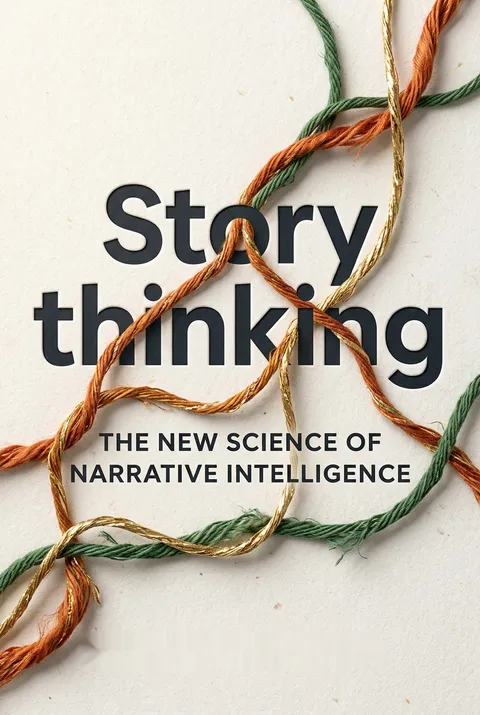

Key Takeaways
1. Storythinking: The Brain's Hidden Intelligence
Story was for thinking.
Beyond communication. For centuries, story has been mistakenly relegated to mere communication—a tool for conveying ideas, not generating them. However, the truth is far more fundamental: story is a core mechanism of human intelligence, predating language and even humans themselves. This "storythinking" or "narrative cognition" is how our brains contemplate "why" and "what if," conjecturing causes to effects and envisioning consequences.
Evolutionary engine. Storythinking dates back hundreds of millions of years to the earliest animal brains, tracing its origins to the creative action inherent in natural selection. It's an imaginatively accelerated form of evolution, allowing our ancestors to mentally model hypotheticals, stick original characters into never-before-seen "storyworlds," and speculate on what happens next. This mental plotting refined Darwinian mechanics into purposeful growth, enabling us to plan better futures and invent everything from republics to rocket ships.
Distinct from logic. Unlike logic, which focuses on stable, high-data environments and timeless truths, storythinking thrives in volatile, low-data environments. It's the intelligence that allows us to strategize in chaos, evolve in doubt, and innovate in the face of uncertainty. Key skills include:
- Prioritizing the exceptional: Focusing on unique events that break patterns.
- Perspective shifting: Imagining actions from another's viewpoint.
- Stoking narrative conflict: Encouraging internal or social battles between asymmetric causes to generate original actions.
2. Logic's Dominance: A Historical Misdirection
The philosopher used reason to think, while the rhetorician used story to communicate.
Ancient severance. Western philosophy, starting with Plato and solidified by Aristotle, severed story from thinking, reducing it to mere rhetoric—a tool for persuasion, not truth. While Aristotle acknowledged story's ability to generate emotion and sway audiences, he ultimately positioned it as distinct from the rigorous thought instrument of logic, which he formalized in his Organon. This split became foundational to Western culture, influencing law, politics, economics, education, and even literary studies.
Philosophy's narrative origin. Ironically, philosophy itself originated in "wisdom literature," which was rich in narrative and focused on the practical question of "how should I live my life?" Early philosophical works, from Sumerian tales to Confucius's Analects, used anthropomorphized characters and plots to explore ethical dilemmas. However, professional philosophy gradually shifted its focus to metaphysics (the search for first principles and ultimate truth) and its method to argument, replacing action with timeless equations and identities.
Socrates's lost intelligence. Aristotle's Topics converted Socrates's literary dialogues into logical dialectic, purging narrative components like character and plot. This deletion, however, eliminated a significant part of Socrates's intelligence, such as his self-irony ("I know that I know nothing"), which is a psychological action (X = NOT X) that cannot be processed by formal logic. By reducing character to communication and thinking to logic, philosophy overlooked the brain's natural power to cogitate in narrative, limiting our capacity for imaginative plotting and experimental expansion of behaviors.
3. The Biological Roots of Narrative Intelligence
Story’s origin goes far deeper than imitation, all the way down to a life-making source of new actions, new actors, and even new worlds.
Beyond imitation. While philosophers like Plato and Aristotle attributed story's origin to imitation, modern science reveals a deeper truth: story's roots lie in the fundamental creative action of life itself. Our brain processes narratives so adeptly not because story is a modern communication method, but because it's an evolutionarily ancient method of thinking, dating back to life's beginnings more than a billion years ago.
The neuron's creative impulse. The evolution of action, from primitive flagella to neurons, gave life the ability to shape its future through experimental flailing and feedback. Neurons, unlike electronic wires, pulse continuously at idiosyncratic frequencies, possessing an "inner impulse" that allows them to initiate activity and pilot their own experiments. This neuronal creativity, the generation of original actions, is a physical operation that can happen without sentience, yet it manifests in our consciousness as storythinking—our brain riffing up new chains of actions.
Synapses: The plotters. The evolution of the synapse, originally a junction between a neuron and a motor cell, enabled neurons to network and affect each other's activity. Synaptic networks generate experimental action scripts, allowing for faster adaptation by discovering new operations for existing anatomies. Our brain's trillions of synapses chain individual actions into causal sequences, enabling us to improvise, test, and revise cognitive narratives, expanding our mental strategies and powering the innovation seen in art, technology, business, and politics.
4. The Limits of Logic and AI
Logic’s limit is that it cannot ever process actions.
The Singularity's flaw. The utopian vision of the Singularity, where mental illness and societal problems are solved by a more logical mind (the computer), rests on the errant belief that intelligence can be reduced to logic. Logic, however, can only compute "what is," not "what could happen." It understands the future as a version of the past, making it effective only in artificially bounded environments with never-changing rules, like board games or mathematical simulations.
AI's fundamental barrier. Computer AI, driven by the same syllogisms (AND/OR/NOT) Aristotle established, cannot react to change, adapt to emergent threats, exploit fresh opportunities, innovate, or grow. This is why AI can defeat humans at chess but cannot write novels, innovate technology, or conduct scientific research—tasks that require planning or processing original actions. Humans will never out-compute computers, making logic-focused education a "double loser" that neglects our brain's main source of intelligence: storythinking.
Action vs. timeless truth. The core reason for AI's failure to "human think" is that logic and story involve different physical mechanisms of intelligence. Logic computes numbers, representations, and symbols, which are timeless. Actions, however, include a cause and its effect, which cannot exist concurrently in logic's "eternal is." When actions are fed into a logical system, they must be rendered into unchanging qualities, effectively "ghosting" their essence of motion. This logical distortion replaces mechanics with semiotics, substituting signification for action, leading to magical thinking where symbols are mystically transubstantiated into causes.
5. Cultivating Storythinking: A Process, Not a Product
To seek one eternal story is to convert narrative into logic, like Aristotle did in Topics.
Campbell's error. Joseph Campbell's influential "Hero's Journey" theory, while popular, made an epic error by seeking "always the one... constant story." This approach converts narrative into logic, chasing the metaphysical dream of ultimate truth (a product) at the expense of story's biological function: creative action (a process). This mistake is common among those who try to reduce movies and novels to timeless story structures, fixed genres, or universal themes.
Refining evolution's core. To become a "story wizard" and escape this evolutionary dead end, we must overturn Campbell's method and search for a better narrative process. This involves refining evolution's two core processes: creation (generating functional variety, or diverse causes) and selection (winnowing that variety). These causes are processes, not static symbols, yielding action, change, and opportunity.
Three ways to improve storythinking:
- Maximizing Creation: Focus on the unique potential of each individual cause.
- Work backward from effects: Imagine a desired outcome, then reverse-engineer an original cause.
- Hybridize causes: Mix and match existing practices and tool uses to generate new actions.
- Maintain an inclusive library: Conserve both successful and unsuccessful tools/tactics, as past "losers" may find their milieu later.
- Honing Selection: Develop a precise sense of the needed result.
- Design tightly controlled experiments: Isolate the effect of each tested action.
- Reject optimization for "good enough": Focus on what's needed, not what's optimal, to maintain flexibility.
- Prioritize second-generation outcomes: Aim for sustainable achievement that balances short-term with long-term success.
- Separating Creation from Selection: Preserve the fruitful antagonism between these two processes.
- Avoid prejudging creations: Don't shape or discard new ideas based on past experiences.
- Never play favorites during selection: Treat storythoughts with ruthless impartiality, allowing them to fight for themselves.
6. Personal Growth Through Narrative Conflict
Growth is born of narrative conflict.
Life's action. Growth is the action of life itself—organic, creative, and unpredictable. While often automatic, it can be accelerated and diversified through conscious planning, which stems from storythinking. John Dewey, a long-lived philosopher, observed that growth fundamentally arises from narrative conflict, a concept he developed by integrating Darwin's evolutionary insights with Hegel's dialectic.
Beyond teleology. Darwin's On the Origin of Species challenged the teleological view that life forms grow into predetermined archetypes, revealing instead a ceaseless process of selecting variants with more potential for variation. Dewey saw in Hegel's idea of growth from conflict a way to invest Darwinian struggle with purpose, not a logical one, but a narrative one. This narrative purpose provides the experience of discovering new possibilities for life activity, stimulating wonder, hope, and meaning.
Three kinds of growth. Dewey's evolutionary ethics reframed conflict from a logical problem into a narrative opportunity for personal growth:
- Physical Growth: Generated by the mind-body conflict, where the mind encourages the body to push beyond its comfort zone, attempting fresh physical narratives.
- Emotional Growth: Occurs when the mind challenges the heart to attempt new behaviors, nurturing mental health and well-being through flexible stories that leverage life's ups and downs.
- Intellectual Growth: Supported by emotional and physical health, this growth expands the brain's range of actions and creative planning by challenging the mind itself, generating fresh behavioral scripts through internal "perspective-shifting" conflicts.
7. Social Growth: Republics Forged by Narrative
Thus it comes about that republics survive better and enjoy good fortune longer than princedoms. Because the diversity of their people allows them to adapt better to the diversity of the times.
Innovation, not timeless rules. Niccolò Machiavelli, exiled and reflecting on ancient Rome, discovered that "innovatori"—inventors of fresh rules for social action—were crucial for societal improvement, challenging the Church's logical insistence on timeless morality. His Conversations with Livy is not a rational inquiry into ideal government but a storywork of stratagems, emphasizing that actions must adapt to the unique contours of each moment. Republics, with their inherent diversity, are better at adapting to changing times than princedoms, which are constrained by unity and fixed rules.
Mutual growth. Social growth, like personal growth, involves an experimental feedback loop, but between storythinking brains. By asking "Why did you do what you did in the past?" without judgment, we access psychological motives, exploring future possibilities neither mind would imagine alone. This process of mutual growth fosters a freedom distinct from classical liberalism's immutable rights; it's a freedom "made" by society through specialization. As individuals specialize, they are liberated from doing everything, creating diverse civic roles and fostering trust.
Narrative conflict as social glue. Counterintuitively, conflict is a source of social cohesion in republics. It's not just fighting against but fighting with others, perpetuating engagement. This conflict, often over specialized social roles and the cherished commodity of freedom, promotes further specialization, pushing individuals to develop unique potentials. Crucially, the destructive force of this conflict is limited because freedoms are mutually interdependent; society has a vested interest in preventing tyranny, ensuring that the struggle maximizes innovation and togetherness. Storythinking communities scale this process, plotting actions more creatively than lone thinkers.
8. Story's Answer: Purpose Beyond Perfection
Our better story, in other words, is one where we concentrate on writing books that help readers imagine more books, on building schools that help students invent new ways of learning, and on engineering technologies that help users pioneer fresh breakthroughs.
The "Why" of existence. The human brain, an engine of planning, eventually confronts the question: "Why are we here? Why keep going?" Traditional answers, often rooted in logic-story fusions like Plato's "Myth of Er" or modern materialist variants like the Singularity, promise eternal bliss or earthly paradise through adherence to fixed rules. However, these logical utopias ultimately lead to boredom because our storythinking synapses crave new challenges and growth, not static perfection.
Beyond happiness. Epicurus's Garden, while aiming for happiness, revealed its limits: brain happiness is a temporary reward for ongoing growth, not an end state. Moreover, turning happiness into a metric is psychologically counterproductive, leading to comparison and discontent. The deeper problem is that logic limits creative action, which is the root driver of our biology. To recover life-sustaining possibilities, we must interrupt the narrowing of story and philosophy that yielded these limiting myths.
Narrative generosity. The ultimate "Why" of human existence, one that resonates biologically with our brain, is to enlarge the stories of outside lives—to expand other people's creative opportunities. This "narrative generosity" or "storygiving" shifts our attention away from counterproductive eternal states and engages us in the worldly action of growing other storythinking minds. This action cannot be weakened by the fear of death, as the story continues beyond us, nor corrupted by self-love, as egoism is channeled into nurturing others' narratives. It provides purpose, energy, and a form of immortality in the temporal flourishing of every life we encounter, echoing George Eliot's idea of "unhistoric acts" that contribute to the "growing good of the world."
Review Summary
Reviews of Storythinking are mixed, averaging 3.57/5. Enthusiastic readers praise it as groundbreaking, celebrating Fletcher's argument that narrative thinking is as vital as logic for human creativity and innovation. Critical readers, however, raise concerns about factual inaccuracies, unclear definitions, and inconsistent reasoning. Some find the writing style engaging yet overly dense, while others consider it inaccessible or poorly structured. Several note the book's central thesis—that Western philosophy has wrongly privileged logic over story—feels familiar, with the practical applications of "storythinking" remaining vague throughout.
People Also Read


Download PDF
Download EPUB
.epub digital book format is ideal for reading ebooks on phones, tablets, and e-readers.








































