


Key Takeaways
See God as love itself, not a suspicious judge tallying your mistakes
The book's foundation is a reframe of God's character. White argues that the great deception is not atheism but a caricature: a severe creditor watching with a jealous eye to catch and punish errors. She insists this portrait is the enemy's slander. Nature testifies otherwise: flowers grow on thistles, birds sing without fear, and rain refreshes the earth without our asking.
Jesus came primarily to correct this misunderstanding. His mission was to make the Father visible, healing whole villages until no sickness remained, weeping over the city that rejected him, never needlessly wounding a sensitive soul. To see Christ's tenderness is to see God's actual character. The starting point of faith, then, is not fear but trust in a love "surpassing a mother's yearning" for her wayward child.
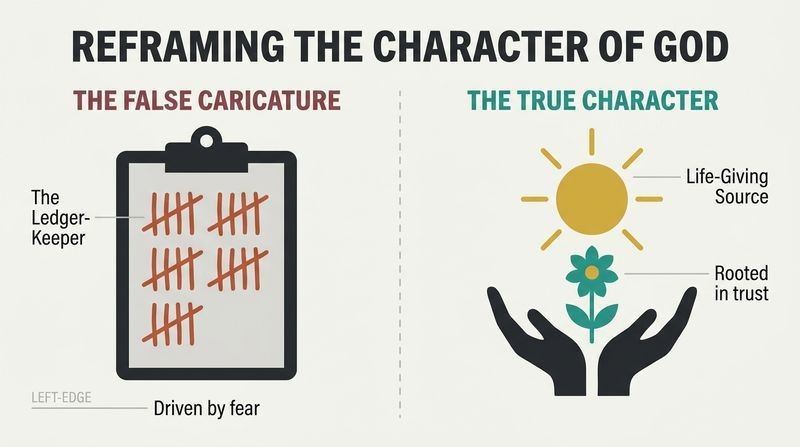
What's striking is how White diagnoses a psychological problem before a theological one. Modern attachment theory echoes this: people who experience a caregiver as capricious or punitive develop anxious or avoidant patterns, and research suggests believers unconsciously project such templates onto the divine. By insisting God's defining attribute is delight rather than surveillance, White anticipates work by psychologists like Tim Keller and Curt Thompson on how a distorted God-image sabotages spiritual growth. The claim is bold and unfalsifiable, of course, but as a reframe it does real work: fear-based religion produces compliance, while love-based religion produces the affection White treats as the engine of transformation.
The cross didn't purchase God's love; his love is what sent the cross
White corrects a common transactional misreading. Many imagine an angry Father appeased only when the Son's sacrifice changed his mind. She flatly rejects this: the atonement was not made to create love in God, but was the outflow of a love that already existed. God gave his Son because he loved the world first, not so that he could begin to.
The suffering was shared, not one-sided. In her telling, the Father suffered alongside the Son at Gethsemane and Calvary; "the heart of Infinite Love paid the price." This reframes redemption from a legal appeasement into a family rescue. The value it places on humanity is enormous: through faith, the subjects of ruin become "sons of God," a phrase White treats as almost too extravagant to believe.

This distinction, that love causes the sacrifice rather than the sacrifice causing love, addresses a genuine tension in atonement theology. Critics of "penal substitution" (the idea that Christ absorbs punishment to satisfy divine justice) have long charged it with depicting a bloodthirsty God. White sidesteps that critique a century before it became fashionable by locating the initiative entirely in love. The move parallels how the Eastern Orthodox tradition frames salvation less as courtroom acquittal and more as healing and reunion. One could push back that she leaves the mechanism (why suffering was necessary at all) somewhat mysterious, but that mystery is arguably the point.
You cannot renovate your own heart; only rebirth from above transforms it
Self-improvement has a ceiling White refuses to ignore. Education, willpower, and culture can polish outward behavior, but they cannot purify "the springs of life." She quotes the stark diagnosis that the natural heart is enmity against God and cannot, by its own effort, become otherwise. The idea that we merely need to develop the good already inside us she calls a "fatal deception."
The only remedy is a new life received, not achieved. Using the image of Jacob's ladder (the dream of stairs connecting earth to heaven), she casts Christ as the sole bridge across the gulf sin created. Paul's cry, "O wretched man that I am," illustrates the honest despair that precedes surrender. The point is not that effort is worthless but that it is powerless at the level of the heart.
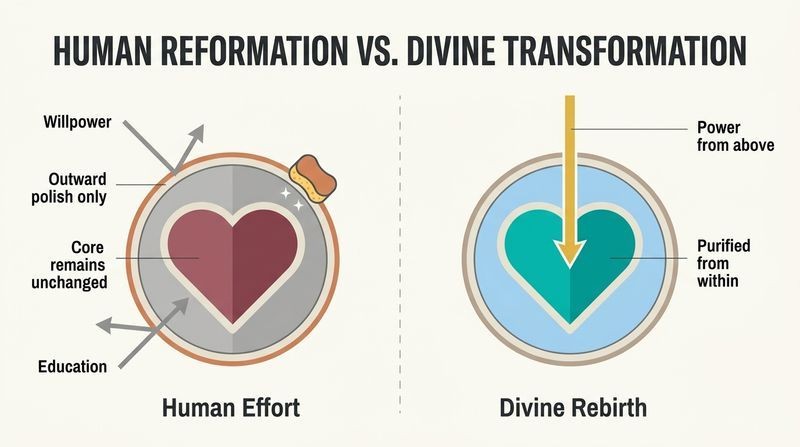
White's skepticism about self-generated change lands surprisingly close to modern behavioral science. Research on "ego depletion" and the limits of willpower (Baumeister and others) shows that white-knuckle self-control is a finite, easily exhausted resource, and that durable change usually requires reshaping identity and environment rather than gritting harder. Her claim that outward correctness can coexist with an unchanged heart also anticipates critiques of moralism found everywhere from psychotherapy to recovery movements like AA, whose first step is admitting powerlessness. The theological wrapper differs, but the structural insight is shared: transformation that starts from within the broken system tends to reproduce the system.
Real repentance grieves the sin itself, not the punishment it triggers
White draws a sharp line most people blur. Countless people feel sorry after wrongdoing, but she argues they usually lament consequences, not the sin. Her case studies: Esau wept over a lost birthright, Balaam confessed only when a sword blocked his path, Pharaoh caved during the plagues then hardened again, and Judas admitted betraying innocent blood but felt only terror, not heartbreak. All regretted outcomes; none abhorred the evil.
Genuine repentance looks like David's. After his fall, David sought not merely to dodge judgment but to be cleansed, praying for a clean heart and the restored joy of holiness. The tell is what you want: escape, or purity. White adds that repentance itself is a gift drawn from Christ, not a prerequisite we manufacture to qualify for him.
The distinction maps neatly onto what social scientists now separate as guilt versus shame, and onto the difference between fearing detection and internalizing values. June Tangney's research suggests guilt ("I did a bad thing") drives reparative behavior, while shame ("I am bad") and pure fear of consequences drive avoidance and defensiveness. White's rogues' gallery, Pharaoh and Judas, are essentially studies in consequence-fear that never matures into moral reorientation. The practical test she offers is diagnostically useful even for secular readers: ask whether you regret the harm or merely the fallout. The former rebuilds character; the latter just recalibrates risk.
Stop waiting to feel worthy; come to Christ exactly as you are, now
White attacks a paralyzing loop. Thousands believe they must first clean themselves up, repent thoroughly, or achieve "holier tempers" before approaching God. She calls this backwards. Since we cannot change our own hearts, waiting to improve first guarantees we never come at all. Repentance is not an obstacle placed between the sinner and the Savior; the drawing power of Christ is what produces repentance in the first place.
The publican beats the Pharisee precisely here. The tax collector who beat his chest and begged for mercy went home justified, while the self-satisfied Pharisee, feeling no need, "received nothing." Pride closes the heart; felt need opens it. She warns against procrastination too: every delay hardens the will and dulls the capacity to yield, making the eventual turning harder, not easier.
There is shrewd psychology in refusing the "get better first" trap. It mirrors the therapeutic principle of radical acceptance: change begins by meeting reality as it is, not as a cleaned-up version. The publican-Pharisee contrast also prefigures research on how self-righteousness blocks growth; people who rate themselves highly moral show less openness to feedback and correction. White's warning about procrastination hardening the will finds a neurological analogue in habit formation, where repeated choices literally strengthen the neural pathways that make them automatic. The counterintuitive move, that unworthiness is the qualification rather than the disqualification, remains the most emotionally liberating idea in the book.
You can't command your feelings, but you can hand over your will
White locates freedom in a single faculty: choice. Many ask despairingly how to surrender when their promises are "ropes of sand," their impulses uncontrollable, their affections divided. Her answer distinguishes what you cannot do from what you can. You cannot directly change your heart or summon the right emotions. But you can choose. The will, "the power of decision," is the governing lever, and it is yours to exercise.
Give God the will, and the rest follows. Once you choose to serve him, God works within you "to will and to do," bringing your whole nature under a new influence. This is why desiring to be a Christian is not enough; White warns that many are lost while merely "hoping and desiring." The decisive act is a definite yielding, renewed daily each morning.
White's elevation of the will over feeling is quietly radical and remarkably durable. It anticipates cognitive-behavioral therapy's core insight that action can precede and reshape emotion rather than waiting on it, captured in the clinical maxim "act your way into feeling." It also resonates with Viktor Frankl's "last of the human freedoms," the power to choose one's stance regardless of circumstance. The daily renewal she prescribes mirrors what habit researchers call recommitment: a decision made once decays, so it must be remade. The potential blind spot is that some readers experience genuine volitional impairment (addiction, depression) where "just choose" oversimplifies, though her insistence that God then supplies the power softens the burden.
Believe you are already forgiven before any feeling confirms it
White borrows Jesus' healing method as a template for faith. She points to the paralytic told to rise and walk. The man could have demanded to feel healed first; instead he believed the word, made the effort, and the power came as he moved. Faith acts on the promise, and the fact follows. Applied to forgiveness: confess, yield, then believe you are cleansed "not because I feel it, but because God has promised."
Feelings are the worst evidence to wait for. Thousands stall here, she says, doubting that God pardons them personally. She frames such doubt as Satan stealing the assurance God freely gives. The prodigal son is her proof: while the wanderer was still far off, the father ran to him. God's disposition toward the returning sinner is not reluctance but eager compassion.
This "act first, feeling follows" sequence is one of the most psychologically sophisticated moves in devotional literature. It inverts the intuitive order (feel, then believe, then act) that keeps anxious people stuck. Behavioral activation, a frontline treatment for depression, works on exactly this principle: patients perform valued actions before motivation arrives, and mood catches up. White essentially prescribes faith as behavioral activation. The vulnerability of the claim is obvious to skeptics, since "believe it and it is so" can shade into wishful thinking. But within her framework the belief is anchored to an external promise rather than to self-generated positivity, which distinguishes it from mere affirmation.
Obedience is faith's natural fruit, never the price tag on salvation
White steers between two ditches. The first error is legalism: trying to become holy by keeping rules, which she says produces only selfishness dressed as virtue. The second is its mirror, the notion that faith frees you to ignore God's law entirely. Both distort the relationship. Her resolution: salvation is a free gift received by faith, and obedience is the fruit that grows from it, the "service and allegiance of love."
The test of discipleship is the habitual direction of a life. Not occasional good deeds, but the settled tendency of one's words and acts. When Christ's righteousness is credited to a believer, that person stands "as if you had not sinned," yet a genuinely changed heart also produces changed behavior. Faith without works, she agrees with James, is dead, but works without faith are merely polished self-interest.
White is threading the needle on the oldest debate in Christian ethics, the relationship between grace and law, faith and works, that split the Reformation. Her formulation (obedience as fruit, not root) is essentially the Protestant consensus articulated with unusual clarity for a lay audience. What's valuable beyond the theology is the behavioral criterion: judge a life by its trajectory, not its highlight reel or its worst moments. That principle is sound psychology; character is better predicted by base rates than by peaks or lapses. A fair challenge is that "habitual tendency" can become a new source of anxious self-monitoring, the very legalism she warns against, if the believer starts auditing every act.
Growth is received like sunlight, not forced by anxious effort
White draws her model of maturity from botany. A flower does not strain to bloom; it turns toward the sun and receives air, light, and rain. A child cannot add to its height by worrying. In the same way, spiritual growth comes not from gritted-teeth striving but from "abiding," the branch drawing life from the vine. Cut off from that source, effort produces nothing; connected, growth is inevitable.
Self-focus is the great saboteur. She identifies a specific trap: sincere people who fixate on their own faults and failures, which paradoxically separates them from Christ, the only source of strength. The counterintuitive sign of real progress is that the closer you draw to Christ, the more flawed you appear to yourself, because your vision is clearer. Feeling worse about yourself can mean you are actually growing.
The claim that heightened awareness of one's flaws signals growth rather than failure is psychologically astute and cuts against naive self-esteem culture. It parallels the Dunning-Kruger dynamic in reverse: competence brings accurate awareness of one's limits, whereas incompetence breeds false confidence. White's warning against ruminating on one's own faults also anticipates clinical findings that self-focused rumination deepens depression rather than resolving it; the therapeutic move is to redirect attention outward. Her botanical passivity has limits, though. Plants do not choose to abide, and elsewhere she insists effort matters. The tension resolves only if "abiding" is itself understood as an active, repeated turning, not genuine passivity.
Serve others to grow spiritually; unused faith atrophies like an idle muscle
White makes service a condition of growth, not a bonus. The Christian who passively absorbs blessings while doing nothing for others is, she says, like someone trying to live by eating without moving; the result is degeneration. Strength comes by exercise. A limb never used loses its power, and so does unexercised faith. The only way to grow in grace is to actively help and bless people who need what you can give.
Ordinary work counts fully. Jesus spent most of his life in a carpenter's shop, she notes, and was as faithful there as when healing the sick. You need not travel to distant lands or possess rare talents; the businessman, the mechanic, and the homemaker all serve God through fidelity in daily work. Even unconscious influence, a kind word to a struggling soul, starts "waves of blessing" whose results you may never see.
The "use it or lose it" model of faith aligns with well-documented findings on prosocial behavior and well-being. Volunteering and generosity reliably predict higher life satisfaction and even lower mortality, a phenomenon researchers call the "helper's high," and self-focused rumination reliably predicts the opposite. White's insistence that mundane vocations carry equal spiritual weight democratizes significance in a way that resonates with Martin Luther's doctrine of vocation and, more recently, with research on meaning showing that perceived contribution matters more than prestige. The one caution is that framing service as necessary for one's own growth risks instrumentalizing others, though White grounds it in love rather than self-optimization, which guards against that distortion.
Doubt's real root is usually the love of sin, not lack of evidence
White reframes intellectual doubt as often a moral posture. She grants that the Bible contains genuine mysteries, the incarnation, the resurrection, the origin of sin, that finite minds cannot fully grasp, and argues this is expected: even a blade of grass baffles the wisest philosopher. Faith, she says, rests on "evidence, not demonstration," and God deliberately leaves room for doubt so that willing hearts find enough light while the unwilling find pretexts.
The honest test is experiential and behavioral. In most cases, she claims, the true driver of skepticism is not unanswered questions but an unwillingness to obey what is already clear. Her prescription: "taste and see." Act on the light you have, do the duty you already understand, and greater clarity follows. Doubt fed by disobedience compounds; doubt met with obedient experiment tends to dissolve.
White's claim that doubt is often motivated rather than purely intellectual is provocative and only partly defensible. On one hand, research on motivated reasoning strongly supports the idea that people reach conclusions their desires favor, then recruit arguments afterward; belief is rarely as dispassionate as it feels. On the other hand, flattening all doubt into disguised sin risks a genetic fallacy and can be pastorally cruel to sincere questioners wrestling with real problems like suffering. The stronger, defensible version is her epistemology: faith operating on sufficient-but-not-coercive evidence, and knowledge advancing through committed practice rather than detached spectating, an idea echoed in William James's "will to believe" and in experiential learning theory.
Gather roses, not thorns: chronic gloom slanders the God you represent
White ends by attacking joyless religion as bad witness. Christians who habitually broadcast their failures, fears, and disappointments give the world a false portrait of God, implying he is a hard taskmaster who begrudges his children happiness. She recounts a dream: walking a garden with a distressed woman who kept pointing at briers while ignoring the flowers. The guide's counsel was simple, leave the thorns, which only wound, and gather the roses.
Speaking doubt multiplies it. Every uttered word of discouragement, she warns, plants a seed in others that may be impossible to counteract, while words of hope brighten struggling souls. The correction of the myth that Jesus never smiled matters here: he was a man of sorrows yet carried "rest and peace, joy and gladness" wherever he went. Rehearse God's mercies, refuse to voice despair, and let gratitude, not grievance, become the habit.
White's insight that expressed emotion is contagious and self-reinforcing anticipates decades of research on emotional contagion and the way rumination spreads through social networks (Christakis and Fowler documented how happiness and misery propagate through friend groups). Her prescription to deliberately rehearse blessings prefigures the gratitude-journaling interventions of positive psychology, which show measurable gains in well-being. The garden dream is a memorable cognitive-reframing device: attention is selective, and what you scan for expands. A fair critique is that the counsel could tip into toxic positivity or suppressed lament, which the Psalms themselves resist. White's framing survives this because she does not deny the thorns exist; she only refuses to let them monopolize the gaze.
Analysis
"Steps to Christ" is a compact devotional (roughly 31,000 words) that functions as a psychological ladder as much as a theological one. Its structure is deliberately sequential: love, need, repentance, confession, consecration, faith, discipleship, growth, service, knowledge, prayer, doubt, and joy. Read as a whole, it is less a doctrinal treatise than a guided reordering of the interior life, moving the reader from a distorted image of God toward a settled, active trust. What distinguishes White within nineteenth-century evangelical writing is her relentless attention to the mechanics of the will and the feelings. She repeatedly separates what a person can control (choice) from what they cannot (emotion, the heart's affections), and builds her entire method on that distinction. This gives the book a surprisingly modern, almost cognitive-behavioral texture: act on the promise, and the feeling follows; yield the will daily, and the nature is reshaped over time. Her insistence that transformation is received rather than manufactured, yet demands active daily recommitment, holds a productive tension that echoes contemporary debates about willpower, identity, and habit.
The book's persuasive power lies in its portraits. Jacob's ladder, the paralytic who walked, the publican and Pharisee, the prodigal's running father, and the garden of thorns and roses are not decorations but arguments, each converting an abstract claim into a memorable image. Its central move, deconstructing the fear-based God-image and replacing it with love, remains its most resonant contribution and its least falsifiable.
The limits are those of its genre and era: it assumes biblical authority, treats doubt as largely moral in origin, and offers little for readers wrestling with suffering as an intellectual problem. Yet as a piece of applied spiritual psychology, its diagnostic clarity about repentance, self-focus, and joyless witness gives it a staying power that explains its translation into more than seventy languages.
Review Summary
Steps to Christ receives overwhelmingly positive reviews, with readers praising its clarity, depth, and ability to inspire spiritual growth. Many find it a timeless classic that offers practical guidance for developing a relationship with Jesus. Readers appreciate its biblical foundation and simple yet profound teachings. Some critics argue it promotes Seventh-day Adventist doctrines, while others find it applicable to all Christians. The book's emphasis on God's love, overcoming doubts, and personal transformation resonates with many readers, who often return to it for renewed inspiration.
People Also Read

FAQ
What's "Steps to Christ" about?
- Spiritual Journey: "Steps to Christ" by Ellen G. White is a guide to understanding the spiritual journey towards a closer relationship with Jesus Christ.
- Christian Living: The book outlines the steps necessary for living a Christian life, emphasizing the importance of faith, repentance, and consecration.
- Practical Guidance: It provides practical advice on how to overcome doubt, grow in faith, and experience the joy of salvation.
- Focus on Jesus: The central theme is the love of God as revealed through Jesus Christ and how individuals can experience this love in their daily lives.
Why should I read "Steps to Christ"?
- Spiritual Growth: The book offers insights into deepening one's spiritual life and understanding the Christian faith more profoundly.
- Practical Advice: It provides practical steps for overcoming personal struggles and living a life aligned with Christian values.
- Inspirational Content: Readers will find inspiration and encouragement to pursue a closer relationship with God.
- Universal Appeal: Although written from a Christian perspective, its themes of love, forgiveness, and personal growth have universal appeal.
What are the key takeaways of "Steps to Christ"?
- God's Love: The book emphasizes God's immense love for humanity and His desire for a personal relationship with each individual.
- Need for Repentance: It highlights the importance of recognizing one's sins and seeking forgiveness through Jesus Christ.
- Faith and Trust: Trusting in God's promises and having faith in His plan are crucial for spiritual growth.
- Prayer and Study: Regular prayer and study of the Scriptures are essential practices for maintaining a strong spiritual life.
How does Ellen G. White describe God's love in "Steps to Christ"?
- Nature and Revelation: God's love is evident in both nature and the Scriptures, showing His care for all creation.
- Sacrifice of Jesus: The ultimate demonstration of God's love is the sacrifice of His Son, Jesus, for the redemption of humanity.
- Personal Relationship: God desires a personal relationship with each person, offering guidance and support through life's challenges.
- Infinite Compassion: God's love is infinite and compassionate, always seeking to uplift and restore individuals to a state of grace.
What is the sinner's need for Christ according to "Steps to Christ"?
- Human Weakness: Humans are inherently weak and unable to resist sin without divine intervention.
- Christ's Role: Jesus Christ is the only source of true strength and redemption, bridging the gap between humanity and God.
- Transformation: Through Christ, individuals can experience a transformation of character and a renewal of spirit.
- Path to Salvation: Accepting Christ is essential for salvation and overcoming the power of sin in one's life.
How does "Steps to Christ" explain the concept of repentance?
- True Repentance: Repentance involves genuine sorrow for sin and a commitment to turn away from it.
- Heartfelt Change: It requires a change of heart and a desire to live in harmony with God's will.
- Role of the Holy Spirit: The Holy Spirit plays a crucial role in awakening the conscience and leading individuals to repentance.
- Continuous Process: Repentance is an ongoing process that deepens one's relationship with God and strengthens faith.
What does "Steps to Christ" say about the importance of prayer?
- Communication with God: Prayer is essential for maintaining a personal connection with God and receiving His guidance.
- Expression of Needs: It allows individuals to express their needs, seek forgiveness, and find comfort in God's presence.
- Strength and Support: Through prayer, believers receive strength and support to overcome life's challenges and temptations.
- Continuous Practice: Regular and sincere prayer is vital for spiritual growth and experiencing God's love more fully.
How does Ellen G. White address doubt in "Steps to Christ"?
- Faith Over Doubt: The book encourages readers to have faith in God's promises, even when faced with doubt and uncertainty.
- Evidence of God's Word: It emphasizes the abundance of evidence supporting the truth of the Scriptures and God's character.
- Personal Experience: Personal experiences of God's love and faithfulness can help dispel doubts and strengthen belief.
- Seeking Understanding: Readers are encouraged to seek understanding through prayer and study, trusting that God will reveal His truth.
What is the role of faith and acceptance in "Steps to Christ"?
- Foundation of Faith: Faith is the foundation of a relationship with God, enabling individuals to accept His love and forgiveness.
- Trust in Promises: Believers are encouraged to trust in God's promises and accept His gift of salvation through Jesus Christ.
- Active Belief: Faith involves actively believing in God's word and living according to His teachings.
- Transformation Through Faith: Acceptance of God's love leads to a transformation of character and a deeper spiritual life.
How does "Steps to Christ" describe the test of discipleship?
- New Creation: True discipleship involves becoming a new creation in Christ, with old habits and desires replaced by new ones.
- Fruits of the Spirit: A genuine disciple will exhibit the fruits of the Spirit, such as love, joy, peace, and patience.
- Obedience and Love: Discipleship is characterized by obedience to God's commandments and a deep love for Him and others.
- Continuous Growth: Being a disciple is a continuous journey of growth and learning, striving to reflect Christ's character.
What are the best quotes from "Steps to Christ" and what do they mean?
- "God is love": This quote encapsulates the central theme of the book, emphasizing that God's nature is rooted in love and compassion.
- "The warfare against self is the greatest battle": It highlights the internal struggle individuals face in surrendering their will to God.
- "Prayer is the opening of the heart to God as to a friend": This quote underscores the personal and intimate nature of prayer.
- "Faith is the hand by which the soul takes hold upon the divine offers of grace and mercy": It illustrates the active role of faith in accepting God's gifts.
How does "Steps to Christ" guide readers in growing up into Christ?
- Spiritual Growth: The book compares spiritual growth to natural growth, emphasizing the need for continuous development in faith.
- Abiding in Christ: It stresses the importance of abiding in Christ, drawing strength and nourishment from Him.
- Daily Consecration: Readers are encouraged to consecrate themselves to God daily, seeking His guidance and strength.
- Transformation Process: Growing up into Christ involves a transformation process, becoming more like Him in character and actions.
About the Author



Download PDF
Download EPUB
.epub digital book format is ideal for reading ebooks on phones, tablets, and e-readers.








































