

Key Takeaways
Stop waiting for a fair world; take full ownership now
The world won't meet your preferences before you act. Emma Grede grew up in Plaistow, East London's poorest district, dyslexic, a parentified eldest daughter raising three sisters, dropping out of fashion school because she couldn't afford it. She still landed on Forbes's richest self-made women list by forty. Her thesis: nobody is coming to rescue you, and blaming men or broken systems, however valid, is not how change happens.
She refuses toxic positivity. Yes, the world is harder for women, people of color, and the poor (she is all three). But she chooses to make equity rather than wait for it. The book's spine is a sequence: clarify your vision, manage your emotions, dismantle inherited "Old Thoughts," then take action.
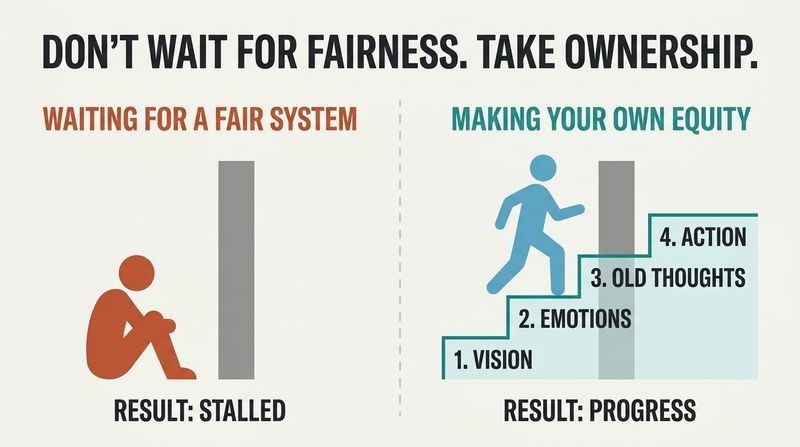
What's striking is how Grede threads self-responsibility without denying structural barriers, a tension many mindset books flatten. Her stance echoes Stoic "dichotomy of control": focus energy only on what you govern. Critics of pure personal-responsibility framing (see sociologist work on structural inequality) would note that agency talk can obscure real constraints. Grede sidesteps this by conceding the barriers explicitly, then arguing that acknowledgment plus action beats acknowledgment plus paralysis. The move resembles Viktor Frankl's insistence that freedom lives in one's response to circumstance, not the circumstance itself.
Draw your future in detail, then reverse-engineer it into weeks
Vision is concrete, not vague dreaming. As a child Grede compulsively sketched a decorated Christmas tree beside a specific console table; twenty years later her first home with her husband matched the drawing detail for detail. She treats these images as signposts, not guarantees, knowing the work would be hers.
Each birthday in September (her personal new year), she writes a vision statement for turning thirty, forty, fifty: how she wants to spend her time and feel, tied to concrete financial goals. She keeps "Emma @ 40" as a phone sticky note reviewed every Sunday. Then she works backward, breaking the vision into yearly, monthly, and weekly chunks. Her annual audit asks brutal questions: why did you miss goals, what are you avoiding, what are you scared of doing?
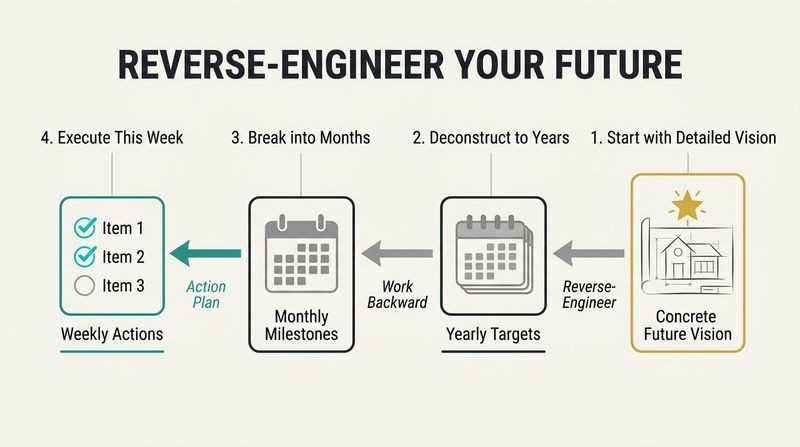
The reverse-engineering method mirrors what psychologists call "backward planning," shown in studies to boost motivation and goal clarity versus forward planning. Grede's emphasis on how she wants to feel, rather than only what she wants to own, aligns with research on affective forecasting: people predict outcomes poorly but predict desired emotional states more usefully. The weekly Sunday review is essentially a lightweight OKR system applied to a life. One caution: rigid visioning can breed tunnel vision, so her insistence that visions are signposts rather than fixed destinations keeps the practice adaptive.
Treat every emotion as data, never as a driver
Feelings inform decisions; they shouldn't make them. After screaming at a deaf woman in a London tube station at nineteen, Grede enrolled in a free three-year anger management course. She learned anger was her default and she could choose otherwise. She maps each emotion to a signal:
1. Anger shows what matters, but must be expressed skillfully, never punching down.
2. Fear signals something important on the other side; if she feels none, she isn't pushing her edge.
3. Guilt is a useful check on integrity only when it comes from your own values, not others' expectations.
4. Sadness invites you inward and is unavoidable.
5. Joy can't be manufactured, only cleared for.
She reframes fear as "challenge stress" or eustress, the racing pulse before something big.
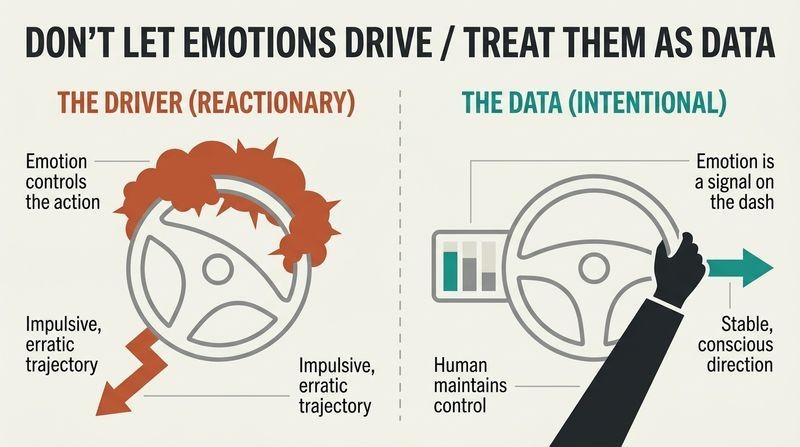
The reframe of fear as excitement has empirical support: Harvard's Alison Wood Brooks found that saying "I am excited" before stressful tasks improves performance more than trying to calm down, because both states share identical arousal physiology. Grede's "Rule of Thirds" (a third good, a third fine, a third rough) is a homespun antidote to the hedonic treadmill and social-media highlight reels. Her insistence that suppressed emotions get "their vengeance" echoes somatic trauma research (van der Kolk). The framework's weakness is that emotional regulation this fluent often requires resources (therapy, time) she acknowledges she initially lacked.
Say you're proud, not grateful, for what you built
Gratitude credits an external source; pride claims your agency. Asked on TV if she felt grateful for her success, Grede bristled: she felt proud, because she earned it. She cites psychologists Emmons and McCullough, who define gratitude as recognizing a positive outcome AND its external source. For achievements you drove, the honest word is proud.
Women, she argues, chronically speak in passive voice: this job was given to me, this brand took off because someone posted it. That disowns power. She invokes Snoop Dogg thanking himself at his Hollywood Star ceremony. She also rejects "empowering women" language, since it implies women lack power to begin with. Better verbs: stand behind, resource, fund, recommend, protect.
The distinction is sharper than it first appears. Gratitude research (Emmons) genuinely links thankfulness to wellbeing, so Grede isn't dismissing it; she keeps a gratitude practice for things others gave her. Her point is attributional: chronic external attribution of one's own wins correlates with what psychologists call an external locus of control, associated with lower persistence and learned helplessness. Yet the counter-nuance matters too, self-attribution can curdle into hubris and blindness to luck, which behavioral economists (see Robert Frank's "Success and Luck") warn against. Grede threads it by rejecting the "self-made" myth while still owning her trajectory.
You can have it all, just never all at once
Trade-offs are unavoidable choices, not failures. Grede replaces the either/or fantasy with both/and, which requires anticipating and pre-deciding what gives. Michelle Obama told her: you can have it all over time, in chapters, but not in a single sitting. Grede plans trade-offs in advance so guilt doesn't ambush her. She skips school emails and birthday crowns, does a maximum of three focused hours as a "mum," and refuses to parent her husband.
She borrows Ellen Langer's finding that there is no "right decision"; effective people make a decision, then make it right. Barry Schwartz's research shows more options and more deliberation decrease happiness and increase regret. Phil Stutz adds: the best leaders make the most decisions, not the best ones, building intuition through volume.
The "satisfice" concept Grede leans on comes from Nobel laureate Herbert Simon, who distinguished maximizers (who exhaustively seek the best) from satisficers (who take good-enough), with later work by Schwartz showing maximizers are measurably less happy. Grede's decision-by-volume philosophy aligns with research on expert intuition (Gary Klein, and Sunita Sah's "expert intuition"), which requires many repetitions in environments with fast feedback. Her honesty that "having it all" is a cultural trap is refreshingly countercultural, though privilege (two nannies, a devoted co-parent) makes her particular trade-offs gentler than most readers face, which she admits.
Talk about money constantly; silence is how it passes women by
Money is a neutral tool women are trained to find inelegant. Grede cannot get titan female podcast guests to discuss capital raises, compensation, or cap tables, while male founder Michael Rubin answered every money question with glee. Women get only 3% of VC funding, and she argues part of the fix is refusing to hide business ambition behind "doing good for the world."
Her approach is exposure therapy: face money, discuss it, research comps, share deal details others hide. She learned careful stewardship from her mother budgeting at the kitchen table, and still knows the price of milk and lettuce, which makes her a formidable merchant. Money, she insists, solves all your money problems, buying freedom, space, and optionality, even if it solves nothing emotional.
The 3% VC figure (elsewhere she cites 2% to all-female teams) is well-documented and structural, not merely attitudinal, so critics rightly note that female reticence about money is a symptom as much as a cause. But Grede's behavioral prescription has teeth: salary transparency research (see studies following pay-disclosure laws) shows openness measurably narrows gender pay gaps. Her framing of money-talk as exposure therapy borrows sound clinical logic, repeated, graded exposure reduces avoidance. The provocative claim that hiding profit motives behind social good "disserves" women challenges the ESG-washing common in female-founder marketing, a genuinely contrarian and useful jolt.
Scarcity is a magic trick; abundance is the truth
If you get more, someone else does not lose. At the fashion production company, two bosses pitted Grede and a colleague against each other for praise and plum jobs. Grede simply proposed they alternate assignments, breaking the spell. She saw scarcity was manufactured for the owners' amusement, and it hurt the business.
Women, she observes, are quickest to assume the short end of the stick is theirs. Her female team leaders return pay-raise budgets bent out of shape on their teams' behalf; her male leaders just distribute and move on. Men see "if him, why not me?"; women think "if I take that, I take it from her." She cites Lynne Twist: believing there isn't enough means accepting that someone must go without. She advocates advocating for yourself first, since money is not relational.
Grede's observation maps onto experimental economics: women negotiate less aggressively for themselves but equally or more effectively for others (Linda Babcock's "Women Don't Ask" and follow-on studies confirm this relational asymmetry). Her reframe, that a peer's compensation is "literally none of your business," is a practical debiasing tool against social-comparison anxiety, which Festinger's comparison theory predicts intensifies when reference groups are similar. The nuance she underplays: in genuinely zero-sum contexts (a fixed bonus pool), scarcity isn't illusory. Her deeper point holds, though, that treating one's market value as relative rather than absolute reliably suppresses women's earnings.
Nobody knows what they're doing; your only job is figuring it out
Imposter feelings are universal, so transform anxiety into curiosity. On Good American's launch day, investors called Grede a genius at 9am and a not-fit-for-purpose idiot by 11am. She sold a million dollars of jeans in two hours, then had no fabric and no factory space for twelve weeks because she didn't know the business. She personally emailed every disappointed customer, who became the brand's fiercest advocates.
She offered nine SKUs in an unprecedented size range (00 to 24), teaching herself denim in Vernon factories. Her lesson: people don't buy when they understand you, they buy when they feel understood. Michelle Obama's secret about every powerful table she's sat at: "They are not that smart." Curiosity, humility, and a refusal to be complacent are the only durable competencies.
The 9am-to-11am whiplash is a vivid case study in what Carol Dweck calls the growth mindset, which Grede explicitly invokes via the George Dantzig anecdote (a student who solved two "unsolvable" problems because he mistook them for homework, not knowing they were impossible). The deeper insight, buy when they feel understood, anticipates Jobs-to-be-Done theory and Brené Brown's work on belonging. Grede's dyslexia reframe is notable: she treats a learning difference as a distillation superpower, consistent with emerging research on dyslexic strengths in big-picture pattern recognition (see Eide & Eide, "The Dyslexic Advantage").
Marketing is the cherry on the icing, not the cake
Product and price come first; marketing can't rescue a broken core. Grede watched London designers win glowing Vogue coverage yet never break 2 million pounds because they obsessed over runway shows, not merchandising or distribution. A beautiful brand with wrong pricing, weak distribution, and no product-market fit will never fly, and pouring money into marketing is filling a leaky colander.
She obsesses over pricing psychology: a capri priced at 129 dollars fails because customers mentally file capris near shorts, not jeans. She insists on a "hero" retailer strategy (Nordstrom's 167 doors beats scattered boutiques), studies competitors obsessively (she knows Levi's pricing better than her own), and champions the 1% details, the exact rivet color, the four-piece waistband. In most healthy businesses, 90% of revenue comes from 10% of SKUs.
Grede's hierarchy (product, price, distribution, then marketing) inverts the founder instinct celebrated by social media and aligns with Peter Drucker's dictum that the aim of marketing is to make selling superfluous through a product that sells itself. Her competitor-obsession runs against the common "stay in your lane, ignore rivals" advice, and she's right: ignorance of the competitive set is a documented predictor of startup failure. The 90/10 SKU concentration echoes the Pareto principle. One tension: her disdain for founder-as-face marketing may underweight how, in creator-economy categories, personal brand genuinely IS product-market fit, a shift she acknowledges is new and unsettled.
Look for shortcuts relentlessly; suffering earns no extra credit
Standing on someone's shoulders is smart, not cheating. Launching Off Season with Kristin Juszczyk, Grede didn't build sports-licensing infrastructure from scratch. She brought in Michael Rubin, whose Fanatics spent fifteen years mastering league deals and holds 220 million customers and twenty million emails, an acceleration point money can't buy. Give away equity for manifold gains rather than owning 100% of nothing.
She invokes the Hendricks' "Zone of Genius": the thing that comes so naturally you take it for granted and assume it isn't a real gift. Most people waste life in their Zone of Excellence (good but not best) or try to fix their Zone of Incompetence (a fool's errand). A cookie baker who dreams of a 6,000-square-foot experiential space is abandoning her hero product for a business she knows nothing about.
The Zone of Genius framework (from Gay Hendricks's "The Big Leap") pairs neatly with the economic principle of comparative advantage: value is maximized by specializing where your relative productivity is highest and trading for the rest, rather than doing everything adequately. Grede's equity-sharing logic is textbook Reid Hoffman network theory, distribution and reach compound faster than solo bootstrapping. The provocation worth sitting with is her attack on the martyrdom bias, the belief that difficulty validates worth, which behavioral science links to effort justification (Aronson). Struggle can be a signal you're avoiding a shortcut, not proof of virtue.
Trade your employee mentality for holding the vision
Stop inventing bosses to subordinate yourself to. At her first board meeting in her own office, Grede sweated and sought the board's approval like an employee. Her husband diagnosed it: "You have an employee mentality." No one in that room was her boss; they awaited her direction. She noticed women in her own meetings assume they're being fired when called in, while men saunter in asking "What's up?"
Leadership, per Jim Collins's Level 5 model, blends personal humility with fierce professional ambition. Grede's philosophy: paint and reinforce the vision, practice radical honesty (she skips exit interviews because people should speak up in the moment), hire people better than herself and get out of their way, and operate an "enterprise mentality," serving the business's good over any individual's, including her ego.
The employee-mentality reframe surfaces a subtle cognitive trap: people with a lifetime of being managed internalize an external authority even after gaining autonomy, a pattern resembling learned helplessness transplanted into leadership. Grede's hiring-people-smarter-than-you principle echoes David Ogilvy's "nesting dolls" maxim and is validated by research on psychological safety (Amy Edmondson), teams thrive when leaders admit ignorance. Her rejection of likability as a leadership goal, in favor of consistency and honesty, aligns with findings that trustworthiness and predictability outperform warmth for effective authority. The enterprise mentality has a shadow she names honestly: layoffs, collateral damage, and the loneliness of decisions that displease people you care about.
Treat DEI as a business edge, not corporate charity
Serving the underserved is a growth engine, not virtue signaling. Grede built Good American on inclusivity because a huge market, women above a US size 12, had no stylish options; retailers had made an unspoken pact to banish them to a separate floor with ugly clothes. She made every product in every size (00 to 24) and let the customer decide. Nordstrom then told every other brand to copy the size range; some luxury houses now attribute 10-15% of profits to added sizes.
Inclusivity isn't why people buy, she stresses; they buy because the jeans make their butts look good. She reframes diversity as commercial common sense: to sell to a diverse culture you need diverse decision-makers in the room. She urges Black founders to build for everyone, since "everyone" is a bigger market than any identity group.
Grede's business case for diversity is empirically buttressed, McKinsey's diversity reports repeatedly correlate diverse leadership with above-median profitability, though correlation-causation debates persist. Her sharper, more contrarian claim is that framing DEI as social responsibility rather than business responsibility actually weakens it, because charity is discretionary and cut in downturns (as the 2023-24 DEI rollbacks demonstrated), while a profit driver is structural. The insight that consumers rarely buy on values alone is supported by the well-documented "intention-action gap" in ethical consumption. Her counsel to Black founders to build broad markets is pragmatic, though some would argue category-specific brands can also scale to acquisition, as Mielle Organics did.
Analysis
Emma Grede's "Start With Yourself" is a business-memoir hybrid structured as a deliberate four-part escalation: vision, emotional regulation, dismantling inherited "Old Thoughts," and action. This architecture is its cleverest move, refusing the genre's usual leap straight to tactics and insisting that mindset and emotional hygiene precede strategy. The book's authority derives from an unusually credible rags-to-riches arc: a dyslexic, parentified, mixed-race girl from Britain's poorest postcode who co-built SKIMS, Good American, and Off Season.
What distinguishes it from adjacent titles (Sandberg's "Lean In," Sara Blakely mythology) is Grede's refusal of both toxic positivity and grievance politics. She concedes structural bias explicitly, then argues, controversially, that waiting for equity is strategically inferior to manufacturing it. This is the book's live wire and its vulnerability. Her personal-responsibility gospel is repeatedly softened by candid admissions of privilege (two nannies, a devoted co-parent, factoring facilities), which is intellectually honest but occasionally undercuts the universality of the prescriptions.
The strongest through-line is money: Grede diagnoses female reticence about capital as both symptom and cause of the 3% VC gap, and prescribes exposure therapy, transparency, and the deliberate separation of profit-seeking from social-good storytelling. This directly challenges the ESG-washing endemic to female-founder marketing and is her most transformative contribution.
Her operational chapters (product before marketing, hero-retailer distribution, the 90/10 SKU rule, obsessive competitor study, shortcut-seeking) are unusually concrete for a mindset book, reflecting genuine merchant expertise rather than platitude.
Weaknesses: the reliance on podcast-guest quotations (Obama, Cuban, Hobson, Rubin) sometimes substitutes celebrity for evidence, and the emotional-regulation claims rest on lived experience more than rigor. Still, the fusion of street-forged pragmatism, denim-margin specificity, and unapologetic ambition makes it a distinctive, useful, and refreshingly honest entry in women's business literature.
People Also Read









Download PDF
Download EPUB
.epub digital book format is ideal for reading ebooks on phones, tablets, and e-readers.








































