
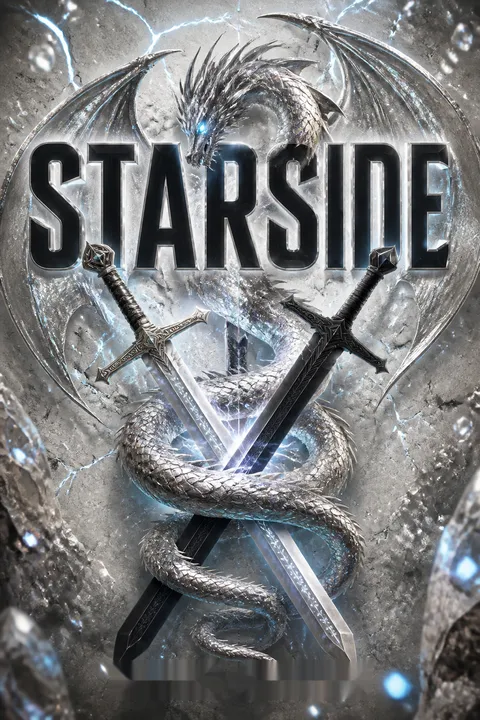


Plot Summary
Ten Minutes of Blood
Aris,1 a half-starved blacksmith's apprentice, hides a Starside steel dagger up her sleeve and shoulders through a bloodthirsty crowd at Nightfell. To qualify for the Questral, the once-in-fifty-years pilgrimage into the immortals' land, she must reach a black stone platform before a silver hawk finishes ten timed cries.
She shields a doomed starving boy, shatters a king's guard's silver sword with her superior blade, severs a groping man's hands, and survives the towering Pagnus Ender's contempt. When the Watchman crowns her with ash, she says yes. But Aris1 is not chasing the goblet of magic everyone craves. She means to cross the gates and kill the gods, beginning with the silver-eyed goddess16 who burned her family alive when she was ten.
The opening fuses spectacle with interiority, establishing a world where sanctioned murder is entertainment and scarcity has hardened mercy into liability. Aris weaponizes underestimation: her smallness, her hidden blade, her performed meekness. Aster frames vengeance not as heroism but as a private engine, separating Aris from the magic-seekers around her. The Questral's brutal arithmetic (fifty spots, hundreds dead) literalizes a society that devours its poor for the powerful's profit. Crucially, the reveal of her true goal reframes everything retroactively: this is not a girl seeking salvation but one carrying a buried inferno, choosing self-destruction with eyes open. The phoenix motif, grief transmuted into purpose, is seeded immediately.
The Blacksmith on the Floor
Stellan,3 the gruff smith who pulled orphaned Aris1 from the gutter and taught her to forge and fight, had begged her not to volunteer. After they quarrel, she returns home to find him bleeding out on the floorboards, his prized Starside steel dagger stolen from its scabbard.
With his last breath he urges her to find someone called Vander Evren,7 then folds her own copper blade toward his heart, asking her to end him before the thief returns. She cannot. He dies cursing her tenderness. Hollowed by guilt at having left him alone, Aris1 swears to hunt whoever did this and use everything he made of her. She boards the cart east toward the king's9 castle, leaving her village a smudge of ash behind her.
Stellan embodies the only love Aris allows herself, and his loss converts abstract vengeance into personal debt. The scene weaponizes guilt: she blames her absence, layering a fresh wound atop her family's death. His dying instruction (find Vander Evren) plants the narrative's long-game mystery, a name that will recur as both threat and salvation. His inability to extract her mercy, even when mercy means killing him, demonstrates the central tension between Aris's hardness and her stubborn compassion. The stolen dagger also functions structurally, marking an unseen antagonist whose identity becomes a delayed reveal. Aster makes the inciting trauma double: a girl who lost everyone, now loses the one who taught her to rise.
The Race to the Gates
At the king's9 castle, Aris1 refuses to swear half her future magic for a royal blade. The Culling then becomes a lethal footrace: a thorn labyrinth that snaps shut like jaws, a graveyard where ancient swords hang in the branches, and a stampede of horned oryx. Cornered, Cadoc Bolter,6 the gold-armored House heir, reveals he murdered Stellan3 and stole the dagger, and raises it to gloat.
In pure desperation Aris1 reaches out, and an ancient Starside steel sword erupts from a grave into her palm, shattering Cadoc's6 blade in a burst of starlight. On the final bridge, she smears beast blood to mask her scent, and Zane5 shoves a rival off the edge to win her the last place. Aris1 becomes one of the Fifty crossing into glittering, deadly Starside.
The Culling externalizes the book's thesis that survival rewards resourcefulness over inherited power. Each trial maps onto a social truth: the maze of bureaucratic cruelty, the graveyard of stolen legacies, the stampede of indiscriminate violence. Cadoc's confession crystallizes the personal antagonist, giving Aris a human face for her rage even as gods loom larger. The grave-born sword is the pivotal mythic gift, a weapon that chooses her, suggesting destiny entangled with merit. Notably, her ascendancy depends on alliance (Zane's sacrifice), undercutting the lone-wolf fantasy. The blood-masking trick rewards her scavenger's intelligence, the kind of survival literacy the privileged challengers lack, foreshadowing how cleverness, not strength, will carry her.
The Scholar's Dissection Table
A violet-eyed scholar named Pelas13 lures Aris,1 Kira,4 and Zane5 to the Tower of Knowledge, feigning curiosity about mortals. Overhearing his plan to poison and cut them open while their blood still flows, Aris1 steals his key-quill, slips into the forbidden library at dawn, and discovers a complete map drawn by a past Questral survivor.
When the scholars corner her, she slashes through magic-soaked books, unleashing smoke, fire, and chaos, and rips the map free. At the door, the elder scholar Ellis lowers his blade and lets her pass, his gaze snagging on the silver markings beneath her torn sleeve and showing no surprise whatsoever. Fleeing into the morning, Aris1 is disturbed less by the dissection plot than by the immortal's calm recognition of what she is.
The tower satirizes intellectual privilege: immortals who study mortals as specimens, hoarding knowledge as the gods hoard magic. Pelas's condescension (writing IDIOTS in his notes) lets Aris weaponize being underestimated again, a recurring survival strategy. The stolen map becomes her literal and figurative advantage, knowledge as power in a world where information was deliberately erased. Most resonant is Ellis's unsurprised glimpse of her silver markings, the forbidden color of gods. It introduces the central mystery of her body: that her secret may be legible to those who understand the prophecy. Aster suggests that the truly dangerous knowledge is not in books but in what Aris unknowingly carries in her own skin.
The Boat and the River
At walled Westwere, a former knight turned innkeeper named Xara8 shelters the travelers, feeds them, and warns that the God of Death's demons hunt by night. She lends a self-sailing boat and explains the Beast Tree, where winged creatures can be claimed by those who leap and survive. On the river a savage storm splinters the boat against rocks; Kira4 dives after her faeling-made sword and her leg is shredded.
Knowing she cannot go on, Kira4 makes Aris1 swear to carry a cup of magic back to her dying little sister, Anise, and lets herself drift home in the boat toward Xara.8 As the current pulls Kira4 away, Aris1 relives the night she lost her own sister, the wound that drives every step she takes.
Xara complicates the mortal-immortal binary: not every immortal is a predator, and kindness, she argues, is a choice in a rotting world. Her trust of metal over people gives Aris a moral counterweight to Raker's coming nihilism. Kira's departure is the first of the friendship sacrifices that structure Aris's grief arc, and her dying request (save Anise) externalizes Aris's failure to save her own sister, offering a redemptive proxy. The parallel sisters, one lost, one possibly saveable, becomes a quiet emotional spine. Aster also seeds worldbuilding economically here: night demons, beast-claiming, godswords, all delivered through hospitality rather than exposition dump, making the lore feel earned and lived-in.
The Leap of Faith
Aris1 and Zane5 climb the mountainous Beast Tree, where seekers fling themselves from the crown hoping a winged creature catches them before stone does. Cadoc's6 archers murder freshly bonded riders to steal their dragons, scattering everyone.
Separated from Zane,5 who dives back for his fallen ax, Aris1 hurls herself off the edge, and a wounded silver dragon15 scaled like melted moonlight rises to save her. They bond instantly, and the creature begins teaching her to wield her crushingly heavy blade with its tail.
But Cadoc6 returns on a fire-breathing dragon and pierces her dragon's wing. To spare her injured companion, Aris1 orders it to flee and draws the hunters toward herself, vanishing alone into a forest Cadoc's6 men set ablaze at nightfall.
The leap literalizes faith and surrender, the opposite of Aris's iron control, and her reward is the first creature to choose her for who she is, silver to silver. The dragon doubles as mirror: wounded, flameless, needing her as she needs it, a relationship of mutual repair rather than dominance. Cadoc's strategy of killing the bonded to inherit their power restates the world's predatory logic of theft over earning. Aris's choice to send the dragon away, sacrificing advantage to protect a creature she barely knows, reaffirms the compassion that both endangers and defines her. The burning forest closes the section on her oldest terror, fire, pulling her toward the next pivotal encounter under threat.
Bargaining With the Devil
Fleeing into a cliffside cave, Aris1 collides with Harlan Raker,2 the masked, hooded head of the king's9 guard whose flawless armor proves no blade has ever touched him. She has loathed him for years, ever since he refused her mercy on a rainy day. Desperate and surrounded by enemies, she proposes they travel together.
When he threatens to kill her and take her memorized map, she burns the parchment before his eyes, making the knowledge in her head the only thing keeping her alive. He accepts with cold contempt and a list of conditions. That night, a demon wearing her dead sister's face lures her from the cave; Raker2 hauls her back, and they shelter on a lake island the night creatures cannot cross.
This is the enemies-to-allies hinge, built on leverage rather than affection: Aris turns her own life into a hostage by destroying the map. Raker arrives as pure antagonist energy, the embodiment of the king's guard she was raised to fear, yet their mutual need forces proximity. The demon wearing her sister's face is psychologically precise, predation that targets grief and longing, and Aris's near-fatal pursuit reveals how unhealed loss makes her exploitable. Raker's reluctant rescue, contemptuous yet effective, establishes the pattern of their dynamic: he saves her body while wounding her pride. Aster sets up a slow excavation, the mask as literal and emotional barrier, the burned map as trust withheld on both sides.
Figure It Out
Raker2 drives a brutal pace through the Prism Pass, a land of green mountains and rainbow waterfalls, refusing to carry or comfort her. He kills a gentle, flower-crowned elk for meat, insisting everything dies. When the world rots into blood-red rivers, a godsword-wielding immortal captures Aris1 to feed her to the God of Death, puppeting her body with his glowing blade until she breaks free and slaughters his band.
Shaken that she nearly died, Raker2 finally begins training her, drilling stances for hours, then feeding her by hand when hunger weakens them both. Slowly, between insults, the wall between them cracks. She learns her blade is no ordinary steel, and that the gods themselves covet such weapons, a clue she does not yet understand.
The Prism Pass stages beauty and brutality as inseparable, the book's recurring argument that wonder and danger share one face. Raker's mantra (figure it out) is cruelty that doubles as pedagogy, forcing Aris to discover reserves of strength she would not access if rescued. The godsword immortal introduces the concept of weapons that command flesh, escalating the stakes and seeding the revelation of what Aris truly carries. His invocation of the God of Death plants the hunting-god threat. The shift from withholding to feeding her, small acts of care smuggled inside contempt, marks the relationship's thaw. Aster builds intimacy through endurance rather than dialogue, the lovers learning each other through shared deprivation and the rhythm of the blade.
A Memory for Passage
Driven into the Bone Woods' silencing mist, Aris1 meets the Gardener,12 an eons-old creature of bone who reads her mind, spares her in exchange for a treasured memory, and warns that the name Vander Evren7 is a perilous summons. Saberwolves then run her down until Raker2 tears through the fog and shreds the entire pack one-handed, sheltering her against his body, before flatly admitting he keeps her alive only for her sword.
In the skyquill forest beyond, a magic-eating steelclaw bear nearly kills her until an immortal hunter fells it with a massive crossbow. The hunter trades them swift passage on a skyhorse for saberwolf fangs, confirms her blade hums with stolen power, and speaks of Vander Evren7 with open dread.
The Gardener literalizes the cost of survival: Aris must surrender a piece of her happiness, the very memories that keep her dead family alive in her mind. It is a devastating bargain that asks whether vengeance is worth eroding love itself. Raker's one-handed slaughter displays godlike capability while his cold admission (he wants her sword) reasserts the transactional frame, even as his shielding body says otherwise, the gap between his words and actions widening. The hunter introduces the ethics of predation, a code among killers, and recurs the Vander Evren mystery alongside confirmation that her weapon is magical. Aster threads three encounters into one movement about what beings extract from the vulnerable, and what they choose to give.
Go Home, Aris
At a ruined lake castle, Raker2 turns cruel, refusing to train her further and ordering her to abandon her sword and crawl back to the gates. Stung, Aris1 flees alone through the Storm Woods, surviving wind serpents that rip trees apart and an eyeless, screaming spectre she defeats by clinging to a happy memory.
The archer Valen14 ambushes her for a reward, confessing that the God of Death has placed a bounty on both Aris1 and Raker,2 with an immortal cavalry already hunting them. Aris1 spares and heals the dying Valen,14 then races back to warn the very man who discarded her. Reaching him as the cavalry closes in, she grasps the truth: it is the gods themselves, not lords, who crave their two swords.
Raker's rejection is self-protective sabotage, pushing away the person breaching his defenses, a pattern the reader now recognizes beneath his cruelty. Aris's solo trek proves her training has taken root: she conquers the storm and the grief-feeding spectre using the same memory-anchoring she will need at the climax. Valen's bounty revelation reframes the entire quest, the hunted become the hunted, and the gods' specific interest in their swords escalates the mystery toward its answer. Most telling is Aris's choice to heal an enemy and return for a man who abandoned her, mercy as compulsion rather than calculation. Her loyalty, even unearned, becomes the moral counterpoint to a world that rewards betrayal.
In the Dark Together
Escaping the cavalry, Raker2 leads Aris1 into pitch-black mountain tunnels, where her terror of darkness nearly undoes her until his steady hand guides her through and she steadies herself with cherished memories. A fire demon ambushes them, feeding on desire to make them open their eyes and burn.
Pressed together in the dark, hands roaming beneath armor and torn fabric, they nearly surrender to a hunger neither will name, until Raker2 beheads the creature and shoves her away, snarling that the moment meant nothing.
Humiliated and aching, Aris1 masks her hurt with fury. The encounter leaves a charged, dangerous current between them, an admission disguised as an accident, proof that the loathing they wield like armor has begun curdling into something far more perilous.
The fire demon is a clever externalization of repressed desire, making the lovers' attraction a survival threat that demands suppression. Darkness, Aris's deepest fear, becomes the only place they can touch, the safety of being unseen permitting honesty the daylight forbids. Raker's violent withdrawal afterward, insisting it was nothing, is the same defensive sabotage as the castle rejection, intimacy followed immediately by retreat. The scene advances the romance through plausible deniability: neither must own what the demon supposedly compelled. Aster uses the supernatural to bypass the characters' defenses while preserving their pride, a structural elegance that lets desire surface without surrender. The current that lingers signals the point of no emotional return approaching.
The Silver Woman's Path
In a corpse-filled bog, skelmires drag Aris1 under; she and Raker2 fight back to back, learning to kill the creatures by tearing the gems from their chests. Poisoned, starved, and collapsing, Aris1 is visited by the Astral Queen,10 a glowing silver woman who lays a glittering road through the forest before vanishing.
The path leads to the hidden Traveling City of the faelings, where sisters Este11 and Gallie heal the travelers. Their blacksmith reveals the staggering truth about her weapon: it is a godsword, forged of paladian, the rarest metal, once wielded by a god. That is why the gods hunt her, and why everyone who glimpses the blade is compelled, helplessly, to try to claim it.
The Astral Queen, helping a mortal for the first time in centuries, signals Aris's cosmic significance and aligns her with forces older than the gods she hunts, recasting her revenge as something prophesied rather than merely personal. The Traveling City offers a rare pause of beauty and care, a glimpse of the life Aris could want, sharpening the tragedy of her death-wish purpose. The godsword revelation is the structural keystone: it retroactively explains the bounty, the magnetic pull others feel toward the blade, and the gods' fear. Aster pays off chapters of seeded clues at once. The faelings' chosen complicity, surviving by not meddling, also poses the book's ethical question about neutrality in the face of tyranny.
When the Light Shattered
Armed with a faeling necklace of starlight that wards off night demons, Aris1 and Raker2 join a band of immortals searching for the Traveling City. When a child stumbles and shatters their protective orb, darkness erupts with demons that tear the pilgrims apart, including a kind young woman named Daphne who had befriended Aris.1
Raker2 pins Aris1 against a cliff, refusing to let her die trying to save them, holding her through hours of screaming. Afterward, grief-maddened, she attacks him; he turns her fury into a true lesson, goading her to fight harder, and lets her press her blade to his throat, drawing the first blood his flawless armor has ever shown. The matching scar becomes a private, wordless vow between enemies.
The massacre restages Aris's foundational trauma, helpless witness to people burning and dying while she survives, and Raker's brutal restraint forces her to live rather than sacrifice herself. His refusal is cruelty as protection, the inverse of the guards who once harmed her. The post-grief duel transmutes anguish into discipline; Raker channels her self-destruction into skill, the only language of care he knows. Drawing his first blood is symbolically immense: she marks the unmarkable warrior, a literal breach in his impenetrability that mirrors the emotional one. The matching throat scars become a recurring emblem of their entanglement, two people who wound and complete each other, hatred and intimacy carved into the same gesture.
The Poison He Took
A silver serpent with the burning red eyes of her enemy goddess16 sinks its fangs into Aris's1 shoulder. Raker2 cuts it down and sucks the venom from her skin, and the poison floods his own heart, leaving him feverish and collapsing as the cavalry thunders near. With no other option, Aris1 slices her palm, drives her blade into magic-soaked ground, and speaks the name Stellan3 gave her with his dying breath: Vander Evren.7
The forest goes silent. A silver-haired immortal heir7 appears, the being even ancient monsters fear, and stays his killing blow only because Aris1 invokes Stellan,3 his old friend and savior. He portals them to his vast estate, hauls the unconscious Raker2 to the stables, and agrees to help her finish the quest.
Raker drinking her poison is the turning point in his arc made physical, a man who claims to want only her sword nearly dying to save her, the contradiction between his words and devotion now undeniable. Aris's summons of Vander Evren pays off Stellan's deathbed instruction, closing a loop opened in the second chapter and proving her guardian was protecting her even in death. Vander's sparing of Aris solely for Stellan's sake reveals the smith's hidden importance, a mortal who earned an immortal's loyalty, deepening the mystery of who Stellan really was. Aster braids past and present: the dead mentor reaches forward to save her again. The estate promises political machinery, a new arena where survival means alliance rather than blades.
The Silver Debutante
Vander Evren,7 revealed to be a blood-drinking bloodbane who lives surrounded by crimson, teaches Aris1 that an oath sworn on her blade can let her portal between Great Houses, vastly shortening her journey. At Heartfall, a months-long courting ball, he dresses her in sheer fabric that displays her silver markings and her godsword like a banner, urging her to stop hiding what she is.
Dancing among scheming heirs, she wins invitations sworn on her blade from several, including the gentle Magnus17 of House Harlow and the dark Lord Rodin, whose estate sits nearest the gods. Raker2 crashes the ball in jealous fury; their charged confrontation ends with Aris1 stumbling onto Vander's7 blood-painted secret and a rumored prophecy that may concern her.
Heartfall transforms the quest from physical to social warfare, where Aris's body and blade become bargaining chips and her silver markings, long a source of shame, are reframed as power to be flaunted. Vander's insistence that she stop hiding completes an arc of self-acceptance, the marks shifting from curse to crown. The oath-bound invitations introduce binding magic that will trap her later, careful setup for payoff. Raker's jealousy cracks his mask further, possessiveness he cannot justify, and the diamond-necklace claiming dispute exposes how deeply he is invested. The whispered prophecy escalates Aris's cosmic stakes, hinting she is the promised one the gods fear. Aster stages desire and politics as the same dance, partners circling, each move a negotiation.
The Trap Beneath Rodin
Portaling to House Rodin, Aris1 is betrayed: Lord Rodin has summoned the God of Death, and her own sworn oath freezes her blade, unable to harm her host or his guards. As a dozen immortals close in, Raker,2 who had let himself be chained in the stables all along, snaps free and beheads the entire room, killing Rodin and saving her.
Fleeing toward the Land of the Gods, Raker2 finally remembers her: two years ago he ordered her thrown off the guards' grounds, not into the prison where they carved their names into her back with rusted blades. He apologizes, telling her she matters. Aris,1 who has hated him for those scars all this time, does not know what to do with his sudden, genuine tenderness.
Rodin's betrayal pays off the oath mechanism with cruel irony, Aris's strategic alliances become a cage, demonstrating that promises themselves can be weapons. Raker's casual revelation that he could break his chains anytime recontextualizes his captivity as choice, a small surrender he made to stay near her. The scars confession is the emotional climax of their backstory: the wound that anchored Aris's hatred was not his intent, complicating her righteous grievance and forcing her to hold contradictory truths. His apology, and the simple insistence that she matters, dismantles her self-erasure more than any battle could. Aster excavates how trauma misattributes blame, and how reckoning, not forgiveness, becomes the ground on which intimacy can finally stand.
Enemy in the Sand
Crossing the great desert, Aris1 is swallowed by sand and confronted by a creature that conjures her dead family to voice her deepest self-loathing, blaming her for every death and urging her to die at last. Crushed, she nearly lets herself be buried, until an echo of Stellan's3 command to rise reignites her fury; she stands and roars her purpose at the illusions until they shatter.
She finds Raker2 trapped in his own visions, swinging his blade blindly, hissing that the blood on his hands would make her flee in horror. Refusing to leave, she presses through his sword until he opens his eyes. They sink to the sand together, knee to knee, two ruined people who have stopped pretending they fight alone.
The desert creature is the book's most interior antagonist, externalizing self-hatred as the deadliest enemy, more lethal than any beast. Aris's victory is not physical but a refusal to accept the lie that her survival is a crime, the same lie grief whispers. That she conquers it by claiming her vengeance, not transcending it, keeps her morally ambiguous rather than redeemed. Raker's trapped visions reveal his self-disgust mirrors hers, two people convinced they are monsters, and Aris saving him by walking into his blade inverts every prior rescue: now she pulls him from the dark. The mutual recognition, I see you too, marks the relationship's true consummation of trust, intimacy as witnessing each other's worst selves.
The Girl Who Wouldn't Burn
At an oasis, Cadoc6 ambushes Aris1 wearing Kira's4 purple sword, gloating that he broke her friend before claiming it, confirming Kira's4 death. They duel atop his dragon above the City on Fire until he kicks her into the inferno. Aris1 falls, her body breaks, and then she rises and walks out of the flames unburnt, the lightning-touched secret she has hidden her whole life: fire cannot harm her.
The faeling Este,11 summoned by Raker2 through the starlight necklace, heals her in a pool of starlight, where Aris1 confesses the night a silver goddess16 locked her family in a burning house while she alone survived untouched. That night, on the eve of the Land of the Gods, she and Raker2 surrender to each other completely.
The phoenix moment fulfills the book's central metaphor literally: Aris rises from ashes unburnt, her shameful difference revealed as the source of her power and the root of her trauma at once. The fire that killed her family could never kill her, an unbearable irony that explains her survivor's guilt. Cadoc's confirmation of Kira's death weaponizes grief mid-duel, his signature cruelty, yet Aris transforms anguish into ascension. The confession to Raker, finally voicing the heat-immunity she never told even Stellan, is total vulnerability, and their consummation that night is the natural culmination of being fully seen. Aster positions the most intimate union immediately before the deepest betrayal, maximizing the coming devastation. Trust and ruin share a threshold.
Gone With Her Sword
Aris1 wakes to find Raker2 vanished and her godsword taken, the betrayal as total as she always feared, after she had begun to love him. Three Questral challengers attack, hunting the bounty; weaponless, she kills all three with their own blades, her fury unleashed.
On a mountaintop, weeping, she summons the Astral Queen10 again, who delivers the shattering revelation: her blade and Raker's are two halves of a single godsword, deliberately split because together they were too powerful, and such a sword can be taken by anyone allowed into its wielder's heart. To stop their reunion and the ruin it would bring, Aris1 must follow him. Her silver dragon15 returns, fed and fierce, and Aris1 flies toward the Land of the Gods to end everything.
The betrayal lands with maximal force because it follows total intimacy, confirming Aris's deepest fear that anyone she loves will be lost or false. The Astral Queen's revelation reframes the entire romance: their attraction was the mechanism of theft, love itself the vulnerability that let him take her blade, a devastating literalization of how opening one's heart enables betrayal. The twin-sword truth pays off the godsword setup and the magnetic pull others felt, while raising apocalyptic stakes around reunification. Aris killing three immortals weaponless marks how far her training and rage have brought her, no longer the trembling girl from the platform. The returning dragon restores agency, transforming heartbreak into propulsion toward a reckoning she now understands far better than she did.
See You in Fifty Years
At the Land of the Gods, Aris1 meets a living Zane5 clutching his cup, learns Cadoc6 survived the immortal Turn, and claims her own goblet of magic for Anise.
She summons the silver-eyed God of Travels, the goddess who burned her village,16 who swears that killing the God of Death will resurrect her family, then is devoured whole by Aris's dragon15 after a clever blood-oath loophole. Summoning the God of Death, Aris1 finds Raker2 upon the throne: he is that god, now also the God of War, who shed his soul on Stormside to survive an assassination and drank magic to reclaim his power.
He begs her to merge their blades and rule together. She tells him she loves him, then stabs him, but death cannot die. She steals his sword and escapes through the closing gates, vowing to return in fifty years.
The climax detonates every concealed truth at once: the mask hid a god, the enemy was the beloved, and the goddess of vengeance offers the impossible bait of resurrection. Aris's blood-oath loophole, sparing the goddess herself while her dragon devours her, showcases the cunning that has always been her real weapon. The revelation that Raker is the God of Death recasts the entire romance as tragedy, she loves the architect of the demons and the keeper of her enemies' realm. Her confession-then-stabbing fuses love and vengeance into a single irreconcilable act, refusing easy resolution. The escape through closing gates, sword stolen, war declared, ends not in catharsis but in a held breath, framing devotion and destruction as the same fifty-year vow.
Analysis
Starside reworks the romantasy quest into a meditation on grief weaponized as identity. Aris1 is not a chosen savior reluctantly embracing destiny; she is a survivor who has fused her entire selfhood to vengeance, repeatedly insisting she died the night her family burned and merely walks on borrowed purpose. Aster's cleverest move is structural irony: the heroine pursues magic everyone wants but seeks only the power to destroy, making her a figure of refusal in a world organized around acquisition. The recurring image of the phoenix, rising from ashes, is interrogated rather than celebrated, because rising costs her, the Gardener12 literally eats her happy memories, and survival demands she sacrifice the love that might make living worthwhile. The romance operates as a dialectic of recognition. Aris1 and Raker2 are mirrored self-loathers, each convinced they are monsters, who can only touch in darkness, under demon influence, or framed as combat, intimacy permitted only with plausible deniability. Their swords, two halves of one blade, literalize the genre's destined-mates trope while subverting it: union here means apocalyptic danger, and love becomes the precise vulnerability through which betrayal enters. The book's politics are pointed. Gods hoard magic exactly as the king9 and Great Houses do, leaving both mortals and lesser immortals to starve, so that the divide between worlds is revealed as the same engine of extraction at larger scale. Knowledge is suppressed, maps destroyed, faces stolen as tolls, neutrality (the faelings) framed as complicity. The climax refuses catharsis: Aris1 confesses love and stabs in the same breath, then flees with a stolen sword and a fifty-year vow. The lesson is uneasy, that vengeance and devotion can occupy one heart without resolving, and that some wounds do not heal but simply learn to fight.
People Also Read


Characters
Aris
Vengeful blacksmith's apprenticeAn orphaned blacksmith's apprentice from the destroyed village of Silverside, Aris hides silver lightning-given markings, the forbidden color of gods, beneath layered clothing. She is small, half-starved, and underestimated, qualities she weaponizes ruthlessly. Trained in secret to fight, she is governed by a grief so total it has hardened into a single purpose: cross into Starside and kill the gods who burned her family alive. Beneath the rage lives a stubborn, self-endangering compassion she cannot suppress, repeatedly saving others at her own cost. Psychologically she is a survivor drowning in guilt, convinced she should have died with those she loved, performing meekness while concealing an inferno. Her arc tests whether vengeance can coexist with the tenderness that keeps making her, against her will, want to live.
Harlan Raker
Masked, feared warriorThe hooded, masked head of the king's guard9, known across Stormside by names that all mean death. His silver armor is famously unmarked because no blade has ever touched him, and his Starside steel sword returns to his hand when thrown. Cold, merciless, and contemptuous, he hides his face and his past with equal ferocity. Born poor, the son of a fisherman and a seamstress, he enlisted to keep a starving family fed and became the best killer alive out of necessity. Beneath the armor lives crushing self-loathing, a man who cannot bear his own reflection. His dynamic with Aris1 is pure enemies-to-lovers: insults, dueling, and reluctant rescue masking a slow, dangerous devotion he sabotages whenever it threatens to surface.
Stellan
Guardian and blacksmithThe gruff, white-bearded smith who found orphaned Aris1 in the gutter and raised her, teaching her to forge steel by day and wield it by night. A past Questral survivor who returned with an empty chalice and a pariah's reputation, he carries secrets about the other side he refused to share. His philosophy, that one rises from the ashes like a phoenix, becomes Aris's1 survival creed. He loves her wordlessly, through soup, long-sleeved shirts, and a promised dagger.
Kira
Warm-hearted fellow challengerA red-haired challenger from the coastal town of Brambleside, quick to laugh and quicker to bleed optimism into grim moments. She joins the Questral to win magic for her frail younger sister, Anise, whom she raised herself after their addicted mother abandoned the child. Brave, loyal, and stubborn, she claims a faeling-made sword and becomes Aris's1 first true friend, the warmth that thaws Aris's guarded isolation and a living echo of the sister Aris lost1.
Zane
Reluctant Great House heirHeir of House Sterling, who owns the silver-rich mountain of Helmspeak, Zane abandoned paradise and a guaranteed life out of curiosity to see beyond the gates and a quieter wish to matter. Tall, dry-humored, and steady, he wields a gemstone-inlaid ax and carries a partial map. Loyal beyond self-interest, he honors pacts at real cost. He motivates the quest with a desire to save his slowly dying mountain home and everyone on it.
Cadoc Bolter
Cruel privileged rivalGold-armored heir of House Bolter, raised on hoarded wealth and surrounded by hired killers and cowed cousins. Vain, sadistic, and entitled, he hunts Aris1 partly for her superior blade and partly out of wounded ego when she refuses him. He excels at finding others' wounds and twisting his inferior weapon into them. A predator who claims power by stealing it rather than earning it, he embodies everything rotten about the Great Houses.
Vander Evren
Dreaded immortal heirThe silver-haired heir of the most powerful Great House on Starside, an immortal so feared that even ancient creatures avoid his name. He is a bloodbane, sustained by blood, surrounded by crimson, and burdened with protecting his people. Prideful, impatient, and unnervingly powerful, he wields a shape-shifting godsword. Yet he once owed his life to Stellan3, and that old friendship makes him the unlikely mentor and ally who teaches Aris1 the politics of oaths and alliances.
Xara
Kind former-knight innkeeperA former battalion-leading knight turned innkeeper at the walled village of Westwere, her enchanted inn runs itself. Generous, wise, and weary, she chooses to see good first, shelters the travelers freely, and lends a self-sailing boat. She insists not all immortals are predators.
The King of Stormside
Magic-hoarding tyrantThe unnaturally long-lived ruler of Stormside, rumored over two centuries old, who keeps himself young by secretly drinking the Questral's returned magic while his people starve. Vain, calculating, and cruel, he presides over the Culling and quietly extracts oaths from desperate challengers.
The Astral Queen
Ancient silver guideA radiant silver woman with a crown of stars, older than the gods themselves, who flies and appears to Aris1 in moments of near-death. She lays glittering paths to safety and dispenses cryptic, pivotal revelations, signaling that Aris's1 fate carries cosmic weight.
Este
Compassionate faeling sisterA starlight-descended faeling of the hidden Traveling City who heals Aris1 and senses prophetic truths that crystallize in her mind. Fierce yet gentle, she believes the world should stop hiding and act, and her conviction makes her willing to sacrifice for Aris's1 cause.
The Gardener
Memory-eating ancient beingAn eons-old creature of bone and mist ruling the Bone Woods, who speaks directly into minds and feeds on emotion. It spares Aris1 in exchange for a cherished memory, intrigued by her courage, and warns her of the danger in summoning Vander Evren7.
Pelas
Arrogant immortal scholarA condescending scholar of the Tower of Knowledge who lures the mortals in under the guise of curiosity, scribbling insults in his notebook, while secretly planning to poison and vivisect them for study. His vanity makes him easy to deceive.
Valen
Lethal archer challengerA tan, short-haired archer of uncanny speed and aim, one of the deadliest Questral challengers. Wounded and feverish, she hunts Aris1 for a bounty out of desperation, revealing the gods' pursuit before Aris1 chooses to spare and heal her.
The silver dragon
Aris's bonded creatureA moonlight-scaled dragon with shredded wings and silver eyes that rises from underground to catch Aris1 when she leaps from the Beast Tree. Wounded and proud, it feeds on gemstones, trains her in combat, and bonds with her soul to soul.
The silver-eyed goddess
Target of Aris's vengeanceThe gem-skinned, silver-haired goddess whose burning of Aris's1 village and family fuels the entire quest. Glimpsed in Aris's1 nightmares turning her back as the flames rose, she is cold, ancient, and indifferent to mortal lives unless they threaten the gods.
Magnus
Gentle Great House heirThe kind, soft-spoken heir of star-crested House Harlow, the first to ask Aris's1 name and treat her with reverence rather than appetite. He kneels to offer his blade and an open invitation, admiring her courage and seeing her as worthy of an alliance.
Plot Devices
The Questral and the Culling
Deadly quest engineHeld once every fifty years, the Questral allows fifty mortals past the gates into Starside to seek a goblet of magic. To qualify, challengers survive the Culling, a brutal sequence of trials: reaching a stone platform, racing across treacherous land, claiming horses, surviving a thorn maze and beast stampedes. The framework supplies relentless escalating stakes, a ticking fifty-day clock (the gates open at sunrise on day fifty and close at sunset), and a moral pressure cooker where alliances and betrayals are equally rewarded. It strands Aris1 among rivals, then funnels her toward the gods. The quest also disguises its true engine: Aris1 pursues not magic but vengeance, making her the only challenger running toward death rather than salvation.
Claimed swords and oaths
Magic and binding systemMetal is the world's last magic, ranked from low metals to high metals to sparkling immortal metals, the rarest being paladian. Great swords choose and are claimed by worthy wielders, can be summoned to the hand when named, and grow stronger with their bearer's soul. Oaths sworn upon a blade are binding: break one and the sword (and sometimes the wielder) shatters. The king9 extracts oaths for half a challenger's magic; later, invitations to Great Houses are oaths that grant portal travel. This system structures power, alliance, and betrayal alike, Aris's1 titanium blade outclasses silver, her grave-born weapon outclasses everything, and a single oath can freeze her hand mid-strike, turning her own promises into a cage.
The memorized map
Leverage and survival keyA complete map of Starside, drawn by a past Questral survivor, that Aris1 steals from the Tower of Knowledge after the original immortal map-keeping was magically destroyed. Knowing the perils ahead (the Beast Tree, the rot, the Bone Woods, the City on Fire, the desert) is itself power in a world stripped of information. Critically, when Aris1 bargains her way into traveling with Raker2, she burns the parchment after memorizing every mile, making the knowledge locked in her head the one thing keeping her alive against a warrior who could kill her instantly. The map thus converts from object to embodied leverage, the bargaining chip that sustains an alliance neither party trusts.
The silver markings and phoenix fire
Hidden identity and powerAfter lightning struck Aris1 at age eight, sparing the sister she pushed aside, the red marks turned silver, root-like lines down her throat, chest, and arms. Silver is the forbidden color of gods, and discovery means imprisonment, study, or death, so she hides her skin beneath layered clothing and bears the constant shame of being sky-touched. The marks make her a target and, eventually, a marvel. Tied to them is a secret power that surfaces only late: Aris1 cannot be harmed by fire, the cruelest irony given the inferno that killed her family. The device drives her psychology of concealment and self-loathing, then inverts into the literal embodiment of the phoenix Stellan3 always called her.
The twin blade
Climactic structural twistAris's1 grave-claimed godsword and Raker's2 famed weapon are revealed by the Astral Queen10 to be two halves of a single godsword, split long ago because their combined power threatened millennia of ruin. The same metal, the same glow, the same impossible magnetism others feel toward both. Because great swords meld to a wielder's heart, letting someone into that heart allows them to take the blade, recasting the entire romance as the mechanism of theft. The device explains the gods' bounty, the helpless pull strangers feel toward the weapons, and why Aris1 and Raker2 keep colliding. Its threatened reunification, a sword capable of claiming all godswords, becomes the engine of the climax and the series-long stakes.
Download PDF
Download EPUB
.epub digital book format is ideal for reading ebooks on phones, tablets, and e-readers.








































