

Key Takeaways
You exercise to build your brain; fitness is the side effect
The real payoff is cognitive. Ratey, a Harvard psychiatrist, argues that toned muscles and a strong heart are almost incidental benefits of movement. The point of a morning run is to condition the brain. Physical activity triggers a chemical cascade that balances neurotransmitters, unleashes growth factors, and physically bolsters the connections between neurons.
We are built to move. Our thinking brain evolved from the motor circuits our hunter-gatherer ancestors used to track food across miles of savannah. He cites a sea squirt that eats its own brain once it stops moving and roots to coral, because a stationary creature has no use for one. Modern life engineered movement out of existence, and inactivity is not just expanding waistlines but physically shrinking brains.
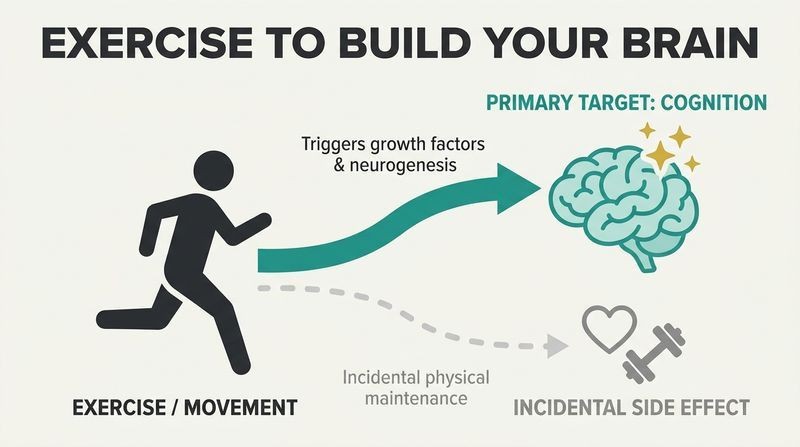
The framing is deliberately provocative: most fitness books sell aesthetics or longevity, while Ratey sells neurons. The evolutionary argument echoes Daniel Lieberman's later work on the "exercised" human as an endurance forager. One caveat worth noting: much of the mechanistic evidence comes from rodent studies where researchers can slice brain tissue, so the leap to human cognition rests partly on inference. Still, the reframe is useful. Telling someone their treadmill session sharpens memory and lifts mood may motivate more durably than promising smaller jeans, because the reward arrives the same day rather than months later.
One Illinois district got kids fit and made them smartest in the world
Naperville reinvented gym class. District 203, led by teachers Phil Lawler and Paul Zientarski, junked the sport-and-humiliation model and graded students on effort measured by heart rate monitors, not athletic skill. A slow runner working at 190 beats per minute earned an A. The philosophy: teach lifelong fitness, not dodgeball.
The academic results stunned everyone. On the TIMSS international exam, Naperville eighth graders finished first in the world in science and sixth in math, beating Japan and Singapore. Only 3% of one sophomore class was overweight versus a 30% national average. Their "Zero Hour" experiment, exercising struggling readers before class, produced a 17% reading gain versus 10.7% for those who slept in. Guidance counselors began scheduling hardest subjects right after gym.
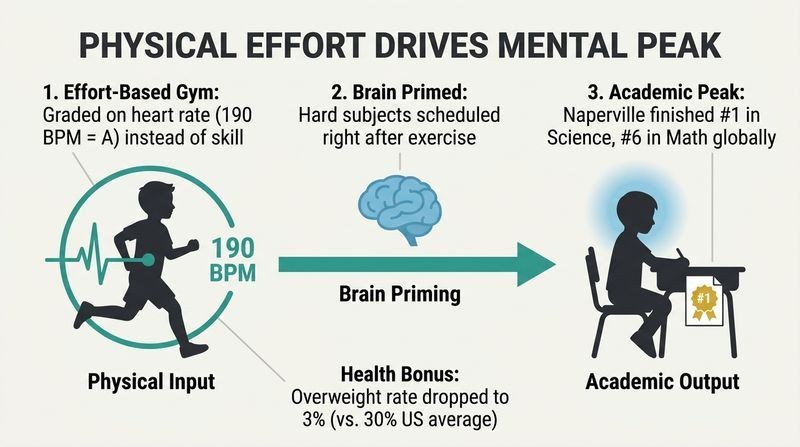
Ratey is careful, to his credit, about confounds: Naperville is affluent, white, and home to educated scientist parents, so the deck is stacked. Correlation is not causation. But the replication in poor Titusville, Pennsylvania, where scores jumped from below to 17% above state average, strengthens the case. The deeper insight for educators is counterintuitive: the No Child Left Behind reflex to cut PE for more seat-time may be self-defeating. A Virginia Tech study found that trading gym for extra academics did not raise scores. Movement appears to prime the neural machinery that makes the seat-time productive.
Exercise floods your brain with Miracle-Gro that grows new neurons
Meet BDNF. Brain-derived neurotrophic factor is a protein that fertilizes brain cells, encouraging them to sprout new branches and forge connections. Ratey nicknamed it Miracle-Gro for the brain. Neuroscientist Carl Cotman proved that mice on running wheels produced more BDNF, and the farther they ran, the higher the levels, concentrated in the hippocampus, the seat of learning and memory.
Movement makes learning stick. BDNF strengthens long-term potentiation, the cellular handshake where neurons that fire together wire together. In one German study, people learned vocabulary 20% faster after exercise, and the gain tracked directly with BDNF levels. Exercise also fuels neurogenesis, the birth of brand-new neurons from stem cells, a phenomenon only confirmed in humans in 1998. Aerobic activity roughly doubled new-cell survival in exercising mice.
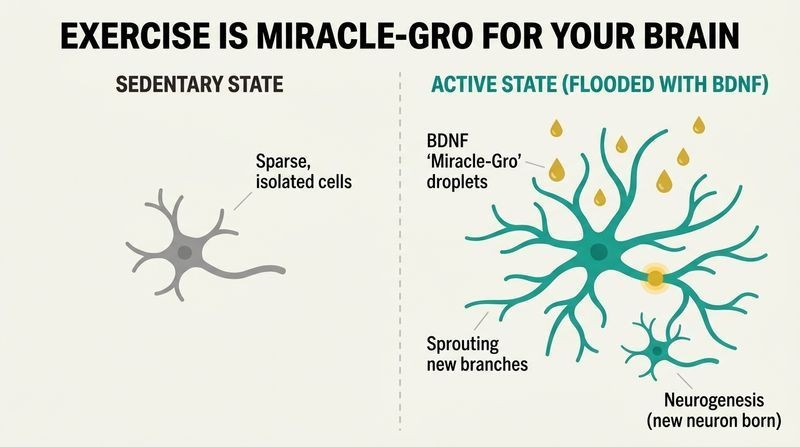
BDNF has become one of neuroscience's most studied molecules, with thousands of papers since Cotman's work. The elegance is that Ratey ties abstract chemistry to a lived prescription: warm up before you study, since blood shunts back to the prefrontal cortex right after a workout. A useful nuance he includes: BDNF is necessary but not sufficient. You cannot inject your way to genius. The molecule readies the soil, but you still have to plant something by actually challenging the brain. This dovetails with the enrichment research from Berkeley showing stimulation plus exercise beats either alone, and it explains why complex sports outperform plain jogging.
Small doses of stress make brain cells tougher, like a vaccine
Stress inoculation is real. Ratey redefines stress biologically as anything that fires a cell and creates wear. The paradox: mild, recoverable stress makes neurons overcompensate and gird against future challenges, much as a vaccine primes the immune system. Exercise is a controlled, self-initiated dose of exactly this kind of productive stress.
The evidence is surprising. A Department of Energy study found nuclear shipyard workers exposed to low radiation had a 24% lower death rate than unexposed peers. Mark Mattson's calorie-restricted mice lived 40% longer. Even broccoli helps not mainly through antioxidants but through mild plant toxins that trigger a protective stress response. The key condition is recovery. Without rest, chronic stress floods the brain with cortisol, which prunes dendrites and can shrivel the hippocampus like a raisin.
This is essentially hormesis, the dose-response principle that toxic in excess can be tonic in trace. Nassim Taleb popularized the cousin concept of antifragility, systems that gain from disorder. Ratey's contribution is applying it to neurons and behavior: active coping raises your stress threshold, while passive worry lowers it. The framing dissolves the popular but sloppy idea that all stress is bad. The critical variable, easy to miss, is control and recovery. The same cortisol that cements a survival memory becomes neurotoxic when chronic, which is why the marathoner who never recovers carries a cortisol paunch. Rest is not optional; it is where adaptation happens.
Beat anxiety by teaching your body that a racing heart is safe
Anxiety is a learning deficit. People with anxiety disorders cannot distinguish danger from safety; their amygdala fires at benign cues as if they were threats. Exercise deliberately produces the very sensations panic mimics (pounding heart, fast breathing, sweating) but pairs them with something you initiated and control. The brain relearns that arousal need not mean doom, a biological bait and switch.
The research backs it up. A 2004 study found only vigorous exercise, not gentle walking, reduced anxiety sensitivity, with effects appearing after the second session. Movement also lowers muscle tension (breaking the feedback loop like a beta-blocker), raises calming serotonin and GABA, and releases atrial natriuretic peptide from the heart, which brakes the stress axis. Ratey's patient Amy replaced Prozac with an elliptical trainer during a brutal custody battle and transformed.
The mechanism aligns with interoceptive exposure, a core technique in cognitive behavioral therapy where clinicians have patients spin in chairs or hyperventilate on purpose to defang bodily sensations. Exercise is essentially self-administered exposure therapy with a chemical bonus. Joseph LeDoux's fear research, cited here, adds depth: taking action reroutes signals from the amygdala's fear pathway toward motor circuits, literally circumventing the panic machinery. One limitation is that the most anxious patients, especially agoraphobics who fear exertion itself, may need graded onboarding and sometimes medication first. Exercise is a tool, not a mandate to abandon pharmacology, a balance Ratey repeatedly stresses.
A daily run rivals Zoloft for depression and beats it long-term
Depression is a connectivity failure. Ratey reframes it not merely as low serotonin but as the brain losing its ability to adapt and rewire. Chronic cortisol shrinks the hippocampus; neurogenesis stalls; the mind gets locked in a negative loop it cannot branch out of. Exercise attacks from both directions: bottom-up (energy, motivation via the brainstem) and top-down (restoring the prefrontal cortex so you can reframe your life).
The landmark data. Duke's 1999 SMILE study pitted exercise against sertraline (Zoloft). All groups improved equally at sixteen weeks, but six months later only 30% of exercisers relapsed versus 52% on medication. Every fifty minutes of weekly exercise cut the odds of depression by half. Britain now uses exercise as a first-line treatment.
The relapse gap is the sleeper finding. Blumenthal's hypothesis is elegant: patients who beat depression through effort internalize self-mastery ("I did this"), whereas pill-takers may attribute recovery externally, leaving them fragile. This maps onto self-efficacy theory from psychologist Albert Bandura. That said, publication and adherence realities temper the enthusiasm: roughly half of exercise-study participants drop out, precisely because anhedonia and fatigue are symptoms of the disease being treated. Prescribing exercise to someone who cannot leave the couch is a genuine catch-22. Ratey's practical answer, start absurdly small and recruit a walking partner, matters as much as the neuroscience for anyone actually stuck at the bottom of the pit.
For ADHD, movement acts like a dose of Ritalin you make yourself
Attention is a motivation problem, biologically. ADHD stems from an under-aroused reward and attention system starved of dopamine and norepinephrine, the exact neurotransmitters that Ritalin and Adderall boost. Exercise raises both immediately and, over time, grows new receptors. Ratey reframes ADHD as an attention variability disorder: the deficit is inconsistency, which is why sufferers can hyperfocus on a video game yet not homework.
Complex movement works best. A study found ADHD boys doing martial arts twice weekly outperformed plain aerobic exercisers on homework, grades, and staying seated. Technical sports (karate, gymnastics, rock climbing) engage balance, sequencing, and focus, taxing the cerebellum and prefrontal cortex simultaneously. Ratey's patient Jackson, a chronic procrastinator, dropped his meds after taking up daily running and earned a 3.9 GPA in college.
The reframe from character flaw to neurological tuning is compassionate and evidence-based, echoing Russell Barkley's model of ADHD as impaired executive function rather than laziness. The overlap Ratey draws between ADHD and addiction (both rooted in the dopamine-deficient reward center, half of ADHD patients struggle with substance abuse) is clinically important and underappreciated. A responsible caveat, which Ratey honors: Jackson's success does not license everyone to quit medication. For most, exercise is an adjunct that lowers required dosage, best done in the morning with the pill timed to kick in as the workout's focusing effect fades. The complex-movement finding deserves more attention than plain cardio recommendations usually get.
Addiction leaves an empty vessel; exercise is the healthiest way to fill it
Quitting is only step one. When an addict removes the drug, an empty core remains, and that void must be filled with positive behavior or relapse follows. Odyssey House in New York found residents who joined its running program stayed in treatment twice as long. Exercise works top-down (learning new rewarding scenarios) and bottom-up (blunting cravings by boosting dopamine and calming the amygdala).
The reward system is the culprit. All addictions (drugs, gambling, overeating, shopping) spike dopamine in the nucleus accumbens; cocaine raises it 300 to 800%. Some people carry the D2R2 gene variant, which starves the reward center of receptors, a reward-deficiency syndrome present in around 70% of severe alcoholics. Exercise restores dopamine balance: ten minutes of cycling cut alcoholics' cravings, and five minutes fought smokers' urges.
The distinction Ratey borrows from Terry Robinson between "wanting" and "liking" is one of addiction science's most important insights: dopamine drives craving, not pleasure, which is why addicts pursue what they no longer enjoy. This is the incentive-sensitization theory, and it reframes willpower failures as hijacked survival circuitry. The Australian self-regulation study is a gem: two months of exercise not only built the gym habit but spilled over into less smoking, less impulse spending, and fewer lost tempers, suggesting self-control behaves like a trainable muscle. The runner's-high chemistry (endocannabinoids, the brain's own marijuana, nearly doubling after exercise) offers a plausible neural substitute for the drug high itself.
Exercise steadies women's brains through PMS, pregnancy, and menopause
Hormonal swings destabilize neurotransmitters. Estrogen and progesterone regulate serotonin, dopamine, and even BDNF, so their monthly and life-stage fluctuations ripple into mood. The difference between women who suffer and those who breeze through seems to be sensitivity to these changes, not hormone levels themselves. Exercise buffers the whole system.
Benefits span every stage. A Duke study found aerobic exercise eased PMS mood symptoms far more than strength training. Contrary to old myths, staying active during pregnancy lowers gestational diabetes risk by up to 75% and produces leaner, more neurologically responsive babies (in Clapp's studies, children of exercising mothers scored higher on IQ and language at age five). For postpartum depression, stroller-walking mothers cut Edinburgh depression scores from 17.4 to 4.6. Post-menopause, fitness protected cognition even without hormone therapy.
This chapter fills a real gap, since most exercise-and-brain research historically used male subjects. The pregnancy findings are the most striking and the most caveated: Clapp's IQ result comes from small samples and cannot establish that running makes smarter kids, only that active mothers' children fared better on some measures. Still, overturning the centuries-old prescription of bed rest and confinement is significant public-health messaging. The menopause section wisely navigates the post-2002 collapse of hormone replacement therapy after the Women's Health Initiative found elevated cancer and stroke risk. Ratey's pitch, exercise as a side-effect-free experiment you can run on yourself, is pragmatic given how contradictory the HRT literature became.
Six months of walking can make an aging brain look years younger
The body and brain age together. The same vascular and metabolic failures that cause heart disease and diabetes also drive dementia. Obesity doubles dementia risk; diabetes raises it 65%. As neurons wear down, synapses erode, capillaries shrink, and we lose about 5% of brain volume per decade after forty. But this decay is not fixed.
Exercise reverses decline. Arthur Kramer put sedentary 60 to 79 year olds on a walking program; after six months, MRI scans showed increased volume in the frontal and temporal lobes, brains that looked two to three years younger. The Nurses' Health Study found active women had a 20% lower chance of cognitive impairment, with benefits appearing at just ninety minutes of walking weekly. Finnish data showed exercising twice weekly halved dementia risk, an effect even stronger in carriers of the Alzheimer's-linked ApoE4 gene.
Ratey's line that "if your brain isn't actively growing, it's dying" captures the use-it-or-lose-it principle now central to cognitive-reserve theory. The story of Sister Bernadette, whose autopsy revealed advanced Alzheimer's pathology despite sharp test scores until death, is the chapter's philosophical core: mental and physical activity build compensatory scaffolding that lets the brain route around damage. A grounding caveat: Kramer's volume-increase finding was, in the words of Cotman quoted here, "on the outer fringe" and awaited replication. Genes still set the odds. But the actionable message is empowering and low-cost: you cannot choose your ApoE variant, but you can choose to walk, and lifestyle appears to matter most precisely for those genetically at risk.
Follow your ancestors: walk daily, jog often, and sprint occasionally
Match your genes. Humans evolved as endurance predators who chased prey to exhaustion, so our DNA is coded for varied-intensity movement. Ratey's regimen mirrors this: roughly six days a week, forty-five minutes to an hour, four days moderate and two days high-intensity, with strength work on the hard days and recovery between them. Use a heart rate monitor and subtract your age from 220 for your max.
The zones do different jobs.
1. Walking (55-65% max) burns fat and lifts serotonin and tryptophan.
2. Jogging (65-75%) triggers capillary-building growth factors and stress-buffering ANP.
3. Running and sprinting (75-90%) release human growth hormone, the brain-volume builder that stays elevated for hours.
A German study found two three-minute sprints during a run raised BDNF and made people learn words 20% faster than steady low-intensity peers.
The prescription is refreshingly concrete in a field that hedges. Ratey's own experiment, adding brief sprints that peeled off a stubborn ten pounds, humanizes the advice. The HGH finding rehabilitates high-intensity interval training on neurological rather than just metabolic grounds, anticipating the HIIT boom that followed the book. Two honest constraints deserve emphasis. First, sprinting demands a solid aerobic base and medical clearance; it is not a couch-to-track move. Second, Elizabeth Gould's rodent work adds a social dimension the solo-athlete framing can obscure: isolated runners initially showed no neurogenesis gain because loneliness kept cortisol high. The takeaway beneath the takeaway is that exercising with others may unlock the brain benefits that exercising alone delays.
Analysis
Spark occupies an unusual niche: a working psychiatrist synthesizing a decade of then-cutting-edge neuroscience into a behavioral prescription. Its thesis, that exercise is the most powerful and underused tool for optimizing the brain, is now closer to scientific consensus than it was in 2008, which is itself a testament to Ratey's early synthesis. The book's rhetorical engine is the pairing of hard mechanism (BDNF, neurogenesis, HPA-axis regulation) with vivid human stories (Naperville's students, Amy's custody battle, Odyssey House's marathoners). This dual structure is its greatest strength and its subtlest weakness. The mechanisms are largely established in rodents, where brains can be dissected, while the human evidence is often correlational or drawn from small trials. Ratey is generally scrupulous about flagging this, repeatedly acknowledging confounds in Naperville's affluence and the fringe status of Kramer's volume findings, but the accumulated effect of chapter after chapter can read as more settled than the individual studies warrant. The reader should hold the physiology as promising rather than proven in every particular.
What elevates the book beyond a fitness manifesto is its reframing of stress. By defining stress biologically as any cellular demand and introducing hormesis (stress inoculation), Ratey collapses the false binary between good and bad stress and locates the decisive variable in recovery and control. This principle unifies the disparate chapters: anxiety, depression, addiction, and aging are all, in his telling, failures of adaptation that controlled exertion can partially reverse. The self-efficacy thread, that beating a condition through effort inoculates against relapse better than passively receiving a pill, connects neuroscience to Bandura's psychology and gives the book its motivational bite.
The enduring value is practical and democratizing. The interventions cost nothing, carry benefits rather than side effects, and scale from a fifteen-minute walk to interval sprints. Ratey never counsels abandoning medication, positioning movement as an adjunct and a form of agency. In an era of pharmaceutical and screen-bound sedentism, that message has only grown more urgent.
Review Summary
Spark explores the profound impact of exercise on brain function and mental health. Ratey presents scientific evidence showing how physical activity enhances learning, memory, mood, and cognitive abilities while combating stress, anxiety, depression, and aging. Many reviewers found the book enlightening and motivating, praising its well-researched content and engaging style. Some readers, however, felt overwhelmed by the technical jargon and repetitive explanations. Overall, the book is highly recommended for those seeking to understand the connection between exercise and brain health.
People Also Read









Glossary
BDNF (brain-derived neurotrophic factor)
Protein that grows brain cellsA protein produced inside neurons when they are active, which Ratey nicknames Miracle-Gro for the brain. It fertilizes existing brain cells to keep them healthy and growing, sprouts new dendritic branches, strengthens the connections underlying memory, and is essential to the birth of new neurons. Exercise reliably raises BDNF levels, especially in the hippocampus.
Neurogenesis
Birth of new brain neuronsThe process by which stem cells divide and mature into functioning new neurons, confirmed in adult humans only in 1998. It occurs mainly in the hippocampus. Exercise dramatically increases the number of new cells born, and environmental stimulation plus social contact helps them survive and integrate into working circuits rather than dying off.
Long-term potentiation (LTP)
Cellular mechanism of memoryThe strengthening of the connection between two neurons through repeated firing, the cellular basis of learning and memory, captured in the phrase neurons that fire together wire together. Repeated activation makes synapses swell and grow new branches. BDNF and exercise both enhance LTP, making it easier to encode and retain new information.
Stress inoculation
Mild stress builds resilienceThe phenomenon in which limited, recoverable doses of stress cause brain cells to overcompensate and gird themselves against future demands, functioning like a vaccine for the immune system. Exercise, calorie restriction, learning, and even plant toxins in vegetables all provide this beneficial stress, provided cells get adequate recovery time afterward.
Reward-deficiency syndrome
Under-receptored dopamine reward centerA genetically influenced condition, linked to the D2R2 gene variant, in which the brain's reward center has too few dopamine receptors, leaving a person chronically craving stimulation. It predisposes people to addiction and appears in roughly 70% of severe alcoholics. Exercise raises dopamine and, over time, builds new receptors to help restore balance.
HPA axis
Body's stress-hormone control loopThe hypothalamic-pituitary-adrenal axis, a signaling relay from the hypothalamus to the pituitary to the adrenal glands that governs the stress response and the release of cortisol. It regulates fuel and immune function. Regular aerobic exercise tunes the HPA axis so it is less trigger-happy, raising the threshold before full stress hormones flood the system.
Endocannabinoids
Brain's own marijuanaA class of neurotransmitters, including anandamide, that bind to the same brain receptors as marijuana's active ingredient. Produced during exercise, they blunt pain and produce feelings of calm and euphoria. Because they cross the blood-brain barrier easily, unlike endorphins, researchers consider them a leading explanation for runner's high.
Zero Hour PE
Exercise before school programNaperville, Illinois's experimental gym class held before first period, in which struggling readers exercised at 80 to 90% of maximum heart rate to prime their brains for learning. Students showed a 17% reading improvement versus 10.7% for peers in standard PE, prompting the district to schedule hard subjects immediately after gym.
Atrial natriuretic peptide (ANP)
Heart hormone that calms stressA hormone produced by heart muscle that increases as heart rate rises during exercise. It passes into the brain and brakes the HPA axis, reducing stress and anxiety and helping regulate mood. Its discovery gave a concrete biological link between the heart, exercise, and emotional calm.
Human growth hormone (HGH)
Anti-aging brain-building hormoneA hormone released by the pituitary gland, especially during high-intensity and anaerobic exercise like sprinting. It burns belly fat, builds muscle, and pumps up brain volume, and researchers believe it can reverse age-related brain-volume loss. A thirty-second sprint can raise HGH sixfold, with levels staying elevated for up to four hours.
FAQ
What's Spark: The Revolutionary New Science of Exercise and the Brain about?
- Connection Between Exercise and Brain: The book explores the significant impact of physical activity on brain function, emphasizing its importance for mental health and cognitive abilities.
- Mind-Body Relationship: It aims to reconnect the often-separated concepts of mind and body, showing how exercise can enhance mood, learning, and overall brain health.
- Scientific Evidence: Dr. John J. Ratey presents extensive scientific research supporting the idea that exercise can combat mental health issues like anxiety, depression, and stress.
Why should I read Spark: The Revolutionary New Science of Exercise and the Brain?
- Transformative Insights: The book provides insights into how incorporating exercise into daily life can lead to profound changes in mental health and cognitive function.
- Practical Applications: It offers practical advice on integrating exercise into your routine, making it accessible for readers looking to improve their mental well-being.
- Motivational Guidance: Dr. Ratey provides motivational strategies and shares inspiring case studies, such as the success of Naperville, Illinois, in improving fitness and academic performance.
What are the key takeaways of Spark: The Revolutionary New Science of Exercise and the Brain?
- Exercise Enhances Brain Function: Regular physical activity improves mood, enhances learning, and protects against cognitive decline.
- Neurotransmitter Balance: Exercise increases levels of key neurotransmitters like serotonin, norepinephrine, and dopamine, essential for mood regulation and cognitive function.
- Long-term Benefits: The benefits of exercise extend beyond immediate mood improvements, contributing to long-term mental health and resilience against stress and anxiety.
How does exercise affect learning according to Spark: The Revolutionary New Science of Exercise and the Brain?
- Increased Neuroplasticity: Exercise promotes neuroplasticity, enhancing the brain's ability to form new connections and adapt, which boosts learning capabilities.
- Boosts BDNF Levels: Physical activity increases brain-derived neurotrophic factor (BDNF), a protein crucial for neuron growth, survival, and memory.
- Improved Focus and Attention: Regular exercise prepares the brain for learning by improving focus, attention, and overall cognitive function.
How does Spark: The Revolutionary New Science of Exercise and the Brain address depression?
- Exercise as an Antidepressant: The book presents evidence that exercise can be as effective as traditional antidepressants in treating depression.
- Boosting Neurotransmitters: Physical activity increases serotonin and norepinephrine levels, essential for mood regulation and combating depressive symptoms.
- Building Resilience: Regular exercise fosters resilience against future depressive episodes by enhancing overall brain health and emotional stability.
What role does stress play in mental health as discussed in Spark: The Revolutionary New Science of Exercise and the Brain?
- Stress as a Challenge: Stress is defined as a challenge to the body’s equilibrium, beneficial in small doses but harmful when chronic.
- Impact on Brain Structure: Chronic stress can alter brain structures, particularly the hippocampus, leading to cognitive decline and emotional disorders.
- Exercise as a Buffer: Exercise mitigates the effects of stress, helping restore balance and improve resilience against stress-related disorders.
How does exercise impact mental health conditions like ADHD and depression in Spark: The Revolutionary New Science of Exercise and the Brain?
- ADHD Management: Exercise helps manage ADHD symptoms by improving focus and reducing impulsivity, stimulating dopamine release.
- Depression Relief: Regular exercise serves as an effective treatment for depression, increasing serotonin levels and reducing cortisol.
- Social Interaction Benefits: Group exercises or team sports enhance mental health benefits, reducing feelings of isolation and boosting well-being.
What specific methods does Dr. Ratey recommend for improving brain health through exercise?
- Aerobic Exercise: Engage in activities like walking, running, or cycling for at least 30 minutes most days to increase heart rate and blood flow to the brain.
- Strength Training: Incorporate strength exercises two to three times a week to maintain muscle mass and bone density, enhancing neuroplasticity.
- High-Intensity Intervals: Short bursts of intense activity improve cognitive function and boost growth hormone levels.
What is the significance of the Naperville case study in Spark: The Revolutionary New Science of Exercise and the Brain?
- Revolutionary PE Program: Naperville implemented a unique physical education program that significantly improved student fitness and academic performance.
- Connection to Learning: The case study illustrates the direct correlation between physical activity and cognitive function, with fit students performing better academically.
- Model for Change: Naperville serves as a model for other schools, demonstrating how prioritizing physical education can lead to healthier, smarter students.
How does Spark: The Revolutionary New Science of Exercise and the Brain address the relationship between exercise and aging?
- Cognitive Decline Prevention: Regular exercise slows cognitive decline associated with aging, with active older adults showing better cognitive function.
- Physical Health Benefits: Exercise maintains physical health, reducing the risk of chronic diseases and promoting longevity.
- Neuroplasticity and Resilience: Exercise enhances neuroplasticity, allowing the brain to adapt and maintain cognitive abilities in later life.
What role does diet play in conjunction with exercise according to Spark: The Revolutionary New Science of Exercise and the Brain?
- Nutritional Support for Brain Health: A balanced diet rich in omega-3s, antioxidants, and vitamins is essential for optimal brain function.
- Caloric Restriction Benefits: Research suggests caloric restriction can enhance longevity and brain health, improving overall well-being.
- Hydration and Energy Levels: Staying hydrated is crucial for maintaining energy levels during exercise, maximizing cognitive and physical benefits.
What are the best quotes from Spark: The Revolutionary New Science of Exercise and the Brain and what do they mean?
- “The point of exercise is to build and condition the brain.”: Emphasizes the primary benefit of exercise is its impact on brain health, not just physical fitness.
- “Exercise is one of the best treatments we have for most psychiatric problems.”: Highlights the book's thesis that physical activity is a powerful tool for improving mental health.
- “You are built to move.”: Reinforces the idea that humans are naturally designed for physical activity, essential for maintaining health.
About the Author
Other books by John J. Ratey
Download PDF
Download EPUB
.epub digital book format is ideal for reading ebooks on phones, tablets, and e-readers.








































