
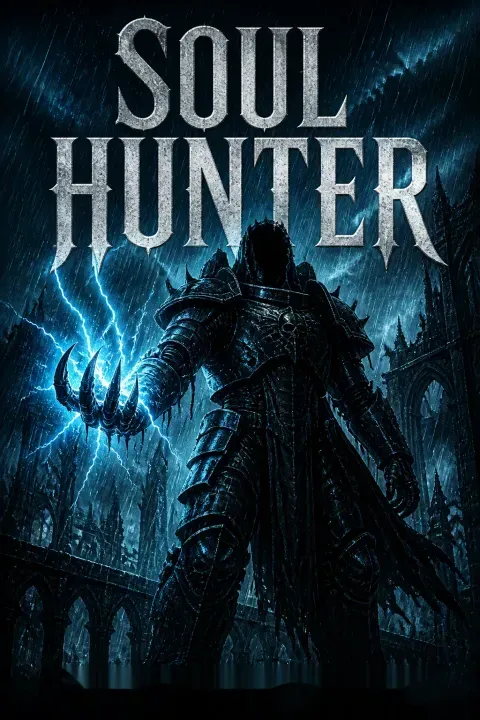


Summary Temporarily Unavailable
This summary is temporarily unavailable and is currently being updated. You can still explore the FAQs and other metadata below.
Plot Summary
Prologue
A boy on Nostramo takes his first life, then is remade by the knives of the VIII Legion. Talos's1 youth unfolds in fragments: a child murderer, a surgical subject carved open and rebuilt with two hearts and gene-forged organs, a teenager who kills again and is called 'brother' by skull-helmed masters, a sniper ending lives at a thousand metres, a young man receiving the black carapace that fuses him to his armour, a warrior butchering aliens under crimson targeting reticules, a conqueror watching civilians beg before his bolter, and finally, a traitor to everything he once held sacred.
Decades later, aboard the Covenant of Blood, he screams prophecies into the vox while his brothers listen. The curse of his gene-sire, Konrad Curze, flows through his blood: visions of futures yet to come, tearing him apart with each seizure.
This origin sequence establishes the Night Lords' fundamental tragedy. Talos is a creature built by violence, not born into it, his humanity systematically stripped away through murder and surgery until nothing remains but the weapon. The prologue's structure, repeating 'He is a...' with each new stage of transformation, mirrors the indoctrination process itself: identity erased, replaced by function. Yet the curse of prophecy, inherited from his primarch, becomes the one thing that distinguishes Talos from his murderous brothers. It is both gift and affliction, setting him apart even as it binds him to his father's doomed legacy. The central question planted here: can a soul forged entirely through atrocity find any meaning beyond it?
The Navigator in the Void
Following a vision that showed him a shard of his destroyed homeworld and a female Navigator,3 Talos1 leads First Claw to an asteroid rich in adamantium ore. A rogue trader vessel, the Maiden of the Stars, has already claimed the rock.
The Covenant of Blood destroys the trader ship from orbit with contemptuous ease, then First Claw descends to the surface. They find over a hundred mining servitors and, hiding aboard a lander, a young Navigator3 named Eurydice Mervallion.3
She attacks Talos1 with a crowbar, her third eye open and lethal, but he has foreseen this moment and keeps his own eyes closed. He chokes her into unconsciousness, drags her aboard the gunship, and claims her for the Legion. The asteroid, once part of Nostramo, holds no other prizes.
This raid establishes the Night Lords' operational reality: scavengers scraping for resources, their glory days long past. Talos's prophetic gift proves practical, delivering exactly what the warband needs, a Navigator to guide them through the warp. Yet there's an elegiac quality to walking the surface of his dead homeworld, the emotional significance lost on brothers like Uzas who 'couldn't have cared less.' The capture of Eurydice is brutal but impersonal: Talos treats her as a resource, not a person, his humanity so atrophied he cannot recognize the terror he inflicts.
Boarding the Sword of the God-Emperor
At the Crythe system, the Warmaster Abaddon's fleet assaults the Imperial Navy. The Exalted,10 commander of the Covenant of Blood, executes a near-suicidal attack run, skimming his strike cruiser past the massive Imperial grand cruiser Sword of the God-Emperor.
Through precise lance strikes and a perfectly timed Coronus Dive, the Covenant overloads the flagship's shields just long enough to launch boarding pods. First Claw punches into the command decks, Talos1 leading the assault.
He unleashes a vox-amplified scream that drops every mortal on the bridge to their knees, rupturing eardrums and sending the ship's machine-spirit into shock. They butcher the armsmen and crew, and Talos1 personally executes Lord Admiral Arventaur, bound to his command throne by life-support cables.
The void battle showcases the Exalted's tactical genius, the one arena where the daemon-possessed captain still excels. His maneuver is elegant in its audacity, turning the Covenant into a surgical instrument rather than a blunt weapon. Talos's scream weaponizes terror itself, the Night Lords' signature doctrine made literal. His execution of the admiral, almost gentle, with whispered words about the Emperor being 'no god,' reveals the crusade's founding grievance still burning beneath centuries of corruption and decay.
Warmaster's Poisoned Offer
On the prison world Solace, Talos1 is summoned before Abaddon the Despoiler. The Warmaster offers him a place in the Black Legion, perhaps even leadership of the fractured Night Lords. When Talos1 refuses, Abaddon shoots him with a storm bolter loaded with daemon-poison, triggering a vision where four Chaos gods, each wearing Talos's1 own face, offer their gifts.
Talos1 rejects them all. Meanwhile, the sorcerer Ruven,14 a former Night Lord now serving Abaddon, arranges for prisoners to storm First Claw's Thunderhawk. Septimus2 is mutilated, left for dead, and Octavia3 is dragged into the prison's depths. Talos1 awakens, kills his captors, and hunts through the complex to rescue her, threatening Ruven14 with death when next they meet.
This sequence crystallizes Talos's defining trait: stubborn refusal. He rejects Abaddon's patronage, the Chaos gods' temptations, and even his brothers' pragmatic corruption. His rescue of Octavia is not compassion but possessiveness, his property threatened. Ruven's betrayal establishes the fratricidal nature of Legion politics. The vision of Chaos gods wearing his face externalizes the internal threat: the Night Lords are becoming what they claim to hate, and Talos's resistance makes him increasingly isolated.
Titan Fall on Crythe Prime
The ground war on Crythe Prime pits the Night Lords against the Mechanicus's Legio Maledictis. A Warhound Titan corners Seventh Claw, slaughtering most of the squad. Talos,1 against the Exalted's10 recall orders, diverts First Claw's Thunderhawk to the engagement zone. Septimus2 executes a near-suicidal bombing run with the transport's remaining missiles, overloading the Titan's void shields.
As the war machine staggers, First Claw charges in at ground level with melta bombs, clamping explosives to its ankle joint. The detonation topples the Titan onto its side. Talos1 tears open the cockpit and drags out Princeps Arjuran Hollison, claiming him as a prisoner, a prize whose tortured mind will later power the Shriek.
The Titan kill represents the Night Lords at their tactical best: indirect, opportunistic, and utterly merciless. Talos's defiance of the Exalted grows more brazen, driven by his need to preserve the dwindling warband. The capture of the princeps is a long-term investment, foreshadowing Deltrian's later weaponization of human agony. The fight also plants the seed of Uzas's betrayal, with Talos's vision showing Uzas raising an axe behind Cyrion during the battle.
Awakening the War-Sage
Talos,1 desperate to restore 10th Company's leadership, orders the tech-priest Deltrian11 to resurrect Captain Malcharion,9 a revered hero entombed in a Dreadnought sarcophagus. The Exalted,10 threatened by this challenge to his authority, sends Vraal of the Atramentar to sabotage the ritual. Vraal storms the Hall of Remembrance, savaging First Claw and nearly killing Deltrian.11
As he advances on the sarcophagus, the Dreadnought's autocannon powers up. Malcharion9 awakens, voicing the immortal words: 'I heard bolter fire.' His first act is to obliterate Vraal with a storm of explosive shells, reducing the Terminator to scraps. The ancient captain, last of the old guard, is reborn into a walking war machine.
Malcharion's resurrection transforms the warband's power dynamics. He represents a legitimacy the Exalted cannot claim, a direct link to the primarch's era. His awakening through the sound of combat is both ironic and poetic: the war-sage cannot rest while his brothers still fight. Vraal's death serves as the Exalted's failed gambit, demonstrating that open conflict with Talos's faction is now too costly. The scene also reveals First Claw's loyalty to Talos over their nominal commander.
Pact with the Blood Reaver
The crippled Covenant of Blood limps into Hell's Iris, the Maelstrom stronghold of Huron Blackheart,13 the Tyrant of Badab. The Red Corsairs, now a vast piratical empire, greet the Night Lords with barely concealed hostility. Huron13 agrees to repair and resupply the Covenant, but at a price: the Eighth Legion must join his upcoming siege of Vilamus, a fortress-monastery of the Marines Errant Chapter.
Talos1 has no choice but to accept. During the negotiations, he recognizes the Venomous Birthright, a strike cruiser in Huron's13 fleet, as the Echo of Damnation, a Night Lords vessel captured centuries ago. He vows to reclaim it. Huron13 also presents a 'gift': the sorcerer Ruven,14 now a blinded, tortured captive in a light-flooded cell.
This alliance is a devil's bargain. The Night Lords, once among the Imperium's most feared Legions, must now serve as mercenaries for a renegade Chapter they consider inferior. Huron's easy dominance in the negotiation underscores how far the VIII Legion has fallen. Talos's recognition of the Echo of Damnation plants the seed for the trilogy's second major act: a theft that will cost the Covenant of Blood its existence. Ruven's presence as Huron's prisoner foreshadows Talos's eventual decision to free the sorcerer, despite past betrayals.
Infiltrating the Fortress-Monastery
Huron's13 plan for Vilamus is elegant: using warp-sorcery to trigger a coronal mass ejection from the system's sun, the Corsairs blind all auspex and vox across the planet. Night Lord Claws infiltrate the fortress through maintenance tunnels and ventilation shafts, moving through the darkness they were born to own.
Talos1 butchers his way through serf dormitories, leaving mutilated corpses as messages. The Bleeding Eyes Raptors12 disable the secondary generatorum, dropping the orbital defence shields. Huron13 teleports in with his Terminator elite, and the siege begins in earnest. First Claw encounters Huron's13 pet, a hideous hamadrya that clings to his armour, a creature Talos1 and Xarl4 instantly want to kill.
The infiltration of Vilamus is the Night Lords fighting their ideal war: terror as a weapon, fear as a force multiplier. The fortress-monastery, designed to repel conventional assault, has no defence against warriors who hunt in the dark and wield psychological warfare with surgical precision. Huron's plan demonstrates strategic genius, but the Night Lords' role as expendable shock troops rankles. The juxtaposition of Talos's brotherhood with the Corsairs' corruption (personified by the hamadrya) reinforces his growing disgust with Chaos worship.
Stealing the Echo of Damnation
As the siege of Vilamus reaches its climax, Talos1 springs his true plan. Variel,8 a Red Corsair Apothecary who owes Talos1 a life-debt from decades past, sabotages the Venomous Birthright. He seals the launch bays, trapping Caleb's Marauders, then opens the hangar to vacuum.
First Claw boards the crippled vessel with Octavia,3 slaughtering the remaining crew. The Navigator3 is forced to bond with the ship's feral machine-spirit and jump it into the warp, escaping alongside the Covenant of Blood.
In the chaos of the void war, the Covenant is overwhelmed by pursuing Corsair vessels. Vandred, the Exalted,10 momentarily regains control from the daemon possessing him, covers the Echo's escape, and rams his dying ship into the enemy cruiser Skies of Badab, buying his brothers their freedom.
The Echo's theft is the trilogy's hinge point: triumph and tragedy fused. Variel's betrayal of his Chapter for a brotherhood he believes in more is the kind of loyalty Talos inspires despite his coldness. Vandred's sacrifice, reclaiming his identity in his final moments, closes the Exalted's tragic arc, the captain who became a monster dying as a Night Lord. But victory costs the Covenant of Blood, the warband's home for millennia, and strands Variel irrevocably with First Claw.
Ruven's Execution
Aboard the captured Echo of Damnation, Talos1 confronts Ruven,14 whom he freed from Huron's13 prison for a specific purpose: to jump the Covenant of Blood as it fled. With that debt paid, Talos1 summons the sorcerer to the bridge under pretense of a war council. As Ruven14 speaks of the future, Talos1 draws his relic blade and bisects him in a single stroke.
The sorcerer, still alive, chokes on his own blood as Talos1 pins him to the deck with a boot on his chest, recounting the murder of his servant Secundus decades before. Variel,8 the new Apothecary, is ordered to skin the corpse. Ruven's14 flayed bones are hung above the occulus as a trophy and warning.
This execution is pure Night Lord justice: patient, theatrical, and absolute. Talos has nursed his grudge for decades, waiting for the moment when Ruven's usefulness expired. The killing is framed as the fulfillment of a promise, binding Talos to his own code in a Legion where oaths are currency and betrayal is expected. Ruven's corpse hung as decoration echoes the primarch's Screaming Gallery, transforming atrocity into art and reminder. It also eliminates the last sorcerer capable of guiding the ship, making Octavia indispensable.
The Callidus Assassin
On a backwater Imperial world, Talos1 baits a trap. Having foreseen the arrival of a Callidus assassin sent to kill a heretical cult's high priest, First Claw ambushes her as she completes her mission. The shapeshifter, named Jezharra, is captured and subjected to excruciation under Variel's8 expert hands. For seventeen days she resists, longer than any human ever has.
When she finally breaks, she reveals the location of a hidden Callidus temple on Uriah III, where a hololithic recording of Konrad Curze's final moments is stored. Talos1 summons the Legion, and dozens of Night Lords warbands gather for the assault. The temple falls in a single night, and the recording is recovered, though the Callidus have already fled.
The Callidus hunt demonstrates Talos's strategic patience and the Legion's enduring obsession with their dead primarch. The brief unity of so many warbands, answering an ancient call, shows the Night Lords' potential for cohesion when a meaningful cause presents itself. Jezharra's seventeen-day resistance is perversely admirable, earning Talos's whispered thanks before he beheads her. The hololithic becomes a relic of faith for warriors who claim to have none, their father's silent laughter on an endless loop.
Return to the Carrion World
Following visions he barely remembers, Talos1 orders the Echo of Damnation to the Eastern Fringe, to the world once called Tsagualsa, the Night Lords' fortress-home after the Heresy. They find it colonized, with crude cities housing twenty-five million souls. Talos1 is stunned by their presence, the Imperium having long ago declared the world cursed and quarantined.
Descending to the surface, First Claw walks the ruins of their ancient fortress, now eroded by millennia of dust storms. Talos1 reflects on the Screaming Gallery, his primarch's throne room of living torment, and the lesson Curze died to teach: that law and order are maintained only through fear of punishment. He decides to teach that lesson again.
This homecoming is the trilogy's emotional fulcrum, forcing Talos to confront the Legion's history directly. The human colonists are living sacrilege, occupying ground consecrated by the Night Lords' suffering. Talos's philosophical musings on Curze's 'lesson' reveal his desperate need for meaning, his attempt to retrofit ideology onto what was always atrocity. The ruined fortress becomes a mirror for the Legion itself: once mighty, now broken, but still dangerous.
Xarl's Last Duel
The Genesis Chapter, descendants of the Ultramarines, tracks the Echo to Tsagualsa and boards in force. On the strategium deck, First Claw is pinned down by Terminators. Xarl,4 having fought through seven Space Marines to rejoin his brothers, faces Tolemion, the Genesis Champion, wielding a thunder hammer and tower shield. The duel is savage, reducing First Claw's armour to wreckage.
Xarl4 headbutts Tolemion repeatedly, shattering his own skull, then spits acid into the Champion's eyes. Blinded and deafened, he impales Tolemion with Talos's1 golden blade and carves upward through his torso. Xarl4 stands victorious, the Genesis Champion dead at his feet, then collapses. His life-sign rune flatlines a moment later.
Xarl's death is the trilogy's most mythic moment, a duel that transcends the brutality of its combatants into something approaching epic. He kills a warrior who has never lost an honour duel in four decades, winning through sheer animal ferocity. His final words to Talos, regretting their earlier argument, grant him a rare moment of vulnerability. The death shatters First Claw's core, leaving Talos without his most reliable blade, and proves that even the unkillable can fall.
Psychic Scream Across the Stars
Talos1 conceives a weapon of unprecedented cruelty. The astropaths captured from Sanctuary are subjected to weeks of excruciation, their pain amplified by the torture of thousands of others. When they are sufficiently broken, Octavia3 is brought before them. One by one, she removes her bandana and forces them to look into her Navigator's3 eye, the warp-gifted organ that kills any non-Navigator who meets its gaze.
Each astropath dies in agony, their psychic death-scream amplified by their tortured state and projected into an Imperial astropathic duct. World after world receives the mortal cry, their own astropaths adding their deaths to the chorus. Dozens of planets are plunged into madness, daemonic incursion, and darkness.
The psychic scream is Talos's masterpiece of terror, fear weaponized on a galactic scale. It is also his most monstrous act, forcing Octavia into the role of mass murderer and using her body as the instrument of atrocity. The scream's consequences echo across the Imperium for years, isolating worlds and breeding warp storms. It is the Night Lords' doctrine made literal: fear as a force multiplier, terror as infrastructure. But it also seals their fate, attracting the attention of the eldar of Ulthwé, who have foreseen this moment in their own prophecies.
The Eldar Noose Tightens
Within hours of the psychic scream, eldar warships appear. The Echo of Damnation runs, diving into the warp again and again, but each emergence is met by another blockade, another ambush. The eldar are not here to punish the scream.
Variel,8 listening to their intercepted communications in his learned eldar tongue, realizes the truth: the xenos seers have foreseen a future where Talos1 unites the Eighth Legion and leads a crusade that bleeds Craftworld Ulthwé beyond recovery. They have come to kill the Prophet1 before his destiny can unfold. The Echo is herded back to Tsagualsa, its engines failing, its Navigator3 exhausted to the point of death. Talos1 knows he must make a final stand.
The eldar pursuit inverts the predator-prey dynamic that defines the Night Lords. Hunters become hunted, herded to a killing ground chosen by their enemies. The revelation that the eldar fear Talos's future, not his past, is both validating and cruel, he will never live to fulfill the prophecy they seek to prevent. Variel's linguistic skills, learned through excruciation of eldar captives, prove invaluable, a rare instance of knowledge serving survival in a Legion that usually values only violence.
The Captain Awakens Truly
In the Hall of Reflection, Deltrian11 has kept Malcharion's9 sarcophagus active, pumping the ancient warrior with chemical stimulants and electrical pulses meant to restore his mind. Instead, the Dreadnought has been screaming in endless agony. When Talos1 discovers this, he is enraged. Deltrian11 has been torturing his captain, 'poking him with sticks' the way Xarl4 once tormented a sleeping dog.
Talos1 destroys the control console over Deltrian's11 protests. The screaming stops. In the silence, Malcharion9 speaks his first sane words in months. The war-sage is awake at last, ready to lead his brothers one final time. His first question is why the Chamber is filled with so few warriors.
Malcharion's true awakening is a rebuke to the Mechanicum's cold methodology. Deltrian could not understand that the 'subject' was already conscious, his screams not mere reflex but the torment of a trapped mind. Talos's act of destruction, based on intuition and empathy rather than data, saves his captain. It also demonstrates his fitness to lead, protecting the Legion's heroes from their own allies' callousness. Malcharion's return, even at the end, grants the final battle a gravity it would otherwise lack.
The Echo's Final Flight
Talos1 orders the Echo of Damnation to run the eldar blockade, a suicide charge through the asteroid field. On the bridge, he tells his mortal crew nothing of the Legion's evacuation. Drop-pods and Thunderhawks flee the dying ship as it absorbs punishing fire. At the last moment, Talos1 and Cyrion5 fight through panicked human crowds to an escape pod, butchering crew members who block their way.
The Echo crashes into Tsagualsa's southern mountains, its reactor going critical in a flash visible from orbit. Thirty thousand souls burn with the ship. First Claw gathers in the catacombs beneath the ruined fortress, Terminator armour scavenged from dead Salamanders, ammunition crates hauled down by servitors, ready to die in the dark.
This sequence is Talos at his coldest, sacrificing thousands of loyal crew to buy his warriors a chance at a meaningful death. The betrayal is not strategic but nihilistic: he does not expect to survive. The flight through the ship, blades clearing a path through his own people, strips away any pretense of nobility. The Terminator armour, looted from the Salamanders at Vykon Point, becomes a final irony: the Night Lords face their end clad in the wargear of the Imperium they once served.
First Claw's Last Hunt
The surviving Night Lords, divided into loose packs, hunt and are hunted through the lightless tunnels. The eldar deploy Howling Banshees, warrior-priestesses whose psychic shrieks induce physical terror even in Astartes. They carve through the depleted Claws, killing warriors who have survived ten thousand years of war.
Malcharion9 fights alone, a walking monument laying waste to dozens of xenos. Third Claw is annihilated. Then a single figure descends into the darkness, a Phoenix Lord, an immortal eldar war-goddess. She kills with blurring speed, her black spear and throwing star reaping Night Lords like wheat. She hunts Talos1 specifically, naming him the 'Hunter of Souls' and promising his death on this world.
The catacombs become the Night Lords' ideal battlefield: absolute darkness, close quarters, no retreat. The Banshees' howl, a weaponized scream that mirrors Talos's own, creates a dark symmetry between predator species. The Phoenix Lord, Jain Zar, the Storm of Silence, is a force beyond anything they have faced, a living myth. Her presence elevates the conflict from skirmish to legend, the kind of death warriors of the VIII Legion might actually find worthy.
Talos Avenges His Brothers
On the rain-lashed battlements, surrounded by the bodies of his brothers, Talos1 confronts Jain Zar. She kills Lucoryphus,12 cripples Variel,8 and mortally wounds Cyrion5 with her throwing star. Talos1 manages to sever her arm with Aurum, but she disarms him, breaks his relic blade across her knee, and impales him with her spear.
As she speaks of derailed prophecy and a future prevented, Talos1 begins to laugh. He has seen this moment in his visions. Above them, the Thunderhawk Blackened arrives, Septimus2 and Octavia3 at the controls, heavy bolters driving the Phoenix Lord into shadow.
Talos,1 bleeding out, crawls to where Cyrion5 lies dying, sharing final words with his last brother. Then he rises, broken sword in one hand, and pursues Jain Zar. He carries no blade to wound her, only grenades stripped from the dead. When she impales him a second time, he releases the pins on every explosive he carries. The detonation consumes them both.
Talos's death is perfect Night Lord doctrine: victory through sacrifice, vindication through destruction. He has foreseen this moment and walks into it willingly, his laughter at the end the same mad mirth his primarch displayed before his own assassination. The Phoenix Lord, immortal but not invulnerable, is at least temporarily destroyed, a death worthy of legend. Talos's final words to Cyrion, his refusal to harvest Uzas's gene-seed, his dismissal of Septimus and Octavia to freedom: all are the actions of a man finally at peace with his choices.
Flight from the Carrion World
Septimus,2 having defied Talos's1 orders to flee, hovers Blackened above the battlements until the prophet's1 death is certain. He and Octavia3 fly to the last surviving city, Sanctuary, and hide among the traumatized colonists. Two months later, Imperial Navy vessels arrive, drawn by the psychic scream and the eldar fleet's presence.
The slaves blend in with refugees, using false identities. On the evacuation shuttle, Octavia3 feels her unborn child kick for the first time. Septimus,2 for the first time in a decade, speaks his birth name: Coreth. They plan to disappear into the Imperium's teeming billions, carrying the child who carries Talos's1 gene-seed, the legacy Variel8 swore to preserve.
The escape of Septimus and Octavia closes the human arc of the trilogy. They are the only characters who grow rather than diminish, Septimus recovering his humanity through love, Octavia finding strength in her captivity. Their flight is not cowardice but survival, the preservation of something the Night Lords have lost: a future. The child in her womb, implanted with gene-seed harvested from Talos's corpse, becomes the trilogy's true MacGuffin, more important than any warship or relic.
Decimus, Prophet of the Eighth
Centuries later, a young Night Lord named Decimus walks the decks of the battleship Sun's Scourge. He is escorted by Variel,8 by Lucoryphus of the Bleeding Eyes12 (somehow still alive, warp-changed and corpse-like), and by the Atramentar Terminators Malek15 and Garadon.
He wears armour cannibalized from many sources, his skull-helm marked with the Nostraman rune for 'Soul Hunter.' He carries Malcharion's9 double-barrelled bolter and a reforged Aurum, the Blood Angel blade. Before the gathered warlords of the Eighth Legion, Decimus reveals his gift: he has foreseen the deaths of dozens of them in the coming Thirteenth Black Crusade.
He offers them a choice: follow him against the eldar of Ulthwé first, or die in the wars to come. When one lord mocks him, Malek15 executes the skeptic on the spot. Decimus removes his helm to reveal a young, unscarred face, and names himself the Prophet of the Eighth Legion.
Decimus is the fulfillment of Talos's legacy, a prophet who unites where Talos could only divide. His gene-seed, harvested from Talos's corpse and implanted into the infant son of Septimus and Octavia, has bred true, granting him the same prophetic gift without the same flaws. He is Talos's hope made flesh: a leader capable of wielding the Legion as a weapon rather than enduring it as a curse. The trilogy's final irony is that Talos's greatest contribution to the Long War was not his actions but his death, and the son that death seeded.
Epilogue
The epilogues trace three fates. Septimus2 and Octavia3 (now Coreth and Eurydice) disappear into the Imperium's refugee population, their child growing in her womb. Imperial records fragment across dozens of worlds, recording the 'Months of Madness' when astropaths died screaming and planets fell dark.
And aboard the Sun's Scourge, the young Night Lord Decimus, bearing Talos's1 reforged blade and Malcharion's9 bolter, flanked by Variel,8 Malek,15 Garadon, and the corpse-like Lucoryphus,12 addresses the gathered lords of the fractured VIII Legion. He has seen their deaths in his visions.
He offers them a choice: follow him against the eldar of Ulthwé, or die in the coming Black Crusade. When one lord protests, Malek15 executes him. Decimus removes his helm, revealing an unscarred face, and declares himself the Prophet of the Eighth Legion, fulfilling the destiny the eldar sought to prevent.
The epilogues complete the trilogy's ouroboros structure: Talos's story ends where it began, with a prophet of the VIII Legion haunted by visions of death. Decimus is the perfected version of Talos, his gene-seed in a compatible host, his prophetic gift untainted by the physical degeneration that killed his genetic father. The eldar's attempt to prevent the prophecy instead ensures it, a classic tragic irony. Septimus and Octavia's quiet survival offers the only note of hope in an otherwise nihilistic epic: love enduring in the shadow of atrocity. The fractured Imperial records remind us that even the Night Lords' greatest atrocity, the psychic scream, becomes just another unexplained catastrophe in an empire too vast to notice its own wounds.
Analysis
The Night Lords trilogy is, at its core, a study in the impossibility of redemption and the persistence of meaning in meaninglessness. Talos Valcoran1 is a monster who knows he is a monster, a man who murders thousands yet weeps for his dead brothers, who skins children before their parents but waxes philosophical about the Legion's lost nobility. This contradiction is not hypocrisy but the central tragedy of the VIII Legion: warriors engineered to be humanity's necessary evil, then discarded when that evil became inconvenient. They are the answer to a question the Imperium no longer dares ask. The trilogy's genius is that it never flinches from atrocity while still making its perpetrators comprehensible, even sympathetic. Talos1 is wrong about almost everything, his vaunted 'lesson' of order through fear is a delusion that Curze himself rejected before dying. Yet his desperate grasping for meaning, his refusal to accept that his existence has been nothing but murder in service to nothing, is deeply human. The Night Lords are not corrupted by Chaos (most of them); they are corrupted by their own nature, by the poison of Nostramo that their primarch tried and failed to excise. The eldar prophecy that drives the final act is the trilogy's most elegant irony: the xenos come to prevent a future where Talos1 unites the Legion, but in killing him they ensure that future, as his gene-seed passes to a host capable of fulfilling it. Decimus is not Talos,1 but he is what Talos1 could have been: a prophet whose gift does not destroy him, a leader who can command rather than merely endure. The trilogy ends not with redemption but with continuation, the Long War grinding on, new monsters rising to replace the old. The only true escape belongs to Septimus2 and Octavia,3 whose flight into the Imperium's anonymous billions offers the faint hope that even in the grim darkness of the far future, love might sometimes, impossibly, survive.
Last updated:
Report IssueReview Summary
Soul Hunter is highly praised for its complex characters, engaging dialogue, and unique perspective on Chaos Space Marines. Readers appreciate the Night Lords' portrayal as pragmatic survivors rather than mindless villains. The book challenges perceptions of traitor legions and offers insights into their daily struggles. Many consider it one of the best Warhammer 40K novels, lauding its world-building, action scenes, and exploration of human perspectives within Chaos warbands. While some found the pacing slow, most readers were captivated by the dark, gritty atmosphere and compelling narrative.
People Also Read

Characters
Talos Valcoran
Prophet of the VIII LegionA Night Lords Apothecary turned reluctant leader of First Claw, 10th Company. Talos is defined by his prophetic gift, inherited from his primarch Konrad Curze, a curse that grants him fragmentary visions of the future at the cost of crippling seizures and agonizing pain. Born on the sunless world of Nostramo to a murdered father and indentured mother, he was a killer by age twelve. His gene-seed implantation was flawed, his body never fully accepting the transformation, causing his visions to grow more frequent and devastating over time. Talos despises what the Legion has become, a band of rapists and murderers bereft of purpose, yet cannot escape its gravitational pull. He clings to the primarch's original ideology: that fear is the only foundation of order, and that the Night Lords were once the Imperium's necessary, righteous weapon. His tragedy is his clarity, he sees the Legion's decay and his own hypocrisy, but lacks the capacity to change either. He is cold, calculating, and capable of staggering cruelty, yet inspires fierce loyalty in his brothers and even his slaves. His crooked smile rarely reaches his black eyes.
Septimus
Talos's artificer and pilotThe seventh of Talos's1 personal slaves, Septimus was captured from the forge world Lok III over a decade before the trilogy begins. He serves as the warband's primary Thunderhawk pilot and Talos's1 artificer, maintaining First Claw's weapons and armour with obsessive skill. His face is partially reconstructed with augmetics after being mutilated during the Solace prison attack. Septimus speaks Nostraman as his primary language, his Gothic rusty and accented. He is defined by his slow reclamation of humanity, triggered by Octavia's3 arrival on the ship. Before her, he had numbed himself to the horrors of Legion service. Her presence forces him to confront his complicity in atrocity, and their eventual love becomes his reason to survive. Despite his position as a slave, he carries himself with quiet dignity and a dry, self-deprecating wit. His mechanical skills, piloting expertise, and linguistic abilities make him one of the most valuable mortals in the warband.
Octavia (Eurydice Mervallion)
Navigator and captiveBorn Eurydice Mervallion to a minor Navigator House on Terra, she was captured by First Claw on an asteroid fragment of dead Nostramo. A scion of the Navis Nobilite, she possesses the third eye that allows Navigators to see into the warp, a lethal weapon against any non-Navigator who meets its gaze. Initially defiant and terrified, she gradually adapts to life aboard the Covenant and later the Echo of Damnation, bonding with the ships' feral machine-spirits and proving herself an exceptionally gifted guide through the Sea of Souls. Her relationship with Septimus2 humanizes her, reawakening emotions suppressed by her aristocratic upbringing and the trauma of captivity. She is sharp-tongued, proud, and resilient, refusing to break despite the horrors she endures. Her pregnancy with Septimus's2 child becomes central to the trilogy's conclusion, as Variel8 intends to implant the infant with harvested gene-seed from First Claw's dead.
Xarl
First Claw's deadliest bladeTalos's1 childhood friend from the gang-ridden streets of Nostramo, Xarl is First Claw's most ferocious warrior. Where Talos is contemplative, Xarl is pure aggression, a weapon shaped by a lifetime of violence. He wears a winged ceremonial helm and carries a massive two-handed chainsword he calls Executioner. He is feared throughout the warband as the one brother no one dares challenge. Despite his brutality, Xarl possesses a harsh honesty and a grudging loyalty to Talos1 that transcends their mutual dislike. He believes the Legion's supposed nobility is a delusion, that they have always been murderers and always will be. His death dueling the Genesis Champion Tolemion becomes the trilogy's most legendary moment: he beats the Champion to death through sheer savage determination, headbutting him repeatedly until his own skull fractures, before collapsing.
Cyrion
First Claw's secret predatorThe most charismatic and witty member of First Claw, Cyrion masks his profound corruption behind easy laughter and sardonic humor. He possesses a latent psychic gift that allows him to taste the fear of those around him, a power that has grown stronger over centuries in the warp. Unlike Uzas6, whose corruption is visible, Cyrion's rot is internal, hidden behind his lightning-streaked helm and amiable demeanor. He feeds on mortal terror, secretly hunting the ship's crew to sate an appetite he cannot control. His actions, including the murder of the void-born's father, are blamed on Uzas6, whose madness makes him an easy scapegoat. Cyrion's relationship with Talos1 is complex: he respects the prophet's vision but resents his moralizing. He dies in the final battle, his chest destroyed by the Phoenix Lord's throwing star, confessing his hatred and his apology to the brother he envied.
Uzas
Blood-maddened berserkerOnce a sergeant of Fourth Claw during the Horus Heresy, Uzas has degenerated into a barely coherent killer, his mind eroded by centuries of bloodshed and the whispers of Khorne, the Blood God. He screams prayers to deities he claims not to worship, licks his teeth obsessively in echo of the primarch, and slaughters crew members in fugue states he cannot remember. Despite his madness, rare moments of lucidity pierce through, revealing the warrior he once was. Talos1 defends him against the others' demands for execution, believing some remnant of nobility remains. In the final act, Uzas realizes Cyrion5 has framed him for murders he did not commit, and confronts his treacherous brother on the rain-swept battlements. Talos1, seeing Uzas raise his axe against Cyrion5, fulfills his own prophecy by killing Uzas with the golden blade, never learning the truth.
Mercutian
First Claw's heavy weapons specialistA former scion of Nostramo's wealthy City's Edge elite, Mercutian wields a skull-mouthed heavy bolter with grim efficiency. He is morose by nature, perpetually expecting the worst, earning him a reputation as First Claw's pessimist. His refined accent, a relic of his privileged upbringing, marks him as different from gutter-born brothers like Xarl4. Mercutian is quietly loyal to Talos1 and writes chronicles of the Legion's deeds, preserving the history his brothers would rather forget. He dies in the catacombs, buying time for First Claw to escape the Phoenix Lord, his heavy bolter the last sound he makes.
Variel the Flayer
Red Corsair turned Night Lord ApothecaryA former Apothecary of the Astral Claws (now Red Corsairs), Variel owes Talos1 a life-debt from the battle of Fryga decades past. Cold, clinical, and utterly devoid of sentiment, he betrays his Chapter to help First Claw steal the Echo of Damnation, then joins the VIII Legion permanently. His pale blue eyes, in contrast to the Nostraman-born's black, mark him as an outsider, but his absolute pragmatism and surgical skill earn him a grudging place. He harvests gene-seed from the dead with dispassionate efficiency and maintains the warband's genetic legacy. Despite his emotionless facade, he is fiercely loyal to the brothers who accepted him. He survives Tsagualsa by crawling away on the stumps of his severed legs, eventually aiding in the creation of Decimus.
Malcharion the War-Sage
Ancient Dreadnought captainThe former captain of 10th Company, a revered tactician whose writings on terror warfare earned him the title 'war-sage' from the primarch himself. He was entombed in a Dreadnought sarcophagus against his will, his final words a plea to cast his ashes into the void. His sarcophagus displays his greatest triumph: the same day he killed three enemy champions from three different Legions. Awakened twice by Talos1, he fights with weary competence, a warrior who has outlived his era and finds little joy in his resurrection. He dies on Tsagualsa, alone in the catacombs, his legend complete.
The Exalted (Vandred Anrathi)
Possessed warband commanderOnce Captain Vandred of 10th Company, a brilliant void tactician, he was possessed by a daemon and transformed into the monstrous Exalted. His body is a twisted fusion of flesh and ceramite, tusked and clawed, with black eyes and shark-like teeth. The daemon and the man wage constant war within their shared mind, Vandred's original personality surfacing only in rare moments. His tactical genius remains intact, making the Covenant of Blood nearly invincible in space combat. He resents Talos's1 status as one of Curze's 'Chosen' and the prophet's growing influence. He dies sacrificing himself to cover the Echo of Damnation's escape, briefly reclaiming his identity to ram his dying ship into an enemy cruiser.
Deltrian
Tech-priest of the Dark MechanicumAn ancient tech-adept allied to the Night Lords, Deltrian has reconstructed his body into a chrome skeleton, a walking effigy of death in red robes. His face is a permanent silver grin, his eye lenses emerald, his voice a mechanical monotone. He maintains the warband's technology, creates the Shriek (a weapon that broadcasts human pain as electronic interference), and oversees the rituals of Dreadnought resurrection. Despite his claims of pure logic, he displays subtle hints of humanity: pride in his work, irritation at being interrupted, and a capacity for cruelty that suggests he understands fear far better than he admits. He escapes Tsagualsa with the Legion's gene-seed reserves aboard his personal vessel.
Lucoryphus of the Bleeding Eyes
Raptor cult leaderThe leader of the Bleeding Eyes, a cult of warp-tainted Raptors who crawl on all fours and weep painted tears of scarlet and silver from their daemon-faced helms. His feet have warped into taloned claws, his body more suited to flight than walking. He commands the pack with bestial authority, communicating in shrieks, hisses, and broken speech. Lucoryphus is ancient, having been among the first to scale the walls of the Imperial Palace during the Siege of Terra. His loyalty to Talos1 is pragmatic, sensing that the prophet is destined for greatness. He survives the trilogy in a state between life and death, his flesh rotting while his mind endures.
Huron Blackheart
Tyrant of the MaelstromThe master of the Red Corsairs, formerly Lufgt Huron of the Astral Claws Chapter. His body was destroyed in the Badab War and rebuilt with crude bionics, leaving him in constant agony that fuels his ambition. He commands the largest pirate fleet outside the Eye of Terror from his throne at Hell's Iris. Despite his ruined appearance, he possesses a disarming charisma and strategic brilliance. He extracts the Night Lords' service for the Vilamus siege in exchange for repairing the Covenant of Blood, a bargain that ultimately costs him the Echo of Damnation. A hamadrya, a psychic xenos-creature, clings to his armour at all times.
Ruven
Traitor sorcerer of the VIII LegionA former Night Lord who abandoned the Legion to serve Abaddon as 'Eyes of the Warmaster.' He is responsible for the murder of Talos's1 servant Secundus and the mutilation of Septimus2 on Solace. Captured by Huron13 and tortured for his sorcerous knowledge, he is left blinded and broken in a light-flooded cell. Talos1 frees him to guide the Covenant of Blood through the warp during the Vilamus escape. Once his usefulness expires, Talos1 bisects him with the golden blade and has his flayed skeleton hung above the bridge as a warning.
Malek of the Atramentar
Terminator championThe leader of the Atramentar, the Exalted's Terminator bodyguard. Malek is Terran-born, one of the oldest warriors in the warband, with his tusked helm and lightning claws marking him as elite. He secretly supports Talos1 against the Exalted10, countermanding the prophet's order to let Malcharion9 die by having Deltrian11 preserve the war-sage's sarcophagus. He disappears during the Covenant's destruction, later revealed to have boarded a Corsair vessel rather than died. He eventually joins Decimus centuries later.
Hound
Octavia's loyal attendantA hunched, eyeless mutant from Nostramo's Hill Folk, his eyes sewn shut by crude stitching. He serves as Octavia's3 most devoted protector among Etrigius's former attendants. He carries a sawn-off shotgun and speaks in simple, childlike sentences. Hound once killed a crag cougar on Nostramo. He dies aboard the Echo of Damnation, killed by the daemon-possessed Caleb during the ship's capture, shielding Octavia3 until his last breath.
Plot Devices
Talos's Prophetic Visions
Drives all major plot decisionsTalos1 inherited his primarch Konrad Curze's gift of foresight, manifesting as crippling seizures during which he screams prophecies. The visions are biologically rooted, his overactive progenoid glands constantly attempting to 'improve' his body despite implantation being complete, causing genetic flux that grants him glimpses of possible futures. The visions are imperfect, sometimes wrong, often symbolic rather than literal. They drive the entire trilogy: the Navigator's3 discovery, the Crythe campaign, the return to Tsagualsa, and the final confrontation with the eldar. Over time, the visions become more frequent and damaging, eventually ceasing to be reliable at all as Talos's1 body breaks down. The gene-seed harvested from his corpse, implanted into Decimus, produces a more stable version of the gift.
Aurum, the Blade of Angels
Trophy and symbol of Legion identityA relic power sword forged when the Imperium was young, originally belonging to Captain Dumah of the Blood Angels. Talos1 claimed it by right of conquest after murdering its previous bearer. The golden blade features an angel-winged crosspiece and ruby teardrops, its craftsmanship far exceeding modern Imperial standards. Three Night Lords have tried to kill Talos1 for it, he killed all three. The sword represents everything Talos1 values: the Legion's legacy, the righteousness of conquest, and the beauty that can exist alongside atrocity. It is broken by the Phoenix Lord Jain Zar during the final duel on Tsagualsa, then reforged with a silver discoloration and passed to Decimus centuries later.
The Shriek
Electronic warfare terror weaponDesigned by Tech-Priest Deltrian11, the Shriek converts the excruciated pain of the captive Titan princeps Arjuran Hollison into a jamming field of howling scrapcode. When broadcast, it blinds enemy auspex, cripples vox communication, and kills illumination systems on targeted vessels. It consumes so much power that void shields must be lowered while active. The Shriek is used to capture Ganges Station without resistance, rendering its defenders blind and deaf. Its conceptual foundation, weaponizing human suffering as electronic interference, inspires Talos's1 later plan to weaponize psychic death-screams through an astropathic duct, the song that devastates dozens of Imperial worlds.
The Psychic Scream (Song)
Galactic-scale terror weaponTalos's1 masterwork of fear, created by torturing the astropaths of Sanctuary for weeks, then forcing them to look into Octavia's3 third eye at the moment of death. Their amplified psychic death-cries are broadcast into an Imperial astropathic duct, where they spread from world to world, each planet's astropaths adding their own deaths to the chorus. The scream plunges dozens of worlds into darkness, breeding warp storms, daemonic incursions, and societal collapse. It serves dual purposes: punishing the Imperium in a way that echoes through history, and proving the Night Lords' doctrine that fear is the ultimate weapon. It also attracts the eldar, sealing the warband's fate.
Gene-seed (Progenoid Glands)
Legacy and future of the LegionThe genetic material harvested from dead Night Lords, stored in cryo-canisters, that allows the creation of new Astartes. Throughout the trilogy, the warband desperately needs to rebuild its numbers, but lacks the resources. Talos's1 gene-seed is uniquely flawed, overactive glands causing his prophetic visions but also killing him slowly. Variel8 recognizes that in a compatible host, Talos's1 gene-seed could produce a stable, powerful seer. This realization drives Variel's8 survival and his eventual creation of Decimus, the child of Septimus2 and Octavia3 implanted with Talos's1 harvested genetic material. The gene-seed becomes the trilogy's true MacGuffin: more valuable than warships or relics, it is the Legion's only hope for a future.
FAQ
Synopsis & Basic Details
What is Soul Hunter about?
- A Legion's Grim Odyssey: Soul Hunter follows Talos, a Night Lord Space Marine, and his warband, First Claw, as they navigate the treacherous 41st Millennium. The narrative delves into their brutal raids, internal conflicts, and desperate search for purpose and resources amidst the shattered remnants of their Legion.
- Quest for Vengeance: At its core, the story is a dark quest for vengeance against the Imperium that betrayed their Primarch, Konrad Curze, and a struggle for survival against both external foes and the insidious corruption within their own ranks. It explores the Night Lords' unique brand of terror and their twisted sense of justice.
- Unveiling a Prophecy: The plot is driven by Talos's prophetic visions, a cursed inheritance from his gene-father, which guide the warband through perilous void battles, boarding actions, and planetary assaults, ultimately leading them to confront their past and an uncertain future.
Why should I read Soul Hunter?
- Deep Character Exploration: The novel offers an unparalleled psychological dive into the minds of Chaos Space Marines, particularly Talos, revealing their complex motivations, internal struggles, and the lingering humanity (or lack thereof) beneath their monstrous exteriors. It challenges simplistic notions of good and evil.
- Visceral, Sensory Prose: Aaron Dembski-Bowden's writing is renowned for its immersive and brutal sensory detail, making the grimdark setting palpable. Readers experience the stench of blood, the whine of power armor, and the chilling atmosphere of a dying galaxy, drawing them deep into the narrative.
- Philosophical & Thematic Depth: Beyond the action, Soul Hunter explores profound themes like the nature of vengeance, the burden of legacy, the meaning of identity, and the cyclical futility of war, offering a thought-provoking commentary on the Warhammer 40,000 universe.
What is the background of Soul Hunter?
- Warhammer 40,000 Universe: Set in the grimdark future of the 41st Millennium, the novel is steeped in the lore of Games Workshop's Warhammer 40,000 universe, portraying a galaxy consumed by endless war between the decaying Imperium of Man and myriad alien and heretical forces.
- The Night Lords Legion: The story centers on the VIII Legion, the Night Lords, one of the nine Space Marine Legions that betrayed the Emperor during the Horus Heresy. They are infamous for their terror tactics, nihilistic philosophy, and descent into depravity, stemming from their Primarch Konrad Curze's brutal upbringing on the perpetually dark world of Nostramo.
- Post-Heresy Chaos Factions: The narrative showcases the fractured nature of Chaos Space Marine Legions ten millennia after the Heresy, depicting them as disparate warbands struggling for survival, resources, and a semblance of their former glory, often clashing with each other as much as with the Imperium.
What are the most memorable quotes in Soul Hunter?
- "Death is nothing compared to vindication.": This chilling mantra, first uttered by Konrad Curze and later echoed by Talos, encapsulates the Night Lords' core philosophy. It highlights their nihilistic pursuit of vengeance and their belief that proving their "rightness" outweighs any cost, including their own lives.
- "My right to destroy is greater than your right to live.": A stark declaration from Talos in the opening pages, this quote defines the Night Lords' self-appointed role as instruments of brutal justice. It underscores their conviction that their past sacrifices grant them ultimate authority to tear down the Imperium they helped build.
- "I hate this Legion, Talos. Not for what it is, but for what it made me become.": Spoken by Konrad Curze in a vision, this line reveals the Primarch's profound self-loathing and regret, a sentiment that Talos himself comes to echo. It encapsulates the tragic irony of the Night Lords' existence, forever bound to a legacy they despise.
What writing style, narrative choices, and literary techniques does Aaron Dembski-Bowden use?
- First-Person Limited & Shifting Perspectives: Dembski-Bowden primarily employs a tight third-person limited perspective, often delving into Talos's internal thoughts and sensory experiences. However, he frequently shifts perspective to other characters (Septimus, Octavia, Variel, even ship machine-spirits and Eldar seers), offering a multi-faceted view of events and deepening the emotional impact.
- Sensory Immersion & Body Horror: The prose is rich with visceral sensory details, particularly focusing on smell ("copper stench of blood," "reek of sweat"), sound ("whine of power armor," "clanking of chains"), and tactile sensations ("cold ceramite," "stinging acid"). This is often intertwined with body horror, vividly describing mutations, injuries, and the grotesque nature of the characters' existence.
- Repetition & Foreshadowing: The author masterfully uses repetition of phrases ("sins of the father," "death is nothing compared to vindication") and recurring motifs (helms, specific wounds, the color red) to reinforce themes and subtly foreshadow future events, creating a cyclical and fated atmosphere.
Hidden Details & Subtle Connections
What are some minor details that add significant meaning?
- Septimus's Augmetic Eye: Initially a simple bionic replacement, Septimus's new eye, capable of filtering out visual noise and seeing augmetic-specific displays, subtly highlights the increasing reliance on technology and the blurring lines between human and machine in the grimdark future. It also mirrors Talos's own enhanced vision and the theme of altered perception.
- The "Void-Born" Girl's Medallion: The ten-year-old girl, Talisha, born on the Covenant of Blood, wears a Legion medallion given by Septimus for protection. Her tragic death, despite the medallion, and the subsequent unrest among the crew, underscores the futility of hope and the arbitrary nature of death even under the Legion's "protection," challenging Talos's perceived control.
- Recurring Architectural Motifs: The repeated descriptions of gothic architecture, spires, and cathedrals, even in prison complexes or corrupted ships, symbolize the pervasive, decaying influence of the Imperium's past. The Night Lords' defilement of these structures (e.g., the broken aquila on Talos's armor) represents their rejection of that legacy.
What are some subtle foreshadowing and callbacks?
- Talos's Vision of Uzas Killing Cyrion: Early in the novel, Talos has a vision of Uzas killing Cyrion on Crythe, which he dismisses as inaccurate. This vision is a powerful piece of foreshadowing, as the actual event occurs much later on Tsagualsa, but in a different context, highlighting the unreliable nature of prophecy and the inevitability of certain character fates.
- The "Screaming Gallery": First mentioned as a place of torture and psychological warfare in Curze's palace, the Screaming Gallery is later revealed to be a living, suffering architectural horror. This callback emphasizes the Night Lords' unique brand of terror and Curze's twisted philosophy of control through fear, directly influencing Talos's later actions on Tsagualsa.
- The Echo of Damnation's True Name: The ship Venomous Birthright is revealed to be the Echo of Damnation, a former Night Lords vessel. This callback to its original name and history subtly foreshadows its eventual reclamation by Talos, reinforcing the theme of reclaiming lost legacy and the cyclical nature of the Legion's struggles.
What are some unexpected character connections?
- Variel's Debt to Talos: The revelation that Variel owes Talos for saving his life on Fryga establishes an unexpected bond between the two, explaining Variel's later loyalty and willingness to aid Talos even against Huron's wishes. This personal debt contrasts sharply with the transactional nature of most Chaos alliances.
- Deltrian's Hidden Affection: The tech-adept Deltrian, seemingly emotionless and logical, displays subtle hints of personal pride and even affection for his creations (like the Dreadnought Malcharion and the Titan Princeps). His "grief" at Malcharion's "failure" and his pride in Variel's work reveal a hidden, almost human, layer beneath his bionic exterior.
- Hound's Unwavering Loyalty: Octavia's attendant, Hound, initially appears as a grotesque, almost mindless servant. However, his unwavering loyalty, concern for Octavia, and even his simple, almost childlike questions ("Are you happy?") reveal a profound, unexpected humanity and emotional depth, contrasting with the more complex but often self-serving motivations of others.
Who are the most significant supporting characters?
- Septimus, the Artificer-Pilot: Beyond his role as Talos's personal slave, Septimus serves as a moral compass and a window into the mortal experience within the Legion. His growing humanity, his love for Octavia, and his internal conflict over his service highlight the psychological toll of living among the Night Lords.
- Deltrian, the Tech-Adept: As a Mechanicum priest, Deltrian embodies the cold, logical, and often grotesque side of technological pursuit. His interactions with Talos and his role in the resurrection rituals and the Shriek device reveal the esoteric and dangerous aspects of Chaos technology, and his subtle personality quirks add unexpected depth.
- Marlonah, the Survivor: A minor character, Marlonah's repeated appearances as a survivor of various atrocities (Crythe, the Echo's boarding) and her eventual journey with Octavia and Septimus symbolize the resilience of ordinary humans caught in the galactic war. Her bionic leg and her quiet determination represent the enduring spirit of the common person.
Psychological, Emotional, & Relational Analysis
What are some unspoken motivations of the characters?
- The Exalted's Fear of Obsolescence: Beneath his monstrous facade and ambition, the Exalted harbors a deep-seated fear of being superseded, particularly by Talos. His willingness to sacrifice Talos to Abaddon and his later attempts to control Malcharion stem from a desperate need to maintain his precarious authority within the fragmented Legion.
- Talos's Search for Meaning: While outwardly driven by vengeance, Talos's deeper, unspoken motivation is a profound search for meaning in a nihilistic existence. His constant questioning of the Legion's purpose, his desire for a "pure war," and his attempts to "reforge" the Legion are all manifestations of this existential yearning, contrasting with his brothers' more simplistic bloodlust.
- Cyrion's Hidden Empathy: Despite his cynical demeanor and occasional cruelty, Cyrion exhibits a subtle, almost hidden, empathy. His ability to "hear" the fear of mortals and his discomfort with Uzas's wanton brutality suggest a deeper emotional complexity and a lingering connection to a humanity he outwardly disdains.
What psychological complexities do the characters exhibit?
- Uzas's Degenerative Clarity: Uzas's madness is not a constant state; he experiences moments of chilling clarity, particularly when discussing his own actions or the Legion's nature. This oscillation between feral bloodlust and lucid self-awareness ("I never worshipped anything") adds a disturbing layer to his character, suggesting a conscious choice in his depravity.
- Octavia's Adaptation to Trauma: Octavia's journey is a study in psychological adaptation. From a sheltered Navigator to a traumatized captive, she gradually acclimates to the horrors around her, developing a cynical wit and a fierce will to survive. Her internal monologues reveal the constant mental battle to maintain sanity and identity in an insane environment.
- Variel's Controlled Dispassion: Variel, the Flayer, embodies extreme dispassion. His cold logic and lack of overt emotion are a coping mechanism for the horrors of his profession and the Maelstrom. His occasional, almost accidental, expressions of amusement or pique are significant because they break through this carefully constructed facade, hinting at suppressed humanity.
What are the major emotional turning points?
- Xarl's Death and Talos's Grief: Xarl's unexpected death at the hands of Tolemion is a major emotional turning point for Talos. Despite their often antagonistic relationship, Xarl was a constant, reliable presence. His death shatters Talos's composure, leading to a raw display of grief and a renewed, more personal, drive for vengeance.
- Octavia's Forced Psychic Attack: The scene where Talos forces Octavia to use her warp eye to kill the astropaths is a brutal emotional turning point for her. It marks her unwilling complicity in the Legion's atrocities, forcing her to confront the destructive power of her gift and the moral compromises of her new life.
- Malcharion's "Awakening" and True State: The revelation that Malcharion is not truly "awake" but a tortured, screaming husk, and Talos's decision to end his suffering, is a poignant emotional climax. It forces Talos to confront the grim reality of the Legion's past and the true cost of their "immortality," influencing his later choices.
How do relationship dynamics evolve?
- Talos and Septimus: Master-Slave to Mutual Reliance: Initially a typical master-slave dynamic, their relationship evolves into one of mutual reliance and grudging respect. Septimus's loyalty and practical skills become indispensable, while Talos, despite his harshness, shows a protective instinct, culminating in his violent reaction to Septimus's injuries and his later confession of affection.
- First Claw's Fractured Brotherhood: The core dynamic of First Claw (Talos, Cyrion, Xarl, Uzas, Mercutian) is a complex blend of loyalty, contempt, and shared trauma. Despite constant bickering and internal animosity, they operate as a cohesive unit in battle. The deaths of Xarl and Mercutian, and Uzas's descent into deeper madness, ultimately shatter this fragile brotherhood, leaving Talos isolated.
- Octavia and Hound: Unlikely Companionship: Octavia's relationship with Hound, her seemingly simple-minded attendant, develops into a touching bond of companionship and mutual comfort. Hound's unwavering devotion and Octavia's gradual acceptance of his presence provide a rare glimpse of genuine, uncorrupted connection amidst the pervasive darkness of the ship.
Interpretation & Debate
Which parts of the story remain ambiguous or open-ended?
- The True Nature of Talos's Visions: While presented as prophetic, the novel frequently blurs the line between genuine foresight and psychological manifestation. Variel suggests Talos's visions are a "genetic incompatibility" and "biological flux," leaving it ambiguous whether they are true prophecies or symptoms of his deteriorating physiology.
- The Fate of the Night Lords Legion: The novel ends with the remnants of the Night Lords facing an overwhelming Eldar force, with Talos seemingly sacrificing himself. The ultimate fate of the surviving warbands and the Legion as a whole remains open, hinting at their continued, fractured existence in the grimdark future.
- The Child's Destiny: Octavia's unborn child is prophesied by the Eldar to be the "Prophet of the Eighth Legion." The novel concludes with the child's escape, leaving its future and whether it will indeed fulfill this prophecy entirely open to interpretation, suggesting a cyclical nature of fate and legacy.
What are some debatable, controversial scenes or moments in Soul Hunter?
- The "Screaming Gallery" and Human Torture: The detailed descriptions of the Screaming Gallery, where living humans are fused into the palace walls and floors to perpetually scream, are highly controversial. This scene pushes the boundaries of grimdark horror, forcing readers to confront the extreme sadism and nihilism of the Night Lords.
- Talos's Use of Octavia to Kill Astropaths: Talos's cold, calculated use of Octavia's warp eye to murder hundreds of astropaths, creating a psychic scream to draw the Imperium's attention, is a morally ambiguous act. It highlights the Night Lords' ruthless pragmatism and Talos's willingness to commit horrific acts for his strategic goals, sparking debate on his "heroism."
- Uzas's "Red Hands" and Blame: The recurring motif of Uzas's "red hands" and the debate among First Claw about his responsibility for the crew's deaths (particularly Arkiah's daughter) is a controversial element. It questions the nature of individual culpability within a Legion of murderers and explores how blame is assigned and accepted, even among those who commit similar atrocities.
Soul Hunter Ending Explained: How It Ends & What It Means
- Sacrifice and Legacy: The novel culminates in a desperate last stand on Tsagualsa. Talos, realizing the Eldar's true motivation is to prevent his future rise as a unifying prophet, orchestrates a final battle. He sacrifices himself, along with the remaining Night Lords, in a brutal confrontation with the Eldar seer, ensuring the escape of Octavia and Septimus (and their unborn child) and the gene-seed of his fallen brothers.
- The Cycle Continues: The ending reinforces the cyclical nature of vengeance and prophecy. Talos's death, mirroring Curze's, is a vindication of his own twisted ideals. The escape of the child, prophesied to be the "Prophet of the Eighth Legion," suggests that the cycle of the Night Lords' legacy, their struggle, and their unique brand of terror will continue, albeit through a new, untainted vessel.
- A Bitter Victory: While the Night Lords are seemingly annihilated, their actions achieve their ultimate goal: drawing the Imperium's attention back to Tsagualsa and ensuring their legacy of fear. The Eldar's desperate measures to prevent Talos's future confirm his significance, turning his final defeat into a symbolic victory for the Legion's enduring influence.
About the Author
Aaron Dembski-Bowden is a highly regarded author in the Warhammer 40,000 universe, known for his exceptional character development and writing style. His work on the Night Lords trilogy, particularly Soul Hunter, has earned him a dedicated following among fans. Readers praise his ability to create complex, morally ambiguous characters and provide fresh perspectives on established lore. Dembski-Bowden's contributions to the Horus Heresy series, including The First Heretic, have further cemented his reputation as a talented storyteller. His writing is characterized by witty dialogue, intense action scenes, and a knack for exploring the darker aspects of the Warhammer 40,000 universe.
Other books by Aaron Dembski-Bowden
Download PDF
Download EPUB
.epub digital book format is ideal for reading ebooks on phones, tablets, and e-readers.








































