

Key Takeaways
You need a 52.4% win rate just to break even
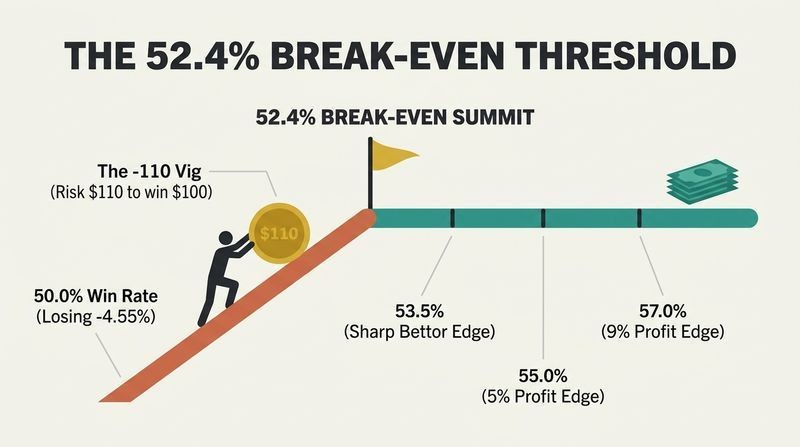
The vig is the mountain you must climb. Standard sports bets are priced at -110, meaning you risk $110 to win $100. That extra $10 is the sportsbook's cut, called the vig or juice. Because of it, winning half your bets is not enough. Flip coins on games at -110 and you bleed money at a rate of 4.55%.
The magic number is 52.4%. Divide 110 by 210 and you get 52.38%, the fraction of bets you must win simply to stay even. Hit 55% and you earn a 5% edge. Hit 57% and you make nearly 9% on money invested. Anyone claiming 70% winners is lying. Sharp handicappers who grind high volume typically document around 53.5%, a razor-thin but real advantage.
What's striking is how this mirrors the transaction-cost problem in active investing. Just as mutual fund fees quietly devour returns, the vig means a bettor can be right slightly more than half the time and still go broke. The 52.4% threshold reframes betting as a margin business, not a prediction contest. It also explains why get-rich claims collapse under arithmetic: the gap between break-even (52.4%) and world-class (57%) is under five percentage points, yet that sliver separates the ruined from the professional. The lesson generalizes to poker, options trading, and any negative-sum game where survival depends on beating a built-in rake.
Betting math only matters once you can actually pick winners
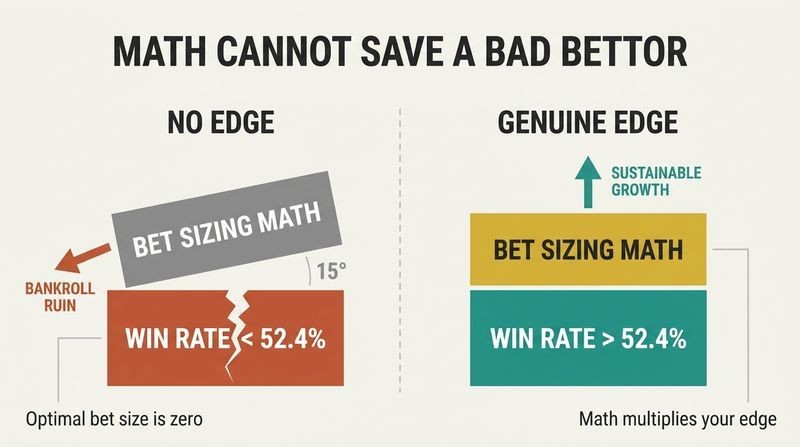
Money management cannot rescue a losing bettor. Wong is blunt: if you cannot pick more than 52.4% winners, your mathematically optimal bet size is zero. All the elegant formulas for sizing bets apply only after you have a genuine edge. People who blow their bankroll love to blame poor money management, but the real culprit is bad picks.
Bet only when expected value is positive. Expected value (EV) is the average result if a bet were repeated endlessly. Wong recommends a personal MinEdge, a minimum edge threshold, of at least 2.5%, with many bettors demanding 5% or more. Below that threshold, keep your money in your pocket. Betting for fun is fine, but admit it is entertainment, not investment. Since your linesmaker often knows things you do not, assume your calculated edge overstates reality.
This is the sports-betting version of Warren Buffett's circle of competence: technique is worthless without an underlying advantage. The behavioral insight buried here is powerful. Gamblers systematically confuse process discipline with edge, believing that careful staking or chasing losses methodically can convert a losing game into a winning one. It cannot. Wong's warning to treat your estimated edge as inflated is essentially a plea for epistemic humility, echoing the overconfidence research of Kahneman and Tversky. The professional's discipline is not in how they bet, but in how often they refuse to bet at all.
Never bet a fixed amount; size to a target win instead
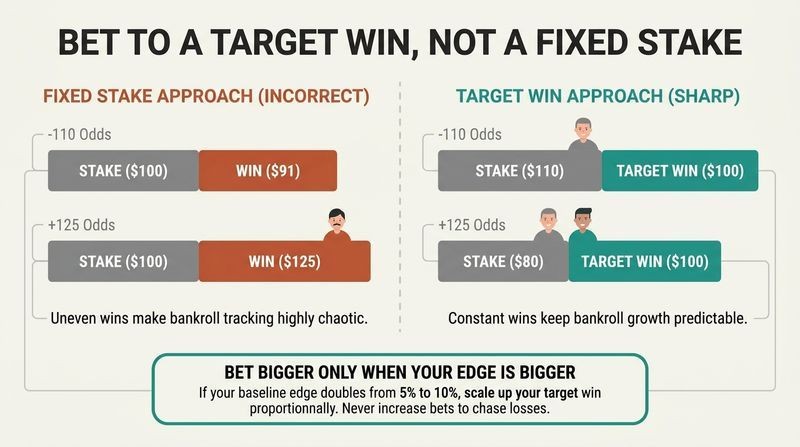
Hold your win amount constant, not your stake. Wong flips conventional thinking. Instead of always wagering the same dollars, decide how much you want to win (your MinWin) and let the odds determine the stake. Want to win $100? At -110, bet $110. At -160, bet $160. At +125, bet only $80. At 20:1, bet just $5.
Bet bigger only when your edge is bigger. If your MinEdge is 5% and you find a bet worth 10%, that is double your edge, so you can double your stake. The framework echoes the Kelly Criterion, the bankroll-growth formula published by John Kelly in 1956. Wong suggests a MinWin of 1.5% to 2.5% of your bankroll per bet. Wanting to get even after losses is never a valid reason to bet more.
The Kelly Criterion is the mathematical backbone here, and it appears everywhere from hedge funds to Ed Thorp's card-counting empire. Its genius is proportional betting: stake scales with edge and shrinks with odds, maximizing long-run geometric growth while mathematically preventing ruin. But Kelly is notoriously aggressive, and full-Kelly bettors endure stomach-churning swings. Wong wisely adds a human override: if a wager costs you sleep, you have bet too much regardless of the math. This is where quantitative finance meets psychology. The optimal bet size on paper is often larger than the optimal bet size for a human nervous system, a tension every practitioner must negotiate.
Sportsbooks don't want balanced action; they exploit the crowd
The balanced-book myth is mostly wrong. Popular belief says bookmakers set lines to split money evenly and pocket the vig risk-free. Wong reports that MGM's sportsbook director confirmed the opposite: books happily take lopsided action when the heavily bet side is likely to lose. On roughly half of NFL games, most opinionated bettors pile onto the same team.
Lines are shaded against the public. Because casual bettors (squares) love favorites, books nudge spreads to make favorites slightly overpriced. A manager who thinks Baltimore has a 50% chance to cover -7.5 might hang -8.5 or -9, knowing squares bet Baltimore anyway. This squeezes extra profit from the crowd, even if it draws a little sharp money to the other side. The line is set for maximum expected profit, not balance.
This overturns the textbook model taught in most gambling primers and aligns with modern research on betting-market inefficiency. Studies of NFL closing lines confirm a persistent favorite-longshot bias and public-team shading. The bookmaker behaves less like a neutral market-maker and more like a casino running a game with a known house edge, willing to carry directional risk because diversification across hundreds of games smooths variance. The parallel to market-making in finance is imperfect precisely here: a stock exchange truly wants flow balance, but a sportsbook is both venue and counterparty. Recognizing this tells sharp bettors to look for value on unpopular dogs the public ignores.
Beating the line requires private news or superior processing
Sports betting is like beating the stock market. Lines, like stock prices, reflect the collective wisdom of everyone betting. To profit, you need one of two things: information not yet public, or a superior ability to process public information. Betting on the Lakers, a heavily analyzed team, is like trading Apple stock: nearly impossible to beat. But an obscure college conference is like a small-cap stock nobody follows.
Attack the games nobody watches. Wong advises avoiding the over-analyzed NFL and instead mastering a small college basketball conference where linesmakers lack time, not information. Three edges exist:
1. Breaking news (injuries, food poisoning) acted on before the line moves
2. Superior analysis of existing data
3. Player motivation the numbers miss
The efficient-market analogy is the book's intellectual spine and remarkably sophisticated for a betting guide. It anticipates the academic literature treating betting markets as natural laboratories for testing market efficiency, where the arrival of a definitive outcome makes them cleaner than stock markets. The small-cap insight is genuinely actionable: inefficiency concentrates where attention is scarce. This is the same logic value investors use hunting neglected micro-cap stocks. One caveat Wong himself flags: the internet has steadily eroded these pockets. What was exploitable in 2001 (a mispriced overnight college total) is far harder now that syndicates scrape lines algorithmically. Edges decay as markets mature.
Bet the home dog, and fade the beloved local team
Home underdogs quietly outperform. Across NFL games since 1985, all the excess wins earned by underdogs went to home dogs, which covered about 52.7% of the time. Most bettors hunt for reasons to back a team rather than against one, and they gravitate to favorites, so books shade lines accordingly. If forced to bet blind, take the biggest home dog available.
Fan money creates fadeable bubbles. When crowds bet with their hearts, prices distort. When the Lakers were 1:6 to win the 2000 title, backing their opponents became profitable. Fezzik bet against soccer star Mia Hamm scoring because her fans overbet the yes. In the 1988 Kentucky Derby, Winning Colors paid $8.80 in Kentucky but only $4.40 in her home California, the same horse, same race.
The Winning Colors example is a beautiful natural experiment in behavioral finance, since pari-mutuel pools were regionally segregated, revealing local sentiment as a pure price distortion. This is home bias, the same phenomenon where investors overweight domestic stocks, transplanted to the racetrack. The fan-money thesis connects to the noise-trader literature: when emotionally motivated participants flood a market, informed traders profit by taking the other side. The nuance worth flagging: as Wong concedes, blindly fading every popular team is not a system, and the internet has globalized betting pools, diluting the local-fan effect that made Winning Colors so lopsided. Sentiment edges are real but shrinking.
A hot record proves nothing until it clears the 1-in-1000 bar
Small samples lie constantly. A gambler bragging about a 27-8 record sounds impressive, but Wong applies the binomial distribution to ask: how often would pure luck produce this? The standard 5% significance test (two standard errors) is far too weak for betting, because if you examine 100 random angles, five will pass by chance alone. This false-pattern hunting is called data mining, and its products are worthless angles.
Demand extraordinary proof. For systems tested on past games, Wong insists on a 1-in-1000 rarity threshold, roughly four standard errors. Crucially, you must test a hypothesis on games never used to form it, just as a roulette system built from 100 spins cannot predict the next 100. And you cannot cherry-pick: if 14-1 becomes 15-5 after five more games, the record is 15-5, period.
This chapter is the book's most transferable lesson, essentially a crash course in avoiding p-hacking decades before that term entered common use. The roulette analogy nails the core error: overfitting noise and mistaking it for signal. Modern replication-crisis research in psychology and medicine has validated exactly Wong's worry, that testing many hypotheses against fixed data manufactures false positives at the nominal significance rate. His insistence on out-of-sample validation is the same principle machine-learning practitioners enforce with train-test splits. Any reader who internalizes this will make sharper decisions far beyond betting, from evaluating trading strategies to reading dubious health headlines built on tortured subgroup analysis.
Parlays enrich the book unless you already beat straight bets
Parlays multiply both payoff and vig. A parlay links multiple bets; all must win or you lose everything. The typical two-team parlay pays 13:5 and the three-team pays 6:1. For a coin-flip bettor, this is a disaster: the house edge balloons from 4.5% on straight bets to 10% on two-teamers and 18.75% on four-teamers.
But parlays reward genuine skill. If you can already beat straight bets at -110, parlays amplify your edge. A bettor with two independent 55% picks earns 5% on each straight but 8.9% parlaying them at 13:5. The real prize is the correlated parlay, where outcomes are linked, like a stingy-defense underdog paired with the game going under. Sportsbooks refuse obvious correlations, so hunt for ones they permit.
Correlation is the concept that elevates this chapter from arithmetic to strategy, and it maps directly onto portfolio theory. In finance, diversification reduces risk by combining uncorrelated assets; in parlay betting, the sharp move is the opposite, deliberately seeking positive correlation so that if one leg hits, the other is likelier to hit too. Wong's St. Louis vs. Tampa Bay example, where the total and the side both hinged on whether one dominant offense could be stopped, is a clean illustration. The sportsbook manager who invoked covariance to cap the bet at $100 shows the house understands this game theoretically, which is why such edges are jealously guarded and quickly closed.
Turn one predicted average into exact probabilities with Poisson
Rare events counted one at a time follow Poisson. For prop bets on how many field goals, sacks, or penalties occur, Wong deploys the Poisson distribution, the math for events that happen individually with low per-chance probability but many chances. Feed in your predicted average and it outputs the odds of every outcome. Predict 4.7 sacks and you can calculate an exact 33% chance of more than five.
Three steps turn judgment into money. First, predict the average number of occurrences. Second, convert that average into win probabilities via Poisson tables. Third, compare to the offered odds to quantify your edge. It even handles matchups: two teams averaging 2.2 and 1.2 field goals yield a 60% chance the first kicks more. Garbage in, garbage out, though: the math is only as good as your prediction.
This is where the book's quantitative rigor peaks, borrowing a tool developed by Simeon Poisson in the 1830s for modeling rare events like wrongful convictions, later famous for predicting Prussian soldiers killed by horse kicks. Its application to prop bets is clever because props are precisely where books spend the least effort, creating soft lines a diligent bettor can exploit. The honest constraint Wong stresses is that Poisson only fits genuinely one-at-a-time events: yards and basketball points scored in bunches violate its assumptions. This discipline about when a model applies, rather than force-fitting it everywhere, is exactly the statistical maturity that separates competent quants from dangerous ones.
In the NFL, 3 and 7 are the numbers that decide bets
Football scores cluster on key numbers. Because touchdowns and field goals come in threes and sevens, NFL margins pile up on specific numbers. A margin of exactly 3 happens about 10% of the time when a team is favored by around three points. Numbers 7, 10, 14, and 17 also matter, while 0, 2, 8, 9, 12, and 13 are rare.
Half a point around 3 is gold. This makes buying a half point (paying worse odds to move the spread) worthwhile only near key numbers. Moving from -3.5 to -3, or +2.5 to +3, is worth paying up to 20 cents. Home teams enjoy a consistent three-point edge already baked into every line, so the value lies in spotting games where that advantage runs larger or smaller than average.
Key-number theory is the most sport-specific insight in the book and has since become gospel among professional football bettors. The clustering is a direct artifact of the scoring system, an example of how institutional rules shape statistical distributions, much as tax brackets create bunching in reported income. The practical upshot is that a half point is not worth a fixed price; its value is entirely contextual, spiking near 3 and near 7 and worthless near 8. This teaches a broader lesson about marginal value: identical-looking increments (half a point) carry wildly different worth depending on where they fall in a distribution's density.
Teasers only pay when they capture both the 3 and the 7
A teaser trades points for lower payouts. In a teaser you shift the spread in your favor, typically six points, but must win multiple legs at reduced odds. Teasing random teams is a loser: over 1999-2010, six-point teased teams covered only 66.8%, short of the roughly 70% break-even. So most teasers feed the house.
The winning trick is targeting key numbers. Wong's data shows teasing teams whose six extra points capture both 3 and 7, meaning favorites of -7.5 to -8.5 and dogs of +1.5 to +2.5, pushed cover rates to roughly 73%, enough to beat generous lines. Two more rules: shop hard for the best teaser terms, and never tease two teams playing each other, since forcing at least one to cover lowers the odds both do.
The teaser chapter is a masterclass in disciplined edge-hunting: an entire betting type that is a sucker play in general but profitable in a narrow, well-defined slice. The 3-and-7 filter is really key-number theory applied twice, and its later popularization as the Wong teaser cemented the author's influence. The advice against teasing opposing teams is a subtle probability point worth savoring: correlation cuts against you here, the mirror image of the correlated-parlay strategy. What is sobering is how such published edges self-destruct. Once books learned to post off lines for teaser legs, stripping the 3 from the teased spread, the documented advantage largely evaporated, a reminder that public strategies have shelf lives.
Offshore books can void your winners; Nevada tickets always pay
A winning ticket is only as good as the book behind it. Wong details how offshore internet sportsbooks cancel bets when lines move your way, void futures after the fact claiming system errors, and quietly limit or ban winners. One bettor had XFL futures at 5:1 and 15:1 voided days before the games. Another got an email closing his account because his luck had exceeded the casino's tolerance.
Undercapitalization and Ponzi dynamics lurk. Some offshore books pay winners with new depositors' money, working on the float, and collapse when the math catches up. By contrast, a Nevada ticket gets paid in hundred-dollar bills immediately, even if the posted number was a mistake. The practical defenses: shop many books, cash out sparingly, stay polite, avoid looking like a bonus hustler, and consult watchdog sites before depositing.
This chapter reads like a field guide to counterparty risk, the same danger that felled clients of collapsed crypto exchanges decades later. The structural problem is jurisdictional: an offshore book operating beyond any court you can reach owes you nothing enforceable, so your deposit is effectively an unsecured loan to a party incentivized to keep it. The behavioral cruelty Wong exposes is that these operations punish exactly the skilled winners a legitimate market would tolerate, revealing they are not really markets but casinos harvesting losers. The enduring lesson transcends betting: in any unregulated venue, the counterparty's willingness and ability to pay matters as much as being right.
Analysis
Sharp Sports Betting is best understood not as a gambling manual but as an applied statistics and market-efficiency textbook wearing a sportsbook's clothing. Stanford Wong, a Stanford PhD who financed graduate school counting cards, imports the analytical apparatus of quantitative finance (expected value, the Kelly Criterion, hypothesis testing, the Poisson and binomial distributions) into an arena where most participants operate on hunches. The book's structure splits cleanly: a general first half on money management, market dynamics, and statistical rigor, and an NFL-specific second half dense with tables on key numbers, teasers, and spread-to-moneyline conversions.
What makes the book intellectually durable is its central metaphor: betting lines are prices set by a market, and beating them requires the same two edges that beat the stock market, private information or superior processing of public information. This framing is more sophisticated than most academic treatments of its era and yields the book's most actionable strategic advice, hunt neglected markets where linesmakers lack time rather than information, mirroring value investing in small-cap stocks.
The book's greatest strength is also its vulnerability: its edges are empirical and therefore perishable. Home-dog value, fan-money bubbles, soft prop lines, and profitable teasers all depend on inefficiencies that internet betting, syndicate scraping, and the books' own countermeasures have steadily eroded since 2001. Wong is admirably honest about this, repeatedly noting that finding great bets has grown harder.
Two lessons transcend the subject entirely. First, the statistical-significance chapter is a rigorous inoculation against p-hacking and overfitting, valuable to anyone evaluating claims from any dataset. Second, the treatment of offshore books is a vivid primer on counterparty risk. The book demands numeracy and offers no shortcuts, which is precisely why its intellectual honesty about the difficulty of winning distinguishes it from the tout industry it quietly indicts.
Review Summary
Sharp Sports Betting receives mixed reviews, with an average rating of 3.66/5. Praised for its introductory content on sports betting basics, particularly NFL betting, and its clear explanations of key concepts. Some readers find it invaluable for beginners and intermediate bettors, while others criticize it for being outdated and lacking depth in mathematical explanations. The book is recommended as a starting point for those new to sports betting, but readers are advised to seek additional resources for a comprehensive understanding of betting strategies.
FAQ
1. What is Sharp Sports Betting by Stanford Wong about?
- Comprehensive sports betting guide: The book serves as a detailed manual for understanding and profiting from sports betting, covering both general principles and NFL-specific strategies.
- Mathematics and strategy focus: It explains the math behind betting, including odds, expected value, and probability distributions, to help readers make informed decisions.
- Practical application: The book provides actionable advice on bet types, money management, and exploiting market inefficiencies, aiming to turn readers into sharper, more disciplined bettors.
- Not a get-rich-quick scheme: Wong emphasizes that there are no magic formulas, but rather a need for sound mathematical reasoning and disciplined execution.
2. Why should I read Sharp Sports Betting by Stanford Wong?
- Expert author credentials: Stanford Wong is a respected gambling author with a Ph.D. from Stanford, known for his expertise in both blackjack and sports betting.
- Mathematical and practical insights: The book blends theoretical knowledge with real-world betting advice, making it valuable for both beginners and experienced bettors.
- Focus on long-term success: Readers learn about expected value, break-even rates, and bankroll management, which are essential for sustained profitability.
- Covers modern betting landscape: The book addresses online betting, legal considerations, and how to navigate bonuses and promotions safely.
3. What are the key takeaways from Sharp Sports Betting by Stanford Wong?
- Understand the math: Mastering odds, expected value, and probability is crucial for making profitable bets.
- Discipline and record-keeping: Wong stresses the importance of disciplined money management and keeping detailed records to evaluate betting performance.
- Market inefficiencies: The book teaches how to spot and exploit inefficiencies caused by fan money, emotional betting, and mispriced lines.
- No shortcuts: Success comes from careful analysis, not from chasing trends or relying on untested systems.
4. What are the main types of sports bets explained in Sharp Sports Betting?
- Straight bets and spreads: The book covers betting against the spread, money lines, and totals, explaining how each works and the math behind them.
- Parlays and teasers: Wong details how parlays and teasers function, their risks, payoffs, and when they might be advantageous.
- Props and futures: Proposition bets and futures are explained, including how to evaluate their expected value and when they offer profitable opportunities.
5. How does Stanford Wong define and apply expected value (EV) in sports betting?
- Definition of expected value: EV is the average result of a bet if repeated many times, calculated using probabilities and payoffs.
- Calculating EV: The book provides formulas and examples for determining whether a bet is profitable based on the odds and likelihood of winning.
- Application to all bet types: Wong shows how to use EV for straight bets, parlays, teasers, props, and futures, emphasizing its central role in decision-making.
- Break-even analysis: He explains how to find the win percentage needed to break even at various odds, helping bettors avoid unprofitable wagers.
6. What money management strategies does Sharp Sports Betting by Stanford Wong recommend?
- Edge and MinWin concepts: Wong introduces the idea of only betting when you have a positive expected value (edge) and setting a minimum win size (MinWin).
- Varying bet sizes: He advocates adjusting bet sizes based on the strength of your edge and the terms of the bet, rather than flat betting.
- Bankroll protection: Bets should be sized as a percentage of your bankroll (typically 1.5% to 2.5% for a 5% edge) to minimize the risk of ruin.
- Discipline and record-keeping: Careful tracking of bets and results is essential for long-term success and improvement.
7. How does Sharp Sports Betting by Stanford Wong use probability distributions like Poisson and binomial in betting analysis?
- Modeling countable events: The Poisson distribution is used to estimate the probability of discrete events (e.g., sacks, field goals) in a game.
- Season-win and prop bets: The binomial distribution helps analyze season-win bets and the likelihood of hitting certain totals or middles.
- Practical tools: Wong provides tables and recommends using Excel for calculations, making these concepts accessible for bettors.
- Application to real bets: These distributions allow bettors to estimate probabilities and expected values for proposition and season-long bets.
8. What advice does Sharp Sports Betting by Stanford Wong give for betting on the NFL?
- Home-field advantage: The book explains the average three-point home-field edge and how to adjust for situational factors like motivation and weather.
- Money lines and spreads: Wong details how to translate point spreads into money line odds and when each bet type offers better value.
- Totals and middles: He provides data on scoring frequencies and explains how to evaluate over/under bets and middle opportunities.
- Teasers and correlated bets: The book discusses when teasers are profitable, especially when they cross key numbers like 3 and 7, and warns against random teaser betting.
9. How does Sharp Sports Betting by Stanford Wong approach handicapping and finding an edge?
- Information and analysis: Wong compares sports betting to stock trading, emphasizing the need for either superior information or better analysis of public data.
- Motivation and situational factors: He highlights the importance of player motivation, team morale, and other situational edges often missed by sportsbooks.
- Probability thinking: Bettors are encouraged to think in terms of probabilities, not just picking winners, and to seek bets where the true chance of winning exceeds the implied odds.
- Testing and skepticism: The book stresses hypothesis testing, statistical significance, and avoiding data mining pitfalls.
10. What does Sharp Sports Betting by Stanford Wong say about the influence of fan money and market biases?
- Fan money skews lines: Popular teams and athletes attract emotional bets, causing sportsbooks to adjust lines and create value on the less popular side.
- Geographic and event biases: Teams near Las Vegas or with large fan bases often have lines shaded against them, offering opportunities for sharp bettors.
- Exploiting inefficiencies: Wong provides examples of profitable situations created by fan money, such as betting against overrated favorites.
- Importance of line shopping: He advises bettors to compare lines across sportsbooks to maximize value and exploit market biases.
11. How does Sharp Sports Betting by Stanford Wong evaluate parlays, teasers, and correlated bets?
- Parlays and their risks: Parlays combine multiple bets for higher payoffs but usually carry higher vig, making them unfavorable for most bettors.
- Teasers and key numbers: Teasers can be profitable if they cross key margins (like 3 and 7 points), but random teasers are generally losing propositions.
- Correlated parlays: Wong discusses situations where outcomes are linked (e.g., halftime and full-game results) and how to exploit these correlations when possible.
- Strategic use only: He recommends using parlays and teasers only when you have a clear edge or can exploit correlation, not as a default strategy.
12. What practical tools, resources, and appendices does Sharp Sports Betting by Stanford Wong provide for bettors?
- Probability tables and appendices: The book includes Poisson and binomial probability tables, as well as joint probability tables for two variables.
- Sample problems and solutions: Readers can practice with real-world betting scenarios and check their understanding with provided solutions.
- Glossary of terms: A comprehensive glossary helps readers master betting terminology and concepts.
- Online resources: Wong references websites like BJ21.com for additional tools and expanded tables to assist with calculations and analysis.
Download PDF
Download EPUB
.epub digital book format is ideal for reading ebooks on phones, tablets, and e-readers.








































