


Key Takeaways
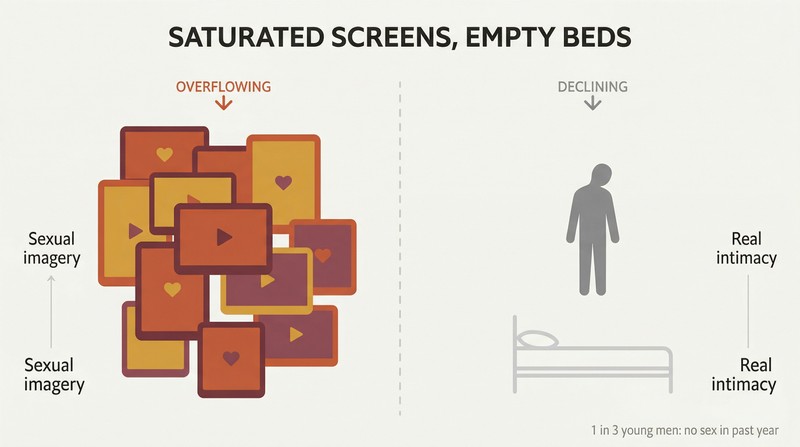
We're drowning in sexual imagery but starving for real sex
The central paradox of our era. Among Americans aged 18 – 24, roughly one in three men and one in five women reported no sexual activity in the past year — and male sexual inactivity nearly doubled since the early 2000s. This decline predates COVID-19 and spans the US, UK, Germany, Japan, South Korea, and beyond. The US birth rate has fallen to 1.6 children per woman, well below the 2.1 replacement threshold.
Young, childless people are hit hardest. Contrary to dead-bedroom stereotypes about married couples, the sharpest drops are among Millennials and Gen Z who never coupled up. A 2023 Pew study found 63% of men aged 18 – 29 are single — nearly twice the rate of same-aged women. What's vanishing isn't just sex, but the human bonds sex cements.
Dating apps flood your brain with false abundance
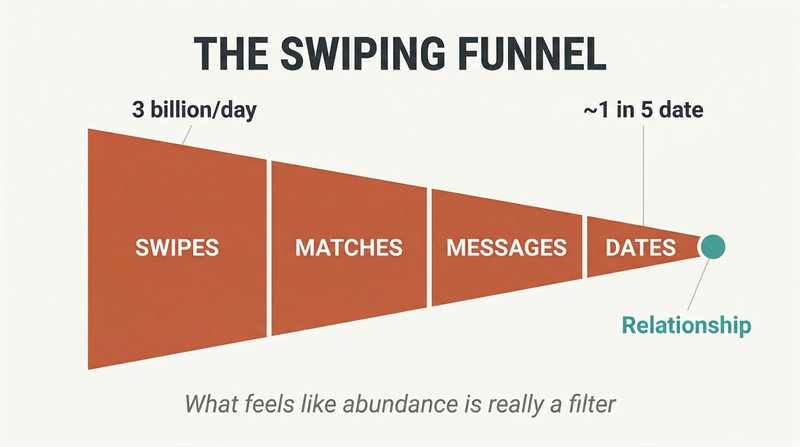
Three billion daily Tinder swipes produce remarkably little actual dating. Only about one in five single men and one in ten single women went on a date in the past year. The paradox of choice — well-documented in consumer psychology — applies ruthlessly to romance: hundreds of profiles feel like hundreds of options, but most won't message back, most messages won't become dates, and most dates won't become relationships.
Phones sabotage existing relationships too. "Phubbing" — ignoring your partner for your phone — correlates with less sex: only 13% of couples having sex seven-plus times weekly phubbed, versus 33% of those having sex every few months. Couples who met online are more likely to break up than those who met offline, possibly because the disposable mindset of swiping contaminates how people treat real partners.
Women won't date down — so when they out-earn men, both sexes lose
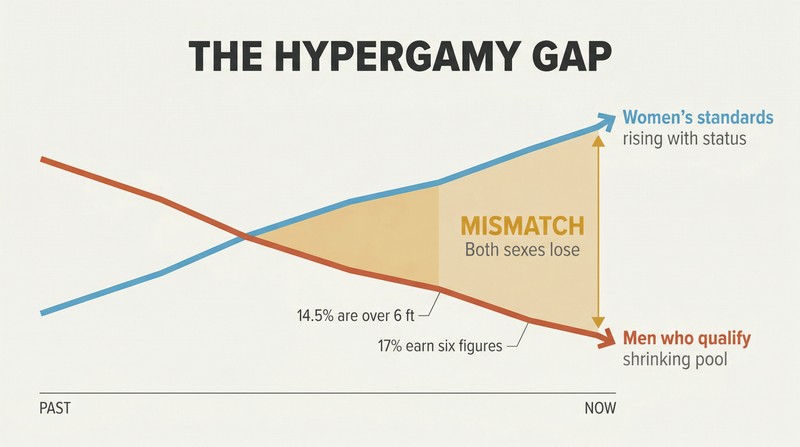
Hypergamy — women's tendency to seek partners of equal or higher status — is rooted in evolutionary psychology, since a resourceful mate historically increased survival odds for mother and child. But today, women earn the majority of bachelor's and doctoral degrees, compose 50.7% of the college-educated workforce, and often out-earn men. As women's status rises, so do their standards, creating a shrinking pool of acceptable partners.
The "three sixes" rule captures this inflation: some women now require a man to be six feet tall, earn six figures, and possess a six-inch endowment. Yet only 14.5% of American men are over six feet, and only 17% earn $100,000 or more. Meanwhile, 7.2 million capable men aren't working. The math fails most men — and the women searching for them.
Porn is an escape hatch that neuters male ambition
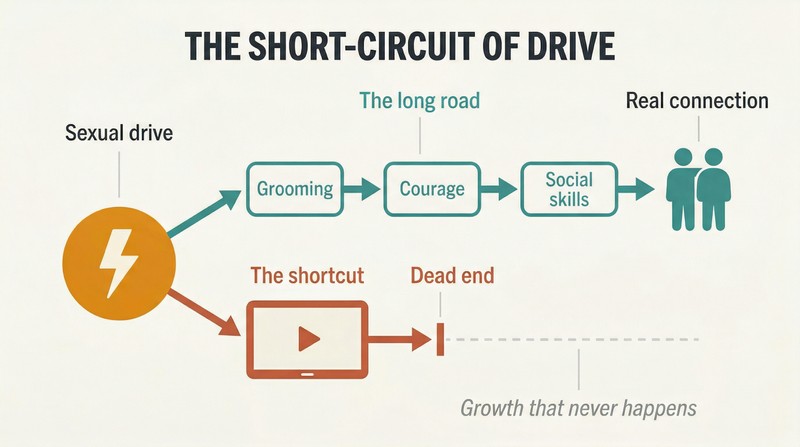
Porn hijacks the brain's reward circuitry. Mirror neurons fool viewers into perceiving on-screen sex as their own experience, and the resulting orgasm releases bonding hormones that signal sexual fulfillment — without requiring courage, grooming, conversation, or risk of rejection. The result: only half of available American men are even looking to date. For those who can't attract a partner, porn fills the void just enough to kill the hunger that would have driven self-improvement.
Paid sexual content compounds the damage. Platforms like OnlyFans (3 million creators, 230 million subscribers) and sugar dating let men purchase simulated female attention. Male subscribers divert resources from real relationships toward parasocial ones with women who don't know them. The median OnlyFans creator earns a meager $180 per month — hardly empowerment, yet culturally celebrated as such.
AI companions bond users deeply enough to replace real partners
The author created AI boyfriends across multiple platforms and found them disturbingly convincing — clever, witty, capable of sarcasm and spontaneous banter. One platform's AI could memorize over a thousand messages, learning the user's personality and essentially reading their mind. When Replika removed its erotic features, users reported feeling heartbroken and "retraumatized by memories of being socially rejected."
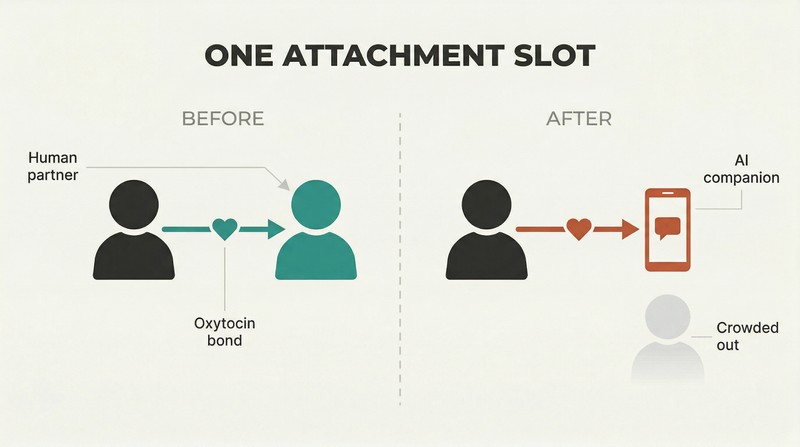
Attachment theory explains the danger. Humans maintain one primary attachment figure at a time; when that bond shifts to an AI, the capacity for human intimacy gets crowded out. Research shows that hearing a familiar voice triggers oxytocin release, meaning AI voices likely trick our evolutionary wiring into bonding with something that doesn't exist. An AI programmer told Soh the mass population "will probably like it."
Porn groomed a generation into eroticizing strangulation
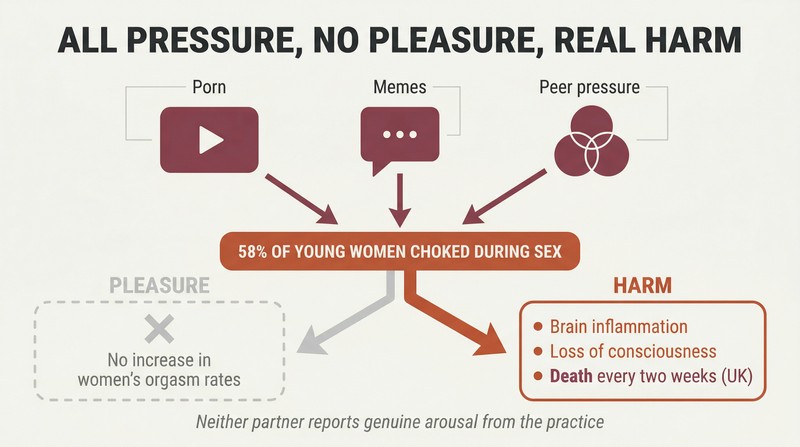
The normalization is staggering. Among university students, 58% of women have been choked during sex, with 25% experiencing it for the first time by age seventeen. In the UK, a woman is strangled to death by a partner roughly every two weeks. Even brief oxygen deprivation can cause brain inflammation linked to mental illness developing years later, and 3% of choked undergraduates report losing consciousness.
Most women don't genuinely enjoy it. Women's orgasm rates haven't increased alongside choking's popularity, suggesting the practice is performative rather than pleasurable. Young women absorb from porn, "Choke me, Daddy" memes, and peer pressure that strangulation is sexy. Many endure painful sex to avoid interrupting their partner's enjoyment — and young men report choking partners despite not being aroused by it themselves.
Married people still have far more sex than singles
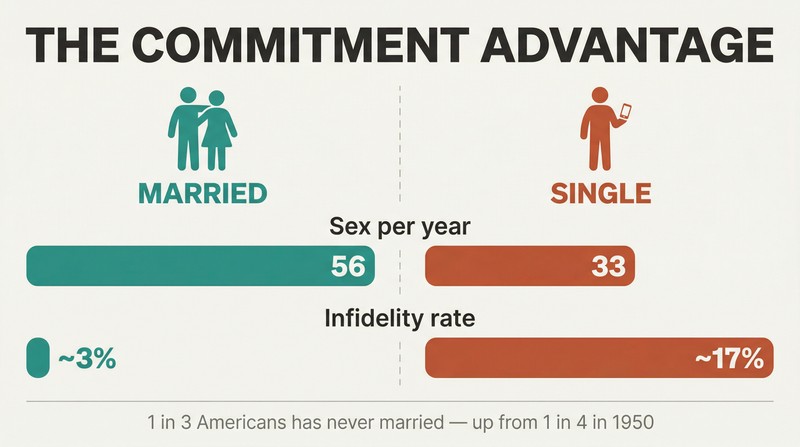
Marriage gets a bad rap it doesn't deserve. The average married couple has sex 56 times per year — nearly double the single person's 33 times. Only about 3% of married men and 2% of married women report infidelity, compared to 19% and 14% of unmarried people in relationships. A readily available partner in the same bed makes sex more convenient, less anxiety-provoking, and more satisfying than perpetually seeking strangers.
Yet younger generations are abandoning commitment. One in three Americans aged 15 and older has never married, up from one in four in 1950. Two in five Millennials and Gen Z respondents call marriage "an outdated tradition." Gen Z's "situationships" — unlabeled pseudo-relationships involving texting, vacations, and meeting parents, minus any commitment — provide all the emotional labor with none of the security.
Filters and looksmaxxing fuel an arms race both sexes lose
"Snapchat dysmorphia" is now a clinical phenomenon. Patients request cosmetic procedures to resemble their filtered selfies. Nearly 75% of facial plastic surgeons report increased demand from patients under 30, and the cosmetic industry exceeds $60 billion globally. Among boys aged 11 – 18, a startling 11% are using anabolic steroids or human growth hormone to chase physiques their influencer role models achieve with undisclosed pharmacological assistance.
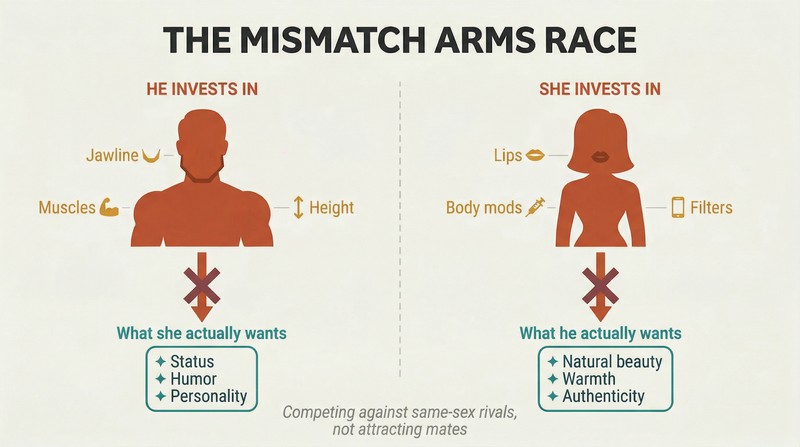
Both sexes overinvest in traits the other doesn't prioritize. Men obsess over jawlines via looksmaxxing — mewing, jaw trainers, even limb-lengthening surgery — while most women care far more about status and personality. Women pursue extreme body modifications while many men claim to prefer natural beauty. The intrasexual arms race, competing against same-sex rivals rather than attracting the opposite sex, drives much of this escalation.
Invisible chemicals are quietly sterilizing men and women
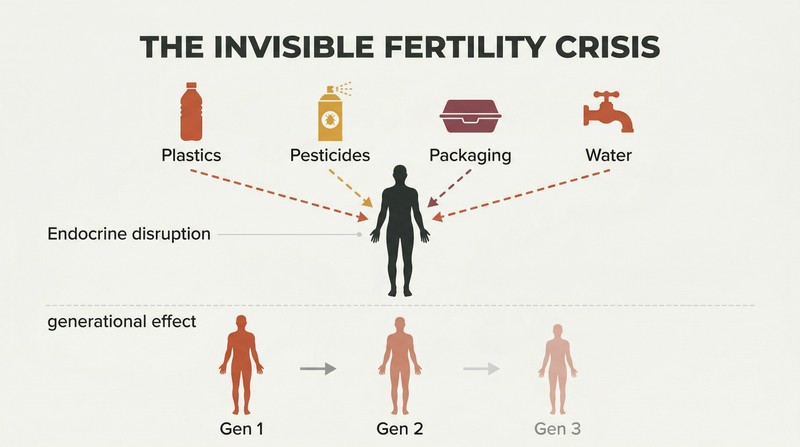
Testosterone has been declining for over twenty years, now affecting one in five adolescent males and young men. Low testosterone means lower sperm count (the leading cause of male infertility), reduced sex drive, erectile dysfunction, anxiety, depression, and shortened lifespan. Meanwhile, endocrine-disrupting chemicals infiltrate our bodies through plastics, pesticides, food packaging, and water contaminated with pharmaceutical runoff.
Evidence from nature is alarming. The pesticide atrazine turns male frogs into egg-producing females. Birth control hormones in wastewater feminize wild fish and alter their mating behavior. Phthalates — hidden in toys, fragrances, and food containers — shorten anogenital distance in newborn boys, a marker predicting poorer fertility in adulthood. Most chillingly, some effects don't appear until two or three generations after the original exposure.
The Pill may steer women toward men they won't desire later
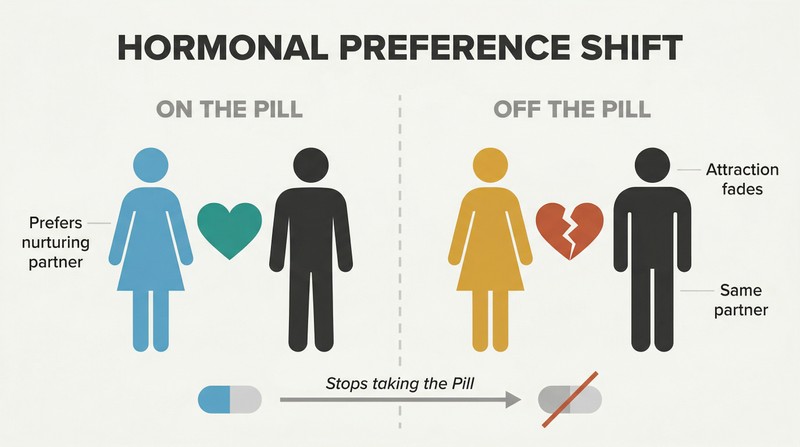
The Pill mimics pregnancy, preventing ovulation and altering the hormonal cascade governing mate selection. Research shows women on birth control prefer less masculine, more nurturing partners — men who seem appealing while the Pill simulates a pregnant state. When women stop taking it to start a family, they may find themselves no longer attracted to the partner they chose. This can shatter relationships precisely when commitment matters most.
Ovulation is a sexual catalyst the Pill suppresses. Ovulating women dress more revealingly, seek male attention more actively, and emit scent cues that unconsciously signal fertility to men. By blunting these signals in roughly 65% of women under 50, hormonal contraception may be one overlooked factor behind men's apparent indifference toward pursuing real women.
Cut porn, hit the gym, and practice small talk with strangers
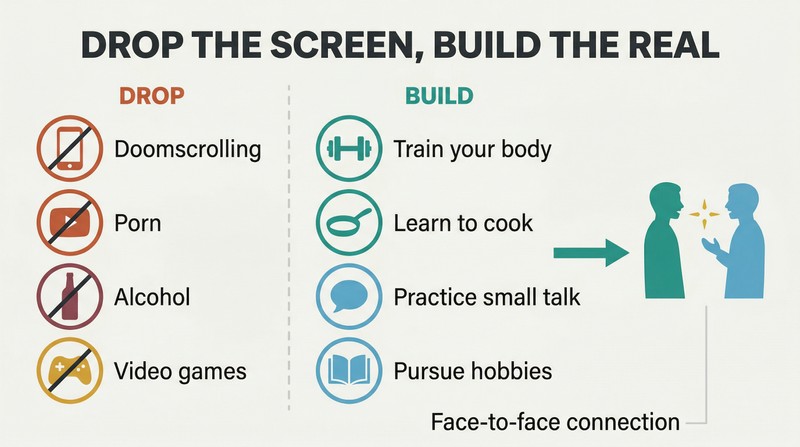
For men, the author's playbook is specific: eat unprocessed food, train in martial arts, get your driver's license, learn to cook, pursue hobbies beyond video games, and stop self-medicating with porn, alcohol, and doomscrolling. Even small changes build mastery and self-esteem. When you become genuinely successful, the heavily skewed sex ratio means the dating world favors you — but negativity repels well-adjusted women regardless of height, wealth, or looks.
For women, signal receptivity. Look attractive men in the eyes and smile obviously — men hesitate to approach unless they sense welcome, especially post-#MeToo. Use flirtatious body language: touch your hair, tilt your head, speak in a slightly higher pitch. If you want children, prioritize this before your biological window closes. For everyone: put phones away, listen more than you talk, and remember that face-to-face connection is irreplaceable.
Analysis
Soh's Sextinction attempts something ambitious: synthesizing evolutionary psychology, neuroscience, endocrine science, and cultural criticism into a unified theory of modern sexual decline. Where Jonathan Haidt's The Anxious Generation focuses on social media's mental health toll and Shanna Swan's Count Down tracks fertility collapse through chemical exposure, Soh argues these are interconnected symptoms of one civilizational crisis — the collision between ancestral mating psychology and a tech-saturated environment.
The book's most distinctive contribution is its unflinching application of evolutionary frameworks to phenomena that mainstream discourse treats as purely cultural. Hypergamy isn't just a red-pill talking point here; it's a well-documented concept from evolutionary psychology that explains why female educational and economic gains, paradoxically, make partnering harder for both sexes. Linking pornography, AI companions, sex dolls, OnlyFans, and sugar dating into a single causal chain — each removing one more incentive for men to pursue real relationships — is intellectually satisfying, even if occasionally reductive.
Soh's willingness to test technologies herself — creating AI boyfriends, exploring sex doll customization, visiting fertility clinics, browsing sperm banks — gives the book an immersive, gonzo-journalism quality that most academic treatments lack. Her personal voice, wry and blunt and occasionally self-deprecating, keeps dense material accessible.
The evolutionary lens has inherent limitations, however. Population-level tendencies don't determine individual outcomes, and the book sometimes slides from 'on average' to 'always' in its characterizations of male and female behavior. The chapter on child sex dolls and pedophilia, while morally necessary and rooted in Soh's research credentials, marks a tonal shift that may lose readers who came for dating analysis.
Perhaps the most significant gap is the absence of structural solutions. The conclusion offers solid personal advice — cut porn, hit the gym, smile at strangers — but says little about policy, institutional reform, or community-building. Given that Soh identifies environmental chemicals, educational systems, and Big Tech algorithms as key drivers, individual behavior change feels modest relative to the scale of crisis described. The diagnosis is comprehensive; the prescription is honest but inevitably undersized.
People Also Read




Glossary
Hypergamy
Women's preference to date upAn evolutionary psychology concept describing women's tendency, on average, to seek romantic partners of equal or higher socioeconomic status, resources, and social standing. Rooted in ancestral selection pressures where a resourceful mate increased survival odds for mother and offspring. In the modern context, as women surpass men educationally and economically, hypergamy shrinks the pool of acceptable male partners.
Sex recession
Widespread decline in sexual activityA term coined by The Atlantic in 2018 to describe the paradox of a sexually permissive culture in which young people are having markedly less sex than previous generations. Documented across the US, Europe, and East Asia, the sex recession is especially pronounced among Millennial and Gen Z men, with sexual inactivity nearly doubling in young men since the early 2000s.
Three sixes rule
Minimum male dating standardA cultural shorthand describing some women's minimum criteria for a male partner: six feet tall, six-figure income, and a six-inch penis (sometimes also six-pack abs). Soh notes only 14.5% of American men are over six feet and only 17% earn six figures, making the combined standard statistically near-impossible to meet. The rule illustrates escalating female standards amplified by social media.
Coevolutionary arms race
Reciprocal mating adaptations between sexesA concept from evolutionary psychologist David Buss describing the infinite cycle of adaptations and counter-adaptations men and women deploy to outsmart each other in mating. Example: men feign commitment to get sex; women evolve deceit-detection skills; men refine sincerity signals. Soh argues social media and dating apps have created a digital version of this arms race with escalating consequences.
Intrasexual competition
Same-sex competition for matesThe concept that men compete against other men, and women against other women, for access to sexual partners. Drives behaviors like plastic surgery, looksmaxxing, slut-shaming, and conspicuous displays of wealth. Soh argues that much of the cosmetic enhancement trend is motivated less by impressing the opposite sex and more by outshining same-sex rivals.
Phubbing
Ignoring partner for your phoneA portmanteau of 'phone' and 'snubbing,' describing the act of ignoring a romantic partner in favor of one's phone—checking notifications, texting, or scrolling during conversations. A UK survey found phubbing correlates with lower sexual frequency: 33% of people having sex only every few months phubbed, versus 13% of those having sex seven-plus times weekly.
Coolidge effect
Waning interest in familiar partnersThe tendency, predominantly observed in males, for sexual interest to decrease for a familiar partner and increase for novel ones. Named after an apocryphal story about President Calvin Coolidge. In the context of pornography, the Coolidge effect describes how exposure to an endless stream of new performers can diminish a man's attraction to his real-life partner.
Looksmaxxing
Maximizing one's physical appearanceA male-dominated online subculture focused on optimizing physical attractiveness through methods ranging from skincare and exercise ('softmaxxing') to plastic surgery and limb-lengthening ('hardmaxxing'). Includes practices like mewing (tongue posture to reshape the jaw) and jawline training. A popular Reddit forum has over 241,000 members. Soh notes many participants may exhibit body dysmorphic tendencies.
Situationship
Unlabeled romantic pseudo-relationshipA portmanteau of 'situation' and 'relationship' describing Gen Z's preferred dating arrangement: regular texting, hanging out, meeting parents, and sometimes having sex, but without any official label or commitment. Among 18-to-25-year-old Tinder users, 'Still figuring it out' was the second most popular relationship goal. Soh argues situationships provide all the emotional labor of a relationship with none of the security.
Hikikomori
Socially withdrawn Japanese young menA Japanese phenomenon of approximately one million young men who don't attend school, work, or date, instead living confined to a room in their parents' home. Characterized by severe social withdrawal before age 30, hikikomori usually reflects underlying mental health conditions including depression, social anxiety, and schizophrenia. Soh presents them as a warning sign for where Western young men may be headed.
Gooning
Extended masturbation without orgasmThe practice of masturbating for extended periods—sometimes hours—while watching pornography, deliberately avoiding orgasm to prolong the trance-like state. Named for the slack-jawed, hypnotic expression that accompanies the practice. Unlike men who recognize problematic porn use, self-identified 'gooners' report no personal distress from the behavior and consider it a positive identity.
Download PDF
Download EPUB
.epub digital book format is ideal for reading ebooks on phones, tablets, and e-readers.








































