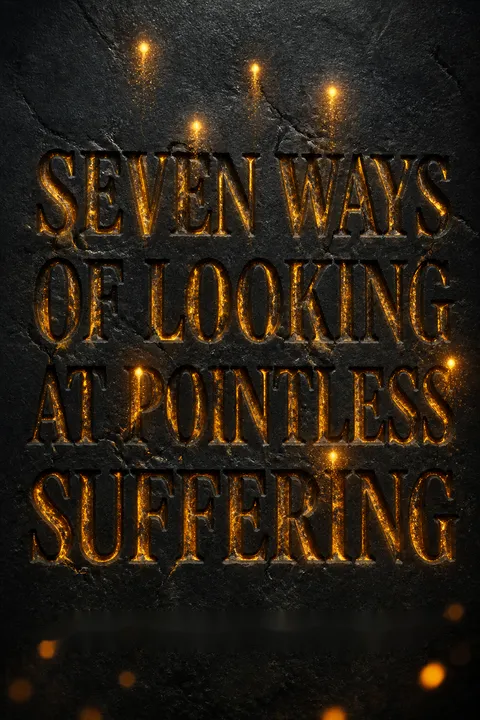

Key Takeaways
1. The Paradox of Pointless Suffering: A Core Human Dilemma
The overarching point I explore in this book is that to be human is to embody a huge paradox: the paradox of having simultaneously to accept and to reject suffering; the paradox of both facing and fixing the same troubles.
Universal experience. Suffering is an inescapable part of the human condition, affecting children, adults, and animals alike. From the tragic death of a child to the pervasive pains of loneliness, injustice, and disease, life is replete with experiences that seem to serve no apparent purpose. This "pointless suffering" challenges our innate desire for a world that aligns with our moral expectations.
Three responses. Humanity typically responds to suffering in three ways:
- Forget-about-it: Ignoring suffering through distraction (e.g., cell phones, entertainment) to maintain a "semi-blissful forgetfulness."
- Fix-it: Viewing suffering as a problem to be minimized or eliminated through science, technology, and political systems.
- Face-it: Regarding suffering as a necessary initiation into a deeper way of being, transforming it into profound art, culture, and knowledge.
Essential paradox. While the "fix-it" attitude drives progress and alleviates many miseries, an exclusive reliance on it risks losing our humanity and the richness that comes from confronting life's difficulties. The book argues that true human flourishing requires a delicate balance: fighting against injustice and pain while simultaneously accepting them as fundamental conditions of existence. This paradox is where the journey of meaning-making begins and ends.
2. Modernity's "Fix-It" Mentality Undermines Meaning
Our increasing commitment to fix-it techniques makes it difficult for many people to accept the face-it basis of institutions like religion, institutions that were once pretty much all we had to confront the onslaught of suffering.
Over-reliance on solutions. Modernity has fostered an unhealthy relationship with suffering, primarily viewing it through a "fix-it" lens. This mindset, while responsible for incredible advancements in medicine, technology, and social reform, has led to a gradual forgetting of suffering's inherent mystery. We now irrationally believe we can dictate the terms of suffering, leading to a peculiar loneliness and a loss of connection to our shared humanity.
Utilitarianism's influence. Philosophers like Jeremy Bentham championed utilitarianism, which posits that suffering is inherently bad and its amelioration is the basis of all moral reasoning. While John Stuart Mill refined this by introducing concepts like political freedom and higher pleasures, the core utilitarian impulse to maximize pleasure and minimize pain can flatten human experience, reducing complex values to a simple calculus. This approach struggles to account for the meaning found in struggle or the intrinsic value of freedom, even when it entails risk.
Consequences of "fix-it-ism." This pervasive "fix-it" mindset leads to:
- Regarding grief, old age, and death as "foreign invaders."
- Envisioning happiness as mere consumption.
- Seeing nature as a resource, not a revered order.
- Reducing politics to safety and economy, jettisoning democratic practices.
- Transforming education into mere skill acquisition.
This approach, often framed as a "War on Death" or "War on Crime," paradoxically generates new forms of suffering by undermining human value and freedom.
3. Embracing Suffering: Nietzsche's Challenge to Affirm Life
“You want, if possible— and there is no more insane ‘if possible’— to abolish suffering. And we? It really seems that we would rather have it higher and worse than ever. . . . The discipline of suffering, of great suffering— do you not know that only this discipline has created all enhancements of man so far?”
Beyond good and evil. Friedrich Nietzsche, grappling with the "death of God," challenged traditional morality rooted in "slave morality" (pity, meekness, universal brotherhood). He argued that these values, born of ressentiment (resentment of the strong), lead to a "bad conscience" and self-punishment. Instead, he advocated for a "master morality" that values strength, growth, and the "will to power"—the desire to overcome and assert oneself, not merely avoid pain.
The last man vs. the superhuman. Nietzsche critiqued the "last man," a wimpy utilitarian who seeks only comfort and tranquilizing entertainment, aspiring to nothing more than an easy, long life. In contrast, he proposed the Übermensch (superhuman), one who embraces life's inherent suffering and challenges. This figure affirms existence in its entirety, transforming pain into a catalyst for growth and self-enhancement, embodying the idea that "What does not kill me makes me stronger."
The eternal return. Nietzsche's ultimate challenge is the "eternal return": the thought that one must live this life, with all its pains and joys, "once more and innumerable times more." This is not a scientific prediction but a spiritual test: are you willing to affirm every moment of your life, even the most agonizing migraines or mundane experiences? This radical affirmation, akin to Dionysian rapture, encourages us to live our lives artistically, forging meaning from everything, including what seems pointless or tragic.
4. Taking Responsibility: Arendt on the Banality of Evil and Human Action
Regardless of his intentions, Arendt thinks that Eichmann should be held responsible for the Holocaust—and, by extension, that we must all take some responsibility for the pointless suffering that our participation in dehumanizing systems enables.
A new trauma. Hannah Arendt argued that humanity has undergone a new trauma comparable to its emergence as rational animals. Events like the Holocaust and the atom bomb demonstrate our capacity to "act into nature," wielding god-like power that surpasses natural disasters. This has led to a "peculiar kind of loneliness," where we are divided between technological gods and biological beasts, losing the distinctive space of being human.
Action vs. behavior. Arendt distinguished between "action," which is the free, unpredictable disclosure of who we are as unique individuals (rooted in "natality"), and "behavior," which is predictable conduct according to external rules. Modern society increasingly reduces action to behavior through bureaucratic systems, standardized processes, and algorithms. This "behaviorism" liquidates individual responsibility and undermines the meaningfulness of human endeavors.
The banality of evil. Arendt's controversial concept of the "banality of evil," exemplified by Adolf Eichmann, highlights how horrific acts can be committed not by fanatical monsters, but by ordinary people who simply "do their duty" without thinking. Eichmann's crime was his thoughtlessness, his inability to engage in the inner dialogue necessary for morality. Arendt argues that we must resist the degradation of work into meaningless "labor" and reclaim our capacity for thought, action, and responsibility to prevent such dehumanizing systems from taking root.
5. Suffering Reveals God and Human Freedom
The problem of pointless suffering doesn’t refute God, nor does it refute us. It constitutes God. It constitutes us.
The problem of evil revisited. The traditional "problem of evil" questions how an all-good, all-powerful God can allow suffering. While a "strict logical disproof" (any evil disproves God) is weak, the "evidential" case (the overwhelming amount of suffering) is stronger. However, the book argues that this problem, whether theological or "anthropological" (self-inflicted by human power), fundamentally misunderstands the nature of existence.
Beyond rationalization. Religious "pious" responses to suffering, like those of Job's friends, often resort to "kettle logic"—self-contradictory rationalizations that protect belief rather than genuinely explain. The Book of Job, however, praises Job's honest questioning and lamentation, even when he challenges God's justice. God's response from the whirlwind doesn't explain suffering but emphasizes the incomprehensible vastness and wildness of creation (Behemoth, Leviathan), which far outstrips human understanding.
Freedom and mystery. Pointless suffering, rather than disproving God, liberates God from "moral bondage" to human expectations, demonstrating His freedom and sublimity. Simultaneously, it liberates human freedom, as our moral worth is most evident in a world that doesn't perfectly align with our sense of justice. This "morally incoherent world" is necessary for morality itself. Suffering, therefore, is not a problem to be solved but a "mystery" that constitutes both God and humanity, opening us to an infinite, unfathomable reality.
6. Atonement with Nature: Epictetus on Gratitude and Inner Freedom
The secret of happiness—and not only happiness but freedom, and not only freedom but our very rationality—is to bring our mindset into accord with how things go.
Harmony with nature. Epictetus, the former slave and Stoic philosopher, taught that the true source of pointless suffering is not the existence of death, pain, or misfortune, but our lament and objection to them. He argued that happiness, freedom, and rationality come from aligning our minds with the natural order of the universe, which he called "nature" or "Zeus." This means refusing to imagine a better world than the one that generates and sustains us.
The game of life. For Epictetus, life is like a game of chess: we have limited moves and will eventually be "taken," but these limits define us and make the game meaningful. To wish for different rules is to wish for no game at all. The Stoic attitude is to "Bring it on," embracing hardships as challenges that test and reveal our humanity. Even in failure, the "game" (the cosmic order) continues, and our participation contributes to its magnificence.
Inner freedom and gratitude. Stoicism is not about inaction or passive acceptance of injustice, but about doing one's duty with a "double mind": trying your best to win while recognizing "it's just a game." This inner discipline allows for perfect happiness under any conditions, even torture, by focusing on what is within our control (our judgments and attitudes) and accepting what is not. The ultimate duty is gratitude for the gift of life itself, which, though hard and mysterious, offers the chance to express our rationality and freedom.
7. Rituals of Compassion: Confucius on Humanity and Social Harmony
Lead them with [moral] excellence and keep them orderly through observing ritual propriety and they will develop a sense of shame, and moreover, will order themselves.
Grief as humanity's core. Confucius, unlike other sages, responded to the pointless death of his favorite student, Yan Hui, with raw, unrefined grief: "Heaven is the ruin of me!" This profound lament, devoid of philosophical explanation, reveals that the space of pure grief is the very space of being human, out of which his entire philosophy of compassion and civilization is born. He refused to refine tragedy into anything but tragedy.
Li over law. In a chaotic world, Confucius rejected penal law and punishment as primary means of maintaining order. He argued that laws merely compel avoidance of punishment without fostering a genuine "sense of shame." Instead, he proposed li (ritual propriety)—meaning-invested roles, relationships, and institutions that facilitate communication and foster community. Simple acts of etiquette, like saying "excuse me," can avert violence and dignify our common humanity (ren).
Empathy and loyalty. Confucianism emphasizes loyalty (zhong) to our social roles and empathetic understanding (shu)—"do not impose on others what you yourself do not want." This means cultivating the ability to put ourselves in another's shoes, especially when in positions of power, to avoid oppression. The cultivation of ren (humanness) involves education in the arts and humanities, which confront suffering and help us relate to it with dignity. Confucius's wordless grief in the face of pointless suffering reestablishes our humanity, reminding us to simply "show up and grieve" for those who suffer.
8. Art as Transfiguration: The Blues and Suffering Humanly
The music of the blues requires distance from the experience of the blues. We need a Congo Square, a juke joint, a guitar and a street corner, a living room with a stereo, a pair of Beats, or even a jail cell of congenial souls, where it’s possible to regroup from the blue devils’ assault.
Slavery and song. The book explores the profound question of whether great art, like the blues, can redeem the suffering from which it arises, such as slavery. Sidney Bechet's autobiography, Treat It Gentle, illustrates this through the story of his grandfather Omar, whose suffering and the complex emotions of those around him (including the master's "lust" and the wife's "night kind of knowing") are depicted with a nuanced "blues-understanding" that transcends simple blame.
The spirit of the blues. The blues, a musical form characterized by its 12-bar structure and "blue notes," is more fundamentally a spirit that transfigures low spirits ("blue devils") into celebration and revelation. It's a triumph of meaning over chaos, integrating painful experiences into the psyche. The blues is life-affirming, reconciling deep human conflicts—victim and victimizer, justice-seeker and injustice-doer—into a buoyant, dignified expression that makes us all free and equal.
Blues-understanding. This unique form of compassion, akin to Simone Weil's concept of "affliction," recognizes injustice while extending sympathy to all involved, without dehumanizing anyone. It's less about minimizing harm and more about maximizing dignity, even when harm is unavoidable. The "Pentalogue of Blues-Understanding" (e.g., "Thou shalt not admire force," "Thou shalt face thy suffering with style") encapsulates this spirit, which grapples with the "blue horizon" of suffering against which justice must be pursued, finding joy in the lament itself.
9. The "Soul-Making" Imperative: Suffering as Essential to Being Human
Do you not see how necessary a World of Pains and troubles is to school an Intelligence and make it a soul? A Place where the heart must feel and suffer in a thousand diverse ways! . . . Call the world if it Please “The vale of Soul-making.”
Life as soul-making. Drawing on John Keats's concept of "soul-making," the book argues that suffering is not merely an unfortunate byproduct of existence but an integral, even necessary, component of human growth and character development. This world is not a paradise, but a "school" or "testing ground" where intelligence is schooled into a soul through diverse pains and troubles. While we cannot offer a positive justification for all suffering, a "negative theodicy" reveals that removing the possibility of pain, death, and wrongdoing would destroy the very conditions for virtues like courage, compassion, and love.
The cost of avoidance. An exclusive focus on eliminating suffering, driven by a utilitarian mindset, risks hollowing out the value of our lives. When we avoid suffering at all costs, work loses its soul-making potential, play becomes mere distraction, education becomes rote, nature is exploited, and politics devolves into management. Love, our fundamental act of saying "yes" to life, becomes a gamble not worth the bother. This leads to a "deluxe despair," where we suffer inhumanly by denying our inherent fragilities.
Suffering humanly. To "suffer humanly" means to live with our physical weaknesses and philosophical ignorance, to oppose wrongdoing while accepting it as an intrinsic part of us. It means facing the barbarism in ourselves and extending compassion to others. This paradoxical approach, like the "bitter-sweet" lament and love described by George Herbert, acknowledges that suffering is so dissolved into certain goods of life that it cannot be totally separated out. It is the "astonishing light of your own being" that emerges from confronting the infinite mystery of suffering, making life a joyful, if arduous, song.
People Also Read






Download PDF
Download EPUB
.epub digital book format is ideal for reading ebooks on phones, tablets, and e-readers.








































