


Plot Summary
Phones Scream in Unison
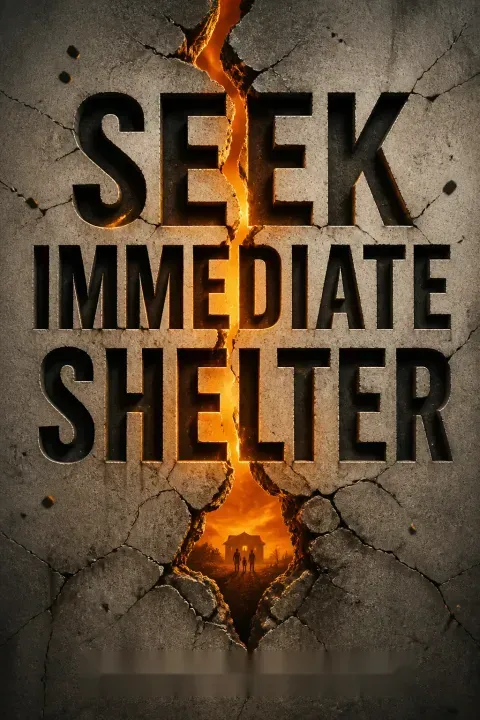
David Li1 jolts awake to his wife Daphne10 shrieking, their infant Nathan wailing. Every phone in Beckitt blares the same message: BALLISTIC MISSILE THREAT INBOUND. SEEK IMMEDIATE SHELTER. THIS IS NOT A DRILL.
Nina Chang,2 in her kitchen with husband Dean,8 watches him grab a knife from the cutlery board and mocks him for thinking he can stab a bomb. Clare Hilldon5 sits across from her husband Jacob at breakfast when he clutches his chest, staggers backward, and crashes to the floor.
At the Anchor restaurant, waitress Janice14 stares at her phone in disbelief while a strange young man with a violin case3 sits parked outside, his plans for the day suddenly irrelevant. All across the county, residents scramble for basements, bathtubs, anywhere that might shield them from obliteration. Eighteen minutes of terror begin.
The novel opens with a moment of collective existential terror that acts as a stress test for every character. The alert is a forced confrontation with mortality that strips away social pretense and reveals what each person values most. In these opening moments, the mundane details of suburban life (a knife, a breakfast table, a waitress shift) collide with the unthinkable. The alert's genius as a narrative device is that it imposes the same extreme condition on an entire community, creating a natural experiment in human behavior under pressure. What people do in these eighteen minutes becomes the defining evidence for or against their own self-conception.
David Guns the Accelerator
Daphne10 gathers formula and diapers while David1 leaps into the car. The garage door rises with agonizing slowness. He hears a distant rumbling, the shriek of a buzz saw from the grounds crew felling a tree across the street, and interprets it as approaching annihilation.
He screams for Daphne,10 honks the horn, then stomps the gas pedal. The car shoots backward, scraping its roof against the still-rising garage door. Only after he stops does he discover the truth: no missile, just a tree branch tangled in utility cables, and his wife10 still standing in the garage holding their baby.
The all-clear arrives eighteen minutes after the initial alert. The roof of their car looks, as Daphne10 later puts it at a dinner with friends, like a barcode, while David1 insists his memory of those moments is just a blur.
David's flight from his own garage dramatizes the gap between who we believe ourselves to be and who we prove to be under duress. His self-image as a protector crumples against the fact of his reflexive self-preservation. The genius of this scene lies in the mundane explanation (a tree, a saw) that deflates his terror but cannot deflate its consequences. David's insistence that he 'thought Daphne was in the car' becomes the flimsy narrative he clings to because the alternative (that he simply did not think of her at all) would annihilate his identity more completely than any missile.
Daphne's Public Indictment
At the Anchor restaurant, David1 and Daphne10 dine with George and Mia Stephan. Daphne10 narrates the morning's events with savage precision: David1 asleep through the first alert, his unilateral decision to flee to his parents' house, the garage door incident.
George attempts a defense rooted in autonomic nervous system responses, arguing David1's reaction was pure biological reflex rather than conscious selfishness. David1 seizes the lifeline eagerly, agreeing with everything George says. But Daphne10 will not relent.
She describes how she stood holding their infant, hand on the door, about to enter the car when her husband1 accelerated without checking if his family was safe. David1 accuses her of gaslighting him. She asks why she would possibly want a narrative in which her husband1 is a coward. The table falls silent.
This dinner scene functions as a public trial where marriage itself stands in the dock. Daphne's insistence on recounting the events, despite the social discomfort, reflects a deeper need: she cannot unknow what she learned about her husband. His cowardice is less the problem than his refusal to acknowledge it. George's biological-determinism defense and David's eager adoption of it show how readily we outsource moral responsibility to physiology. The scene captures the peculiar loneliness of being forced to defend a version of reality that your partner denies.
Nina's Deathbed Text
In their dank basement, Nina Chang2 types a message to her daughter Cate,16 who moved to California six months earlier to chase a girlfriend: 'Dad and I just received missile warning. If NEthing happens we luv u. I guess being selfish was worth it.' She sends it believing these may be her final words.
When the all-clear comes and Cate16 calls back an hour later in hysterics, Dean8 confronts his wife.2 Nina2 deflects with sarcasm and cruelty. But the text was not random malice. Nina2 carries a secret: she is dying of cancer. She has not told Cate.16
Her relationship with her daughter16 has been a decades-long exercise in misunderstanding, with Cate16 interpreting her mother2's criticism and emotional volatility as bigotry and coldness rather than the unskillful expression of love from a woman raised by exacting immigrant parents.
Nina's text is both unforgivable and painfully legible. It marries her deepest fear (that her daughter's departure was an act of selfish abandonment) with her deepest self-loathing (that she herself is too selfish to be loved). The message performs multiple functions: it punishes Cate for leaving, tests whether Cate will still care, and preemptively confirms Nina's suspicion that she is fundamentally unlovable. The tragedy is that Nina cannot say what she means (I am terrified and I miss you and I am dying) so she says something designed to wound, ensuring the very rejection she fears.
Cancer and Cruelty Collide
As spring turns to summer, Nina2's condition worsens. She endures aggressive treatment that leaves her weak and feverish. Still, she withholds the diagnosis from Cate,16 telling Dean8 she does not want to upset her daughter16 further.
When Cate16 video-calls to introduce her girlfriend Shana, Nina2 responds with cold formality. Later, Cate16 suggests her mother2 may have PTSD from the alert. Nina2 scoffs. Dean,8 desperate, tells Cate16 that older people's brains sometimes change, that 'the parts that are supposed to show good taste just disappear.'
Nina2 overhears and rages at him for pathologizing her. The truth is more complicated: Nina2 fears that if she reveals her illness, Cate16 will feel obligated to return, and any reconciliation will be tainted by pity. She would rather be hated authentically than loved out of duty.
Nina's refusal to disclose her cancer is a profound act of self-sabotage disguised as protectiveness. She constructs a martyrdom in which her daughter's freedom depends on not knowing. But the real calculus is darker: Nina cannot bear the possibility that Cate might not care enough to return even with the diagnosis. By withholding the information, she retains the fantasy that Cate would come running if she only knew. The section exposes how terminal illness does not automatically confer wisdom or grace; sometimes it magnifies our most self-defeating patterns.
Nina Meets Her Grandson
Cate16 calls again, this time with Shana, to show them an adopted baby boy named Freddie. Nina2 studies the crib, the cheap materials, the heavy blanket that could impede breathing, and bites back every critical impulse. When Cate16 asks her to visit, Nina2 finally reveals she is dying.
The words come haltingly. Cate16's face freezes. Dean8 appears in the frame. Nina2 says she does not know how long she has, but she loves her daughter16 very much. After the call ends, arrangements begin for Cate16 and Freddie to visit.
Nina2 lies down, feeling lighter than she has in months. She has a grandchild now, someone who will know her only through stories, through whatever version of herself she can leave behind in the time remaining. The fear of being forgotten gives way to the relief of being remembered.
The introduction of Freddie shifts the stakes for Nina. An adopted grandchild with no biological connection to her becomes the catalyst for honesty because the relationship requires active construction rather than passive inheritance. Nina must choose to be present, must articulate love rather than assume it is understood. The scene captures how new life can reorganize our relationship to death. Freddie represents continuity beyond Nina's own vanishing, a reason to stop hoarding her pain and start distributing whatever love she has left.
Nick Finds His Bluegrass Voice
Nick Chen,3 a violinist with compulsive tics that alienate everyone around him, is failing out of the Cleveland conservatory. His instructor tells him bluntly. After a breakdown in a practice room, a stranger named Darin Lee11 finds him and takes him to a bar where a guitar duo plays rowdy improvisations.
Darin,11 an older former student who left the conservatory years ago, introduces Nick3 to bluegrass. The music does something classical training never could: it loosens the anxious knots in Nick3's mind. He learns to chop rhythms, to slide between notes, to improvise freely.
They form a duo called the Eastern Mountain Boys and start playing local bars. For the first time, Nick3 feels he belongs somewhere. His tics recede when he plays. Darin11 tells him they have a shot at leaving a real artistic legacy, something that would survive even nuclear winter.
Nick's conversion from classical violin to bluegrass is a parable about the tyranny of institutional gatekeeping. The conservatory's rigid standards pathologized Nick's difference; bluegrass's improvisational ethos transforms that same difference into a strength. Darin's mentorship initially seems like salvation, but his rhetoric about legacy and survival already hints at the transactional nature of the relationship. Nick's desperate need for belonging makes him vulnerable to a kind of love that is indistinguishable from exploitation.
Darin Expands, Nick Implodes
The Eastern Mountain Boys sign a record deal. They tour, they share hotel rooms, they make love after a drunken celebration dinner. But Darin11 begins expanding the sound against Nick3's wishes, adding vocalist Sadie Wallace, a drummer, a rhythm guitarist.
Their music grows thinner, poppier, more formulaic. Nick3's improvisational solos are cut from set lists. During a gig in Colorado, Nick,3 high on pills and whiskey, notices Darin11 rubbing Sadie's knuckle with his thumb.
He lurches to the microphone, outs his relationship with Darin11 to five thousand strangers, speculates about the conservatory faculty's indifference, and vomits on stage. The next morning, Darin11 sits at his bedside and tells him his future in the band is over. The early stuff was special, Darin11 says, but things evolve. Nick3 realizes he has been a stepping stone.
The band's trajectory from innovative duo to generic chamber-pop act mirrors the commodification of Nick's talent and intimacy. Darin's genius for recognizing Nick's gifts was always coupled with a genius for extracting value from them. The onstage breakdown is Nick's desperate attempt to force acknowledgment of what he gave, what was taken, what was real between them. But Darin's response (it was special, it happened, it's over) reduces their relationship to a consummated transaction. The tragedy is that the authentic connection Nick felt was, for Darin, just another phase in a career of phases.
Nick's Father Dies, Nick Drifts
Nick3 returns home to Ohio to find his father (Pop) ravaged by a Parkinson's-like illness. They reconcile on the porch over afternoons of CD listening. Pop admits he felt lonelier than he could bear and fears he passed that sensitivity to his son.
Nick3 plays his violin for him one final afternoon. His father closes his eyes and never reopens them. After the funeral, Nick3 takes to the road, driving east with no destination. He stops in Beckitt, parks outside a restaurant called the Anchor, and waits.
His plan is to reach the coast, walk into the freezing Atlantic, and let the waves take him. He orders pancakes from a waitress named Janice14 who hums to herself. She tries to make conversation. He deflects. He is waiting for the momentum to carry him toward his final decision.
Nick's arc reaches its nadir in a rented car outside a small-town restaurant. His father's death severs the last tether to unconditional love while Darin's betrayal poisons the very medium (music) through which Nick understood himself. The coastal suicide plan is not merely despair but a perverse assertion of control: if he cannot choose how his story is told, he can at least choose how it ends. Janice's cheerful humming represents an alternative frequency of existence, a different kind of music, but Nick cannot yet hear it.
Janice Jumps In His Car
Janice14 has just returned Nick3's change when both their phones shriek with the missile warning. She tumbles into his passenger seat. They speed out of the parking lot, past the soccer field where teenagers scramble toward their school, past the redbrick buildings and the golf course.
Janice14 directs him through the grid of empty streets toward the freeway. The whole town has vanished into shelters. And then, cutting through the car's tense silence, Nick3 hears something unexpected: Janice14 humming, a soft improvised melody that harmonizes with the engine's hum.
It is beautiful. It is spontaneous and reactive. His heart, which moments ago was striding toward annihilation, suddenly wants to stay alive long enough to play with her. When the false alarm arrives, they keep driving. Days later, Nick3 and Janice14 are in Nashville, performing together.
The missile alert that traumatized the community becomes, for Nick, an act of accidental salvation. The eighteen minutes of shared terror with a stranger who hums are enough to rewire his orientation toward life. Janice's humming represents everything Darin's commodified music lacked: spontaneity, presence, connection unmediated by ambition. Where Darin offered legacy at the cost of authenticity, Janice offers only the moment. Nick's decision to keep driving toward Nashville rather than the coast is his first genuine choice in years, a turn toward an unscripted future.
Rachel Connects the Dots
In the girls' locker room, Rachel4 and her soccer team huddle through the alert. Boredom and fear loosen tongues. She overhears senior Charlotte Evans confessing something about Dr. Stephan, their AP Biology teacher.
Her best friend Rianne, flipping through Rachel4's phone photos, recognizes a skirt on Rachel4's mother and mentions seeing her at Planned Parenthood. Rachel4's mind races back to the weeks of hushed Mandarin arguments she overheard through her apartment's thin walls: her father's anguish, her mother's remorse, the repeated question 'Isn't this why we came to America?'
The pieces assemble with sickening clarity. Her mother was pregnant. They terminated the pregnancy. The secret they have been keeping from her, the sacrifice they made to preserve her future, reshapes everything Rachel4 thought she understood about her family and her own place in it.
Rachel's discovery inverts the parent-child power dynamic. She has been fighting for autonomy, resenting her parents' overprotectiveness, without understanding what that protection has cost them. The revelation that her parents terminated a pregnancy (likely because resources were finite and her future was paramount) transforms their controlling behavior from oppression into sacrifice. The section captures how growing up is often a series of such inversions, where the stories we told ourselves about our parents are revealed as incomplete, and our grievances must be recalibrated against new information.
Chase Sends the Real Alert
At the Massachusetts Emergency Management Agency office atop the Wingham DMV, Chase Sun6 is running on no sleep. He has spent days arguing with his boyfriend Mick,15 who wrote a racist online comment telling someone to kill themselves.
When a test call comes in, Chase6's coworker Felicity puts it on speaker partway through. Chase6 catches the words 'this is not a drill' and misses the expected 'exercise exercise exercise' opening. Following the protocol he has rehearsed dozens of times, he navigates the drop-down menus and selects 'Missile Alert' instead of 'TEST Missile Alert.'
The system asks: Are you sure? He clicks yes. The alert goes out to every phone in the county. His boss Dan Hinge stares at him with fury. Chase6's phone buzzes with a text from Mick.15 What has he done?
Chase's error is the novel's central mechanism, the butterfly wing that generates the hurricane. But it is not random. His exhaustion, his emotional turmoil over Mick's casual cruelty, his distraction and heartbreak, all converge at the precise moment the system requires perfect attention. The scene is a study in how catastrophic failures are rarely the result of malice or even gross negligence; they emerge from the friction between human vulnerability and systems that demand inhuman reliability. Chase becomes the novel's most accidental antagonist, the unwitting author of everyone else's crisis.
Jacob's Other Family Emerges
Clare Hilldon5 buries Jacob, who died of a heart attack triggered by the alert. Then a handwritten letter arrives from Emma Chou,17 a young assistant manager at the Anchor, claiming she had an affair with Jacob and has a six-year-old son named Kevin.
Clare5 meets the girl, interrogates her, demands proof. Emma17 produces bank records, emails, and a photo of a boy who unmistakably bears Jacob's features. Clare5 refuses to help financially. She cannot exhume Jacob for a DNA test; she cannot bear to.
The revelation retroactively poisons her memory of their marriage, his proposal, his talk of quantum entanglement and souls connected across distance. She had believed she was his entangled particle. She was, instead, one particle among several, his constancy a performance she mistook for physics.
Clare's discovery forces a complete revision of her life's narrative. Every memory must be reexamined; every expression of love now reads as potential cover for deception. The section explores how betrayal not only destroys trust in the other person but in one's own judgment. Clare's professional skill set (public relations, narrative management) becomes useless when she cannot control the story of her own life. The quantum entanglement metaphor Jacob used to woo her becomes bitterly ironic: particles that behave identically despite distance, except one of them was entangled with someone else entirely.
Jorie Arrives, Then Leaves
Clare5's older sister Jorie12 shows up uninvited, dragging a suitcase and a lifetime of unsolicited advice. She cooks, she bird-watches, she presses Clare5 to help Emma17 and the boy. But Jorie12 has her own secret: debt collectors are pursuing her, and she has been using Clare5's home as a refuge.
When Clare5 discovers a collection letter addressed to Jorie,12 the fragile peace shatters. They trade accusations. Clare5 says Jorie12 is a leech who has never committed to anything. Jorie12 says Clare5 is the loneliest person she has ever met, too afraid of winding up alone to truly love anyone.
Jorie12 packs and leaves. Days later, cleaning the guest room, Clare5 finds a travel atlas Jorie12 left behind, bookmarked to the Galápagos Islands. Marginalia in Jorie12's handwriting reads: 'Tell her she isn't starting from nothing.' Clare5 texts her sister about finches. She drives off.
The sisters' conflict replays the novel's central tension between control and surrender, between protecting oneself and risking connection. Jorie's debt and Clare's emotional stinginess are mirror dysfunctions: both women are terrified of needing others and being needed. The Galápagos atlas, with its lesson about adaptive radiation and finches evolving different beaks for different environments, becomes the section's governing metaphor. Survival requires adaptation. Clare's final gesture (the text, the open road) suggests she may finally be ready to evolve beyond the identity her husband's death forced upon her.
Grant Chooses the Residents
Grant Gao,9 an orderly at Lark's Landing nursing home, has spent years stealing opioids from deceased and living patients alike. His fiancée Milly left him. A nurse named Olive18 introduced him to the drugs, then tried to pull him back, but he has fallen too far.
When the missile alert arrives, his first instinct is to raid the medication closet. But something stops him. Instead, he begins evacuating residents to the basement via the freight elevator. He pushes beds, grabs walkers, carries the frail and demented.
Olive18 begs him to flee with her back to her apartment where her son Jesse waits, and where she has drugs they can take together if the end is coming. Grant9 refuses. The residents, wheeled through the hallways, begin chanting his name: 'Hero! Hero! Hero!' For the first time in years, Grant9 feels like a person rather than a collection of hungers.
Grant's eleventh-hour redemption is the novel's most concentrated argument for the possibility of change. His addiction has stripped him of every moral qualm, yet in the moment of collective crisis, something older and deeper surfaces. The residents' chant of 'Hero!' is almost unbearably ironic given what he has done to them, but the novel does not undercut it. Instead, it suggests that redemption is not the erasure of past sins but the choice, in a single moment, to act differently. Grant may relapse tomorrow, but today he saved people. The section asks whether a good act can coexist with a bad life and answers, unsteadily, yes.
Analysis
Seek Immediate Shelter operates as a literary stress test, applying the same extreme condition (a false missile alert) to a diverse ensemble and observing what cracks open. The eighteen minutes of collective terror function as a narrative equalizer, stripping away the routines and self-deceptions that normally insulate people from their own truths.
The novel's deepest inquiry concerns whether change is possible. David Li1 cannot change because he cannot admit what he is. Nina Chang2 changes only when the imminence of death overcomes her lifelong habit of pushing love away through cruelty. Nick Chen3 changes because a stranger's humming reattaches him to life. Grant Gao9 changes in a single moment of choosing others over his addiction. The book offers no consistent theory of transformation; some characters evolve, others remain trapped in their patterns, and the difference seems to lie in the willingness to let go of a cherished self-narrative.
The ensemble structure creates a community portrait where individual crises reflect systemic failures. Chase6's error at MEMA is enabled by a badly designed bureaucratic system. Lark's Landing's medication abuses are enabled by private equity's profit extraction. The Changs' family estrangement is enabled by immigrant generational trauma that nobody names. Private pain is always partly public in origin.
Vincent Yu writes with clinical precision about emotional chaos. His characters are masters of self-justification, and the novel's third-person voices track their rationalizations without mocking them. The prose is elegant but never precious, capable of moving from a joke about grief support group rivalries to a dying woman's final courage without tonal whiplash.
Ultimately, the book argues that the most important shelter we seek is not from missiles but from the versions of ourselves we can no longer sustain. The false alarm is a gift: eighteen minutes to discover who you are, followed by whatever time remains to decide if that is who you want to be.
Characters
David Li
PR executive who abandons familyA second-generation Chinese American PR professional who has spent his career at his father's firm, Li and Peters. David prides himself on his ability to spin narratives for clients and for himself. He is married to Daphne10 and has an infant son, Nathan. Beneath his competent professional exterior, he harbors an unexamined terror of his own inadequacy. When the missile alert forces him to act, he discovers that his self-image as a protector does not align with his instincts. His subsequent attempts to control the narrative of his cowardice (through his father's PR advice, through a planned Hawaii trip, through semantic arguments with his wife10) reveal a man who cannot tolerate the gap between who he wants to be and who he actually is. His arc explores whether genuine change is possible when someone's entire identity is built on image management.
Nina Chang
Dying mother estranged from daughterCo-owner of Major Third music shop, wife to Dean8, mother to Cate16. Nina is the daughter of Chinese immigrants whose expectations she both resented and internalized. She experiences emotional volatility that she cannot control, describing her soul as a sky sometimes clear and pristine, sometimes stiflingly overcast. Her relationship with Cate16 has been defined by mutual misunderstanding: Nina expresses love through criticism and worry, which Cate16 interprets as rejection and bigotry. Diagnosed with terminal cancer, she keeps the illness secret from her daughter16, partly out of pride and partly out of fear that Cate16's response will confirm her deepest fear that she is fundamentally unlovable. Her arc traces the belated discovery that courage means vulnerability, not stoicism.
Nick Chen
Violinist seeking belonging and purposeA classically trained violinist with OCD-like tics that emerge as compulsive touching, head jerking, and obsessive fixations. His tics have alienated him from peers his entire life. His father (Pop) raised him after his mother's absence, providing unconditional love that Nick both depended on and took for granted. At the conservatory, his talent proves insufficient against institutional standards, and his loneliness becomes crushing. Bluegrass offers him a musical language where his differences become assets rather than liabilities. His relationship with Darin11 is his first experience of being truly seen and valued, which makes Darin11's eventual betrayal devastating. After losing his band, his father, and his sense of purpose, he contemplates ending his life before the missile alert and a chance encounter redirect him.
Rachel Yen
Teenager uncovering family secretsA high school junior, soccer player, and clarinetist. The daughter of Dana and Tom Yen, Chinese immigrants who work at the nursing home and urgent care clinic respectively. Rachel chafes against her parents' overprotectiveness, their refusal to let her carpool with friends, their constant surveillance of her social life. She feels 'embarrassed but not ashamed' of her family, caught between gratitude for their sacrifices and resentment at the constraints those sacrifices impose. The missile alert forces her into a position of unwelcome knowledge when she pieces together that her mother terminated a pregnancy, likely to preserve resources for Rachel's future. This revelation transforms her understanding of what her parents have given up for her and complicates her adolescent rebellion with adult knowledge.
Clare Hilldon
Widow reconstructing her shattered lifeA recently retired PR executive whose husband Jacob dies of a heart attack triggered by the missile alert. Childless by choice, wealthy, and meticulously self-controlled, Clare has spent her life constructing an identity through career success and strategic decision-making. Her marriage to Jacob, which she believed was built on mutual understanding and his romantic notion of quantum entanglement, is revealed posthumously to have included a long-term affair and a secret child. This discovery forces her to reexamine not only her husband but her own choices, including her refusal to have children. Her relationship with her older sister Jorie12, whom she has always viewed as reckless and irresponsible, becomes a crucible for examining what it means to adapt and evolve after the life you planned has vanished.
Chase Sun
MEMA worker who triggers the alertA contractor at the Massachusetts Emergency Management Agency whose job involves processing weather alerts and running emergency drills. He loves hiking, solitude, and his sister Janice14. His relationship with Mick Luong15 has been moving toward domesticity (they recently moved in together) when he discovers Mick15's casual online cruelty. This revelation, combined with family secrets his sister14 discloses about their late mother, destabilizes his sense of who he is and what he wants. Exhausted and distracted, he makes the catastrophic error of sending a real missile alert instead of a test message. His subsequent scapegoating by the agency and by the public forces him to confront whether his life's choices have been wrong and whether he has the courage to make different ones.
Russell Zhang
Son haunted by paternal abandonmentA textbook sales representative, husband to Ruthie19, father to young Miles. When Russell was six, his father abandoned the family without explanation, leaving his mother and grandmother to raise him. This wound has shaped his entire life, manifesting as obsessive questioning about why his father left, a complicated admiration for the man's decisiveness, and a fear that he might inherit the same capacity for desertion. The missile alert reactivates this old trauma, sending him into a spiral of drinking, emotional withdrawal, and near-infidelity. His attempts to track down his father or his father's other potential children lead him to his mother, who reveals a more complicated story than he imagined. His arc concerns whether understanding the past can ever bring genuine closure.
Dean Chang
Widower learning to live againNina2's husband of several decades, Cate16's father, co-owner of Major Third music shop. Dean is gentle, conflict-avoidant, and deeply kind, qualities that Nina2 both loved and resented him for. He served as the 'good cop' in their parenting, which Nina2 accused of undermining her relationship with Cate16. After Nina2's death from cancer, he joins a grief support group where he meets Quinn13, a woman whose son is in prison for killing someone while drunk driving. Their relationship forces Dean to confront his unprocessed anger at Nina2, his guilt over his failures as a father, and his fear of being a burden to his daughter16. His arc asks whether love late in life is possible when grief remains an active presence rather than a resolved chapter.
Grant Gao
Addicted orderly seeking redemptionAn orderly at Lark's Landing nursing home whose dreams of medical school dissolved into opioid addiction. His fiancée Milly left him on their wedding day, unable to commit. A nurse named Olive18 introduced him to stealing painkillers from deceased patients, and his use escalated until he was shortchanging living residents. His addiction has hollowed him out; he can remember being a person with feelings and ambitions but can no longer access that version of himself. The missile alert presents him with a stark choice: raid the medication closet one last time or help evacuate the vulnerable residents whose trust he has systematically violated. His choice in this moment becomes the novel's most concentrated test of whether people can change.
Daphne Li
David's wife demanding accountabilityDavid1's wife and mother to infant Nathan. She was the one who woke David1 during the alert and gathered emergency supplies while he fled. Her refusal to let David1 control the narrative of his cowardice, her insistence on airing the truth at dinner with friends, and her naming of what happened ('coward') are acts of profound self-respect. She is not cruel but clear-eyed: she cannot unsee what she saw, and she will not pretend otherwise to protect her husband1's ego.
Darin Lee
Older musician who uses Nick's talentA mandolinist and banjo player who left the same conservatory years before Nick3. He finds Nick3 during a breakdown and offers him an alternative musical path through bluegrass. Charismatic and visionary, he speaks passionately about creating art that will outlast them. But his pattern of forming and dissolving musical partnerships, his gradual pivot toward commercial accessibility, and his ultimate disposal of Nick3 reveal a man for whom people are instrumental to an artistic project rather than ends in themselves.
Jorie Hilldon
Clare's messy, loving older sisterClare5's older sister, a divorcée with grown children who have scattered, a retired government worker, a bird-watcher, a romance novel reader. She arrives at Clare5's house after Jacob's death and provides cooking, company, and unsolicited advice. Behind her cheerful exterior, she is fleeing debt collectors and a lifetime of choices that never quite added up. Her relationship with Clare5 is defined by a dynamic from childhood: Jorie was the beautiful, effortless one; Clare5 was the disciplined, watchful one. The crisis of Jacob's death forces both sisters to see each other more clearly.
Quinn
Dean's grief support group connectionA former high school teacher whose son Alexander is serving a twelve-year sentence for killing a man while driving drunk. She has not spoken to her son in years, having stopped taking his calls from prison. She attends the grief group partly for her own pain and partly to escape the group leader who poaches members from a rival support group. Her relationship with Dean8 is complicated by her unprocessed guilt, her anger at herself for abandoning her son, and her ambivalence about whether she deserves happiness or love.
Janice Sun
Waitress who becomes Nick's partnerChase6's younger sister, a waitress at the Anchor restaurant with a beautiful singing voice. In high school, she became pregnant, gave the baby up for adoption, and has lived with quiet regret ever since. She hums constantly, as if keeping loneliness at bay. The missile alert throws her into Nick Chen3's car, and her spontaneous humming during their escape becomes the catalyst for his decision to live. She and Nick3 form a musical partnership in Nashville, her voice finally finding the outlet it always deserved.
Mick Luong
Chase's boyfriend with hidden crueltyChase6's boyfriend who works part-time at Lark's Landing nursing home to get his mother higher on the resident waiting list. He is passionate about esports betting and video games. Chase6 discovers that Mick has written racist comments online telling strangers to kill themselves. Mick defends this as blowing off steam, not real malice. His inability to understand why this matters to Chase6, and his framing of Chase6's reaction as unreasonable, exposes fundamental differences in how they understand harm and accountability.
Cate Chang
Nina and Dean's estranged daughterNina2 and Dean8's only child, a teacher in the San Francisco Bay Area who moved to California to chase a girlfriend. She experiences her mother2's criticism as emotional abuse and has constructed a narrative of trauma around her childhood. Her adoption of a child with her partner Shana, and her gradual reconciliation with her parents, force her to reexamine whether her understanding of her mother2 was complete. She struggles to balance her legitimate grievances with the recognition that her mother2 loved her, however imperfectly.
Emma Chou
Jacob's mistress and mother of his childAn assistant manager at the Anchor restaurant who had an extended affair with Clare5's husband Jacob, resulting in a son named Kevin. She is young, struggling financially, and genuinely remorseful about the affair. Her request for financial support after Jacob's death is both opportunistic and desperate. She represents the collateral damage of Clare5's marriage, a living reminder that Jacob's betrayal was not abstract but embodied in real people who now need help.
Olive Bowden
Nurse who enables Grant's addictionA nurse at Lark's Landing who introduced Grant9 to opioids by offering him a pill from a deceased patient's supply. A single mother to her son Jesse, she is charismatic and lively with residents but carries her own addiction. Her relationship with Grant9 oscillates between enabling and attempted rescue. She represents the complexity of addiction: she genuinely cares for Grant9 and her son while also being the vector through which Grant9's life unraveled.
Ruthie Zhang
Russell's wife and music educatorRussell7's wife who runs the Beckitt school district's music program and rents instruments from Major Third. The daughter of an alcoholic father who drank himself to death, she is vigilant about Russell7's drinking. She is clear-eyed, practical, and unwilling to be collateral damage to Russell7's unresolved trauma.
Nadine Chard
Grief group leader and Mary Kay sellerLeader of the grief support group at Beckitt Presbyterian Church who also runs a successful Mary Kay cosmetics unit. She scouts obituaries to recruit members before her rival Delilah Fister can, and may plant fake mourners in her own group. Her commercialization of grief is both absurd and oddly pragmatic.
Plot Devices
The False Missile Alert
Catalytic event connecting all charactersAn erroneous ballistic missile warning sent to every phone in Hampden County, Massachusetts, lasting eighteen minutes before the all-clear. The alert is accidentally triggered by Chase Sun6 at MEMA when he selects the wrong option from a drop-down menu. Though no missile exists, the alert functions as a real traumatic event for the community, forcing each character into a confrontation with mortality that reveals their deepest fears, values, and hidden selves. The alert serves as the novel's structural center, with each section exploring its ripple effects through different lives: David Li1's cowardice, Jacob Hilldon's fatal heart attack, Nina Chang2's cruel text to her daughter16, Nick Chen3's interrupted suicide, Rachel Yen4's discovery of family secrets, and Grant Gao9's redemptive choice to save nursing home residents.
Major Third Music Shop
Community hub linking multiple storylinesThe music store owned by Dean8 and Nina Chang2 in the Beckitt Shoppes, selling and renting instruments while hosting school concerts. The shop connects several characters: Ruthie Zhang19 rents instruments there for the school district, Clare Hilldon5 bought a guitar for her husband Jacob there, and Nick Chen3 considers selling his violin there upon arriving in Beckitt. After Nina2's death, the store goes out of business, becoming a physical marker of loss and change. Its name (a musical interval) and its function (making music accessible to the community) underscore the novel's interest in how art, connection, and commerce intersect in small-town life.
Lark's Landing Nursing Home
Setting for Grant's addiction and redemptionFormerly Sunnyvale Retirement and Rehabilitation Center, rebranded after acquisition by a private equity group. The facility exemplifies the novel's critique of institutional neglect, where profit motives lead to understaffing, medication mismanagement, and resident mistreatment. Grant Gao9 works here as an orderly, stealing opioids from deceased and living patients. Mick Luong15 works here part-time to move his mother up the waiting list. The managing director Bob Cowell is the father of Rachel Yen4's classmate Clark. During the missile alert, Grant9's evacuation of residents through the freight elevator to the basement becomes his moment of moral reclamation.
The Anchor Restaurant
Social crossroads for Beckitt charactersA seafood restaurant in the Beckitt Shoppes where Janice Sun14 works as a waitress and Emma Chou17 works as an assistant manager. It serves as the setting for David1 and Daphne10's disastrous dinner with friends, Clare5's confrontation with Emma17, Dean8 and Quinn13's lunch date, and Nick Chen3's arrival in town. The restaurant's maritime decor (plastic lobsters, foam anchors) contrasts with Beckitt's inland location, mirroring the novel's interest in people who feel out of place. Its casual atmosphere belies the weight of the confrontations and revelations that occur within its walls.
Download PDF
Download EPUB
.epub digital book format is ideal for reading ebooks on phones, tablets, and e-readers.








































