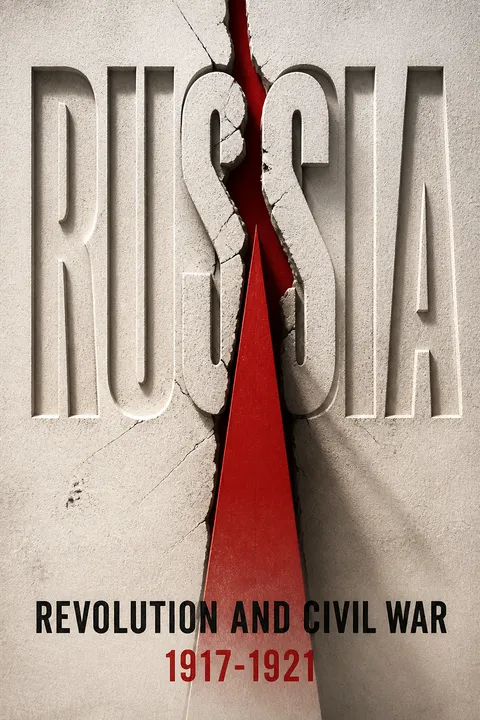

Key Takeaways
1. The Tsarist regime collapsed under the weight of its own archaic rigidity and the pressures of World War I.
"Autocracy without an autocrat is a terrible thing," observed Shulgin.
Archaic imperial decay. The Russian Empire entered the twentieth century trapped in anachronistic grandeur, completely detached from the political developments of modern Europe. The Romanov autocracy, led by the weak and obstinate Nicholas II, resisted any meaningful democratic reforms, believing the peasantry remained blindly loyal to the crown.
Wartime devastation. World War I acted as the ultimate catalyst for the regime's downfall, exposing the deep rot within the military and administrative systems. Millions of poorly equipped peasant conscripts were sent to the front as cannon fodder, leading to catastrophic casualties and widespread suspicion of treason at court.
Key systemic failures:
- Severe shortages of basic supplies, ammunition, and footwear for front-line soldiers.
- Extreme resentment caused by the stark contrast in living conditions between officers and men.
- Complete breakdown of the transportation and railway systems, preventing food from reaching major cities.
2. The February Revolution created a fragile dual-power system that failed to establish authority.
"The Tsarist symbol of the double-headed eagle was being replaced by a dual form of government."
Spontaneous popular uprising. In early 1917, severe food shortages and freezing temperatures in Petrograd triggered spontaneous protests that rapidly escalated into a full-scale revolution. When the garrison troops mutinied and refused to fire on the crowds, the Tsarist authority collapsed almost overnight, forcing Nicholas II to abdicate.
A divided leadership. The sudden vacuum of power was filled by two competing bodies: the liberal Provisional Government and the socialist Petrograd Soviet. This uneasy arrangement, known as "dual power," paralyzed the state as neither side possessed the confidence or legitimacy to govern effectively.
Consequences of dual power:
- The Provisional Government insisted on delaying major land reforms until a Constituent Assembly could be elected.
- The Petrograd Soviet wielded veto power over government decisions without assuming administrative responsibility.
- The state structure entered a political no man's land, leaving the country vulnerable to radical forces.
3. Lenin exploited the power vacuum by offering simple, radical promises to the desperate masses.
"Lenin simply battered away with a blunt instrument at the darkest corner of people’s souls."
Radical revolutionary vision. Upon his return to Russia in April 1917, Vladimir Lenin shocked even his fellow Bolsheviks by demanding the immediate overthrow of the Provisional Government. He rejected any compromise with moderate socialists and outlined a radical program to bypass the bourgeois-democratic phase of revolution.
Appealing to the masses. Lenin understood that the war-weary population cared little for complex political theories or democratic procedures. By framing his campaign around simple, powerful slogans, he successfully tapped into the deep-seated anger of the lower classes.
Bolshevik slogans of 1917:
- "Peace, Land, and Bread" to address the immediate needs of soldiers, peasants, and workers.
- "All Power to the Soviets" to undermine the legitimacy of the Provisional Government.
- Encouragement of immediate, unauthorized land seizures by the peasantry in the countryside.
4. The Bolshevik coup dismantled democratic institutions to secure absolute, single-party control.
"What Lenin contemptuously called ‘bourgeois democracy’ had not even been allowed to last twelve hours, signifying the death of the liberal and socialist intelligentsia."
The October insurrection. In late October 1917, the Bolsheviks launched a carefully planned armed coup in Petrograd, seizing key strategic points and arresting the Provisional Government. Led by Leon Trotsky's Military Revolutionary Committee, the insurrection was presented as a defensive measure to protect the Soviets.
Crushing democratic hopes. When the nationwide elections for the long-awaited Constituent Assembly returned a massive majority for the moderate Socialist Revolutionaries, Lenin refused to yield power. The assembly was forcibly dissolved by armed sailors after its very first session, ending Russia's brief experiment with democracy.
Establishment of dictatorship:
- Creation of the Council of People's Commissars (Sovnarkom) as an exclusively Bolshevik cabinet.
- Systematic banning of all non-Bolshevik newspapers and opposition political parties.
- Postponement of democratic reforms in favor of centralized, authoritarian control.
5. Order No. 1 and the collapse of military discipline crippled the Russian army's ability to fight.
"Respect for rank has disappeared."
Destruction of authority. Issued by the Petrograd Soviet in March 1917, Order No. 1 stripped military officers of their traditional authority and handed control of weapons to elected soldiers' committees. This measure, designed to prevent a counter-revolutionary military coup, effectively destroyed the chain of command.
Disintegration of the front. The collapse of discipline led to widespread fraternization with the enemy, mass desertions, and the lynching of unpopular officers. Soldiers in the trenches were far more interested in returning home to participate in land redistribution than in fighting a futile war.
Impact on the military:
- Officers were treated as class enemies and subjected to severe humiliation and violence.
- The failed Kerensky Offensive of June 1917 confirmed the total collapse of the army's fighting spirit.
- Elite "Death Battalions" and women's units failed to shame the demoralized conscripts into advancing.
6. The Treaty of Brest-Litovsk was a humiliating but necessary compromise for Bolshevik survival.
"In Russia, it was seen as a humiliation, but this brilliant stroke of realpolitik by Lenin preserved Bolshevik power."
A desperate peace. Facing a relentless German advance and possessing no disciplined army to resist, Lenin insisted on accepting Germany's harsh peace terms. Despite fierce opposition from Left Communists and Left Socialist Revolutionaries who advocated for a "revolutionary war," Lenin argued that survival of the regime was paramount.
Massive territorial losses. Signed in March 1918, the Treaty of Brest-Litovsk stripped Russia of its richest agricultural and industrial territories, including Ukraine, the Baltic states, and Finland. This humiliating capitulation deeply outraged Russian nationalists and officers, providing a powerful rallying cry for the anti-Bolshevik movement.
Strategic consequences of the treaty:
- The Bolsheviks secured a vital breathing space to consolidate their power and build the Red Army.
- The loss of Ukraine's grain supplies triggered severe food shortages and famine in northern cities.
- The treaty alienated the Left Socialist Revolutionaries, who withdrew from the coalition government in protest.
7. Red Terror was systematically deployed as a deliberate policy of class warfare and state survival.
"The first question you must ask is: what class does he belong to, what education, upbringing, origin or profession does he have?"
Institutionalized state violence. Following an assassination attempt on Lenin in August 1918, the Bolsheviks officially unleashed the Red Terror. Under the direction of Feliks Dzerzhinsky's Cheka, violence was transformed from spontaneous popular anger into a highly organized, state-sanctioned policy of class extermination.
Targeting class enemies. The terror did not seek to establish individual guilt, but rather to eliminate entire social categories deemed hostile to the socialist state. Aristocrats, bourgeois intellectuals, wealthy peasants, and moderate socialists were systematically arrested, held as hostages, or executed.
Key elements of the Red Terror:
- Execution of thousands of hostages in Petrograd and Moscow in retaliation for attacks on Bolshevik leaders.
- The brutal massacre of the former imperial family in Ekaterinburg to prevent them from becoming a symbol for the Whites.
- The deployment of specialized "food detachments" to forcefully requisition grain from starving peasants.
8. The White movement failed due to political division, reactionary aims, and brutal treatment of local populations.
"The Whites were shooting their prisoners and finishing off the wounded with such brutality that they could not possibly hope for mercy."
Reactionary political blindness. The White armies, led by generals like Denikin, Kolchak, and Wrangel, were united only by their hatred of Bolshevism. Their stubborn commitment to a "Great, One, and Indivisible Russia" alienated potential allies among national minorities, such as the Finns, Estonians, and Poles.
Alienating the peasantry. By refusing to recognize the peasants' land seizures and attempting to restore the rights of former landowners, the Whites drove the rural population back into the arms of the Reds. Furthermore, the rampant corruption, looting, and anti-Semitic pogroms carried out by White forces destroyed any claim to moral superiority.
Reasons for the White defeat:
- Failure to coordinate military operations across the vast, disconnected fronts of the Russian empire.
- Extreme political division between moderate socialists, liberals, and reactionary monarchists.
- Widespread atrocities and looting that turned local populations against White administrations.
9. The Civil War ended in a devastating famine and the total suppression of popular revolutionary ideals.
"All of Soviet Russia has been turned into an all-Russia penal colony."
A devastated nation. By 1921, five years of continuous warfare, revolution, and economic collapse had reduced Russia to a state of ruin. The Bolshevik policy of "War Communism," characterized by forced grain requisitions and the militarization of labor, triggered a catastrophic famine that claimed millions of lives.
The betrayal of the revolution. The growing disillusionment with Bolshevik dictatorship culminated in the Kronstadt Uprising of March 1921, where the very sailors who had been the "pride and glory" of the revolution demanded a return to democratic Soviet power. The rebellion was ruthlessly crushed by Red Army troops, signaling the final death of popular revolutionary ideals.
The legacy of the conflict:
- The complete destruction of the country's economy, infrastructure, and agricultural production.
- The consolidation of a highly centralized, authoritarian one-party state that tolerated no dissent.
- The introduction of the New Economic Policy (NEP) as a temporary tactical retreat to ensure regime survival.
Review Summary
Download PDF
Download EPUB
.epub digital book format is ideal for reading ebooks on phones, tablets, and e-readers.








































