
Plot Summary
Coin Tosses and Coincidences
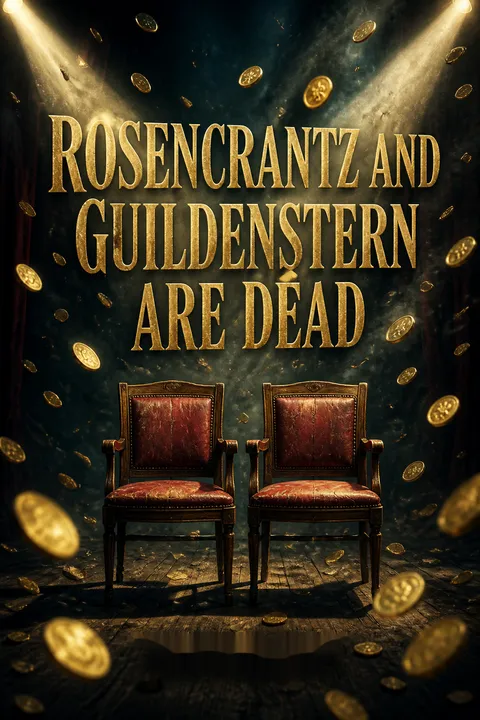
Rosencrantz and Guildenstern, two minor characters pulled from Shakespeare's "Hamlet," find themselves inexplicably stuck in a featureless nowhere, flipping coins that always land heads. While Rosencrantz, amiable and unquestioning, sees only his improbable luck, Guildenstern grows increasingly disturbed by the violation of probability's laws. Their repetitive actions and uncertain memories highlight the unreliability of their own existence. As the coins pile up, so does the sense that fate—or something more arbitrary—has locked them into a story not their own, foreshadowing questions about free will, identity, and purpose. Their comic banter barely masks the dread creeping into the cracks of their logic, setting the tone for a journey that will test the limits of reason, reality, and their own survival.
Summoned to Elsinore
Their comically circular conversation is interrupted when the memory of being summoned to the Danish royal court finally emerges. A messenger's call set them on a journey, but the why and how are lost in the fog of their consciousness. Elsinore is a place with great urgency, and the task they're given is both vague and weighty. The duo's confusion about their mission reinforces their position as pawns rather than protagonists. They are swept along by events set in motion elsewhere, unable to control their fate or even remember what they're supposed to do. The audience feels the unease—duty and destiny have enveloped them, but the rules of the game remain frustratingly out of reach.
Encounter with the Players
Rosencrantz and Guildenstern's path intersects with a troupe of itinerant actors, the Tragedians, led by the self-aware Player. This boisterous meeting blurs the boundaries between reality and illusion—actors and audience, voyeurs and participants. The Player's offerings—drama, tragedy, spectacle—unsettle Guildenstern, who longs for deeper meaning, not mere performance. The Tragedians' readiness to play any scene, even the obscene or tragic, serves as a chilling metaphor for the characters' lack of agency: they're all simply acting according to script, whether they know it or not. The Players' confidence in the face of meaninglessness highlights Rosencrantz and Guildenstern's discomfort, underscoring the difference between acceptance and existential anxiety.
Into Hamlet's World
Swept into the narrative of "Hamlet," Rosencrantz and Guildenstern become secondary figures in a larger drama. Their attempted self-assertion collapses as they stumble through Shakespeare's courtly intrigue, never quite sure of where they stand or what's expected. They encounter Ophelia, Hamlet, Claudius, and Gertrude—each unmoved by the newcomers' confusion. Despite being sent to comfort Hamlet and uncover the source of his madness, they quickly learn that they lack both the knowledge and the power to change the unfolding story. Their sense of self blurs further; even their own names become interchangeable, a poignant metaphor for the loss of identity in a world indifferent to their plight.
Royal Assignments and Confusion
The two are formally tasked by King Claudius and Queen Gertrude to discern Hamlet's troubles and, if possible, resolve them. Steeped in ceremony and misidentification—nobody seems able to reliably tell which is Rosencrantz and which is Guildenstern—they attempt to take themselves seriously. Yet their attempts to turn their roles into something meaningful only further expose their lack of agency. Far from central players, they become part of the background machinery that powers royal schemes. Deepening confusion interrupts even their private bond, as they struggle for "consistency" in a world where names and purposes are fluid, and where meaning itself seems arbitrary.
Games of Questions
In a fit of boredom and desperation, Rosencrantz and Guildenstern play at questions and answers, inventing rules and finding only more confusion. Language becomes both weapon and prison, a way to fill the void left by lack of direction. Their "game" unintentionally mirrors their real dilemma: answers are unattainable, questions are endless, and no matter how cleverly they spar, both are trapped by fate and circumstance. The playfulness grows dark. The distinction between statement and question, certainty and doubt, serves as an existential dead end—every exchange only clarifies how little either knows about themselves or their predicament. This section wrings both humor and sadness from the futility of seeking meaning in an absurd world.
Failing to Glean Hamlet
Finally confronting Hamlet directly, the two are outmatched. Their attempt at subtle inquiry collapses in the face of Hamlet's wit, evasions, and purposeful madness. Instead of gaining insight, they become the butts of Hamlet's games, veering further from their goal. Despite coaching themselves on strategy and purpose, Rosencrantz and Guildenstern are overwhelmed by ambiguity and rhetorical misdirection. Their failure isn't just personal—it's structural. The play-within-a-play recapitulates the real tragedy: no matter how earnestly they try to "play their roles," the narrative is controlled by others, and their function is merely to move the plot along toward predetermined disaster.
Watching the Play Within
The Players are called to perform before the court—the infamous "Mousetrap" play that Hamlet arranges to expose Claudius. Rosencrantz and Guildenstern watch the performance spiral into chaos, mirroring their own uncertainties and impotence. Staged deaths, betrayals, and theatrical conventions blur with real threats and real political machinations. The border between acting and being acted upon disappears: is their life less scripted than the play they're watching? As the dumbshow prefigures violence to come, they see themselves reflected in the doomed "minor" spies—their fates sealed, their stories swallowed by the tragedy of others. Art and actuality fold into each other with uncomfortable precision.
The Trap is Set
As Hamlet's play unsettles Claudius and the court, Rosencrantz and Guildenstern find themselves more entangled. The roles of observer, participant, and victim are hopelessly entangled as they try to follow shifting orders. Their attempts to "trap" Hamlet, or even execute a simple task, result in farce—missteps, missed signals, and the slow, dawning realization that they are themselves being trapped by forces beyond comprehension. They fumble through increasingly menacing situations, anxious to fulfill assignments but unable to affect the outcome. The sense of being mere chess pieces—moved by unknown hands—becomes inevitable as events spiral out of their control.
Madness, Murder, and Mission
Hamlet's madness culminates in murder—he kills Polonius—and the panic of the court spills over to Rosencrantz and Guildenstern. Now their assignment has teeth: they are charged with finding Hamlet and restoring order. Their efforts to comply are absurd, marked by slapstick misdirection and the comedy of being perpetually one step behind. The narrative accelerates; they stumble, bicker, and re-examine their roles. Conversation becomes circular, anxieties multiply, but stakes have never been higher. They cling to the letter from Claudius as both literal and symbolic orders—yet even this document's meaning will be corrupted, used as a tool of their undoing. Their journey, once vague, now seems inexorably fatal.
Death Becomes a Question
With Hamlet in custody, Rosencrantz and Guildenstern must escort him to England by royal command, still clutching the king's fateful letter. The sea voyage—shrouded in darkness, isolation, and philosophical dread—becomes a space for deeper existential reflection. In monologue and dialogue, the questions turn somber: what is death? Is it something, or nothing? Repeated metaphors of being boxed or erased reflect their terror—not so much of dying, but of becoming nothing, of a total loss of identity. Their mortality mirrors the uncanny fate of fictional characters: as soon as the story ceases, so do they. This terror gnaws at the very heart of Stoppard's meditation on existence.
The Voyage to England
Drifting on a ship to England, Rosencrantz and Guildenstern attempt to anchor themselves to facts: the task, the destination, the king's letter. They quarrel over purpose and meaning, growing hysterical as their sense of agency slips further away. The appearance of the Tragedians stowed away in barrels, blending reality with performance once more, only heightens the absurdity of their predicament. As the duo fixates on the promise that the letter explains everything, the hollowness of such assurances is palpable. Each small comfort is undermined by uncertainty: will the letter save them, or doom them? Their journey through treacherous metaphorical waters becomes literal, their "drift" reflecting the deeper drift of lives governed by fate and narrative.
Letters and Loyalties
A new horror unfolds when Hamlet, unseen, switches the letter they carry for another—one that now commands the deaths of Rosencrantz and Guildenstern themselves. Loyal to the end, the two discuss their undertakings with mounting dread, never suspecting the treachery sealed within their only safeguard. As events on the boat become more surreal—pirate attacks, missing companions, confusion over identity—the looming specter of doom hangs heavy. Loyalties, once clear, are now weapons deployed against the innocent, and their very faith in the system and its instructions has become their undoing. The inevitability of their fate is weighted with the bitter irony that their main crime is simply being there.
Drift Toward Doom
With Hamlet escaped and pirates having intervened, Rosencrantz and Guildenstern are left stranded—deprived of their "mission," and soon discovering that the letter now orders their own deaths. The comic and tragic reach their apotheosis: even now, they attempt to reason their way out, practice their explanations, and assure each other it will all be well. Their final debate over which direction to go—an emblematic, achingly funny series of starts and stops—encapsulates the futility of all their efforts. The dream of meaning unravels; the illusion of choice is revealed as a farce. They vanish from the narrative as abruptly as they entered, their only lasting trace being the report that they are, indeed, dead.
Pirates and Lost Purpose
A sudden pirate attack throws the ship into chaos. Amidst frantic confusion, barrels become hiding spots; Hamlet disappears, the fateful letter is altered, and the boundaries between possibility and futility evaporate. The Tragedians' presence, along with their relentless performances, brings home the cyclical, despairing comedy of the situation: death is merely another role, and the script tolerates no deviation. The action crescendos but resolves nothing—purpose is now as lost as Hamlet. Left to deliver the letter that dooms them, Rosencrantz and Guildenstern find themselves isolated in a world where chances, like the coins at the start, are always weighted against them.
Fate's Final Turn
Events reach their predestined conclusion as Rosencrantz and Guildenstern realize, too late, that their deaths are inevitable, encoded in the letter they so faithfully carried. The Player Tragedian delivers mock deaths, performances that echo and mock the duo's existential struggles. The "deaths" staged by the Tragedians, stylized and rote, contrast with the true erasure that awaits the two protagonists. Their supplication—for explanation, for some sense that their fates matter—goes unanswered. In this recognition, resignation replaces hope, and any last resistance is overwhelmed by the weight of inevitability.
Applause for Empty Deaths
Guildenstern, desperate for authenticity, attempts to kill the Player only to discover it is but another staged "death." The Tragedians, undisturbed, rise and deliver their curtain-call performances. But for Rosencrantz and Guildenstern, no such applause awaits—"real" death is an absence, a silence no play can fill. As the fictional is confused with the real, they face their dissolution with a last struggle for meaning, only to disappear, unremarked. The play closes with the court tableau from Hamlet—a reminder that their story is, ultimately, only a footnote in someone else's tragedy.
Disappearance and Unremembered Ends
As the stage clears, the verdict arrives from England: Rosencrantz and Guildenstern are dead. Their erasure from the story is as unceremonious as their entrance. No one seems to mourn or even remember them. Horatio's observations, the closing lines from Hamlet, and the finality of the stage's darkening seal their fate. Their existential search ends not with answers but with absence—the true finality of being minor characters both in the narrative and in life itself. The audience is left with the ache of their vanishing, a cautionary tale about meaning, memory, and the limits of what it is to be noticed at all.
Analysis
"Rosencrantz and Guildenstern Are Dead" is Tom Stoppard's dazzling meditation on the absurdity of existence and the precariousness of meaning, identity, and agency. The play masterfully exposes the fragility of narrative logic by placing two "minor" Shakespearean characters at its heart, then stripping them of clarity, confidence, and control. Their desperate attempts to reason, remember, and matter are continually frustrated by the mechanisms of the larger story—one written by others, powered by conventions, and indifferent to those on its margins. Through games, metatheatre, and comic dialogue, Stoppard makes profound philosophical questions approachable: Are we the authors of our lives, or mere actors? How do fate, language, and performance shape our realities? And what becomes of those who disappear unremarked? In the end, their deaths—unseen and unremembered—are a cautionary tale about modern alienation, the loss of meaning in a constructed universe, and the minor tragedies hidden within epic stories. The play insists that even the overlooked, the interchangeable, and the lost have inner lives worth noticing, and it leaves audiences haunted by the lingering echoes of their vanishing.
Review Summary
Readers widely praise Rosencrantz and Guildenstern Are Dead as a witty, philosophical masterpiece blending absurdist humor with existential depth. Many highlight Stoppard's dazzling wordplay, metatheatrical complexity, and debt to Beckett's Waiting for Godot. Familiarity with Hamlet is frequently recommended for fuller appreciation. The film adaptation starring Gary Oldman and Tim Roth receives enthusiastic mentions. A few readers found the pacing slow or struggled with the format. Standout quotes about death, fate, and identity resonated deeply, with the bridge-burning metaphor cited most frequently as particularly profound.
People Also Read


Characters
Rosencrantz
Rosencrantz is the more naïve and easygoing half of the duo, often content to accept reality without question, and finding humor even in absurdity. His innocence is both shield and weakness, as he rarely recognizes the danger facing him until far too late. Psychologically, Rosencrantz seeks comfort in games, routines, and the superficial trappings of meaning. His attachment to Guildenstern borders on dependency; their confusion over names hints at a deeply fused sense of self. He craves clear answers and recoils from existential uncertainty, longing for home and meaning. Yet, beneath the surface, he is capable of deep anxiety, especially as the absurdities and threats close in. His arc traces a journey from comic sidekick to tragic cipher—vanishing, unremarked, from the world that never noticed him.
Guildenstern
Guildenstern is the more philosophical and serious partner. He perceives strangeness in the world—such as the coin tosses and the unreliability of memory—as crises that reveal the arbitrariness of existence. Introspective and anxious, he repeatedly tries to impose order, structure, or logic on events. His attempts at reason often collapse into helpless circularity, underlining his profound existential terror. Guildenstern's need to understand—his insistence on meaning, rules, and integrity—marks him as a tragic figure, aware enough to sense doom but powerless to prevent it. His relationship with Rosencrantz is both a comfort and a burden, as their identities bleed into each other. By the end, Guildenstern is exhausted, resigned, and vanishes into the narrative void, leaving behind only the questions he could never answer.
The Player
Leader of the Tragedians, the Player embodies the play's themes of illusion, performance, and the arbitrariness of meaning. With wild confidence, irony, and acceptance of chaos, he is both comic relief and philosophical provocateur. The Player claims he is always "in character"—ultimately asserting that all life is performance. His troupe's willingness to enact any scene, including their own stylized deaths, reveals how far people will go to fit scripts imposed upon them. The Player's cheer in the face of adversity underscores existential freedom through acceptance: he survives not by denying fate, but by embracing his role within it. His repeated "deaths" are reminders of the distinction between acting and being—and that even the most convincing performance cannot elude the reality of oblivion.
Hamlet
Though the play's protagonists orbit him, Hamlet moves through their world merely as the main character of a different, larger narrative. His madness, both real and feigned, and his capacity for self-reflection bewilder Rosencrantz and Guildenstern. Hamlet's cryptic language and shifting moods frustrate their every attempt to fulfill their mission. Nor does he offer them understanding; his schemes ultimately shift their fate from pawns to sacrifices. His final unseen act—switching the letter that dooms Rosencrantz and Guildenstern—exposes the lethal indifference of central characters toward the minor ones. Hamlet's tragedy is foregrounded in Shakespeare's play, but here he is the force that destabilizes and ultimately destroys the two men pulled, unwillingly, into his orbit.
Claudius
King Claudius is the royal power who commands Rosencrantz and Guildenstern's service. To him, they are means to an end—tools in his efforts to monitor and ultimately control Hamlet. Claudius's manipulations ripple through the narrative without regard for the duo's confusion or innocence. He is pragmatic and callous, embodying the indifference of those wielding power over lesser players. Though he only appears intermittently, his decisions drive much of the action and doom the pair. In Stoppard's metatheatrical universe, Claudius is emblematic of narrative forces—an inscrutable author whose motives and machinations determine the fates of others with merciless ease.
Gertrude
Queen Gertrude appears intermittently but forms an essential part of the royal plot. She is maternal but distant, often complicit in Claudius's schemes. Her inability (or refusal) to distinguish between Rosencrantz and Guildenstern underscores the duo's erasure from meaningful existence. More symbol than person, Gertrude stands for the obliviousness of those at the center of drama to the suffering of those on the margins. She softens some of Claudius's harshness, but her role is ultimately passive—a reflection of the court's larger indifference and a subtle echo of existential neglect.
Polonius
Polonius is the meddling advisor, obsessed with the mechanisms of court and power. His verbosity and pretense of wisdom mask his essential cluelessness. He, too, becomes a pawn and, ultimately, a victim—a fate that mirrors what lies ahead for Rosencrantz and Guildenstern. As the father of Ophelia and Laertes, his familial anxieties echo the play's motif of misplaced or misunderstood loyalty. His murder by Hamlet causes the shift from intrigue to outright danger for the duo and sharpens the play's tragic tone.
Ophelia
Ophelia's pain and decline run in parallel to the confusions of Rosencrantz and Guildenstern. She is the unheeded voice of innocence—rejected by Hamlet, misunderstood by all. Her suffering is mostly observed, not engaged with, by the protagonists, accentuating the theme of peripheral tragedy. Ophelia's fate, sealed through no fault of her own, mirrors and prefigures the existential erasure that awaits all minor players who are swept along by stories larger than themselves.
Alfred
Alfred is the youngest Tragedian, forced by his troupe to play female roles and, by extension, to endure exploitation and humiliation. His discomfort with the demands placed upon him accentuates the theme of helplessness under imposed scripts, both theatrical and social. Alfred's repeated victimization is a darkly comic echo of the suffering that awaits Rosencrantz and Guildenstern. He is a silent witness to the broader brutality of "the show"—a pawn among pawns.
The Tragedians
The ensemble of actors under the Player's guidance, the Tragedians personify the machinery of drama itself. They are both performers and signifiers of fate, enacting deaths, betrayals, and absurdities as required by the play within a play. Their presence is a constant reminder that all are following scripts, and that life and art are indistinguishable in the world Stoppard creates. They act as a choric presence, echoing and amplifying the absurdities, ironies, and ultimate futility of the protagonists' predicament.
Plot Devices
Metatheatre and Fate's Machinery
The central device is metatheatre: Rosencrantz and Guildenstern are aware, at some level, that they are characters in a play—yet they are powerless to resist the logic and fate imposed by the narrative. Play-within-a-play moments, games, and repeated motifs (coin tosses, questions, rehearsed dialogue) reinforce the sense that both they and the world are constructed performances. Their inability to alter their fate—even as they speculate about free will and causality—underscores the power of story and the illusion of agency. Foreshadowing is achieved through parallels with the Tragedians' play, which enacts their doom before it unfolds, and through motifs of doubling and mistaken identity: they are everyone and no one, fully themselves only when nobody else is looking. Dialogue circles endlessly, cutting off every escape as meaning collapses beneath language's performances.
Download PDF
Download EPUB
.epub digital book format is ideal for reading ebooks on phones, tablets, and e-readers.








































