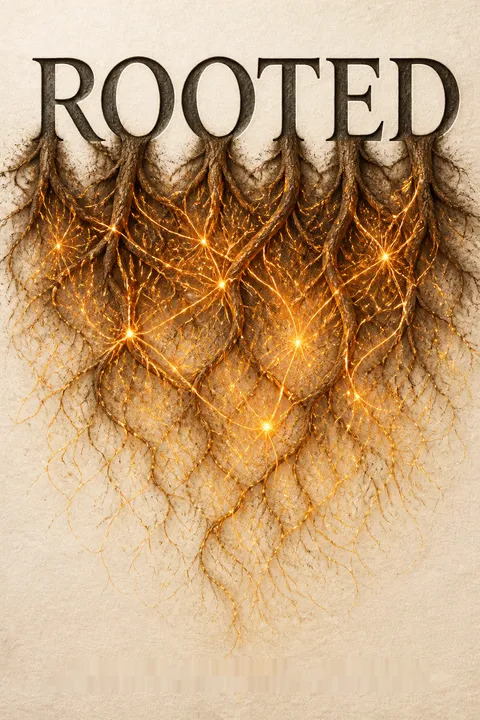

Key Takeaways
1. Embrace a Rooted Way of Being
Rootedness is a way of being in concert with the wilderness—and wildness—that sustains humans and all of life.
A new paradigm. In an era of unprecedented ecological crisis and widespread anxiety, a "rooted" way of living offers a path forward by integrating nature, spirit, and modern science. This approach acknowledges the innate connection between humans and the natural world, moving beyond traditional divisions to foster a holistic understanding of life. It's about recognizing that our bodies, minds, and spirits are deeply intertwined with the earthen community.
Science affirms intuition. Academic research increasingly supports truths long held by mystics, poets, and Indigenous cultures. Studies reveal that trees communicate, animals possess complex intelligences, and time in nature enhances human creativity, reduces depression, and improves physical health. This scientific validation provides a language and courage for many to trust their intuition about nature's profound influence, challenging the modern cultural separation from our "indwelling earthen intelligence."
Radical interconnection. The concept of "rootedness" stems from the Latin radix, meaning the intrinsic, organic heart of being and action. It calls us to live radically intertwined with the planet's vitality, fostering a sense of groundedness amidst fear and paralysis. This "amphibious" existence at the crossroads of science, nature, and spirit offers clear-sighted hope, reminding us that we can simultaneously hold anxiety and beauty, despair and possibility, making our lives a foundational form of activism.
2. Listen to the Wild Summons
Who wants an everyday path—paved and void of danger—when we can have beasts and shadows and secret flowers and unexpected visits from the feral wolf of our imaginations?
The wolf's invitation. The ancient tale of Little Red Riding Hood can be reinterpreted not as a warning against the wild, but as an invitation to step off the conventional path. The wolf's "task" of picking wildflowers leads Red to discover hidden beauty and her own way through the woods, emerging exhilarated from being "swallowed whole by the wild." This symbolizes a call to embrace the unpredictable, untamed aspects of life and self.
"Adsum": I am here. Facing ecological collapse, we are asked for a profound response. The monastic vow "adsum" signifies a radical openness to constant evolution within rootedness, a joyful and persevering commitment despite obstacles. This isn't blind optimism but a mature hope that acknowledges brokenness while demanding participation in earth's renewal. It's about engaging fully with both the nightmarish and transformative aspects of our time.
Pilgrimage on the wild path. The "wolf path" beckons us to a wilder, more authentic self, recognizing that our urban lives, while diverse, are not enough. Just as Saint Francis listened to and understood the wolf of Gubbio, we are called to listen to the wild earth, affirming our presence with "I am here." This journey, though solitary, is deeply entangled with all creatures, fostering a "wildness" that is both sacred land and a quality of consciousness.
3. Shed the Unnecessary, Connect with Earth
When you take off your shoes, you will notice this is holy ground!… because what prevents you from seeing that it’s holy ground is the dead skin you have to shed.
Earthing and humility. Walking barefoot, or "earthing," is more than a trend; it's a conscious connection with the earth. While the electromagnetic science remains debated, biomechanics confirms that shoeless walking strengthens muscles and enhances physical intelligence. Metaphorically, shedding shoes, like Moses at the burning bush, is a radical act of casting off what separates us—pretense, comfort, and the "dead skin" of limited thinking—to reveal the inherent holiness of the ground beneath our feet.
Beneathness and remembrance. Barefoot walking deepens ecological knowledge, revealing hidden wonders like feathers, fungi, and animal tracks. It allows us to feel the "beneathness" of the soil, alive with roots, mycelia, and decomposers—a quiet symphony of life and death. This practice connects us to the ancient "mother clay" from which we emerged, fostering a humility rooted in the earth (homo from humus), and reminding us of our belonging to nature's cycles.
Reclaiming natural movement. Modern footwear, while protective, has tamed and hobbled our feet, diminishing their natural intelligence. Biomechanist Katy Bowman highlights how super-protective shoes on even surfaces "cheat us of many of the benefits of walking." By slowly reintroducing barefoot movement on varied terrain, we can restore our feet's agility and sensory discernment, preserving the "footsteps of our ancestors" and moving with greater joy and gratitude upon an ever-changing, holy path.
4. Wander to Reawaken Your Inner Cartography
The mind, like the feet, works at about three miles an hour. If this is so, then modern life is moving faster than the speed of thought, or thoughtfulness.
The pace of thought. Wandering, derived from the Old English wandrian (to wend, to wind), is a goalless, aimless movement that brings mind and body into healing congruity. In a world of schedules and deadlines, wandering offers a rare spaciousness of mind and an unhurried pace, allowing us to escape the "speed of thought" that characterizes modern life. It's about tilting into kairos—sacred time—where footsteps are decommodified and guided by the inclination of our spirit.
Feral adventures. Like Frodo stepping out his door, wandering is a "dangerous business" that invites unpredictability and adventure. It can lead to microadventures, like discovering a hidden community garden in a familiar neighborhood, or profound shifts in perspective, as Bashō experienced when his melancholia lifted during his spartan rambles. This undomesticated movement fosters a sense of freedom and openness to the luminous and unexpected.
Inner cartography. Nobel-winning research on location-grid neurons in the hippocampus reveals our innate biological capacity to know ourselves in relation to place. While modern life and technology can make these neurons "flabby," wandering freely allows us to gather landmarks, ecological awareness, and a sense of kithship. Our footsteps in the outer world create an inner, wilder cartography, whispering "This way, this way," and fostering creative flourishing through "moodling" and "choiceless awareness."
5. Immerse in Nature, Beyond Commodity
The forest is not a therapist. Not a pill, not a spa. Not a cog in the capitalist wellness industry.
Beyond human utility. While the science of "forest bathing" (shinrin-yoku) affirms nature's health benefits—reducing stress, lowering blood pressure, boosting immunity—it's crucial to engage with it beyond a commodified, human-centric framework. The original Japanese practice, rooted in Shinto animism, recognized the kami (aliveness) in all things, fostering a transpersonal "interflow" with a vividly inspirited world. Reducing nature to a "prescription" or "spa" diminishes its intrinsic value and the reciprocal relationship we owe it.
The irreplaceable wild. The trend of "nature-derived stimuli"—videos, fragrances, sounds—as substitutes for actual contact with nature, while offering some benefits, risks replacing our necessary attentiveness to living ecosystems. As philosopher Jack Turner warned, "intimacy with the fake will not save the real." True immersion, like Thoreau's at Walden Pond, asks not "What can nature do for me?" but "How should I live?", fostering a deeper, more ethical relationship with the wild.
Empathy in complexity. Authentic immersion means embracing the "calm anxiety of creation," recognizing that the natural world is often severe and uneasy, not just tranquil. The author's rattlesnake encounter, for instance, brought fear, adrenaline, and a visceral intimacy with the brisk, uneasy calculus of the wild. This "fruitful empathy" with the fretful, complex wild, even the prick of nettles or the presence of predators, allows us to emerge "mingled with the stuff of the earth," with a heart rate calm yet beautifully feral.
6. Cultivate Solitude for Primal Sanity
Wrong solitude vinegars the soul, right solitude oils it.
A culture of distraction. Modern life, with its constant technological intrusions, has created a "culture of unsolitude," making us unaccustomed to and ill-prepared for alone time. Studies show many people prefer electric shocks to just fifteen minutes of undistracted thought, highlighting a deep-seated discomfort with stillness. Yet, periods of extended solitude are essential for a deepened sense of wholeness, clarity, and interflow with all of life.
Facing inner wilderness. Solo time in nature often brings initial fear and anxiety, as the author experienced with imagined cougars and men on Mount Rainier. These "night-crazies" are common, especially for women, whose fears often "circle around people and contain an unmistakable sexual twinge." However, statistics show wilderness is often safer than urban environments. This confrontation with fear, and the subsequent peace, leads to a "primal sanity" and "divine insanity" that transcends societal norms.
The solitary brain. Neuroscience reveals that our brains are constantly active, but without external distractions, highly potent "self-referential" processes (memories, emotions, self-evaluation) work at full capacity. Solitude allows our brainscape to roam free, unshackling us from the "spotlight effect" and the compulsion to curate our lives for social media. This "all + one" experience paradoxically leads to a deeper comprehension of our essential interconnection with both humans and the beyond-human world, shedding psychic layers for a difficult, shimmering center.
7. Relate to an Infinity of Animal Intelligences
Emotions are the gifts of our ancestors. We have them and so do animals. We must never forget this.
Beyond anthropomorphism. For centuries, Western thought, influenced by Descartes, relegated consciousness to humans, dismissing animal pain as mere "squeak of a door hinge." However, modern science, culminating in the 2012 Cambridge Declaration on Consciousness, now affirms that all animals possess consciousness worthy of ethical consideration. Evolutionary biologists like Marc Beckoff remind us that "emotions are the gifts of our ancestors," shared across species. It's time to abandon the term "anthropomorphism" and acknowledge animal consciousness—both shared continuities and unique mysteries—without hindrance.
A multiplicity of intelligences. Living intimately with animals, like the author's starling, Carmen, reveals astonishing intelligences beyond human measures. Carmen mimics sounds and anticipates actions, demonstrating aural attunement. Vultures navigate by smell, bats by hearing, bees by geometric pattern recognition and wavelengths invisible to us. Each species possesses a unique way of knowing, forming an "infinity of animal intelligences" that encircles our lives in shimmering complexity, a constant reminder of the diverse ways of being in the world.
Coming into animal presence. Modern life has led to "species loneliness," a "desperate hunger for connection with other life." To recover, we must cultivate a courageous tolerance for complexity and discomfort in the presence of wild creatures. The "sit spot" practice—choosing a place to visit often, alone, and quietly—allows us to witness animals returning to their natural behaviors as our human presence ebbs. This stillness fosters "shapeshifting," a "transgressive experience" of self-forgetting and identification with something beyond, leading to a liberating new wisdom and a sacred obligation to "lift up" our animal kindred, like the Lummi Nation's devotion to the orca Tokitae.
8. Speak and Name with Truth and Intention
All power is one in source and end, I think. Years and distances, stars and candles, water and wind and wizardry, the craft in a man’s hand and the wisdom in a tree’s root: they all arise together.
The magic of language. The ancient incantation "abracadabra" suggests "what is spoken is what becomes," highlighting how language shapes our perceptions, actions, and outcomes. Just as Ursula Le Guin's Earthsea wizards understood the power of "true naming"—a soul name that can enhance or thwart existence—our words are not mere building blocks but constellations that offer worldviews and action plans. Using utilitarian or mechanistic language for nature, such as "commodity" or "computer," unwittingly invites exploitation and diminishes its aliveness.
Excavating true names. Robert Macfarlane emphasizes the need for "place-particularizing" language to deepen our understanding and love for the earth. Knowing specific names for creatures and landforms fosters intimacy. However, many official species names reflect a colonial legacy, honoring white male explorers and ornithologists, often with problematic histories. While scientific binomials are crucial for global communication, we must also excavate and honor Indigenous names, and create community, poetic, and personal names that reflect our kithship and the unique relationship to place.
A language of animacy. The way we speak about other-than-human beings matters. Referring to animals as "it" objectifies them, creating a barrier to empathy. The move towards gender-nonbinary language for humans can inspire a rethinking of pronouns for other species. Robin Wall Kimmerer's suggestion of "ki" (from aaki, meaning "land," signifying "a being of the living earth") offers a powerful alternative, imbuing all beings with aliveness in our language. Ultimately, "beholding"—contemplative witness without the urge to name or tell—allows us to see deeper into the beheld, cultivating a unique wholeness and listening to the "wordless language" of the earth.
9. Grow with the Wisdom of Trees
Trees stand outwardly as individuals but are joined into a radical reciprocity, so recently beyond the imagining of science.
The grieving forest. Trees, like humans, possess a "fun'iki"—an ineffable atmosphere of feeling. The author's experience of a felled beech tree in an urban park evoked a profound sense of grief, suggesting that trees, too, register loss. This intuition is increasingly supported by science, which reveals that trees comfort, heal, speak, and move in ways previously unimagined, challenging the historical divide between humans, animals, and plants.
The wood wide web. Pioneering research by Suzanne Simard and others uncovered the "mycorrhizal network," or "wood wide web"—a vast underground matrix of fungal mycelia that connects trees and other plants. This ancient mutualism allows trees to share nutrients, communicate danger, and fortify one another, even supporting sick individuals or stumps. This intricate, entangled process, which Simard calls a "kind of intelligence," demonstrates that trees forge "their duality into a oneness, making a forest," a profound lesson in radical reciprocity.
Reciprocity and attunement. Trees, far from being static, exhibit complex biological processes mirroring our own: growth, reproduction, community care, and regeneration. They even possess neurotransmitters like dopamine and serotonin. To assist trees, Simard suggests simply spending time among them, fostering a sense of being "claimed" by a particular tree. Practices like hugging trees, entrainment (shedding shoes to feel their rhythms), and even reading to them, cultivate a deep attunement. This "elementary satisfaction" of listening to trees speak, as "sane people used to hear them," is the rooted foundation for all bold activism on behalf of wild lands.
10. Embrace the Fruitful Darkness
Darkness offers an intelligent stillness that fills and tills our psyche in a manner both difficult and beautiful—this is the fruitful darkness Joan Halifax speaks to in her lustrous book by that name.
Unseeing for clarity. The author's experiment to improve night vision by walking a lake trail without a flashlight led not to better sight, but to a greater comfort with "not-seeing" and a new kind of clarity. An encounter with a moose in the unlight, where she could both see and not-see, taught her to soften her eyes and let go of preconceived notions of sight. This "unseeing" is essential to apprehending the world beyond cultural conceptions.
Reclaiming darkness. Our language and psyches often conflate good with light and evil with darkness, a symbolism deeply ingrained in our culture. However, Ursula Le Guin's Earthsea series challenges this duality, showing that integrating one's "shadow" or dark self leads to salvation. Darkness possesses its own essential grace: it bears liminal imaginings, restorative sleep, starlight, and forces reliance on inner vision. As John O'Donohue notes, "Each thing creeps back into its own nature within the shelter of dark."
Life at the speed of dark. Ninety percent of life unfolds in complete darkness—beneath soil and sea—where seeds germinate and decomposers toil. Yet, artificial light has created an "eternal summer" that disrupts circadian rhythms, disorients migrating birds and moths, and disorders tree growth. For humans, constant light dramatically worsens physical health, leading to inflammation, muscle loss, and faster aging. Embracing "fruitful darkness" means turning off lights, stepping into the night, and allowing our senses to heighten, fostering an "intelligent stillness" and a more intricate wisdom in these precarious times.
11. Create Your Unique Art of Earth Activism
The human task now is to bring it.
The paradox of action. In a world facing ten thousand interconnected crises, the paralysis of overwhelm is common. Yet, we are called to act within this paradox, embracing both the "fox" (knowing many things) and the "hedgehog" (knowing one important thing). Like the Thousand-Armed Kannon, each of us offers a unique gift to the world. This isn't about doing everything, but about holding all things in mind while choosing our particular forms of "rooted, creative action."
Star-human creation. The words "create," "creature," and "creation" are deeply intertwined, reminding us that all beings are co-formed. We are literally "star stuff"—the elements in our bodies forged in distant supernovas. This hallowed privilege of existence comes with a sacred "obligation" (from ligament, that which binds us) to live with meaning. "Creation" itself implies an unending ground of existence, a matrix of constant renewal that embraces all living and "nonliving" elements, inviting us to create within creation.
The creative ecology of home. Our elemental bodies are vectors of action, inspired by the "creative wind" (inspiratus). This "creative art of earth activism" extends beyond grand gestures to the "home economics" of our daily lives. Our choices in how we eat, clothe, warm ourselves, and manage waste bind us biologically and spiritually to ecosystems far beyond our doorstep. By embracing radical simplicity, deleveraging acquisitions, and sharing generously, we contribute our unique "charism"—a particular gift received in grace—to a new story of just and sacred economics, in solidarity with all beings and in reciprocity with the dreaming earth.
12. Spiral into Earthen Immortality
Against this cosmic background the life span of a particular plant or animal appears not as a drama complete in itself, but only as a brief interlude in a panorama of endless change.
Death as transformation. Time in nature is a constant presence of essential death, where leaves become soil, and deer corpses feed vultures. The author's contemplation of a fallen redcedar, which continues to nourish new life as a "mother log," illustrates death not as an end, but as a spiral of continuous transformation. This "beneathness"—the writhing substrate of decomposition—reclaims bodies for the nourishment of life above soil, demonstrating an intricate cellular intelligence long after apparent death.
The cadaveric ecosystem. New science reveals that after our hearts stop, our bodies become a convivial "cadaveric ecosystem." The thanatomicrobiome—a vast community of bacteria—begins to self-digest cells and tissues, spreading throughout the body. This process attracts a variety of insect species, which in turn feed other arthropods, reptiles, and birds, carrying our matter to sky, forest, or mountain. Inexplicably, some genetic material even expresses itself after medical death, suggesting purposes we don't yet understand, and challenging our linear view of life and death.
Material immortality. This understanding informs a "to-do list" for death, advocating for natural burial without embalming or concrete vaults, allowing the body to return directly to the earth. As Rachel Carson articulated, this is "material immortality," where our bodies are broken down and resurrected physically in new cellular arrangements. Like Julian of Norwich's vision of a "small thing, the size of a hazelnut," representing "all that is created" yet cradled in a limitless sacred whole, our individual lives are brief interludes in an endless panorama of change, radically connected to all life, with nothing truly lost.
Review Summary
Rooted by Lyanda Lynn Haupt receives mixed reviews averaging 4.01 stars. Readers appreciate the blend of memoir, spirituality, science, and nature philosophy, with many praising the peaceful, meditative quality and beautiful writing. The book encourages practices like barefoot walking, forest bathing, and reconnecting with nature. However, critics feel it leans too heavily on personal memoir rather than science, with some finding it preachy, rambling, or lacking focus. Fans compare it favorably to Braiding Sweetgrass and value its validation of nature spirituality, while detractors expected more scientific rigor and less mysticism.
People Also Read



Download PDF
Download EPUB
.epub digital book format is ideal for reading ebooks on phones, tablets, and e-readers.








































