
Key Takeaways
1. Rome and Han China followed parallel paths of institutional convergence before permanently diverging into fragmented Europe and unified China.
In terms of state size, state capacity, and state institutions, we observe a prolonged process of gradual convergence that lasted for many centuries but was eventually replaced by a process of increasing divergence that continued into the early twentieth century.
Twin imperial trajectories. Rome and Han China were remarkably similar in scale, population, and administrative complexity, ruling over half of humanity. Both empires featured god-like emperors, massive standing armies, and extensive bureaucratic networks. They faced similar internal pressures, such as elite competition for agricultural surplus, and external threats from nomadic "barbarians" on their frontiers.
Institutional convergence. Over several centuries, both states developed highly parallel administrative structures. By the fourth century CE, the late Roman Empire closely mirrored the Han state in its division of provinces, separation of civilian and military authority, and reliance on a centralized court. This "Great Convergence" proved that massive agrarian empires face identical structural challenges that demand similar institutional solutions.
The great divergence. Despite these parallel developments, their ultimate fates diverged dramatically after the sixth century CE. While China repeatedly reconstituted its unified empire under successive dynasties, Europe remained permanently fragmented into a polycentric system of competing nation-states.
- China's compact geography and centralized bureaucratic legacy favored cyclical reunification.
- Europe's fragmented geography and autonomous religious institutions resisted hegemonic control.
- The "First Great Divergence" laid the groundwork for the modern global political landscape.
2. Intense, existential warfare forced early Chinese states to bureaucratize, while Rome expanded through external alliances and citizenship.
In these states warfare was no longer the means by which an aristocracy defined its authority, but rather the primary institution used by the rulers of states to organize, rank, and control their subjects.
Symmetric existential warfare. In China, the Warring States period featured intense, continuous, and symmetric warfare between evenly matched states. This existential threat forced rulers to implement radical domestic reforms to maximize resource extraction. The state of Qin led this transformation by replacing aristocratic privileges with a meritocratic, highly regimented bureaucratic system.
Asymmetric Roman expansion. In contrast, Republican Rome faced asymmetric conflicts against less organized tribal societies or weaker Hellenistic states. This allowed Rome to expand without developing a highly centralized domestic bureaucracy. Instead of deep administrative penetration, Rome relied on a massive network of Italian allies (socii) and the strategic extension of citizenship to secure manpower.
Contrasting state structures. These different military challenges produced fundamentally different state capacities. While China developed a professional, non-hereditary civil service to manage conscription and taxation, Rome relied on private contractors and local elites.
- Qin divided its territory into uniform conscription districts (xian) with mutual surveillance.
- Rome utilized a minimal administrative apparatus, leaving local elites autonomous.
- Chinese states prioritized agricultural productivity and direct taxation to fund continuous war.
3. Both empires shifted from citizen-conscripts to professional armies, balancing military efficiency against the political survival of the regime.
The triumph of apologists for autocracy over the claims of expertise initiated both the long-term devaluation of military command in China and the emergent ideal of the literary man who was able when necessary to bring his general skills to bear on military command.
Conscripts to professionals. Both empires eventually transitioned from citizen-soldier conscripts to long-service professional standing armies. In Rome, Augustus established a professional military to secure his own autocratic power and prevent rival warlords from challenging his regime. In China, the Eastern Han abolished universal conscription in favor of professional garrisons, convicts, and nomadic allies to fight mobile steppe enemies.
Political control of command. The integration of civilian and military leadership differed sharply between the two empires. Roman aristocrats and emperors routinely commanded armies as a primary source of political legitimacy and personal glory. In China, the state actively devalued military expertise, preferring to place command in the hands of obedient courtiers or literary scholars to prevent military usurpation.
Regime survival over efficiency. Both systems prioritized the political survival of the ruling regime over pure military efficiency. This structural choice had profound long-term consequences for frontier defense and internal stability.
- Roman emperors monopolized military glory, attributing all victories to their personal genius.
- Han courts feared powerful generals, leading to the systematic marginalization of military specialists.
- Both empires eventually suffered from barbarian infiltration and the rise of localized private armies.
4. While Roman law evolved from private civic disputes to imperial administration, Chinese law fused Legalist state control with Confucian moral-cosmic accountability.
In contrast, legitimate punishments based on state authority must be justifiable at large within the political community.
Justifying state violence. Both empires faced the critical challenge of legitimizing the state's monopoly on violence and punishment. In China, the Legalist tradition advocated for clear, public, and severe laws to deter dissent and mobilize the population. However, this harsh approach was tempered by Confucian ideals, which argued that the ruler must act as a moral exemplar to maintain cosmic harmony.
Roman legal evolution. Roman law transitioned from a system of private dispute resolution among citizens to a highly bureaucratized administrative tool under the Empire. The introduction of "cognition" trials placed judicial power firmly in the hands of state-appointed magistrates. This shift allowed the imperial state to define crimes, such as treason (maiestas), more broadly to protect the emperor's security.
Cosmic vs. civic accountability. The philosophical justification for law and punishment followed distinct paths in the East and West.
- Chinese cosmology linked imperial justice directly to the natural world, blaming droughts on unjust punishments.
- Roman law prioritized procedural justice and the preservation of elite status privileges.
- Both systems struggled to balance the absolute power of the monarch with institutional legal constraints.
5. Secluded monarchs in both empires relied on castrated servants and imperial women to bypass traditional aristocratic and bureaucratic elites.
Since they could not be assimilated into the formal aristocracy, they not only acted as a counterweight to aristocracy and magistrates but also, as Keith Hopkins has pointed out, as "lubricants" for the system.
The secluded monarch. As both empires matured, their rulers became increasingly secluded within elaborate palace complexes, separated from the general populace and the formal bureaucracy. This physical isolation created a power vacuum that was rapidly filled by informal actors. Eunuchs and court women emerged as the primary gatekeepers, controlling access to the emperor and manipulating state policy.
Eunuchs as safe servants. Castrated servants were uniquely suited for imperial service because their physical deformity excluded them from traditional social structures. Lacking the ability to establish hereditary dynasties or integrate into the formal aristocracy, their survival depended entirely on the emperor's favor. This absolute dependence made them highly reliable instruments of autocratic power against ambitious noble families.
Alliances of the inner court. Court women, particularly dowager empresses, frequently allied with eunuchs to bypass the formal civil administration and assert their own political influence.
- Eunuchs managed the intimate daily life of the emperor, including his education and sexual liaisons.
- Roman emperors used household slaves and freedmen to build a loyal administrative apparatus.
- Both empires experienced violent aristocratic backlashes against the perceived corruption of "inner court" power.
6. Agrarian empires extracted tribute by force, relying on market networks to convert bulk agricultural goods into liquid state resources.
The problem of how to combine a political discourse that was frequently hostile to and always suspicious of trade and merchants with the widespread existence of markets and commercialism constitutes one of the great conundrums in the history of agrarian empires such as Rome and China.
The tributary enterprise. Both the Roman and Han empires operated as massive machines for extracting agricultural surplus from local communities. This tribute was concentrated in imperial capitals and military frontiers, funding monumental architecture, public doles, and standing armies. By imposing taxes, the state forced resources out of self-sufficient local economies and into a wider sphere of circulation.
The market as transformer. Because taxes were often collected in kind, the state relied on market networks to convert agricultural goods into liquid assets. Merchants and financial middlemen played a crucial role in buying up state grain and converting it into cash or precious metals. This interaction between state coercion and commercial exchange stimulated widespread monetization and regional trade.
Anti-merchant ideology. Despite their reliance on commercial networks, both imperial elites maintained a deeply hostile attitude toward merchants and trade.
- Roman moralists argued that luxury imports corrupted the military virtue of the conquerors.
- Chinese literati advocated for the "fundamental" industry of agriculture over the "branch" industry of commerce.
- Both states periodically intervened in the economy through monopolies, price controls, and trade restrictions.
7. Han charity targeted the rural peasantry to preserve the state's agricultural tax base, whereas Roman benevolence was urban-centric, funding civic monuments and spectacles.
The primary forms of public benevolence, both for the ruler and members of the elite, were the construction of new buildings for public use (theaters, gymnasia, baths, arenas for games), the sponsorship of games, and the maintenance of aqueducts and roads.
Urban-centric Roman euergetism. In the Roman world, public benevolence was deeply tied to the civic identity of the city-state. Wealthy elites and emperors competed for prestige by funding monumental stone buildings, public baths, theaters, and lavish games. This "euergetism" created a highly visible, shared public space that defined Roman citizenship and reinforced the social hierarchy.
Rural-focused Han charity. In contrast, Han imperial benevolence was directed primarily toward the rural peasantry to preserve the state's agricultural tax base. The emperor distributed ranks, land, tax relief, and food to the aged and impoverished in local villages. This rural focus reflected the Chinese state's direct administrative relationship with individual farming households.
Contrasting spaces of power. The physical manifestation of elite generosity shaped the daily experience of subjects in distinct ways.
- Roman monuments were built of durable stone, preserving the donor's name for generations.
- Han structures were made of perishable wood, emphasizing continuous renewal and ritual action.
- Roman emperors displayed themselves at public games, while Chinese rulers remained hidden behind palace walls.
8. Rome's monetary economy was anchored in gold and silver coins, while China relied on a massive supply of low-value cast bronze coins supplemented by bullion.
While silver and later gold dominated the monetary economy of the Roman Empire, the victorious Chinese regimes operated a system of bronze coinages supplemented by uncoined precious-metal bullion.
Precious metal dominance. The Roman monetary economy was anchored in high-value gold and silver coins, such as the aureus and denarius. This bimetallic system was supported by Spain's rich silver mines and the integration of Mediterranean trade networks. High-value coins facilitated large-scale state transactions, military pay, and elite wealth accumulation across the empire.
The bronze cash standard. China, by contrast, relied on a massive supply of low-value cast bronze coins (wuzhu) supplemented by uncoined precious-metal bullion. This choice was driven by geological constraints, as central China lacked abundant silver deposits, and by different fiscal demands. Bronze cash served as a highly effective medium for daily market transactions and peasant tax payments.
Divergent monetary paths. These physical and structural differences created distinct patterns of monetization and economic integration.
- Rome's precious-metal coinage facilitated long-distance trade and high-value financial transactions.
- China's bronze cash system required the state to mint tens of billions of individual coins.
- Both empires used uncoined bullion as a store of value and for high-level elite gifts.
9. Neither empire operated a purely fiat or purely metallistic currency; both systems balanced intrinsic metal value with state-enforced nominal values.
The mature Han currency system accommodated a significant degree of seigniorage due to the basic fact that production costs for base-metal coin are nontrivial relative to the price of the raw materials.
The hybrid currency model. Neither the Roman nor the Han empire operated a purely fiat or purely metallistic currency system. Instead, both systems were hybrids that balanced the intrinsic metal value of coins with state-enforced nominal values. The state's near-monopoly on minting allowed it to overvalue coins, collecting seigniorage to cover production costs and generate revenue.
Limits of state fiat. However, the state's ability to manipulate currency was strictly limited by the market's sensitivity to intrinsic value. When rulers attempted to issue highly overvalued token coins to cover budget deficits, the public responded with widespread counterfeiting and rejection. Both Wudi's "white metal" and Wang Mang's complex token currencies failed because they ignored these metallistic constraints.
Creeping debasement. In times of stability, both empires successfully managed gradual, creeping debasement without triggering immediate hyperinflation.
- Roman silver coins underwent a slow, centuries-long reduction in weight and fineness.
- Han wuzhu coins experienced a gradual 25% weight loss while maintaining their nominal value.
- Sudden, drastic currency manipulations invariably shattered public trust and disrupted the imperial economy.
Review Summary
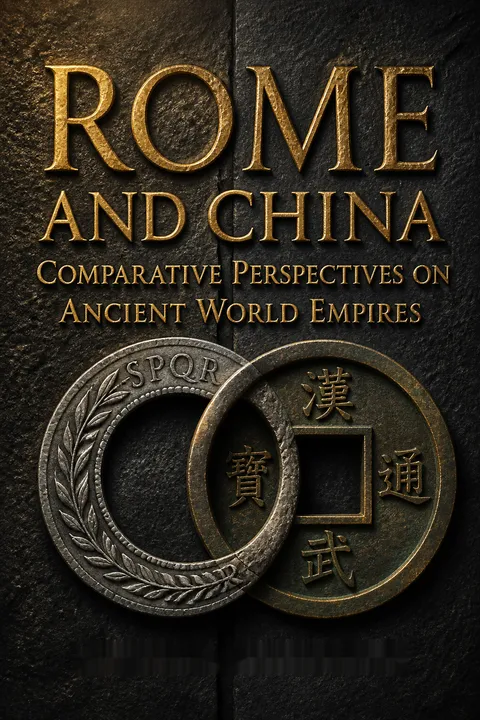
The reviews of Rome and China give it a middling 3.47 out of 5. Readers acknowledge its ambitious and informative comparisons between ancient Rome and Han China, covering military institutions, legal systems, gender roles, trade, philanthropy, and coinage. However, reviewers consistently note that the writing is dense, technical, and inaccessible to general readers, being clearly aimed at academic specialists. While some found the content rewarding after significant effort, most agree it reads more like conference proceedings than an engaging historical narrative.
About the Author

Download PDF
Download EPUB
.epub digital book format is ideal for reading ebooks on phones, tablets, and e-readers.








































