Key Takeaways
1. Unwanted Sensations Are Normal Neural Messages
Tinnitus sounds or dizziness sensations are truly there inside of you. They are neural messages created by your brain and body, for you.
Sensory conflicts. Vertigo and tinnitus are not signs of going crazy, but rather, they are neural messages created by your brain and body. These sensations arise from neural firing patterns that don't match your current environment, creating a sensory conflict. It's important to understand that these are real, internal experiences, not imagined or fabricated.
- These sensations are not your fault, you don't deserve them, and you are not going crazy.
- They are neural messages created by your brain and body, for you.
- They can change daily, and you do not need to feel stuck.
Body communication. Your body is constantly communicating with you through sensations, and these messages become louder when ignored. Pain, discomfort, and unwanted sounds are your body's way of signaling that something needs attention. Instead of suppressing these feelings, try to understand what your body is trying to tell you.
- All feelings are normal, and they carry a message of wisdom.
- Your inner world is unique to you, and it holds all of your memories, thoughts, and ideas.
- Getting to know the physical, mental, emotional, and spiritual aspects of yourself is important for healing.
Self-study. The process of healing involves self-study, or Svādhyāya, which is a personal inquiry that brings you closer to your inner truth. This involves observing your body, emotions, and thoughts without judgment. It's about cultivating self-compassion and understanding the neural patterns that create your unique experience.
- Self-study is a personal inquiry that brings us closer to our inner truth.
- Anyone is capable of self-study, and there are many simple and accessible ways to look within.
- One of the most powerful self-study practices is the body scan.
2. Neuroplasticity: Your Brain's Capacity to Heal
You can change your neural pathways using the functional neurons you have.
Brain's adaptability. Neuroplasticity is the brain's ability to form and reorganize synaptic connections, especially in response to experience or injury. This means that your brain is not fixed, and you have the power to change your neural pathways. You can use healthy neurons to override damaged pathways and create new neural settings that feel normal again.
- Neurons communicate by sending chemical messages from one to the next.
- Neural pathways are created through repetition, exposure, and emotional context.
- Your focus determines which neurons are firing.
Mind-body connection. Your thoughts, feelings, beliefs, and actions change the shape of your brain and create your perceptions of the world. The more you believe that you can relax in your body, the more you are going to feel relaxed. The more you believe life is unjust, the more you are likely to feel angry.
- Emotions play an important role in mapping the world as we see it, feel it, and hear it.
- Chronic stress inhibits neuroplasticity.
- You can retrain your neural maps and create new perceptions inside your body and brain by focusing on the sensations that you want to feel.
Empowerment through neuroplasticity. Neuroplasticity is not something that others can do for you; it is a process of self-knowing and self-healing. You are the one who cultivates any desired changes within yourself. You choose how you practice and what resources you use to support yourself.
- Medication cannot change neurons for you.
- Only you can change your neural maps.
- You can use the healthy neurons within your brain and body to override any damaged pathways and to create new neural settings that feel normal again.
3. Focus on Desired Feelings, Not Symptom Removal
The starting point is an openness to learn. Ask yourself: Am I willing to believe that my body can heal?
Shifting focus. Instead of focusing on getting rid of unwanted sensations, shift your attention to cultivating desired feelings. This is because wherever you focus generates neural firing in that part of your brain. If you are thinking about your dizziness, then the areas of your brain responsible for dizziness become stimulated.
- The biggest barrier to healing is disbelief that you can actually do it yourself.
- Many people struggle to redefine their new normal and get stuck on “trying to get rid of symptoms.”
- Healing can begin only after clarifying what feeling normal means to you.
Redefining normal. Clarify what "normal" feels like to you. It's not about the absence of symptoms, but rather about cultivating a state of peace, calm, or confidence. Once you know what you want to feel, you can begin to find tools that help you practice feeling that way daily.
- It is not about getting rid of symptoms, but rather about redefining your new normal sensations.
- Building your new normal neural pathways will then become your daily practice.
- You build those pathways by practicing feeling them in whatever way you choose.
Daily practice. Create a daily practice that helps you stimulate the neural pathways for your desired feelings. This could include body scans, breath awareness, emotional processing, or any activity that makes you feel good. The more you feel it, the more you fire it, the more you hardwire it.
- You create your neural settings by using repetition, exposure, and emotional context.
- The more you believe that you can relax in your body, the more you are going to feel relaxed.
- The more you practice being kind to yourself and your inner world, the faster you can heal.
4. Medical Clearance is Key, Not a Perfect Diagnosis
You are the expert in you.
Medical investigation. Medical doctors are trained to investigate medical disease and recommend treatments. It is not their role to teach you the recovery process required to rewire symptoms. They are skillfully trained to identify any disease, illness, or condition that may be causing symptoms.
- Doctors cannot reset your neural pathways for you.
- Doctors are performing a difficult job, and they’re doing it very well.
- They are providing all the solutions and treatments that they can.
Medical clearance. The most important part of Stage 1 is getting medical clearance. You need to check that your vital signs are safely operational. The first question needs to be, Am I okay? Do I need medical intervention? After medical clearance you can be reassured by your doctors and get an idea of your possible diagnosis.
- The tests that your doctors order will help you learn about your diagnosis and get medical reassurance.
- The tests are not designed to heal you.
- Following investigations, diagnosis, and medical clearance, you will be ready to learn about your own recovery process.
Beyond diagnosis. Following investigations, diagnosis, and medical clearance, you will be ready to learn about your own recovery process. This includes learning how to use neuroplasticity to reset your abnormal neural sensations so that you can feel normal again. You are the expert in what you feel and what you need.
- You are the one who can change your neural patterns.
- The medical doctors and health professionals can be considered your investigation assistants.
- They can assist you in gathering important knowledge about your body.
5. Tinnitus and Vertigo: Understanding the Inner Experience
Your truth is that you feel it within you, and this feeling comes from a neural pathway inside of your brain and body.
Tinnitus explained. Tinnitus refers to sound sensations that are heard inside of your body—ringing, buzzing, popping, roaring, squeaking—that are not coming from the external environment. These sounds are generated by neural pathways anywhere along the inner ears, midbrain, or the auditory cortex areas of our brain.
- Tinnitus sounds are noises that only we can hear because they are coming from our own body.
- Tinnitus is not always a sign of disease or abnormality.
- The most “damaging” part of tinnitus is the emotional impact or debilitating effect it can have if someone becomes afraid of it.
Vertigo explained. Vertigo is any sensation of movement or disorientation when you are still. It can manifest as disequilibrium, dizziness, nausea, unsteadiness, or feeling “not quite right” (NQR). It is related to how the brain interprets neural messages coming from the inner ears.
- Vertigo is a sensation of movement when you are still.
- It can manifest as disequilibrium, dizziness, nausea, unsteadiness, or feeling “not quite right” (NQR).
- Both vertigo and tinnitus are related to how the brain interprets neural messages coming from the inner ears.
Normalizing the experience. Both tinnitus and vertigo are common experiences, and it's important to normalize them rather than view them as medical disorders. Your body is capable of creating internal noise and movement sensations, and this is perfectly healthy.
- Healthy ears make noise.
- Healthy brains hear all forms of sound and noise, both internal and external.
- Healthy people can hear their own tinnitus.
6. The Roller Coaster of Healing: Embrace the Ups and Downs
You can change your neural maps and create new perceptions inside your body and brain by focusing on the sensations that you want to feel in your body.
Non-linear process. Healing is not a linear process, and you will experience ups and downs along the way. There will be times when you feel great and other times when you feel NQR. This is normal, and it's important to be patient and kind to yourself.
- The process of building neural pathways is individual.
- Don’t compare yourself to others as you heal.
- Be honest with yourself and keep focused on what you want to feel.
Integration and reboot. Neural change and rewiring neural networks takes a period of integration and reboot. This can look like a day in bed, a week of fatigue, or a month of fogginess. Sometimes we need to go through an integration period that feels NQR so that we can reset and renew our underlying neural patterns.
- During the integrative neuroplasticity process, we implement changes, we allow time for our system to update, and then we have a little reboot.
- This can feel like a truck has hit you.
- You need to be patient and invest time into it.
Resilience and self-compassion. The key to riding the roller coaster is to develop resilience and self-compassion. This means learning how to self-soothe, manage anxiety, and trust your body's ability to heal. It's about being prepared for any sensation that you feel in your body, heart, or mind.
- You need to be able to feel through it and see it clearly so that you can resolve it and return the ball.
- You need your mindset to remain equally curious, present, and reassuring.
- You need that voice inside of you to declare, I’ve got this.
7. Your New Normal: A Life Beyond Symptoms
You can use the healthy neurons within your brain and body to override any damaged pathways and to create new neural settings that feel normal again.
Beyond symptom focus. Your new normal is not about getting rid of symptoms, but rather about living a life that is rich, meaningful, and fulfilling despite any sensations you may experience. It's about shifting your focus from what you don't want to what you do want.
- You don’t need to get rid of symptoms, because you can instead override them.
- You want your brain to put the dizziness and tinnitus signals at the bottom of the priority list.
- You do not want your symptoms to be perceived as threatening or important.
Embracing change. Your new normal is a dynamic state that evolves as you change and grow. It's about being open to new experiences, new perspectives, and new ways of being. It's about accepting yourself just as you are, with all of your imperfections and quirks.
- Humans keep changing in order to stay healthy.
- Our neural maps are like our software settings. They need frequent updates to keep us in touch with reality.
- You are not the person you were five years ago or even yesterday.
Living with purpose. Your new normal is about living a life that is aligned with your values, your passions, and your purpose. It's about doing things that light you up and bring you joy. It's about connecting with others, contributing to the world, and making a difference.
- You can choose what you feel ready to experience.
- You can open up to more of your wholeness and allow yourself to just be.
- This is the ultimate practice of self-love, self-acceptance, and self-compassion.
Review Summary
Rock Steady receives mixed reviews, with many praising it as life-changing for those with vertigo and tinnitus. Readers appreciate the neuroplasticity approach and the author's empathy. Some found hope and practical tools for self-healing. However, critics argue the book is repetitive, vague, and serves as an advertisement for the author's expensive program. Several reviewers suggest the core message could be condensed into fewer pages. Despite criticisms, many readers report significant improvements in their symptoms and overall quality of life after applying the book's principles.
People Also Read




FAQ
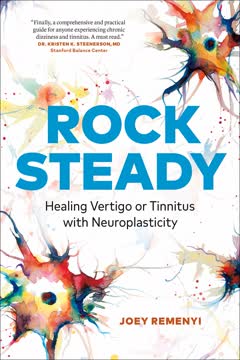
1. What is "Rock Steady: Healing Vertigo or Tinnitus with Neuroplasticity" by Joey Remenyi about?
- Neuroplasticity for healing: The book explores how neuroplasticity—the brain’s ability to rewire itself—can be harnessed to heal persistent vertigo and tinnitus symptoms.
- Holistic, integrative approach: Joey Remenyi advocates for addressing physical, mental, emotional, and spiritual aspects of healing, moving beyond just medical tests or symptom management.
- Empowerment and self-study: Readers are encouraged to become experts in their own healing, using daily practices and self-compassion to regain balance and peace.
2. Why should I read "Rock Steady" by Joey Remenyi if I suffer from vertigo or tinnitus?
- Validation and hope: The book reassures readers that their symptoms are real and offers hope through neuroplasticity, countering feelings of dismissal or hopelessness.
- Practical, actionable guidance: It provides clear explanations, real-life case studies, and home exercises that make complex neuroscience accessible and actionable.
- Addresses emotional needs: Unlike many medical texts, it acknowledges the emotional and spiritual toll of these conditions and offers tools for self-compassion and inner healing.
3. What are the key takeaways from "Rock Steady" by Joey Remenyi?
- You can retrain your brain: Neuroplasticity allows you to change how your brain processes vertigo and tinnitus, reducing symptoms over time.
- Self-compassion is essential: Healing is supported by kindness toward oneself and acceptance of all emotions, not just physical exercises.
- Patient-led recovery: True healing comes from within, with patients taking the lead in their recovery journey, supported but not dictated by medical professionals.
4. How does Joey Remenyi define neuroplasticity in "Rock Steady" and why is it important for healing vertigo or tinnitus?
- Brain’s rewiring ability: Neuroplasticity is the brain’s capacity to form and reorganize neural connections in response to experience, attention, and practice.
- Permanent vs. temporary change: The book distinguishes between neuroplasticity (lasting change) and neuroelasticity (temporary change), emphasizing the need for consistent, focused practice.
- Symptom modulation: By consciously focusing on desired sensations, patients can strengthen healthy neural pathways and diminish those associated with symptoms.
5. What is the integrative medicine approach to vertigo and tinnitus in "Rock Steady"?
- Whole-person healing: The approach addresses physical, mental, emotional, and spiritual dimensions, recognizing that healing is not linear and requires simultaneous attention to all layers.
- Trust and commitment: Success depends on trusting the chosen healing path and committing to it, rather than dabbling in multiple therapies.
- Presence and self-awareness: Cultivating present-moment awareness and self-study is key to stimulating neuroplasticity and breaking symptom cycles.
6. How does "Rock Steady" by Joey Remenyi explain the sensations of vertigo and tinnitus?
- Neural firing patterns: Vertigo and tinnitus are described as real neural sensations that do not match the external environment, creating sensory conflicts.
- Not psychological or imagined: The book reassures readers that these sensations are not a sign of craziness or personal fault, but are generated by the nervous system.
- Understanding for healing: Recognizing symptoms as neural patterns helps shift focus from elimination to retraining the brain for normal sensations.
7. What practical neuroplasticity exercises does "Rock Steady" recommend for managing vertigo and tinnitus?
- Body scan practice: Mindful attention to bodily sensations from head to toe helps reconnect with the body and cultivate feelings of safety and steadiness.
- Desired feelings cultivation: Focusing on sensations like calm or confidence strengthens those neural pathways and helps override symptom-related ones.
- Releasing tension: Gentle, mindful movements and stretches reduce anxiety-related muscle tension that can exacerbate symptoms.
8. How does "Rock Steady" by Joey Remenyi address the emotional and mindset aspects of healing?
- Emotions shape neural pathways: Emotional states like fear or self-criticism can reinforce symptoms, while self-compassion and positive emotions support healing.
- Permission to feel: The book encourages embracing all emotions, including difficult ones, as part of the healing journey.
- Changing self-talk: Identifying and shifting limiting beliefs and the inner critic to a more supportive dialogue is crucial for neuroplastic change.
9. What does "Rock Steady" say about the limitations of traditional medical treatment for vertigo and tinnitus?
- Medical clearance, not cure: Doctors are skilled at diagnosing and ruling out serious conditions but cannot rewire neural pathways or teach recovery processes.
- Symptom management focus: Medications and tests may help manage symptoms but do not address the underlying neural patterns sustaining chronic issues.
- Need for patient-led recovery: The book emphasizes that patients must take the lead in stimulating neuroplasticity, with health professionals as supportive guides.
10. How does "Rock Steady" by Joey Remenyi recommend approaching medical diagnosis and testing?
- Seek essential tests: Obtain medical clearance with recommended tests like hearing, oculomotor, and positional tests to rule out serious conditions.
- Avoid diagnostic fixation: Don’t get stuck in endless testing that delays healing; focus on recovery once serious issues are ruled out.
- Healing is patient-guided: Neuroplasticity-based healing is guided by personal sensations and experiences, not just test results.
11. What are the most common vestibular conditions explained in "Rock Steady" and how are they characterized?
- Persistent postural-perceptual dizziness (PPPD): Chronic dizziness without physical damage, often linked to anxiety and sensory mismatch, with symptoms like rocking and visual sensitivity.
- Benign paroxysmal positional vertigo (BPPV): Brief spinning vertigo triggered by head movements, treatable with maneuvers like the Epley.
- Ménière’s disease: Characterized by episodes of vertigo, fluctuating hearing loss, tinnitus, and ear fullness, requiring stress management and neuroplasticity support.
12. What evidence and outcomes support the effectiveness of the ROCK STEADY program described by Joey Remenyi?
- Research-backed results: Among 146 participants, the six-module ROCK STEADY program led to statistically significant improvements in emotional, functional, and positional symptoms.
- Broad applicability: Improvements were consistent regardless of age, gender, diagnosis, or time since symptom onset, demonstrating wide relevance.
- Empowerment and community: The program’s success is attributed to teaching self-healing with neuroplasticity, providing 24/7 resources, and fostering a supportive recovery community.
Download PDF
Download EPUB
.epub digital book format is ideal for reading ebooks on phones, tablets, and e-readers.








































