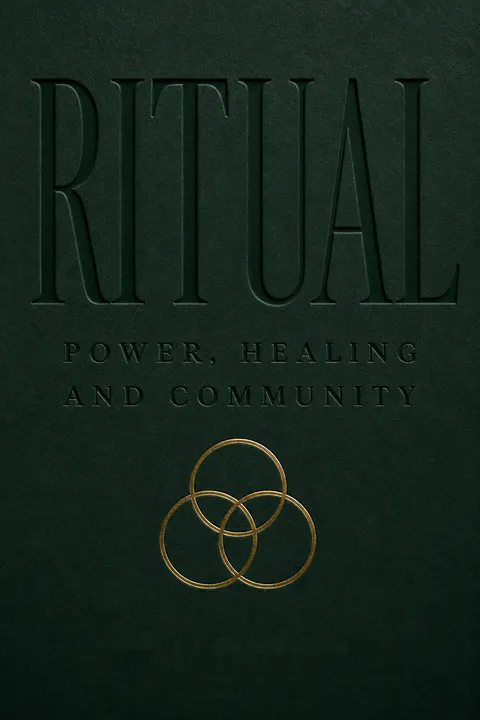

Key Takeaways
1. Ritual is Essential for a Balanced Life
For the Dagara, ritual is, above all else, the yardstick by which people measure their state of connection with the hidden ancestral realm, with which the entire community is genetically conncected.
Cosmic connection. In the Dagara tribe of Burkina Faso, West Africa, ritual is not merely a tradition but the very fabric of existence, linking humans to the spirit world, ancestors, and the natural order. Life is determined by what these natural forces require, with ritual preceding human involvement in farming, hunting, and travel. This deep connection ensures that the visible world is always in harmony with its unseen, symbolic dimensions.
Daily practice. The Dagara integrate ritual into their daily lives, addressing ancestors and nature shrines before undertaking any significant activity, from planting crops to embarking on a journey. This constant engagement with the Otherworld means that physical ailments or misfortunes are seen as symptoms of deeper spiritual imbalances, requiring ritual intervention before direct physical treatment. Ritual, therefore, acts as a mechanism to uproot dysfunctions at their spiritual source.
Interdependent dimensions. Rituals exist on communal, family, and individual levels, all interdependent. A communal ritual, like honoring the Earth Shrine, liberates energy that supports family and individual rites. Neglecting one level can have devastating consequences for all, as seen when a priest's failure to perform a fundamental communal rite led to widespread drought and death, emphasizing that individual and collective duties are inseparable in maintaining cosmic order.
2. Neglecting Ritual Invites Catastrophe
The abandonment of ritual can be devastating.
Spiritual debt. The story of the luminous goat and the subsequent death of the author's stepbrother vividly illustrates the dire consequences of neglecting ritual. The stepbrother's death was attributed to a witch who exploited a weakened family shield, a direct result of the father's decade-long outstanding debt to the Earth Shrine, which was to be paid through a ritual. This incident underscores that unfulfilled spiritual obligations can lead to tragic outcomes for the innocent.
Cosmic responsibility. From the Dagara perspective, every individual and community bears responsibility for maintaining cosmic order. Failure to perform prescribed rituals energetically stains this order, threatening the future. When ritual is absent, the young become restless or violent, true elders are scarce, and adults are bewildered, leading to a dim future. This highlights that spiritual negligence is not a private matter but has far-reaching societal repercussions.
Witchcraft and protection. The Dagara believe that homes are protected by spiritual ancestors and specific juju. A witch could only penetrate the author's home due to the father's unfulfilled ritual debt, which weakened the protective shield. The subsequent "strategic grief ceremony" and tight security prevented the witch from touching her victim's body, leading to her own death, demonstrating that ritual is a powerful defense against malevolent forces when properly maintained.
3. Modern Culture's "Machine" Alienates the Soul
The greatest shock that American culture has on traditional people is its notion of speed.
Speed as distraction. Modern Western culture, characterized by its relentless speed and work-obsessed frenzy, is perceived by the Dagara as a movement away from something, rather than towards it. This constant motion serves as a distraction, preventing individuals from confronting inner turmoil, the "anger of nature within each of us, the anger of the gods, the anger of the ancestors or the spirit world." This contrasts sharply with the indigenous focus on the state of one's spirit.
Materialism and waste. The Dagara are suspicious of abundance, viewing it as a trick from a god to induce complacency before a fall. They see Western society's waste and squandering as an insult to the gods, indicative of a culture that prioritizes materialism over spiritual priorities. This leads to a "starvation of the soul," where individuals are fed with material things but starved for everything else, losing touch with their higher selves.
Technological displacement. The "Machine culture" of the West, driven by technology, is seen as diametrically opposed to the indigenous world's emulation of nature. Where machines speak in place of gods, people struggle to listen to their inner selves or vibrate with nature. This technological imperialism, often intertwined with Christianization, has ravaged indigenous cultures, creating a "violent break away from the realm of spirit" and leading to widespread spiritual and psychic emptiness.
4. Pain and Wounds are the Soul's Call for Ritual
Pain, therefore, is our body complaining about an intruder.
Soul's language. For the Dagara elder, pain is not merely a physical sensation but a profound communication from the soul, signaling a resistance to something new or a need for growth. It is understood as "Tuo," meaning invasion or a violent encounter with a boundary. To shut down pain is to override the soul's call, leading to repressive measures against oneself with somber consequences.
Call to growth. A body in pain is a soul in longing, aspiring toward growth and remembering what has been forgotten. Hearing pain as a creative action connects a person with their highest self, prescribing an alternative to spiritual death. This perspective encourages individuals to work through pain, rather than stop, seeing it as a commotion, emotion, and a call for rebirth, drawing life-essence from nature and the cosmos.
Wounds as entry points. The psychic and physical wounds experienced in modern culture—such as auto accidents, psychological illness, stress, or depression—are evidence of a soul in crisis. These wounds are a language spoken by the body, indicating a need for acknowledgment and a special creative process. Ritual provides the realm where these unacknowledged parts of oneself can be addressed, offering a pathway to healing and survival against the tyranny of progress.
5. True Community is Built on Trust and Shared Spirit
Without a community you cannot be yourself.
Interdependent existence. A true community, as observed in the Dagara village, is a place of self-definition where individuals draw strength from one another. It is characterized by an indivisible sense of unity, where each member is like a cell in a body, essential to the whole. This interdependency, or "supportive presence," allows individuals to feel secure and honored, fostering a collective identity that transcends mere individualistic pursuits.
Openness and trust. Dagara villages operate without locked doors, symbolizing open minds and hearts, and a high degree of trust among members. The absence of a police force signifies a community where consensus prevails, and the "real police" is Spirit, which sees everyone. Transgressions are believed to be punished immediately by Spirit, as in the story of the girl who stole grain and suffered a self-inflicted wound that would not heal until she publicly confessed.
Core characteristics. A functioning Dagara community embodies several key traits:
- Unity of spirit: Members feel an indivisible connection.
- Trust: Everyone is assumed to be well-intentioned.
- Openness: Individual problems become community problems.
- Love and caring: Resources are shared, diminishing egotism.
- Respect for Elders: They are pillars of wisdom, memory, and guidance.
- Respect for Nature: The primary source of wisdom, medicine, and initiation.
- Cult of the Ancestors: Ancestors live in spirits, reborn into nature, guiding the community.
This framework highlights that community is not a place of distraction or reform, but a nurturing home where individuals can truly belong and thrive.
6. Hidden Power Sustains, Displayed Power Enslaves
The relationship draws more strength, more power, and even gets more momentum within its hiddenness.
Secrecy and effectiveness. In the Dagara tradition, the hiddenness of ritual content and spiritual power is paramount for its effectiveness and preservation. Disclosing sacred secrets is not only forbidden but can be lethal, as it "tears open a space that must remain hermetically sealed," causing a decompression that harms all involved. This principle ensures that spiritual forces retain their potency and are not diminished by exposure to the profane.
The trap of visibility. Western culture's "show-off" nature, particularly in corporate power displays, is seen as inherently disempowering. When power is made visible, it shrinks the person who displays it, turning them into a servant of that power. The constant need to maintain this overt display leads to a loss of touch with one's own soul and the invisible world, resulting in marginality and spiritual emptiness for those in positions of power.
Spiritual vs. overt power. True spiritual power, cultivated through ritual and inner connection, manifests as gentleness, love, and compassion, fostering balance and understanding in a person. This contrasts with the "youthful exuberance" and craving for immediate, overt power seen in industrial cultures, which often leads to individuals becoming victims of the very powers they acquire too quickly. The story of the Gatekeeper, who lost his healing abilities after charging money and displaying power, serves as a cautionary tale against the corruption of spiritual gifts.
7. Grief Ritual is Crucial for Healing and Transition
Grief delivers to the dead that which they need to travel to the realm of the dead — a release of emotional energy that also provides a sense of completion or endedness, closure.
Emotional debt. For the Dagara, death is not an end but a transition, yet it creates a profound emotional debt and disorientation for the living. Grief is seen as essential "food for the psyche" and a vital energy release owed to the dead, enabling them to journey to the ancestral realm. Without proper communal grief, the deceased can become trapped between worlds, intruding upon the living and causing further distress, as illustrated by the ghost in the apartment.
Communal catharsis. Dagara funeral rituals are sophisticated, involving the entire village in a prolonged, cathartic expression of grief. Women's wailing signals the death, while men create the sacred ritual space through ash throwing and invocation. This communal validation allows for free emotional expression, including anger and despair, and is believed to transport the dead home, healing the hurt in the psyches of the living.
Roles and re-enactment. The funeral involves specific roles: musicians, mourners (kotuosob) who are close relatives and at high risk of being overwhelmed, and containers who support and prevent mourners from going "out of bounds." Joking partners (laluoro) balance the emotional intensity. A crucial element is the "xanu" or re-enactment of the deceased's life by their initiation group, which frees both the living and the dead, allowing the deceased to reach the ancestors and eventually return.
8. Ritual Requires Purpose, Humility, and Proper Structure
Purpose is the driving force that contributes to the effectiveness of ritual.
Intentionality is key. Rituals are not random acts but are undertaken with a clear purpose, often in response to the soul's communication of need or absence. Ego-driven rituals, performed for show, are considered "spiritual farces" that can backfire, turning against the performer. For a ritual to be effective, it must be an invitation to spirits to intervene in matters beyond human capacity, or an honoring of divine gifts, approached with sincerity and humility.
Structured interaction. While no two rituals are exactly alike, they adhere to fundamental structures that facilitate interaction with the spirit world. These include:
- Invocational: Humans humbly call upon non-human entities for specific aid.
- Dialogical: A solemn dialogue unfolds between humans, spirits, and oneself.
- Repetitive: Core actions, like pouring libations, remain consistent.
- Opening and Closure: The ritual space is consciously opened by invoking spirits and closed by thanking and symbolically sending them away, ensuring that spirits do not linger and cause disruption.
Consequences of error. Performing a ritual incorrectly or failing to close a ritual space can have serious repercussions, ranging from minor incidents to major accidents, depending on the nature of the invoked spirits. The Dagara emphasize that a failed ritual must be immediately repaired by the person responsible, as acknowledgment of error is crucial for preventing further damage and maintaining balance with the spirit world.
9. Re-ritualizing Life: A Path to Healing the Modern Soul
To ritualize life, we need to learn how to invoke the spirits or things spiritual into our ceremonies.
Soul's longing. The author, Malidoma, sees his calling as bridging the Dagara world with the West, recognizing a deep spiritual hunger in modern society. He suggests that the absence of ritual starves the soul, leading to widespread social problems that cannot be cured by material means. The path to healing the modern soul lies in re-ritualizing life, not by copying traditions, but by being inspired by cultures still connected to their primal selves.
Humble invocation. Re-ritualizing life begins with learning to humbly invoke spirits or the Divine into daily ceremonies. This involves openly admitting one's weaknesses and surrendering tasks to the gods or God, recognizing that greater alignment with the Universe leads to better outcomes. Even simple, private prayers at the start and end of the day can sanctify one's life, transforming everyday actions into divine work.
Emotional emancipation. A crucial step in this process is emotional emancipation. Modernism often equates to unemotionalism, a repression of feelings that creates a backlog of "undelivered emotions." The author suggests that modern communities could benefit from a "massive funeral day" to collectively shed tears for the "titanic loss wrecked by Progress on people's souls." Expressing emotions, particularly grief, is a powerful way to reconnect with one's spirit and begin the journey of healing and self-discovery.
Review Summary
Reviews of Ritual reflect a generally positive reception, with readers praising Somé's vivid portrayal of Dagara traditions and his critique of Western "machine culture." Many found the book thought-provoking, particularly his treatment of grief rituals and community. Common criticisms include shallow arguments against Western culture, gendered perspectives, and an assumption that Dagara rituals are universally applicable. Readers frequently noted tension between the book's spiritual wisdom and modern contradictions. Several recommended pairing it with Somé's autobiography, Of Water and the Spirit.
People Also Read





About the Author

Download PDF
Download EPUB
.epub digital book format is ideal for reading ebooks on phones, tablets, and e-readers.








































