

Key Takeaways
When civilization collapses, ride the destruction instead of resisting
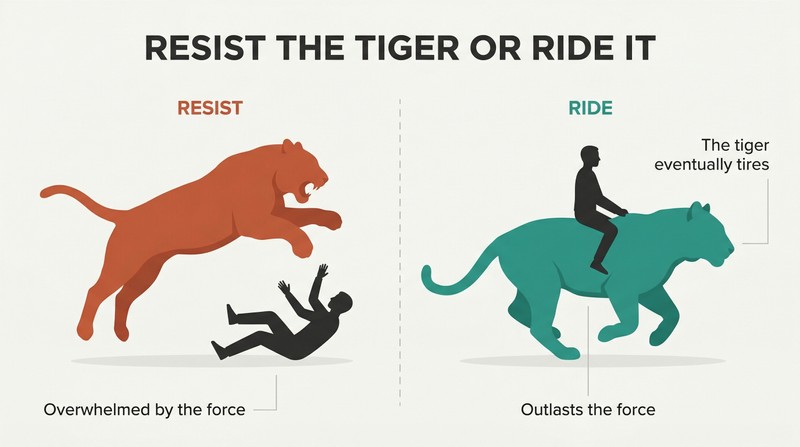
The book's title is its thesis. A Far Eastern saying holds that if you succeed in riding a tiger, you avoid being leapt upon — and if you hold your seat, you may eventually outlast the beast. Evola argues we live in what Hindu cyclical doctrine calls the Kali Yuga, or Dark Age: a terminal phase in which traditional norms are cancelled and dissolution defines everything. The forces of the epoch are too strong for direct opposition.
Rather than resisting or retreating, the "differentiated man" — Evola's term for someone who inwardly belongs to the world of Tradition but must live in modernity — should maintain his inner orientation while letting destructive currents exhaust themselves. The tiger eventually tires. Those who stay awake through the long night may greet those who arrive at dawn.
Stop defending bourgeois ruins — they caused this collapse
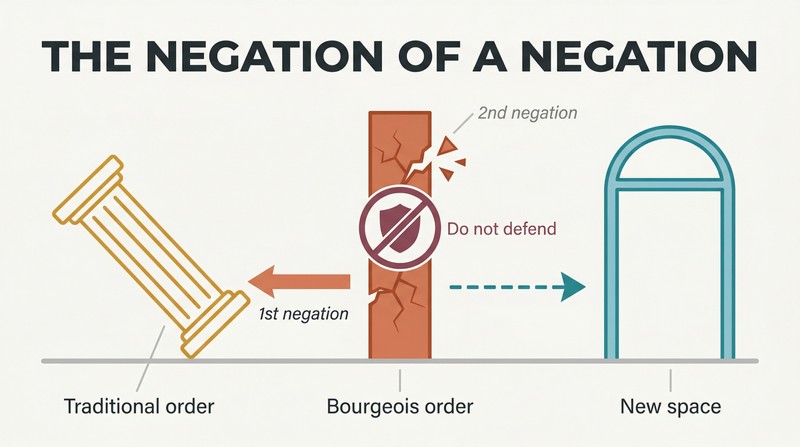
Evola draws a counterintuitive line: what's crumbling is not Tradition but bourgeois civilization — liberal democracy, industrial capitalism, Enlightenment rationalism — which itself was the first revolution against traditional order. The French Revolution and Third Estate liberalism already destroyed the old hierarchies; Marxism simply pushed their logic further. Defending bourgeois remnants with traditional rhetoric drags sacred values into a losing battle for something that never deserved them.
The crisis is a "negation of a negation." The bourgeois order that dismantled the ancient world is now being dismantled in turn. For those who see this clearly, the rubble might open new space rather than signify mere catastrophe. The enemy of your enemy is still not your friend — but his fall may be your opportunity.
Nietzsche diagnosed the spiritual crisis but his cure fails
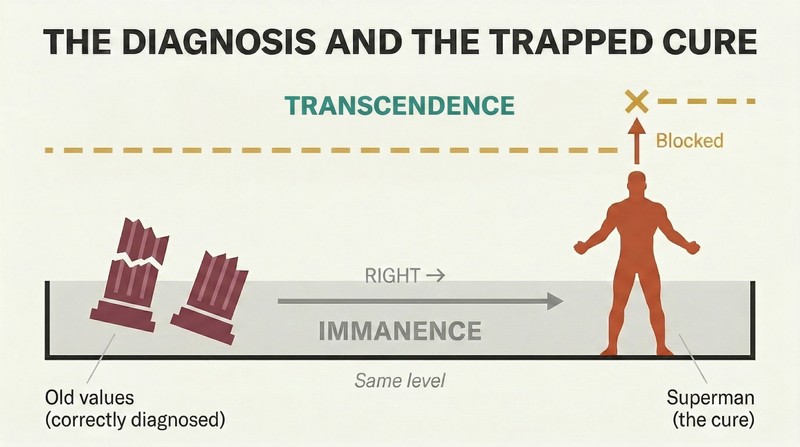
Evola takes Nietzsche as his primary interlocutor — the thinker who best diagnosed European nihilism and proclaimed "God is dead." Nietzsche's proposed answer was the superman and the will to power: life affirming itself beyond old moralities. But Evola argues this collapses on its own terms. The will to power is merely one manifestation of life, not its essence. The superman is an arbitrary new idol, not fundamentally different from Marxism's utopian future man.
What Nietzsche lacked was conscious transcendence. His philosophy remained trapped in immanence — in "life" with no dimension beyond life. This explains both his brilliance and his eventual breakdown. Evola characterizes Nietzsche as someone in whom transcendence had awakened as raw energy, but who could not recognize or channel it, becoming its victim rather than its master.
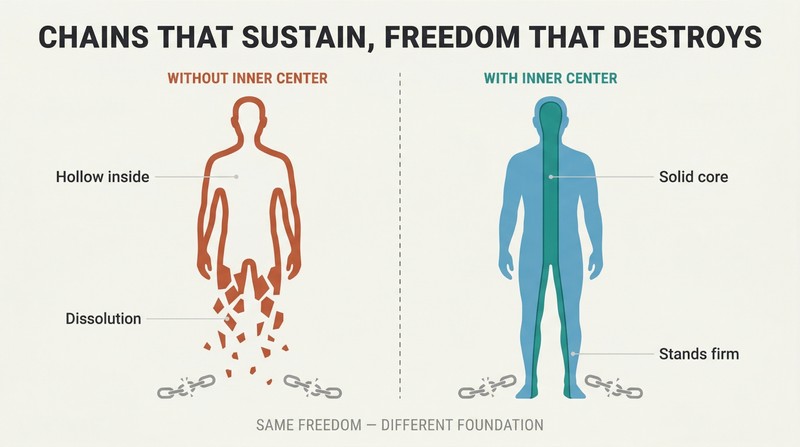
Freedom without inner substance is a death sentence
The modern condition is a failed liberation. Humanity shed divine authority — but those "chains" were also supports. Zarathustra's challenge reverberates throughout the book: "Free from what? Free for what?" When people without inner resources gain absolute freedom, they collapse into meaninglessness. Dostoyevsky's characters illustrate this vividly: Stavrogin tests his strength everywhere and finds nothing at his center; his freedom turns against him and ends in suicide.
Sartre's line captures the predicament perfectly: "We are condemned to be free" — freedom experienced as burden rather than triumph. Evola sees this as the definitive proof that modern man failed his own test. Only those who already possess an internal direction, an existential center deeper than personality, can survive the vacuum that freedom creates.
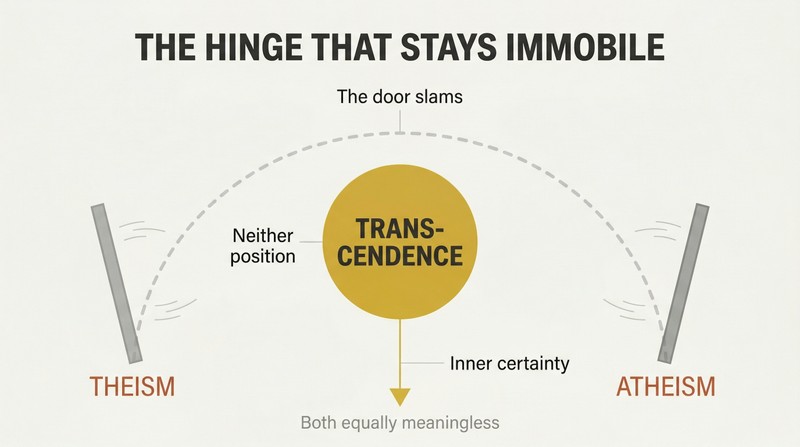
Anchor in transcendence, beyond both theism and atheism
The God who "died" was specifically the moral, personal God of theistic religion — not the metaphysical Absolute known to older traditions. Hinduism, Neoplatonism, Taoism, and esoteric Christianity all recognized a principle beyond good and evil, beyond the antithesis of immanence and transcendence. Evola argues the differentiated man must find transcendence not through belief or prayer but as direct existential reality — as fundamental as his own heartbeat.
This is not faith. It is an inner certainty so complete that doubting it would mean doubting oneself. Terms like "believer," "atheist," and "freethinker" become equally meaningless once transcendence is experienced as an inalienable dimension of one's own being. No invocation is necessary; no negation of God is possible. One has gone beyond both attitudes entirely.
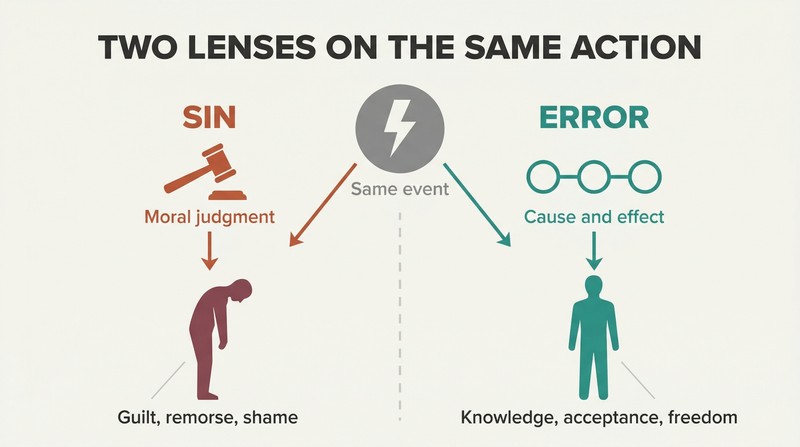
Replace 'sin' with 'error' — think in causes, not commandments
Traditional teachings describe karma not as divine punishment but as neutral cause and effect — consequences following actions with no moral sanctioning agency. Evola likens this to weather forecasts before a mountain climb: knowing the risk, you either turn back or accept the danger. Freedom remains intact; no "moral" factor enters. An old Spanish proverb captures it: "God said: take what you want and pay the price."
The differentiated man replaces guilt with objective assessment. He recognizes that inner sanctions — remorse, shame — are psychological reactions conditioned by heredity and social environment, not transcendent verdicts. What matters is knowledge of consequences and willingness to accept them. The "sin complex" is a pathological formation born under the personal God. The more metaphysical traditions substituted consciousness of error for the sense of sin.
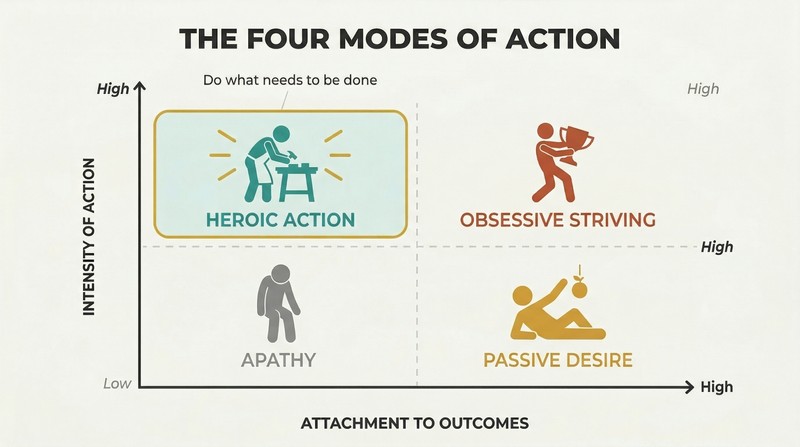
Act with total intensity but zero attachment to outcomes
Two traditional maxims define this orientation: "act without regard to the fruits" and "action without acting." The first means full engagement regardless of success, failure, approval, or disapproval. The second describes action that doesn't stir the higher principle of Being — yet that principle remains the true subject, guiding everything from start to finish. Evola calls this "doing what needs to be done," impersonally.
This is not cold Stoic duty. Evola distinguishes "ardent pleasure" (passive satisfaction of desire) from "heroic pleasure" (the fire accompanying decisive action from one's depths). The master craftsman who puts identical care into seen and unseen work exemplifies the principle. Impersonal perfection becomes pure expression of the self — the quality never varies whether in humble work or commanding armies.
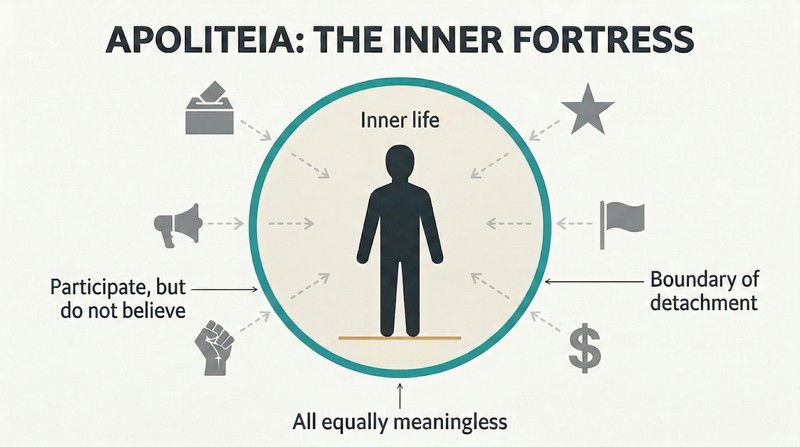
Practice apoliteia: inner distance from all modern politics
No legitimate political authority exists today, Evola argues — no true sovereigns, no hierarchies rooted in spiritual principle. Both the democratic West and the communist East lack any higher ideal worth spiritual investment. Apoliteia means refusing to grant transcendent significance to any current political engagement. But it does not require withdrawal: one can participate in politics impersonally, for the sake of action itself, without believing the game matters.
The danger is capture by political myths. Even yesterday's regimes that opposed democracy and Marxism proved that mass enthusiasm, built on subintellectual forces, vanishes at the first crisis. The differentiated man sees the confrontation between capitalism and communism as spiritually meaningless — at most a practical question about which system leaves more room for his invisible inner life.
Most modern 'spirituality' is corpse-glow, not rebirth
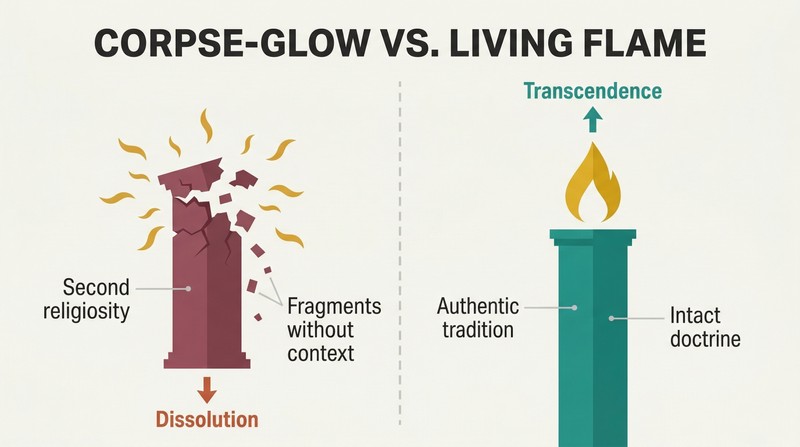
Spengler coined "second religiosity" for the spiritual movements that proliferate as civilizations decay. Evola catalogs the evidence: Theosophy, spiritualism, Anthroposophy, popularized yoga, newspaper astrology — dominated by mediums, dilettantes, and a disproportionate number of failed or displaced women. These movements borrow fragments from esoteric Tradition but strip them of context, mixing them with Western sentimentality.
Far from countering materialism, they complement it. Guénon warned they open people to subpersonal psychic forces rather than genuine transcendence — "fissures in the Great Wall" that protects ordinary consciousness from dark influences. The differentiated man may study traditional texts through modern scholarship, but he must rigorously distinguish authentic metaphysical doctrine from its counterfeit spiritualist packaging. The stature of those Eastern teachers currently exporting "wisdom" to the West speaks for itself.
Contemplate death daily to measure your actual sovereignty
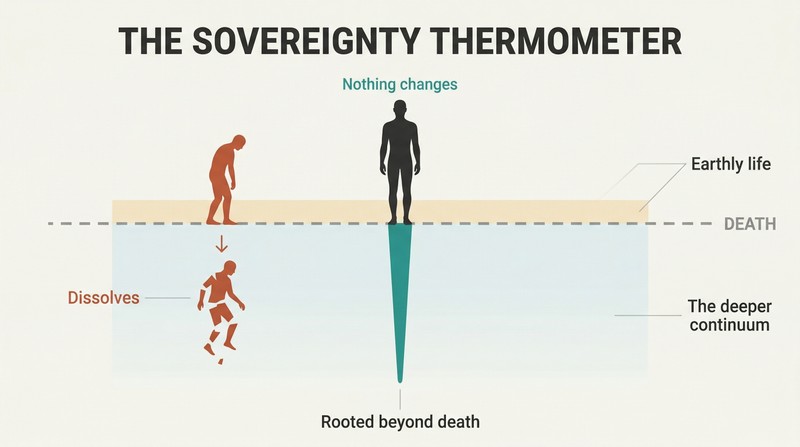
Evola proposes daily confrontation with death as the ultimate inner thermometer. The test: at the prospect that today is your last, you should change nothing in your thinking or acting. He cites Japanese kamikaze pilots who maintained ordinary training and recreation for months while awaiting missions with no return — without tragic heaviness. This isn't numbness. It is the natural consequence of a being rooted in something deeper than biological survival.
The traditional doctrine of preexistence provides the backdrop: one's being neither begins at birth nor ends at death. Earthly life is "a journey in the night hours" — a restricted section in a continuum traversing many states. From this perspective, every contingency becomes an opportunity to test whether one's inner magnetic orientation holds firm, not merely through life but through its dissolution.
Analysis
Ride the Tiger occupies a paradoxical position in twentieth-century thought: a traditionalist philosopher writing a survival manual for an age when tradition has been obliterated. Published in 1961, Evola's diagnosis of consumer nihilism, generational protest, spiritual charlatanism, and the meaninglessness pervading prosperous societies was remarkably prescient — today's 'meaning crisis' discourse essentially restates his thesis in secular vocabulary.
The book's intellectual architecture is formidable. Evola systematically works through Nietzsche, Heidegger, Sartre, and Jaspers — not as academic exercises but as diagnostic case studies of modern man's spiritual collapse. His key structural move is distinguishing the bourgeois world (which is collapsing) from the traditional world (which the bourgeoisie already destroyed). This 'double negation' framework prevents the common conservative error of defending Enlightenment liberalism as though it were ancient wisdom.
Yet the framework carries serious vulnerabilities. The concept of the 'differentiated man 'can easily become narcissistic self-flattery — every disaffected intellectual may convince himself he belongs to this spiritual aristocracy. Evola's cyclical theory of history, borrowed from Hindu and Greco-Roman sources, is unfalsifiable by design: all counter-evidence is absorbed as further symptoms of decline. His wholesale dismissal of modern science as 'non-knowledge' and democracy as inherently degraded reveals a rigidity that undercuts his genuine insights about consumer anesthesia and existential emptiness.
The book's enduring power lies in its refusal to offer comfortable solutions. Unlike self-help manuals promising wholeness, Evola insists the situation is genuinely dire — and that the only honest response is a kind of spiritual aristocratism grounded not in resignation but in a sovereign claim to inner freedom. Concepts like apoliteia and action without desire remain practically applicable regardless of whether one accepts the metaphysical scaffolding. Whether one finds this vision inspiring or dangerously elitist likely depends on whether one reads it as existential diagnosis or as political program. Evola intended the former; history has sometimes delivered the latter.
Review Summary
Ride the Tiger receives mixed reviews. Many praise Evola's critique of modernity and philosophical insights, finding it thought-provoking and relevant. Some appreciate his analysis of existentialism and cultural decay. However, others criticize the dense writing, lack of clear solutions, and controversial views. Critics argue Evola's ideas are outdated, impractical, or even dangerous. Some readers struggle with the abstract concepts and philosophical references. Overall, the book is seen as challenging but influential, appealing mainly to those interested in traditionalist philosophy and critiques of modern society.
People Also Read



Glossary
Tradition
Transcendently ordered civilizationEvola's capitalized term for a civilization or society ruled by principles that transcend the merely human and individual, where all sectors are formed and ordered from above. Not custom or inherited habit, but the universal spiritual order that underlies authentic hierarchical civilizations across cultures—Hindu, Roman, medieval European—prior to the modern era. Contrasted with both the bourgeois world and modernity.
Differentiated man
Tradition's heir in modernityEvola's term for the specific human type addressed by the book: someone who lives within the modern world but does not inwardly belong to it, preserving a connection to the world of Tradition despite lacking any institutional support. Distinguished from the ordinary modern person by possessing the 'dimension of transcendence' as a constitutional element of his being.
Ride the tiger
Master dissolution by enduring itA Far Eastern saying expressing the strategy of mounting a dangerous force rather than opposing it directly. In Evola's usage, it means accepting the destructive processes of the modern epoch without being inwardly affected by them, maintaining one's position until the forces exhaust themselves. Comparable to the Mithraic trials where Mithras lets the bull drag him until it stops.
Apoliteia
Inner detachment from politicsAn ancient concept Evola revives to describe the differentiated man's proper relationship to contemporary political life: complete inner distance from all modern political systems, parties, and ideologies, without necessarily requiring practical abstention from political activity. One may participate but refuses to grant any spiritual significance to today's degraded political arena.
Dionysian Apollonism
Stability integrated with intensityEvola's term for the ideal existential state combining Dionysian intensity of experience with Apollonian clarity and self-possession. Unlike Nietzsche's confused opposition of the two principles, this integration means possessing the stability that results from the Dionysian experience already behind oneself—encountering life's chaos and intensity from an unshakable center of Being.
Second religiosity
Terminal-phase spiritual decayOswald Spengler's concept, adopted by Evola, describing the spiritual movements that proliferate in the final phase of a civilization's cycle. These movements—Theosophy, spiritualism, popularized Eastern teachings—appear alongside materialism as its counterpart, not its antidote. They represent fragmented, subintellectual eruptions rather than genuine spiritual renewal, comparable to fluorescence from decomposing matter.
Kali Yuga
Terminal Dark Age cycleIn Hindu cyclical doctrine, the final and darkest of four ages in a cosmic cycle, characterized by dissolution of all higher principles and the dominance of material, chaotic forces. Evola identifies the present epoch with this phase, in which the goddess Kali—symbolizing elementary, primordial forces in their lower aspects—is said to be 'wide awake,' and traditional norms of conduct are cancelled.
Action without desire
Impersonal engagement, detached from resultsA traditional maxim describing action performed without regard to its fruits—success, failure, pleasure, pain, or others' approval. Combined with the related principle of 'action without acting,' where the higher dimension of Being sustains and guides action while remaining itself unstirred. The result is total engagement driven by impersonal perfection rather than by conditioned motives.
FAQ
1. What is Ride the Tiger by Julius Evola about?
- Crisis of Modernity: The book explores the spiritual and existential crisis of modern civilization, which Evola sees as an age of dissolution and nihilism.
- Survival Manual: It serves as a guide for the "aristocrats of the soul"—individuals who do not inwardly belong to the modern world—on how to survive and maintain integrity amid chaos.
- Tradition vs. Modernity: Evola contrasts the principles of traditional civilization with the antithetical values of the modern era, emphasizing the impossibility of returning to the past.
- Transcendence and Conduct: The work focuses on how to live authentically and with inner sovereignty in a world that has lost its connection to higher, transcendent values.
2. Why should I read Ride the Tiger by Julius Evola?
- Unique Perspective: The book offers a rare, uncompromising critique of modernity from a traditionalist and metaphysical standpoint.
- Guidance for Outsiders: It provides practical and philosophical advice for those who feel alienated by contemporary society and seek a deeper sense of purpose.
- Intellectual Challenge: Evola’s arguments challenge readers to reconsider the foundations of their beliefs about society, culture, and the self.
- Relevance to Modern Crisis: The themes of nihilism, alienation, and the search for meaning are highly relevant to current existential and cultural dilemmas.
3. Who is the intended reader or "aristocrat of the soul" in Ride the Tiger by Julius Evola?
- Differentiated Individual: The book is aimed at those who, while living in the modern world, do not inwardly belong to it and maintain a connection to transcendent or traditional values.
- Survivors Among Ruins: These readers are described as "still on their feet among the ruins," able to resist the dissolution of modernity both materially and spiritually.
- Not for the Ordinary Man: Evola explicitly excludes the average person, focusing instead on those with the inner strength and character to withstand the pressures of nihilism.
- Spiritual Elite: The "aristocrats of the soul" are those who can maintain their integrity and sovereignty in a world that has lost its higher principles.
4. What are the key takeaways from Ride the Tiger by Julius Evola?
- Affirmation of Self: The importance of affirming one’s own being and acting beyond conventional notions of good and evil.
- Transcendent Anchor: The necessity of anchoring oneself in a transcendent dimension to achieve calm, sovereignty, and invulnerability.
- Detachment and Action: The value of acting impersonally and without attachment to outcomes, maintaining detachment from the chaos of the external world.
- Critical View of Modernity: A deep critique of modern science, art, politics, and social institutions as expressions of nihilism and dissolution.
5. How does Julius Evola define "Tradition" in Ride the Tiger?
- Transcendent Principles: Tradition is a civilization ruled by principles that transcend the human and individual, ordering all aspects of life from above.
- Constant World: Evola claims that, beyond historical forms, there has always existed an essentially identical and constant world of Tradition.
- Antithesis to Modernity: Modern civilization is seen as the exact opposite of Tradition, making a return to it nearly impossible under current conditions.
- Foundation for Normalcy: Only societies rooted in Tradition can be considered "normal" in a higher, metaphysical sense.
6. What does the phrase "ride the tiger" mean in Julius Evola’s Ride the Tiger?
- Survival Strategy: The phrase, borrowed from Far Eastern wisdom, means that if one can ride the tiger, one avoids being devoured and may eventually master it.
- Personal and Historical Application: It applies both to individual conduct and to navigating the end of a civilizational cycle marked by chaos and dissolution.
- Doctrine of Cycles: Evola connects the phrase to the traditional doctrine of the "Four Ages," with the present being the terminal, most chaotic phase.
- Active Engagement: "Riding the tiger" involves engaging with the forces of dissolution without being destroyed by them, using them as opportunities for inner growth.
7. How does Ride the Tiger by Julius Evola interpret the crisis of the modern world and nihilism?
- Collapse of Values: Evola sees the modern world as marked by the collapse of all higher values, symbolized by Nietzsche’s "God is dead."
- Phases of Nihilism: He outlines a progression from autonomous morality to utilitarian ethics, ending in anarchic dissolution and existential alienation.
- Spectrality and Absurdity: The crisis manifests in a sense of absurdity, alienation, and the loss of meaning, especially among youth and cultural movements.
- Opportunity for Transformation: Despite its dangers, nihilism is also seen as a potential stage for the emergence of a new, essentialized spiritual existence.
8. What is "positive nihilism" in Ride the Tiger and how does it relate to Nietzsche?
- Nihilism as Transition: Evola interprets Nietzsche as the first to live and overcome nihilism, seeing it as a necessary but transitional stage.
- Affirmation Beyond Values: Positive nihilism means affirming life as a value in itself, organizing existence without reliance on external or traditional meanings.
- Freedom and Nobility: Nietzsche’s challenge is to live freely and nobly without laws from above, proving one’s worth through self-mastery.
- Limits of Nietzsche: Evola critiques Nietzsche for lacking awareness of the transcendent dimension, which he sees as essential for true invulnerability.
9. How does Julius Evola in Ride the Tiger critique modern science, art, and culture?
- Science as Pragmatic: Modern science is criticized for abandoning true knowledge in favor of practical utility and power over nature, reducing truth to probability.
- Art’s Dissolution: Modern art and culture are seen as fragmented, neutral, and disconnected from any higher unifying principle, reflecting societal dissolution.
- Spiritual Irrelevance: Both science and art are viewed as spiritually irrelevant, failing to provide access to deeper realities or transcendence.
- Potential for Liberation: Despite their flaws, the self-dissolution of modern art and the exposure of science’s limits can have a liberating value for the differentiated individual.
10. What is the "Animal Ideal" in Ride the Tiger by Julius Evola, and how does it relate to modern man?
- Biological Emphasis: The "Animal Ideal" refers to the modern focus on physical well-being, comfort, and material success, reducing man to his animalistic aspects.
- Roots in Darwinism: Evola links this ideal to Darwinism and evolutionism, which promote a purely naturalistic and regressive view of human existence.
- Critique of "Back to Nature": He condemns the confusion between returning to nature and regressing to a denatured, subhuman state.
- Discipline of the Body: True human existence, for Evola, requires disciplining the body as part of a higher, integrated personhood.
11. What is "apoliteia" and how does Julius Evola advise engaging with politics and society in Ride the Tiger?
- Inner Detachment: Apoliteia is the attitude of inner detachment from the modern political and social world, which lacks true authority and higher ideals.
- Crisis of the State: Evola describes the disappearance of traditional states and leaders, replaced by mass democracy and administrative systems.
- Impersonal Action: While detached, the differentiated man may still act politically or socially, but always impersonally and without illusions.
- Absence of Transcendence: Engagement with society is done with the recognition that contemporary politics is devoid of transcendent values.
12. What practical advice does Julius Evola give in Ride the Tiger for living in a nihilistic modern world?
- Affirm One’s Being: Be oneself and act as one’s own law, beyond conventional morality and external rewards or punishments.
- Act Without Attachment: Engage in action impersonally, without desire for specific outcomes, and with full involvement in the present.
- Maintain Transcendence: Anchor oneself in the transcendent dimension to achieve calm, sovereignty, and invulnerability amid chaos.
- Cultivate Detachment: Practice apoliteia and maintain inner tension, using the challenges of modernity as opportunities for spiritual growth.
About the Author

Download PDF
Download EPUB
.epub digital book format is ideal for reading ebooks on phones, tablets, and e-readers.








































