

Plot Summary
The Forbidden Email Chain
While combing Austin Speak's archives for the paper's thirtieth anniversary edition, journalist Natalie Hearst1 stumbles into her father Nate Butler's3 old email folder. The messages span years of flirtation, devotion, and heartbreak between Nate3 and Stella Emerson, now Stella Crowne,4 wife of famed drummer Reid Crowne.5
They were engaged. Natalie,1 who idolizes both her father3 and Stella's4 career, never knew. The intimacy in the exchanges, the private jokes, the way they bent words for each other, rattles her to the bone.
She cannot square this buried history with her parents' seemingly perfect marriage. Too afraid to ask Nate3 directly, terrified of what the answer might mean about her own existence, she hides the file on her desktop and begins reading obsessively, prying open a box that was never hers.
Stewart frames the inciting wound as an epistemic violation: the archivist invading the source she most reveres. Natalie's transgression is doubly Oedipal, recasting her father as a passionate young man rather than a parent, which destabilizes her origin myth. The emails function as forbidden scripture, and her compulsion to keep reading dramatizes how curiosity curdles into self-harm. Her professional identity, built on ethical truth-seeking, collides with a private hunger she cannot name. The section establishes the novel's central tension between knowing and peace, suggesting that some truths corrode rather than illuminate, and that the line between investigation and trespass is mostly a matter of who gets hurt.
Catfishing the Rock Prince
Through gossip columnist Rosie,12 Natalie1 learns that Easton Crowne2 plans to release a debut album with no press and no warning. She weaponizes the tip. Phoning Easton,2 she threatens to print the story unless he grants an exclusive, offering to bury his father's5 production role in exchange for his silence about their parents' history.
She never intends to publish a word; the interview is merely a pretext to reach the other half of her father's3 hidden love story. Lying to her parents about needing rest, she maxes out her credit card on a red-eye to Seattle. The woman who built her name on integrity has crossed every ethical line she swore to uphold, propelled by a longing she still refuses to examine.
Here Natalie becomes the very thing she despises, the manipulative predator she once vowed never to be. The catfish is a moral inversion that the narrative refuses to soften, and her self-justifications ring hollow even to her. Stewart explores how obsession manufactures permission, how a person rationalizes betrayal in small, escalating increments. The pretext also reveals a deeper psychology: Natalie cannot approach Easton honestly because honesty would require admitting she wants something unprofessional and unspeakable. The professional mask becomes a shield against vulnerability, foreshadowing a recurring pattern where she hides behind roles, decorum, and other people's expectations rather than naming her own desire.
The Bar Showdown
Easton2 meets her in a grimy Seattle bar, bristling with contempt for the media. He orders her to describe the room to prove she can write, then rises to leave when she stumbles.
Sleep-deprived and unraveling, Natalie1 physically wedges herself into the cab of his truck and refuses to retreat, challenging whether he fears his father's5 fame will swallow his work. Something in her raw, undisguised desperation pierces his guard. Against his own judgment, he tells her to get in.
The attraction between them detonates instantly, unwelcome and impossible to ignore. He has already filed her as a polished media princess; she senses real depth beneath his fury. Neither anticipated this magnetism, and both register it, in the same breath, as a genuine danger.
The combative meet-cute stages attraction as antagonism, a recognition disguised as friction. Easton's interrogation is a test of authenticity, his single religion; Natalie's refusal to flee signals the buried steel beneath her composure. Stewart uses the truck as a threshold space, a literal choice to let someone in. Both characters perform armored versions of themselves while privately registering recognition, which the prose treats almost as physical injury (the crowbar to the chest). The scene establishes their dynamic: he demands raw truth, she deflects with polish, and the heat between them punishes both. Danger and desire are deliberately fused, priming the reader for a love that will cost everything.
The Vulture and the Girl
Easton2 walks Natalie1 through Chihuly's glass installations, refusing to give her a puff piece. To lower his guard, she confesses the image that defined her: the Pulitzer photo of a starving Sudanese child stalked by a vulture, and photographer Kevin Carter's later suicide. The story shaped her vow to be neither vulture nor feeder, only an honest witness.
Easton,2 shaken by how exactly her fears echo his own, admits he dreads fame, dreads being held to inhuman standards, dreads becoming responsible for strangers' choices. He wants to share only his music, never himself. He tells her she is beautiful and that he pities her, then extends his hand. A fragile trust takes root between two people who unexpectedly recognize each other.
The Carter anecdote crystallizes the book's ethics of looking: the act of witnessing carries moral weight, and detachment can be its own cruelty. Natalie's identification with both photographer and subject reveals her terror of complicity, a guilt that prefigures her later betrayals. Easton, positioned on the opposite side of the lens, fears being consumed by the very gaze she wields. Their mirrored anxieties create intimacy faster than seduction could. Stewart stages confession as foreplay, with vulnerability functioning as the true erotic currency. The glass sculptures, beautiful and fragile, fused in patterns that shouldn't cohere but do, become a visual thesis for the relationship forming in the dim, reverent room.
Lost on Purpose
The next morning Easton2 drags Natalie1 to a motocross track, stripping down to ride a brutal course while she panics in the stands, then reveals he has secretly raced for years under cover. He drives her through Seattle with no destination, insisting music is fuel and the truest path to connection.
He confides his darkest wound: his father's5 year-long collapse after a fan died at a Sergeants concert, an echo the family still feels. He explains why he may never release his album, why he refuses to be anyone's messiah. Natalie1 reaches over and grips his hand. He asks her to remember this exact moment, the two of them deliberately adrift together, and she promises she will, sealing an intimacy neither expected to want.
The aimless drive inverts Natalie's structured, goal-driven existence; getting lost becomes a spiritual practice and a quiet rebellion against living out others' expectations, which Easton calls prison. His secret racing alias reveals a man desperate for anonymity inside a life of exposure. The dead fan story reframes celebrity as a moral hazard, fame as a contagion that infects the people one loves. By asking Natalie to memorialize the moment, Easton attempts to fix permanence onto something transient, a recurring impulse. Stewart contrasts adrenaline pursued privately (motocross) with adulation endured publicly (fame), arguing that authentic vitality must be chosen freely, not imposed by an audience hungry for a savior.
The Hotel Piano
After days of circling their attraction, Easton2 marches Natalie1 into her hotel lounge, sits at a baby grand, and plays a half-century-old oldies song he heard once on the radio, rebuilding every instrument through the piano alone. His voice, his ease, the sunset gilding him, expose the full scope of his genius.
Natalie1 weeps, certain she has met not a budding star but a supernova destined to eclipse them all. He admits afterward, almost shyly, that this was the first time he has ever played in public anywhere. The enormity of what he has trusted her with both humbles and shames her, deepening her infatuation even as it sharpens the guilt of the deception she is still carefully maintaining.
The impromptu performance functions as a reverse striptease, the artist baring his rarest self while remaining clothed. That his debut audience is an audience of one inverts the very fame he fears, offering Natalie a private deity. Stewart treats musical memory as a kind of magic, the ability to reconstruct a whole arrangement from a single hearing, marking Easton as a prodigy who undersells himself. Natalie's tears confirm music's power, the thesis Easton has been preaching, but her simultaneous shame underscores the asymmetry between them: he gives unguarded truth while she withholds her real motive. The scene escalates intimacy and stakes at once, making her eventual confession inevitable.
The Pier Confession
Walking a midnight pier, Natalie1 finally tells Easton2 the truth: she never came for an article. She came because she found her father's3 old emails to Stella,4 discovered they were engaged, and could not stop herself from seeking out the other side of a love story that wrecked her assumptions. She fears her father settled for her mother, fears the timeline, fears what it means about her own life.
Instead of recoiling, Easton2 names what she cannot: she is envious, starving for a love like the one she read about, never having been properly loved herself. He forgives the deception, laces their fingers together, and admits the pull is mutual. They nearly kiss outside the hotel before he forces himself, with visible effort, to walk away.
Confession reframes the entire relationship from transaction to communion. Natalie's fear that her parents' marriage is a consolation prize reveals the deeper terror animating her quest: that love is rationed, that some people receive the leftovers of a greater passion. Easton's diagnosis, that she craves what she witnessed on the page, is psychologically acute and slightly weaponized, the perceptive lover wielding insight as both gift and dominance. By forgiving her, he refuses the role of wronged party, complicating the moral ledger. His restraint at the hotel demonstrates the self-denial that will define him, a man who fights dirty for what he wants yet refuses to take what isn't freely offered.
One Night, Then Goodbye
Before her flight home, Easton2 brings Natalie1 to his shabby leased studio and lets her hear his unreleased album through headphones, making her only the second person alive to hear it after his father.5 Seventy-seven minutes leave her sobbing at its brilliance. He kisses her, and they make love on the studio couch, collapsing months of restraint into a single afternoon.
Then reality reasserts itself. Natalie1 insists their parents can never know, that this would devastate everyone, and despite his protests she tears herself away. Joel6 drives her to the airport while she weeps inconsolably. On the plane she writes the article she will never publish, framed as his own words, and lands in Austin already in love and already broken.
The album reveal completes Easton's act of radical trust: music being the most personal thing he owns, sharing it surpasses physical intimacy. Their lovemaking consummates a connection built on confession rather than pursuit, which is why Natalie's flight registers as betrayal rather than caution. Stewart dramatizes the collision between cosmic recognition and pragmatic dread; Natalie chooses her father's imagined pain over her own ecstatic present, a choice that will haunt the entire novel. The article she writes on the plane becomes a love letter disguised as journalism, transforming her professional craft into an instrument of protection. Departure here is not an ending but a wound that refuses to close.
The Rock Star Returns
Easton2 releases False Image to instant viral acclaim, the lead single being the very song they made love to. He calls Natalie1 twice weekly for two months; she never answers, mourning him like a breakup while drowning in work. Then he appears outside Austin Speak, having driven from a tour stop with his band stuffed into a reeking van.
He coaxes her into a secret weekend on the road, half-teasing that he will expose them to her father3 if she refuses. Watching him command a stage before thousands, Natalie1 finally yields to their pull. They agree to a clandestine relationship, trusting only Joel,6 hiding from both sets of parents while they test whether what they share can survive the weight of their inheritance.
The album's success literalizes Natalie's prophecy and raises the stakes of secrecy: loving Easton now means loving a public phenomenon. His refusal to leave a voicemail, calling only to breathe, captures a man too proud to beg yet unable to let go. The road trip reintroduces their dynamic in a new register, the lovers as fugitives, with Joel as their sole co-conspirator. Stewart contrasts the deafening adoration of the crowd with the silence Natalie imposed, suggesting Easton is starved for the one listener who matters. Their pact to hide is presented as both protective and doomed, a deferral of consequences that the narrative will exact with interest.
The Stadium Proposal
At a Salt Lake City show, Easton2 dedicates a borrowed ballad to Natalie1 from the piano and tells the entire arena he loves her. Overwhelmed, she abandons her insistence on secrecy. He proposes on the spot, and she says yes. They board the Sergeants' jet, fly to the Arizona desert, and marry beneath the stars at dawn with Joel6 as witness.
Their Sedona honeymoon becomes a private paradise of crab feasts, drum lessons, and lovemaking, and they plan a future of dual homes near both families, certain their bond can outrun the history that chains their parents. For a handful of perfect days they exist only for each other, gloriously and dangerously unaware of the reckoning gathering just beyond the villa door.
The public proposal reverses the novel's logic of concealment; Easton forces their love into the light, and Natalie's yes is an act of defiant faith. The starlit desert wedding fulfills the cosmic, fated framework Stella espouses while remaining defiantly their own ceremony. Stewart lingers in honeymoon bliss precisely to maximize the coming fall, deploying dramatic irony as the couple plans a future the reader senses cannot hold. Their vows, patience, kindness, keeping no record of wrongs, are seeded here deliberately, to be measured against later failures. The section marks the apex of the emotional arc, the moment of perfect love that the rest of the book will test, mourn, and try to recover.
The Villa Reckoning
On their final honeymoon morning, Nate Butler3 pounds on the villa door, having tracked them through the leaked marriage license. Reid Crowne5 arrives moments later.
The confrontation detonates: Nate3 nearly strikes Easton,2 Reid5 threatens Nate,3 and the newlyweds learn Stella4 was sedated for two days, pushed to the brink of a rare stroke condition by the headline that her son2 married her ex-fiancé's3 daughter.1 Nate,3 gutted by the full scope of Natalie's1 deception, the catfishing, the secret Seattle trip, demands an annulment.
Both fathers order the marriage dissolved. Easton2 refuses to surrender, but Natalie,1 paralyzed by guilt and her father's3 raw devastation, leaves with Nate.3 The newlyweds part in tears, their union now intact only on paper.
The reckoning weaponizes consequence, collapsing the couple's bubble with the force of accumulated history. Stella's near-stroke literalizes the stakes, making the lovers' selfishness measurable in a mother's body. Stewart stages the fathers as mirrors of the children, men ruled by temper, pride, and old wounds, which complicates the moral framing: no one is purely villain. Nate's anguish reframes Natalie's choice as a referendum on loyalty, recreating the very triangle that destroyed his youth. The scene's tragedy lies in its inevitability; everything the lovers ignored now arrives at once. Natalie's paralysis, her inability to choose her husband over her father in the moment, becomes the fault line that will widen into divorce.
Married and Bleeding Out
Suspended from the paper and exiled to her mother's10 company, Natalie1 scrambles to repair her bond with Nate3 while Easton2 tours, his resentment swelling at her absence. They drift, fighting by phone, neither flying to the other.
A misleading photo of Natalie1 with a gay coworker and headlines of Easton2 beside singer Misty Long13 feed mutual jealousy. At the gala honoring Nate,3 the couple fights bitterly; Easton2 demands she come to him that night, she refuses for her father's3 milestone.
Then divorce papers materialize in Natalie's1 inbox, filed by Nate's3 law firm without her knowledge. Easton,2 believing she filed them, hangs up. The marriage that survived the villa now drowns in misunderstanding, jealousy, and the slow attrition of distance and competing loyalties.
This is the marriage's death by a thousand cuts, dramatizing how love starves without proximity and trust. Stewart turns the live-signing divorce document into a cruel mechanism of miscommunication, the technological equivalent of a misdelivered letter in classic tragedy. Natalie's pattern, prioritizing her father, hiding her struggles, repeats the paralysis from Sedona, while Easton's pattern, demanding ultimatums when wounded, repeats his impatience. The gala juxtaposes Nate's triumph with the couple's collapse, underscoring how Natalie keeps choosing the established love over the new one. The jealousy subplot exposes both characters' insecurity, and the filed papers, born of error and pride, show how easily devastation can masquerade as decision.
You Are a Stain
Months later Natalie1 attends the Super Bowl with quarterback Tye,14 the man she is tentatively dating, while Easton2 performs the halftime show with the Dead Sergeants. They collide backstage.
In a bathroom, Easton2 turns vicious, calling her a stain on his future, prophesying her hollow life with the superhero, smearing her lipstick to erase another man's kiss. She insists, again and again, that she has stayed faithful. During the halftime show Easton2 sings the Sergeants' anthem Drive, forcing Nate,3 seated beside Natalie,1 to relive losing Stella4 decades earlier.
Wrecked, Natalie1 resolves to bury her love for good. That night Easton,2 gutted by the sight of her in another man's jersey, finally signs the divorce papers, sealing their official end.
Cruelty here is grief turned inside out; Easton's prophecy is less prediction than self-wounding, the lover who would rather poison the well than watch someone else drink. The lipstick-smearing is a primal claim staked in the language of erasure. Stewart layers generational echo through the Drive performance, collapsing past and present so that Nate and Natalie suffer parallel heartbreaks in the same stadium, music again functioning as a time machine. Natalie's repeated insistence on faithfulness, met with disbelief, dramatizes the tragedy of unheard truth. Easton's signature, prompted by jealousy rather than conviction, completes the pattern of decisions made in pain, proving that brutal honesty, his creed, can become its own form of dishonesty.
The Memoir on the Grass
Six weeks after the divorce, Easton2 returns to Austin and pulls Natalie1 into his SUV, rescuing her from paparazzi swarming after her quarterback's14 public infidelity. He drives her to a childhood pasture and gives her Stella's4 full memoir, Drive, the true account of her mother4 loving both Nate3 and Reid.5
Reading through tears, Natalie1 finally understands: Nate3 ended the engagement himself, selflessly, when he recognized Stella's4 heart belonged to Reid.5 Easton2 admits he can no longer hate Nate3 after reading it. They reach a fragile peace, both confessing they will never regret each other. Yet that night, after sending her the encore he sang of their ruin, Easton2 signs the papers, and Natalie1 watches her supernova2 streak past her and vanish.
The memoir operates as a key that unlocks compassion, transforming the parents from obstacles into fellow sufferers who once loved and lost as fiercely as their children. Stewart uses the embedded text to collapse the generational divide, revealing that Nate's villainy was actually sacrifice, that history rhymes rather than repeats. The pastoral setting, ordinary and cow-scented, grounds revelation in unglamorous reality. Crucially, understanding does not equal reunion; clarity arrives alongside finality, the cruelest timing. Easton's encore-as-message and his signing demonstrate that comprehension cannot, by itself, repair a relationship sabotaged by silence and pride. The section reframes the entire conflict as tragedy of inheritance, where children pay debts they never knew they carried.
Tequila in Paradise
Seven months on, Natalie1 finally inherits Austin Speak as Editor in Chief, the title she sacrificed everything to earn, and discovers it feels like settling. Her father3 sends her to a Mexican resort with best friends Holly7 and Damon.8 Drunk on tequila and grief at the poolside bar, Natalie1 turns to find Easton2 standing there, vacationing with his new girlfriend Misty.13
The odds are impossible, the timing merciless. Humiliated and wasted, she stumbles toward the ocean to escape him. The reunion neither of them chose forces both to confront everything they buried, and Easton,2 who had only just begun to move on, finds himself dragged back into the gravity of the one woman who has ever unmade him.
The hollow victory of inheriting the paper exposes the novel's deeper argument: ambition fulfilled without love is mere settling, the precise fate Easton once prophesied. Stewart deploys the impossible coincidence as both narrative engine and thematic statement, fate refusing to release these two, though the engineering behind it remains hidden. Natalie's drunkenness strips her composure, letting buried truth surface, while Easton's careful progress proves fragile on contact. The tropical paradise as setting for emotional catastrophe sharpens the irony. The scene resets the romance for its final movement, demonstrating that geographic distance and new partners cannot dissolve a bond the characters themselves describe as soul-deep and timeless.
The Distillery Confession
Damon,8 meddling, books the group plus Easton2 and Misty13 on a tequila distillery tour. Over a cliffside dinner, Easton2 baits Natalie,1 accusing her of justifying the divorce. She erupts, abandoning all pride: she has stayed faithful, never slept with the quarterback,14 and loves Easton2 wholly, unconditionally, definitively.
She accuses him of hypocrisy, demanding her brutal honesty yet refusing to hear it now. The confession sends Misty,13 weeping, from the table. Damon8 hauls a sobbing Natalie1 away. For the first time Natalie1 fights for them with the same reckless courage Easton2 always showed her, laying her entire heart on the line without knowing whether he will catch it or let her shatter on the rocks below.
This is Natalie's transformation, the woman who hid behind decorum finally choosing exposure over self-protection. By weaponizing Easton's own creed, brutal honesty, against him, she proves she has internalized his lesson while exposing his fear of receiving what he demands from others. Stewart stages the reversal precisely: the partner who once fought dirty now stands paralyzed, while the one who fled now charges. Misty's tears function as collateral, the recurring cost of brutal truth that the novel refuses to sanitize. The public spectacle mirrors Easton's stadium declaration, completing a structural rhyme. Courage, the book insists, is not composure but the willingness to risk humiliation for love, regardless of outcome.
The Beach and the Phone Call
On the dark beach, Natalie1 powers up her phone and calls Nate,3 describing the man she fell for in Seattle, naming Easton2 as the one who comes first, choosing her marriage over her father's3 approval. Easton,2 who has sent Misty13 home and chased Natalie1 across the resort, overhears every word.
When she rises and finds him standing there, he asks what took her so long, reminding her he promised to wait right where she left him. They reconcile, confessing that the vows they failed to keep mattered more than any promise. Nate,3 still on the line, asks only to finally meet the man his daughter1 loves. Within hours they remarry, ecstatic and certain, choosing their own story over their parents' inherited grief.
Resolution arrives through an act of declared priority: Natalie finally chooses her husband aloud, to the one person whose approval she has always placed first, dissolving the triangle that doomed them. Easton's overhearing converts private confession into witnessed vow, healing the wound of his earlier unbelief. Stewart distinguishes promises from vows throughout, and the reconciliation hinges on this: vows are commitments to keep choosing, not guarantees against failure. Nate's blessing signals the parents' release of their inheritance, breaking the cycle of repetition. The swift remarriage rejects the cautious, expectation-bound life both feared, affirming that love worth having demands recklessness. The arc completes by transforming the inciting obsession into earned, chosen union.
Epilogue
Six months later, Nate3 dresses for his daughter's1 second wedding on a tiny island, reflecting on his enduring marriage to Addie10 and his hard-won peace with Stella,4 whom he embraces warmly for the first time in decades. At the reception, he and Reid5 share whiskey and reveal their secret: the two fathers engineered the Mexico collision, deliberately throwing Easton2 and Natalie1 together to force the reunion.
They vow to carry the scheme to their graves. As Holly7 and Damon,8 Ben and Lexi,16 and Benji9 and Rian17 navigate their own tangled loves, Nate3 watches his daughter1 dance with Easton,2 content that his own lost love story ultimately gave rise to theirs.
The epilogue's twist recasts fate as fatherly design, reframing the entire novel's cosmic coincidences as orchestrated mercy. Stewart lets the rivals become co-conspirators, suggesting that the men who once destroyed the lovers' happiness ultimately engineered its restoration, a redemption of the parental generation. Nate's reverie on Addie reaffirms the book's thesis that the right love is not necessarily the first or most consuming, but the one that fits and endures. The reveal also gently undercuts Stella's superstition: 11:11 magic was partly human intervention, blurring fate and choice. By closing in Nate's voice, the narrative completes the circle it opened with his hidden emails, transforming buried grief into generational blessing.
Analysis
Reverse is a study in inheritance: how children unknowingly relive their parents' passions, errors, and reconciliations, and whether knowledge of the past liberates or imprisons. Stewart structures the novel as a deliberate echo, two love stories rhyming across thirty years, both involving a Crowne and a Butler, both threatened by fame, fate, and the impossible arithmetic of competing loyalties. The central irony is that Natalie's1 investigative gift, her hunger to know the whole story, becomes the very force that wounds everyone she loves; the truth-seeker learns that some truths corrode. The book interrogates its own genre's premise of destined love by repeatedly asking whether cosmic coincidence is a gift or a curse, then complicating the answer with a final reveal that fate was partly human design. Psychologically, the novel maps two opposite defenses: Easton's2 compulsive brutal honesty and Natalie's1 protective deference, and argues that both are forms of avoidance, his a refusal to be vulnerable to others' truths, hers a refusal to claim her own desire. Their healing requires each to adopt the other's strength, he to receive honesty, she to risk humiliation by speaking it. The recurring distinction between promises and vows carries the thematic weight: promises are guarantees that shatter, while vows are commitments to keep choosing, and the marriage fails not because love dies but because the couple stops choosing each other amid distance and pride. Music functions as the novel's spiritual center, the timeless language that outlasts memory and collapses generations. Ultimately Reverse contends that the right love is not always the first or most consuming, that selflessness and selfishness are both required to keep it, and that the courage to choose openly, regardless of cost, is what separates a lived headline from a settled life.
Review Summary
Reverse is a highly emotional and polarizing sequel to Drive, following the love story of Easton Crowne and Natalie Butler. Many readers praise the intense romance, complex characters, and musical elements, considering it a masterpiece. However, some criticize its length and find Natalie's character frustrating. The book explores themes of forbidden love, family dynamics, and the impact of past relationships. While most reviewers give it high ratings for its emotional depth and writing quality, a few feel it was unnecessary or disappointing compared to the first book.
People Also Read




Characters
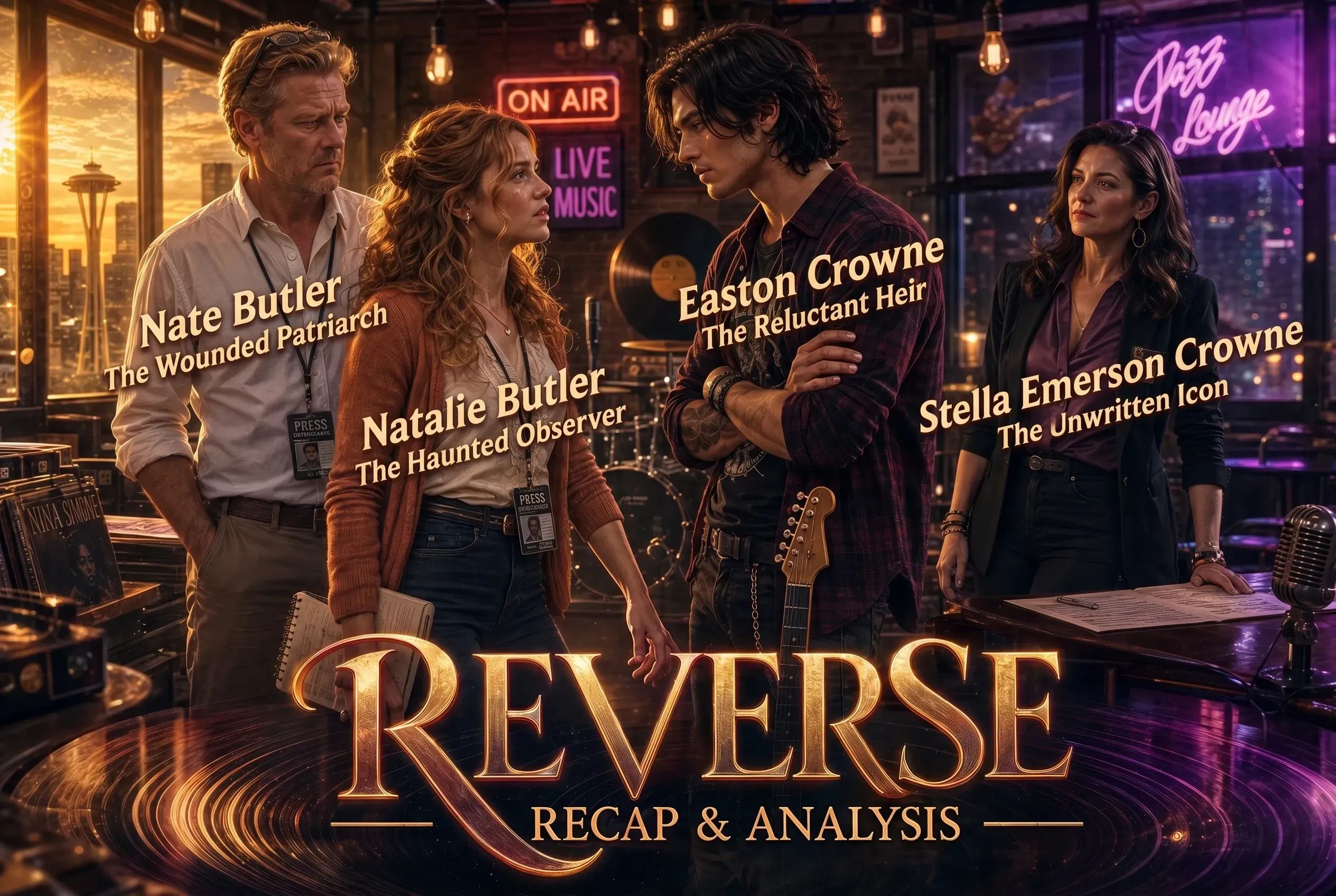
Natalie
Driven journalist heiressDaughter of editor Nate Butler3 and media heiress Addison10, Natalie writes under the Hearst name and dreams of inheriting her father's paper. Strawberry-blonde with her father's3 indigo eyes, she is intelligent, ambitious, and structured to a fault, having mistaken work for living. Beneath her polished composure runs a fierce stubbornness and a hidden hunger for a love grander than the one she was raised beside. Her defining flaw is deference: she places her father's approval and others' feelings above her own desires, hiding behind professionalism rather than naming what she wants. Her arc traces a woman learning that courage means risking humiliation, that some truths cost too much, and that choosing oneself is not betrayal but survival. She is both investigator and trespasser, witness and participant.
Easton
Reluctant rock prodigyThe only child of Stella4 and Reid Crowne5, Easton is a staggeringly gifted multi-instrumentalist who recorded an album in secret for years, terrified of the fame he was born into. Dark-haired, olive-skinned, and hazel-eyed like his father5, he speaks and lives by brutal honesty, prizing authenticity above all and despising disguise. He is perceptive to the point of mind-reading, fiercely protective of those he loves, and ruled by an inherited temper he fears. Music is his oxygen and his religion; he refuses to be anyone's messiah. His great contradiction is that he demands raw truth from others yet cannot always bear to receive it. Generous, intense, and stubborn, he loves with a completeness that becomes both his strength and his undoing.
Nate Butler
Beloved editor fatherFounder and editor in chief of Austin Speak, Nate built a respected paper from nothing despite dyslexia, beginning with a story tied to 9/11. He is Natalie's1 hero, frank to the point of bluntness, warm, empathetic, and devoted to his wife and daughter. Decades ago he was engaged to Stella Emerson4 before selflessly releasing her. He carries that history with buried grace, having found his true match in Addison10. When his daughter's1 secret detonates, his hurt curdles into uncharacteristic rage and control, revealing how deeply old wounds still live beneath his composure. His shared temper and stubbornness mirror Natalie's1, and his journey toward forgiveness mirrors hers toward courage.
Stella Emerson Crowne
Legendary journalist motherOne of the world's leading music journalists, Stella began her career at Austin Speak under Nate3, who once loved and nearly married her. Half-Latina, superstitious, and emotionally expressive, she believes fiercely in fate, the 11:11 sign, and the cosmic forces that reunited her with Reid5. She wears her heart openly and feels everything deeply, a trait Easton2 inherited. She lives with a rare condition that can trigger a stroke under extreme stress. Author of the memoir Drive, she has made peace with her past while guarding it closely. Her great fear is the fame machine that endangers those she loves; her great gift is loyalty that survives every storm.
Reid Crowne
Rock legend drummer fatherDrummer of the iconic Dead Sergeants, Reid rose from poverty and addicted parents to stardom, nearly destroyed before Stella4 saved him. He is Easton's2 mentor, encourager, and touchstone, sharing his son's2 temper and his talent. Reid carries lingering insecurity about Stella's4 history with Nate3, a paranoia he masks behind devotion. Gruff, generous, and fiercely protective of his wife and child, he understands desperation and second chances better than anyone. When the marriage scandal erupts, his loyalty to family complicates his fury. Beneath the rock-god exterior lives a man who learned, through years of waiting, that love is not selfish.
Joel
Loyal bodyguard confidantEaston's2 driver and bodyguard since his early twenties, Joel is more uncle than employee, having watched Easton2 grow up. Ex-Army, warm, and unflappable, he becomes the lovers' sole trusted ally, ferrying them to hideaways and shielding their secret. His steady affection for both Easton2 and Natalie1 makes him the relationship's quiet guardian, the one person who recognized their bond before they admitted it themselves.
Holly
Devoted lifelong best friendNatalie's1 best friend since infancy, daughter of one of Addison's10 closest friends. Beautiful, loyal, and dramatic, Holly nurses a years-long love for Damon8 she insists on calling a crush. She demands transparency from Natalie1 and bristles at being shut out. Her own slow-burning romance threads the later chapters, mirroring the novel's themes of long-deferred love finally claimed.
Damon
Brotherly best friendSon of Nate's3 best friend Marcus, raised alongside Natalie1 as a near-sibling. Strikingly handsome and a notorious charmer who has avoided commitment, Damon harbors buried feelings for Holly7 he refuses to examine. Protective and loyal, he meddles in Natalie's1 reconciliation while reckoning with his own fear of risking a lifelong friendship for love.
Benji
Jaded tattoo-artist brotherSon of Ben First and Lexi16, Easton's2 closest friend, who goes by G. A gifted tattoo artist scarred by his parents' decades of volatile on-off love, Benji is brilliant, acid-tongued, and commitment-phobic, having walked away from the woman he loves. He serves as Easton's2 harsh mirror and occasional conscience, a hypocrite who preaches detachment while privately bleeding.
Addison Butler
Strong-willed media matriarchNatalie's1 mother, who inherited a media empire and met Nate3 at a Chicago conference where she shot him down before falling for him. Sharp, confident, and unshakable in her marriage, Addie is the family's steel spine. Her candor and security become a balm, and her own past heartbreak gives her hard-won wisdom about which loves get the best and worst of us.
LL (Leif)
Troubled lead guitaristEaston's2 British-raised, Scandinavian-born lead guitarist, strikingly handsome and seemingly self-destructive. Mistaken for a drug addict, he is in fact battling a severe medical condition while chasing his last shot at a musical dream. Envious, sharp, and morally murky, LL is connected to the chain of events that set the entire story in motion.
Rosie
Celebrity gossip columnistAustin Speak's celebrated gossip columnist, recruited from California, with an unerring nose for celebrity news and devotion to all things Crowne. Her tip about Easton's2 album becomes Natalie's1 pretext for contact.
Misty Long
Rock star's later girlfriendA beautiful singer and collaborator who becomes Easton's2 girlfriend during the separation. Gracious and largely innocent, she is caught in the crossfire of a love that predates and overwhelms her.
Tye
Charming star quarterbackA legendary NFL quarterback who pursues Natalie1 during her separation. Charismatic and confident, he represents her tentative attempt to move on, a relationship the media inflates far beyond its reality.
Tack and Syd
Easton's bandmatesTack, the tattooed Midwestern drummer, and Syd, the British-Indian bassist, are Easton's2 hired musicians who become bandmates and friends in REVERB. Tack is warm and talkative; Syd is laconic and unflappable.
Ben and Lexi
Volatile rock-era coupleBen First is the Dead Sergeants' lead singer; Lexi, Stella's4 lifelong best friend, is Benji's9 mother. Their thirty-year on-off saga, born of betrayal and pride, shadows the younger generation as a cautionary parallel.
Rian
Guitarist's grown daughterRye Wheelan's only daughter, grown into a striking young woman. She once returned Benji's9 affection before he closed the door, and their unresolved tension simmers among the extended family.
Plot Devices
The Email Archive
Buried-history catalystWhile digitizing Austin Speak's archives, Natalie1 finds years of intimate emails between her father Nate3 and Stella4, revealing a hidden engagement. This discovery is the engine of the entire plot, transforming a routine assignment into an obsession that drives her across the country. The emails function as forbidden scripture, their tenderness destabilizing Natalie's1 understanding of her parents and her own origins. They establish the generational love story that the younger generation will unknowingly repeat, and they seed the central question, did her father3 settle, that haunts her until the memoir later answers it. The archive embodies the book's preoccupation with the cost of knowing what was meant to stay buried.
Music as Language
Emotional communication systemThroughout the novel, songs carry what characters cannot say aloud. Easton2 communicates love, grief, and rage through cover songs and original compositions, serenading Natalie1 at a hotel piano, dedicating ballads at concerts, and later screaming their ruin into a microphone. Each chapter borrows a song title, and Natalie1 builds a playlist that maps their relationship. Music is framed as timeless, capable of collapsing decades so that parents and children suffer parallel heartbreaks to the same melody. It becomes the lovers' truest dialect, more honest than dialogue, and the medium through which Easton2 bares the self he otherwise guards. The motif argues that art expresses the soul more faithfully than the biography critics crave.
The Memoir Drive
Truth-revealing embedded textStella's4 published memoir recounts the full story of her loving both Nate3 and Reid5, the account Hollywood romanticized while erasing Nate3 entirely. When Easton2 finally gives the book to Natalie1, it functions as the key that unlocks compassion, revealing that Nate3 ended the engagement himself out of selfless love when he saw Stella4 belonged to Reid5. The memoir collapses the generational divide, transforming the parents from obstacles into fellow sufferers and dissolving the children's resentment. It reframes the entire conflict as a tragedy of inheritance rather than villainy. A wedding-day letter tucked inside, written on Edgewater Hotel stationery, deepens the eerie parallels between the two love stories.
The 11:11 Fate Motif
Cosmic-coincidence frameworkStella's4 superstitious belief in fate, signaled repeatedly by the time stamp 11:11, frames the impossible coincidences that throw Easton2 and Natalie1 together, in Seattle, in Mexico, at the same resort. The motif raises the novel's recurring question of whether their collisions are destiny or accident, and whether destiny can be trusted given how much pain it inflicts. It threads through Easton's2 reluctant inheritance of his mother's4 rituals and colors the lovers' sense that they were always meant to find each other, even as that meaning costs them dearly. The framework is both romantic engine and philosophical puzzle the ending complicates.
The Live Divorce Document
Misunderstanding catastrophe engineA digital divorce petition that notifies each spouse whenever the other opens or signs it becomes the cruel mechanism of the marriage's collapse. Nate's3 law firm files it without Natalie's1 knowledge during a phone fight, leading Easton2 to believe she initiated the divorce. The document's real-time signatures turn a technological convenience into an instrument of devastating miscommunication, the modern equivalent of a misdelivered letter in classic tragedy. Both spouses repeatedly open it without signing, a silent standoff that reveals neither truly wants the end, until grief and jealousy finally drive the irreversible signatures. The device dramatizes how pride and distance can manufacture an outcome neither person actually chose.
FAQ
Synopsis & Basic Details
What is Reverse about?
- A Journalist's Unveiling: Reverse follows Natalie Butler, a driven young journalist, as she uncovers a hidden past between her esteemed editor father, Nate Butler, and legendary music journalist Stella Emerson Crowne, a relationship that predates her parents' marriage. This discovery, made through old emails in the Austin Speak archives, shatters Natalie's perception of her family and ignites a quest for deeper truths.
- A Collision of Legacies: Driven by a need to understand this secret history, Natalie uses a professional pretext to seek out Easton Crowne, Stella's notoriously private and talented musician son. Their initial hostile encounter quickly evolves into a complex, undeniable attraction, forcing both Natalie and Easton to confront the intertwined legacies of their families and the emotional baggage of their parents' unresolved past.
- Love Against the Odds: The story explores Natalie and Easton's burgeoning romance as they navigate personal deceptions, the relentless scrutiny of the media, and the deep-seated wounds of their respective families. Their journey is a fight for their own happiness and identity, challenging whether they can forge a future together that isn't dictated by the echoes of a previous generation's heartbreak.
Why should I read Reverse?
- Emotional Depth & Raw Honesty: Readers should dive into Reverse for its unflinching exploration of complex emotions, from Natalie's identity crisis and guilt to Easton's profound fear of fame and his guarded vulnerability. The narrative doesn't shy away from the messy realities of love, betrayal, and the struggle for self-acceptance, offering a deeply resonant emotional experience.
- Unique Narrative Structure: The novel masterfully weaves together past and present through epistolary elements, primarily Nate and Stella's old emails, which provide a rich, intimate backdrop to Natalie and Easton's contemporary romance. This dual timeline, coupled with the integration of music as a central motif, creates a multi-layered story that is both intellectually stimulating and emotionally captivating.
- A Modern Rock & Roll Romance: Beyond the family drama, Reverse delivers a passionate, high-stakes love story between two compelling characters. Fans of rockstar romance will appreciate Easton's artistic genius and guarded persona, while Natalie's journey as a strong, ambitious woman fighting for her truth offers a powerful, relatable arc. The story challenges conventional notions of fate and destiny, asking if love can truly conquer all, even generational curses.
What is the background of Reverse?
- A Near-Future Setting: The story is primarily set in 2035, offering a subtle glimpse into a slightly advanced technological world where digital archives are commonplace and social media's influence is pervasive, yet personal privacy remains a fiercely guarded commodity. This near-future setting allows for technological liberties, such as advanced media archiving, without veering into sci-fi, grounding the narrative in relatable contemporary issues.
- Sequel to Drive & Music as Muse: Reverse is a standalone sequel to Kate Stewart's Drive, building upon the world and characters established in the previous novel, particularly the iconic rock band Dead Sergeants and Stella Emerson Crowne's journey. Music is not just a backdrop but a foundational element, with each chapter titled after a song, and Easton's entire existence revolving around his musical talent and the legacy of his rockstar father, Reid Crowne.
- Author's Personal Connection: Kate Stewart dedicates the book to "all those creatives who we declared heroes before we spotlighted their flaws and exploited their demons," hinting at the novel's exploration of the human cost of fame and public perception. The author's note also reveals her initial reluctance to write a sequel, emphasizing how deeply she fell in love with this particular story and its characters, suggesting a profound personal investment in its themes.
What are the most memorable quotes in Reverse?
- "With the lights out, it's less dangerous. Here we are now, entertain us.": This Nirvana lyric, serving as the epigraph for Part I, perfectly encapsulates Easton's deep-seated aversion to fame and public scrutiny, highlighting his desire for authenticity and privacy even as he steps into the spotlight. It foreshadows his internal conflict and the emotional cost of his musical career.
- "Love is patient. Love is kind. Love is not boastful, nor does it insist on its own way. Love is not self-seeking, or easily angered. Love keeps no records of wrongdoings.": Recited during Natalie and Easton's impromptu wedding vows, these lines from 1 Corinthians 13 serve as a poignant thematic anchor. They represent the ideal of love they aspire to, contrasting sharply with the impatience, anger, and record-keeping of past hurts that plague their parents' generation and initially threaten their own relationship.
- "You're a supernova. I thought it the first time you sang for me in Seattle, and it's what I thought the night we locked ourselves in that Dallas hotel while we were falling in love, making love. I knew I caught one and told myself to hold onto you with everything in me.": Natalie's internal monologue about Easton captures the overwhelming, almost fated nature of their connection. It highlights his immense talent and charisma, but also her desperate, almost possessive desire to cling to a love she instinctively knows is both extraordinary and fragile, foreshadowing the immense struggle to keep him.
- "You're a stain. I'm in your skin, in the blood that flows through your veins . . . and we all know a villain can't make it with a superhero.": Easton's brutal, heartbroken words to Natalie during their confrontation reveal the depth of his pain and his perception of their doomed relationship. This quote encapsulates the theme of inherited conflict and the idea that their love, born from deception and family rivalry, is irrevocably "tainted" by the past, making a future seem impossible.
What writing style, narrative choices, and literary techniques does Kate Stewart use?
- Epistolary & Dual Perspective: Kate Stewart masterfully employs an epistolary style through the extensive use of emails between Nate and Stella, providing intimate access to their past romance and shaping Natalie's initial quest. This is complemented by Natalie's first-person narration, which later shifts to include Easton's perspective, creating a rich, multi-faceted understanding of the characters' internal worlds and the generational echoes of their love stories. This technique, particularly the emails, serves as a 'found document' plot device, driving the initial mystery and emotional core.
- Music as a Narrative Backbone: Each chapter is titled after a song, and music functions as a powerful literary device, acting as both a literal soundtrack and a metaphorical language for unspoken emotions and thematic development. Easton's music, in particular, becomes a conduit for his deepest fears and desires, while Natalie's evolving appreciation for it mirrors her own emotional awakening. This integration elevates music beyond mere background, making it an active participant in the storytelling and a key element of Reverse's unique identity.
- Raw, Emotional Prose & Dialogue: Stewart's writing is characterized by its intense emotionality and candid dialogue, often reflecting the characters' internal turmoil and passionate connections. The prose is direct and visceral, immersing the reader deeply in the characters' experiences, particularly during moments of high conflict or intimacy. This raw style, combined with frequent internal monologues, allows for a profound psychological exploration of motivations, fears, and the complexities of love and loyalty.
1. Hidden Details & Subtle Connections
What are some minor details that add significant meaning?
- Easton's LELO-HEX-XL Condoms: Natalie's discovery of Easton's specific brand of condoms (LELO-HEX-XL) in his jacket pocket is a subtle detail that speaks volumes about his sexual confidence and experience. It hints at a man who is not only prepared but also discerning in his intimate life, contrasting with Natalie's own admitted lack of recent sexual experience and contributing to her initial intimidation and burgeoning attraction. This detail subtly foreshadows the intense physical chemistry and sexual awakening she experiences with him.
- The "World Dominance" Bumper Sticker: On the hybrid van Easton's band uses, the bumper sticker reading "World Dominance" with a stiletto heel running through it (Chapter 26) is a humorous yet telling detail. It contrasts sharply with Easton's personal aversion to fame and his desire for authenticity, highlighting the commercial realities of the music industry he's navigating. It also subtly reflects the ambitious, perhaps even ruthless, drive required for success, a trait Easton possesses but struggles to reconcile with his private nature.
- Nate's Colorblindness & Tie: Stella's email to Nate (Chapter 13), where she playfully scolds him for his "green tie doesn't match your blue suit" due to his partial colorblindness, is a tender, intimate detail. It reveals a deep level of familiarity and affection in their past relationship, showing Stella's keen observation and Nate's vulnerability. This seemingly minor detail underscores the profound intimacy Natalie uncovers, making her father's hidden heartbreak even more poignant and personal.
What are some subtle foreshadowing and callbacks?
- The 11:11 Motif: The recurring mention of "11:11" (Chapter 2, 25) as a time when superstitious Stella made wishes, and Natalie's own observation of it, subtly foreshadows the fated, almost magical connection between Natalie and Easton. It's a callback to Stella's belief in cosmic signs, suggesting that despite the chaos and pain, their meeting and subsequent love story might be part of a larger, predetermined design, echoing the "full circle" theme.
- Easton's "I'm Right Here" Echo: When Easton whispers "I'm right here" to Natalie (Chapter 14), it's a direct callback to Reid's words to Stella in Drive (and the movie adaptation) just before their first kiss. This subtle echo not only highlights the parallel destinies of the two couples but also deepens the intimacy of the moment, suggesting a profound, almost inherited understanding between Easton and Natalie that transcends their individual experiences.
- The "Vulture and the Little Girl" Photo: Natalie's detailed recounting of Kevin Carter's Pulitzer-winning photograph (Chapter 6) serves as a powerful piece of foreshadowing and thematic exposition. Her struggle with the ethics of journalism and the personal cost of observation ("I won't be the vulture, either") directly foreshadows her own moral dilemma in pursuing Easton's story and the emotional toll it takes on her, ultimately leading to her decision to protect his privacy.
Who are the most significant supporting characters?
- Joel, the Steadfast Protector: Joel, Easton's driver and bodyguard, is far more than a secondary character; he's Easton's emotional anchor and a silent guardian for both protagonists. His unwavering loyalty, quiet wisdom, and willingness to bend rules for Easton's happiness (e.g., chartering the plane for Natalie, acting as a confidant) make him a pivotal figure. He represents unconditional support and a safe harbor in the tumultuous world of fame and family drama, often providing Natalie with crucial insights and comfort.
- Benji First, the Cynical Mirror: Benji, Easton's cousin and tattoo artist, serves as a cynical foil and a parallel character. His jadedness about love and commitment, stemming from his parents' tumultuous relationship, mirrors Easton's initial guardedness and Natalie's fears. His brutal honesty, while sometimes harsh, forces both Easton and Natalie to confront uncomfortable truths about their own choices and the generational patterns they risk repeating, making him a catalyst for self-reflection.
- Holly & Damon, the Loyal Confidantes: Natalie's best friends, Holly and Damon, provide essential emotional support and a grounding force in her life. Their own slow-burn romance subtly parallels Natalie and Easton's, highlighting themes of unspoken feelings and the courage to take a chance on love. They represent the "normal" life Natalie temporarily abandons, and their reactions to her choices underscore the profound impact of her relationship with Easton on her established world.
2. Psychological, Emotional, & Relational Analysis
What are some unspoken motivations of the characters?
- Natalie's Quest for Authenticity: Beyond journalistic curiosity, Natalie's deep dive into Nate and Stella's past is driven by an unspoken need to validate her own identity and the authenticity of her parents' marriage. The discovery of their engagement challenges her foundational belief in their "perfect" love, leading her to question if her own life is built on a truth or a carefully constructed narrative, as seen in her internal struggle: "I'm terrified of what my gut is saying—my dad wouldn't have kept their relationship hidden unless he wanted it that way."
- Easton's Desire for Unconditional Acceptance: Easton's initial hostility towards the media and his reluctance to fully embrace fame stem from an unspoken longing for acceptance that isn't tied to his rockstar lineage or public persona. His vulnerability with Natalie, particularly his confession about his music being his most personal offering, reveals a deep desire to be seen and loved for who he truly is, not for the "rock royalty" he was born into. His fear of fame is a fear of losing himself to external expectations.
- Nate's Protective Guilt: Nate's fierce overprotectiveness of Natalie and his initial fury over her relationship with Easton are rooted in an unspoken guilt and regret over his past with Stella. His confession to Easton, "I did let it happen. I made it happen. That situation in there started because of me," reveals his deep-seated belief that his past choices caused pain, driving his desperate need to shield Natalie from a similar fate, even if it means controlling her choices.
What psychological complexities do the characters exhibit?
- Natalie's Identity Diffusion: Natalie grapples with a complex identity, torn between being "Natalie Butler" (her father's legacy, the aspiring journalist) and "Natalie Hearst" (her mother's maiden name, a symbol of her own path). Her obsession with her parents' past is a manifestation of her struggle to define herself outside their intertwined legacies, leading to self-deception and a temporary abandonment of her own moral compass. Her internal conflict is evident when she questions, "Who are you?" after realizing her attraction to Easton.
- Easton's Empathic Burden: Easton, despite his guarded exterior, is profoundly empathic, absorbing the emotional toll of fame on his parents and others. This empathy fuels his desire to protect his private self and his music from public consumption, as he states, "I don't want to be human, not for them, because I'll be crucified no matter what." His artistic genius is intertwined with this sensitivity, making him both brilliant and deeply vulnerable to the pressures of his world.
- Stella's "Cosmic Believer" vs. Lived Reality: Stella's character embodies the psychological complexity of a "cosmic believer" who trusts in fate and destiny, yet her life is marked by pragmatic, often painful choices. Her belief system, while romanticized in Drive, is shown in Reverse to be a coping mechanism for navigating a tumultuous life, particularly her split from Nate and her eventual reunion with Reid. This contrast highlights the human need to find meaning in chaotic events, even if it means selectively interpreting reality.
What are the major emotional turning points?
- Natalie's Email Revelation: The moment Natalie discovers Nate and Stella's engagement email (Chapter 13) is a profound emotional turning point. It shatters her idealized view of her parents' marriage and triggers an identity crisis, leading her to question everything she thought she knew about love and loyalty. This revelation is the catalyst for her entire journey, driving her to Seattle and ultimately to Easton.
- Easton's Piano Serenade: Easton's decision to play "Only You Know" by Dion for Natalie in the hotel lobby (Chapter 15) is a pivotal emotional moment. It's his first public performance, a raw act of vulnerability that reveals the depth of his talent and his growing feelings for her. This intimate gesture breaks down Natalie's remaining defenses, solidifying her infatuation and making her realize the true magnitude of his genius, leading her to confess, "I was close to begging... That was... fucking incredible."
- Natalie's Gala Confession: Natalie's impassioned, tequila-fueled confession at the Dallas gala (Chapter 73), where she publicly declares her love for Easton and her regret over their separation, marks a critical emotional shift. This raw outpouring of truth, despite the public setting and the presence of her family, signifies her breaking free from self-preservation and choosing to fight for her love, even if it means further alienating her parents. It's a moment of profound bravery and vulnerability.
How do relationship dynamics evolve?
- Natalie and Nate: From Idolization to Estrangement to Reconciliation: Their relationship undergoes a dramatic arc, starting with Natalie's deep idolization of her father ("Nate Butler is the greatest man I've ever known"). Her discovery of his past with Stella leads to feelings of betrayal and deception, causing a painful estrangement. Ultimately, through shared pain and mutual confessions, they begin a slow, difficult path toward reconciliation, culminating in Nate's apology and acceptance of Natalie's choices, albeit with lingering hurt.
- Easton and Natalie: From Hostility to Deep Intimacy to Hard-Won Partnership: Their dynamic begins with mutual suspicion and hostility, fueled by Natalie's deception and Easton's guarded nature. This quickly evolves into intense physical and emotional intimacy, marked by raw honesty and a shared understanding of their inherited burdens. Their separation and eventual reunion are characterized by profound longing and a hard-won commitment to open communication and mutual support, transforming their initial "reckless and stupid" love into a mature, resilient partnership.
- The Crowne and Butler Families: From Hidden History to Open Warfare to Fragile Truce: The initial dynamic is one of unspoken history, with both families having buried the past. Natalie and Easton's relationship forces this history into the open, leading to explosive confrontations between Nate and Reid, and deep emotional pain for Stella and Addison. The families descend into a "war" of wills, but eventually, through the parents' own reconciliation and the children's unwavering love, a fragile truce is established, hinting at a future of cautious acceptance rather than full harmony.
3. Interpretation & Debate
Which parts of the story remain ambiguous or open-ended?
- The Full Extent of Nate and Stella's Breakup: While Nate eventually provides his version of why he broke off his engagement with Stella (Chapter 59), the emotional nuances and Stella's complete perspective on that pivotal decision remain somewhat ambiguous. Her memoir, Drive, focuses on her journey with Reid, and while Easton reads it, the reader only gets glimpses. This leaves room for interpretation regarding the true depth of Stella's feelings for Nate at the time of their split and whether she truly "outgrew" him or was simply drawn to a different destiny.
- The Long-Term Impact of Family Reconciliation: The novel concludes with the parents achieving a fragile truce and even a degree of friendship, but the lasting impact of their past on Natalie and Easton's future remains open-ended. While they are married and committed, the deep-seated resentments and the "war" between the families suggest that their journey will continue to be challenging. The question of whether the families can truly integrate harmoniously, especially with future children, is left for the reader to ponder.
- Easton's Future Relationship with Fame: Despite Easton's initial aversion to fame and his desire for
The Bittersweet Symphony Duet Series

About the Author
Other books by Kate Stewart




Download PDF
Download EPUB
.epub digital book format is ideal for reading ebooks on phones, tablets, and e-readers.








































