

Key Takeaways
You are not broken; you were always whole, just forgetting it
The core reframe. Tuttle rejects the conventional self-help premise that people are damaged and need repair. Her thesis: every human is already complete, whole, and divine, but has forgotten this truth through birth, generational conditioning, and painful experience. Healing is not fixing what is broken. It is clearing away the accumulated debris (limiting beliefs, buried emotions, generational patterns) that obscures a wholeness that never actually left.
She uses the metaphor of a mansion with dark rooms. Truth is remembered, not discovered, and each insight turns on another light. Negative emotions signal that you are believing a lie about yourself, because it feels uncomfortable to live inside a falsehood about your true divine nature.
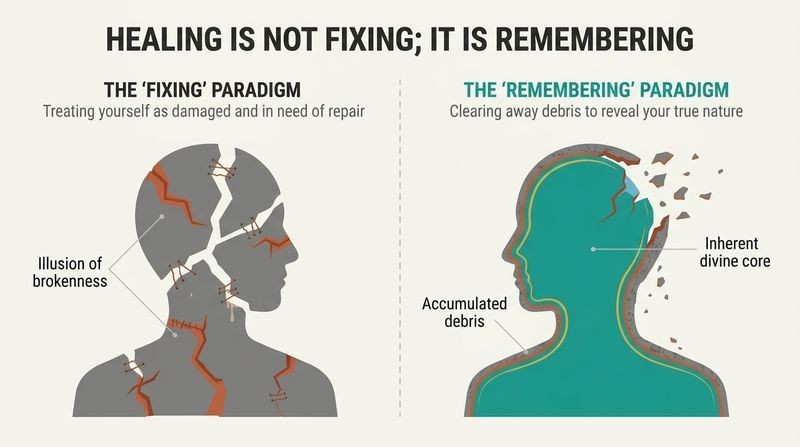
What's striking is how this inverts the deficit model dominant in Western therapy, aligning instead with humanistic psychology's Carl Rogers, who argued people possess an innate actualizing tendency. The framing resembles Buddhist and Vedic notions that suffering stems from forgetting one's true nature rather than acquiring a defect. The upside is empowering: clients arrive as inherently capable, not diagnosed. The risk is that declaring everyone already perfect can minimize real trauma or bypass the slow, evidence-based work of recovery. The most useful reading treats wholeness as a starting assumption that fuels agency, not a denial that genuine wounds require genuine tending.
Whatever you believe, you experience multiplied through the law of creation
Belief becomes reality, amplified. Tuttle's central mechanism is the law of creation: whatever you focus on in belief, thought, and feeling returns to you magnified. She compares it to gravity, operating whether or not you understand it. Worry about scarcity and you attract more to worry about. Fear violence and you help create it. Life is a mirror reflecting your deeper convictions back at you.
She distinguishes conscious thoughts from subconscious beliefs, arguing the subconscious ones (often inherited or formed in childhood) are the more powerful creators. This is why positive affirmations alone sometimes fail: they stir up contradicting subconscious material that must first be cleared. To know your true beliefs, she says, simply examine what keeps showing up in your life.
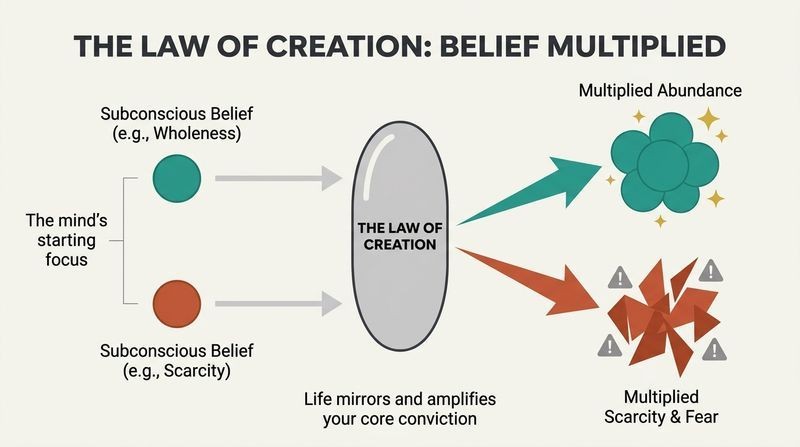
This is the Law of Attraction, popularized by The Secret, and Tuttle credits Abraham Hicks and Louise Hay as influences. The defensible kernel: expectations shape attention, behavior, and self-fulfilling prophecy, well-documented in psychology (Pygmalion effect, confirmation bias). Beliefs genuinely filter perception and drive action. The overreach is metaphysical causation, the claim that thoughts directly reorganize external matter and events. That crosses into territory unsupported by evidence and, applied to tragedy, becomes ethically fraught. The strongest version keeps the psychological insight (mindset shapes outcomes you can influence) while resisting the leap that every circumstance is self-authored.
Your birth left an imprint that scripted your life as struggle
The birth clearing. Tuttle argues the birth experience stamps lifelong emotional patterns. A premature baby may grow into an adult who rushes and waits anxiously; an overdue one chronically runs late; a Cesarean birth can seed people-pleasing or stubbornness. She claims anyone born before the year 2000 entered an energy of struggle, and a birth clearing is the single most impactful shift she recommends.
One example: John, overdue and blamed for nearly killing his mother at birth, spent his life believing he could not have his own life without harming her. Sonja, born via Cesarean and told she was an inconvenient diva, became a chronic people-pleaser until she reframed her birth story and learned to assert her needs.
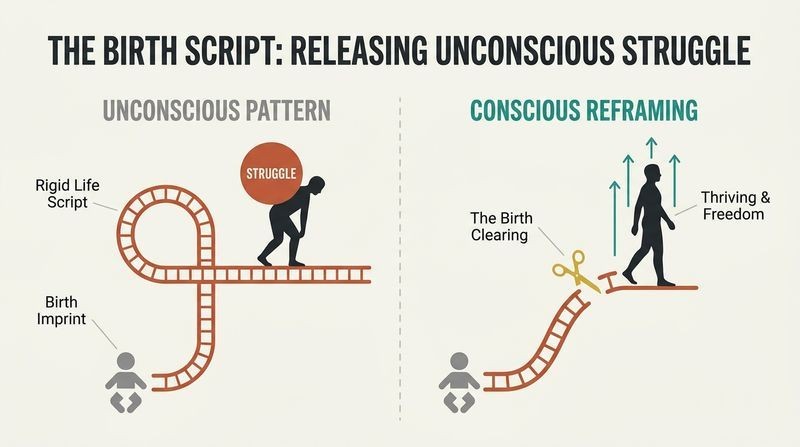
The mechanism (literal energetic imprints from birth) lacks scientific support, and specific correspondences like breech-equals-wrong-position read as symbolic pattern-matching. Yet there is a real signal underneath. Prenatal and perinatal stress genuinely influence development: maternal cortisol affects fetal neurodevelopment, and epigenetic research shows early environment shapes gene expression. Attachment theory confirms that the earliest caregiving imprints relational templates. Tuttle's stories may work less through birth energy and more through narrative reframing, giving clients a coherent origin story they can consciously rewrite. That therapeutic power (a new self-narrative reduces shame) is well established, whatever one makes of the proposed cause.
Treat negative emotion as a guidance signal, not an enemy
Two kinds of bad feeling. Tuttle separates negative emotion into self-generated criticism and worry versus a genuine guidance system alerting you that your current thoughts or choices are off course. Feeling bad is information: it means your attention has drifted to what you do not want. Rather than wallowing or suppressing, she advises pausing to ask what belief or choice is producing the discomfort, then redirecting.
She illustrates with Steve, a chronic worrier who believed worry proved love and prevented disaster. He married a fellow worrier and their shared anxiety cut them off from clear decision-making. Worry, she argues, is a false sense of control: bracing for hurt so you are never surprised by it, a pattern common among those with traumatic childhoods.
This maps closely onto Abraham Hicks's emotional guidance scale, but it also echoes rigorous frameworks. Acceptance and Commitment Therapy treats emotions as data rather than commands, and affective neuroscience frames feelings as appraisals signaling whether goals are being met. The reframe of worry as illusory control is sharp and clinically accurate; cognitive behavioral therapy identifies exactly this intolerance-of-uncertainty loop. Where caution is warranted: not all negative emotion is a course-correction to think your way out of. Grief and depression sometimes need to be felt and metabolized, not decoded and redirected, a nuance the guidance-signal model can underweight.
Rewrite the scripts you handed everyone playing a role in your life
Life as a play you cast. Tuttle frames every person in your life as an actor performing a script you wrote, entering to teach lessons you came to learn. When you blame, resent, or rage at someone, you have forgotten you handed them their part. If you refuse the lesson, you attract someone else to play it, usually more intensely.
Her visualization: picture everyone on a stage, thank them for their roles, invite those with negative scripts to burn them, and let a new script direct everyone to honor you, because you now honor yourself. The catch: people can only play the negative part while some part of you still believes you deserve poor treatment. Her most personal example is reconciling with her abusive father through a dream reframe.
The theatrical metaphor is a potent cognitive-reframing tool, echoing narrative therapy's premise that we live by stories we can re-author. Changing how you perceive and project onto others genuinely shifts relational dynamics; interpersonal expectancy effects are real. The ethically delicate move is the implication that abuse victims scripted their own abuse before birth, which Tuttle acknowledges drew heavy pushback. The steelman: she uses it to restore agency to survivors, not to excuse perpetrators, and she insists on boundaries. Still, the framing risks sliding into self-blame. The durable takeaway is narrower and sound: you cannot control others, only the story and energy you bring to them.
Physical disease often carries an emotional and mental message
The body as message center. Tuttle claims illness frequently originates in unexpressed emotion and limiting beliefs lodged at a cellular level, drawing on Louise Hay's catalog linking criticism to arthritis, resentment to cancer, guilt to pain. The body signals imbalance so you will clear the deeper disharmony; treating only the physical symptom lets the underlying pattern resurface elsewhere.
She describes finding a breast lump in her forties, researching its supposed emotional roots (over-mothering, difficulty releasing children), adjusting her behavior with her dating daughter, visualizing white light, and finding the cyst gone at her surgical appointment. She also warns against fusing diagnosis with identity: saying I am diabetic instructs every cell to comply. Instead, frame it as a past condition with a message to decode.
The mind-body connection is real and increasingly evidenced: chronic stress elevates inflammation, suppresses immunity, and worsens cardiovascular and metabolic disease, and psychoneuroimmunology has mapped many pathways. The insight about not fusing identity with diagnosis is genuinely useful and echoes narrative medicine. The danger is the strong version, that specific emotions cause specific diseases and that visualization dissolves tumors. This risks blaming patients for illness and delaying medical care. Tuttle does note not everyone is meant to heal physically, which softens the claim. Read responsibly, the chapter encourages addressing emotional stress alongside, never instead of, evidence-based treatment.
Match your belief to your desire on a 0-to-10 scale
The desire-belief gap. Tuttle offers a diagnostic for why manifestation stalls. Rate your desire for something 0 to 10, then rate your belief that you can have it. Most people want a new outcome at a 10 but believe it possible at only a 3 or 4. That gap, not weak desire, blocks results. Her fix: do not shrink the desire, energize the belief up to match.
Her creation process runs five steps: know what you want, ask a higher power, believe without doubt, let go and allow, and express gratitude on receiving (which restarts the cycle). She adds tools to pump up belief: energy circles, acting as if, and imagining the worst outcome to defuse fearful attachment, since neediness itself kinks the flow.
Stripped of metaphysics, this is a shrewd model of self-efficacy, Albert Bandura's finding that belief in one's capability predicts whether people attempt and persist. The desire-belief gap resembles expectancy theory in motivation science: effort follows expectancy times value. Naming belief as the limiting variable is more actionable than generic positive thinking. The defusing-attachment step also parallels paradoxical intention and the psychology of loosening outcome fixation to reduce performance anxiety. The weakness is attributing results to signals sent to the Universe rather than to changed behavior, persistence, and opportunity recognition that high belief actually produces. The tool works; the proposed cause is debatable.
Be a Savior on Mount Zion who breaks your family's inherited pain
The transition person. Borrowing family therapist Carlfred Broderick's phrase, Tuttle describes certain individuals assigned to interrupt destructive generational cycles, absorbing the inherited poison and refusing to pass it forward so the lineage after them runs clean. Abuse, addiction, poverty consciousness, and depression, she argues, transmit across generations until someone clears them.
When you heal, you free not only yourself but ancestors and descendants, because everyone is energetically networked. She invokes the four-minute mile: once Roger Bannister broke the barrier in 1954, others quickly followed, as if a collective ceiling had lifted. Her most dramatic case is Karla, who arrived in a wheelchair with dissociative identity disorder from ritual abuse and, over months, integrated her personalities and rebuilt her life.
The generational-transmission claim has surprising scientific traction. Research on intergenerational trauma documents how abuse and neglect patterns repeat across families, and epigenetics suggests stress responses can be biologically transmitted. Family systems theory formalizes how one member's change ripples through the whole. Bowen called this the differentiated individual who stops the multigenerational transmission process. The four-minute-mile analogy is beloved but historically shaky; the record fell partly due to better tracks, pacing, and competition, not a lifted psychic ceiling. Still, the emotional truth of social permission and modeling is real. The role of transition person is genuinely powerful and, notably, often thankless, which Tuttle candidly acknowledges.
Feel your prayers with all five senses to ground them into form
Sensory prayer. Tuttle argues prayer with feeling is far more potent than mental petition. When asking for something, imagine what it would look, sound, smell, taste, and feel like as if already real. She prayed for rain by imagining the sound of drops, the smell on cement, the darkened sky, and reports the rain came. Praying for money, she carried cash to feel it, changed her ringtone to a money-themed song, even smelled the bills.
Her reasoning: the physical body vibrates slowest of the four bodies (spiritual, mental, emotional, physical), so engaging the senses grounds an intention into material form. She also insists God does not decide whether you may have something; you hold that power through asking, believing, and receiving.
The technique is mental contrasting and vivid visualization, and here the science partly cuts against Tuttle. Gabriele Oettingen's research shows that fantasizing about goals as already achieved can sap the energy to pursue them, whereas contrasting the dream with obstacles fuels action. Multisensory imagery does, however, improve performance in athletes and is central to sports psychology, likely by priming motor and emotional systems. The sensory-embodiment angle is the freshest part: emotion and the body encode intentions more durably than abstract thought, consistent with embodied cognition research. The rain and money anecdotes are unfalsifiable, but the practice of making goals vivid and felt has real motivational teeth when paired with action.
Stop telling your trauma story to earn validation from others
How to keep yourself stuck. Tuttle warns that talk therapy and support groups, tools she values, can trap people when the focus stays fixed on the past and on retelling the wound to receive sympathy. If you need a group to validate you, you still believe you are not enough. Attachment to the story of a childhood from hell keeps recreating its effects in adult life.
Her alternative is inner-child work: from 1999 to 2004 she journaled with her wounded younger self, writing questions with her dominant hand and answers with her non-dominant hand to engage the emotional brain. The goal is to become the adult who finally hears and validates that child, so you no longer need your story for support and can release it.
This lands on a live debate in trauma treatment. Repeatedly recounting trauma without resolution can indeed entrench it, and researchers have questioned whether some debriefing and rumination-heavy approaches help or harm. Modern trauma therapy (EMDR, somatic work, and the reprocessing Tuttle intuits) aims to metabolize memory, not merely rehearse it, echoing her feeling-is-healing instinct. Her non-dominant-hand journaling has no strong empirical backing but resembles chair work and internal family systems, which do. The caution: telling one's story to a witness is often a necessary stage of healing, not just a trap. The wisdom is knowing when narration has shifted from processing to identity maintenance.
Money is neutral energy that flows toward whoever expects abundance
Poverty versus prosperity consciousness. Tuttle treats money like air: a resource there is plenty of, made scarce only by belief. She catalogs poverty-consciousness beliefs (money comes only from hard work, rich people are crooks, poverty keeps me humble) and contrasts them with prosperity affirmations. Every anxious transaction broadcasts lack; every peaceful one signals abundance.
Her behavioral tricks: always carry cash so you can honestly answer that you have money, pay bills in gratitude, and play a game where you imagine an endless supply of hundred-dollar bills replacing themselves as you spend. She shares her own decade of financial struggle after moving to Utah, which drove her to study money's laws and eventually create a popular money course. The struggle, she argues, seeded the solution.
Behaviorally, money mindset has real effects: scarcity thinking, as Mullainathan and Shafir showed, taxes cognitive bandwidth and worsens financial decisions, while a sense of sufficiency supports planning and calm negotiation. Reframing shame around money can unlock earning and investing behavior. The carry-cash and gratitude practices nudge genuine psychological shifts. The overreach is implying that belief alone, independent of skills, market conditions, and structural constraints, summons wealth. That framing can quietly blame the poor for poverty and ignore systemic barriers. The strongest reading: mindset removes self-imposed brakes and improves money behavior, but abundance still requires competence, opportunity, and often plain luck alongside the belief work.
The era of learning through pain is ending; choose growth through joy
Old energy versus new energy. Tuttle's culminating claim is that humanity is graduating from an old paradigm where struggle and suffering were the required medium for spiritual growth into a new one where growth can come through joy, ease, and deliberate creation. The old belief that life must be hard, she says, is imprinted in every human, but it is now optional.
Contrast still exists (you cannot know joy without having known pain) but struggle no longer must. The question she poses shifts from how much pain can you endure to how much joy can you hold and how long can you hold it. She frames the challenges of 2020 as a collective crossroads inviting people to reclaim their power rather than default to fear.
The joy-versus-suffering reframe is the book's most quietly radical move, pushing against deep cultural and religious scripts (no pain no gain, redemptive suffering) that psychologists note can become self-justifying. Positive psychology supports part of her case: Barbara Fredrickson's broaden-and-build theory shows positive emotion expands cognition and resources, so joy is generative, not merely pleasant. Yet post-traumatic growth research also confirms that adversity, not just joy, catalyzes meaning and development. The likely truth is both-and: suffering can teach, but it is neither the only nor the noblest teacher. Tuttle's permission to stop romanticizing struggle is genuinely freeing, especially for those who unconsciously manufacture hardship to feel worthy.
Analysis
Remembering Wholeness is a New Age spiritual self-help handbook structured as sixty short chapters, each a stated universal truth followed by a client story and, in this anniversary edition, a twenty-year addendum reflecting on how the author's understanding matured. Its distinctive move is fusing Law of Attraction metaphysics (thoughts create reality, energy follows thought) with explicitly Latter-day Saint Christian theology (premortal existence, sacred agreements, Christ's atonement, Heavenly Father and Mother). This synthesis is both its originality and its friction point: Tuttle openly anticipates that Christians will call it heresy and New Age readers will find the Christ references jarring.
The book's intellectual backbone borrows heavily from Louise Hay, Abraham Hicks, Neale Donald Walsch, and Gregg Braden, which Tuttle credits. What she adds is a practitioner's clinical texture: three decades of energy-healing case studies (dissociative identity disorder, chronic fatigue, suicidal depression, infertility, marital collapse) that make abstract principles concrete. The addendums are the edition's most valuable feature, because they show a teacher revising herself. She admits her chronic pain and suicidal depression required a brain SPECT scan and antidepressant medication, conceding that manifestation alone did not heal her, a striking crack of empirical humility in an otherwise metaphysically confident text.
Critically evaluated, the book oscillates between psychologically sound and scientifically unfounded. Its defensible core (mindset shapes attention and behavior, self-efficacy drives outcomes, reframing reduces shame, the mind-body connection is real, intergenerational patterns transmit) is genuinely useful and increasingly corroborated. Its overreaches (thoughts directly rearrange matter, souls pre-arrange their own abuse, visualization dissolves cysts) risk victim-blaming and medical bypass. The most responsible reading extracts the agency-restoring psychology while treating the metaphysical causation as unfalsifiable belief. For readers drawn to spiritually framed personal development, the book delivers a coherent, empowering, and occasionally beautiful invitation to stop identifying as broken. Its enduring value is permission: to reclaim authorship of one's story, to question inherited struggle, and to expect more joy than suffering scripts allow.
Review Summary
Remembering Wholeness receives mixed reviews. Many readers find it life-changing, praising its insights on positive thinking and energy healing. Some appreciate the LDS perspective, while others find it too new-agey. Critics argue it oversimplifies complex issues and may blame victims. The book's concepts on manifesting desired outcomes and spiritual growth resonate with many, but some struggle with its more unconventional ideas. Overall, readers recommend approaching the book with an open mind, taking what resonates and leaving the rest.
People Also Read





FAQ
What's Remembering Wholeness about?
- Spiritual Growth Focus: Remembering Wholeness by Carol Tuttle centers on recognizing and reclaiming our inherent wholeness and spiritual identity. It challenges the notion of inherent flaws, promoting the idea that we are whole beings capable of creating our reality.
- Energy Healing Principles: The book introduces energy healing concepts, suggesting that thoughts and emotions directly influence physical health and well-being. Tuttle provides insights into clearing negative energies and beliefs that hinder personal growth.
- Practical Guidance: Tuttle offers practical advice and exercises, encouraging readers to engage actively in their healing process and spiritual awakening. It serves as a handbook for thriving in the 21st century.
Why should I read Remembering Wholeness?
- Transformative Insights: Readers can gain valuable insights into their lives and learn how to shift perceptions and beliefs for a more fulfilling existence. Tuttle’s teachings can lead to profound personal transformation.
- Empowerment through Responsibility: The book emphasizes personal responsibility in creating one’s reality, empowering readers to take charge of their lives. It encourages a shift from victimhood to active participation in one’s spiritual journey.
- Holistic Approach: Tuttle combines spiritual teachings with practical self-help strategies, making it accessible for anyone seeking to improve their emotional and spiritual health.
What are the key takeaways of Remembering Wholeness?
- Inherent Wholeness: We are inherently whole and not defined by struggles or past traumas. Recognizing this truth is essential for personal growth.
- Thoughts Shape Reality: Our thoughts and beliefs shape our reality, and by changing them, we can change our experiences. This principle is foundational to manifestation.
- Healing through Love: Unconditional love, for oneself and others, is a powerful force for healing and transformation. It is essential for overcoming negative patterns and beliefs.
What are the best quotes from Remembering Wholeness and what do they mean?
- “The answers are within us.”: This quote emphasizes the idea that we possess innate wisdom and power to heal and create our reality. It encourages self-reflection and trust in one’s inner guidance.
- “We create what we experience.”: This statement underscores the principle that beliefs and thoughts directly influence life experiences. It serves as a reminder of the power of personal responsibility in shaping our lives.
- “Whatever we believe we experience multiplied.”: This quote highlights the law of creation, suggesting that beliefs manifest in reality. It encourages readers to examine beliefs and align them with desires.
How does Carol Tuttle define energy healing in Remembering Wholeness?
- Healing from Within: Energy healing is a process that allows individuals to initiate deep and lasting healing within their mind-body energy system. It involves using natural, self-applied methods to clear negative energies.
- Clearing Limiting Beliefs: The process focuses on identifying and releasing limiting beliefs and emotional wounds that block spiritual growth. By clearing these energies, individuals can reconnect with their true selves.
- Tools for Transformation: Tuttle provides various tools and techniques for energy healing, emphasizing that these methods facilitate the healing process rather than being the healing power themselves.
What is the significance of the present moment in Remembering Wholeness?
- Power of Now: The present moment is our most powerful point of creation, where thoughts and feelings shape future experiences.
- Letting Go of the Past: Focusing on the present allows for the release of past traumas and limiting beliefs, enabling healing and transformation.
- Creating New Realities: By consciously choosing thoughts and beliefs in the present, we can create the reality we desire. Tuttle encourages embracing the now as a space for empowerment.
How can I apply the principles of Remembering Wholeness in my daily life?
- Daily Affirmations: Use affirmations to reinforce positive beliefs and intentions. Regularly affirming desires aligns energy with them.
- Energy Circles: Visualize desires and send them out into the universe through energy circles. This technique helps manifest intentions.
- Mindfulness and Reflection: Incorporate mindfulness practices to stay aware of thoughts and feelings. Reflecting on experiences allows for identifying patterns and making conscious choices.
What role do negative emotions play in Remembering Wholeness?
- Guidance System: Negative emotions signal misalignment with our highest good, guiding us toward healing.
- Opportunity for Growth: Experiencing negative emotions provides opportunities for self-reflection and growth. Addressing these feelings clears limiting beliefs.
- Transforming Energy: Negative emotions can be transformed into positive energy by acknowledging and processing them, essential for healing and personal development.
How does Remembering Wholeness address the concept of unconditional love?
- Foundation of Healing: Unconditional love is the most powerful force in the universe and essential for healing. It allows acceptance without judgment.
- Energy of Support: Embodying unconditional love supports oneself and others in healing journeys, fostering connection and compassion.
- Transformative Power: Unconditional love helps release negative patterns and beliefs, enabling joy and fulfillment. Tuttle encourages cultivating this love in life.
What is the process of proxy healing mentioned in Remembering Wholeness?
- Healing for Others: Proxy healing involves clearing negative energies and beliefs on behalf of another person, assisting loved ones in their healing journeys.
- Visualization Technique: Imagine the person being healed in a state of light and love, facilitating healing energy and support.
- Generational Impact: Proxy healing can clear generational patterns, benefiting the individual and their family lineage, emphasizing interconnectedness.
How can I enhance my spiritual gifts as described in Remembering Wholeness?
- Practice Intuition: Develop intuitive abilities by paying attention to feelings and insights. Regularly tuning into inner guidance strengthens these gifts.
- Meditation and Reflection: Engage in meditation to connect with the spiritual self and enhance awareness of gifts. Reflection allows for deeper understanding and growth.
- Ask for Guidance: Seek help from angels and spiritual guides. Inviting their assistance opens greater clarity and support in developing spiritual gifts.
How does Carol Tuttle suggest we manifest our desires?
- Energizing Beliefs: Use a rating system for desires and beliefs, ensuring both are at a high level for easier manifestation. Energize beliefs to match desires.
- Daily Affirmations: Use daily affirmations and scripts to set intentions for creation. Speaking positively about desires attracts them into life.
- Energy Circles: Practice energy circles by speaking desires into an imaginary circle, building energy around them for focused intention and effective manifestation.
About the Author



Download PDF
Download EPUB
.epub digital book format is ideal for reading ebooks on phones, tablets, and e-readers.








































