
Key Takeaways
1. Your Memory Isn't Broken: It Just Needs the Right Tools (SEE-LINK-GO!)
As I’ve said, the difference between remembering and forgetting a piece of information is not about a failure to pull it out of your brain but about a failure to put it into your brain in a memorable way.
Memory is trainable. Many believe they have a "bad memory" or lack a "photographic memory," but this is a myth. Memory champions, like Nelson Dellis, aren't born with innate gifts; they train rigorously using ancient, proven techniques. Nelson himself struggled with memory until his grandmother's Alzheimer's diagnosis ignited a passion to improve his own. This journey revealed that memory is not inelastic but a skill that can be dramatically enhanced.
Forget the myths. Dispel common misconceptions that hold you back. Your brain's capacity is immense—around a million gigabytes—far beyond what you'll ever fill. Everyone can visualize mentally, regardless of whether they consider themselves a "visual learner." The key isn't about inherent talent, but about applying the right strategies to encode information effectively.
The core method. The entire system boils down to three simple, powerful steps: SEE—LINK—GO! This framework provides a reliable procedure to save and load memories, much like a computer organizes files. By consistently applying these steps, you transform abstract, forgettable information into vivid, unforgettable mental experiences, making memory a joyful adventure rather than a tedious chore.
2. Transform Abstract Information into Vivid Mental Images (SEE)
The important thing to take away here is that the brain prefers visualizing pictures over abstractions like numbers and letters.
Visualize everything. The first crucial step in memorization is to SEE the information you want to remember as a vivid mental image. Our brains evolved to process visual information for survival, making pictures inherently "stickier" than abstract concepts like numbers, names, or words. This means actively paying attention and consciously converting dull data into something your mind can easily grasp and retain.
Imagination is power. Don't just passively read or hear information; actively engage your imagination to create a "movie" in your mind. For instance, to remember a 24-digit number, Nelson transforms it into a bizarre scene: an elephant driving a tractor, George W. Bush moonwalking and flicking a cigarette onto a turtle playing guitar with a mushroom. The more unreal and impossible the scene, the more memorable it becomes.
Beyond sight. While "SEE" emphasizes visual imagery, it's about engaging all your senses in your mind's eye. When you visualize, try to incorporate:
- Sounds: The roar of a tractor, the strumming of a guitar.
- Smells: The scent of summer grass, smoke from a cigarette.
- Feelings: The cold arctic air, the texture of a turtle's shell.
This multi-sensory engagement creates a richer, more robust mental picture that is far less likely to fade.
3. Anchor Memories to Familiar Locations for Effortless Recall (LINK)
The things you know like the back of your hand can be used to link/anchor new information.
Memory storage system. Just as you save a document to a specific folder on your computer, you need to LINK your mental images to known locations in your brain. This provides a retrieval cue, making it easy to find and access information later. Without a designated "folder," memories can become disorganized and difficult to retrieve.
Leverage existing knowledge. The most effective anchors are things you already know intimately. These can be:
- Simple Association: Linking a new fact to another well-known fact.
- The Linking Method: Chaining images together in a sequence for short lists.
- The Peg Method: Anchoring items to a pre-learned list (e.g., alphabet, numbers, body parts) for random access.
- The Journey Method (Memory Palace): The most powerful technique, anchoring images to locations along a familiar path (e.g., your home, office, or a fictional place).
Brain's natural wiring. The Journey Method works exceptionally well because your brain is hardwired for spatial memory. Specialized cells in the hippocampus create "geotags" that help you remember where and when specific memories were formed. By intentionally "slapping" these geotags onto new information, you tap into your brain's natural ability to remember places, making memories incredibly durable and accessible.
4. Amplify Recall with Sensory Overload, Absurdity, and Movement (GO!)
Adding those three little ingredients to your mental scene is like adding saltpeter to your gunpowder mix—they will make your memory gun, so to speak, go BANG!
Make it unforgettable. Once you've visualized your information (SEE) and linked it to a location (LINK), the final step is to GO! This means meshing and gluing everything together with an extra "magic ingredient" to make it truly unforgettable. This involves three key elements: Sensory Overload (SO), Grotesque Absurdity (GA), and Moveable Attributes (MA).
Sensory Overload (SO). Engage all five senses to create a rich, interactive scene in your mind. Don't just see the image; experience it. If you imagine a pizza, don't just see it.
- Hear: The sizzling of cheese, gurgling noises.
- Feel: Scalding grease dripping on your hands, hands on fire.
- Smell/Taste: Perhaps it smells like raw sewage, not pizza, to evoke a strong emotional response.
The more sensory details you add, the more vivid and memorable the image becomes.
Grotesque Absurdity (GA) and Moveable Attributes (MA). Take your sensory additions to the extreme by making them weird, outlandish, and full of action. This evokes strong emotional responses—bizarreness, hilarity, gore, eroticism—that make images stick. For example:
- A stripteasing pizza dancing, bending over, twirling, and flashing.
- A dead rat on your pizza, still twitching because it's not quite dead yet.
Adding movement (MA) to these absurd scenes (GA) figuratively "sets your memory on fire," ensuring that the image explodes with brain-adhering power.
5. Master Everyday Memory Challenges with Simple Associations
The more you learn about memory techniques and the better you get at them, the more aware you become of your own memory, and in turn, the more you’ll remember . . . to remember.
Conscious attention. Many daily memory lapses, like forgetting why you walked into a room or where you put your keys, stem from a lack of conscious attention. Your brain compartmentalizes thoughts by location, so moving between rooms can "file away" previous thoughts. The solution is to cultivate "meta-memory"—a constant awareness of your memory—which naturally primes you to pay better attention.
Practical strategies for common annoyances:
- Forgetting why you walked into a room: Go back to the room where the thought originated. More importantly, develop a memory-aware mindset.
- Remembering tasks from conversations: Maintain eye contact, put away distractions, and visualize the instructions as a mental movie. For specific details, anchor the image to the person who gave the instruction (e.g., your boss's head slammed into a copier for 100 copies).
- Finding lost items (keys, wallet): Designate a consistent spot for frequently used items. For unexpected placements, use the "Move It or Lose It" method: perform a bizarre action while placing the item (e.g., tap your head with your keys before tossing them on the couch).
Remembering names and faces. This common struggle isn't a flaw; it's a lack of technique.
- LINK: Anchor the name to a prominent, permanent facial feature (e.g., a large nose, distinct eyebrows).
- SEE: Pay attention, repeat the name, and break down abstract names into visualizable syllables (e.g., "Shannon" becomes "shine on").
- GO!: Mesh the name image with the facial feature in an absurd way (e.g., Shannon's cheeks shining like the sun). This process, though seemingly bizarre, allows you to remember names quickly and accurately.
6. Unlock Numbers: From PINs to Passwords, Make Digits Meaningful
By viewing numbers as made up of these ten digits, we can create some very simple and powerful mnemonic systems.
Numbers are abstract. Numbers are inherently difficult to remember because they lack sensory qualities. To make them memorable, you must transform them into concrete, visual images. This isn't about mathematical prowess but about storytelling and consistent encoding systems.
Small number systems:
- Ventriloquist Technique: For single, temporary numbers (like counting laps), say each number in a different voice or intonation to make it distinct.
- Number-Rhyme System: Assign a rhyming image to each digit (e.g., 1=bun, 2=shoe).
- Number-Shape System: Assign an image based on the digit's shape (e.g., 1=pencil, 2=swan).
For PINs or short sequences, string these images into a memorable story and link it to the item (e.g., 1002 for a phone PIN becomes a pencil, marble, orange, and swan interacting on your phone).
Medium to large numbers: The Major and PAO Systems.
- Major System: Converts digits into consonant sounds (e.g., 0=s/z, 1=t/d). You then add vowels to form words, which become your images. This allows you to chunk multiple digits into a single word (e.g., 86 = FISH).
- Person-Action-Object (PAO) System: Nelson's preferred method. Each two-digit number (00-99) is assigned a specific Person, an Action they perform, and an Object associated with them. This chunks six digits into one vivid image (Person-Action-Object). For example, 16-35-15 could be Arnold Schwarzenegger (16) shooting (35's action) a chalkboard (15's object). This fixed structure and familiar images make recall highly efficient.
Passwords and dates. For complex passwords, use a simplified PAO system: initials for the person (e.g., CX for Charles Xavier), a lowercase letter for the action (c for climbing), and a symbol/number shape for the object (^ for mountain). Link this PAO sequence to the website's logo or a related memory journey. For dates, link a PAO image representing the month and day to the person or event. These systems transform abstract data into unforgettable mental narratives.
7. Conquer Complex Text: Speeches, Poems, and Foreign Languages
There is no right or wrong way to split up the lines. It’s my personal preference to split them in half, but it’s not always the case.
Text memorization made easy. Memorizing speeches, poems, or foreign vocabulary can be daunting, but with the right techniques, it becomes manageable and even enjoyable. The goal is to convert abstract words and phrases into concrete, visual images that can be anchored in a memory journey.
Speeches and presentations. For key points, use the Journey Method. Create a path through a familiar location (or the actual venue) and place a vivid image for each talking point at an anchor spot. For example, if discussing a honey badger, imagine a snake in a tree at your bed, then a house full of bees in your bathroom. This ensures you hit all your points in order without relying on rote memorization.
Word-for-word recall (poems/scripts). For precise memorization, you need a longer journey and a code for abstract words, punctuation, and capitalization.
- First Letter Method: For short quotes, write down the first letter of each word. Reading this minimal version helps your brain fill in the rest, providing an instant, temporary recall.
- Image encoding: Convert each word (even "and" or "the") into a unique image. For "and," you might use "sand"; for a comma, imagine something falling.
- Journey placement: Place these word-images sequentially along your journey. For a poem like "One Inch Tall," you might use a cross-country road trip, placing images for each phrase at landmarks like Miami Beach or the White House.
Language acquisition.
- Vocabulary: Treat new words and their definitions as an equation. Create an image for the new word (e.g., "Garderobe" sounds like "garter" and "robe") and an image for its definition (e.g., "medieval toilet"). Link these two images in an absurd way (e.g., a sexy woman in a garter and robe on a disgusting medieval toilet).
- Foreign words: Focus on sound-alikes. "Chou" (French for cabbage) sounds like "shoe," so imagine a shoe stomping a cabbage. For grammatical gender, assign specific locations (e.g., a "masculine house" for male-gendered words, a "feminine house" for female-gendered words). These techniques accelerate vocabulary acquisition, making language learning more efficient.
8. Memorize Anything: From Dates to Decks of Cards, Your Brain is Limitless
The more you put each of these tools to use, the more you’ll find it to be an endless Swiss Army knife of possibilities.
Historical dates and facts. Memorizing dates is similar to learning vocabulary, but with numbers. Use your Major or PAO system to convert years and dates into images, then link them to the historical event. For example, the Battle of Hastings (1066) could be "eats-judge" (Major System for 10-66) linked to William Shatner conquering and eating a judge. For multiple dates in a century, assign a unique location to each century (e.g., 1800s = saloon, 1900s = Eiffel Tower) and place all related images there.
Calendar mastery. The "Doomsday Calculation" allows you to determine the day of the week for any date in a given year with minimal memorization and simple arithmetic. By memorizing short code lists for years, months, and days of the week, you can quickly calculate the day. This practical trick demonstrates how a small amount of memorized data, combined with a simple system, can yield impressive results.
Memorizing a deck of cards. This is the "apex of memory skills" and an excellent way to practice and measure your mnemonic abilities.
- PAO System for cards: Assign a unique Person, Action, and Object to each of the 52 cards. Face cards can be intuitive (King of Clubs = Tiger Woods), while number cards can use your PAO number system (Aces=1s, 10s=0s).
- Chunking: Store three cards per anchor point in a memory journey (Person of card 1, Action of card 2, Object of card 3). For example, Queen of Spades, Jack of Spades, King of Hearts could be Jennifer Connelly (QS) moonwalking (JS's action) on a piece of paper (KH's object).
- Practice: Shuffle a deck, place three cards at a time in a journey, and visualize the PAO sequence. Time yourself and strive for speed and accuracy. This rigorous training builds confidence and sharpens focus.
9. Cultivate a Healthy Brain: Beyond Techniques, It's a Lifestyle
The root of all health is in the brain. The trunk of it is in emotion. The branches and leaves are the body. The flower of health blooms when all parts work together.
Holistic brain health. While memory techniques are powerful tools, they are most effective when supported by a healthy brain. Nelson's journey to improve his memory was also driven by a desire to prevent Alzheimer's, leading him to identify four key pillars of brain health that complement mnemonic training. These lifestyle choices contribute to overall cognitive sharpness and longevity.
Interconnected well-being. Your brain doesn't operate in isolation; it's deeply connected to your physical and emotional state. What's good for your body is generally good for your brain. By adopting simple, science-backed habits in diet, sleep, exercise, and social activity, you create an optimal environment for your memory to thrive. These "intangibles" are just as crucial as the techniques themselves.
Long-term investment. Think of these pillars as the "oil, fuel, and nuts and bolts" that make your brain a complete package. Incorporating them into your daily regimen isn't just about short-term memory boosts; it's an investment in your future cognitive health. A healthy brain is more receptive to learning, more efficient at encoding memories, and more resilient against cognitive decline.
10. Fuel Your Mind: Diet, Sleep, Exercise, and Social Connection are Key
I always aim to get at least seven hours of sleep, as many nights of the week as I can.
Nourish your brain (Diet). What you eat directly impacts your cognitive function.
- DHA (Omega-3): Studies show daily DHA supplementation (900mg algal DHA) improves memory and learning.
- Antioxidants: Foods like berries, pecans, and artichokes combat oxidative damage in the brain.
- Whole foods: Diets like Ketogenic, Paleo, or Whole30 can reduce inflammation, sharpen cognition, and eliminate brain fog. Avoid processed foods, sugars, and excessive carbs. Ginkgo biloba is ineffective and potentially harmful.
Rest for retention (Sleep). Sleep is paramount for memory formation and consolidation.
- Memory formation: A good night's sleep enhances your ability to form new memories the next day.
- Retention: It helps solidify what you learned previously.
- Impact of sleeplessness: All-nighters can reduce memory performance by up to 40% and make memories more susceptible to interference. Aim for at least seven hours of quality sleep, and use power naps to compensate for lost rest.
Move for mental acuity (Exercise). Physical activity directly benefits brain health.
- Brain structure: Aerobic exercise increases the size of the hippocampus, a key memory region.
- Cognitive function: It improves spatial memory and overall cognitive function.
- Mental clarity: Exercise enhances blood flow to the brain, reduces stress, and clears your mind, leading to better focus and processing abilities. Regular, even moderate, activity makes a significant difference.
Connect for cognitive resilience (Social Activity). Social engagement is vital for brain health.
- Stress reduction: Loneliness is linked to higher blood pressure and stress.
- Dementia risk: Elderly individuals with larger social networks show lower susceptibility to dementia.
- Mental stimulation: Socializing involves learning about others, retaining information, and navigating conversations, which broadens your mental frame of reference and provides opportunities to practice memory skills like names and faces.
11. Continuous Challenge and Trust: The Path to Unstoppable Memory
When you trust your memory, you begin to build confidence in your memory. And when you have confidence in your brain and your mnemonic powers, you will be unstoppable; your progress toward an unstoppable memory will be unstoppable.
Active brain engagement. The most significant booster for memory is consistently challenging your brain. This means actively seeking out new learning experiences:
- Learning a new language or skill.
- Reading complex or unfamiliar material.
- Engaging in puzzles or strategic games.
- Regularly practicing memory techniques in daily life.
The more you challenge your brain, the stronger its neural connections become, creating a more robust and efficient memory system.
Motivation and passion. Sustaining brain activity requires motivation. Find activities you are passionate about, as this intrinsic drive makes consistent practice enjoyable rather than a chore. Whether it's memorizing, baking, or learning an instrument, daily engagement in something you love will naturally keep your brain active and healthy. Memory techniques can be seamlessly integrated into everyday tasks, turning routine into practice.
Trust and confidence. The ultimate key to an unstoppable memory is trust. When you consistently apply memory techniques and witness their effectiveness, you build profound confidence in your brain's capabilities. This confidence, born from consistent training and practice, creates a "flow" state where memorizing becomes effortless and intuitive. Just like an athlete who trusts their trained body in a high-stakes moment, you will learn to trust your trained mind, making your memory truly unstoppable.
Review Summary
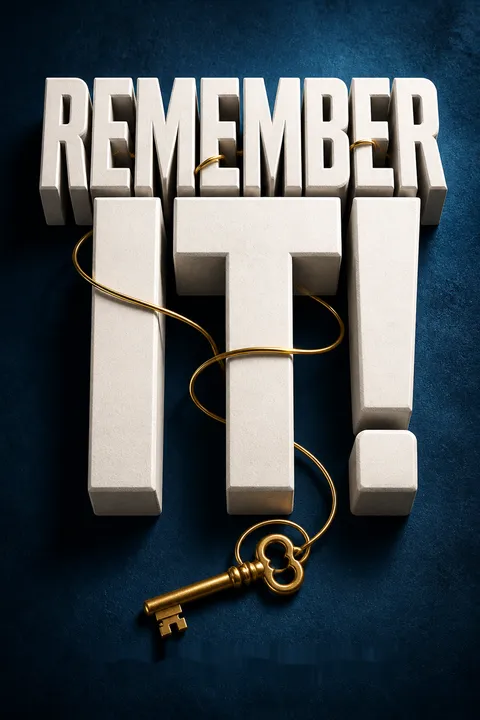
Remember It! by Nelson Dellis teaches memory techniques through a practical, engaging approach. The book focuses on the "SEE-LINK-GO" method, using visualization and linking to remember everyday items like names, passwords, and locations. Reviewers appreciate Dellis's enthusiastic teaching style, numerous real-world examples, and the PAO (Person-Action-Object) system for memorizing numbers. Common criticisms include insufficient guidance on long-term retention and spaced repetition. While some found the techniques overly elaborate, most readers report successful results with practice, praising the book's accessibility and humor over theoretical depth.
People Also Read



About the Author
Other books by Nelson Dellis
Download PDF
Download EPUB
.epub digital book format is ideal for reading ebooks on phones, tablets, and e-readers.








































