


Key Takeaways
Boys aren't defective girls; they're wired differently from the womb
Biology, not just conditioning, shapes boys. For three decades, parents were told gender was purely learned, so well-meaning adults pushed dolls on boys and blocks on girls. It didn't work. Brain-scanning technology settled the debate: real, wired-in differences exist. Boy babies are less attuned to faces, girls have sharper touch sensitivity, and boys' retinas register more movement and less color.
Difference is not deficiency. Biddulph's core warning is that acknowledging difference must never slide into calling boys broken or excusing bad behavior with "he can't help it." The differences are slight, they are tendencies, they don't apply to every individual, and crucially, boys can be helped to overcome any weak spots. The goal is understanding minus blame.
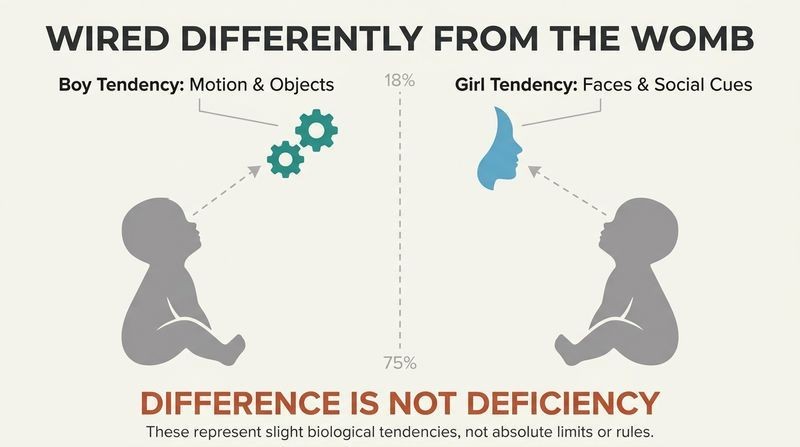
What's striking is how Biddulph threads a needle that still trips up public debate. He accepts biological difference while refusing biological determinism, a stance closer to modern behavioral genetics than to the pop-science extremes on either flank. Cordelia Fine's Delusions of Gender rightly cautions that many claimed brain differences are exaggerated or vanish once socialization is controlled. The honest synthesis lands where Biddulph does: differences are real but modest, overlapping, and highly modifiable. His "tendency, not destiny" framing is the antidote to both the blank-slate ideology he critiques and the crude essentialism his own examples occasionally flirt with.
Raise boys in three stages, adding ingredients not swapping parents
Boyhood unfolds in three eras. Biddulph maps development across ages, each needing a different lead player:
1. Birth to six, the gentle years, when a boy belongs mostly to his mother and learns that the world is warm and safe.
2. Six to fourteen, when a boy "locks on" to his father or another man to study how to be male.
3. Fourteen to adult, when he needs mentors beyond his parents to complete the crossing into manhood.
The shift is emphasis, not replacement. These stages are not a relay where one parent tags out. Mothers stay close throughout, fathers can be deeply involved from birth, and the point is layering new figures on as a boy grows. Get the ingredient wrong at the wrong time and problems like poor motivation, depression, and delinquency can follow.
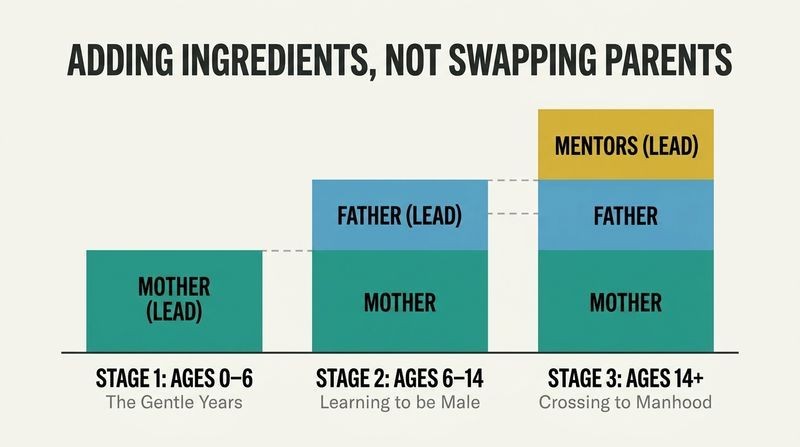
The three-stage arc is Biddulph's organizing spine, and its strength is prescriptive clarity for overwhelmed parents. The weakness is empirical: the claim that these stages are "timeless and universal" across the San, Lakota, and Aboriginal peoples romanticizes ethnographic diversity that anthropologists would contest. Still, the developmental logic aligns with attachment research (secure early bonding) and adolescent neuroscience (the prefrontal cortex maturing into the mid-twenties). The most durable insight is the least mystical one: children need different things at different ages, and mid-adolescence is systematically underserved in modern life. That gap, not the tribal parallels, is where the book earns its keep.
A boy's testosterone jumps 800% at fourteen, so expect the storm
Hormones run on a predictable clock. Biddulph tracks testosterone like a weather forecast. A newborn boy carries levels rivaling a twelve-year-old, then it drops. A surge around age four brings heroics and rough play. It calms at five, just in time for school. Then from puberty it climbs until, around fourteen, it sits roughly 800% above toddler levels, triggering rapid limb growth, a nervous system that must rewire, and the moodiness that makes fourteen the hardest year.
Testosterone drives rank and order. Boys crave hierarchy. A classic monkey study showed injecting a low-status male with testosterone sent him fighting his way to the top until the dose wore off. Boys act tough to mask fear; give them clear, fair structure and they relax and drop the act.
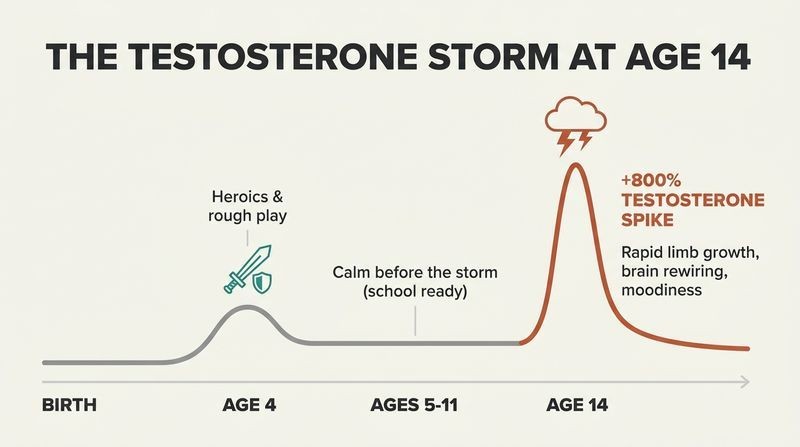
Biddulph's "testosterone needing tutoring" reframe is pedagogically useful because it converts a moralized problem (a "bad" boy) into a manageable one (a boy riding a hormonal wave). The hard science is messier than his tidy percentages suggest, and testosterone's behavioral effects are bidirectional: winning raises it, losing lowers it, and threatening environments spike it, as he himself notes. That environmental feedback loop is the genuinely actionable part. It means adults are not passive spectators to biology; a calm, structured, non-humiliating setting measurably lowers the aggression it would otherwise provoke. The hormone sets the stage, but the room's climate writes the script.
Read and talk to boys relentlessly to wire their weaker language brain
Boys' brains link the hemispheres less richly. The corpus callosum, the fiber bundle connecting the brain's two halves, is proportionately smaller in boys, and testosterone slows left-hemisphere growth in the womb. The result: language, reading, and naming feelings come harder. In classrooms, struggling readers and speakers outnumber girls roughly four to one. Two language regions are 20 to 30% larger in females.
The window is birth to eight. Because the brain is most plastic early, Biddulph urges parents to talk one step ahead of a child's stage (say "milk bottle" when he says "milk"), narrate daily life, and read aloud with rhyme and prediction games. This deliberate flooding of words builds the cross-brain connections that turn a boy into a man who can express feelings rather than only act on them.
The neuroanatomy here is Biddulph's most dated ground; claims about the corpus callosum have been substantially walked back since the 1990s, with meta-analyses finding the sex difference small and inconsistent once brain size is controlled. But the practical prescription survives the shaky mechanism intact. Hart and Risley's landmark word-gap research showed that early conversational richness predicts later vocabulary and school success regardless of sex, and boys who lag verbally benefit disproportionately from extra input. So even if the "why" is overstated, the "what to do" (talk more, read daily, name emotions) is among the best-supported interventions in developmental science.
Consider starting boys in school a year later than girls
Boys' fine-motor skills lag by six to twelve months. At five or six, when formal schooling begins, the average boy's brain is developmentally behind the girl at the next desk, especially in the finger control needed to hold a pencil or scissors, and in the words to tell a teacher what he needs. Forced to sit still while his motor nerves scream "move," he sees the girls' neater work and concludes school is not for him.
Readiness, not the calendar, should decide. Biddulph argues age is a crude enrolment rule. Every four-year-old should attend half-day preschool, where teachers can judge who is genuinely ready. A boy given an extra year moves through school intellectually on par with peers rather than branded an early failure. Einstein, he notes, was a slow starter.
This is one of Biddulph's most consequential and testable claims, and the evidence has caught up favorably. Economists studying "redshirting" and school-entry age find that relatively younger children in a cohort are more likely to be diagnosed with ADHD, to underperform, and to lack confidence, an effect concentrated among boys. The mechanism may be less about brain hardware than relative maturity within the classroom. One caveat: universal delay could widen inequality if wealthier families exploit it strategically, and some research shows early academic gaps fade by later grades. Individualized readiness assessment, which Biddulph advocates, sidesteps the blanket-policy risks.
Fight to be a present dad; children read love through touch, not paychecks
Twentieth-century fathering was largely absent. Many men proved love by working far from home, leaving a generation unsure what good fathering looks like. Biddulph insists a child cannot see you worrying over bills; he knows he is loved through hugs, eye contact, and laughter. Dads increased time with kids 300% since the 1970s, and it shows in improving outcomes.
Five fathering essentials anchor the role:
1. Start early, bonding during pregnancy and infant care.
2. Make time, refusing family-hostile career demands.
3. Show love physically, since affection does not make boys "soft."
4. Lighten up, playing without heavy coaching.
5. Heavy down, sharing discipline and housework so you are a real parent, not a "good-time" dad.
Boys with absent fathers are statistically more prone to violence, school failure, and gangs.
Biddulph's fatherhood chapter reads as advocacy, and the correlational evidence he leans on cannot fully separate father absence from the poverty and instability that often accompany it. Sociologist Sara McLanahan's work suggests both selection and causation are at play. Yet the mirror-neuron point he raises (children imitate what they watch, mood and gesture included) gives the argument teeth beyond mere presence: it is the quality of modeled behavior that transmits. His racist-comment anecdote, where a four-year-old parrots his father's slur, captures this vividly. The takeaway resists nostalgia by defining fathering as verb, not title: available single mothers who recruit good men achieve the same ends.
Rough-and-tumble play secretly teaches a boy the biggest male lesson
Wrestling is a curriculum, not chaos. Fathers, uncles, and older brothers across cultures instinctively wrestle with little boys, and mothers instinctively try to calm it down. Biddulph reveals the hidden purpose: the boy is learning to be excited, loud, even angry, and still know when to stop. For someone destined to live in a stronger male body, self-control is the essential skill.
The stop is the lesson. Play starts happily, then the small boy "loses it," jaw jutting, elbows flying. A skilled dad halts everything and calmly sets rules: bodies are precious, no kneeing or punching, "can you handle it?" Then they resume. This tiny back-lawn ritual scales up to the adult man who can be furious yet leave his partner feeling completely safe, the foundation of a marriage that can survive honest conflict.
This is Biddulph at his most original, reframing a behavior that anxious parents suppress as developmentally vital. The claim finds unexpected support in play researcher Anthony Pellegrini's work on rough-and-tumble, which links it to social competence and emotional regulation rather than aggression, provided an adult scaffolds the boundaries. The neuroscience angle is Panksepp's PLAY system, a mammalian circuit theorized to build prefrontal self-regulation. The framing risk is essentializing calm-mother versus rowdy-father roles, when either parent can teach the stop. But the core insight, that self-control is trained through arousal and de-escalation rather than through the absence of arousal, is genuinely counterintuitive and worth internalizing.
Mid-teen boys need mentors, or they drift with only lost peers
Adolescence fails without other caring adults. Fathers and fourteen-year-olds famously drive each other crazy, so every traditional society brought in mentors and initiation. The Lakota sent boys on a vision quest, with tribal men secretly guarding them in the dark, then barred the boy from speaking to his mother for two years so he could not "fall back" into boyhood before returning as a man.
Modern mentoring is piecemeal and often absent. Biddulph tells of Nat, fifteen, who left school for a pizza job; his boss Stan casually talked him out of buying a dangerous motorbike, something his parents never could. A mentor is someone the boy is special to, who lets him make "glorious mistakes" that aren't fatal. One good adult friend outside the family measurably reduces juvenile crime.
The anthropology is stylized, but the structural diagnosis is sharp: modern societies extend dependency for years past biological adulthood while stripping away the apprenticeships and elder relationships that once channeled adolescent hunger for status and glory. Robert Bly's "sibling society," which Biddulph cites, names the vacuum where peers raise peers. Contemporary mentoring research (Big Brothers Big Sisters trials) confirms that a single sustained non-parental adult relationship improves outcomes, echoing his "one good adult friend" claim. The gendered framing of initiation feels archaic, but the underlying prescription (deliberately embed teenagers in a web of trustworthy adults) is a concrete answer to modern adolescent isolation.
Boys need to know who's in charge and that rules are fair
Structure is what boys crave, not freedom. Biddulph borrows a scoutmaster's rule from the Elium's work: boys always need to know three things.
1. Who is in charge?
2. What are the rules?
3. Will those rules be enforced fairly?
Without structure, boys jostle to build their own pecking order. He observed even in Calcutta's slums that people felt safer with an imperfect hierarchy than with none.
Fair beats fierce. The boss must be strict yet kind. A bully raises boys' stress and returns them to the law of the jungle; a fair, firm adult lets them drop the macho act and learn. What looks like boys "dominating the space" with noise is often an anxiety response, one that vanishes in structured settings like Montessori classrooms with concrete, hands-on work.
The reframe of male noise as anxiety rather than dominance is quietly radical and shifts the adult's job from suppression to reassurance. It resonates with self-determination theory, where clear structure paired with warmth (not control) supports intrinsic motivation. The claim that boys specifically need hierarchy more than girls is the debatable part; group-dynamics research suggests all children benefit from predictable authority, and framing it as a male trait risks excusing authoritarian teaching. The more defensible reading is that under-structured environments harm boys more visibly because their anxiety expresses outward. The actionable core, calm and consistent authority beats both permissiveness and intimidation, is sound across genders.
Teach housework early; usefulness builds unshakeable self-esteem
Real self-worth comes from being useful, not admired. Biddulph estimates we absorb roughly three thousand advertising messages a day, each whispering we are not good enough. The antidote is not praise about looks but competence: a boy who can cook a meal, care for a pet, or hold a part-time job owns a pride nothing can strip away.
Housework is also a conversation trick. He suggests every boy prepare a full evening meal weekly by age ten. Beyond independence, chores exploit how boys talk: sideways, shoulder to shoulder while busy, rather than in eye-to-eye confrontation. Washing dishes or building something together is exactly when a son offloads worries about school or a girl. Do all the work for him and you lose both his skills and his confidences.
The "talk sideways" observation is one of the book's most practically useful nuggets and squares with communication research showing many males disclose more during shared activity than face-to-face conversation, which can read as interrogation. The self-esteem argument also anticipates later critiques of the empty-praise movement: Carol Dweck's work and subsequent studies found that praising fixed traits backfires while effort and competence build resilience. Biddulph's insistence on service to others as an esteem source aligns with research linking prosocial behavior to well-being. The gender framing is looser here than elsewhere, and rightly so, since the usefulness-breeds-worth principle is universal, applicable to daughters just as forcefully.
Delay a young driver's passengers; a full car quadruples his death risk
Boys aged fifteen to twenty-five die at three times the rate of girls, mostly from accidents, violence, and suicide, and cars are the sharpest danger. Biddulph cites research with a chilling gradient:
1. A lone teenage boy driving is relatively safe thanks to modern practice hours.
2. Add one male passenger and fatal-crash odds rise about 50%.
3. Add several backseat passengers and the driver's death risk climbs over 400%, worse after dark or with alcohol.
A female passenger, oddly, makes him drive more carefully.
Policy and parenting both work. Graduated licensing with passenger limits cut young-driver deaths 30% in Ontario. Biddulph's blunt advice: keep ferrying your sixteen-year-old and his friends for another year or two. Teens sound persuasive, but under peer pressure their judgment collapses.
This is the book's most immediately life-saving section and its evidence base has only strengthened. The peer-passenger effect is now well documented in adolescent traffic research, and neuroscience offers the mechanism: in emotionally arousing peer contexts, the adolescent brain's reward circuitry overrides its still-maturing self-control systems, a finding from Laurence Steinberg's driving-simulator studies where teens took more risks simply when friends watched. Graduated licensing laws are among the most cost-effective public-health interventions of the past few decades. The parenting implication is uncomfortable but rational: autonomy is not a fixed birthday entitlement but a capacity that matures unevenly, and delaying peak-risk exposure by even a year yields disproportionate safety returns.
Guard boys from porn and teach respect, or "creepiness" hardens
Sexual confidence is built through friendship, not screens. Biddulph names three attractions boys must learn to distinguish: liking (a meeting of minds), loving (warm and tender), and lusting (hot and hungry). Boys who cannot relate to real girls as equals risk a "creep" mentality: if I can't meet her, I'll control her. Mothers who praise a son's conversation and looks, and fathers who model respect, defuse this.
Online porn is a new and documented harm. A 2012 UK report found 80% of sixteen-year-old boys regularly access porn and one in three ten-year-olds has seen explicit material. Heavy use correlates with dehumanizing women and escalating to harder content. Biddulph's remedies are practical: filters, computers in shared rooms, phones charging in the kitchen overnight, and calm, non-shaming conversation.
The distinction between liking, loving, and lusting is a clean teaching tool that survives changing sexual mores. Biddulph's porn warnings, written before smartphones saturated adolescence, now look prescient, though the causal claims outrun the evidence: correlational studies link heavy consumption to callous attitudes, but disentangling cause from selection remains genuinely hard. His anthropological aside, James Prescott's cross-cultural finding that societies with less affectionate child-rearing show more adult violence, offers a deeper frame: tenderness received in childhood is the true inoculation. The non-shaming stance is wise; research on sexual-health messaging consistently finds that shame drives behavior underground rather than curbing it, making honest conversation the more protective path.
Analysis
Raising Boys is a work of persuasive translation more than original science. Steve Biddulph, a family therapist writing at the tail end of the 1990s "boy crisis" discourse, takes emerging brain and hormone research and renders it into warm, actionable counsel for exhausted parents. Its enduring appeal lies in giving anxious mothers and absent fathers permission to see boys' energy, hierarchy-seeking, and verbal slowness as workable traits rather than pathologies. The three-stage developmental arc gives the book its narrative spine, and Biddulph's gift for the memorable anecdote (the sick boy whose father cancels conferences, Stan the pizza-shop mentor, the ring of men embracing a losing rugby team) carries ideas that could have been dry.
The book's vulnerabilities are precisely where it leans hardest on 1990s neuroscience. Claims about the corpus callosum, acoustic brain response, and hemispheric wiring have been substantially qualified or overturned; Cordelia Fine and others have shown how readily modest, overlapping sex differences get inflated into hard architecture. Biddulph half-anticipates this with his "tendency, not destiny" caveats and his "Sexism Alert" sidebar, which is intellectually honest, yet the prescriptive confidence sometimes outpaces the evidence beneath it.
Where the book ages best is in its behavioral and structural claims, the ones least dependent on contested brain scans. School-entry timing, the peer-passenger driving effect, the value of sustained non-parental mentors, and the usefulness-breeds-self-esteem thesis have all gained empirical support. These are the takeaways a modern reader should weight most heavily.
Ultimately the book is best read as humane parenting philosophy dressed in the scientific idiom of its moment. Strip away the dated neurology and a durable core remains: boys thrive on early affection, present and non-punitive male figures, clear fair structure, deliberate language input, and a community that catches them in adolescence. That prescription requires no MRI to justify.
Review Summary
Raising Boys receives mixed reviews, with an average rating of 3.74/5. Many praise its insightful approach to understanding boys' development and practical parenting advice. Readers appreciate the author's warm tone and emphasis on fathers' involvement. However, some criticize the book for outdated or stereotypical views on gender and sexuality. Critics also note a lack of scientific evidence for some claims. While some find it helpful for first-time parents, others consider it too simplistic or conservative. Overall, the book sparks debate on raising boys in modern society.
People Also Read






FAQ
What's "Raising Boys" about?
- Focus on Boys' Development: "Raising Boys" by Steve Biddulph explores the unique developmental stages of boys and how they differ from girls, emphasizing the importance of understanding these differences to raise well-balanced men.
- Stages of Boyhood: The book outlines three distinct stages of boyhood: birth to six years, six to fourteen years, and fourteen to adulthood, each requiring different parenting approaches.
- Role of Parents: It highlights the critical roles that both mothers and fathers play in a boy's life, offering practical advice on how to support boys through their developmental stages.
- Community Involvement: The book also stresses the importance of community and mentorship in helping boys transition into adulthood.
Why should I read "Raising Boys"?
- Understanding Boys' Needs: The book provides insights into the specific needs of boys at different stages of their development, helping parents and educators support them effectively.
- Practical Advice: It offers practical strategies for dealing with common challenges in raising boys, such as handling their energy levels and communication difficulties.
- Research-Based Insights: The book is grounded in research, offering evidence-based advice on how to nurture boys' emotional and psychological well-being.
- Positive Outcomes: By understanding and applying the book's principles, readers can help boys grow into happy, confident, and well-adjusted men.
What are the key takeaways of "Raising Boys"?
- Boys Are Different: Boys have unique developmental needs and challenges that require specific parenting strategies.
- Three Stages of Development: Understanding the three stages of boyhood is crucial for providing the right support at the right time.
- Role of Fathers: Fathers play a vital role in a boy's development, especially from ages six to fourteen, when boys look to them for guidance.
- Community Support: Boys benefit from a supportive community and positive male role models outside the family.
What are the best quotes from "Raising Boys" and what do they mean?
- "Boys are fun. They make you laugh. They are full of life and can share that energy with you." This quote highlights the joy and vitality boys bring to life, emphasizing the importance of cherishing these qualities.
- "We can raise a generation of boys who are happier, more alive, more connected to the human race." This reflects the book's optimistic view that with the right support, boys can grow into compassionate and engaged men.
- "Understanding is the key." This underscores the book's central message that understanding boys' unique needs and challenges is crucial to raising them successfully.
How does "Raising Boys" define the three stages of boyhood?
- Birth to Six Years: This stage focuses on forming a strong bond with the mother, providing love and security to help boys feel safe and valued.
- Six to Fourteen Years: Boys start looking to their fathers for guidance, learning skills, and developing a sense of masculinity through active involvement.
- Fourteen to Adulthood: Mentorship becomes crucial as boys need guidance from male role models to navigate the transition to adulthood.
- Developmental Focus: Each stage requires different parenting approaches to support boys' emotional and psychological growth.
What role do fathers play according to "Raising Boys"?
- Primary Influence: Fathers become the primary influence during the six to fourteen years stage, helping boys develop skills and a sense of masculinity.
- Modeling Behavior: Fathers model how to treat others, especially women, and how to handle emotions and challenges.
- Active Involvement: The book emphasizes the importance of fathers being actively involved in their sons' lives, sharing activities and interests.
- Supportive Role: Fathers should support their sons' relationships with their mothers and encourage positive interactions with other male role models.
How does "Raising Boys" suggest handling boys' energy and behavior?
- Understanding Testosterone: The book explains how testosterone affects boys' energy levels and behavior, leading to restlessness and competitiveness.
- Structured Environment: Boys thrive in environments with clear rules and structure, which help them feel secure and focused.
- Physical Activity: Providing opportunities for physical activity is crucial for boys to channel their energy positively.
- Calm Guidance: Parents should guide boys through conflicts with calm reasoning rather than aggression, teaching them self-control.
What advice does "Raising Boys" offer for mothers raising sons?
- Building Confidence: Mothers can help their sons feel confident around girls by teaching them social skills and encouraging positive interactions.
- Affection and Praise: Showing affection and praising boys' looks and achievements helps build their self-esteem.
- Adjusting Parenting Style: As boys grow, mothers should adjust their parenting style, granting more responsibility and freedom while maintaining support.
- Encouraging Independence: Mothers should encourage boys to take on household responsibilities, fostering independence and self-esteem.
How does "Raising Boys" address the issue of boys and education?
- Later School Start: The book suggests that boys may benefit from starting school a year later than girls due to slower brain development.
- Male Role Models: Increasing the presence of male teachers and mentors in schools can positively impact boys' educational experiences.
- Active Learning: Schools should incorporate more physical and hands-on learning activities to engage boys effectively.
- Addressing Literacy: Special programs targeting boys' literacy and language skills can help them overcome educational challenges.
What does "Raising Boys" say about developing a healthy sexuality in boys?
- Positive Messages: The book emphasizes the importance of giving boys positive messages about sexuality, distinguishing between liking, loving, and lusting.
- Open Communication: Parents should maintain open communication about sex, providing accurate information and discussing values and attitudes.
- Respect and Empathy: Teaching boys to respect others and develop empathy is crucial for healthy relationships.
- Avoiding Pornography: Parents should discourage exposure to pornography and discuss its negative impact on relationships and attitudes toward women.
How does "Raising Boys" suggest involving the community in raising boys?
- Mentorship Programs: The book advocates for community mentorship programs where boys can learn from positive male role models.
- School Involvement: Schools should engage the community in supporting boys' education and personal development.
- Parental Networks: Building networks of parents and community members can provide additional support and resources for raising boys.
- Cultural Initiatives: Initiatives that celebrate and honor boys' transition to manhood can help them feel valued and supported by the community.
What are the potential challenges in raising boys according to "Raising Boys"?
- Behavioral Issues: Boys may exhibit challenging behaviors due to high energy levels and testosterone, requiring structured environments and calm guidance.
- Educational Struggles: Boys often face difficulties in language and literacy, necessitating targeted educational support and later school start times.
- Social Pressures: Boys may feel pressured by societal expectations and media portrayals, impacting their self-esteem and relationships.
- Lack of Role Models: The absence of positive male role models can hinder boys' development, highlighting the need for community involvement and mentorship.

Download PDF
Download EPUB
.epub digital book format is ideal for reading ebooks on phones, tablets, and e-readers.








































