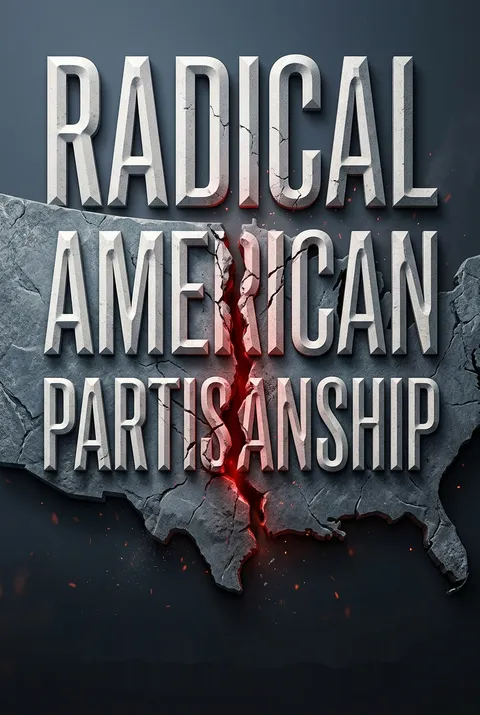

Key Takeaways
1. Radical Partisanship is Widespread and Growing
In November 2017, just over 60 percent of partisans believed the opposing party was a “serious threat to the United States and its people.”
Alarming prevalence. The research reveals a significant and often overlooked depth of partisan animosity and openness to violence among ordinary Americans. In 2017, a substantial majority of partisans already viewed the opposing party as a national threat, with a large minority describing them as "evil" or even "less than human." This level of hostility far surpasses traditional measures of partisan animosity, which often focus on milder sentiments like feeling "cold" towards opponents.
Escalating trends. From 2017 to 2021, the study tracked a worrisome increase across nearly all dimensions of radical partisanship. Belief that the opposing party was a "serious threat" rose from 61% to 72%, while those who considered opponents "downright evil" jumped from 40% to 59%. Most strikingly, the percentage of partisans who dehumanized opponents, believing they "behave like animals," more than doubled from 18% to 36% over this four-year period, indicating a profound erosion of empathy.
Openness to violence. While most Americans reject partisan violence, a concerning minority do not. In 2017, 12% found it acceptable to send threatening messages to opposing leaders, and 8% approved of harassing ordinary opponents online. This willingness to endorse threats and violence increased, particularly after the 2020 election and the January 6th Capitol attack, with Republicans showing a notable surge in radical views by February 2021.
2. Historical Roots of Violence in US Politics
The United States has a long history of political violence, much of it entangling partisanship with white supremacy.
Recurring patterns. American political violence is not a new phenomenon but a recurring pattern, often intertwined with partisan conflicts over enduring social and political hierarchies. From the American Revolution to the Civil War, Reconstruction, and the Jim Crow era, violence has frequently erupted when deep social divisions, particularly those related to white supremacy, aligned with partisan competition. This historical context suggests that current conflicts are a continuation of familiar patterns rather than an unprecedented anomaly.
Racial-partisan cleavage. White supremacy has been a defining cleavage in many of the largest and most persistent violent episodes in US history.
- Civil War: Southern Democrats refused to accept the 1860 election, leading to a rebellion to preserve Black enslavement and white supremacy.
- Reconstruction/Jim Crow: White Democrats used violence (Ku Klux Klan, White League) and authoritarian tactics to suppress Black voters and re-establish racial hierarchy.
- Modern Era: The late 20th-century racial-partisan realignment saw white Southerners shift to the Republican Party, bringing white supremacist violence and efforts to disenfranchise Black voters with them.
Conditional legitimacy. Americans are not absolute pacifists; their support for political violence is highly conditional and shaped by political culture. While the violence of the American Revolution is widely celebrated (76% support), other historical acts of violence, like the Confederate Rebellion (37% support) or 20th-century terrorism, receive far less public endorsement. This highlights how leaders and cultural narratives legitimize certain forms of violence while condemning others.
3. Psychological Drivers of Extreme Partisanship
So strong is this propensity of mankind to fall into mutual animosities, that where no substantial occasion presents itself, the most frivolous and fanciful distinctions have been sufficient to kindle their unfriendly passions and excite their most violent conflicts.
In-group/out-group dynamics. James Madison's early warning about human animosity underscores the psychological roots of partisan conflict. Social psychology, particularly the work of Henri Tajfel, demonstrates how even arbitrary group distinctions can lead to in-group favoritism and out-group discrimination, as individuals tie their self-worth to their group's status. Partisanship, race, and religion are powerful social identities that amplify these effects, making people willing to harm opposing groups even at their own expense.
Obedience and authoritarianism. Post-WWII psychologists like Stanley Milgram and Theodor Adorno explored the mechanisms behind mass violence. Milgram's obedience experiments showed how leaders can persuade ordinary people to inflict harm, while Adorno's work identified authoritarian personality traits that predispose individuals to prejudice and aggression against minority groups. These findings suggest that under certain conditions, widespread violence is possible, and partisanship can be a powerful driver.
Moral disengagement. This psychological process allows individuals to rationalize harmful behaviors against opponents, reducing remorse or shame. By removing political opponents from a circle of empathetic care, moral disengagement provides the "moral leeway" to endorse actions that would otherwise be unacceptable. This vilification of out-groups is a critical risk factor for adopting violent attitudes, making it easier for partisans to justify aggression.
4. Radicalism is Tied to Social Hierarchy Defense
For Republicans, hostility toward Black Americans and women strongly predicts partisan moral disengagement—in fact, those attitudes are the most important factors in shaping Republican radicalism.
Divergent motivations. While Democrats and Republicans often exhibit similar levels of radical partisanship, the underlying motivations differ significantly. For Republicans, radical moral disengagement is powerfully predicted by racial resentment and hostile sexism, far surpassing the influence of partisan social identity or trait aggression. This indicates that for many white Republicans, vilifying Democrats is deeply intertwined with defending traditional social hierarchies and resisting perceived threats to the elevated status of white men.
Racial resentment's role. White Republicans who deny systemic racism and attribute Black Americans' struggles to individual failings are significantly more likely to dehumanize and demonize Democrats. Conversely, white Democrats who hold racially progressive views are more likely to vilify Republicans, reflecting their party's increasing alignment with racial justice. This highlights how the conflict over racial equality fuels partisan animosity, with Republicans defending a system they refuse to acknowledge as racist.
Hostile sexism's impact. Hostile sexism, characterized by beliefs that women seek power over men, also strongly predicts moral disengagement among Republicans. This reinforces the idea that the partisan divide is not merely about policy but a battle over social order. Interestingly, hostile sexism also correlates with increased support for partisan violence in both parties, suggesting a broader societal link between sexist attitudes and a general acceptance of aggression, regardless of political affiliation.
5. Violent Attitudes Translate to Aggressive Behaviors
Behaviorally aggressive partisans are massively more likely to hold violent partisan attitudes.
Beyond mere expression. Violent partisan attitudes are not just "blowing off steam" but correlate strongly with real-world aggressive political behaviors. The study found that individuals who report insulting, threatening, or physically attacking others due to politics are significantly more likely to endorse partisan violence. This establishes a crucial link between internal beliefs and external actions, validating the seriousness of these radical attitudes.
Prevalence of aggression. Self-reported data reveals a surprising level of aggressive behavior in American politics:
- Insults: 47% of all respondents reported being insulted, and 27-42% admitted insulting others.
- Threats: 15% reported being threatened, and 1-6% admitted threatening others.
- Physical Attacks: 3% reported being physically attacked, and 1-5% admitted physical aggression.
These numbers, even at their lower bounds, represent millions of Americans engaging in extreme political behavior that often goes unnoticed in news and scholarship.
Direct observation. To further validate these self-reports, the study used a "noise blast" experiment, a psychological method for directly observing mild physical harm. Partisans were significantly more likely to assign "painfully loud" noise blasts to opposing party members than to their own. This observed aggression was strongly predicted by trait aggression and strong partisan social identification, mirroring the predictors for violent attitudes and reinforcing the idea that these are genuine aggressive tendencies.
6. Support for Violence is Conditional, Not Absolute
Americans do endorse political violence in some cases—they aren’t absolute political pacifists—but not in others.
Context matters. The public's views on political violence are highly dependent on context, rather than reflecting absolute pacifism. While a large majority (75%) reject partisan violence today, an even larger majority (76%) endorse the violence of the American Revolution. This stark contrast highlights how historical narratives and political culture shape perceptions of legitimacy, with the Revolution being widely revered despite its violent nature.
Legitimizing conditions. When presented with hypothetical scenarios, Americans are more likely to justify violence in response to government abuses than to threats to free and fair elections.
- Higher justification (around 60% support): Imprisoning critics, government corruption, racial/religious discrimination, and lawless rulers.
- Lower justification (around 50% support): Absence of free elections, unequal votes, or a "dangerous" party winning power.
This suggests that grievances related to individual rights and government overreach are more potent triggers for justifying violence than electoral integrity issues, though both are significant.
Partisan differences. While overall support for violence varies by scenario, partisan differences emerge. Republicans are more likely to endorse violence if all guns are banned (23% vs. 10% for Democrats) and if a governing party disobeys laws while prosecuting opponents. These findings underscore how specific grievances, often aligned with partisan platforms, can selectively legitimize violence for different groups.
7. Elections and Violence are Intertwined
Election losses fuel radical partisan reactions—in anticipation and in actuality—and election-cheating views correspond with more violent partisan views.
Loss as a radicalizer. Electoral defeat is a potent catalyst for radical partisanship, evoking strong emotions and increasing support for violence. Both hypothetical scenarios and real-world observations show that anticipating or experiencing a presidential loss significantly boosts the number of partisans willing to endorse violence. This effect is particularly pronounced when combined with beliefs that the election was illegitimate or fraudulent.
Fraud perceptions. Beliefs about election fraud are a critical link between electoral outcomes and violent attitudes.
- Pre-election: The expectation of opponent cheating correlated with increased support for violence if that opponent won, and for specific acts like military coups or armed citizen resistance.
- Post-election: The belief that opponents did cheat directly correlated with increased support for general partisan violence and specific acts of resistance, especially among Republicans who refused to accept the 2020 results.
This highlights how leaders' rhetoric about election integrity can directly fuel violent sentiments among their followers.
Real-world shifts. The 2020 presidential election and its aftermath provided clear evidence of this dynamic. While Democrats and Republicans showed similar levels of violent views during much of the Trump presidency, the February 2021 survey, following Biden's inauguration and the Capitol attack, revealed a significant partisan gap. Republicans, as the losing party, exhibited substantially higher levels of support for violence and moral disengagement than Democrats, demonstrating how actual power shifts can radicalize the disempowered.
8. Leaders' Words Shape Partisan Radicalism
The most important practical finding in the book is that antiviolence messages from Biden and Trump significantly reduced support for partisan electoral violence, especially among the strong partisans who are most inclined to support violence.
Pacifying power. Leaders possess a powerful ability to either inflame or pacify radical partisan attitudes. The study's experiments showed that explicit anti-violence messages from both Donald Trump and Joe Biden significantly reduced public support for partisan violence, particularly among highly identified partisans who are typically the most radical. This crucial finding suggests that consistent, unified condemnation of violence from party leaders could effectively de-escalate tensions.
National unity appeals. Messages promoting a shared national identity also proved effective in reducing partisan moral disengagement. Appeals to "common American identity" significantly decreased the perception of the opposing party as a "national threat" by 8 points, with similar effects observed for both Trump's and Biden's messages across partisan lines. This indicates that leaders can foster a sense of unity that lessens the vilification of political opponents.
Inflammatory rhetoric's limits (and dangers). While Trump's real-world rhetoric clearly incited the January 6th Capitol attack, the study's experimental tests of single, milder inflammatory messages generally showed minimal effects on radical attitudes. However, one notable exception was Biden's accurate accusation that Republicans disenfranchise Black voters, which increased Democratic support for violence. This suggests that truth-telling about systemic threats to democracy, even if inflammatory, is essential, and the focus should be on mitigating undue reactions rather than suppressing such speech.
9. The Looming Threat of Authoritarianism and Violence
Grave risks for violence and authoritarianism persist and continue to grow (especially given Republican unwillingness to hold people to account for their violent Capitol insurrection).
Post-2020 escalation. The period following the 2020 election and the January 6th Capitol attack marked a critical escalation in radical partisanship. Instead of recommitting to democratic norms, most Republican leaders doubled down on election fraud claims, voter disenfranchisement efforts, and enabling interference with future election administration. This "Big Lie" perpetuated by the party leadership directly fueled the violent sentiments observed in the public and poses an ongoing threat to democratic processes.
Asymmetric risks. While radicalism exists in both parties, the risk of real-world violence and authoritarianism is currently asymmetric. Right-wing violence during the Trump presidency significantly outpaced left-wing attacks, building on a decade of increasing radicalism among white men and Christians who perceive a loss of their traditional hegemony. This demographic shift, combined with the Republican Party's increasingly nativist and white identity, creates a volatile environment where a minority group seeks to maintain power against a diversifying majority.
Future flashpoints. The upcoming federal election cycles (2022 midterms, 2024 presidential election) are anticipated flashpoints for heightened conflict and potential violence. The losing side, particularly in presidential elections, is expected to exhibit more violent views and potentially acts, especially if leaders encourage rejection of legitimate results. The Republican Party's continued efforts to undermine free and fair elections, coupled with their constituents' grievances and higher rates of gun ownership, suggest a persistent and growing threat of ethno-partisan violence and authoritarian backsliding.
10. Democratization Requires Confrontation, Not Compromise
The only just way to move beyond our current precarious situation is for Americans who support democracy to publicly and unapologetically advance the goal of democratizing the US, no matter the costs from intensifying conflicts that will inevitably follow.
Beyond "polarization." The study challenges the notion that "party polarization" is inherently bad, arguing that it can be essential for a democratic party confronting an authoritarian one. When one party deviates from fundamental democratic principles like fair elections and civic equality, the democratic party should not moderate or compromise for the sake of peace. Historically, force, not compromise, was necessary to advance democracy against authoritarian threats, as seen during the Civil War and Reconstruction.
"Good trouble" for democracy. The current era presents unprecedented opportunities for democratic growth, driven by a consolidating multiracial democratic coalition within the Democratic Party. This movement aims to realize the democratic promises of the nation's founding documents in a truly multiracial form. While this will inevitably cause more partisan conflict and potentially violence, the costs of surrendering to authoritarianism and maintaining systemic injustice are far greater.
Confronting systemic issues. The Democratic Party's increasing recognition that racism, religious bigotry, and sexism are systemic problems requiring government intervention marks a significant shift. This partisan divide, defined by identity-based equality and justice, creates a unique opportunity to dismantle barriers to full democracy. Suppressing violent resistance from authoritarians is crucial for this democratization project, even if it means enduring intensifying conflicts.
People Also Read








Download PDF
Download EPUB
.epub digital book format is ideal for reading ebooks on phones, tablets, and e-readers.








































